The DOP Estimation Method Is Biased and
Inconsistent
Mark Johnson
∗ Brown UniversityA data-oriented parsing or DOP model for statistical parsing associates fragments of linguistic representations with numerical weights, where these weights are estimated by normalizing the empirical frequency of each fragment in a training corpus (see Bod [1998] and references cited therein). This note observes that this estimation method isbiasedandinconsistent; that is, the estimated distribution does not in general converge on the true distribution as the size of the training corpus increases.
1. Introduction
The data-oriented parsing or DOP approach to statistical natural language analy-sis has attracted considerable attention recently and has been used to produce sta-tistical language models based on various kinds of linguistic representation, as described in Bod (1998). These models are based on the intuition that statistical gen-eralizations about natural languages should be stated in terms of “chunks” or “frag-ments” of linguistic representations. Linguistic representations are produced by combining these fragments, but unlike in stochastic models such as Probabilistic Con-text-Free Grammars, a single linguistic representation may be generated by several different combinations of fragments. These fragments may be large, permitting DOP models to describe nonlocal dependencies. Usually the fragments used in a DOP model are themselves obtained from a training corpus of linguistic represen-tations. For example, in DOP1 or Tree-DOP the fragments are typically all the connected multinode trees that appear as subgraphs of any tree in the training corpus.
This note shows that the estimation procedure standardly used to set the parame-ters or fragment weights of a DOP model (see, for example, Bod [1998]) is biased and inconsistent. This means that as sample size increases, the corresponding sequence of probability distributions estimated by this procedure does not converge to the true distribution that generated the training data. Consistency is usually regarded as the minimal requirement any estimation method must satisfy (Breiman 1973; Shao 1999), and the inconsistency of the standard DOP estimation method suggests it may be worth looking for other estimation methods. Note that while the bulk of DOP re-search uses the estimation procedure studied here, recently there has been rere-search that has used other estimators for DOP models (Bonnema, Buying, and Scha 1999; Bod 2000), and it would be interesting to investigate the statistical properties of these estimators as well.
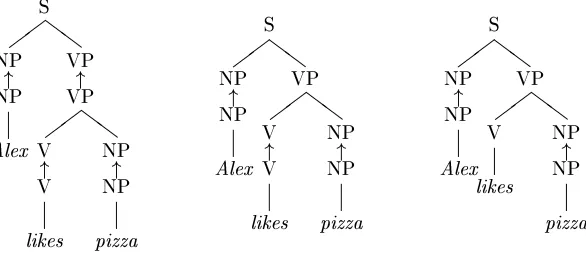
Z Z Z Z S NP VP V likes NP NP pizza NP Alex " " Z Z Z Z VP V NP NP pizza " likes V " S VP " NP " NP Alex Z Z Z Z S NP VP NP NP pizza NP Alex " " likes V V " Figure 1
Depictions of three different derivations of the same tree representation ofAlex likes pizza, with arrows indicating the sites of tree fragment substitutions.
2. DOP1 Models
For simplicity, this note focuses on DOP1 or Tree-DOP models, in which linguistic representations are phrase structure trees, but the results carry over to more complex models that use attribute-value feature structure representations such as LFG-DOP. The fragments used in DOP1 are multinode trees whose leaves may be labeled with nonterminals as well as terminals. A derivation starts with a fragment whose root is labeled with the start symbol, and it proceeds by substituting a fragment for the leftmost nonterminal leaf under the constraint that the fragment’s root node and the leaf node have the same label. The derivation terminates when there are no nonter-minal leaves. Figure 1 depicts three different derivations that yield the same tree. The fragments used in these derivations could have been obtained from a training corpus of trees that contains trees for examples such asSasha likes motorcycles,Alex eats pizza, and so on.
In a DOP model, each fragment is associated with a real-valued weight, and the weight of a derivation is the product of the weights of the tree fragments involved. The weight of a representation is the sum of the weights of its derivations, and a probability distribution over linguistic representations is obtained by normalizing the representations’ weights.1Given a combinatory operation and a fixed set of fragments,
a DOP model is a parametric model where the fragment weights are the parameters. In DOP1 and DOP models based on it, the weight associated with a fragment is estimated as follows (Bod 1998). For each tree fragment f, let n(f) be the number of times it appears in the training corpus, and let Fbe the set of all tree fragments with the same root as f. Then the weightw(f)associated with f is
w(f) = P n(f)
f0∈Fn(f0)
.
This relative-frequency estimation method has the advantage of simplicity, but as shown in the following sections, it is biased and inconsistent.
3. Bias and Inconsistency
Bias and inconsistency are usually defined for parametric estimation procedures in terms that are not quite appropriate for evaluating the DOP estimation procedure, but their standard definitions (see Shao [1999] for a textbook exposition) will serve as the basis for the definitions adopted below. LetΘbe a vector space of real-valued parameters, so that Pθ,θ∈Θis a probability distribution. In the DOP1 case,Θwould be the space of all possible weight assignments to fragments. An estimator φ is a function from a vectorxofnsamples to a parameter valueφ(x)∈Θ, and anestimation procedurespecifies an estimatorφn for each sample sizen.
Let X be a vector of n independent random variables distributed according to Pθ? for some θ? ∈ Θ. Then φ(X) is also a random variable, ranging over parameter vectorsΘ, with an expected value Eθ?(φ(X)). The biasof the estimator φat θ? is the difference Eθ?(φ(X))−θ? between its expected value and the “true” parameter value
θ?that determines the distributionX. A biased estimator is one with nonzero bias for some value of θ?.
Aloss functionLis a function from pairs of parameter vectors to the nonnegative reals. Given a samplexdrawn from the distributionθ?,L(θ?,φ(x))measures the “cost” or the “loss” incurred by the error in the estimateφ(x)ofθ?. For example, a standard loss function is the Euclidean distance metricL(θ?,φ(x)) =kφ(X)−θ?k2 (note that the
results below do not depend on this choice of loss function). The riskof an estimator
φ at θ? is its expected loss E
θ?(L(θ?,φ(X)). An estimation procedure is consistent if and only if the limit of the risk of φn is 0 as n → ∞ for all θ?. (There are various different notions of consistency depending on how convergence is defined; however, the DOP1 estimator is not consistent with respect to any of the standard definitions of consistency.)
Strictly speaking, the standard definitions of bias and loss function are not appli-cable to DOP estimation because there can be two distinct parameter vectorsθ1,θ2for which Pθ1 =Pθ2 even though θ1 6= θ2 (such a case is presented in the next section).
Thus it is more natural to define bias and loss in terms of the probability distributions that the parameters specify, rather than in terms of the parameters themselves. In this paper, an estimator is unbiased iff PEθ?(φ(X)) = Pθ? for all θ
?; that is, its expected
parameter estimate specifies the same distribution as the true parameters. Similarly, the loss function is the mean squared difference between the “true” and estimated distributions; that is, ifΩis the event space (in DOP1, the space of all phrase structure trees), then
L(θ?,φ(x)) = X ω∈Ω
Pθ?(ω)(Pθ?(ω)−Pφ(x)(ω))2.
As before, the risk of an estimator is its expected loss, and an estimation procedure is consistent iff the limit of the expected loss is 0 asn→ ∞.
4. A DOP1 Example
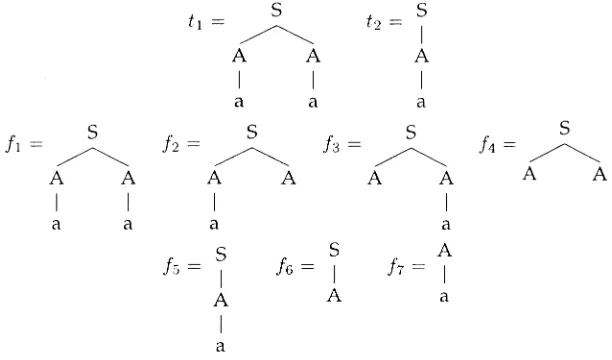
Figure 2
The treest1,t2and their associated fragmentsf1,. . .,f7 in the DOP1 model.
Suppose the “true” weights for the fragmentsf1,. . .,f7 are 0 except for the
follow-ing fragments:
w?(f4) = p,
w?(f6) = 1−p,
w?(f7) = 1.
Then Pw?(t1) = p and Pw?(t2) = 1−p. (Note that exactly the same tree distribution could be obtained by settingw?(f
1) =p andw?(f5) =1−p and all other weights to 0;
thus the tree weights are not identifiable.) Then in a sample of sizendrawn from the distribution Pw? the expected number of occurrences of treet1 isnp and the expected number of occurrences of treet2 isn(1−p). Thus the expected number of occurrences
of the fragments in a sample of sizen is
E(n(fi)) = np fori=1,. . ., 4;
E(n(fi)) = n(1−p) fori=5, 6;
E(n(f7)) = n+np.
Thus after normalizing, the expected estimated weights for the fragments using the DOP estimator are
E( ˆw(fi)) =
p
2+2p fori=1,. . ., 4;
E( ˆw(fi)) = 1−p
2+2p fori=5, 6;
E( ˆw(f7)) = 1.
Further calculation shows that
PE(ˆw)(t1) =
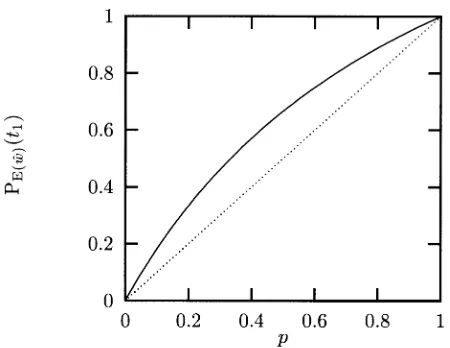
Figure 3
The value of PE(ˆw)(t1)as a function of Pw?(t1) =p. The identity functionpis also plotted for
comparison.
PE(ˆw)(t2) =
1−p 1+p.
Figure 3 shows how PE(ˆw)(t1) varies as a function of Pw?(t1) = p. The difference PE(ˆw)(t1)−p reaches a maximum value of approximately 0.17 at p =
√
2−1. Thus except forp=0 andp=1, PE(ˆw)6=Pw?; that is, the DOP1 estimator is biased.
Further, note that the estimated distribution PE(ˆw) does not approach Pw? as the sample size increases, so the expected loss does not converge to 0 as the sample size nincreases. Thus the DOP1 estimator is also inconsistent.
5. Conclusion
Acknowledgments
I would like to thank Rens Bod, Michael Collins, Eugene Charniak, David
McAllester, and the anonymous reviewers for their excellent advice.
References
Bod, Rens. 1998.Beyond Grammar: An Experience-Based Theory of Language. CSLI Publications, Stanford, CA.
Bod, Rens. 2000. Combining semantic and syntactic structure for language modelling. InProceedings of the 8th International Conference on Spoken Language
Processing (ICSLP 2000), Beijing.
Bonnema, Remko, Paul Buying, and Remko Scha. 1999. A new probability model for data oriented parsing. InProceedings of the 12th Amsterdam Colloquium, Amsterdam. Breiman, Leo. 1973.Statistics with a View
toward Applications. Houghton Mifflin, Boston.
Geman, Stuart, Elie Bienenstock, and Ren ´e Doursat. 1992. Neural networks and the bias/variance dilemma.Neural
Computation, 4:1–58.