Printed in Great Britain
A STUDY IN INSECT MULTIPARASITISM
I. HOST SELECTION AND OVIPOSITION
BY R. C. FISHER
Department of Zoology, University of Cambridge*
(Received 12 October i960)
INTRODUCTION
When an insect is attacked by more insect parasites than can develop upon it, competition occurs between them. Some or all of the parasite larvae are unable to complete their development and die, either through mutual starvation or by some means of physical or physiological combat. When the supernumeraries are of the same parasite species the phenomenon is known as superparasitism, and when they are of different species it is called multiparasitism.
There has, however, been confusion between these two phases of parasitism in the early literature, principally because no distinction was made between supernumerary parasitism by individuals of the same, and of different, species. The simultaneous parasitism of a host insect, first pointed out by Howard (1897), was called 'accidental secondary parasitism' by Pierce (1908), 'double parasitism' by Fiske & Thompson (1909), 'superparasitism' by Fiske (1910) and 'mixed parasitism' by Pierce (1910). The terminology was eventually standardized by Smith (1916), who defined multiple parasitism as ' that form of symbiosis where the same individual host insect is infested simultaneously with the young of two or more different species of primary parasites'; and restricted superparasitism to a superabundance of parasites of a single species attacking an individual host insect. The former term is synonymous with 'multi-parasitism' of Imms (1937) and others. More recently, two further terms have been used: 'epiparasitism' by Haviland (1921, 1922) and 'coparasitism' by Keler (1955). In his recent text-book Sweetman (1958) used the term 'multiple parasitism' to denote supernumerary parasitism regardless of the parasite species. In the present paper, however, these terms are rejected in favour of Smith's (1916) definitions which are precise and in wide usage.
The importance of multiparasitism was first brought forward by the early ex-ponents of biological control, Pemberton & Willard (1918), who concluded that inter-specific competition between opiine parasites of fruit flies in Hawaii was responsible for the decrease in numbers of the most effective parasite. This theory was criticized by Smith (1929), who showed that their conclusions were not supported by the data they presented and suggested that the observed decrease in parasitism was due to other biotic and environmental factors which became effective only when the intro-duced parasites became fully established. He did not deny that the introduction of several primary parasites of an insect pest might result in some multiparasitism and
• Present address: Department of Zoology, University of London King's College.
competition, but contended that this would be more than counterbalanced by the greater percentage parasitism achieved.
Though the most typical condition of multiparasitism is probably that of a host attacked by a sequence of parasites (Tothill, 1922) the occasion also arises when one instar of a host is attacked by two parasites simultaneously. In this form it is strictly analogous to superparasitism which has been analysed experimentally by several authors, notably Salt (1934) and Simmonds (1943). However, despite the frequency with which the occurrence of multiparasitism is mentioned in the literature on biological control, it has received little more than cursory attention, although it is important in the study of insect behaviour and parasite populations.
Fiske (1910) recognized that the prevalence of multiparasitism 'depends entirely upon whether or not the female parasite is gifted with a prescience which will enable her to select healthy hosts for her offspring'. He came to the conclusion that the power of discrimination in insect parasites is generally absent. However, it has since been abundantly demonstrated that insect parasites are able to discriminate between para-sitized and unparapara-sitized hosts and can avoid ovipositing in the former (Salt, 1934; Ullyett, 1936; Lloyd, 1938, 1940). This experimental study of multiparasitism is there-fore divided into three parts: the behaviour of the adult female parasites in host selec-tion and oviposiselec-tion; competiselec-tion between their immature stages for possession of the host; and its effects on the populations of both parasite species and their host. The present paper is concerned with the first of these, and is restricted to assessing the tendency of female parasites to attack previously parasitized hosts.
MATERIAL AND METHODS
With but a few exceptions (Lloyd, 1940, 1942) almost all the published observa-tions on multiparasitism have been made on parasitized material collected in the field. The present study has been facilitated by the selection of a parasite-host complex which can be kept in laboratory culture under controlled environmental conditions. For this purpose two species of Hymenoptera which attack the mature larvae of the moth Ephestia sericarium Scott (Phycitidae) were selected: Nemeritis canescens Grav. and Horogenes chrysostictos Gmelin (Ichneumonidae, Ophioninae). The biology of the former species is well known (Diamond, 1929; Beling, 1932; Ahmad, 1936), and a preliminary study of Horogenes has shown that it is similar to Nemeritis both in adult behaviour and pre-imaginal development within larvae of Ephestia (Fisher, 1959).
A study in insect multiparasitism. I 269
the females were isolated individually in glass vials until oviposition. Nemeritis is thelytokous, males being extremely rare and apparently sexually functionless (Thorpe,1939)-As Lloyd (1940) has pointed out, the experimental approach to the study of multi-parasitism must begin with an investigation of the oviposition behaviour of the com-peting adult parasites, since its occurrence depends upon the ability of the female to distinguish between parasitized and unparasitized hosts as well as on its behaviour towards those already parasitized. To test this behaviour experimentally, females of Horogenes and Nemeritis which had been isolated and fed for 24 hr. were confined in glass jars with sets of 10 larvae, five of which were already parasitized by the other species. The larvae were buried 3-4 mm. deep in a layer of rolled oats on the bottom of the jar, but no restriction was placed upon their movements; consequently there was no constant spatial relationship between parasitized and unparasitized hosts during the experiments. The parasitized hosts had previously been obtained by putting three females with 15 larvae for 4 hr. at 250 C. This gave an average of 3-6 eggs per host for Nemeritis and 5-1 eggs per host for Horogenes.
Two methods of presentation were used. In the first each jar contained five para-sitized and five unparapara-sitized hosts; in the second the parasites were presented alter-nately with jars containing unparasitized and parasitized hosts, each for a period of 2 hr. The host larvae were dissected after 48 hr. incubation at 25° C.; recovery of the parasite eggs was facilitated by their increase in size during this period. Mature larvae of Ephestia were used as hosts so as to eliminate any possibility of size dis-crimination in experiments designed to test the avoidance of multiparasitism.
RESULTS
Oviposition by Horogenes
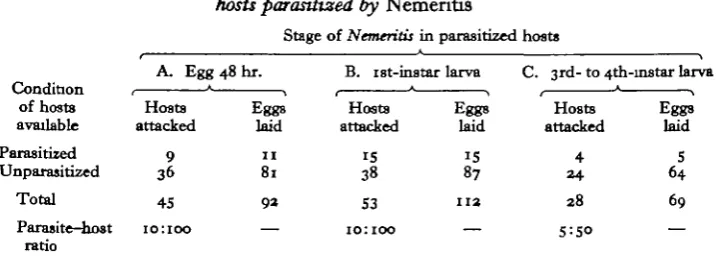
In the first experiment 10 females of Horogenes were each exposed to 10 host larvae for a period of 2 hr. In each replicate five of the 10 hosts contained 48 hr.-old eggs of Nemeritis (Table 1 A). On dissection of all hosts 48 hr. later it was found that, out of all 10 replicates, Horogenes laid in 45 of the 100 hosts available. Of these 36 were previously unparasitized and only nine were multiparasitized.
If one assumes no discrimination by the parasite, the numbers of both groups of hosts attacked would conform approximately to a ratio of 1:1. For the 45 hosts attacked the standard error is ±3-35. Since the number of healthy hosts selected (36) exceed the number of 22-5 expected on a 1:1 ratio by more than twice the stand-ard error, it is concluded that the parasite did not attack both groups of hosts at random. Since there was some variation in the numbers of both groups attacked in each replicate, the homogeneity of the parasites' oviposition behaviour was also tested using the x2 test. It was found that there was no significant difference between the results of the individual replicates (x* = 5-345, P = <o-o).
In a second test the females were presented with five unparasitized larvae for a period of 2 hr.; then with five parasitized larvae containing eggs of Nemeritis for a further 2 hr. Horogenes laid a total of 84 eggs in 50 unparasitized hosts and only 21 single eggs in 21 of the parasitized host larvae available (x2 = 4-164, P = < 0-05).
between unparasitized hosts and those containing eggs of another species, and that the females limit oviposition when parasitized hosts only are available to them. How-ever, in both cases a number of hosts were multiparasitized.
Table 1. Oviposition by Horogenes given a choice between unparasitized hosts and hosts parasitized by Nemeritis
Stage of Nemeritis in parasitized hosts
Condition of hosts available Parasitized Unparasitized Total Parasite-host ratio A. Egg Hosts attacked 9 36 45 10:100 48 hr. Eggs laid 1 1 81 9 3 — B. I8t-instar Hosts attacked IS 38 S3 10:100 larva Eggs laid IS 87
1 1 2
—
C. 3rd- to 4th-in
Hosts attacked
4
24
2 8
5 = 5°
star lar" Eggs laid S 64 69 —
The experiments were therefore extended to test the discrimination when there is a much more marked physiological difference between the parasitized and unpara-sitized hosts. At the end of the first instar the Nemeritis larva ceases to feed solely on the haemolymph of its host and begins to digest its fat body which is rapidly cyto-lysed as the parasite matures. Using the same methods Horogenes females were tested with series of hosts containing Nemeritis larvae in the first and third or fourth instars. Ten females were each placed for 2 hr. with 10 hosts, five of which contained
Nemeritis larvae in the first instar. Out of 100 hosts examined (Table iB), 53 were
attacked. Of these, 87 eggs were laid in 38 unparasitized hosts and only 25 eggs in 15 parasitized hosts. The x2 test showed that the females were able to recognize the parasitized hosts and preferred to oviposit in the unparasitized ones (x2 = 0/98,
P = < 0-005). A contingency table analysis for x2 was applied to the results of this and succeeding experiments to test whether Horogenes laid proportionately fewer eggs in the already parasitized host larvae. A x2 of 1 -7 indicated no significant difference between the proportions of eggs laid per host attacked in each group.
In a further test each of five females was given a choice between five unparasitized hosts and five containing third- or fourth-instar larvae of Nemeritis (Table iC). Subsequent dissection showed that, in all, 69 eggs were laid in 28 of the 50 hosts available, five eggs being laid in four parasitized hosts and the remaining 64 eggs in unparasitized hosts. The avoidance of the former is marked (x2 = 14-285,
P = < o-ooi). There was, however, no significant difference in the proportions of
eggs laid per host attacked in each group (x2 = 2-25, P = < o-6).
A study in insect multiparasitism. I 271
Table 2. Oviposition by Horogenes in alternate series of unparasitized hosts and
hosts parasitized by Nemeritis
Stage of Nemeritis in parasitized hosts
Exposure no.
1
2 3 4
No. and condition of hostB 25 unparasitized 25 parasitized 25 unparasitized 25 parasitized Total Parasite-host ratio A. Egg Hosts attacked 20 S 18 43 5:75 48 hr. Eggs laid 62 13 55
1 3 0
—
B. 3rd- to 4th-ii
Hosts attacked 20 4 IS 3 4a 5:100 istarlai Eggs laid S3 6 41 10 n o —
enclosed with five unparasitized hosts for 2 hr. They were then transferred to host larvae containing eggs of Nemeritis for a further 2 hr.; finally they were allowed to oviposit in unparasitized hosts once more. The distribution of eggs in each group of hosts (Table 2 A) shows a marked decrease in the number of eggs laid in already para-sitized host larvae, though there is no significant difference between the numbers of eggs laid per host attacked in each group (x2 = 3*413, P = o-io).
In the final test of discrimination by Horogenes, five females were each presented alternately with five unparasitized hosts and five containing Nemeritis larvae in the third or fourth instar, each for a period of 2 hr. The results, shown in Table 2 B, are from 25 hosts in each exposure. The reduced oviposition in hosts already containing advanced parasites is well demonstrated. As in previous experiments the x2 test showed that there was no heterogeneity in the distribution of eggs in the two groups of hosts (x2 = 2-579, P = °"4)- At the end of the experiment, in exposure 4, the avoidance of oviposition in parasitized hosts broke down and egg-laying became erratic and slightly higher superparasitism occurred in the attacked hosts.
Table 3. Oviposition by Nemeritis when given a choice between unparasitized hosts
and hosts parasitized by Horogenes
Stage of Horogenes in parasitized hosts
Condition of hosts available Parasitized Unparasitized Total Parasite-host A. Egg Hosts attacked 23 39 62 10:100 48 hr. Eggs laid 41 i°3 144 — B. ist-instar Hosts attacked 39 39 78 10:100 larva Eggs laid 78 148
2 3 6
C. 3rd- to
Hosts attacked 4 23 2 7 5:5° 4th-instar 1 Eggs laid 4 79 83 ratio
Oviposition by Nemeritis
[image:5.451.49.413.456.583.2]In the first experiment, 10 females were each confined for 2 hr. with 10 host larvae, five of which contained eggs of Horogenes 48 hr. old. Out of 100 host larvae, 41 eggs were laid in 23 of the parasitized hosts and 103 eggs in 39 of the unparasitized hosts (Table 3 A). The x2 test applied to the numbers of both groups of hosts attacked showed that Nemeritis did not discriminate between parasitized and unparasitized larvae (x2 = 3-571, P = < 0-05), but that it laid fewer eggs in the parasitized hosts. In the second experiment 10 Nemeritis females were each given a choice between five hosts containing first-instar Horogenes larvae and five unparasitized hosts (Table 3C). The results demonstrated that Nemeritis is able to distinguish between parasitized and unparasitized hosts (x2 = 12-0, P = < o-ooi) and laid proportion-ately fewer eggs in those parasitized hosts which it did attack (x2 = 5"8i,P = < 0-05).
Table 4. Oviposition by Nemeritis in alternate series of unparasitized hosts and
hosts parasitized by Horogenes
Stage of Horogenes in parasitized hosts
Exposure no.
1
2
3 4
No. and condition of hosts 35 unparasitized 25 parasitized 25 unparasitized 25 parasitized Total Parasite-host ratio A. Egg t Hosts attacked 24 10 18 8 6 0 5:100 48 hr. Eggs laid 62 33 60 25
1 8 0
—.
B. 3rd- to
Hosts attacked 17 3 13 5 38 5:100 4th-instar la Eggs laid 48 4 47 ti n o — The last two experiments with Nemeritis were designed to test the oviposition behaviour of the females to alternate sets of parasitized and unparasitized hosts, presented successively for periods of 2 hr. each. In the fourth test the parasitized hosts contained 48 hr.-old eggs of Horogenes. Five female Nemeritis were each exposed to four sets of five host larvae during an 8 hr. period. The hosts in the first and third periods were unparasitized; those in the second and fourth periods contained 48 hr.-old eggs of Horogenes. The results shown in Table 4A are totals of oviposition by all females in the 25 host larvae from each exposure. It is apparent that Nemeritis attacks fewer parasitized than unparasitized hosts (x2 = 10-933, P = 0-02), although it does not restrict the numbers of eggs laid in each host attacked (x2 = 2-398, P = 0-4).
In the final test, this experimental series was repeated with the parasitized hosts presented in the second and fourth exposures containing Horogenes larvae in the third or fourth instar (Table 4B). The reduction of oviposition in the parasitized hosts was again significant (x2 = 13*54, P = o-ooi).
DISCUSSION
A study in insect multiparasitism. I 273
approached individually by the parasite as a prospective host. Whether an egg is laid in it or not depends upon the sum total of the responses to the stimuli the parasite receives from that host.Nevertheless, both parasites do achieve the effect of discrimination either by not ovipositing in hosts that are already parasitized, or by laying fewer eggs in them than they do in healthy unparasitized hosts. This behaviour continues when the parasites are exposed successively to parasitized and unparasitized hosts or offered a simul-taneous choice between them.
There is, however, a considerable variation in the percentage of multiparasitism achieved by both species in similar experiments. Whereas the data show that Horogenes can distinguish a host containing eggs or larvae of Nemeritis at any stage of develop-ment, and may avoid ovipositing in it, there is no statistically significant restriction of oviposition in those parasitized hosts that it does attack.
Nemeritis, on the other hand, attacks both groups of hosts more readily than does Horogenes. The numbers of parasitized and unparasitized hosts attacked cannot be
separated statistically on experiments of choice when the parasitized hosts contain eggs or first-instar larvae. Yet there is a statistically significant reduction in the number of eggs laid in those that are already parasitized. However, if no choice is available and the parasitized and healthy hosts are presented alternately, as they are in the latter experiments, both species restrict their attack on parasitized hosts. In general, the actual numbers of eggs laid in them are also reduced, although not to a level of statistical significance.
These results are in accordance with the partial avoidance of superparasitism ob-served for Nemeritis by Simmonds (1943) and for Angitia (Horogenes) cerophaga Grav. by Lloyd (1940). It is clear that the distribution of eggs by these parasites is not made at random but is related to the nature of the available hosts (cf. Lloyd, 1938). The progressive reduction in the numbers of eggs laid in Ephestia larvae containing advancing larval stages of parasites indicates that the adult females of both species are able to perceive the decreasing suitability of such larvae as hosts.
The wholly artificial parasite-host densities of these laboratory experiments pre-clude their quantitative application to the extent of multiparasitism in field populations. But they do demonstrate that the avoidance of multiparasitism, even of hosts containing advanced larval stages of another species, is only partially developed. Thus multi-parasitism of Ephestia can be expected to occur in natural populations of Horogenes and Nemeritis, and, although the extent to which it does so is dependent upon the abundance of both parasites and host, it is most probable in hosts containing eggs or larvae in the first instar.
SUMMARY
1. The oviposition behaviour of the ichneumon flies- Horogenes chrysostictos and
Nemeritis canescens has been examined in relation to their multiparasitism of larvae
of the moth Ephestia sericarium.
2. Horogenes is able to distinguish healthy hosts from those that are parasitized
3. Although Horogenes attacks fewer parasitized than healthy hosts, it does not lay proportionately fewer eggs in a parasitized host.
4. Nemeritis is also able to distinguish healthy hosts from those parasitized by
Horogenes. Though it attacks parasitized hosts more readily than does Horogenes,
it lays fewer of its eggs in them.
5. Both species avoid ovipositing in a host containing an advanced larval parasite more frequently than in a host containing a parasite egg.
6. An Ephestia larva multiparasitized by Horogenes and Nemeritis may therefore contain these parasites at widely different ages, but the host selection behaviour of the adult parasites makes multiparasitism by parasite larvae of similar age more likely in field populations.
This paper represents part of a thesis submitted for the Ph.D. degree in the Uni-versity of Cambridge. I would like to thank Dr G. Salt, F.R.S., for encouragement and supervision of this work. My thanks are also due to the Agricultural Research Council for financial support.
REFERENCES
AHMAD, T. (1936). The influence of ecological factors on the Mediterranean flour moth, Ephestia, and its parasite Nemeritis canescens. J. Antm. Ecol. 5, 67-93.
BELINO, J. (1932). Zur Biologic von Nemeritis canescens. I. Zuchtungserfahrungen und flkologische Beobachtungen, Z. angeto. Ent. 19, 223—49.
DIAMOND, V. R. (1929). Biology of Nemeritis canescens, a parasite of the Mediterranean flour moth.
Rep. Ent. Soc. Ontario, 60, 84-9.
FISHER, R. C. (1959). The life history and ecology of Horogenes chrysostictos Gmelin (Hymenoptera, Ichneumonidae), a parasite of Ephestia sericarium Scott (Lepidoptera, Phycitidae). Canad. J. Z00L 37.429-46.
FISKE, W. F. (1910). Superparasitism; an important factor in the natural control of insects. J. Econ.
Ent. 3, 88-97.
FISKE, W. F. 8C THOMPSON, W. R. (1909)- Notes on the parasites of the Saturniidae. J. Econ. Ent. a, 450-60.
HAVILAND, M. D. (1921). The bionomics of certain parasitic Hymenoptera. Proc. Comb. PhiL Soc. ai, 27-8.
HAVTLAND, M. D. (1922). On the post-embryonic development of certain Chalcids, hyperparasites of Aphides. Quart. J. Micr. Sci. 66, 322.
HOWARD, L. O. (1897). A study in insect parasitism. Bull. U.S. Dep. Agric. Bur. Ent. (Tech. Series), no. 5.
IMMS, A. D. (1937). Recent Advances in Entomology, 2nd ed. London. KELER, ST VON (1955). Entomologisches WSrterbuch. Berlin.
LLOYD, D. C. (1938). A study of some factors governing the choice of hosts and distribution of progeny by the chalcid, Ooencyrtus kuvanae. Phil. Trans. B, 339, 275-322.
LLOYD, D. C. (1940). Host selection by Hymenopterous parasites of the moth Plutella maculipennis.
Proc. Roy. Soc. B, 138,
451-84-LLOYD, D. C. (1942). Further experiments on host selection by Hymenopterous parasites of Plutella
maculipamis. Rev. Canad. Biol. 1, 635-45.
PEMBERTON, C. E. & WILLARD, H. F. (1918). Inter-relations of fruit fly parasites in Hawaii. J. Agric.
Res. xa, 285-95.
PIERCE, W. D. (1908). Studies of parasites of the cotton boll weevil. Bull. U.S. Bur. Ent. 73.
33-PIERCE, W. D. (1910). On some phases of parasitism displayed by insect enemies of weevils. J. Econ.
Ent. 3, 451-8.
SALT, G. (1934). Experimental studies in insect parasitism. II. Superparasitism. Proc. Roy. Soc. B, « 4 . 455-76.
SIMMONDS, F. J. (1943). The occurrence of superparasitism in Nemeritis canescens Grav. Rev. Canad.
Biol. a, 15-48.
SMITH, H. S. (1916). An attempt to redefine the host relationships exhibited by entomophagous insects.
A study in insect multiparasitism. I 275
SMITH, H. S. (1929). Multiple parasitism; its relation to the biological control of insect pests. BulL
Ent. Res. ao, 141-9.
SWEETMAN, H. L. (1958). The Principles of Biological Control, revised ed. Dubuque, Iowa: W. C. Brown and Co.
THORPE, W. H. (1939). Occurrence of the male of Nemeritis canescem in Britain. Proc. R. Ent. Soc.
Land. A, 14, 47.
TOTHIU., J. D. (1922). The natural control of the fall webworm {Hyphantria cunea Drury) in Canada.
Tech. BulL Dom. Canada Dep. Agric. no. 3, 107 pp.
ULLTETT, G. C. (1936). Host selection by Microplectron fusdptnnis Zett. (Chalcid. Hym.). Proc. Roy.