196
Diversify Your Datasets:
Analyzing Generalization via Controlled Variance in Adversarial Datasets
Ohad Rozen1, Vered Shwartz2,3, Roee Aharoni1, and Ido Dagan1 1Computer Science Department, Bar-Ilan University, Ramat-Gan, Israel
2Allen Institute for Artificial Intelligence
3Paul G. Allen School of Computer Science & Engineering, University of Washington
{ohadrozen,roee.aharoni}@gmail.com, [email protected], [email protected]
Abstract
Phenomenon-specific “adversarial” datasets have been recently designed to perform targeted stress-tests for particular inference types. Recent work (Liu et al.,2019a) pro-posed that such datasets can be utilized for training NLI and other types of models, of-ten allowing to learn the phenomenon in fo-cus and improve on the challenge dataset, in-dicating a “blind spot” in the original training data. Yet, although a model can improve in such a training process, it might still be vul-nerable to other challenge datasets targeting the same phenomenon but drawn from a differ-ent distribution, such as having a differdiffer-ent syn-tactic complexity level. In this work, we ex-tend this method to drive conclusions about a model’s ability to learn andgeneralizea target phenomenon rather than to “learn” a dataset, by controlling additional aspects in the adver-sarial datasets. We demonstrate our approach on two inference phenomena – dative alterna-tion and numerical reasoning, elaborating, and in some cases contradicting, the results ofLiu et al.. Our methodology enables building bet-ter challenge datasets for creating more robust models, and may yield better model under-standing and subsequent overarching improve-ments.
1 Introduction
To successfully recognize textual entailment (RTE; Dagan et al.,2013), also known as natural language inference (NLI) (MacCartney and Man-ning,2008;Bowman et al.,2015), a system needs to model a broad range of inference phenomena. Pre-neural systems often included explicit compo-nents, such as engineered features or syntax-based transformations (e.g.Stern and Dagan,2012;Stern et al., 2012; Bar-Haim et al., 2015), to address particular inference types such as syntactic, lexi-cal, and logical inferences. Today’s neural mod-els do not explicitly model such inferences, but
instead attempt to learn them implicitly from the training data. Despite their success on common NLI dataset, recent challenge datasets designed for probing different linguistic phenomena showed that neural models often fail on particular infer-ence types, like recognizing semantic relations and negation (Poliak et al., 2018; Naik et al., 2018; Glockner et al.,2018).
Recently, Liu et al. (2019a) showed that when probing reveals a model’s failure on a specific lin-guistic phenomenon, it is often possible to amend this failure. They suggested to fine-tune the model on (a training section of) the challenge dataset it-self, in order to teach it to address the specific tar-get phenomenon, or in other words, to “inoculate” it against the adversarial data. Inoculation has two possible outcomes. The first - a success to ad-dress the phenomenon after fine-tuning - suggests the original training set did not cover this phe-nomenon sufficiently (“blind spot” of the dataset). A failure, on the other hand, indicates an inherent model weakness to handle the target phenomenon. This was presented as a general methodology, and was demonstrated on the NLI task, among others. The inoculation approach seems an appealing way to teach NLI models to properly address a broad range of inference phenomena, by training on a targeted inoculation dataset for each phe-nomenon. However, the methodology as sug-gested in Liu et al. (2019a) is not conclusive as to whether inoculation succeeded thanks to the model learning the target phenomenon in ageneral manner or due to overfitting the particular distri-bution of the inoculation data, possibly leveraging superficial cues or artifacts. Accordingly, success-ful inoculation may not reliably predict whether the model would successfully address the same target phenomenon when facing it on datasets drawn from different distributions.
method-ology, analyzing the ability of models to gener-alize across different data distributions when ad-dressing a specific inference phenomenon. In par-ticular, we suggest varying both training and test distributions along several linguistic dimensions, like syntactic complexity or lexical diversity. In addition to indicating the model generalization ability, our methodology directs how to design the inoculation data in order to sufficiently cover the targeted phenomenon, when possible.
We demonstrate our methodology on two in-ference types, picked from the GLUE benchmark (Wang et al., 2019) diagnostic dataset: (1) da-tive alternation, a syntactic phenomenon, and (2) a specific type of numerical reasoning, pertaining to logical and arithmetic inference. To create our datasets, we introduce a templating method, by which we generated hundreds of synthetic exam-ples from a single original sentence, while con-trolling the variance between the datasets.1 We employ a recent NLI model, based on the pre-trained BERT masked language model (Devlin et al., 2019) fine-tuned on the MultiNLI dataset (Williams et al.,2018). For the dative alternation case, we find that the model struggles with gen-eralizing over the syntactic dimension, requiring training over a relatively large variety of syntacti-cally complex sentences. For the numerical rea-soning case, we find that the model notably fails to generalize across diverse number ranges, a con-clusion that might have been missed if we were to use only the original inoculation methodology. We hope our methodology will be adopted for ad-ditional NLP tasks, and specifically to a broader range of entailment inference types, as an avenue for developing robust NLI systems that can ad-dress specific inference phenomena.
2 Background
Neural NLI Models. Natural language infer-ence is the task of identifying, given two text frag-ments, whether the second (hypothesis) can be in-ferred from the first (premise). While earlier mod-els for these tasks relied on domain knowledge and lexical resources like WordNet (e.g MacCartney et al.,2008;Heilman and Smith,2010), the release of the large-scale Stanford natural language infer-ence dataset (SNLI;Bowman et al.,2015) shifted the focus to neural models which thrive given such
1All datasets and resources are available at https://github.com/ohadrozen/generalization.
large datasets. Typically, these models encode each of the premise and the hypothesis, combine them into a feature vector, and feed it into a clas-sifier to make the entailment prediction. The en-coding of the two sentences can be either indepen-dent of each other or depenindepen-dent using an attention mechanism. These models typically do not rely on any external knowledge other than pre-trained word embeddings.
Contextualized Word Embeddings. Recently, the word embedding paradigm shifted from static token-based embeddings to dynamic context-sensitive ones. Notable contextual representations are ELMo (Peters et al., 2018b), BERT (Devlin et al.,2019), GPT (Radford et al.,2018) and XL-Net (Yang et al., 2019), which are pre-trained as language models on large corpora. Contextual-ized word embeddings have been used across a broad range of NLP tasks, outperforming the pre-vious state-of-the-art models. Specifically, several works showed that they capture various types of linguistic knowledge, from syntactic to semantic and discourse relations (e.g. Peters et al., 2018a; Tenney et al., 2019; Shwartz and Dagan, 2019). Among many other tasks, NLI has also benefited from the use of contextualized word embeddings. The current state-of-the-art models use pre-trained contextualized word embeddings as their underly-ing representations, while fine-tununderly-ing on the NLI task (Liu et al.,2019b;Devlin et al.,2019). De-spite their remarkable success on several datasets, it still remains unclear how these models repre-sent the various linguistic phenomena required for solving the NLI tasks.
Existing Drawbacks and Challenge Datasets.
Glockner et al.(2018) showed that substituting a single premise term with its hypernym (to cre-ate entailment examples) or a mutually exclusive term (for contradiction examples) challenges sev-eral pre-trained NLI models that performed well on the datasets on which they were trained. Naik et al. (2018) constructed a suite of “stress-tests”, each pertaining to some linguistic phenomenon, and showed that NLI models fail on many of them (e.g. numerical reasoning, logical negations, etc.). Another line of work showed that NLI models may reach a surprising performance level on the NLI test sets just by exploiting artifacts in the gener-ation of the hypotheses, rather than learning to model the complex entailment relationship (Guru-rangan et al.,2018;Tsuchiya,2018;Poliak et al., 2018).
Fine-tuning on Challenge Datasets. Recently, Liu et al. (2019a) suggested that a model’s fail-ure to address a specific linguistic phenomenon may be attributed to one of the following cases: either the NLI training data does not sufficiently represent this phenomenon (“dataset blind spot”) or the model is inherently incapable of learning to address this phenomenon. They suggested to fine-tune the NLI model on the specific challenge dataset in order to find out which case is cur-rently observed. Specifically, in the case of a data blind spot, the performance on the challenge dataset is expected to improve after fine-tuning (i.e., the model is “inoculated” against the adver-sarial data). Otherwise, if the performance does not improve despite exposure to the phenomenon by fine-tuning, this may be an inherent weakness of the model. Finally, an additional possible out-come is that the performance on the original NLI test set is severely hurt after fine-tuning on the specific phenomenon, which may be due to over-fitting.
3 Methodology
We extend the inoculation approach of Liu et al. (2019a) by additionally controlling for finer-grained dimensions of the training and test data. For a given inference type (Section 3.1), our methodology consists of the following steps. (1) First, we extract premises in the MultiNLI (Williams et al., 2018) training set that in-clude the targeted linguistic phenomenon (Sec-tion 3.2). (2) For each found premise, we gener-ate multiple diverse variations using our
templat-ing method (Section 3.3). (3) After generating diverse premises, we generate multiple matching synthetic hypotheses using a templating method (Section3.4). As we generate synthetic hypothe-ses, we can make sure the premise-hypothesis pairs differ along our proposed diversity dimen-sions. (4) Finally, we define the train and test sets so that the variance between them is con-trolled with respect to the different dimensions (Section3.5). This facilitates probing the success of the model to generalize a given inference type with respect to a specific dimension of the data.
3.1 Inference Types
We focus on the following two inference types from the diagnostic set of the GLUE benchmark (Wang et al.,2019) as test cases for our methodol-ogy.
Dative Alternation. This inference type refers to the alternation between a double-object con-struction (“I baked him a cake”) and a preposi-tional indirect-object construction (“I baked a cake for him”).
Numerical Reasoning. We focus on sentences relating to numbers by the relational phrases “more than” and “less than”, normalizing all num-bers to numerals. For example, “There are3 ap-ples on the table” entails “There aremore than 2 apples on the table”
3.2 Premise Extraction
Dative Alternation
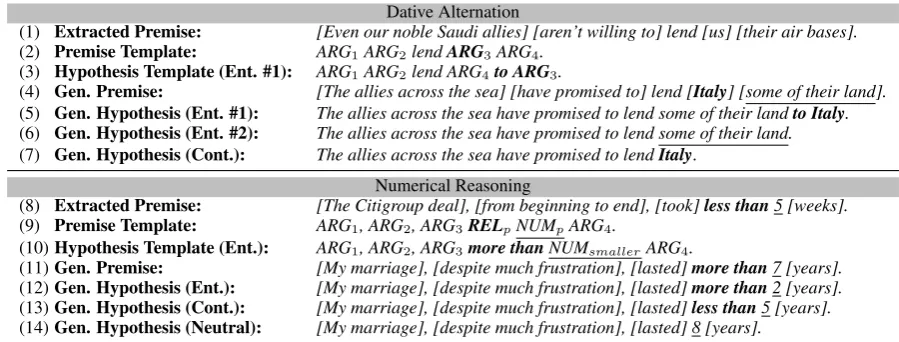
(1) Extracted Premise: [Even our noble Saudi allies] [aren’t willing to] lend [us] [their air bases].
(2) Premise Template: ARG1ARG2lendARG3ARG4.
(3) Hypothesis Template (Ent. #1): ARG1ARG2lend ARG4to ARG3.
(4) Gen. Premise: [The allies across the sea] [have promised to] lend [Italy] [some of their land].
(5) Gen. Hypothesis (Ent. #1): The allies across the sea have promised to lend some of their landto Italy.
(6) Gen. Hypothesis (Ent. #2): The allies across the sea have promised to lend some of their land.
(7) Gen. Hypothesis (Cont.): The allies across the sea have promised to lendItaly.
Numerical Reasoning
(8) Extracted Premise: [The Citigroup deal], [from beginning to end], [took]less than5 [weeks].
(9) Premise Template: ARG1, ARG2, ARG3RELpNUMpARG4.
(10)Hypothesis Template (Ent.): ARG1, ARG2, ARG3more thanNUMsmallerARG4.
(11)Gen. Premise: [My marriage], [despite much frustration], [lasted]more than7 [years].
(12)Gen. Hypothesis (Ent.): [My marriage], [despite much frustration], [lasted]more than2 [years].
(13)Gen. Hypothesis (Cont.): [My marriage], [despite much frustration], [lasted]less than5 [years].
[image:4.595.72.522.65.236.2](14)Gen. Hypothesis (Neutral): [My marriage], [despite much frustration], [lasted] 8 [years].
Table 1: Examples for the premise-hypothesis generation process (notations are explained in Sections3.3and3.4): (a) Premises are extracted from the MultiNLI train set (rows 1 and 8) (b) Premise templates are manually created (rows 2 and 9) (c) Hypothesis templates are automatically generated using the premise templates (rows 3 and 10) (d) New premises are automatically generated by instantiating them with the turkers’ answers (rows 4 and 11) (e) new hypotheses with same instantiations are generated (rows 5-7 and 12-14).
length and syntactic complexity (see Section3.5). Rows 1 and 8 in Table1exemplify such premises for the dative alternation and numerical reasoning inference types.
3.3 Premise Generation
To isolate the lexical dimension from the syntac-tic one, for each target phenomenon we synthe-size multiple new premises, all sharing a similar syntactic structure by construction. To do so, we manually generate a premise template by replac-ing at least four spans in the premise with argu-ments ARGi as placeholders. We do so while keeping the words related to the phenomenon in focus within the template. For example, from the premise “Even our noble Saudi allies aren’t will-ing to lend us their air bases.”, we generated the template “ARG1 ARG2 lendARG3 ARG4.” (see
rows 2 and 9 in Table 1). We then let crowd-sourcing workers instantiate each of the arguments to create new sentences. For the instantiations to later construct coherent sentences with high like-lihood, we ask the workers to instantiate each ar-gument separately, leaving the rest of the sentence unchanged, in a way that yields a new grammati-cal and coherent sentence that can make sense in some possible made up context (e.g. “Even our noble Saudi allies〈span to fill in〉lend us their air bases.”). To maintain similar sentence lengths and structures, we limit the instantiations to be at most one word longer or shorter than the original spans. For each argument we collected 6 instan-tiations which were manually validated for
gram-maticality and semantic coherence. We used all possible combinations of instantiations to gener-ate hundreds of premises per templgener-ate (rows 4 and 11 in Table1). The annotation task was performed in Amazon Mechanical Turk, where to control the quality of the workers, we required that they have at least 98% acceptance rate for prior HITs. We paid $2.5 for two instantiations of all arguments in a given sentence (at most 14 instantiations per sentence).
3.4 Hypothesis Generation
For eachpremise templatewe automatically gen-erate multiple hypothesis templates for each en-tailment label (enen-tailment, neutral and contradic-tion), which differ from the premise only in the phenomenon in focus, as detailed for each infer-ence type below.
Dative Alternation. We generate the entailed hypothesis templates by applying the inference type. Specifically, for entailing dative alterna-tion, we either switch to the alternate constructions (row 5 in Table1) or remove the first argument af-ter the dative verb (row 6). For contradicting hy-potheses templates, we remove the second argu-ment, creating a grammatical yet contradictory hy-pothesis template (row 7). For each premise tem-plate we therefore generate 2 entailment hypothe-ses and 1 contradictory (no neutral).
{less than, more than, ∅}, we generate mul-tiple hypotheses by replacing the target number by a random number (from a given target range, see further below) and the relational expression by each of the expressions. The sentence-pair label is determined by the relation between the numeric expressions in the premise and the hypothesis, and may be any of entailment, neutral, or contradic-tion. For example, consider the premise template “[The union] [has] more than 4 [thousand mem-bers] [in Canada]”. Replacing the numeric ex-pression “more than 4” by “3” yields contradic-tion, while the substitute “more than 3” is entail-ing, and “more than 5” is neutral. This way, for each premise template we generate 22 different hypotheses: 4 entailment, 6 neutral and 12 contra-diction. We used numeric values within the range 2-999.
3.5 Controlled Data Splits
The main motivation for our data splits is to con-trol the variance between the train and test sets with respect to certain data dimensions. Specifi-cally, for both inference types, we create a vari-ance along the syntactic complexity dimension. Based on the premise template, we divided each dataset into 3 subsets with different syntactic com-plexity levels: simple, mediumand complex, de-noted byS, M andC respectively. We do so ac-cording to two criteria: sentence length and the depth in the constituency parsing tree in which the inference type occurs, using the Stanford Parser (Manning et al.,2014) (see Table2).2
We also create a variance along different lexical dimensions. From thesimplesubsetS we gener-ate two additional subsetsSLex1andSLex2 in the
following way. For eachsimpletemplate, we first split its original instantiations into two groups, and then instantiate each such group separately into the template, creating two sets of instantiations of the same templates1 ∈ SLex1ands2∈ SLex2, which
are syntactically similar by construction, yet lex-ically different. We repeat this process for the complexsubset as well to createCLex1andCLex2.
We further split the dative alternation datasets lex-ically by the main verb, which allows testing how well the model generalizes this inference type for
2
For dative alternation we consider the depth of the dative verb, while for the numeric reasoning data we look at the depth of the number. We consider premise templates with less than 16 words and depth< 4assimple, more than 25 words and depth>6ascomplex, and the rest asmedium.
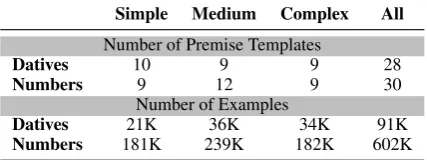
Simple Medium Complex All
Number of Premise Templates
Datives 10 9 9 28
Numbers 9 12 9 30
Number of Examples
Datives 21K 36K 34K 91K
[image:5.595.310.524.64.144.2]Numbers 181K 239K 182K 602K
Table 2: Statistics of the dative alternation and numeri-cal reasoning datasets divided by syntactic complexity level.
different dative verbs. This is done by changing the main dative verb inSLex2 andCLex2 creating
new subsetsSLex0 2 and CLex0 2.3 We split the nu-merical reasoning dataset similarly using different numerical ranges in the training and test sets.
In Section4 we experiment with various splits of the training and test sets, which allow us to test the model’s generalization over the various dimen-sions. For example, we test whether the model can learn an inference type on syntacticallysimple ex-amples and generalize it tocomplexones. See Ta-ble2for the statistics of each dataset.
4 Experiments
We use a standard model based on BERT (Devlin et al., 2019) as our NLI model. Specifically, we used the base-uncased pre-trained model from the pytorch-pretrained-bert library4, and fine-tuned it for the NLI task on MultiNLI.5We conduct several experiments. First, we use our datasets for a typi-cal probing task, i.e. testing how well the model performs on each inference type, without being trained to address the specific inference type (Sec-tion4.1). Then, similarly toLiu et al.(2019a), we test the model’s ability to learn each inference type by further fine-tuning on specific examples for it (Section4.2). Finally, incorporating our innova-tion, we analyze the model’s generalization abil-ity by introducing variance in the proposed data dimensions between the train and test sets (Sec-tion4.3).
4.1 Probing
We randomly selected 4,000 examples from each of thesimple,mediumandcomplexdatasets, with
3
For each template we choose a new dative verb that keeps the sentence coherent and grammatical.
4
Figure 1: Average test accuracy on the dative alternation dataset (left) and the numerical reasoning dataset (right) as a function of number of training examples, divided by label. The black lines represent the average accuracy of the model on MultiNLI matched development set after fine-tuning. For numerical reasoning we use a larger range on the x-axis to capture the near-perfect performance for 100k examples.
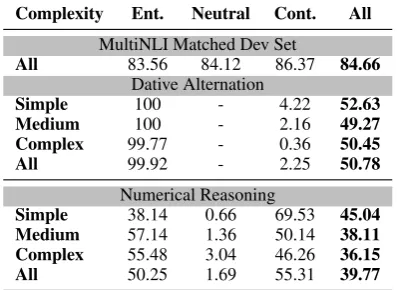
Complexity Ent. Neutral Cont. All
MultiNLI Matched Dev Set
All 83.56 84.12 86.37 84.66
Dative Alternation
Simple 100 - 4.22 52.63
Medium 100 - 2.16 49.27
Complex 99.77 - 0.36 50.45
All 99.92 - 2.25 50.78
Numerical Reasoning
Simple 38.14 0.66 69.53 45.04
Medium 57.14 1.36 50.14 38.11
Complex 55.48 3.04 46.26 36.15
[image:6.595.82.281.257.402.2]All 50.25 1.69 55.31 39.77
Table 3: Accuracy of the model trained only on MultiNLI on our datasets, which are used as probing datasets. The Complexity column refers to the syntac-tic complexity of the sentences.
balanced labels, to serve as a test set. Table 3 shows the accuracy of the model on each test set.
On our dative alternation dataset, the accu-racy on our test sets is substantially lower than on the MultiNLI development set (50.78% versus 84.66% respectively), suggesting that the model has not learned to address this inference type from the MultiNLI training data. The model has very high accuracy on the entailment examples, while close to zero on the contradiction ones. This is un-derstandable considering that the sentence-pairs in this dataset by construction have high lexical over-lap between the premise and hypothesis, leading the model to default to almost always predicting entailment.
On the numerical reasoning dataset, the model also seems to fail on this inference type with test set accuracy much lower than on the MultiNLI de-velopment set, suggesting that the model hasn’t learned to address this inference type as well. The model has relatively low accuracy on the
entail-ment and contradiction examples while close to zero accuracy on the neutral ones. This is due to the fact that the model classifies sentence-pairs with high lexical overlap but with a different nu-merical phrase as either entailment or contradic-tion, but almost never as neutral.
4.2 Fine Tuning
We follow Liu et al. (2019a) and fine-tune the model on the phenomenon-specific examples, test-ing how many traintest-ing examples the model needs to observe before it performs reasonably well on this inference type.6
We split each dataset to training (77%) and test (23%) sets such that the same template is not used in both training and test. Each set consists of tem-plates from all syntactic complexities, and a bal-anced number of examples from each label. We experiment with a different number of training ex-amples ranging from 0 to 4,000 for the dative al-ternation sets and from 0 to 100,000 for numerical reasoning. We repeat this experiment five times with different training and test splits, while also testing the performance on the original MultiNLI matched development dataset. We report in Fig-ure1the average accuracy across runs as a func-tion of the number of training examples. In both datasets, fine-tuning greatly improves the perfor-mance.
On the dative alternation data, fine-tuning brings the performance on contradiction from 0 to 90%, suggesting the model can now distinguish well between the entailing and contradictory ex-amples, reaching similar accuracy on both. The
6To fine-tune BERT, we use the Adam optimizer (Kingma
good performance on this inference type indicates a blind spot in the MultiNLI dataset rather than a model weakness. As expected, the model reaches slightly better performance on examples with sim-pler syntactic structure than those with complex ones. Fine-tuning with 4,000 examples reduces the performance on the MultiNLI development set in about 2%. AsLiu et al. suggested, this could result from the distribution of our dataset deviat-ing from the distribution of the MultiNLI dataset, and possibly from having the original model over-fitting to that distribution.
With respect to numerical reasoning, though only after a relatively large number of 10,000 training examples, the model seems to succeed in learning the phenomenon. According to Liu et al. (2019a), this result suggests that our chal-lenge dataset did not reveal a weakness in the model, but instead a blind spot in the original dataset. Yet, this conclusion is challenged in the next subsection. In the numerical reasoning case we notice an even larger decrease in the perfor-mance on MultiNLI after fine-tuning - up to 6.5%. This may again result from different distributions across the datasets, influencing the performance more intensely due to the larger number of training examples.
4.3 Generalization
We now analyze the model’s ability to general-ize for each inference type across various data di-mensions, using our proposed methodology. As we will see, this type of analysis yields addi-tional, more elaborate and sometimes contradic-tory insights, which are not attainable by the prior methodologies that we applied in the previous two subsections.
Dative Alternation. First, we test the model’s generalization ability at the syntactic complexity dimension, by training it on a dataset belonging to one category of syntactic complexity (among sim-ple, medium and complex; see Section 3.5), and testing it on a dataset belonging to eithersimpleor complex. We make sure examples in the training and test sets were generated by different templates. The left side of Figure 2 displays the perfor-mance on the various experiments, revealing an interesting pattern: on thesimple syntax test set, good performance is attainable regardless of the training set, while for thecomplexsyntax test set, training on simple syntax performs inferiorly to
training on complex syntax. This suggests that although the model is able to learn the dative al-ternation phenomenon and generalize to a certain extent, the model does not learn the phenomenon on its own, decoupled from learning argument po-sitions, but rather it needs to be trained with dative alternation examples of high syntactic complexity to perform well.
The second data dimension we test is lexical di-versity. We test the model’s ability to generalize across syntactically-similar examples with a dif-ferent main dative verb. To isolate the lexical as-pect from other asas-pects, we fix the syntax by using the same templates for training and testing. For the simplecategory, we train the model on theSLex1
subset and test it on both the SLex2 subset with
the same main dative verb, and onSLex0 2 with a different main verb that has not been seen in the training examples (see Section3.5). We repeat the same process for thecomplexcategory.7
The right side of Figure 2 shows that when tested on the same syntactic complexity level as seen during training, the performance remains similar regardless of the similarity between the train and test dative verbs. This suggests that the model generalizes well on the lexical dimension and learns to recognize the dative alternation in-ference independently of the specific verb. We also observe that the model generalizes more eas-ily from examples with simple syntax: on this cat-egory, the performance gap between the two test setsSLex2 and SLex0 2 is smaller than the gap
be-tween the graphs of the complex category. This suggests the conclusion that unlike syntactic diver-sity, a large lexical diversity is not necessary when inoculating for dative alternation.
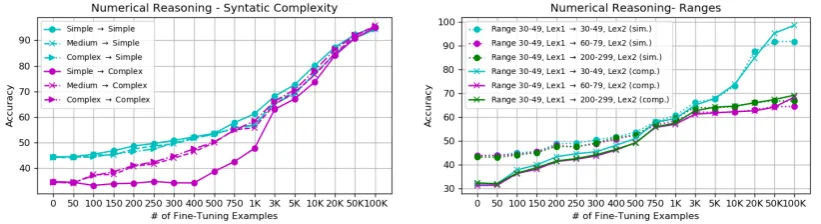
Numerical Reasoning. Again, we test the model’s generalization ability with respect to syn-tactic complexity by splitting the train and test sets based on this dimension (left side of Figure 3). As opposed to dative alternation, here the gap between the performance when testing examples with more complex syntax than the training set and the performance when testing on simpler ex-amples is rather small after enough training exam-ples (up to 3.2% difference after 3,000 examexam-ples). We conjecture that the model learns to identify lo-cal patterns (e.g. “more thanX”) while the
rela-7For both S
Lex1 and CLex1 we sample 256 examples
Figure 2: Test accuracy on the dative alternation dataset over the syntactic dimension (left) and average perfor-mance on the lexical dimension (right) as a function of number of training examples. The larger gaps on the left graph in comparison to the much smaller gaps on the right graph indicate a limited generalization ability over the syntactic dimension and a better one over different dative verbs
Figure 3: Test accuracy on the numerical reasoning dataset over the syntactic dimension (left) and on the range dimension (right) as a function of number of training examples. The gaps on the right graph comparing to the convergence on the left one suggest a good generalization ability over the syntactic dimension and a poor one over different number ranges.
tionships between them are less dependent on the global syntactic structure of the sentence. More-over, the difference between the premise and the hypothesis is lexical and local (i.e. replacing the relational operator and the number), while their syntax remains otherwise identical, shifting the model’s focus away from the syntax.
Regarding lexical diversity, we test whether the model can be trained on one range of numbers and perform well when tested on another. To that end, we populate the number placeholders in the templates with randomly sampled numbers from within a certain range, among 30-49, 60-79 and 200-299. We train on the first range and test on each of the ranges. To isolate the numeric aspect from the syntactic one, we fix the syntax by using the same templates for training and testing, while using different argument instantiations (as we did for the dative alternation when testing for lexical diversity of the dative verb).
The right side of Figure 3 shows the perfor-mance of each model as a function of training ex-amples. Training and testing on the same range yields substantially better performance, while
test-ing on a different range reaches accuracy of less than 70% even after 20,000 training examples, and seems to reach saturation. We also repeated the same experiment with number range of 1000-9999 in the test sets, resulting in a graph very simi-lar to the 200-299 range. This indicates an in-herent weakness of the model to learn the phe-nomenon and generalize it over different number ranges. Given that the number of training exam-ples is limited, it might be challenging to inocu-late the model to perform well on a wide variety of challenge datasets for this phenomenon. The success within the same (narrow) number range, when training gets large enough, might suggest that the model mostly memorizes specific num-ber pairs and the arithmetic relation between them, rather than learning the arithmetic rules. These sights contradict the conclusion of the original in-oculation analysis of a blind spot in the original dataset (in Section4.2).
5 Conclusions
[image:8.595.94.505.247.359.2]phenomenon and successfully generalize its mod-eling to datasets drawn from different distribu-tions. By controlling the differences between the training and test sets along syntactic and lex-ical data dimensions, we were able to analyze how well the model generalizes with respect to each phenomenon over the different dimensions. We demonstrated our methodology on a standard model based on BERT, focusing on dative alter-nation and numerical reasoning. We found that high syntactic complexity is necessary for teach-ing dative alternations, while beteach-ing less important for numerical reasoning. We also showed that the model is incapable of generalizing over different number ranges for numerical reasoning, indicating an inherent modeling weakness.
We suggest that our work opens promising as well as challenging research directions. A natu-ral direction for future work would be to apply our methodology to a broader range of inference types and data dimensions. This would enable exten-sive analysis of NLI models’ learning and gener-alization abilities, and may yield models that can truly address a range of inference phenomena in a fairly general manner. One question that still re-mains open at this point regards the models’ abil-ity to handlemultipleinference phenomena within the same example, which is more representative of real-world scenarios.
Finally, we observed that fine-tuning the model on the phenomenon-specific data some-times yields a decrease in the performance on the original dataset. One potential direction to avoid this in the future would be to perform multi-task learning rather than fine-tuning on the phenomenon-specific data. Better scheduling of multi-task training as presented by Kiperwasser and Ballesteros (2018) may also reduce the per-formance loss in such scenarios.
Acknowledgments
We would like to thank Ori Shapira for assisting in data analysis, and the anonymous reviewers for their constructive comments. This work was sup-ported in part by the German Research Founda-tion through the German-Israeli Project Cooper-ation (DIP, grant DA 1600/1-1), by a grant from Reverso and Theo Hoffenberg, and by the Israel Science Foundation (grant 1951/17).
References
Roy Bar-Haim, Ido Dagan, and Jonathan Berant. 2015.
Knowledge-based textual inference via parse-tree transformations.J. Artif. Int. Res., 54(1):1–57.
Samuel R. Bowman, Gabor Angeli, Christopher Potts, and Christopher D. Manning. 2015. A large anno-tated corpus for learning natural language inference. In Proceedings of the 2015 Conference on Empiri-cal Methods in Natural Language Processing, pages 632–642, Lisbon, Portugal. Association for Compu-tational Linguistics.
Ido Dagan, Dan Roth, Mark Sammons, and Fabio Mas-simo Zanzotto. 2013. Recognizing textual entail-ment: Models and applications. Synthesis Lectures on Human Language Technologies, 6(4):1–220.
Jacob Devlin, Ming-Wei Chang, Kenton Lee, and Kristina Toutanova. 2019. Bert: Pre-training of deep bidirectional transformers for language under-standing. InProceedings of the 2019 Conference of the North American Chapter of the Association for Computational Linguistics: Human Language Tech-nologies, Minneapolis, Minnesota. Association for Computational Linguistics.
Max Glockner, Vered Shwartz, and Yoav Goldberg. 2018.Breaking NLI systems with sentences that re-quire simple lexical inferences. InProceedings of the 56th Annual Meeting of the Association for Com-putational Linguistics (Volume 2: Short Papers), pages 650–655, Melbourne, Australia. Association for Computational Linguistics.
Suchin Gururangan, Swabha Swayamdipta, Omer Levy, Roy Schwartz, Samuel R Bowman, and Noah A Smith. 2018. Annotation artifacts in natural language inference data. In The 16th Annual Con-ference of the North American Chapter of the Asso-ciation for Computational Linguistics: Human Lan-guage Technologies (NAACL-HLT), New Orleans, Louisiana.
Michael Heilman and Noah A. Smith. 2010. Tree edit models for recognizing textual entailments, para-phrases, and answers to questions. InHuman Lan-guage Technologies: The 2010 Annual Conference of the North American Chapter of the Associa-tion for ComputaAssocia-tional Linguistics, HLT ’10, pages 1011–1019, Stroudsburg, PA, USA. Association for Computational Linguistics.
Diederik P. Kingma and Jimmy Ba. 2015. Adam: A method for stochastic optimization. In 3rd Inter-national Conference on Learning Representations, ICLR 2015, San Diego, CA, USA, May 7-9, 2015, Conference Track Proceedings.
Eliyahu Kiperwasser and Miguel Ballesteros. 2018.
Nelson F Liu, Roy Schwartz, and Noah A Smith. 2019a. Inoculation by fine-tuning: A method for analyzing challenge datasets. InProceedings of the 2019 Conference of the North American Chapter of the Association for Computational Linguistics: Human Language Technologies, Minneapolis, Min-nesota. Association for Computational Linguistics.
Xiaodong Liu, Pengcheng He, Weizhu Chen, and Jian-feng Gao. 2019b. Multi-task deep neural net-works for natural language understanding. CoRR, abs/1901.11504.
Bill MacCartney, Michel Galley, and Christopher D. Manning. 2008. A phrase-based alignment model for natural language inference. In Proceedings of the Conference on Empirical Methods in Natural Language Processing, EMNLP ’08, pages 802–811, Stroudsburg, PA, USA. Association for Computa-tional Linguistics.
Bill MacCartney and Christopher D. Manning. 2008.
Modeling semantic containment and exclusion in natural language inference. InProceedings of the 22Nd International Conference on Computational Linguistics - Volume 1, COLING ’08, pages 521– 528, Stroudsburg, PA, USA. Association for Com-putational Linguistics.
Christopher D. Manning, Mihai Surdeanu, John Bauer, Jenny Finkel, Steven J. Bethard, and David Mc-Closky. 2014. The Stanford CoreNLP natural lan-guage processing toolkit. InAssociation for Compu-tational Linguistics (ACL) System Demonstrations, pages 55–60.
Aakanksha Naik, Abhilasha Ravichander, Norman Sadeh, Carolyn Rose, and Graham Neubig. 2018.
Stress test evaluation for natural language inference. InProceedings of the 27th International Conference on Computational Linguistics, pages 2340–2353, Santa Fe, New Mexico, USA. Association for Com-putational Linguistics.
Matthew Peters, Mark Neumann, Mohit Iyyer, Matt Gardner, Christopher Clark, Kenton Lee, and Luke Zettlemoyer. 2018a. Deep contextualized word rep-resentations. In Proceedings of the 2018 Confer-ence of the North American Chapter of the Associ-ation for ComputAssoci-ational Linguistics: Human Lan-guage Technologies, Volume 1 (Long Papers), pages 2227–2237, New Orleans, Louisiana. Association for Computational Linguistics.
Matthew E. Peters, Mark Neumann, Mohit Iyyer, Matt Gardner, Christopher Clark, Kenton Lee, and Luke Zettlemoyer. 2018b. Deep contextualized word rep-resentations.CoRR, abs/1802.05365.
Adam Poliak, Aparajita Haldar, Rachel Rudinger, J. Edward Hu, Ellie Pavlick, Aaron Steven White, and Benjamin Van Durme. 2018. Collecting di-verse natural language inference problems for sen-tence representation evaluation. InProceedings of the 2018 Conference on Empirical Methods in Nat-ural Language Processing, pages 67–81, Brussels,
Belgium. Association for Computational Linguis-tics.
Alec Radford, Karthik Narasimhan, Tim Sali-mans, and Ilya Sutskever. 2018. Improv-ing language understandImprov-ing by generative pre-training. URL https://s3-us-west-2. amazon-aws. com/openai-assets/research-covers/language-unsupervised/language understanding paper. pdf.
Vered Shwartz and Ido Dagan. 2019. Still a pain in the neck: Evaluating text representations on lexi-cal composition. InTransactions of the Association for Computational Linguistics (TACL), page (to ap-pear).
Asher Stern and Ido Dagan. 2012. Biutee: A modu-lar opsource system for recognizing textual en-tailment. In Proceedings of the ACL 2012 System Demonstrations, ACL ’12, pages 73–78, Strouds-burg, PA, USA. Association for Computational Lin-guistics.
Asher Stern, Roni Stern, Ido Dagan, and Ariel Felner. 2012. Efficient search for transformation-based in-ference. InProceedings of the 50th Annual Meet-ing of the Association for Computational LMeet-inguis- Linguis-tics: Long Papers - Volume 1, ACL ’12, pages 283– 291, Stroudsburg, PA, USA. Association for Com-putational Linguistics.
Ian Tenney, Patrick Xia, Berlin Chen, Alex Wang, Adam Poliak, R Thomas McCoy, Najoung Kim, Benjamin Van Durme, Sam Bowman, Dipanjan Das, and Ellie Pavlick. 2019. What do you Learn from Context? Probing for Sentence Structure in Con-textualized Word Representations. InInternational Conference on Learning Representations.
Masatoshi Tsuchiya. 2018. Performance impact caused by hidden bias of training data for recog-nizing textual entailment. In Proceedings of the Eleventh International Conference on Language Re-sources and Evaluation (LREC-2018).
Alex Wang, Amanpreet Singh, Julian Michael, Felix Hill, Omer Levy, and Samuel R. Bowman. 2019.
GLUE: A multi-task benchmark and analysis plat-form for natural language understanding. In Inter-national Conference on Learning Representations.
Adina Williams, Nikita Nangia, and Samuel Bowman. 2018. A broad-coverage challenge corpus for sen-tence understanding through inference. In Proceed-ings of the 2018 Conference of the North American Chapter of the Association for Computational Lin-guistics: Human Language Technologies, Volume 1 (Long Papers), pages 1112–1122. Association for Computational Linguistics.