Abstract— Voltage sag can cause hours of downtime, substantial loss of product and also can attribute to malfunctions, instabilities and shorter lifetime of the load. Accurate voltage sag source location can help to minimize the loss and problems caused by voltage sag in a power distribution system. This paper presents a development of a current component index algorithm to locate the source of voltage sag in power distribution system. The product of the RMS current and the power factor angle at the monitoring point is employed for the sag source location. A graph of this product against time is plotted. The voltage sag source location is determined by examining the magnitude of the current component index at the beginning of the sag. The proposed method has been verified by simulations and real data.
Index Terms— Voltage sag, Double source, Current
I. INTRODUCTION
OLTAGE sag is a temporary decrease in the RMS voltage magnitude between 0.1 – 0.9 p.u and with duration of mostly less than 1 second. Its frequency of occurrence is between a few tens and several hundreds times per year [1]. It is the most important power quality problem facing many industrial customers since equipment used in modern industrial plants such as process controllers and adjustable speed drives is becoming more sensitive to voltage sag. The causes of voltage sags are fault conditions, motor starting, transformer energizing and other sudden load changes. Voltage sags are typically caused by fault conditions [2], in which short-circuit faults and earth faults are found to cause severe voltage sags [3]. In industrial and commercial power systems, faults on one-feeder tend to cause voltage drops on all other feeders in the plant [4]. During short circuit faults, voltage sags occur whenever fault current flows through fault impedance. Voltage returns to normal as soon as a fault-clearing device interrupts the flow of current. These faults may be far from the interrupted process, but close enough to cause problems throughout the system. Even when voltage returns to normal, many sensitive loads experience a production outage if the voltage sag magnitude and duration are outside the load ride-through capabilities.
Manuscript received November 18, 2010. N. Hamzah is with the Universiti Teknologi MARA, 40450 Shah Alam, MALAYSIA. (phone: 603-55435030; fax: 603-5543 5077; e-mail: [email protected]
). Mohamed, is with Universiti Kebangsaan Malaysia, 43600 Bangi, MALAYSIA. (e-mail: [email protected]). A. Hussain is with Universiti Kebangsaan Malaysia, 43600 Bangi, MALAYSIA. (e-mail:
Locating the source of voltage sag is important before any voltage sag mitigation algorithm is done to eliminate the sag. A wrong mitigation solution can aggravate the voltage sag problem because only after information about a voltage sag source location is available, can power-quality trouble-shooting, diagnosis and mitigation be carried out. The advantage of locating the source of voltage sag is that any disputes among the major responsibility party can be resolved fairly [5].
To date only four references cite the methods to locate the sources of voltage sags from the literature. A method using the disturbance power and disturbance energy to determine which side of a recording device the voltage sag originates is based on the concept that active power tends to flow away from a nonlinear load [6]. This concept is translated in terms of disturbance power and disturbance energy to determine on which side of a recording device the voltage sags originate. The directions of the disturbance energy as well as the disturbance of real power flow are used to locate the voltage sag source. The method will rely on the degree of confidence of both the disturbance power and disturbance energy. Thus, the degree of confidence will be reduced if results from disturbance energy and disturbance power do not match. Another most recent algorithm to locate the origin of voltage sag is by employing the slope of the line fitting parameters of current and voltage during voltage sag [5]. The method plots the product of voltage magnitude and power factor against current magnitude at a particular measurement point. A line fitting of the measured points are performed and the sign of the slope indicates the direction of voltage sag source. A positive slope shows that the sag is from upstream and a negative slope shows that it is from downstream. The method has only been verified using three-phase-to-ground faults. Reference [7] applies the concept of instantaneous energy direction for voltage sag source detection which is claimed to be able to locate the voltage sag source. The other method is by applying the state estimation theory to estimate the location of voltage sag [8]. Faults in distribution system have been well known as a major cause of voltage sag. Hence this paper focuses on the development of new algorithm which is based on the fault on the distribution power system. The development of the new algorithm based on a single source system was published in [9]. The new algorithm proposed in this paper is for a double source system. The proposed algorithm utilizes the phase angle difference between current and voltage or power factor angle is used to determine the voltage sag source. In the method, magnitude of currents and phase angles of voltages and currents are measured at the measuring point. The current magnitude is then multiplied with the cosine of the power factor angle and the product is then plotted against
Current Component Index Algorithm for
Voltage Sag Source Localization
N. Hamzah, Member, IAENG, IEEE, A. Mohamed, Senior Member IEEE, A. Hussain, IEEE
I∠α
Figure 3 Double Source System and Monitoring Point at MA
MA
E1∠φ E
2∠φ2
V∠θ X
Z1 Z2
time. The product polarity is used to indicate the direction of voltage sag source either it is from behind the monitoring point or in front of the monitoring point. The proposed method is verified on a test distribution system modeled using an electromagnetic transient program EMTDC/PSCAD and also on real data. The data are processed via MATLAB codes.
II. VOLTAGE SAG SOURCE LOCATION FOR DOUBLE SOURCE SYSTEM ANALYSIS
In this section, development of voltage sag source indicator is elaborated based on double source system. Most of power system network has more than one source, hence, double sources network are very commonly used worldwide. Figure 1 shows a single line diagram of a double source system. There are two sources in the system, namely source 1 and source 2
From Figure 1, before fault occurs, current flows from E1 to E2 and is given by,
δ
φ
φ
α
∠
∠
−
∠
=
∠
Z
E
E
I
1 1 2 2 (1) In which, Z∠δ is the impedance between the sources, E1∠φ1 and E2∠φ2 is the source from 1 and 2 respectively.
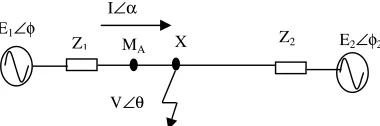
Before fault occurs, current I∠α flows in a loop from source 1 to source 2, assuming that E1 > E2. When fault occurs at point X, automatically fault impedance will be created as shown by Zf∠δf in Figure 2. In the figure, two loops will be created as well. The voltage at X is approaching zero and current I1, I2 and If will be developed. Current I1 flows from source E1∠φ, current I2 flows from source E2∠φ2 and If is the current through the fault impedance to the ground. The direction of current I1 is similar to the direction of current before I∠α since the currents flow from the same source E1 towards point X. If, impedance Z2 is much higher than the fault impedance Zf, therefore current I2≈ 0 and current from source E1 will flow towards akan Zf. Otherwise, current I2 will be seen as flowing from source E2 towards Zf. The concept of these directions of currents as either flowing from source E1 or E2 during fault will be employed to develop an indicator to locate the source of voltage sag in this paper.
A. Development of Current Component Index (CCI)
In this research steps taken to develop the Current Component Index (CCI) algorithm is based on the single line diagram in Fig. 3. In the figure, short circuit fault and the monitoring point is assumed to occur at point X and at MA respectively. The current before and after fault occurs will be considered and the current is assumed to flow from source E1 to source E2.
Before short circuit fault occurs at point X, employing Kirchoff Current Laws, current at MA is given by,
)
(
2 2 1 1
α
θ
φ
φ
α
−
∠
∠
−
∠
=
∠
T
Z
E
E
I
(2)From (2),
I
* is denoted as follows,T
T Z
E E
Z E E
I ( ) ( )
) (
) ( )
( 1 2 2 1 1 2 2
1 φ θ α φ θ α
α θ
φ φ
α = ∠− + − − ∠− + − −
− ∠
− ∠ − − ∠ = −
∠ (3)
Multiplying both sides of (3) by the voltage at the monitoring
V
∠
θ
and by considering the real part will yield,
T
Z VE VE
VIcos(θ−α)= 1cos(2θ−α−φ1)− 2cos(2θ−α−φ2) (4)
By dividing both sides of (4) with V, the current magnitude and its direction can be obtained as,
T
Z E E
[image:2.612.84.278.281.373.2]Icos(θ−α)= 1cos(2θ−α−φ1)− 2cos(2θ−α−φ2) (5) Figure 1 Double Source System, before fault occurs
Source 2 E2∠φ2
Source 1
E1∠φ1 Z∠δ
I∠α
[image:2.612.326.516.343.406.2]N
Figure 2 Double sources system During Fault E2∠φ2
E1∠φ1 Z1∠δ1
I1
N
Z2∠δ2
I2
If
Zf∠δf
Double Source System For Voltage Sag analysis and Monitoring Point at MB
MB
E1∠φ1 E2∠φ2
∠
XI∠α
Z1 Z2
Zf By employing (5), the current before fault at monitoring
point MA can be written as,
T
bf Z
E E
Icos(θ−α) = 1cos(2θ−α−φ1)− 2cos(2θ−α−φ2) (6)
Subsequently, by considering the impedance during fault as Z1, then at the monitoring point MA, the current component index is given as,
T
f
Z
E
I
cos(
θ
−
α
)
=
1cos(
2
θ
−
α
−
φ
1)
(7)Equation (7) is the current component during fault. By dividing (7) and (6) the following equation is obtained,
− − − − − − − = − − T bf f Z E E Z E I I ) 2 cos( ) 2 cos( ) 2 cos( ) cos( ) cos( 2 2 1 1 1 1 1 φ α θ φ α θ φ α θ α θ α
θ (8)
These angles φ1, φ2 are the double source angles whereas and α is the voltage and current angle at the monitoring point respectively. Assuming that R<<X these values are very small. It is commonly practiced that the source voltage angle is used as reference and approaching zero. Thus, the right hand side of (8) can be written and simplified as,
− = − = − − 1 2 1 1 2 1 1 1 ) cos( ) cos( Z Z E E E Z E E Z E I I T T bf f α θ α
θ (9)
Since normally the value of ZT > Z1 then
1
1>
Z
Z
T , and alsothat E1>E2 will yield
1
2 1 1>
−
E
E
E
, thus (9) can be written as,
1
)
cos(
)
cos(
>
−
−
bf fI
I
α
θ
α
θ
(10) Quotation Icos( - )f and Icos( - )bf is the current component index during fault (CCIf) and before fault (CCIbf) respectively. Therefore (10) can be written as.
CCI
f>
CCI
bf (11) From (11), it can be concluded that at the beginning of voltage sag, if the current is higher than the current before fault, i.e. CCIf>CCIbf, the source of voltage sag is located in front of the monitoring point.The following derivation is for the source of voltage sag behind the monitoring point. Figure 4 shows the fault at point X and the monitoring point is at MB.
In the case of the source of fault is behind the monitoring point, MB, current before the occurrence of the fault is from E1 to E2 and is given in (7). During the occurrence of the fault at point X, in which the value of Zf << Z2 the current will flow to the ground through fault impedance Zf, and thus current at the monitoring point MB is actually from the source E2 to the monitoring point X. Hence, the value of current from E2 to point X, is given as,
)
(
2 2 2α
θ
φ
α
−
∠
∠
=
∠
Z
E
I
(12)From (12),
I
* can be quoted as,2 2 2
2 2
2 ( )
) ( ) ( Z E Z E
I φ θ α
α
θφ
α = ∠− + −
− − ∠ − ∠ = −
∠ (13)
Multiplying both sides of (13) with the voltage at the monitoring
V
∠
θ
, and only consider the real part will yield,2 2
2cos( )
) cos(
Z VE
VI θ−α = θ−φ +θ−α (14)
By dividing both sides of (14) with V, the current component at the monitoring point MB is given as,
2 2
2cos(2 )
) cos( Z E I f φ α θ α
θ− = − − (15)
Equation (15) shows the current component at monitoring point MB generated from the source E2, in which obviously the value is negative hence flowing from E2 to X as compared to the positive value of current component before fault as shown in (6), which flows from E1 to E2. Quotation Icos( - )f and Icos( - )bf is the current component index during fault (CCIf) and before fault (CCIbf) occurs respectively. Therefore at monitoring point MB, at the beginning of voltage sag it can be shown that CCIf <CCIbf.
plot when the location of voltage sag source is in front of the monitoring point. On the hand, Figure 5b represents the plot when the location of voltage sag source is in behind the monitoring point. The beginning and end of the voltage sag is denoted by t1 and t2 respectively.
B. The Implementation Of The Current Component Index
The proposed method to locate the source of voltage sags is verified on a test distribution system modeled using an electromagnetic transient program PSCAD/EMTDC. The procedure implemented is as follows:
(i) Detect the beginning of the voltage sag.
(ii) Obtain the magnitude and phase of voltage and current from the measuring meter at pre-fault and during fault times.
(iii)Calculate the values of Icos(θ-α) for a few cycles of pre-fault and during fault durations.
(iv)Graphically plot coordinates of Icos(θ-α) against time of a few cycles of pre-fault and during fault durations. Check the polarity of Icos( - )bs and Icos( - )s at the beginning of fault. If CCIs < CCIbs then, the location of the source of voltage sag is behind the monitoring point. On the other hand if CCIs > CCIbs, the source of voltage sag is in front of the monitoring point.
III. TEST SYSTEM AND RESULTS
The test system used in this study is as shown in Fig. 6. The system is fed by a voltage source of 33kV, 15MVA and 3 kV, 7.5MVA at 50 Hz frequency. By referring to Fig. 6, three fault locations have been considered, which are FA, FB and FC, whereas the monitoring points are PCC, MA1, MA2, MB1 and MB2. Two types of faults have been simulated namely balanced and unbalanced faults. The three phase balanced faults have been simulated for about 0.3 seconds. On the other hand the unbalanced faults simulated are the single line fault (SLF) and double line fault (DLF).
A. Balanced Faults
By referring to Fig. 6, details of results from observation for the monitoring points and their respective fault location can be obtained. Table I presents the details of fault location and monitoring points simulated for the test system in Fig. 6.
TABLEI
DETAILS OF BALANCED FAULTS FOR A DOUBLE SOURCE SYSTEM
Fault
Location In front of fault location Behind fault location Monitoring points
FA PCC, MA1 MA2, MB1, MB2
FB PCC, MB1 MA1, MA2, MB2
FC - PCC, MA1, MA2,
MB1, MB2
Fig. 9 shows the plots of CCI against currents for monitoring points at MA1, MA2 and MB1 for balanced faults at point FA. In Fig. 9a), it can be seen at the beginning of voltage sag, the value of CCI before sag is higher than the value of CCI during sag, i.e, CCIs > CCIbs. This result indicates that the source of voltage sag is in front of the monitoring point. The results for the monitoring at points MA2 and MB1 are plotted in Fig. 7b) and c) show that at the beginning of voltage sag, CCIs < CCIbs. Both results show that the source of voltage sag is behind the monitoring points MA2 and MB1. These results are in a good agreement with the observation in Table I. Hence, it has been proven that the CCI can be used to locate the source of voltage sag.
Figure 8 Double source 13 bus system
PCC FC
FA FB MA1
MA2 MB2
MB1 1
2
3 4 5
6
9 7 8
1
13 12 11
Figure 7 Current Component Index For Double Source System a)In front of monitoring point b) Behind the monitoring
I c
os
(
θ
-α
)
t1 t2
Masa
CCIs>CCIbsa) t1 t2
Masa
b) CCIs <CCIbsI c
os
(
θ
-α
)
I
co
s
(
θ
-I c
os
(
θ
-0
[image:4.612.321.528.47.246.2]0
Figure 7 Results of CCI for Balanced Fault at FA with monitoring points at a) MA1 b) MA2 and c) MB1.
I c
os
(
θ
-α
)
(k
A
)
Time(s) a) CCI s > CCI bs
θ
I c
os
(
θ
-α
)
(k
A
)
CCI s < CCI bs
CCI s > CCI bs
I c
os
(
θ
-α
)
(k
A
)
Time(s) b)
a)
[image:4.612.319.545.599.683.2]The credibility of CCI algorithm has also been verified by applying a balanced fault at FB with monitoring points are at MB1, MB2 and MA1. Figure 8a shows CCIs > CCIbs. This result indicates that the source of voltage sag at FB is in front of the monitoring point , i.e. at MB1. On the hand, Figures 8b and 8c show that CCIs< CCIbs which indicate the source of voltage sag is behind the monitoring points. These results are also in good agreement with the observation in Table I, thus prove the credibility of the CCI in determining the source of voltage sag.
B. Unbalanced Faults
In this paper, results from unbalanced fault are also presented for various monitoring points of Fig. 6 to further verify the CCI algorithm. Table II presents the details of fault location and monitoring points simulated for the test system in Fig. 6. Two types of unbalanced faults are considered namely, Single line to ground fault (SLF) and double line to ground faults (DLF). Table II presents the details of unbalanced faults at FA, FB and FC. This information is then used to justify the accuracy of the simulation results using the CCI.
TABLEII
DETAILS OF UNBALANCED FAULTS FOR A DOUBLE SOURCE SYSTEM
Fault
Location In front of fault location Behind fault location Monitoring points
FA PCC, MA1 MA2, MB1, MB2
FB PCC, MB1 MA1, MA2, MB2
FC - PCC, MA1, MA2, MB1,
MB2
The results of unbalanced faults created at FA are presented and analyzed. In Fig. 9a), it can be seen at the beginning of voltage sag, the value of CCI before sag is higher than the value of CCI during sag, i.e, CCIs > CCIbs. This result indicates that the source of voltage sag is in front of the monitoring point. On the other hand results plotted for the monitoring points at MA2 and MB2 are shown in Fig. 9b) and c) respectively. Both results show CCIs < CCIbs. These results imply that the source of voltage sag is behind the monitoring points MA2 and MB2. By comparing the details observation in Table II, these results are correct.
C. Real data
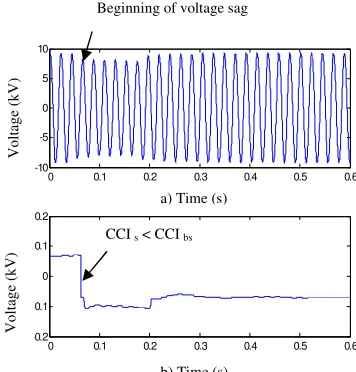
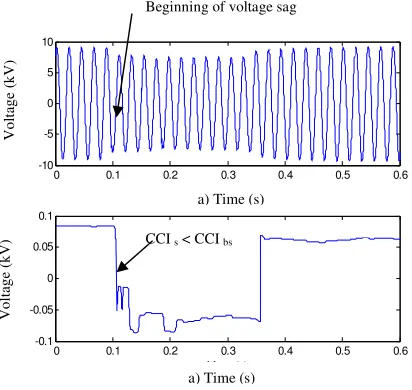
The CCI algorithm has also been verified using real data obtained from a utility. Figure 10a) and b) depict the voltage sag waveform and its respective CCI plot. In Fig. 10 a) at the beginning of the sag, t=0.07s it is observed that CCIs < CCIbs in which it indicates that the source of voltage sag is behind the monitoring point. This result is in aggreement with the information from the utility that the source of voltage sag is behind the monitoring point. Another sample of real data depicted in Figure 11 also shows that CCIs < CCIbs in which it indicates that the source of voltage sag is behind the monitoring point. This result also aggrees with the information obtained that the source of voltage sag is behind the monitoring point. Thus both real data have verified the validity of the CCI in determining as whether it is behind the monitoring point or vice versa.
Figure 10 a) Original Voltage sag waveform b) CCI plot
0 0.1 0.2 0.3 0.4 0.5 0.6
-10 -5 0 5 10
V
ol
ta
n
(k
v)
Masa (s)
0 0.1 0.2 0.3 0.4 0.5 0.6
-0.2 -0.1 0 0.1 0.2
Masa (s)
Beginning of voltage sag
I c
os
(
θ
-α
)
b a
a) Time (s)
b) Time (s)
V
ol
ta
ge
(k
V
)
V
ol
ta
ge
(k
V
) CCI s < CCI bs
Figure 8 Results of CCI for Balanced Fault at FB with monitoring points at a) MB1 b) MB2 and c) MA1.
I c
os
(
θ
-α
)
(k
A
)
Time (s) a)
CCI s > CCI bs θ θ
CCI s < CCI bs
CCI s < CCI bs
I c
os
(
θ
-α
)
(k
A
)
I c
os
(
θ
-α
)
(k
A
)
Time (s)
[image:5.612.74.291.164.262.2]b) Time (s) c)
Figure 9 Results of CCI for Unbalanced Fault at FA with monitoring points at a) MA1 b) MA2 and c) MB2.
θ θ θ
I c
os
(
θ
-α
)
(k
A
)
Time (s) a) CCI s > CCI bs
I c
os
(
θ
-α
)
(k
A
)
I c
os
(
θ
-α
)
(k
A
)
Time (s)
[image:5.612.329.507.409.595.2]IV. CONCLUSION
This paper has presented a new algorithm to locate the source of voltage as seen at the monitoring points by examining the value of the current component index (CCI) at the beginning of the voltage sag. From the results, it has been proven that the CCI satisfy 100% of the voltage sag source location for balanced and unbalanced faults for the double source system. The CCI algorithm also been verified using real data. The advantage of the CCI can be listed as follows:
• It only requires three parameters for calculations, namely the magnitude for current and the phase angles of voltage and current at the monitoring points.
• It has been proven to work well with both balanced and unbalanced faults in double source distribution system.
ACKNOWLEDGMENT
The authors would like to express heartiest appreciations to Universiti Teknologi MARA and its Research Management Institute for the support during the research. The authors also gratefully acknowledge Universiti Kebangsaan Malaysia (IRPA code 02-02-0014-EA188) for financial support on the project.
REFERENCES
[1] M. H. J. Bollen, “Voltage Sags in Three-Phase Systems”, IEEE Power Engineering Review, September 2001, pp.8-15, 17.
[2] M. H. J. Bollen, Understanding Power Quality Problems, IEEE Press, 2000, pp. 1-34.
[3] M. F. McGranaghan and D. R. Mueller, “Voltage Sags in Industrial systems”, IEEE Trans. On Industry Applications, Vol. 29, No. 2, March/April 1993, pp. 397-403.
[4] IEEE Std. 1159-1995: Recommended Practice for Monitoring Electric Power Quality, ISBN 1-55937-549-3.
[5] C. Li, T. Tayjasanant, W. Xu and X. Li, “ Method for voltage sag source detection by investigating slope of the system trajectory”, IEE Proc. Gener. Transm. Distrib., Vol. 150, No. 3, May 2003, pp. 367-372.
[6] A. C. Parsons, W. M. Grady, E. J. Powers and J. C. Soward, “A Direction Finder For Power Quality Disturbances Based Upon Disturbance Power and Energy”, IEEE Transactions On Power Delivery, Vol. 15, No. 3, July 2000, pp.1081-1086.
[7] W. Khong, X. Dong and Z. Chen, “Voltage Sag Source Location Based on Instantaneous Energy Detection, Proc. Of The 8th Int.
Power Engineering Conference 2007, 3-6 Dec 2007, pp. 90-94. [8] H. Liao, “ Voltage sag Source Location in High-Voltage Power
Transmission Networks”, Proc. IEEE Power and Energy Soceity General Meeting- Conversion and Delivery of Electrical Energy in the 21st Century, 20-24 July 2008, pp. 1-4.
[9] N. hamzah. A. Mohamed, A. Hussain, “Development of New Algorithm for Voltage Sag Source Location”, Proc. Int. MultiConference of Engineers and Computer Scientists 2009, 18-20 March 2009, pp. 1469-1474.
BIOGRAPHIES
N. Hamzah received her B.Eng. (Hon) and M.Sc. (Power System), from University of Wales Institute of Science and Technology, UK in 1988 and University of Malaya, Malaysia in 1993 respectively. She obtained a PhD in Electrical Engineering (Electrical and Electronics) from the Universiti Kebangsaan Malaysia in 2006. She is an associate professor at the faculty of Electrical Engineering, University Teknologi MARA, Malaysia. She is actively publishing technical papers in the national and international conferences and journals and also serves as referee internationally journal. Her research interests include power quality studies, application of advanced signal processing in power system and artificial neural network studies.
A. Mohamed received her B.Sc.Eng. from King’s College, University of London in 1978 and M.Sc. and PhD (Power System), from University of Malaya, Malaysia in 1988 and 1995, respectively. She is a professor at Universiti Kebangsaan Malaysia (UKM), Malaysia. Her current research interests are in power quality and other power system studies.
A. Hussain received her BSc. in Elect. Eng. Louisiana State University, USA, Sc in System and Control, UMIST, UK and PhD, Universiti Kebangsaan Malaysia (UKM) in 1985, 1989 and 1997, respectively. She is currently a professor at Universiti Kebangsaan Malaysia, Malaysia. Her research interests are signal processing, neural networks and their applications, which include power quality.
I c
os
(
θ
-α
)
a
b
0 0.1 0.2 0.3 0.4 0.5 0.6
-10 -5 0 5 10
V
ol
ta
n
(k
v)
Masa (s)
0 0.1 0.2 0.3 0.4 0.5 0.6
-0.1 -0.05 0 0.05 0.1
Masa (s)
Beginning of voltage sag
V
ol
ta
ge
(k
V
)
V
ol
ta
ge
(k
V
)
a) Time (s) a) Time (s)
Figure 11 a) Original Voltage sag waveform b) CCI plot
[image:6.612.74.280.68.263.2]