Reduce the Cycle Time of Galvanizing by applying
Kaizen Approach
Shantanu Patel1, Mr. Prashant khanna2, Mr. K.D.Bhavsar 3 1, 2, 3
PG Fellow, Production Engineering Dept. at Parul University
Abstract: Galvanization is the process of applying a protective zinc coating to steel or iron in order to prevent premature rust and corrosion. Proponents of galvanized steel, who may use it to construct or repair steel structures, for example, benefit from lower maintenance and repair costs because of its special properties Without protection, steel will rust due to atmospheric conditions over time.
Keywords: galvanizing, men power, housekeeping, kaizen approach
I. INTRODUCTION
galvanizing was known to the world from the beginning of 17th century. It is essential for iron and steel in protecting their life and
utility. Science and technology has developed the process of Hot Dip Galvanizing in the 18th century in USA. The first hot dip
galvanized iron sheets were imported to Australia in the 1850s.
II. GALVANIZING
Steps involved in process of galvanizing are listed as below
A. Loading: material is checked before galvanizing.
B. Degreasing bath: dust, oil grease etc. are removing in this bath by hot alkaline cleaner.
C. HCL bath: the material is dipped into HCL to remove rusting other impurities.
D. Dicromating bath: it creates a film on material to prevent from oxidation.
III. KAIZEN APPROACH
A. Area [1]: Workplace improvement of Galvanizing
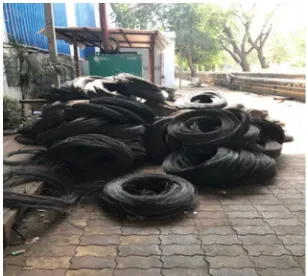
1) Idea: Prepare stand for wire bundle stacking Problem description: there is no proper system and provision for keeping wire bundle. This creates poor housekeeping, wastage of wire and handling issue. in manual loading the worker unload the wire bundle from the transport vehicle and keep the bundle improperly like one upon another in a random way, which is a wrong way. So when it needs to be use for galvanizing, the worker who goes to get the wire he will pick the above one. And due to this improper management of wire keeping and housekeeping will occur.
B. Area [2]: Kaizen result area, galvanizing
1) Idea: Replace wire with rod for hanging material on galvanizing jig
Problem description: There is higher wire consumption for galvanizing jig. Also facing issue with jig cleaning due to wire usage. It is also impacting on cycle time for material unloading and unloading on jig, after every process there will be zinc rust gathered on jig so it becomes very time consuming to clean up the zinc from the jig. And the wire is also not reusable. So after every process it will become scrap.
IV. FIGURES
Figure 1 shows, improper wire bundle staking after unloading from the truck. Figure 2 shows, rusted jig after removing from galvanizing pit.
Fig 1: improper wire bundle staking
Fig 2: rusted jig
Fig 3: scrap after process
V. LITERATURE SURVEY
A literature review surveys scholarly articles, books, dissertations, conference proceedings and other resources which are relevant to a particular issue, area of research, or theory and provides context for a dissertation by identifying past research. Various research papers were reviewed regarding my project "reduce the cycle time of galvanizing by applying kaizen approach" as follows.
evaluation session of kaizen ed is structured in two means: the personal evaluation process and the others evaluation process. s. In the former one, the students are expected to question their journey in the group work including what to study, if he/she has developed, what methods utilized. In the latter process, each person gets and receives nonjudgmental evaluation to each other. At the final part of the session, the evaluation about the group process are also discussed.
[2]Mohd Ghazali Maarof: He gave the research paper about, A Review of Contributing Factors and Challenges in Implementing Kaizen in Small and Medium Enterprises. He reviewed the Malaysian industries. Small and medium enterprises (SMEs) have played a major contribution to the development of Malaysian economy. SMEs accounted for the majority business entity in Malaysia. Based on the 2013 SME Malaysia annual report for instance, SMEs accounted for 98.5% of total number of firms in Malaysia. SMEs in Malaysia also contributed about 32.73% of national GDP and exported 19% of Malaysia total export value. The organization structure is another important factor that will affect Kaizen implementation outcome. A study that was conducted among the United States manufacturers indicated that only 11% of companies doing continuous improvements have considered their initiatives to be successful (Mendelbaum, 2006). Some organizations have failed to motivate their employees to participate in the Kaizen activities due to the absence of compensation or reward, lack of proper training for the employees and long delays in getting the suggestions processed (Robinson & Schroeder, 2004). The top management should develop a reward system that would recognize the effort done by their employees and managers to ensure Kaizen success (Imai, 1986). So basically the, Conclusion of the paper is ensuring a successful Kaizen implementation and its challenges. The above review indicates that factors such as communication between the top management and its employees, clear strategy, the need of a personnel who can champion the implementation of Kaizen in a company, having good knowledge and provide employees with certain level of empowerment are important to ensure a successful Kaizen implementation.
[3]Victor Emmanuel de Oliveira Gomes: Victor reviewed the topic A Proposal Simulation Method towards Continuous Improvement in Discrete Manufacturing. Basically A Simulation Method towards applying kaizen. Simulation is an experimental process which uses a detailed model of a real system to determine responses to changes caused in its structure, environments and boundary. A common problem faced by many companies looking to employ simulation tools into manufacturing process is to obtain the information that their users really need. In this context, the effective use of these tools is related to standardization of procedures of own corporate system. The kaizen process is one of these procedures already applied in many discrete manufacturing corporations and establishes an opportunity of obtaining standard information needed by simulation tools users and, consequently, their joint use can help employers adhere to use of simulation tools. Victor highlighted the importance of the use of simulation techniques applied to support the continuous improvement process. with the creation of a data base (with input and output data) for computational models, simulation processes to aid in modifying layouts will be faster and more efficient, and consequently improvement projects will be more effective.
[4]Miroslava Mĺkvaa, Vanessa Prajováa: Their research is about Standardization - one of the tools of continuous improvement. They said Standardization is a key element of lean manufacturing. The standardization process is considered the basis for continuous improvement (Kaizen). Improving standardized work is a never ending process. Every improvement and change in the manufacturing process is completed the development of standards. Without standards, there is improvement and management. The standards define best practices for the implementation of the work. The aim is to do the job right the first time without error, without negative effects on humans and the surroundings [2]. If you improve the standard, the new standard becomes the basis for further improvements etc. Miroslava and vanessa’s aim was, to highlight standardization as a tool useful in improving the organization. The benefits of standardized work include documentation of the current process for all shifts, reductions in variability, easier training of new operators, reductions in injuries and strain, and a baseline for improvement activities. The basic methods using standardization include 5S, Standardisation of processes, Visual management.
methods. In the competitive world, productivity is one of the key success factors. Among methods aimed at increasing productivity, we can cite lean management techniques (kanban, kaizen, 5S), quantitative methods such as operations research, the just-in-time concept, total productive maintenance (TPM) and much more. According to a survey conducted in Czech Republic, 94% of businesses assessed their own productivity, but 74% of them have evaluated only labor productivity. This is due to historical reasons, when human labor was the dominant resource. However, nowadays, labor costs represent only a small proportion of total costs. The intention of MACHEK was to analyze the differences in using TFP methods in these two paradigms and their causes and possible weaknesses and misinterpretation of results. Fortunately, TFP measures do not rely on the assumption of perfect competition. The differences between the TFP approach in regulated and non-regulated business arise from two reasons: the purposes of its use and the obtained results.
[7]Žaneta Rylková: her topic of paper was Performance measurement and management in Czech enterprises. Research was attended by 402 companies from the Czech Republic the research period was the year 2010. In terms of the distribution of the respondents there were 27% of large enterprises, 36% of medium-sized companies, 27% of small businesses and 10% were micro enterprises. Half of the respondents were focused on manufacturing activity, 30% of enterprises in services and 20% were commercial enterprises. Enterprises in the survey indicated that relevant reasons why to implement a system of performance measurement and management in the company are numerous. Strategic planning, controlling and motivating and rewarding are considered to be the most important. Up to 70% of Czech companies said that the results of performance evaluation are interconnected with the system of executive pay of managers. Often companies also stated that as the basis of the incentive system is used indicator EVA. 16% of enterprises thus linked remuneration system don´t have, but in the future it is planning. But as far as regular employees, there already is a job performance evaluation underestimated as a tool for increasing productivity and consequently competitiveness of the company. In order to be SMEs (small and medium sized enterprises) successful in innovation, they should have a clear idea what direction they will take, they should set goals for innovation, which they will attempt to achieve and after that they should create innovative strategies which can help them to implement and achieve innovation activities. Innovative strategies have be able to deal with complex and changing external environment. The performance measurement should include five main dimensions, namely financial dimension, the dimension of the market and customers, the dimension of processes, employee development dimension and dimension of standards for the future.
[8]Yen Ting, Yee Shee: Their topic was about, Internet of Things for Real-time Waste Monitoring and Benchmarking: Waste Reduction in Manufacturing Shop Floor. In today’s practice, many companies (e.g. SMEs) have limited waste monitoring system in manufacturing shop floor. So that they tried to research about the problem. This study starts with identification of waste generation of an entity, where the entity could be a machine, station, shop floor, site or factory that comes with a set of parameters. After the waste generation entity has been identified, the relevant process data will be collected for further analysis. The data can be collected directly from built-in sensors or attach additional sensors to get the critical process data. this study uses estimation method to generate input data and then correlate with output data which is calculated based on production data. Next, the data will be used as input data for Data Envelope Analysis (DEA) model for analysis. With the right set of data, DEA model able to calculate the relative efficiency complying with certain conditions . The efficiency values indicate waste performance of the entity, and it is classified using quartile. Besides, knowing the best efficiency values as reference, waste reduction potential can be determined. The work of this paper is one part of waste management system, thereby further research is necessary to make a complete solution. In order to transform the knowledge of waste status into action for improvement, root cause analysis is required to identify the faults or problems. Overall, with Internet connectivity and IT tool, a system view and integration of solution with the infrastructure enable waste management a success.
[10] Bianca Cirjaliu, Anca Draghici: their paper topic was Ergonomic Issues in Lean Manufacturing. s. The lean manufacturing system is complex and benefic but the possible changes can bring ergonomical issues. The nature of the problems is often felt by the human resources, the most important element in an organization. They presented a qualitative briefing and review in order to understand the evolution of lean implication. A literature synthesis on Lean Manufacturing includes,1) . Overview of lean manufacturing 2) . General delimitation of lean manufacturing tools. the impact of lean practices in workers’ safety can be an important issue, this impact has been neglected. There are also recent examples of the analysis of the relationship between safety and LPS. They have concluded that the differences between lean theory and lean practice, the employees needs for feedback and direct involvement in the company, stress reduction in lean manufacturing through reporting all misunderstandings, the inside collaboration between employees and managers. All this together represent an ergonomical perspective through Lean Manufacturing.
VI. RESEARCH GAP
From the literature survey, it was found that there is a scope to minimize the time of galvanizing process by implementing strategies like kaizen so that we get continuous improvement in work, along with reduced the time of cycle and improved communication between two stations and better flow path.
VII. OBJECTIVES AND SCOPE
A. Identify current issues in the process of galvanizing.
B. Applying proven approaches “kaizen” to reduce the issues.
C. Replace wire with rod(s.s rod) and eliminate usage of wire for material loading on jig. So, eliminate jig cleaning issue also. And approximately 8% of wastage will be reduce.
D. With the provision of stand, wire bundle stacking will be proper and improved housekeeping. Also, the issue of wire wastage due to improper stacking will be eliminated.
E. Improved housekeeping and arrangement of wire bundle. Eliminated wastage issues of wire due to improper stacking.
F. When we replace wire with rod then, benefits will be (approximately): 30 days= 56700 meters, 35kg/m, 1,17,482 for 10 gauge, 7541 for 14 gauge= 124480 per month, 15,00,000 per year 30,000(250 kg ss rod).
VIII. CONCLUSIONS
From the literature survey and practical observation, it has found that there is a scope to improvement in work place area of galvanizing, eliminate the usage of wire for material loading and also eliminate jig cleaning issue by applying kaizen strategy. By implementing strategies like kaizen so that we get continuous improvement in work, along with reduced the time of cycle and improved communication between two stations and better flow path.
REFERENCES
[1] department Cemrenur Topuz and Zeynep Arasan / Procedia - Social and Behavioral Sciences 84(2013 ) 1356 – 1360 [2] Mohd Ghazali Maarof and Fatimah Mahmud / Procedia Economics and Finance 35 ( 2016 ) 522 – 531
[3] Victor Emmanuel de Oliveira Gomes and Luis Gonzaga Trabasso / Procedia CIRP 57 ( 2016 ) 270 – 275 [4] Miroslava Mĺkvaa, Vanessa Prajováa / Procedia CIRP 68 ( 2016 ) 250 – 27
[5] J. Hambach et al. / Procedia CIRP 63 ( 2017 ) 330 – 33
[6] MACHEK Ondrej and HNILICA Jiri / Procedia - Social and Behavioral Sciences 57 ( 2012 ) 223 – 230 [7] Žaneta Rylková and Werner Bernatík / Procedia - Social and Behavioral Sciences 110 ( 2014 ) 961 – 96 [8] Yen Ting et al. / Procedia CIRP 61 ( 2017 ) 382 – 38
[9] Halvor Holtskog / Procedia CIRP 7 ( 2013 ) 575 – 57