124
©IJRASET: All Rights are Reserved
RGB Image Compression Algorithm using Error
Tolerant 2D Discrete Cosine System
Miss Surabhi Shukla1, Asst. Prof. Laxmikant Dewangan2
1
M.Tech. Scholar ECE Department, Chouksey Engineering College Bilaspur (CG)
2
Asst. Prof. ECE Department, Chouksey Engineering College Bilaspur (CG)
Abstract: This is the era of 3D and 4G technology where everyone is using smart phones and they need fast image or video processing on their smart phones. As we know when any image is capture so initially the size of image is very high which we can’t transfer to online so for that we need a compression unit which will reduce the size of the generated image and maintain the quality of that image. So or that there is lots of image compression process are there like JPEG, MPEG etc. On every compression unit there is basic building block is require which is DCT. DCT is an outstanding strategy utilized in video or picture pressure. DCT calculations are calculation escalated and include expansive number of augmentation and expansion activities. In this manner, with the expansion in number of length of the DCT, The number of duplication and expansion tasks additionally increment prompting high algorithmic time issue and execution debasement. The essential part of the 2-D DCT calculation is to process the DCT coefficients, where an extensive number of numerical calculations are required. In this work we will devolve a compression algorithm for RGB image where we are designing an error tolerant DCT system using the fixed bit logic. This system we will design by using of Matlab and quality analysis we be perform by using of PSNR, SSIM, FSIM, RFSIM, GMSD parameters. Here our main focus is to reduce the time complexity issue of previous existing algorithm.
Keywords: DIP, DCT, JPEG, MPEG, RGB.
I. INTRODUCTION
In show time, Multimedia has transformed into an organized some segment of every correspondence and the wellspring of information contains unrefined data as picture message, video's, etc. These constitute the surge of considerable proportion of data into arrange and along these lines impact the channel information exchange limit and consequence of it is, control need is more for hand-held contraption. An impressive parcel of sight and sound applications fundamentally oversee picture and video data, since human are more helpless towards pictures, or picture insight. To be sure, even with minimal quality degradation may not affect human perception with change objectives of picture. Picture data which is set up for correspondence primarily involvement with a couple of standards of Digital Image Processing (DIP) weight like JPEG (Joint Photographic Expert Group) , MPEG-x (Motion Picture Expert Group),... which begins critical part in the present data centered world. While Studying the Structures/Standards of Image/Video, the most prominent and enlisting part is Discrete Cosine Transform (DCT) and only depends for data weight and data flooding in the correspondence channel isolated from encoding and translating. DCT changes the banner or data as low to high repeat speeded in various territories for proposed square of data. The repeat is centered around the different corner of square. In this report, my prime spotlight is on the JPEG IP square. JPEG is abbr. as Joint Photographic Expert Group. This is an overall weight standard for still picture, may it be diminish or shading. The JPEG standard is joint exertion among the International Telecommunication Union (ITU), International Organization for Standardization (ISO), and International Electro specific Commission (IEC). Its official name is "ISO/IEC 10918-1 Digital pressure and coding of persistent tone still picture", and "ITU-T Recommendation T.81". JPEG have the accompanying methods of tasks:
1) Lossless mode: The picture is encoded to ensure correct recuperation of each pixel of unique picture despite the fact that the pressure proportion is lower than the lossy modes.
2) Sequential mode: It packs the picture in a solitary left-to-right, start to finish filter.
3) Progressive mode: It packs the picture in different outputs. At the point when transmission time is long, the picture will show from ill defined to clear appearance.
4) Hierarchical mode: Compress the picture at various goals so the lower goals of the picture can be gotten to first without decompressing the entire goals of the picture.
125
©IJRASET: All Rights are Reserved
quantization process. The progressive mode can utilize DCT based coding or prescient coding alternatively. The most generally utilized mode by and by is known as the pattern JPEG framework, which depends on consecutive mode, DCT-based coding and Huffman coding for entropy encoding. This paper is divided in 5 sections II literature review, III Research gap, IV Future Objectives V Conclusion.
II. LITERATUREREVIEW
A In this section we are talking about the all the previous existing approaches and what is error tolerance logic what are the benefits of that logic.
A. The Discrete Cosine Transform
Like diverse changes, the Discrete Cosine Transform (DCT) tries to de-relate the photo data. After de-relationship each change coefficient can be encoded unreservedly without losing weight efficiency. This region portrays the DCT and a part of its basic properties.
In reference to figure from introduction, remembering the true objective to achieve awesome weight execution, connection between's the shading parts is first lessened by changing over the RGB shading space into a de related shading space. In standard JPEG, a RGB picture is first changed into a luminance-chrominance shading space, for instance, YCbCr. The upside of changing over the photo into luminance-chrominance shading space is that the luminance and chrominance portions are especially de related between each other. Also, the chrominance channels contain much abundance information and can without a doubt be sub inspected without yielding any visual quality for the revamped picture. Since the eye is apparently more fragile at the luminance than the chrominance, luminance is taken in every pixel while the chrominance is taken as a medium impetus for a 2x2 square of pixels. Besides, thusly will result a good weight extent with no incident in visual perspective of the new inspected picture. To apply the DCT the photo is isolated into 8x8 squares of pixels. If the width or stature of the principal picture isn't divisible by 8, the encoder should make it separable. The 8x8 squares are set up from left-to-right and from topto-base. The purpose behind the DCT is to change the estimation of pixels to the spatial frequencies. These spatial frequencies are bounteously related to the level of detail appear in a photo. A high spatial repeat thinks about to raised measures of detail while a lower repeat identifies with cut down levels of detail.
126
©IJRASET: All Rights are Reserved
The matrix data's are rounded off to 2 decimal place[7]. [3] Has deals with optimization in multiplication, as reducing above matrix because of similarity, to a sequence of odd and even matrix.
The 1D-DCT transforms Image in one dimension, this can be extends to 2DDCT in similar fashion and the analysis is carried out provides that, component are arranged in increasing order of frequency. To archive for error resiliency/tolerant, Speed, Power, Area and Accuracy will be a challenging part to achieve, many a time trade-off scenario is observed[7].
A Dynamically Reconfigurable DCT Architecture for Maximum Image Quality Subject to Dynamic Power and Bit rate Constraints In this paper, a dynamically reconfigurable DCT architecture system is proposed that can be used to maximize image quality while meeting real-time constraints on bit rate and dynamic power. Optimal DCT architectures are computed using dynamic partial reconfiguration and are generated by varying both the number of non-zero DCT coefficients and the quality factor from the quantization table
In this the author have introduce dynamic partial reconfiguration controller which will have 64 bits stored according to the user requirement, the technique utilized is the clock gating for the defined coefficient path for bit-rate optimization and image quality.
B. Colour Image Compression Algorithm Based on the DCT Blocks
In This paper presents the performance of different block-based discrete cosine transform (DCT) algorithms for compressing colour image. In this RGB component of colour image are converted to YCbCr before DCT transform is applied. Y is luminance component; Cb and Cr are chrominance components of the image. The modification of the image data is done based on the classification of image blocks to edge blocks and non-edge blocks, then the edge block of the image is compressed with low compression and the non-edge blocks is compressed with high compression. The analysis results have indicated that the performance of the suggested method is much better, where the constructed images are less distorted and compressed with higher factor.
As we already know Compression unit is most import unit for the image and video processing system. According to previous existing algorithm there is following issues:
Time complexity: This is big hazard for every image compression techniques as we know nowadays we are living in the era of fast internet, and due to that there is online streaming of video is most popular part. On those case compression unit have the capability to compression information in less time.
Limited for Gray-scale Images: There are many DCT approaches available, but all those approaches are only based on gray-scale images, which is a big problem for current era. Memory, Complexity and Image quality these all are the research gap where we can focus and try to reduce those problems. To introduce an Error Acceptance DCT algorithm which can compete the existing algorithm by reducing the time complexity issue devolve a compression system for RGB image. Design, Implement & Validate DCT algorithm on different standards using an appropriate image processing parameter.
[image:3.612.59.554.532.718.2]Error Tolerant: Estimated circuit configuration is a plan logic where the traditional requirement of requiring 100% precision in circuits is loose. On a very basic level, this logic includes a fourth measurement of exactness to the present 3-dimensional circuit configuration space traversing around control utilization, region and deferral.[13]
127
©IJRASET: All Rights are Reserved
III.METHODOLOGY
In this section the methodology to overcome the research gaps are mentioned. Reducing the simulation time taken by JPEG unit, (DCT simulation time). To reduce the simulation time we adopt the error resilient technique in which the image quality at user end is decided as per the user.
Here we will design an novel algorithm which is based on truncate approach as we know for DCT coefficients there is need of 64 blocks means 8X8 matrix, but according to our proposed design there is no need to take all 64 blocks because some blocks are having to all information which will create complete image so there is no need to take all coefficients. According to proposed design we will take only 40 blocks. Now thus we will follow in our proposed algorithm:
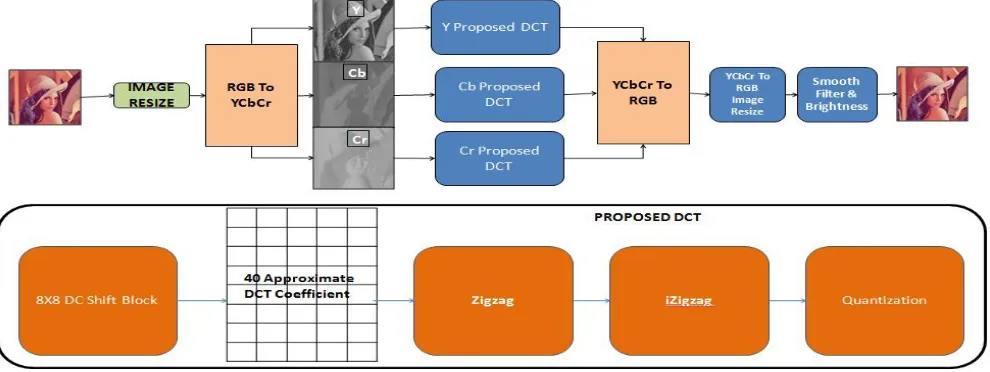
1) The input image can be read by using image read process and then broken into 8x8 block of matrixes.
2) The algorithm can be applied for resize the image into the small size so it will reduce the time complexity issue.
3) Apprly RGB to YCbCr process because we need to apply DCT on RGB image.
4) Apply total 40 coefficients on input image block. These coefficients are following and it follows the fixed bit logic.
Fixed Point Approx DCT
Approx DCT Coefficients
5) DCT is applied to each block on its both the rows and columns. Strassen’s matrix multiplication algorithm is applied on the DCT matrix multiplication calculation.
6) Each block is compressed by quantization. Suitably the quantization matrix is selected. They are standard matrices used in JPEG.
7) The array of compression blocks that constitute the image is stored in a significantly reduced amount of space.
8) The image is reconstructed through decompression using Inverse DCT.
9) After that process we again convert YCbCr image into RGB and convert in to original size
10) For quality improvement we use Gaussian smooth filter and brightness logic. Our proposed system we show on fig. 1.
IV.RESULTANDANALYSIS
In this section we will represent the comparative analysis between existing and proposed design. Here we will did both algorithm level and hardware level analysis. Algorithm level analysis is done on MATLAB tool.
Algorithm Level Analysis:
Here for algorithm analysis we use two test images which are:
1) Lena
We will apply our proposed and previous existing design on both test image and did comparative image quality analysis in terms of:
2) PSNR
3) SSIM
4) FSIM
5) GMSD
6) Time
128
©IJRASET: All Rights are Reserved
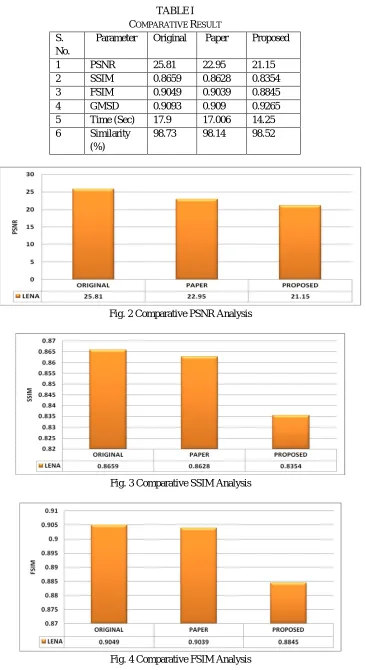
TABLE I COMPARATIVE RESULT S.
No.
Parameter Original Paper Proposed
1 PSNR 25.81 22.95 21.15
2 SSIM 0.8659 0.8628 0.8354
3 FSIM 0.9049 0.9039 0.8845
4 GMSD 0.9093 0.909 0.9265
5 Time (Sec) 17.9 17.006 14.25
6 Similarity
(%)
98.73 98.14 98.52
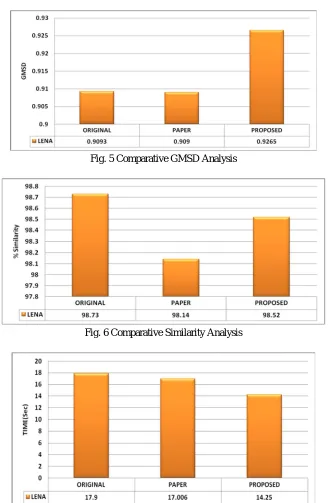
Fig. 2 Comparative PSNR Analysis
[image:5.612.131.497.72.742.2]Fig. 3 Comparative SSIM Analysis
129
[image:6.612.148.476.67.570.2]©IJRASET: All Rights are Reserved
Fig. 5 Comparative GMSD Analysis
Fig. 6 Comparative Similarity Analysis
Fig. 7 Comparative Time Analysis
So as per our result analysis we can see that generated image from our proposed approach is quite good in terms of time complexity and it also did proper justice with all image quality parameters.
V. CONCLUSION
130
©IJRASET: All Rights are Reserved
REFERENCES
[1] Jin Zeng; Au, O.C.; Wei Dai; Yue Kong; Luheng Jia; Wenjing Zhu, "A tutorial on image/video coding standards," Signal and Information Processing Association Annual Summit and Conference (APSIPA), 2013 Asia-Paci_c , vol., no., pp.1,7, Oct. 29 2013-Nov. 1 2013
[2] Yuebing Jiang; Pattichis, M., "Dynamically recon_gurable DCT architectures based on bitrate, power, and image quality considerations," Image Processing (ICIP), 2012 19th IEEE International Conference on ,Sept. 30 2012-Oct. 3 2012
[3] Jongsun Park; Jung-Hwan Choi; Roy, K., "Dynamic Bit-Width Adaptation in DCT: An Approach to Trade O_ Image Quality and Computation Energy,"Very Large Scale Integration (VLSI) Systems, IEEE Transactions on , May 2010
[4] Wei Zheng; Yanchang Liu, "Research in a fast DCT algorithm based on JPEG," Consumer Electronics, Communications and Networks (CECNet), 2011 International Conference on , 16-18 April 2011
[5] Emre, Y.; Chakrabarti, C., "Data-path and memory error compensation technique for low power JPEG implementation," Acoustics, Speech and Signal Processing (ICASSP), 2011 IEEE International Conference on , 22-27 May 2011
[6] Whatmough, P.N.; Das, S.; Bull, D.M.; Darwazeh, I., "Circuit-Level Timing Error Tolerance for Low-Power DSP Filters and Transforms," Very Large Scale Integration (VLSI) Systems, IEEE Transactions on , June 2013
[7] Gupta, V.; Mohapatra, D.; Raghunathan, A.; Roy, K., "Low-Power Digital Signal Processing Using Approximate Adders," Computer-Aided Design of Integrated Circuits and Systems, IEEE Transactions on , Jan. 2013
[8] De Silva, A.M.; Bailey, D.G.; Punchihewa, A., "Exploring the implementation of JPEG compression on FPGA," Signal Processing and Communication Systems (ICSPCS), 2012 6th International Conference on , 12-14 Dec. 2012.
[9] Kitsos, Paris; Voros, Nikolaos S.; Dagiuklas, Tasos; Skodras, Athanassios N., "A high speed FPGA implementation of the 2D DCT for Ultra High Definition video coding," Digital Signal Processing (DSP), 2013 18th International Conference on , 1-3 July 2013
[10] Emre, Y.; Chakrabarti, C., "Energy and Quality-Aware Multimedia Signal Processing," Multimedia, IEEE Transactions on , Nov. 2013
[11] Karakonstantis,G.; Banerjee, N.; Roy K.,"Process-Variation Resilient and Voltage-Scalable DCT Architecture for Robust Low-Power Computing," IEEE Transactions on Very Large Scale Integration (VLSI) Systems, 2010.
[12] Zhou Wang; Bovik, A.C.; Sheikh, H.R.; Simoncelli, E.P., "Image quality assessment: from error visibility to structural similarity," Image Processing,IEEE Transactions on , vol.13, no.4, pp.600,612, April 2004 doi:10.1109/TIP.2003.819861
[13] Lin Zhang; Zhang, D.; Xuanqin Mou, "RFSIM: A feature based image quality assessment metric using Riesz transforms," Image Processing (ICIP), 2010 17th IEEE International Conference on , vol., no., pp.321,324, 26-29 Sept.2010
[14] Lin Zhang; Zhang, D.; Xuanqin Mou; Zhang, D., "FSIM: A Feature Similarity Index for Image Quality Assessment," Image Processing, IEEE Transactions on , vol.20, no.8, pp.2378,2386, Aug. 2011
[15] Xue, W.; Zhang, L.; Mou, X.; Bovik, A., "Gradient Magnitude Similarity Deviation: A Highly E_cient Perceptual Image Quality Index," Image Processing, IEEE Transactions on , vol.PP, no.99, pp.1,1