Image Watermarking Algorithm of Embed &
Extraction for RGB Noisy Images Using SVD, DCT,
Arnold Transform & Error Acceptance Gabor
Filter for Copyright Protection
Shweta Singh Rathore1, Vivek Singh Rathore2 1, 2
Department of Computer Science & Engineering, Chouksey Engineering College
Abstract: We are living in the age of advance technology where we are talking about the nanotechnology. As we know this era needs fast processing systems which can be perform any task in very short time. Now if we are talking about the current era so there is a most important issue is there which is pilgrims , there is lots of content which is easily copied from internet and user represent those work as there own work. We also know currently we are living in web era where anything can be copy in a few seconds. There is lots of algorithms are available which are able to protect the content but all those algorithms are not in terms of noise effect on RGB color image. So in this paper basically we present an system which is able to resolve the issue of copy right with reduction in noise issue. According to our proposed approach we are basically using the error tolerant approach according to this approach we will not utilize the complete system we are using only those apart which are require rest we simply truncate. According to our proposed approach basically we design an algorithm which will take the input RGB nosiy image and for reduction of noise we will use error acceptance DWT filter. Now as per the image water ,marking we proposed two more process which are embed & extract process to complete this process we proposed one more error acceptance based algorithms which is Arnold transform. Here we are also using Arnold algorithm but that Arnold algorithm is accurate one. Here we also discuss the applications and need of the digital watermarking applications.
Keywords: Error Tolerant, DWT, Algorithm, FLOW, Communication, Latency, Watermarking.
I. INTRODUCTION
the off chance that the watermark is same, at that point result is verified information. Amid the sending of the watermarked information on system, the aggressor may have decimate the information, if any adjustments in the information is distinguished by contrasting the separated watermark and the first watermark. Watermarking procedure have two fundamental properties indistinctness and heartiness. On the off chance that we can't recognize have picture and watermarked picture, at that point this is called impalpability. Indistinctness relies upon comparability between the host picture and watermarked picture. Then again heartiness estimates the trouble in expelling or decimating watermark from watermarked picture. In this paper we proposed an advanced watermarking strategy dependent on DWT, DCT and SVD change. These plans give a decent subtlety and high heartiness against different sorts handling assaults. The remainder of the paper centers around review of Transforms for watermarking plans, gives the subtleties of proposed watermarking calculations, and gives advancement parameters and trial results.The rest of the paper is organized as follows. Necessary background and underlying principle on watermarking is given in Section II whereas Section III describes proposed methodology & Implementation details. Experimental results and its analysis are given in Section V. Finally, Section VI concludes the paper.
II. LITRECTUREREVIEW
A. Latency Complexity
B. Accuracy on watermark algorithm
C. Watermarking Level is low
D. Quality Complexity after extraction watermark image
III.PROPOSEDMETHADOLOGY&IMPLIMENTATION
In this section we discuss about the implementation details of previous existing work and our proposed work. Here we implement the multiple previous existing work which are base on DWT, DCT, SVD, Arnold Transform etc. Here are those previous existing approaches:
1) DWT Based Embed & Extract
2) DWT SVD Based Embed & Extract
3) DWT SVD DCT Based Embed & Extract
4) DWT ARNOLD Based Embed & Extract
5) LSB Based Embed & Extract
6) Proposed Error Acceptance DWT DCT SVD Arnold Based Embed & Extract:
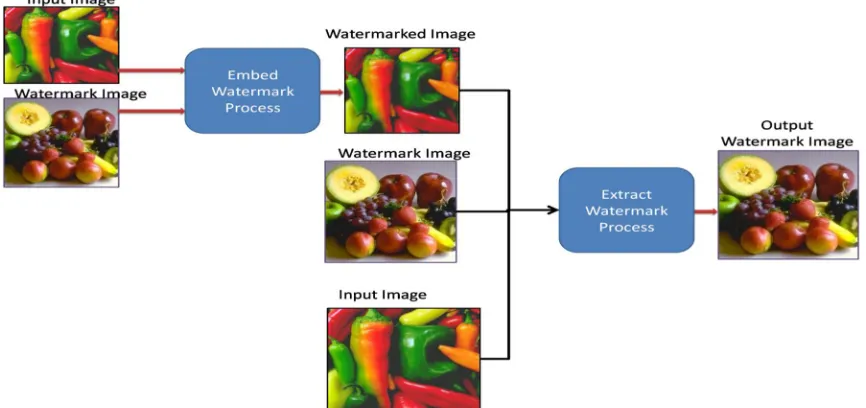
According to our proposed approach basically we design a system which is able to handle the noisy images as a input and generate a good quality result. As per our proposed approach for embed watermarking we performs followings steps which are followings:
a) Task perform on Input image like Resize, RGB to YCbCr , DWT, Arnold & SVD.
b) Task perform on watermark image like Resize , RGB to YCbCr , DWT, SVD, Error acceptance Gabor Filter generated results watermark image
[image:4.612.43.556.315.715.2]c) Watermark image extraction using SVD, DWT
Fig. 3.2 Block Diagram of Proposed Copy right Water marking process
IV.RESULTANALYSIS
In this section we present the comparative study about our proposed approach with all different type of existing approach. Here we will use some existing scientific parameter which will prove proper justification for our proposed approach. Those parameters are:
A. PSNR
B. SSIM
C. FSIM
D. RFSIM
E. Correlation
F. Similarity (%)
G. Time Complexity
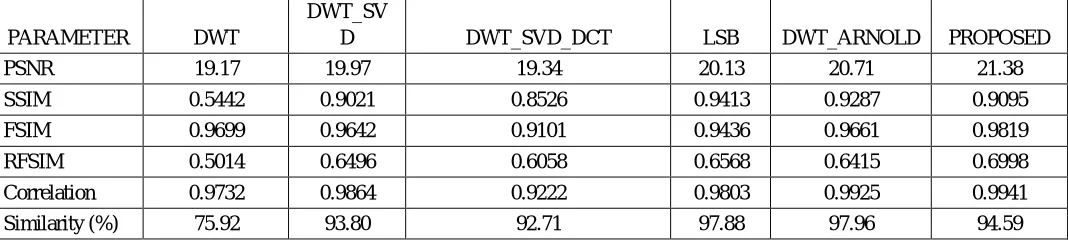
According to table 4.1 we can see the comparative analysis between all those parameters. As we can see our proposed approach is far better than all previous existing approaches. Our proposed approach is make proper justification with image quality and also with the time complexity. According to fig. 4.1 is shows the comparative analysis in terms on of time complexity as we know for any application time complexity is a main barrier , our proposed approach have approximately double time improvement as compare to Arnold transform based watermarking technique. Similar our proposed approach also show a very good improvement over LSB techniques.
Table 4.1 Image Quality Comparison in proposed and previous existing approaches for generated water marked image
PARAMETER DWT DWT_SVD DWT_SVD_DCT LSB DWT_ARNOLD PROPOSED
PSNR 15.91 16.84 19.34 20.13 21.03 19.62
SSIM 0.5442 0.568 0.6426 0.6213 0.5937 0.6812
FSIM 0.8595 0.878 0.9201 0.9036 0.8956 0.9202
RFSIM 0.0715 0.3534 0.6158 0.4668 0.4691 0.4692
Correlation 0.9361 0.9578 0.9422 0.9603 0.9601 0.9878
Similarity (%) 69.58 91.79 96.71 97.48 97.96 93.23
[image:5.612.49.564.575.703.2]Table 4.2 Image Quality Comparison in proposed and previous existing approaches for generated water mark image
PARAMETER DWT
DWT_SV
D DWT_SVD_DCT LSB DWT_ARNOLD PROPOSED
PSNR 19.17 19.97 19.34 20.13 20.71 21.38
SSIM 0.5442 0.9021 0.8526 0.9413 0.9287 0.9095
FSIM 0.9699 0.9642 0.9101 0.9436 0.9661 0.9819
RFSIM 0.5014 0.6496 0.6058 0.6568 0.6415 0.6998
Correlation 0.9732 0.9864 0.9222 0.9803 0.9925 0.9941
Similarity (%) 75.92 93.80 92.71 97.88 97.96 94.59
Similar we can see on watermark extract result our proposed approach perform well in terms of others parameters.
V. CONCLUSIONS
As per current innovation future is completely founded on virtual world. At the present time everything depends on online like shopping, films, pictures, trainings estimated time of arrival. So for these sort of use there is need of some other steady framework which are known as communitarian framework, organizing, Internet of things and so forth now every one of these frameworks depend on some scientific capacities which are known as trigonometric capacity. In this work basically we present a new algorithm which is based on the concept of error acceptance. Here we present the complete watermarking approach which ibsaically combination of two main process embed & extract. Here we also proposed a new Gabor filter for the filtering process aprt from that we use Arnold transformation, SVD, DCT and DWT with addition of resize, rgb to ycbcr As we can see according o result we are far better than with previous existing technique. Here we also reduce the noisy issues for RGB image. In future our proposed algorithm can be convert into the architecture level.
REFERENCES
[1] Gorodetski V.I., Popyack L.J., Samoilov V.” SVD-BasedApproach to Transparent Embedding Data into Digital Images”,Proceedings of International Workshop onMathematical Methods, Models and Architectures for Computer Network Security(MMM-ACNS01),
[2] St.Petersburg,Russia (2001) ,pp.263-274. Bao, P. and Ma, X.”Image Adaptive Watermarking UsingWavelet Domain Singular Value Decomposition”, IEEE Transactions on Circuits and Systems for Video Technology,Vol. 15, No. 1 (2005) ,pp.96-102.
[3] Quan, L. and Qingsong, A.”A Combination of DCTBased and SVD-Based Watermarking Scheme” ,Proceedings of 7th International Conference on Signal Processing (ICSP04), Vol. 1 (2004) ,pp.873-876.
[4] Ganic E. and Eskicioglu A.M.”Robust DWT-SVD Domain Image Watermarking:Embedding Data in All Frequencies”,Proceedings of the ACM Multimedia and Security Workshop (MM&SEC04) Magdeburg, Germany (2004) ,pp.166-174.
[5] Liu, R. and Tan, T.”An SVD-Based Watermarking Scheme for Protecting Rightful Ownership”,IEEE Transactions on Multimedia, Vol. 4, No. 1 (2002), pp.121- 128..
[6] Shiva, M.G.; D’Souza, R.J.; Varaprasad, P. Digital signature-based secure node disjoint multipath routingprotocol for wireless sensor networks. IEEE Sens. J. 2012, 12, 2941–2949.
[7] Chain, K.; Kuo, W.C. A new digital signature scheme based on chaotic maps. Nonlinear Dyn. 2013, 74, 1003–1012. [CrossRef]
[8] Asifullah, K.; Ayesha, S.; Summuyya, M.; Sana, A.M. A recent survey of reversible watermarking techniques. Inf. Sci. 2014, 279, 251–272.
[9] Ritu, J.; Munesh, C.T.; Shailesh, T. Digital audio watermarking: A survey. In Proceedings of the International Conference on Computer, Communication and Computational Sciences, Ajmer, India, 12–13 August 2016; Volume 554, pp. 433–443.
[10] Asikuzzaman, M.; Mark, R.P. An overview of digital video watermarking. IEEE Trans. Circuits Syst. Video Technol. 2017. [CrossRef]
[11] Su, Q.T.;Wang, G.; Lv, G.H.; Zhang, X.F.; Deng, G.L.; Chen, B.J. A novel blind color image watermarking based on contourlet transform and Hessenberg decomposition. Multimed. Tools Appl. 2017, 76, 8781–8801. [CrossRef]
[12] Singh, D.; Singh, S.K. DWT-SVD and DCT based robust and blind watermarking scheme for copyright protection. Multimed. Tools Appl. 2017, 76, 13001– 13024. [CrossRef]
[13] Mehta, R.; Rajpal, N.; Vishwakarma, V.P. A robust and efficient image watermarking scheme based onLagrangian SVR and lifting wavelet transform. Int. J. Mach. Learn. Cybern. 2017, 8, 379–395. [CrossRef]
[14] Makbol, N.M.; Khoo, B.E.; Rassem, T.H.; Loukhaoukha, K. A new reliable optimized image watermarking
[15] scheme based on the integer wavelet transform and singular value decomposition for copyright protection.Inf. Sci. 2017, 417, 381–400. [CrossRef]
[16] Rasti, P.; Anbarjafari, G.; Demirel, H. Colour image watermarking based on wavelet and QR decomposition. In Proceedings of the 25th Signal Processing and Communications Applications Conference, Antalya, Turkey, 15–18 May 2017.
[17] Castiglione, A.; De Santis, A.; Pizzolante, R.; Castiglione, A.; Loia, V.; Palmieri, F. On the protection of fMRI images in multi-domain environments. In Proceedings of the 29th IEEE International Conference on Advanced Information Networking and Applications, Gwangju, Korea, 25–27 March 2015; pp. 476– 481.
[19] Fazli, S.; Moeini, M. A robust image watermarking method based on DWT, DCT, and SVD using a new technique for correction of main geometric attacks. Optik 2016, 127, 964–972. [CrossRef]
[20] Lutovac, B.; Dakovi´c, M.; Stankovi´c, S.; Orovi´c, I. An algorithm for robust image watermarking based on theDCT and Zernike moments. Multimed. Tools Appl. 2017, 76, 23333–23352. [CrossRef]
[21] Yang, H.Y.;Wang, X.Y.; Niu, P.P.;Wang, A.L. Robust color image watermarking using geometric invariant quaternion polar harmonic transform. ACM Trans. Multimed. Comput. Commun. Appl. 2015, 11, 1–26.[CrossRef]
[22] Zhang, Y.P.; Wang, C.Y.; Wang, X.L.; Wang, M. Feature-based image watermarking algorithm using SVD and APBT for copyright protection. Future Internet
2017, 9, 13. [CrossRef] Appl. Sci. 2018, 8, 410 19 of 19
[23] Ye, X.Y.; Chen, X.T.; Deng, M.; Wang, Y.L. A SIFT-based DWT-SVD blind watermark method against geometrical attacks. In Proceedings of the 7th International Congress on Image and Signal Processing, Dalian, China, 14–16 October 2014; pp. 323–329.
[24] Lee, H.; Kim, H.; Lee, H. Robust image watermarking using local invariant features. Opt. Eng. 2006,45, 535–545.
[25] Luo, H.J.; Sun, X.M.; Yang, H.F.; Xia, Z.H. A robust image watermarking based on image restoration using SIFT. Radio Eng. 2011, 20, 525–532.
[26] Lyu,W.L.; Chang, C.C.; Nguyen, T.S.; Lin, C.C. Image watermarking scheme based on scale-invariant feature transform. KSII Trans. Internet Inf. Syst. 2014, 8, 3591–3606.
[27] Thorat, C.G.; Jadhav, B.D. A blind digital watermark technique for color image based on integer wavelet transform and SIFT. Procedia Comput. Sci. 2010, 2, 236–241. [CrossRef]
[28] Pham, V.Q.; Miyaki, T.; Yamasaki, T.; Aizawa, K. Geometrically invariant object-based watermarking using Proceedings of the 13th International Conference on Intelligent Information Hiding and Multimedi Signal Processing, Matsue, Shimane, Japan, 12–15 August 2017; pp. 381–389
[29] Satyanarayana Murty P. and Rajesh Kumar P “TOWARDS ROBUST REFERENCE IMAGE WATERMARKING USING DWT- SVD AND EDGE DETECTION” International Journal of Computer Applications (0975 – 8887) Volume 68– No.9, April 2013
[30] Wang, Chengyou, Yunpeng Zhang, and Xiao Zhou. "Robust image watermarking algorithm based on ASIFT against geometric attacks." Applied Sciences 8.3 (2018): 410.
[31] SIFT feature. In Proceedings of the 14th IEEE International Conference on Image Processing, San Antonio, TX, USA, 16–19 September 2007; Volume 5, pp. 473–476.
[32] Zhang, L.; Tang, B. A combination of feature-points-based and SVD-based image watermarking algorithm. In Proceedings of the International Conference on Industrial Control and Electronics Engineering, Xi’an, China, 23–25 August 2012; pp. 1092–1095.
[33] Nam, S.H.; Kim, W.H.; Mun, S.M.; Hou, J.U.; Choi, S.; Lee, H.K. A SIFT features based blind watermarking for DIBR 3D images. Multimed. Tools Appl.
2017, 1–40. [CrossRef]