©IJRASET: All Rights are Reserved
293
Leaf Texture Feature Extraction using GLCM and
GLRLM Approaches
Prof. Mrs. K. ChandraPrabha
1, M. Pon Aruvi
21Associate Professor & Head, 2PG Student, Department, Department of Computer Science & Engineering, ACGCET, Karaikudi,
Tamil Nadu.
Abstract: The proposed system starts with Collection of various plant images. Images capture from DSLR camera. Various shape of leave images stored as dataset. To extract texture features, apply GLCM (Grey Level Co-occurrence Matrix) methods to extract texture features such as Autocorrelation, Contrast, correlation, Dissimilarity Energy and Entropy and GLRLM (Grey Level Run Length Matrix) methods to extract texture features such as Grey level Non-Uniformity (GNU), Long Run Emphasis(LRE), Short Runs Emphasis(SRE), Run Length Non-Uniformity(RLNU). The classified using (K-Nearest Neighbours) KNN Method. It has 2 phases such as Training phase and testing phase. In Training phase, texture features are extracted from a given set of training images. In testing phase given test image texture feature is extracted and classify the results. Compare the GLCM and GLRLM accuracy level with existing system. Application of the project is less computation task and efficiently used for siddha leaf Recognition and homoeopathy.
Keywords: Image Capture, GLCM, GLRLM, KNN, Classification.
I. INTRODUCTION
Image processing is a method to convert an image into digital form and perform some operations on it, in order to get an enhanced image or to extract some useful information from it. It is a type of signal dispensation in which input is image, like video frame or photograph and output may be image or characteristics associated with that image. Usually Image Processing system includes treating images as two dimensional signals while applying already set signal processing methods to them. It is among rapidly growing technologies today, with its applications in various aspects of a business. Image Processing forms core research area within engineering and computer science disciplines too.Image processing basically includes the following three steps.
1) Importing the image with optical scanner or by digital photography.
2) Analyzing and manipulating the image which includes data compression and image enhancement and spotting patterns that are not to human eyes like satellite photographs.
3) Output is the last stage in which result can be altered image or report that is based on image analysis.
A. Purpose of Image Processing
The purpose of image processing is divided into 5 groups. They are: 1) Visualization - Observe the objects that are not visible.
2) Image sharpening and restoration - To create a better image. 3) Image retrieval - Seek for the image of interest.
4) Measurement of pattern – Measures various objects in an image. 5) Image Recognition – Distinguish the objects in an image.
[image:1.595.205.380.589.735.2]II. METHODOLOGY
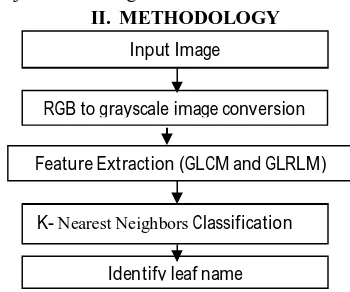
Fig. 1 Block Diagram of the Leaf Reorganization System Input Image
RGB to grayscale image conversion
Feature Extraction (GLCM and GLRLM)
K- Nearest Neighbors Classification
©IJRASET: All Rights are Reserved
294
A. Image Acquisition
In image acquisition module capture the image from DSLR camera. The images are RGB images. Plants have become an important source of energy, and are a fundamental piece in the puzzle to solve the problem of global warming. There are several diseases that affect plants with the potential to cause devastating economical, social and ecological losses. In this context, diagnosing diseases in an accurate and timely way is of the utmost importance. There are several ways to detect plant pathologies. Some diseases do not have any visible symptoms associated, or those appear only when it is too late to act. In those cases, normally some kind of sophisticated analysis, usually by means of powerful microscopes, is necessary. In other cases, the signs can only be detected in parts of the electromagnetic spectrum that are not visible to humans. An common approach in this case is the use of remote sensing techniques that explore multi and hyper spectral image captures. The methods that adopt this approach often employ digital image processing tools to achieve their goals. Read input image from a dataset images. Convert from RGB to gray image. The images stored in mat file function.
I= imread( );
B. Training Dataset
The conventional image to feature extraction Stored as a folder formatting. The training image similarly classified a result. Training image is performed to identify leaf pixels and background pixels. After holes have been closed and small image is converted to binary and the interior of the leaf is subtracted, leaving an image of the leaf’s outline contour. To implement the training dataset convert RGB image to gray image and remove the noises from images. The goal of conventional image is
1) Convert RGB images into grey scale images. 2) Using rgb2gray (variable name).
I=rgb2gray (I);
C. Feature Extraction
GLCM and GLRLM methods are used to extract texture feature. These features are applied as inputs to the Artificial Neural Network Algorithm GLCM and GLRLM contains the second-order statistical information of spatial relationship of pixels of an image. Texture feature calculations use the contents of the GLCM to give a measure of the variation in intensity at the pixel of interest. In computing GLCM and GLRLM of an image two parameters Offset and Distance d between pixels are considered. Here, offset represents the direction of pairing pixels. For example, with 0 offset and d = 1 represents pairing horizontally adjacent elements. In this paper d = 1 and four offsets 0, 45, 90, and 135 are considered. The Offsets 45, 90 and 135 are obtained by pairing the right diagonal elements, vertically upward elements and left diagonal elements respectively. Most of the texture calculations are weighted averages of the normalized symmetrical GLCM cell contents. Contrast (Con): Contrast is a measure of intensity or gray-level variations between the reference pixel and its neighbor. GLCM is implemented on all the training images, from which texture features of each and every training image are obtained. KNN is implemented on those values of the training image set.GLCM (Gray Level Co-occurrence Matrix) measures the join probability of occurrence of the specified pixel pairs. GLCM can be calculated using the multiple spatial offset directions is 0 degree, 45 degree, 90 degree and 135 degree. Once GLCM matrix is obtained extract its features and to stored it.Used to extract the texture features such as Contrast, Correlation , Homogeneity, Energy. The GLCM feature extraction for image pixel calculation using multiple offset directions. Various type of leaves image recognition is training datasets. The various pixel size and direction of image calculating GLCM feature.
TABLE I
FEATURE EXTRACTION
Features GLCM GLRLM
©IJRASET: All Rights are Reserved
295
1) GLCM
a) Contrast: The contrast is degree of image difference grayness. Various degree direction calculation of contrast feature in GLCM method.
Contrast = ∑ ∑( − ) ( , ) (1)
b) Correlation: The correlation is difference of neighboring image pixels. Neighboring image pixel is calculating the feature extraction for GLCM method.
Correlation = ∑ ∑ ( , ) µ (2).
c) Homogeneity: The homogeneity is degree of pixel repeated in grayness. Image pixel repeated in matrix calculation for the GLCM matrix components. Homogeneity image pixel is calculating the training dataset images.
Homogeneity = ∑ ∑ ( , )
| | (3)
D. Classification
The conventional method of leaf classification involves two main steps. The first step is obtaining a priori knowledge of each class to be recognized. Normally this knowledge encompasses some sets of texture feature of one or all of the classes. Once the knowledge is available and texture feature of the observed image are extracted, then classification techniques, for example nearest neighbors and decision trees, can be used to make the decision that is the second step. Such a procedure is illustrated the tasks that texture classification has been applied to include the classification of plant leaves images. Currently there are a huge number of texture feature extraction methods available and most of the methods are associated with tunable parameters. It is difficult to find the most suitable. Patten recognition, the k-nearest neighbors Algorithm (k-NN) is a non-parametric method used for classification and regression.
In both cases, the input consists of the k closest training examples in the feature space. Compare the texture Features values of training and testing image. Classify the leaf recognition using (K-Nearest Neighbours) KNN method according to the result of comparison.
1) Euclidean Distance,
d(x - y)= √∈( − )
where, d => distance data test to the data sample xi => data test i, with i= 1, 2, …,n
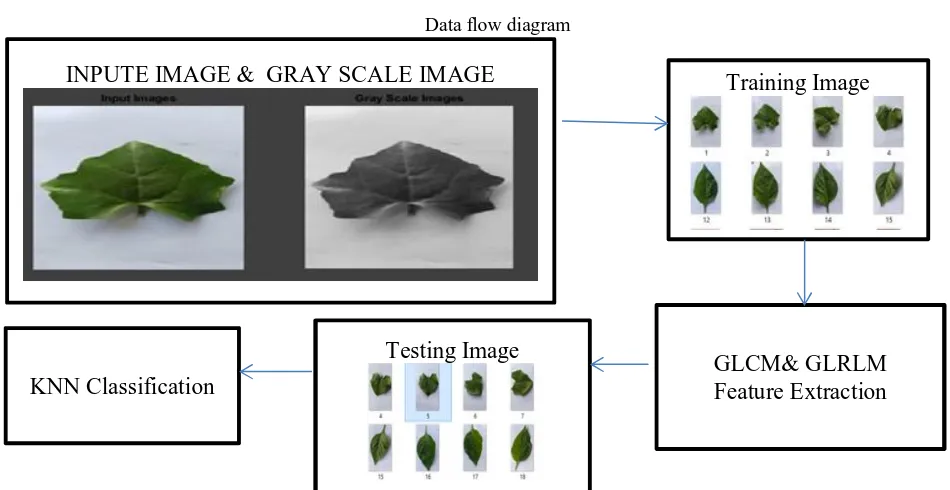
[image:3.595.49.524.491.736.2]Data flow diagram
Fig. 2 Architecture of the k-nearest neighbors
INPUTE IMAGE & GRAY SCALE IMAGE
Training Image
GLCM& GLRLM
Feature Extraction
Testing Image
©IJRASET: All Rights are Reserved
296
III.RESULTANDDISCUSSION
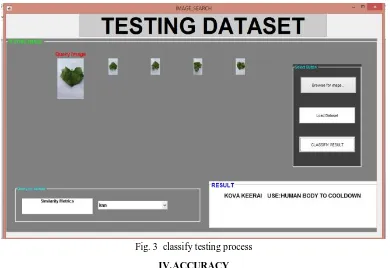
[image:4.595.104.494.185.453.2]The classification based on the recognizing the leaves images with extracted texture features was proposed and performed. The texture features have been extracted with using the Gray-Level Co-occurrence Matrix (GLCM) and the GLRLM algorithms. Four texture features are extracted in GLCM such as Contrast, Correlation, Homogeneity and Energy. Seven texture features are extracted in GLRLM such as LRE, HRE, RP, HGRE, LGRE, GLN, and RLN. The classified using (K-Nearest Neighbours) KNN Method
Fig. 3 classify testing process
IV.ACCURACY
Results from both training and testing stages of the developed k-nearest neighbors algorithm show that this algorithm is capable of properly classifying leaf images.
Accuracy =
× 100% (9)
= 18 20
= 93%
V. CONCLUSION
In this study, the classification based on the recognizing the leaves images with extracted texture features was proposed and performed. The texture features have been extracted with using the Gray-Level Co-occurrence Matrix (GLCM) and the GLRLM algorithms. Four texture features are extracted in GLCM such as Contrast, Correlation, Homogeneity and Energy. Seven texture features are extracted in GLRLM such as LRE, HRE, RP, HGRE, LGRE, GLN, and RLN. The classified using (K-Nearest Neighbours) KNN Method. Our initial assumption in characterizing image texture is that all the texture information contained in the GLCM and GLRLM. Some GLCM Extracted the textural features are illustrated in-order to develop a leaves classification system based on the K-Nearest Neighbor (KNN). It has 2 phases such as Training phase and testing phase. In Training phase, texture features are extracted from a given set of training dataset images. In testing phase given test image texture feature is extracted and classify the results. Compare the GLCM and GLRLM. Therefore, it was specified that the GLCM is very sensitive in any changes for images such as deforming or giving the new leaf image as a test. In addition, the KNN method comes out to be more efficient compare to the GLCM and GLRLM.
VI.FUTURESCOPE
©IJRASET: All Rights are Reserved
297
REFERENCES
[1] American Cancer Society, “Cancer Statistics, 2005”, CA: A Cancer Journal for Clinicians, 55: 10-30, 2005,
“http://caonline.amcancersoc.org/cgi/content/full/55/1/10”.
[2] B.V. Ginneken, B. M. Romeny and M. A. Viergever, “Computer-aided diagnosis in chest radiography: a survey”, IEEE, transactions on medical imaging, vol. 20, no. 12, (2001).
[3] D. Lin and C. Yan, “Lung nodules identification rules extraction with neural fuzzy network”, IEEE, Neural Information Processing, vol. 4,(2002).
[4] B. Zhao, G. Gamsu, M. S. Ginsberg, L. Jiang and L. H. Schwartz, “Automatic detection of small lung nodules on CT utilizing a local density maximum algorithm”, journal of applied clinical medical physics, vol. 4, (2003).
[5] A. El-Baz, A. A. Farag, PH.D., R. Falk, M.D. and R. L. Rocco,M.D.,“detection, visualization, and identification of lung abnormalities in chest spiral CT scans: phase I”, Information Conference on Biomedical Engineering, Egypt (2002).
[6] Linda G. Shapiro and G.C. Stockman., Computer Vision: Theory and Applications. 2001: Prentice Hall.
[7] The DICOM Standards Committee. DICOM homepage. http: //medical.nema.org/, September 2004.
[8] B. Magesh, P. Vijaylakshmi, M. Abhiram, “Computer aided Diagnosis System for identification and classification of Lessions in Lungs”, International Journal of Computer Trends and Technology- May to June Issue 2011.