The Pragmatics of Referring and
the IViodality of Communication 1
Philip R. C o h e n
Laboratory for Artificial Intelligence Research Fairchild C a m e r a and I n s t r u m e n t Corporation
Palo Alto, C A
This p a p e r presents empirical results comparing s p o k e n and keyboard communication. It is shown that s p e a k e r s a t t e m p t to achieve m o r e detailed goals in giving instructions than do users of keyboards. One specific kind o f f i n e - g r a i n e d communicative act, a request that the h e a r e r identify the r e f e r e n t of a noun phrase, is shown to dominate s p o k e n instruction-giving discourse, but is nearly absent f r o m keyboard discourse. M o s t important, these requests are only achieved " i n d i r e c t l y " . - through u t t e r a n c e s whose surface forms do not explicitly convey the s p e a k e r s ' intent. A p l a n - b a s e d t h e o r y o f communication is shown to uncover the speakers' intentions underlying many cases o f indirect identification requests found in the corpus, once an action for r e f e r e n t identification has been posited. In so doing, the t h e o r y demonstrates how intent (or plan) recognition can be applied in reasoning about the use of a description. As a consequence o f this approach, it is shown that the conditions on the planning o f successful identification requests account for S e a r l e ' s conditions on the act o f referring. It is concluded that intent recognition will n e e d to be a central focus for p r a g m a t i c s / d i s c o u r s e c o m p o n e n t s o f future speech understanding systems, and that computational linguistics n e e d s to develop formalisms for reasoning about speakers' use of descriptions.
1 Introduction
A s n a t u r a l l a n g u a g e i n t e r a c t i o n with c o m p u t e r s b e c o m e s m o r e w i d e s p r e a d , s y s t e m s ' abilities to e n g a g e users in d i s c o u r s e will b e c o m e i n c r e a s i n g l y i m p o r t a n t . T h e s e c a p a b i l i t i e s will b e e s p e c i a l l y in d e m a n d w h e n users can s p e a k n a t u r a l l y to their m a c h i n e s . A l t h o u g h it is w i d e l y s u s p e c t e d that s p o k e n l a n g u a g e is d i f f e r e n t f r o m w r i t t e n language, the q u e s t i o n of p r e c i s e l y w h a t the d i f f e r e n c e s are has o n l y r e c e n t l y b e c o m e a t o p i c o f c o m p u t a t i o n a l linguistic r e s e a r c h . P r e v i o u s i n v e s t i g a t i o n s h a v e c o n c e n - t r a t e d on s y n t a c t i c d i f f e r e n c e s b e t w e e n s p o k e n a n d w r i t - ten l a n g u a g e ( H i n d l e 1983, K r o c h a n d H i n d l e 1982, T h o m p s o n 1980), with the goal o f a d a p t i n g p a r s i n g t e c h - niques to h a n d l e the s y n t a x of s p o k e n language. H o w e v - er, e v e n if this goal w e r e a c h i e v e d , a s y s t e m n e e d s to b e p r e p a r e d to h a n d l e a n y u n i q u e p r o p e r t i e s o f the discourse
structure o f s p o k e n i n t e r a c t i o n if it is to b e successful in c o n d u c t i n g a dialogue.
O f course, t h e r e has b e e n m u c h w o r k on d i s c o u r s e p r o c e s s i n g within c o m p u t a t i o n a l linguistics (e.g., G r o s z 1977, S i d n e r 1979, W e b b e r 1978), a n d a n y f u t u r e s y s t e m s will u n d o u b t e d l y i n c o r p o r a t e p r e v i o u s l y success- ful techniques. H o w e v e r , o n e s u s p e c t s t h a t the c o v e r a g e
This research was supported primarily by the National Institute of Education under contract US-NIE-C-400-76-0116 to the Center for the Study of Reading of the University of lllinois and Bolt Beranek and Newman Inc., and in part by the Oregon State University. The paper was written at the Fairchild Camera and Instrument Corporation, and revised at SRI International. The revisions of this paper have been made possible by a gift from the System Development Foundation to SRI as part of a coordinated research effort with the Center for the Study of Language and Information, Stanford University. Author's current address: Artificial Intelligence Center, SRI International, Menlo Park, CA 94035.
Copyright 1984 by the Association for Computational Linguistics, Permission to copy without fee all or part of this material is granted provided that the copies are not made for direct commercial advantage and the CL reference and this copyright notice are included on the first page. To copy otherwise, or to republish, requires a fee and/or specific permission.
0 3 6 2 - 6 1 3 X / 8 4 / 0 2 0 0 9 7 - 5 0 5 0 3 . 0 0
Philip R. Cohen The Pragmatics of Referring and the Modality of Communication
of discourse processing algorithms may depend on the corpora from which they were developed, and m a n y of those reflect keyboard-mediated dialogue. Thus, to determine whether and how current techniques need to be adapted to the way people speak, research is needed to compare the discourse structure of spoken and keyboard interaction.
This paper presents an empirical study and theoretical analysis of utterance form and function as determined by the communication modality. The two initial objectives are:
1. To develop an empirical methodology for analyzing discourse pragmatics.
2. To use that methodology to identify both the goals that speakers attempt to achieve in spoken and keyboard modalities, and the discourse and sentence structures they use in achieving those goals.
These objectives are investigated in a study of instruc- tion-giving discourse, a communication task that inti- mately ties utterance function to a nonlinguistic task being accomplished by the conversants. In addition to depending on the communication task, the goals people achieve with language are a function, in part, of the communication situation - i.e., of how the speaker(s.), hearer(s), object(s) under discussion, and discourse itself are situated in the world. F o r example, the utterance " O n the table is a little yellow piece of rubber," would be interpreted quite differently in a narrative than in a set of instructions for assembling an object. The communi- cation situation helps to determine the pragmatics o f reference - what speakers intend hearers to do with refer- ring expressions. Thus, a third goal of this paper, a subsidiary to objective 2 is to consider
3. H o w the speakers' goals for the interpretation of referring expressions are expressed and achieved in different modalities.
Results indicate that speakers attempt to achieve more detailed referential goals in giving instructions than do users of keyboards. That is, speakers explicitly request hearers to identify the referents of noun phrases (NPs), but users of keyboards do not. Instead, the referential goals achieved by these requests are subsumed by other requested actions. Most importantly, these identification requests are only achieved "indirectly" - through utter- ances whose surface forms do not explicitly convey the speakers' intent.
Current theories propose that the speaker's intentions underlying the use of indirect speech acts can be recog- nized as a by-product of a more general, independently motivated process of inferring a speaker's plans (Bruce 1983, Cohen and Perrault 1979, C o h e n and Levesque 1980, Perrault and Allen 1980, Schmidt 1975, Sidner and Israel 1981). Essentially, illocutionary acts, which communicate the speaker's intentions, are regarded as steps in a speaker's plan, just as physical acts are.
Furthermore, just as observing an agent's behavior may lead one to infer what the agent is trying to do, so too can the observation/understanding of a speaker's utter- ance lead an observer to infer the speaker's intentions. This approach has led to formal and computational models of discourse processing (Allen 1979; Allen and Perrault 1980; Brachman et al. 1979; C o h e n and Levesque, in preparation; Sidner et al. 1981). Although these provide a more comprehensive account of indirect speech act interpretation than previous linguistic or philo- sophical approaches, they have not been tested against a corpus other than the ones that supported their creation (e.g., Horrigan 1977). Therefore, as an adequacy test, the fourth objective for this paper is:
4. To evaluate how well a plan-based theory of communication can uncover the intentions underly- ing the use of m a n y surface forms in the transcripts. The theory is shown to account for approximately 7 0 % of the indirect requests for referent identification found in the transcripts, once an action for referent iden- tification has been posited. An important aspect of the account is the demonstration that speakers and hearers can reason about referent identification much as they reason about other actions and plans. Hence, the last goal for this paper is to
5. Contrast the plan-based analysis of referring, and the flexibility it allows, with Searle's account of reference as a speech act.
I show that Searle's analysis cannot account for m a n y of the examples treated here, and that those examples it does cover can also be handled by the present analysis.
The conclusions I draw are specific to the conversa- tional task of giving instructions about objects physically present to the hearer. This task was chosen for four reasons:
• First, it was expected that speakers would frequently issue requests. Because requests dominate interactions with m a n y question-answering systems, and with most conceivable interactive applications of natural language processing, they have b e e n extensively studied in computational linguistics.
• Second, because the task is simple and constrained, it provides an excellent adequacy test for proposed theo- ries and computational techniques; any theory of communication that cannot handle the p h e n o m e n a of this study can hardly be called general. However, since the domain is functionally similar to those of various k e y b o a r d - b a s e d systems (Brachman et al. 1979, Robinson et al. 1980, Winograd 1972), the data and results of the study m a y suggest directions for extending those systems.
• Third, the domain is similar to those analyzed by other researchers (Chapanis et al. 1972, Chapanis et al. 1977, Grosz 1977), and thus the dialogues could serve to confirm or refute their results.
Philip R. Cohen The Pragmatics of Referring and the Modality of Communication
• Finally, instructions play a crucially important role in people's everyday lives - success in industrial, academ- ic, and bureaucratic tasks, for example, requires the following of instructions. Children are initially instructed face-to-face, but they eventually learn to follow written instructions. The present study, though not this paper, should ultimately provide a window on how the language of written instructions differs from that of instructional dialogue.
In summary, this paper applies an empirical methodol- ogy for analyzing discourse pragmatics to compare spoken and keyboard language for an instruction-giving task. The primary differentiating phenomenon, the use of explicit identification requests, is used as an adequacy test for a plan-based theory of communication. Conversely, the theory is used to explicate how such communicative actions might be analyzed. Finally, the theory gives rise to a pragmatic analysis of referring that subsumes Searle's (1969).
The remainder of this paper is organized as follows: Section 2 discusses previous-research in a number of related areas. Section 3 isolates the p h e n o m e n a of inter- est - referent identification. Section 4 describes the study and the method of discourse analysis, and Section 5 presents and discusses the empirical results. Section 6 sketches the plan-based theory of communication and applies the theory to key examples. Section 7 counters possible alternative explanations that would purport to explain the data without recourse to an analysis of speak- er intent. Section 8 compares the analysis with Searle's, and suggests generalizations based on independently motivated principles. Finally, the appendices contain the materials, transcripts, and codings on which these analyses are based. A full set of coded transcripts m a y be obtained on request.
2 P r e v i o u s R e s e a r c h
Four traditions of research bear on the problems at hand: empirical work on differences between spoken and writ- ten language, discourse analysis, psychological studies of referential communication, and computational linguistics studies of discourse that have been based on observation of actual communicative interaction.
The subject of oral/written language comparisons has received much attention from researchers: Anthropolo- gists have traditionally studied characteristics of " o r a l " and "literate" cultures; human-factors researchers have investigated the opportunities that particular modalities afford for effective communication; and educational psychologists, using empirical and anthropological meth- ods, have sought answers to children's reading and writ- ing problems in the study of oral/written language differences.
Rubin (1980) discusses methodological weaknesses in m a n y oral/written studies - weaknesses that stem from a
simplistic division of language experiences into " o r a l " and "written". Instead, she classifies language experi- ences in terms of their characteristic values on several dimensions such as: the use of voice or print, the ability of " s p e a k e r " and " h e a r e r " to interact, their spatial a n d / o r temporal commonality, their mutual involvement in the discourse, and the concreteness of the referents. Face-to-face conversations about physically present objects are seen to lie at one extreme within this "communication space" (with "positive" values on the above dimensions), whereas written text is at the oppo- site. Other language experiences that differ along these dimensions include communication by telephone, keyboard, audiotape, picturephone, writing, etc. 2 Rubin reports that m a n y studies comparing language experi- ences present conclusions about oral/written language differences even though the language experiences differ from one another along multiple dimensions. In such cases it is not clear if the observed differences result, for example, from the presence of voice, the ability to inter- act, or both.
There is evidence that at least some
quantitative
linguistic and efficacy results are primarily determined by the presence of voice in the communication modality. A series of studies by Chapanis and colleagues (Chapanis et al. 1972, Chapanis et al. 1977) compared problem-solv- ing effectiveness among teams communicating in face-to- face, voice only, written, keyboard, and other communication modalities. D e p e n d e n t measures included problem solution time, number of words, sentences, utterances, etc. Results indicate that problems are solved twice as fast in vocal modalities as they are in written ones, even though communicators use twice as m a n y words when speaking. 3 Although motivating the development of speech-understanding systems, these results unfortunately tell us little about how the process- ing of spoken utterances differs from the processing of written ones.Other research has c o m p a r e d the syntax of spoken and written discourse. The primary findings are: Written language is syntactically more integrated than spoken, employing nominalizations, participles, complements, relative clauses, etc. (Chafe 1982); and spoken language exhibits regular patterns of false starts and hesitations (Hindle 1983, Kroch and Hindle 1982). The former results can help a system designer to determine which syntactic constructs to emphasize in a g r a m m a r for pars- ing. The latter results are more useful to computational
z This approach essentially characterizes language situations as multidi- mensional vectors whose components, describing the above dimensions, are binary values (e.g., +/- voice). Thus, it is assumed that neighboring modalities afford equal communicative possibilities in all dimensions in which they are the same. This is obviously untrue for the dimension of interaction.
3 Thompson (1980) has confirmed Chapanis et al.'s results for face-to- face and keyboard modalities.
Philip R. Cohen The Pragmatics of Referring and the Modality of Communication
linguistics. Not only are regularities in nongrammatical speech identified, but a class of "editing" rules is provided that can make such utterances parsable. Current work on relaxing grammar rules and on parsing ill-formed input (Hayes and Mouradian 1981, Kwasny and Sondheimer 1981, Weischedel and Black 1980) is in much the same spirit.
The purposes at hand require analyses of the pragmat- ic and discourse structure of actual dialogues. Grosz (1977) and Bruce (1981) (among others) have shown how such discourse analyses can have direct implications for algorithm design. In their work, transcripts of dialogues were collected and analyzed, leading to the development of algorithms for speech-understanding systems (Walker 1978, Woods et al. 1976). 4 Grosz' analyses indicate that anaphoric reference in task-orient- ed dialogues is constrained by the hierarchical structure of the physical task. A parallel structuring of "focus spaces" was proposed as a mechanism to constrain the search for co-referents, and became the mainstay of the discourse component of two systems (Robinson et al. 1980, Walker 1978). Although this research did not directly address the problem of discovering cross-modal similarities and differences, the major finding of explicitly "stacked" topics serving to constrain co-reference was validated independently in a domain of casual, face-to- face conversation (Reichman 1981).
Bruce's pragmatics component for the HWIM system was based on transcripts of human keyboard-mediated dialogues simulating interactions with a travel budget manager. Users were seen to be interacting in various " m o d e s " (e.g., editing-a-trip mode, creating-a-trip mode, etc.). The system attempted to track the user's progress through these modes, using an ATN-based represen- tation, and thereby to create expectations of h i s / h e r future utterances. Discourse analysis revealed that users did not follow the strict embedding of subdialogues required by the ATN model. Consequently, the pragmat- ics component was reorganized as a " d e m a n d " model in which the system was seen as responding to one of a set of pending goals. Although this research did not directly address issues of cross-modal similarities and differences, it did point out the promise of a goal-oriented view of language processing.
Many researchers in the field of discourse analysis have tried to identify goals or intentions in dialogue. For example, Labov and Fanshel (1977) analyzed transcripts of therapy sessions by employing the vocabulary of linguistics and speech act theory. Their analyses presented rules for interpreting the intentions behind utterances of various syntactic forms - e.g., rules for when a hearer will interpret utterances as indirect requests for physical action or verbal confirmation. However, these rules were stipulated as regularities of discourse rather than as derived from underlying proc-
esses. Their findings should serve as data to be explained, rather than as a satisfying account of discourse.
In research more relevant to computational linguistics, Mann et al. (Mann, Moore, and Levin 1977; Mann, Carlisle, Moore, and Levin 1977) applied traditional empirical methods to the identification of speaker inten- tion and utterance function in dialogue. 5 Their goal was to build systems to replicate observers' scorings of tran- scripts. The observers, and ultimately the systems, were to identify repeated reference, requests, expressions of comprehension, topic structure, etc., in keyboard dialogues between a user and a computer operator, and in radio dialogues between Apollo astronauts and ground control. Much care was taken to develop a scoring scheme, train dialogue observers, and attain reliability Mann, Carlisle, Moore, and Levin 1977). A separate computer program was to have been built for processing each transcript. By merging the common features of these systems, an empirically-based theory and computa- tional model were to have been developed. This work resulted in a goal-directed, "dialogue games" model of conversational interaction (Levin and Moore 1977), though it is not clear whether the model's formulation resulted from the merging of implementations.
Finally, there is a huge literature of psychological studies of referential communication. I will not survey it here (but see Dickson 1981 for recent papers and Asher 1979 for an extensive review), but mention only two themes of relevance to this study. First, such work has shown that, in spoken interaction, noun phrase length tends to decrease as subsequent references to an object are made. However, in non-interactive spoken modalities (Krauss & Weinheimer 1966), the decrease for subse- quent references is lessened. These results indicate that efficiency in referential communication is a function of user feedback.
The development of the component skills involved in referring is a second theme in this literature. In order to test Piaget's "egocentrism" hypotheses, a typical question asked is whether children take their listener's "perspective" into account when planning their referring expressions. 6 Another question raised is whether children of certain ages can adequately make comparisons of the properties of referents and non-referents in order to formulate an adequate referring expression. This line of
4However, neither corpus incorporated true spoken interaction. The SRI dialogues that were analyzed in depth were taken from a mixed c o m m u - nication mode in which one, an "expert", typed instructions to a third party, who spoke them to an "apprentice", and typed the apprentice's spoken replies to the expert. The BBN "incremental simulation" dialogues involved only keyboard communication.
5Similar approaches include those of Dore et al. (1978), and Sinclair and Coulthard (1975).
Shatz and G e l m a n (1973) showed they can do so (though not neces- sarily accurately (Asher 1979)) at a m u c h earlier age than had been supposed.
Philip R. Cohen The Pragmatics of Referring and the Modality of Communication
work is more relevant to the present concerns of charac- terizing the act of identification, but the subskills exam- ined are still too coarse for our needs.
Previous research has thus provided many lessons, among them:
• the need to compare (at least initially) modalities that are minimally different,
• the need for repeatable methods for characterizing linguistic behavior at the pragmatics and discourse structure level,
• the need to assess the adequacy of our theories, and • the need for couching explanations in computational
terms.
The present study addresses each of these needs.
3 The Phenomena of Interest: Referent Identifi- cation
One referential goal that is essential to the present communication task is to get the hearer to identify the object the speaker has in mind. I shall be using the term "identify" in a very narrow, though important and basic, sense - one that intimately involves perception. Thus, the analysis is not intended to be general; it applies only when the referents are perceptually accessible to the hearer, and when the hearer is intended to use perceptual means to pick them out. For the time being, I shall explicitly not be concerned with a hearer's mentally "identifying" some entity satisfying a description, or discovering a co-referring description, although these operations are certainly important aspects of processing many referring expressions. In the remainder of this section, properties of the referent identification act are examined, in part by contrasting it with other concepts that have previously entered into computational linguistic analyses of reference.
Referent identification requires an agent and a description. The essence of the act is that the agent pick out the thing or things satisfying the description. The agent need not be the speaker of the description, and indeed, the description need not be communicated linguistically, or even communicated at all. A crucial component of referent identification is the act of percep- tually searching for something that satisfies the description. To determine which method(s) should be used in identifying the referent, the agent first requires some representation of the description per se. The description is decomposed by the hearer into a plan of action for identifying the referent. The intended and expected physical, sensory, and cognitive actions to be included in that plan may be signalled by the speaker's choice of predicates. For example, a speaker who utters, "the magnetic screwdriver, please", may expect and intend for the hearer to place various screwdrivers
against some piece of iron to determine which is magnet- ic. Similarly, a speaker uttering the description "the three two-inch long salted green noodles" may expect and intend the hearer to count, look at, measure, and perhaps taste various objects. For their part, hearers decompose the noun phrase/description to discover that " g r e e n " is determinable by vision, "inch" by measuring, "salted" primarily by taste, " n o o d l e " primarily by vision, and " t h r e e " by counting. Speakers know this is what hearers can do, and l~hus, using a model of the hearer's capabilities and the causal connections among people, their senses, and physical objects, design the referring expression D to suggest the actions needed to identify the referent.
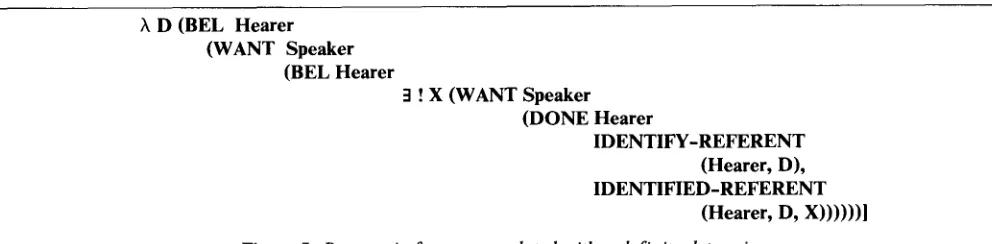
Speakers often not only plan for hearers to identify the referents of descriptions, but also communicate, in the Gricean way (1957), their intention that the hearers do so. This intention may not be explicitly signalled in the utterance, but rather have to be recognized by the hear- er. To respond appropriately, a hearer decides when identification is the intended act to perform in response to a description, what part this act will play in the speak- er's and hearer's plans, and when to perform the act. If perceptually identifying a referent is represented as an action in the speaker's plan, hearers could reason about it just as they do about any other act, thereby becoming able to infer the speaker's intentions behind, for example, indirect identification requests.
3.1 A sketch of a definition of perceptual refer- ent identification
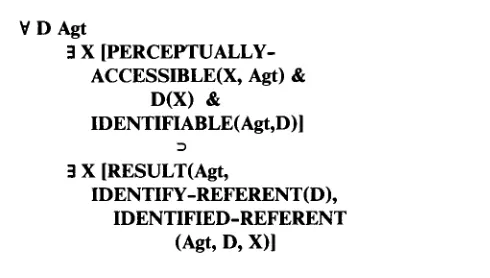
Figure 1 presents a sketchy definition of the referent identification action, in which the description is formed from " a / t h e y such that D ( y ) " . 7
Y D A g t
3 X [PERCEPTUALLY- ACCESSIBLE(X, AgO &
D(X) &
IDENTIFIABLE(Agt,D)] D
3 X [RESULT(Agt,
IDENTIFY-REFERENT(D), I D E N T I F I E D - R E F E R E N T
(Agt, D, X)I
Figure 1. The act o f referent identification.
7 This definition is not particularly illuminating, but it is not any vaguer than others in the literature, including Searle's (1969). The point of giving it is that if a definition can be given in this f o r m (i.e., as an action characterizable in a dynamic logic), a plan-based analysis (see section 7.5) applies.
[image:5.612.313.558.476.615.2]Philip R. Cohen The Pragmatics of Referring and the Modality of Communication
The formula follows the usual axiomatization of actions in a dynamic logic: P z [Act]Q; that is, if P is true, after doing Act, Q holds.
(1980) possible worlds semantics operator RESULT is taken to be action, and a formula, iff in all from the agent's performing that true. 8
Following M o o r e ' s for action, the modal true of an agent, an world states resulting action, the formula is
The antecedent says there exists some (perhaps more than one) object satisfying three conditions. The first is a "perceptual accessibility" condition to guarantee that the IDENTITY-REFERENT action is applicable. This should guarantee that, for example, a speaker does not intend someone to pick out the referent of " 3 " , " d e m o c r a c y " , or "the first m a n to land on Mars". The condition is satisfied in the experimental task because it rapidly becomes mutual knowledge that the task requires communication about the objects in front of the hearer.
The second condition states that X fulfills the description D. Here, I am ignoring cases in which the description is not literally true of the intended referent, including m e t o n y m y , irony, and the like (but see Perrault and C o h e n 1981). Finally, D should be a description that is identifiable to this particular Agt. It should use descriptors whose extension the agent already knows or can discover by action. I am assuming that we can know that a combination of descriptors is identifiable without having formed a plan for identifying the referent.
If the antecedent is true, then the agent picks out something (not necessarily the object satisfying the ante- cedent) as the referent of D. His picking out the "right" (i.e., the intended) object is handled by a separate char- acterization of the speaker's intention with respect to this action (see section 7.5). Here, I will merely give a name to the state of knowledge the agent is in after having identified the referent of D - (IDENTIFIED-REFERENT Agt D X). That is, Agt has identified the referent of D to be X. Of course, what has been notoriously difficult to specify is just what Agt has to know about X to say he has identified it as the referent of D. Clearly, "knowing who the D is" (Hintikka 1969, Moore 1980) is no substi- tute for having identified a referent. After having picked out the referent of a description, we m a y still not not k n o w who the D is. On the other hand, we m a y know who or what the description denotes, for example, by knowing some "standard n a m e " for it, and yet be unable to use that knowledge to pick out the object. F o r exam- ple, if we ask "Which is the Seattle train?" and receive the reply " I t ' s train number 11689", we m a y still not be able to pick out and board the train if its serial number is not plainly in view. Clearly, the notion of identification needs to be made relative to a purpose, which perhaps could be derived from the bodily actions that Agt is intended to perform upon the intended referent. 9
Finally, although not stated in this definition, the means by which the act is performed is some function mapping D to some plan or procedure that, when executed by Agt, enables Agt to discover the X that is the referent of D.
Even with this imprecise understanding of referent identification, it is apparent that not all noun phrases used in task-oriented conversations (even with the perceptual access conditions satisfied) are uttered with the intention that their referents be identified. F o r exam- ple, in dialogues with an information b o o t h clerk in a train station (Allen 1979, Horrigan 1977), patrons utter- ing "the 3:15 to Montreal?" are not intending the clerk to pick out the train. Instead, as part of their plan for boarding a train, patrons are intending the clerk to supply them with a co-referring noun phrase that will allow them to identify the train. The attributive use of definite noun phrases (Donnellan 1960) is another case in which the speaker has no intention that the hearer identify a refer- ent. Other non-anaphoric uses of noun phrases include labeling an object, correcting a referential miscommuni- cation, getting the speaker to wait while the speaker identifies the referent, etc. 1°
3.2 Comparisons with computational linguistics approaches to reference
Computational linguistics research has usually been concerned with co-reference - the relationship of words and symbols to other words and symbols. Typically, referents of descriptions are determined by intersecting the extensions of the predicates in the description, subject to the quantificational constraints imposed by the determiner. Although perhaps adequate for interfacing with databases, this approach presupposes that the exten- sions can be computed from information currently in the database. However, in interpreting and generating discourse about some physical task, the system m a y have to form a plan that it or its user p e r f o r m physical actions to determine the extensions of the predicates.
Five approaches are most closely related to ours. First, Winograd's SHRDLU (1972) attempted to simulate true reference with co-reference, at SHRDLU had a PLANNER function, THFIND, that could find objects in the database satisfying THGOAL statements as a simulation of finding
8 Actually, Moore characterizes R E S U L T as taking an event and a formula as arguments. In his framework, an agent's doing an action denotes an event. However, this difference is not critical for what follows.
The connection with the contextually relevant actions is a matter of inference (see section 6).
~0 For other discussion of speakers' goals in uttering noun phrases (see Sidner (1983) and Wilkes-Gibbs, unpublished ms).
Ii On the other hand, one might argue that S H R D L U engaged in true reference because the discourse was about non-existing blocks " c o n t a i n e d " within the system. To pursue the truth of the matter would take us too far afield.
Philip R. Cohen The Pragmatics of Referring and the Modality of Communication
blocks in the real world. THFIND was included in the semantic representation of definite NPs, and in the repre- sentation of indefinite NPs when those NPs were embed- ded in an action verb. However, THFIND is not attributed as a user goal, nor is it reasoned about (other than to maintain a distinction between definite and indef- inite NPs). Furthermore, it is not treated in the same way as acts such as PICKUP, whose execution is marked specially so that the system can later answer " w h y " ques- tions.
Second, Allen's (1979) system used an IDENTIFY state in the control part of the plan-recognition mech- anism. Again, for this system, identification meant to find something in the database satisfying the requisite predicates. However, the IDENTIFY action itself was not part of the plan being recognized. The system did not reason about when IDENTIFY should be done (it always tried to IDENTIFY referents), nor did it attribute IDENTIFY to be part of its user's plan.
The TDUS system (Robinson et al. 1980) engaged in a dialogue about the assembly of an air compressor that, it was understood, was being assembled by an apprentice. Thus, the referents of the system's noun phrases were perceptually accessible to the hearer. The system was primarily oriented towards utterance interpretation, but it did generate responses to questions. In doing so, the system was in the same circumstances as the experts in the present study. However, because it was assumed that the extensions of all of the system's descriptors were already known to the hearer, the system did not reason that it should choose particular referring expressions so that the hearer could pick out their referents. Instead, the choice of referring expressions was constrained by uniqueness and focus (Grosz 1977), constraints that are not considered here but are clearly necessary. Although TDUS employed the concept of locating an object in its representation of successful task performance, this concept did not play a role in choosing referring expressions unless the system was asked a question about an object's location.
Appelt's KAMP system (1981) generalized TDUS to plan referring actions as part of the planning of illocu- tionary acts. However, KAMP would only include descriptors in a referring expression for which it was already mutually believed that the hearer knew the refer- ent. Thus, it could not generate referring expressions to new objects for the hearer to pick out. Furthermore, as argued earlier, the concept of "knowing what the refer- ent is", which was central to KAMP's planning of refer- ring phrases, is too strong to be an accurate representation of referent identification.
Finally, the HAM-ANS question-answering system (Hoeppner, Morik, and Marburger 1984) generates descriptions of objects in a hotel room from visually derived information, assuming the user's visual search
processes are identical with its own. In another applica- tion, the system answers questions about traffic flow based on visual data. In its tying reference to perception, the HAM-AN_S System has some of the flexibility that I am advocating. However, as with the others, it does not reason about identification as an action that the speaker intends it to do. In this paper, 1 argue why such reason- ing is needed.
3.3 S u m m a r y
In summary, I am suggesting that referent identification be an action that the hearer infers to be part of the speaker's plan, and that speakers plan for hearers to perform. To ensure that hearers can do so, speakers employ their knowledge of the hearer's perceptual abili- ties, and choose descriptions that will make use of those abilities. The ability to reason about the referent identifi- cation act will allow the hearer to infer the intentions behind m a n y utterances that secure reference separately from predication, and do so indirectly. With this concept in mind, we can proceed to examine its use in discourse.
4 T h e S t u d y
Twenty-five subjects ( " e x p e r t s " ) each instructed a randomly chosen " a p p r e n t i c e " in assembling a toy water pump, following G r o s z ' s (1977) and Chapanis et al.'s (1972) task-oriented dialogue paradigm. 12
Subjects were paid volunteer students from the University of Illinois, all of w h o m were familiar with CRT terminals. Five "dialogues" took place in each of the following modalities: face-to-face, by telephone, keyboard ("linked" CRTs), (noninteractive) audiotape, and (non-interactive) written. In all modes, the appren- tices were videotaped as they followed the experts' instructions.
Face-to-face and written modalities are the ones usual- ly compared in oral/written discussions. However, they differ along m a n y dimensions (Rubin 1980). Pairwise comparisons of the modalities in this study can determine the effects of mutual vision, interaction, and the use of voice or print. Telephone and keyboard dialogues are analyzed first because our conclusions would indicate the effects of having a voice channel, and moreover would have implications for the design of speech understanding and production systems. These modalities t a k e ' o n inter- mediate values in Rubin's dimensional space: the conver- sants share the same time frame, can interact, cannot see each other, and are conversing about objects mutually known to be physically present to one of them.
Each expert participated in the experiment on two consecutive days, the first for training and the second for instructing an apprentice. Subjects playing the expert role were trained by following a set of assembly directions consisting entirely of imperatives, assembling
,2 An exploded parts diagram of the pump can be found in Appendix A.
Philip R. Cohen The Pragmatics of Referring and the Modality of Communication
the p u m p as often as desired, and then instructing a research assistant. This practice session took place face to face. Experts knew that the research assistant already knew how to assemble the pump. Experts were given an initial statement of the purpose of the experiment, which indicated that communication would take place in one of a n u m b e r of different modes. Experts were not informed of the modality in which they would communicate until the next day. t3
Apprentices were told the purpose of the experiment was to analyze the communicating of a set of instructions in different modalities. They were not initially informed that they were engaged in an assembly task.
In both modes, experts and apprentices were located in different rooms. Experts had a set of p u m p parts that, they were told, were not to be assembled but could be manipulated. In Telephone mode, experts communicated through a standard telephone and apprentices communi- cated through a speaker-phone. This device did not need to be held and allowed simultaneous t w o - w a y communi- cation. Distortion of the expert's voice was apparent, but not measured.
Subjects in " k e y b o a r d " mode typed their communi- cation on Elite Datamedia 1500 CRT terminals connected by the Telenet computer network to a computer at Bolt Beranek and N e w m a n Inc. The terminals were "linked" so that whatever was typed on one would appear on the other. Simultaneous typing was possible and did occur. Subjects were informed that their typing would not appear simultaneously on either terminal. Response times averaged 1 to 2 seconds, with occasionally longer delays due to system load.
4.1 Sample transcripts
The following are representative samples of transcripts in the two modalities.
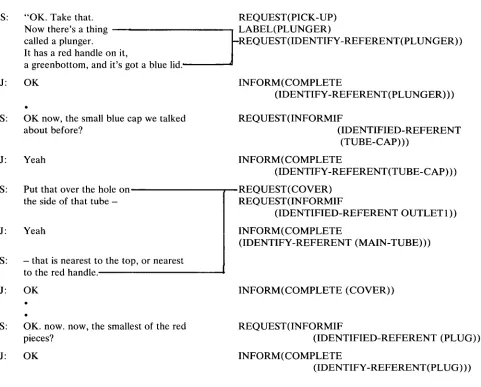
A TELEPHONE DIALOGUE FRAGMENT
S: " O K . Take that. N o w there's a thing called a plun- ger. It has a red handle on it, a green bottom, and it's got a blue lid.
J: O K
S: O K now, the small blue cap we talked about before?
J: Yeah
S: Put that over the hole on the side of that tube -
J: Yeah
t3 The instructions given to the expert about the experiment and the assembly task are given in Appendix A. Burke (1982) reports that the order of the instructions, and the descriptions of the pieces, influenced the order and vocabulary of the expert's subsequent instructions.
S: - that is nearest to the top, or nearest to the red handle.
J: O K
S: OK. Now. now, the smallest of the red pieces?
J: O K "
A KEYBOARD DIALOGUE FRAGMENT
B: "fit the blue cap over the tub end
N: done
B: put the little black ring into the large blue cap with the hole in it...
N: ok
B: right Put the 1 / 4 inch long 'post' into the loosely fitting hole...
N: i d o n ' t understand what you mean
B: the red piece, with the four tiny projections?
N: O K
B: place it loosely into the hole on the side of the large tube...
N: done
B: very good. See the clear elbow tube?
N: yes
B: place the large end over that same place.
N: ready
B: take the clear d o m e and attach it to the end of the elbow joint..."
4.2 Method of analysis
Discourses are analyzed for m a n y reasons, with a corre- sponding variety of methods. Some analyses of discourse strive to explain what the text itself meant. Recent work on discourse pragmatics emphasizes the need to explain what the speaker meant in producing the utterances, i.e., what were the speaker's intentions? To build dialogue systems, we need to devise first theories and then algo- rithms for deriving what the speaker meant as a function of what was said and of contextual factors. The logical first step toward such a formalization is to establish reli- able methods for isolating the words, context, and speak- er intent. Each of these aspects of the discourse is considered below.
Philip R. Cohen The Pragmatics of Referring and the Modality of Communication
First, the typewritten transcript of a verbal interaction provides reasonably accurate data on what was said, provided one's goal is not to study prosody. Second, contextual factors can be modelled in a setting in which the objects, communication task, and modality have been selected by the experimenter. The conversants' know- ledge of the domain is somewhat constrained by the experimental setup and the initial instructions. This semi-controlled environment can enable the experimenter to model the participants' initial experiment-induced beliefs, intentions, and expectations, which constitute our model of the cognitive effects of context.
Finally, as the conversation progresses, one needs interpretations of what each speaker meant, stated in terms of further attributions of beliefs and intentions. Standard empirical methods should be used to minimize experimenter bias in making such attributions. In partic- ular, the theorist must be careful not to be the source of belief/intent attributions, for if given the leeway, he will undoubtedly find what he is looking for. To avoid this problem, I trained two people to employ a vocabulary for describing intentions in discourse, the so-called "illocutionary acts" (or, loosely, "speech acts") (Austin 1962, Searle 1969). That is, the discourse analysts " c o d e " the speaker's intentions in making an utterance by assigning illocutionary act labels to utterances (or groups of them). Fortunately, the illocutionary act vocabulary is the natural one in our common-sense psychology for making such attributions. However, unlike most theories of illocutionary acts, I do not claim that the conversants themselves attempt to determine what illocutionary acts were performed, although they might be able to do so if requested. 14 The illocutionary act interpretations are therefore our interpretations, as coders and as theorists.
The data that need to be compared and explained are these illocutionary act codings. As mentioned earlier, a number of researchers have attempted similar analyses, but are content with solely identifying regularities in their discourses. A preferable analysis would derive regulari- ties from more basic principles. The method employed here for formulating such derivations includes the follow- ing components:
• A logic of beliefs, mutual beliefs, and goals.
• A specification of the goals achieved by utterances of various forms (e.g., a y e s / n o question is an attempt to get the hearer to inform the speaker whether or not the proposition in question is true).
• A formal theory of rational, intentional action that specifies how an agent's actions are determined by both his goals and his knowledge of the effects of,
~4 See Cohen and Levesque (1980, in preparation) for a plan-based theory of communication that does not require the recognition of illocu- tionary acts.
preconditions for, and means of accomplishing various action types.
The aim of a
competence theory
of communication based on plans is to specify the set of possible plans underlying the appropriate use of various illocutionary acts. In applying such a theory to the analysis of discourse, plans are used to connect an utterance's form and content with the observers' illocutionary act coding, which is our best approximation to the speaker's intent. It is important to remember that these intentions may not be identical to those conveyed by the literal utterance. The plans make use of a formalization of the exper- imental task, the modality and the prior discourse, expressed in terms of the participants' mutual beliefs, goals, expectations, and possibilities for action. Thus, the theory captures, albeit in an indirect way, the depend- ence of the discourse structure on the experimental task and communication modality.In addition, a
performance model
would include algo- rithms for forming and recognizing plans of action to derive the observer's intent codings. Although such models have been built (Allen 1979, Brachman et al.1979), I do not discuss them further here.
In summary, the discourse analysis methodology is as follows:
• Train coders to identify various illocutionary acts (IAS).
• Compare the distribution of IAs across modalities. • Independently, characterize those IA types in terms of
plans.
• Formally derive the IA codings as a rational strategy of action, given attributions of the participants' beliefs, goals, and expectations at the point in the discourse in which the IAs occurred.
When our work is complete, we will have analyses of the differences in achievement of the same overarching set of goals (the assembly task) as a function of modality.
4.2.1 Coding the transcripts
The first stage of discourse analysis involves the coding of the communicator's intent in making various utter- ances. Following the experiences of Sinclair and Coul- thard (1975), Dore et al. (1978), and Mann, Carlisle, Moore, and Levin (1977), a coding scheme was devel- oped and two people were trained in its use. The coders relied on written transcripts, audiotapes, and on vide- otapes.
The scheme, which was tested and revised on pilot data until reliability was attained, included a set of approximately eight illocutionary act categories that were used to label intent, and a set of " o p e r a t o r s " and prop- ositions that were used to describe the assembly task, as in Sacerdoti (1975). Appendix B lists the propositions and operators for the physical actions. For example, putting two hollow, pipe-like pieces together was termed
Philip R. Cohen The Pragmatics of Referring and the i o d a l i t y of Communication
CONNECTing; putting a part with a protrusion into a part with a hole was termed MESHing. The operators for physical actions often served as the propositional content of the communicative acts.
The following illocutionary act categories were coded:
Communicative Act
Example
Request(Assembly Action)
"But that on the hole"
Request(Orientation Action)
"the other way around" "the top is the bottom'"
Request(Pick-up)
"take the blue base"
Request(Identify-Referent)
"there is a little yellow piece o f rubber'"
Request(Informif([relation]))
"and you've got the base on it?"
Request (Informif(Identified-referent))
"got it?"
"'the little red plug?"
Request(Achieve([relation]))
"and the purpose o f that is to cover up that hole ....
[relation] = (Cover V2 Hole(TB)))]
Label
"'that's a plunger"
As discussed earlier, the action of referent identifica- tion is labelled IDENTIFY-REFERENT, and the state of affairs resulting from i t is termed IDENTIFIED- REFERENT. Communicating that the speaker wants, the hearer to do something is termed REQUESTing. Y e s / n o questions are REQUESTs to get a hearer to perform an INFORMIF action, i.e., to tell the speaker whether or not some proposition holds. One subcase of this is to tell the hearer whether or not a referent for a description has been identified. Finally, speakers often request that hearers make a relation true, without specifying an action that would do so. This is cap[ured by the REQUEST to ACHIEVE [relation] coding.
Regarding referent identification, the coders were asked to state which utterances, or groups of utterances, constituted either an explicit request by the speaker that the hearer identify the referent of a noun phrase or a question about whether or not the hearer had done so. The coders were instructed not to consider whether or not an utterance was an indirect request to pick some- thing up (but see section 6.4.1). Furthermore, they were told not to consider noun phrases in assembly requests as identification requests unless identification was somehow "explicitly marked". 15 Because agreement about the
intent behind utterance parts was not obtainable, I cannot assert, on the basis of empirical evidence alone, that noun phrases embedded in imperatives are requests to identify the referents. Instead, the speaker's intent behind whole utterances (though not necessarily complete sentences) was coded, t6
4.2.2 Mechanics of coding
Of course, a coding scheme must not only capture the domain of discourse, it must be tailored to the nature of discourse per se. Many theorists have observed that a speaker can use a number of utterances to achieve a goal, and can use one utterance to achieve a number of goals. Correspondingly, the coders could consider utterances as jointly achieving one intention (by "bracketing" them), could place an utterance in multiple categories, and could attribute more than one intention to the same utterance or utterance part. The coders were instructed to ignore false starts, even though a false start may communicate information.
Although our goals did not include a precise analysis of how prosody reflects speaker-intent and meaning, some decisions about bow to translate prosody into orthographic form, which undoubtedly influence subse- quent discourse analyses, were made by the transcriber of the audiotapes. To minimize inconsistencies in tran- scription, all transcriptions were checked by a second party. Moreover, it was discovered that the physical layout of a transcript, particularly the location of line breaks, affected which utterances were coded. To ensure uniformity, each coder first divided each transcript into utterances that he or she would code. These joint "bracketings" were compared to yield a base set of coda- ble utterance parts. The coders could later bracket utter- ances differently if necessary.
For one third of the transcripts, interrater reliabilities were calculated within each mode, for each category. The measure consisted of twice the number of agree- ments divided by the number of times that category was coded (cf. Mann, Carlisle, Moore, and Levin 1977). Reliabilities were high (above 8 8 % ) . Because each disa- greement counted twice (against both categories that were coded), agreements also counted twice.
4.2.3 Coding the sample dialogue fragments The previous fragments are coded below to indicate some of the complexities of the data as well as the scoring scheme. A number of shortcuts have been taken for expository purposes. First, if an act is stated as
~ The above Telephone dialogue fragment contains one such intona- tionally marked noun phrase.
t6 For a formal analysis that does make such a claim, see section 8.4 and Cohen (1984).
~7 The action-effect relation holding between the various propositions and assembly actions can be readily inferred from Appendix B.
Philip R. Cohen The Pragmatics of Referring and the Modality of Communication
COMPLETE, then the proposition stated as the effect of that act holds. 17 Second, some of the arguments to the embedded propositions have not been presented when those arguments are not problematic. Third, as argued above, the second argument of IDENTIFY-REFERENT should be a description in some appropriate logical form representing the meaning of the speaker's noun phrase. However, because it was too difficult to get coders to determine logical forms for the noun phrases, they instead coded only the canonical names of the referents as arguments. Finally, the elapsed time between utter- ances is not shown here, but is available from the vide- otapes.
The codings of S's first turn indicate an attempt to achieve more than one intention in one utterance. Specifically, the form "there's a ...", is a typical way to perform a request to identify something satisfying the description (the "..."). In this case, the speaker said "thing", and labelled that thing a plunger. Whereas the labelling act may be finished, the request for referent identification apparently is not, and is continued over a number of utterances.
The other "bracketed" turn is an example of a speak- er's prosodically achieving multiple goals at once. Here, the use of rising intonation in the middle of an imperative is used to check whether the hearer knows what the speaker is talking about. The pragmatics of this discourse situation led to the coding of "knowing what the speaker is talking about" as a request to physically identify a referent. Finally, notice the subsequent use of a questioned noun phrase fragment to perform the same act. The use of fragments will be discussed further below.
The coding of the Keyboard utterances is more straightforward. There are three strategies of instruction here. First, direct requests for assembly actions, in the form of imperatives, as in line (1). Second, there are conjoined direct requests, for picking up followed by an assembly action, as in (12). Finally, B performs separate identification requests, as in (7) and (8).
What is important to notice here is that B shifts his strategy (in a fashion that resembles driving a three- speed car). Before this fragment, the conversation had proceeded smoothly, in "high gear", with B initially "upshifting" from first a "take and assemble" request to six consecutive assembly requests (one of them indirect), the last of which is utterance (1) of this fragment.
In (5)-(7), we observe clarification dialogue about a noun phrase. Immediately after an apparent breakdown at (3), B "downshifts" to questioning the achievement of his first subgoal, identifying the red piece. Once that is corrected, B stays in "low gear", explicitly ensuring success of his reference, in (8), before requesting an assembly action in (9). After that success, he "upshifts" to "second gear" - with requests to pick-up and assemble
Computational Linguistics Volume 10, Number 2, April-June 1984
in (13). After being successful yet again, B "upshifts" to "high gear", using direct assembly requests, for the rest of the dialogue (seven more requests).
What could explain this conversation pattern? A common sense analysis of the plan for assembling would indicate that to install a piece, one must be holding it; to hold it, one must pick it up; to perform any action on an object, one must have identified that object. By request- ing an assembly action ("high gear"), one requires the listener to infer the rest of the plan. By requesting the sequence take-and-assemble ("second gear"), the speak- er makes one of the inferences himself, but requires the listener to realize that identification of the speaker's part description is needed. Finally, "low gear" involves the speaker's checking the success of the component subgoals, which involves identifying the referents of the speaker's descriptions. In summary, the strategy shift to "low gear" occurs after a referential miscommunication because it affords a more precise monitoring of the listener's achievement of the speaker's goals. The ques- tion to be asked is how, if at all, the use of identification requests differs across modes of communication.
5 Results
5.1 Analysis 1: Distribution of requests
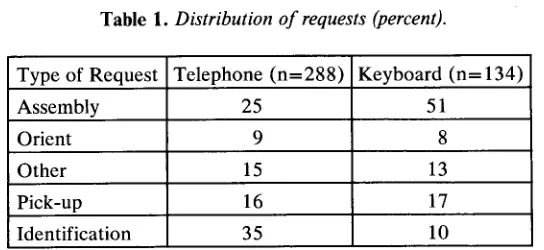
Because most of each dialogue consists of the making of requests, the first analysis examined the frequency of the various kinds of requests in the corpus of five transcripts for each modality. Table 1 displays the findings.
Identification requests, which include questions about whether a referent has been identified, are much more frequent in Telephone dialogues than in Keyboard conversations. In fact, they constitute the largest catego- ry of requests in the former. Because orientation requests, pick-up requests, and other requests are often issued to clarify or follow up on a previous request, it is not surprising that they would increase in number (though not as a percentage) with the increase in the use of identification requests. Furthermore, it is sensible that there are about the same number of requests for assem- bly actions (and hence half the percentage) in each mode because the same "assembly work" is accomplished. Therefore, identification requests seem to be the primary request differentiating the two modalities. 18 Notice also that Chapanis et al.'s finding of twice as many words used in spoken over written modes holds true when we consider the number of requests rather than just words.
t8 The only cases of unreliable coding resulted from attempts to code identification requests when they were not obviously separate utter- ances. Most of these unreliable cases were found in the Keyboard dialogues, but were included in the totals for that modality. Thus, using a strict criterion of counting only reliable examples of identification requests, the differences between the two modes are even stronger than shown i~ the table.
i
Philip R. Cohen The Pragmatics of Referring and the Modality of Communication
UTTERANCE C O D I N G
S: "OK. Take that. Now there's a thing called a plunger.
It has a red handle on it,
a greenbottom, and it's got a blue lid.'
J: O K
S: OK now, the small blue cap we talked about before?
J: Yeah
S: Put that over the hole on the side of that tube -
J: Yeah
S: - that is nearest to the top, or nearest to the red handle..
J: OK
S: OK. now. now, the smallest of the red pieces?
J: OK
R E Q U E S T ( P I C K - U P ) L A B E L ( P L U N G E R )
- R E Q U E S T ( I D E N T I F Y - R E F E R E N T ( P L U N G E R ) )
I N F O R M ( C O M P L E T E
( I D E N T I F Y - R E F E R E N T ( P L U N G E R ) ) )
R E Q U E S T ( I N F O R M I F
( I D E N T I F I E D - R E F E R E N T ( T U B E - C A P ) ) )
I N F O R M ( C O M P L E T E
( I D E N T I F Y - R E F E R E N T ( T U B E - C A P ) ) )
R E Q U E S T ( C O V E R ) R E Q U E S T ( I N F O R M I F
( I D E N T I F I E D - R E F E R E N T O U T L E T 1 ))
I N F O R M ( C O M P L E T E
( I D E N T I F Y - R E F E R E N T ( M A I N - T U B E ) ) )
I N F O R M ( C O M P L E T E ( C O V E R ) )
R E Q U E S T ( I N F O R M I F
( I D E N T I F I E D - R E F E R E N T ( P L U G ) ) )
I N F O R M ( C O M P L E T E
( I D E N T I F Y - R E F E R E N T ( P L U G ) ) )
Figure 2.
The telephone fragment coded.
5.2 A n a l y s i s 2: F i r s t - t i m e i d e n t i f i c a t i o n s
Although frequency data are important for computational linguistics, they supply only a coarse description of discourse phenomena and the dialogue itself. For assess- ing the importance of a phenomenon, it is important to discover the context in which it occurs. In our case, the question arises whether the frequent use of identification requests is a function of the modality itself or a function of the dynamics of the discourse (or both). For example, identification requests might arise primarily after referen- tial miscommunication, as in the above Keyboard dialogue. If they did, one might argue that people would speak more carefully to machines than they do to people, leading to less miscommunication and therefore a smaller frequency of identification requests than we found. Consequently, the argument that identification requests are important for computational linguistics research would be weakened. However, Fertig (unpublished) found no significant differences in the frequency of
miscommunication across modes. The observed modality differences in the use of identification requests are there- fore due to other causes.
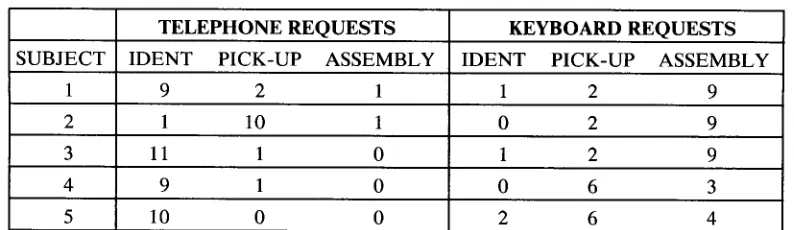
To determine if the frequent use of identification requests holds across subjects within modes, a second analysis of the utterance codings was undertaken that was limited to "first-time" identifications - that is, how objects were first introduced to hearers. Each time a novice first identified a piece in response to a communi- cative act, that act was noted. Furthermore, that act was counted only if it was not preceded by another mention- ing the same part prior to the novice's identification attempt. This analysis therefore examines only requests used to make
first effective
reference to an object. Table 2 indicates the results for each subject in Telephone and Keyboard modes.Subjects were classified as habitual users of a commu- nicative act if, out of 12 pieces, the subject "introduced" at least 9 of the pieces with that act. In Telephone mode,
[image:12.612.58.539.81.468.2]