A Comparative Study of Different Metric
Structures: Thinking on GPU Implementations
Roberto Uribe-Paredes
1, Diego Cazorla
2,José L. Sánchez
2and Enrique Arias
2Abstract—Nowadays, similarity search is becoming a field of increasing interest because these kinds of methods can be applied to different areas in science and engineering, for instance, pattern recognition, information retrieval, etc. This search is carried out over metric indexes decreasing the number of distance evaluations during the search process, improving the efficiency of this process. However, for real applications, when processing large volumes of data, query response time can be quite high. In this case, it is necessary to apply mechanisms in order to significantly reduce the average query response time. In this sense, the parallelization of the metric structures processing is an interesting field of research. For that purpose, modern GPU/Multi-GPU systems offer a very impressive cost/performance ratio. In this paper, the authors make a comparative study of the most popular metric structures and pivot selection methods in order to stablish a set of attractive features from the point of view of future GPU implementations. Therefore, this work represents a state-of-the-art paper setting up the starting point for future parallel implementations of similarity search techniques.
Index Terms—Comparative study, range queries, similarity search, metric spaces.
I. INTRODUCTION
I
N the last decade, the search of similar objects in a large collection of stored objects in a metric database has become a most interesting problem. This kind of search can be found in different applications such as voice and image recognition, data mining, plagiarism detection and many others. A typical query for these applications is the range search which consists in obtaining all the objects that are at some given distance from the consulted object.A. Similarity Search in Metric Spaces
Similarity is modeled in many interesting cases through metric spaces, and the search of similar objects through range search or nearest neighbors. A metric space(X, d) is a set X and a distance function d : X2 → R, such that
∀x, y, z∈Xfulfills the properties of positiveness[d(x, y)≥
0, andd(x, y) = 0 ⇐⇒ x = y], symmetry [d(x, y) =
d(y, x)] and triangle inequality[d(x, y)+d(y, z)≥(d(x, z)]. In a given metric space(X, d)and a finite data setY⊆X, a series of queries can be made. The basic query is the range query (x, r), a query beingx∈Xand a ranger∈R. The range query around x with ranger (or radius r) is the set of objects y ∈ Y such that d(x, y)≤ r. A second type of query that can be built using the range query is k nearest neighbors (kN N), the query being x∈ Xand object k. k nearest neighbors toxare a subsetAof objectsY, such that
University of Magallanes, Avda. Bulnes 01855, Punta Arenas (Chile)1and
University of Castilla-La Mancha, Avda. España s/n, 02071-Albacete (Spain)
2. Email for correspondence:{roberto.uribeparedes}@gmail.com, Telephone
number: +34-967-599200 Ext: {2683}, Fax number: +34-967-599224.
if |A| =k and an object y ∈ A, there is no object z 6∈A such thatd(z, x)≤d(y, x).
Metric access methods, metric space indexes or metric data structures are different names for data structures built over a set of objects. The objective of these methods is to minimize the amount of distance evaluations made to solve the query. Searching methods for metric spaces are mainly based on dividing the space using the distance to one or more selected objects.
Metric space data structures can be grouped into two classes [1], clustering-based and pivots-based methods. The clustering-based structures divide the space into areas, where each area has a so-called centre. Some data is stored in each area, which allows easy discarding the whole area by just comparing the query with its centre. Algorithms based on clustering are better suited for high-dimensional metric spaces. Some clustering-based indexes are BST [2], GHT [3], M-Tree [4], GNAT [5], EGNAT [6] and many others.
There exist two criteria to define the areas in clustering-based structures: hyperplanes and covering radius. The for-mer divides the space into Voronoi partitions and determines the hyperplane the query belongs to according to the cor-responding centre. The covering radius criterion divides the space into spheres that can be intersected and one query can belong to one or more spheres.
In the pivots-based methods, a set of pivots is selected and the distances between the pivots and database elements are precalculated. When a query is made, the query distance to each pivot is calculated and the triangle inequality is used to discard the candidates. Its objective is to filter objects during a request through the use of a triangular inequality, without really measuring the distance between the object under request and the discarded object. Mathematically, these construction and searching processes can be expressed as follows:
• Let {p1, p2, ..., pk} a set of pivots, pi ∈ X. For each elementy of the databaseYthe distance to thekpivots
(d(y, p1), ..., d(y, pk)) is stored. Given a query q and a range r, the distance (d(q, p1), ..., d(q, pk)) to the k pivots is calculated.
• If for some pivot pi the expression
|d(q, pi)−d(y, pi)| > r is holding, then for triangle inequality d(q, y)> r, and therefore it is unnecessary to explicitly evaluate d(q, y). All the objects not discarded by this rule have to be directly compared to the queryq.
Some pivots-based indexes are LAESA [7], FQT and its variants [8], Spaghettis and its variants [9], FQA [10], SSS-Index [11] and others.
structures used to reduce the computational cost to obtain the number of candidates keeping invariable the evaluation of distances.
Many indexes are trees and the children of each node de-fine areas of space. Range queries traverse the tree, entering into all the children whose areas cannot be proved to be disjoint with the query region.
The increased size of databases and the emergence of new data types create the need to process a large volume of data. Then, new research topics appear such as efficient use of computational resources (storage and its hierarchy, proces-sors, network, etc) that allows us to reduce the execution time and to save energy. In this sense, recent appearance of GPUs for general purpose computing platforms offers powerful parallel processing capabilities at a low price and energy cost. However, this kind of platforms has some constraints related to the memory hierarchy.
The present work analyses, by means of a set of exper-iments, the results obtained for several metric structures in order to obtain those attractive features from the point of view of a future GPU-based implementation: selection of pivots and centres techniques, needed storage and simplicity of the data structure.
The paper is structured as follows. In Section II the metric structures considered in this paper are described. In Section III the features to be evaluated are presented. Section IV outlines the experimental results and discussion. Finally, the conclusions and future work are commented in Section V.
II. METRICSTRUCTURES
The metric structures considered in this comparative study are:
a) Generic Metric Structure (GMS): This structure rep-resents the most basic structure: it is an array-type structure based on pivots, which are obtained randomly. From this generic structure could be derived the rest of structures based on arrays and the choice of the pivots could be carried out according to SSS-Index or MSD methods. These pivot selection techniques will be introduced later.
b) Spaghettis: It is an array-type structure based on pivots and does not assume any pivot selection method. However, each entry in the array, that represents distances between an element in the database and the pivots, is sorted with respect to this distance, obtaining a reduction on the execution time by means of a binary search. In this work, the array is sorted considering only the first pivot.
c) SSS-Index: SSS-Index (Sparse Spatial Selection) [11] is basically the generic structure varying the way in which the pivots are selected. The selection methods will be introduced later.
d) LAESA: Like SSS-Index, it is a structure similar to the generic one, but the selection of pivots is carried out by a method called Maximun Sum of Distances (MSD).
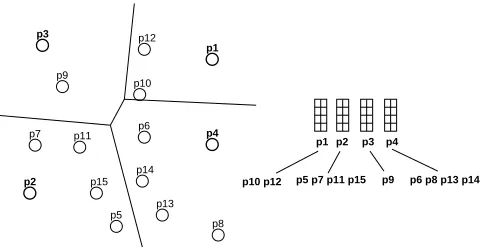
e) EGNAT: Evolutionary GNAT [6] is a clustering tree-type structure derived from GNAT structure. This method pretends to exploit the secondary memory hierarchy (see Figure 1). This structure is far from the array-type of the generic structure.
p14
p13
p8 p15
p12
p6 p7 p11
p9
p2
p5
p4 p10
p2
p1 p3 p4
p10 p12 p5 p7 p11 p15 p9 p6 p8 p13 p14 p1
[image:2.595.306.547.52.176.2]p3
Fig. 1. Construction of EGNAT structure: data space and metric structure.
The choice of these metric structures is motivated because they are representative of this field of knowledge, and we have considered structures based on pivots and on clustering, array-type and tree-type.
With respect to the choice of pivot selection, we have considered the following:
a) Randomly: As the name suggests, this method con-sists in selecting randomly the set of pivots of the database. b) Sparse Spatial Selection (SSS): Sparse Spatial Se-lection [11] is a method to select a dynamic set of pivots or centres distributed in the space. Let (X, d) be a metric space,U⊂XandM the largest distance between all pairs of objects, i. e.M =max{d(x, y)/x, y∈U}. Initially, the set of pivots contains the first element of the collection. After that, an elementxi ∈U, is selected as a pivot if and only if the distance between it and the rest of selected pivots is greater than or equal to M ∗α, being αa constant whose optimum values are close to 0.4 [11] (see Figure 2).
Obj 1
[image:2.595.303.550.439.524.2]Obj 2
Fig. 2. Partition of the space using SSS methods.
c) Maximun Sum of Distances (MSD): MSD (Maximun Sum of Distances) is used in LAESA (Linear Aproximating Search Algorithm) [7], [12]. The underlying idea is to select pivots considering that the distance between them is always the maximum. Starting with a base pivot arbitrarily selected, the distance between the objects and the selected pivot is calculated, and then the new base pivot to be selected is the one located to the maximum distance. The distances are added in a vector to calculate the next base pivot. This is an iterative process that ends when the required number of base pivots is obtained.
III. METRIC STRUCTURES FEATURES TO BE EVALUATED
In the literature it is possible to find a wide range of metric structures for similarity searching [1], [13].
process compensates the complexity of the implementation, taking into account that the decision taken here will condition the future implementation on a GPU-based platform.
The relevant features considered in this work are: a) Execution time: The execution time is a key factor in order to determine the best implementation. In the literature lot of papers are found talking about evaluation of distances [6], [11], but they do not consider execution time (floating point operations and I/O operations), memory accesses, etc. b) Distance evaluations: In general, the reduction on evaluation of distances has been considered as the main goal of the new structures design, and evidently, it has a direct impact on the execution time. However, the high processing capacity of current computational platforms implies that distance evaluation is not always the operation with a higher computational cost. For instance, in GPU-based platforms, sorting operation affects to the execution time more than the evaluation of distances.
c) Storage requirements: A very interesting feature to evaluate is the memory needed to store a structure, even more if memory constraints are considered as is the case of GPU platforms. We have only addressed main memory, being secondary memory out of the scope of this paper. The point is, "how much storage I am willing to sacrifice versus performance?".
IV. EXPERIMENTAL EVALUATION
A. Case of studies and platform
In this section, the case studies used as benchmarks and the testbed considered in this paper are described.
We considered two datasets: a subset of the Spanish dictionary and a color histograms database, obtained from the Metric Spaces Library1. The Spanish dictionary we used is composed of 86,061 words. The edit distance was used. Given two words, this distance is defined as the minimum number of insertions, deletions or substitutions of characters needed to make one of the words equal to the other. The second space is a color histogram. It is a set of 112,682 color histograms (112-dimensional vectors) from an image database. Any quadratic form can be used as a distance, so we chose Euclidean distance as the simplest meaningful alternative.
The results presented in this section belong to a set of experiments with the following features:
• For all data structures considered in this paper, a set
of tests were carried out using pivots from 1 to 1362 for word space and from 1 to 244 for color histograms (see Figure 3). From all the results, only the best results have been plotting.
• For words space, each experiment has 8,606 queries
over a Spaghettis with 77,455 objects. For vectors space, we have used a dataset of 101,414 objects and 11,268 queries.
• For each query, a range search between 1 and 4 was
considered for the first space, and for vectors space we have chosen ranges which allow to retrieve 0.01%, 0.1% and 1% from the dataset.
We have chosen this experimental environment because is the most usual environment to evaluate this kind of
1www.sisap.org
algorithms. Also, these datasets are representative of discrete and continuous searching, respectively.
The hardware platform used is called Marte and belongs to the Albecete Research Institute of Informatics (I3A: http://www.i3a.uclm.es.). Marte is a 2 Quadcore Xeon E5530 at 2.4GHz and 48GB of main memory, and Ubuntu 9.10 (64 bits) Linux Operating System. The compilation has been done using gcc 4.3.4 compiler.
B. Experimental results and discussion
Although results are usually shown considering the search ranges in the X axis, in this paper we have considered a different approach. In order to compare the behaviour of different pivot-based structures, in our opinion, it is more interesting to show the results againts the number of pivots, typically 4, 8, 16 and 32, but also 1 and a number of pivots bigger than32, especially when we need to compare with SSS-Index. This structure does not allow to choose the number of pivots (they are calculated depending on several parameters such as the value of α and the kind of search space) and usually uses a big number of pivots.
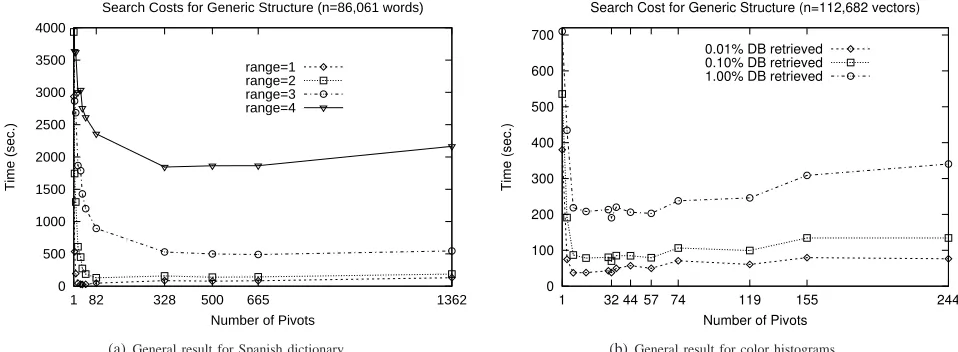
Figure 3 shows an overview of the behaviour of the generic structure based on pivots for both datasets.
Usually in metric structures, the performance of a structure increases with the number of pivots. Nevertheless, as can be seen in Figure 3 for the generic structure, the performance increases till a point (that depends on the range considered, e.g. 32 pivots for range 1) from where the performance remains the same or decreases. This behaviour is common to all the structures as shown in Figure 4. In this figure only the results close to the best one are shown.
Notice that when using the SSS structure we cannot select a priori an exact number of pivots. This is the reason why the minimum number of pivots is 44 (for word space) and
35 (for color histograms). For word space, as the distance is discrete, there are not values between 328 and 665, so the value 500 does not exist in SSS-Index. The value 500
neither is shown in EGNAT because the needed structure is bigger than the RAM memory, swapping is needed and consequently performance is poor.
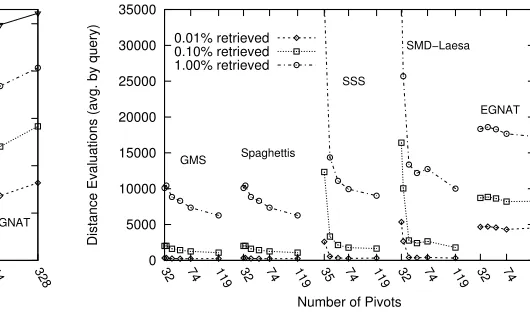
Analysing the results in Figure 4 we can conclude that for small ranges Spaghettis has the overall best performance considering both datasets. The reason is that the use of binary search allows a quick search of the first element in the database inside the range. GMS is very close to Spaghettis performance, and the other 3 structures have a bad behaviour in one of the two datasets, color histograms in MSD and SSS, and the Spanish dictionary in EGNAT. Nevertheless when we consider bigger search ranges, the advantage of Spaghettis is lost; in this case the price in time of the binary search is not worthy because less elements are discarded.
0 500 1000 1500 2000 2500 3000 3500 4000
1 82 328 500 665 1362
Time (sec.)
Number of Pivots
Search Costs for Generic Structure (n=86,061 words)
range=1 range=2 range=3 range=4
(a)General result for Spanish dictionary.
0 100 200 300 400 500 600 700
1 32 44 57 74 119 155 244
Time (sec.)
Number of Pivots
Search Cost for Generic Structure (n=112,682 vectors)
0.01% DB retrieved 0.10% DB retrieved 1.00% DB retrieved
[image:4.595.60.539.76.252.2](b)General result for color histograms.
Fig. 3. Execution time for the implementation considering a generic metric structure (GMS).
0 500 1000 1500 2000 2500 3000
44 328 50044 328 50044 328 50044 328 50044 328
Time (sec.)
Number of Pivots
Search Cost for Implemented Methods (n=86,061 words)
GMS
Spaghettis
SSS
MSD−Laesa EGNAT r=1
r=2 r=3 r=4
(a) General result for Spanish dictionary.
0 100 200 300 400 500 600
32 74 119 32 74 119 35 74 119 32 74 119 32 74 119
Time (sec.)
Number of Pivots
Search Cost for Implemented Methods (n=112,682 vectors)
GMS Spaghettis
SSS
MSD−Laesa
EGNAT 0.01% DB retrieved
0.10% DB retrieved 1.00% DB retrieved
[image:4.595.165.436.327.519.2](b)General result for color histograms.
0 10000 20000 30000 40000 50000
44 328 50044 328 50044 328 50044 328 50044 328
Distance Evaluations (avg. by query)
Number of Pivots
Search Cost for Implemented Methods (n=86,061 words)
GMS
Spaghettis
SSS
MSD−Laesa
EGNAT
r=1 r=2 r=3 r=4
(a)General result for Spanish dictionary.
0 5000 10000 15000 20000 25000 30000 35000
32 74 119 32 74 119 35 74 119 32 74 119 32 74 119
Distance Evaluations (avg. by query)
Number of Pivots
Search Cost for Implemented Methods (n=112,682 vectors)
GMS Spaghettis
SSS
SMD−Laesa
EGNAT
0.01% retrieved 0.10% retrieved 1.00% retrieved
[image:5.595.267.532.68.226.2](b)General result for color histograms.
[image:5.595.47.294.309.435.2]Fig. 5. Distance evaluations for the implementation considering all structures.
TABLE I
EXECUTION TIME FOR THE BEST METHODS ON WORDS SPACE(COLUMN:
RANGE;ROW:DATA STRUCTURE)
Index 1 2 3 4
Spaghettis 32 18.24 270.39 1434.78 2769.06 MSD 32 on GMS 665 25.32 255.37 1453.01 2783.26 MSD 32 on GMS 1362 25.78 251.16 1436.40 2802.90 MSD-Laesa 32 25.84 291.08 1510.68 2879.07
GMS 32 26.18 274.37 1428.74 2754.02
MSD 32 on SSS 665 27.61 249.92 1489.16 2953.54 MSD 44 on random 1362 27.79 168.91 1200.94 2647.71 MSD 32 on SSS 1362 27.86 269.72 1506.16 2910.85 SSS-Index 44 (α= 0.55) 31.93 180.91 1404.33 3153.15
Tables I and II show, in detail, the execution time (in seconds) of the best cases depending on the range or on the data retrieved percentage, respectively. In these tables several modifications of the generic structure are considered. In these modifications the pivots were not selected randomly but following the pivots selection methods used by the other structures. Thus, first we get a subset of pivots from the database randomly or using SSS and then MSD is applied to get the number of pivots for the best performance case (32 or 44 depending on the range). Only modifications of the structure with a good performance are considered in the tables (e.g. “MSD x on SSS y” cases are not included in color histograms because they have a poor performance).
The results obtained for the modified generic structures are good. For small ranges Spaghettis is still better, but when the range increases the new structures have better performance. The advantage of using MSD over a big number of pivots randomly chosen is that it allows to choose the best pivots and the exact number of pivots desired and, consequently, it allows to determine the size of the structure which is an important factor to consider when we need to fit the structure in a virtual page or in GPU memory.
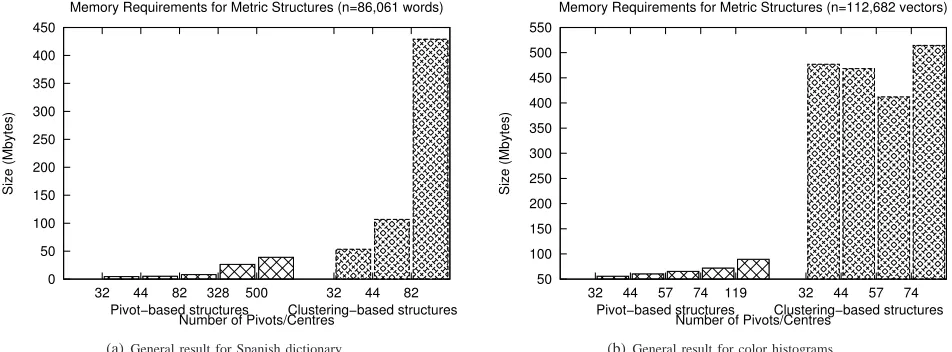
Looking forward to the GPU implementation, the size of the structure is a very important factor. A structure that does not fit into GPU memory will not have a good performance. Figure 6 shows that EGNAT structure is much bigger than pivot-based structures. As expected, the size of
TABLE II
EXECUTION TIME FOR THE BEST METHODS ON COLOR HISTOGRAMS
(COLUMN:DATA RETRIEVED PERCENTAJE;ROW:DATA STRUCTURE)
Index 0.01 0.1 1.0
Spaghettis 32 21.00 54.90 182.87
GMS 32 37.77 69.89 190.74
MSD 32 on GMS 119 39.28 71.85 190.26 MSD 32 on GMS 1014 46.55 96.10 246.91
EGNAT 32 53.01 91.86 180.89
SSS-Index 57 (α= 0.6) 55.77 95.91 249.85
MSD-Laesa 35 91.33 199.75 406.99
the structure in pivot-based structures is directly proportional to the number of pivots. In order to have a more detailed view, the bigger values were removed from the table (e.g. in color histograms EGNAT with119 centres needs2 GBytes, in word space EGNAT with328 centres needs6 GBytes).
Tree-type structures have a good performance when the radius increases, and they are very stable with respect to the number of pivots or centres. This means that we can get a good performance even selecting a small number of centres. The problem with this kind of structure is that when a new node in the tree is created, there is no guarantee that it will be completed, leading to a situation in which the size of the structure can grow a lot depending on how objects are distributed in subtrees. In the tree-based structure used in this paper we obtained that less than 20% of the nodes were completed.
V. CONCLUSIONS ANDFUTUREWORKS
In this work a comparative study of different metric structures has been carried out.
Different types of metric structures and pivot selection methods have been considered in order to make a good comparison. The comparison has been made according to three criteria: execution time, evaluation of distances and storage requirements.
0 50 100 150 200 250 300 350 400 450
32 44 82 328 500 32 44 82
Size (Mbytes)
Number of Pivots/Centres
Memory Requirements for Metric Structures (n=86,061 words)
Clustering−based structures Pivot−based structures
(a)General result for Spanish dictionary.
50 100 150 200 250 300 350 400 450 500 550
32 44 57 74 119 32 44 57 74
Size (Mbytes)
Number of Pivots/Centres
Memory Requirements for Metric Structures (n=112,682 vectors)
Clustering−based structures Pivot−based structures
[image:6.595.61.537.59.235.2](b)General result for color histograms.
Fig. 6. Memory requirements for pivot-based structures (GMS, SSS, MSD, Spaghettis) and clustering-based structures (EGNAT)
structure + MSD and EGNAT. However from the point of view of a future GPU implementation the best one is Generic + MSD due to:
1) By using a generic structure it is not necessary to apply a binary search like Spaghettis. Binary search operation is very expensive in a GPU-based platform in comparison with the evaluation of distances. 2) Using a generic structure the storage requirements are
lower than using a EGNAT structure.
3) Thanks to the combination of generic structure and MSD pivot selection, it is possible to reduce the number of pivots till satisfying the memory constraints inherent to the GPU-based platforms.
To sum up, using the generic structure we will take benefits in terms of execution time, storage and, in addition, the code is more simple.
As we said in the introduction, the work presented in this paper allows us to choose the best option from the point of view of a parallel implementation of the similarity search method based on metric structures on a GPU platform, representing that the future work.
ACKNOWLEDGMENT
This work has been supported by the Ministerio de Ciencia e Innovación, project SATSIM (Ref: CGL2010-20787-C02-02), Spain and Research Center, University of Magallanes, Chile.
REFERENCES
[1] E. Chávez, G. Navarro, R. Baeza-Yates, and J. L. Marroquín, “Search-ing in metric spaces,” in ACM Comput“Search-ing Surveys, September 2001, pp. 33(3):273–321.
[2] I. Kalantari and G. McDonald, “A data structure and an algorithm for the nearest point problem,” IEEE Transactions on Software Engineer-ing, vol. 9, no. 5, 1983.
[3] J. Uhlmann, “Satisfying general proximity/similarity queries with metric trees.” in Information Processing Letters, 1991, pp. 40:175– 179.
[4] P. Ciaccia, M. Patella, and P. Zezula, “M-tree : An efficient access method for similarity search in metric spaces.” in the 23st International Conference on VLDB, 1997, pp. 426–435.
[5] S. Brin, “Near neighbor search in large metric spaces.” in the 21st
VLDB Conference. Morgan Kaufmann Publishers, 1995, pp. 574–
584.
[6] G. Navarro and R. Uribe-Paredes, “Fully dynamic metric access meth-ods based on hyperplane partitioning,” Information Systems, vol. 36, no. 4, pp. 734 – 747, 2011.
[7] L. Micó, J. Oncina, and E. Vidal, “A new version of the nearest-neighbor approximating and eliminating search (aesa) with linear preprocessing-time and memory requirements,” Pattern Recognition Letters, vol. 15, pp. 9–17, 1994.
[8] R. Baeza-Yates, W. Cunto, U. Manber, and S. Wu, “Proximity match-ing usmatch-ing fixedqueries trees.” in 5th Combinatorial Pattern Matchmatch-ing (CPM’94), ser. LNCS 807, 1994, pp. 198–212.
[9] E. Chávez, J. Marroquín, and R. Baeza-Yates, “Spaghettis: An array based algorithm for similarity queries in metric spaces,” in 6th Inter-national Symposium on String Processing and Information Retrieval
(SPIRE’99). IEEE CS Press, 1999, pp. 38–46.
[10] E. Chávez, J. Marroquín, and G. Navarro, “Fixed queries array: A fast and economical data structure for proximity searching,” Multimedia Tools and Applications, vol. 14, no. 2, pp. 113–135, 2001.
[11] O. Pedreira and N. R. Brisaboa, “Spatial selection of sparse pivots for similarity search in metric spaces,” in 33rd Conference on Current Trends in Theory and Practice of Computer Science (SOFSEM 2007), ser. LNCS, vol. 4362. Harrachov, Czech Republic: Springer, January, 20-26 2007, pp. 434–445.
[12] L. Micó, J. Oncina, and R. Carrasco, “A fast branch and bound nearest neighbor classifier in metric spaces,” Pattern Recognition Letters, vol. 17, pp. 731–739, 1996.