Analysis of a paper- and software-based Scrum task board
Author: Jan Segers
Business Information Technology MSc Thesis. Enschede, September 2012.
Management summary
The company that hosts this master thesis project is specialized in offering consultancy in terms of an agile software development method called Scrum. One aspect of a Scrum consultant is to advise the client for making Scrum related choices regarding a certain artifact that is called a task board. A task board can be based on plain paper or on a dedicated software tool. The purpose of this master thesis project was to get insight into the advantages and disadvantages of a paper-based respectively software-based solution to form a common ground for Scrum consultants that have to advice their clients in this regard. To do so, I created in this master thesis guidelines that help companies to decide in choosing the matching task board variant.
This master thesis project draws on input from multiple sources. Available literature has been reviewed, company-internal and company-external experts have been consulted, and field research has been performed by visiting companies that use Scrum to investigate their task board usage. Finally, a set of Scrum software tools has been evaluated. Criteria for comparing software with paper have been identified and defined, next to identifying and defining criteria for a software versus software evaluation.
The results of this master thesis project have shown that paper offers more advantages in terms of a task board than software-based solutions. However the latter become more and more important in times of increasing globalization. The evaluation of Scrum software tools backed up the findings of the paper versus software analysis, which showed that software-based approaches currently suffer from shortcomings in various areas.
During the evaluation of the companies that were subject of the field research, an intermediary solution, which combined the advantages of both variants without introducing any crucial disadvantages, was found.
Next to the software versus paper analysis and the evaluation of software tools, company characteristics have been determined based on the companies that were evaluated. Using the results of the software versus paper analysis, the Scrum software tools evaluation and the company characteristics, guidelines in form of a simple decision graph were created. This decision graph is an easy, yet effective tool for consultants who have to advise companies that face such a decision.
The conclusions of this master thesis project are the following:
• A paper-based task board outperforms its software-based pendant in terms of accessibility, motivation, haptic quality, costs, availability, overhead & communication.
• A software-based task board outperforms its paper-based pendant in terms of flexibility, integration, archiving & distance.
• Companies that want to explore Scrum should stick to the paper-based task board, as it is easy to set up and, moreover, cheap.
• Companies that have multiple Scrum teams, which on top of that also might be geographically dispersed, are literally forced to use a Scrum tool and thus a software-based task board to cover other aspects like reporting, administration, etc.
Thesis structure
The chapters of this thesis should be read consecutively to understand the line of reasoning. However, for readers who are solely interested in specific pieces of information, the following explanation might be helpful:
• To obtain more details about the background of this thesis, the reader should go to chapter 1. This chapter describes the motivation, the research questions and the methodology that is used to answer those questions.
• Chapter 2 can be used to give readers that are not familiar with Scrum a short introduction. This chapter is divided into three sub parts, which describe the Scrum roles, the Scrum events and the Scrum artifacts. Readers who already are familiar with what Scrum is about are free to skip this chapter, with the exception of section 2.6, in which the task board is discussed in more detail.
• The purpose of chapter 3 is to evaluate the paper-based and the software-based task board. The criteria to perform this comparison are described and then applied to both task board types.
• In chapter 4, several major Scrum tools are tested regarding their ability to visualize a Scrum task board. Again, criteria will be defined and used to perform the evaluation.
• Chapter 5 describes different usage scenarios, gives insight into which task board type different companies are using and which company characteristics influence the choice of a certain task board type. Finally, guidelines that support companies to make a choice are given.
Preface
When I received my bachelor degree some years ago, I did not know anything about Scrum or Agile Software Development models at all. I studied Engineering and Computing Science and had worked at several companies as a Software Engineer. However, I was not satisfied – something did not feel right. I liked programming a lot, but most of the time I had to write documentation. Besides that, I felt that the developers around me (including myself) could work much more efficient if people from the higher management would hear our suggestions for improvements. However, this only happened occasionally. I was not satisfied how things were going; as a result I decided to follow a master’s program to get to know more about IT project management. The master course I followed was Business Information Technology at the University of Twente.
During one of my courses, I got a brief introduction to Agile Software Development methods including Scrum: that was the moment when I felt that this might be what I was looking for. Unfortunately, the topic of most of the courses was not related to Scrum so I bought myself some books about it and read them in my spare time. From then on, I was convinced that agile methods would make programming software more efficient and whenever a course gave me the freedom to apply Scrum to other fields I did so.
When it was time to do my master thesis project, I knew that I had to do something Scrum related. I applied for master thesis projects at various companies, one of them being bor!sgloger consulting in Germany. Within a week I was asked for a job interview and directly after that interview I got an assignment – the result of it is this master thesis.
I am deeply indebted to various people. At first I would like to thank both Christiaan Katsma and Klaas Sikkel of course for being my supervisors as well as for telling me something about Agile Software Development methods during their courses – otherwise I could not have written this thesis. This whole master thesis project was quite enjoyable thanks to their great support, including suggestions and feedback on my research.
I also would like to thank Boris Gloger for offering me the possibility to write this master thesis as well as for the topic suggestion and his feedback. I am very grateful to all the people at bor!sgloger consulting, especially to my internal company mentor Bernd Krehoff, who always had a willing ear for all of my questions and issues. The same is true for Kristina Klessmann, who is also writing her master thesis at bor!sgloger consulting and therefore was a supportive co-worker to discuss master thesis related topics. I also want to say thanks to Olga Repnikova who inspired me to think about usage scenarios, one of the key aspects of my master thesis project.
Table of contents
Introduction ... 8
1
Background ... 8
1.1
Motivation ... 10
1.2
Constraints ... 10
1.3
Company ... 10
1.4
Problem statement ... 11
1.5
Research goal ... 12
1.6
Research questions ... 13
1.7
Research question flow ... 15
1.7.1
Research methodology ... 16
1.8
Literature Review ... 16
1.8.1
Expert Opinions ... 16
1.8.2
Field Research ... 16
1.8.3
Software evaluation ... 17
1.8.4
Putting it all together ... 17
1.9
Wrap Up ... 18
1.10
Scrum ... 19
2
Background ... 19
2.1
Roles ... 20
2.2
Team ... 20
2.2.1
ScrumMaster ... 20
2.2.2
Product owner ... 21
2.2.3
Customer ... 21
2.2.4
User ... 21
2.2.5
Management ... 21
2.2.6
Artifacts ... 22
2.3
Vision ... 22
2.3.1
Product Backlog ... 22
2.3.2
Sprint Backlog ... 22
2.3.3
Impediment Backlog ... 22
2.3.4
User Story ... 22
2.3.5
Task ... 23
2.3.6
Burn Down Chart ... 23
2.3.7
Events ... 24
2.4
Sprint ... 24
2.4.1
Estimation Meeting ... 24
2.4.2
Sprint Planning Meeting 1&2 ... 24
2.4.3
Daily Scrum ... 24
2.4.4
Sprint Review ... 24
2.4.5
Retrospective ... 25
2.4.6
How Scrum is put together ... 25
2.5
Task board Types ... 26
2.6
Paper ... 27
2.6.1
Software ... 28
2.6.2
Wrap Up ... 28
2.7
Task board Evaluation ... 29
3
Evaluation Criteria ... 29
3.1
Accessibility ... 30
3.1.1
Flexibility ... 30
3.1.2
Motivation ... 30
3.1.3
Haptic Quality ... 30
3.1.4
Integration ... 30
3.1.5
Costs ... 30
3.1.6
Archiving ... 31
3.1.8
Overhead ... 31
3.1.9
Distance ... 31
3.1.10
Communication ... 31
3.1.11
Paper vs. Software Evaluation ... 31
3.2
Accessibility ... 32
3.2.1
Flexibility ... 32
3.2.2
Motivation ... 32
3.2.3
Haptic Quality ... 33
3.2.4
Integration ... 33
3.2.5
Costs ... 34
3.2.6
Availability ... 34
3.2.7
Archiving ... 34
3.2.8
Overhead ... 35
3.2.9
Distance ... 35
3.2.10
Communication ... 36
3.2.11
Paper vs. Software Overview ... 37
3.3
Paper-based task boards ... 37
3.3.1
Software-based task boards ... 39
3.3.2
Wrap Up ... 40
3.4
Task board Tools ... 41
4
Criteria for selecting Scrum tools ... 41
4.1
Vendors ... 41
4.1.1
Costs ... 41
4.1.2
Platform ... 41
4.1.3
Selected Tools ... 42
4.1.4
Evaluation Criteria ... 42
4.2
Usability ... 44
4.2.1
Resources ... 44
4.2.2
Quality ... 44
4.2.3
Integration ... 45
4.2.4
Functionality ... 45
4.2.5
Motivation ... 45
4.2.6
Costs ... 46
4.2.7
Tool Evaluation ... 46
4.3
Atlassian JIRA ... 46
4.3.1
CollabNet ScrumWorks Pro ... 49
4.3.2
Microsoft Visual Studio 2010 Team Foundation Server / Urban Turtle ... 53
4.3.3
Rally Software ... 56
4.3.4
VersionOne ... 59
4.3.5
Software Tools Overview ... 62
4.4
Wrap Up ... 64
4.5
Company Characteristics & Guidelines ... 66
5
Scenarios ... 66
5.1
Paper ... 67
5.1.1
Paper & Audio/Photo/Video ... 67
5.1.2
Software ... 68
5.1.3
Software with Big Screens ... 68
5.1.4
Paper & Software in Coexistence ... 68
5.1.5
Company settings ... 69
5.2
Company 1 ... 69
5.2.1
Company 2 ... 70
5.2.2
Company 3 ... 71
5.2.3
Company 4 ... 71
5.2.4
Overview ... 72
5.2.5
Potential Company Characteristics ... 73
5.3.1
Analyzing the Company Characteristics ... 75
5.3.2
Applicable Company Characteristics ... 76
5.3.3
Company Guidelines ... 78
5.4
Decision graph ... 78
5.4.1
Coexistence Scenario explained ... 81
5.4.2
Wrap Up ... 82
5.5
Conclusions ... 83
6
Results ... 83
6.1
Limitations & Further Research ... 84
6.2
Reflection ... 86
6.3
Final words ... 88
6.4 References ... 89
List of figures
Figure 1: The waterfall model ... 8Figure 2: Scrum is an iterative model ... 9
Figure 6: Example of a burn down chart ... 23
Figure 7: The Scrum flow ... 25
Figure 8: Simple representation of a task board ... 26
Figure 9: A paper-based task board ... 27
Figure 10: A software-based task board ... 28
Figure 11: JIRA Task Board ... 47
Figure 12: JIRA Rapid Board ... 47
Figure 13: ScrumWorks Pro Task Board ... 50
Figure 14: Urban Turtle task board ... 53
Figure 15: Rally task board ... 56
Figure 16: VersionOne task board ... 59
Figure 17: Company guidelines in form of a decision graph ... 78
List of tables
Table 1: Putting the research aspects together ... 17Table 2: Criteria found in stages ... 29
Table 3: Criterion properties ... 32
Table 4: Evaluation comparison ... 37
Table 5: Tools matched with criteria ... 42
Table 6: Criteria for evaluating tools ... 43
Table 7: Software tools criteria with their properties ... 44
Table 8: Atlassian Service Level Agreements ... 48
Table 9: JIRA costs ... 49
Table 10: CollabNet Service Level Agreements ... 51
Table 11: ScrumWorks Pro costs ... 52
Table 12: Team Foundation Server & Urban Turtle costs ... 55
Table 13: Rally Service Level Agreements ... 57
Table 14: Rally costs ... 58
Table 15: VersionOne Service Level Agreements ... 60
Table 16: VersionOne costs ... 62
Table 17: Scrum Tools Summary ... 63
Table 18: Scrum Tools Results ... 64
Table 19: Task board usage scenarios ... 67
Table 20: Field research summary ... 72
Table 21: Company characteristics found in literature ... 74
Table 22: Mapping company settings to characteristics ... 75
Introduction
1
This chapter defines and explains the master thesis project. First, background information is given to understand the context, followed by the actual motivation to do this master thesis project as well as its constraints. As a company hosts this master thesis project that company will be introduced as well. The second part, the problem statement, defines the resulting research goal as well as the research questions and the corresponding methodology to answer them.
Background
1.1
When doing a software project for a customer, usually the customer has some kind of idea he wants to get realized. He then has sales conversations with different companies and eventually chooses one that he thinks suits best for realizing his idea. After setting up the formalities, the customer will explain his idea to the company in detail to create the requirements, and after the company has the feeling it has enough knowledge to build the software (based on the customers idea) they will usually start right away. On day X, the day when the software has to be ready, the company will see to have finished the software and to deliver it to the customer. The customer receives the software and is pleased, as it matches exactly what he wants.
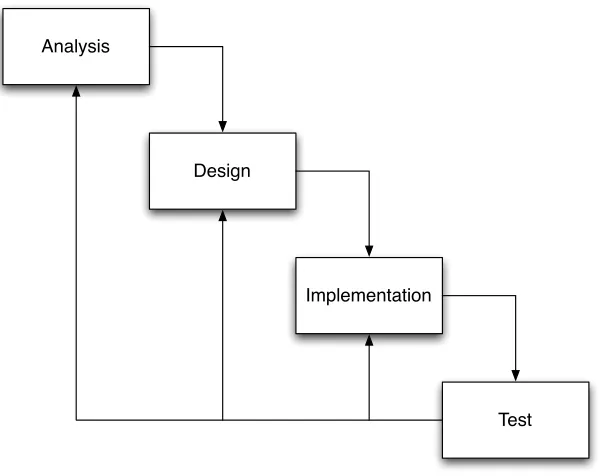
[image:8.595.157.457.355.593.2]Unfortunately, this is only true in theory; in real life such outcomes for projects do not exist. Far too often the problem will be that the company was unable to finish the software in time, that it did involve more money than expected or, even more troublesome, that the software performs in a way the customer does not expect or isn’t even sure to want at all.
Figure 1: The waterfall model
In order to overcome such problems, certain project methods were introduced. One of the most famous (and still used nowadays) methods is the so-called Waterfall model (Royce, 1970). The major advantages in contrast to using no project method at all were that it encourages the developers to specify what the software is supposed to do before developing the system and that it divides development into several steps with intermediate deliverables that lead to the final piece of software. Still, the waterfall model is not a perfect model as it comes with certain disadvantages, namely assuming that all requirements are known and as soon as the design is created, requirements cannot be changed anymore (Kan, p. 9-13, 2002).
In the early 2000’s the field of Software Engineering experienced a radical change when the so-called Agile Manifesto was published. This manifesto was a reaction based on emerging lightweight software methods that had their origins already in the mid 90’s. Those methods promised to lift the heavy burden of the waterfall model from the software engineers by focusing on what was really important: making high quality software in the shortest amount of time possible, without projects that
Analysis
Design
Implementation
were always overdue and without the need for extensive documentation. Agile software development has produced many different forms; forms sharing the same principles, but using different approaches. One of these methods is called Scrum. It is the most often used agile method (Azizyan, Magarian & Kajko-Mattson, 2011).
Scrum defines certain roles (e.g. customer, development team, etc.), events (e.g. a 1-4 week lasting development session called sprint, a daily meeting called daily scrum, etc.) and artifacts (a list containing all aspects the final product should have called product backlog, a list of current tasks called sprint backlog, etc.). Instead of involving the customer only during the analysis phase as is done within the waterfall model in order to map customer wishes to requirements and excluding him after that, with Scrum the customer visits the team at least once each sprint. Besides intensive customer involvement, Scrum also makes sure that after each sprint, a working software product is delivered so that the customer can test it and give direct feedback. Figure 2 visualizes the Scrum flow, which is explained in more detail in chapter 2.
Figure 2: Scrum is an iterative model
In contrast to the waterfall model, Scrum does not divide the project into four subparts. Instead, the project is divided into so-called user stories. A user story is basically a small slice of the product (all user stories are stored in the product backlog) that is more tangible for the customer by providing a concrete example, e.g. how he will experience the component when it is implemented into the product. User stories in turn are divided into tasks, which are generally solvable by one person within a day. By doing so, every member of the team can reflect each day on the tasks he has to do, he is currently doing or he already has accomplished during the Daily Scrum standup meeting. The benefits of the user story - task idea is that the work that has to be performed is more concrete to the team and to the customer and that it is less complex at the same time.
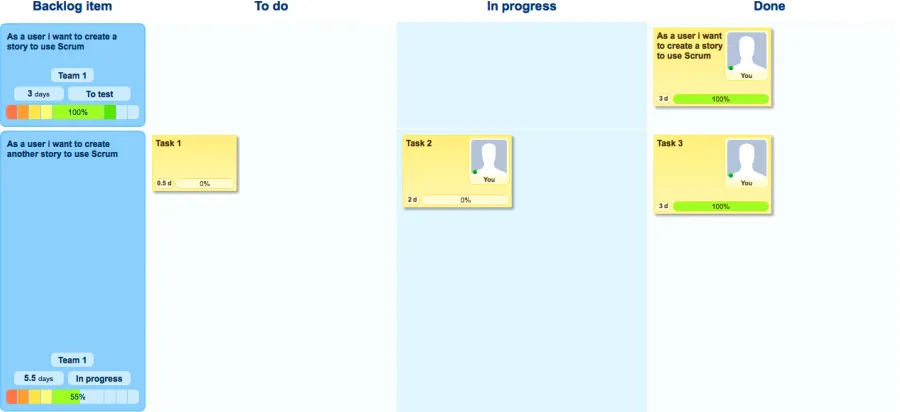
Regarding this master thesis, one particular Scrum artifact is of importance, namely the sprint backlog. When Scrum was invented, the sprint backlog was visualized using a task board with Post-Its. The task board lists the user stories and their corresponding tasks (user stories split into smaller pieces), which are planned for the current sprint. It is one of the most important Scrum artifacts as the task board takes a central position. It is used to support the team to track its work, but it also makes the process of software development more accessible for everyone who is interested in it. As time goes by, software tools were invented that ought to replace the original method of visualizing the task board as the original method is limited when it comes to geographically dispersed teams: A paper-based task board is only available at one single location due to its nature. As a result, a paper-based task board is not suitable for teams working at different geographical locations.
However, this does not mean that a software-based task board outperforms a paper-based one on each level: next to the geographical aspect several other aspects exist for which a paper-based task board might still be the better choice. An example are the costs of a task board: the costs of acquiring a sheet of paper and a bunch of Post-Its cannot be compared to the costs of buying servers as well as a Scrum tool license. It is the purpose of this master thesis project to identify all aspects, to analyze and eventually to evaluate them so that both types of Scrum task boards, paper-based as well as software-based are understood. By doing so, one is able to understand why both types exist and what their advantages and disadvantages are.
Backlog Item 1
Backlog Item 2
Backlog Item 3
Backlog Item 4
Backlog Item 5
Backlog Item 6
....
Backlog Item n
Backlog Item 1
Backlog Item 2 Task 1
Task 2
Task 3
Task 4
Task 1
Task 2 Sprint
Planning 1&2
Sprint Review & Retrospective
Product Backlog
Sprint Backlog
To perform this analysis one has to evaluate a set of Scrum software tools that are capable to represent the task board as all tools have their advantages as well as their disadvantages. Thus, besides comparing the task board types it is also necessary to compare these Scrum software tools in order to find out to which extent they are able to represent the task board.
Companies that are using Scrum have difficulties when it comes to choosing a task board type, be it paper or be it software as both types differ on many levels. Therefore, the evaluation will also include findings that have been made during field research, e.g. by visiting companies that are using Scrum. Practical as well as theoretical input is of importance to create a complete and thorough evaluation. Eventually, the results of these evaluations are used to support companies in making the right choice in terms of the type of a Scrum task board. The different areas that are covered by these evaluations will make sure that the outcome of this master thesis project will make it as easy as possible to support different types of companies.
Motivation
1.2
As stated before, software-based task boards are not superior to paper in every aspect – they both have their right to exist. To put it simply, most of the advantages of the one are the disadvantages of the other and vice versa. After following the hype of software-based task boards, companies became aware that not everything is as good as it seemed to be (Perry, 2008). As a result, companies struggle nowadays when they have to choose between the one and the other. Although the topic is known for years (Perry, 2008), countless expert discussions still take place whether software or paper is superior. The motivation behind this master thesis project is to advise companies in solving that question. Therefore, by providing certain guidelines, this study aims to help those companies in making a choice between paper and software and if decided for software, which type of Scrum tool is best.
Constraints
1.3
As described in section 1.1 Scrum features different types of roles, events and artifacts. Depending on the functionality of a Scrum software tool, most of the events and artifacts can be represented electronically. The focus of this master thesis is on one single Scrum artifact, the task board.
Second, although the Agile Manifesto (Agile Manifesto, 2001) is the basis for all lightweight software development methods, only Scrum will form the basis of this master thesis project. Giving an overview of all the available alternatives to Scrum within the agile context is therefore out of scope. Although multiple companies are subject of the field research that will be conducted, it cannot be guaranteed that the scenarios experienced will match with the ones that every company has to face in making a choice regarding the nature of the task board artifact. As a result, it is not possible to state that the guidelines will be applicable for all existing software development companies as each company is more or less unique. Nevertheless, it is the purpose of this master thesis project to define guidelines that assist as many companies as possible.
Company
1.4
Problem statement
1.5
Research goal
1.6
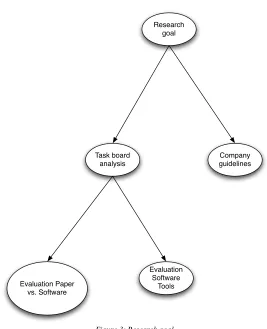
The research goal of this master thesis project is twofold. The first half of the research goal of this master thesis is to perform a thorough analysis of both task board types. The essence of this analysis is again twofold: first, paper-based and software-based task boards are evaluated in general e.g. what are the advantages and disadvantages of paper and software in terms of a task board. Secondly, a set of current Scrum software tools that are able to represent a software-based task board are evaluated. Software tools have individual strengths and weaknesses; the same is true for companies: when comparing them, in some areas they are equal whereas in other areas they are completely different. Therefore, this evaluation is done in order to give an indication which of the current available software tools offers the best solution for each different type of company. See Figure 3 for a graphical representation of the research goal.
However, the emphasis of the first half of the research goal is on the analysis of paper-based and software-based task boards. The reasoning behind this is that the author is well aware of the fact that the status quo of today’s technology can be outperformed easily by the development of tomorrow’s technology. Therefore it is important to perform this analysis so that one is able to understand the line of reasoning behind the general comparison of paper versus software. As a result, the evaluation of the Scrum software tools is merely a snapshot of what is possible today – no one can guarantee that they are valid for any fixed amount of time in the future.
The second half of the research goal is to create guidelines for companies that have to choose a Scrum task board variant. These guidelines have to be common enough so that they are useful for different types of companies. They will be based on derived company characteristics that in their turn are based on aspects e.g. how many developer teams does the company have, how many developers are within one team or whether these teams are geographically dispersed, only to name a few. Based on several research methods (see upcoming section 1.8), positive as well as negative experiences and aspects will be used to form these guidelines.
Research goal
Task board analysis
Evaluation Software
Tools
Company guidelines
[image:12.595.163.430.241.570.2]Evaluation Paper vs. Software
Research questions
1.7
In order to address the problem statement, the following research questions have to be answered to reach the research goal. A total of five research questions will be defined, which are used to get to the research goal step-by-step.
Research question 1
What is the role of a task board in Scrum?
This research question has four sub-questions: 1. What is Scrum?
2. What is a task board?
3. What is a paper-based task board? 4. What is a software-based task board?
Before the actual analysis can be performed, first the Scrum framework has to be explained and described so that the reader is able to understand the context of this master thesis project. Second, after explaining the Scrum framework, the task board Scrum artifact has to be explained in more detail regarding what it exactly is about, which purpose it serves and why it is so important.
Third, the task board variants, namely a paper-based and a software-based task board have to be explained. By answering this research question, it will become clear what is meant by a task board, how it looks like, what it provides and why so many different variants exist.
Research question 2
Which criteria can be used to compare a paper- and a software-based task board?
Now that research question 1 has set the prerequisites, the actual comparison is split in two research questions. Before the comparison can be performed, the purpose of research question 2 is to define criteria that are necessary to compare both variants.
First, the origin of these criteria will be described and second, each single criterion will be explained thoroughly so that it becomes clear to which extent each criterion is used to answer this research question.
Research question 3
What are the advantages and disadvantages of paper-based and software-based task boards?
As described previously, research question 3 uses the outcomes of research question 2 to reach one part of the research goal. After defining criteria to compare both task board variants, the purpose of this research question is to make the actual comparison. To do so, the criteria will be used to unveil the advantages and disadvantages to get a complete image. The analysis is not limited to functionality; also other domains (e.g. usability) have to be explored to obtain a holistic view.
Answering research question 2 and research question 3 will lead to reaching the evaluation of the software versus paper part of the research goal that has been described in section 1.6.
Research question 4
Which software-based task board tools exist and how well do they perform?
This research question has three sub-questions:
1. Which criteria can be used to evaluate task board tools?
2. Does the evaluation back up the results of the previous analysis? 3. To which extent are the tools able to represent a Scrum task board?
In section 1.6, the research question was split into two halves of which the first half was split again into two parts. The first half (task board analysis) of the research goal will be reached by giving an answer to research question 2, 3 and 4.
will be evaluated. The outcome of this evaluation will be used to research whether these findings back up the analysis of the paper versus software that has been done by answering research question 2 & 3. Finally, the tools will be compared to each other in order to determine the extend in which they are able to represent the task board.
Research question 5
Which Scrum task board-related company characteristics and guidelines can be defined?
This research question has four sub-questions:
1. Which usage scenarios regarding the task board do currently exist?
2. Which task board type do companies use and how satisfied are they with them? 3. Which company characteristics can influence the choice of a task board type? 4. How can these company characteristics be used to create guidelines?
This research question has to be answer in order to reach the second half of the research goal, namely to create guidelines that support companies in making a choice between both task board variants. As the purpose is to create guidelines, it is necessary to know for whom these guidelines are created. Therefore, company characteristics have to be determined that can be linked to certain outcomes of the previous research questions, which in its turn will result into guidelines that are general enough to be applicable by other companies.
The first sub-question aims to collect all current usage scenarios. Two of them are obvious: using a paper-based task board and using a software-based task board. Still, intermediary solutions exist, e.g. teams at different locations could make a photo of their task board every day and send it to the other team so that they can synchronize each others task board. Different companies use different scenarios, therefore it is necessary to summarize them with their positive and negative aspects.
After collecting all possible usage scenarios, the second sub-question is used to determine how satisfied or dissatisfied companies are with their current scenario. To do so, several companies will be visited to evaluate their types of task boards.
As soon as the task board usage scenarios and the outcomes of the companies that were visited are known, the third sub-question is used to evaluate whether certain characteristics exist that influence a company’s task board choice. To do so, potential candidates for such characteristics are analyzed and evaluated whether they are applicable or not.
Research question flow
1.7.1
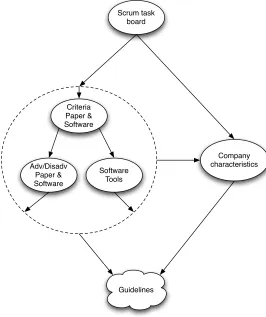
When reading the research questions it becomes clear that they all are somehow connected with each other. The rationale behind this connectivity is the research goal. The research questions follow a hierarchical principle, e.g. research question 1 has to be answered before research question 2 can be answered and research question 2 has to be answered before research question 3 can be answered and so on. The research questions are thus related and this relationship is summarized in Figure 4:
[image:15.595.152.418.174.491.2]This figure can be read the following way: At first, Scrum and its task board have to be explored and described (research question one). Based on these prerequisites, criteria are defined (research question two) for comparing paper- and software-based task boards. Based on these criteria, the actual analysis can be performed by identifying the advantages and disadvantages of paper- and software-based task boards (research question three). These criteria also serve as input for evaluating Scrum software tools that are able to represent the task board (research question four). The outcomes of exploring the Scrum task board (research question one) as well as the outcomes of research question two, three and four are used to define company characteristics as well as the guidelines (research question five) that support companies in choosing the right task board variant.
Figure 4: Research question flow
Scrum task board
Guidelines
Company characteristics Criteria
Paper & Software
Adv/Disadv Paper & Software
Research methodology
1.8
To reach the research goal of this master thesis project, four different types of research methods will be used: a literature review, expert opinions, field research and software evaluation. The following four sections will explain the usage of these methods.
Literature Review
1.8.1
The literature review process was twofold. First, literature was searched to give an introduction to Scrum, e.g. what are its origins, why has it been developed, how does it work and what does it exactly mean – in order to create a common basis for the following sections. To do so, mainly Scrum-related books were taken into account. This literature review is used to write the Scrum-related background in chapter 2.
Second, another literature review was conducted to research what has been written about both task board variants. Other aspects also had to be covered: how do users feel themselves when they work with the task board? Do they like/dislike it? Why do they like/dislike it?
Different search terms were used in order to create an overarching view:
• Scrum taskboard
• Scrum task board
• Taskboard
• Task Board
• Scrum sprint backlog
• Sprint backlog
The yield was rather poor; only around 25 articles were found that were applicable for this master thesis project. Most results were received by using the plain “taskboard” / “task board” keyword, but many of these articles described totally different task boards that had nothing in common with Scrum. The result was split among three different categories:
1. Experiences regarding the usage of a task board 2. Experiences regarding Scrum software tools 3. Agile Tool surveys
The first category is used for deriving criteria regarding the evaluation of software and paper in chapter 3; the second and third category are used to define criteria for evaluating the task board capabilities of Scrum-related software in chapter 4. The third category is also used as input for chapter 5: the company characteristics & guidelines.
However, the results are not used for the before-mentioned chapters exclusively; for example the first category is also used in other chapters besides chapter 3.
Expert Opinions
1.8.2
The second research method used in this master thesis project are expert opinions. There are two types of experts that were consulted: company-internal experts, thus employees of bor!sgloger consulting and company-external experts, who are employees of clients of bor!sgloger consulting.
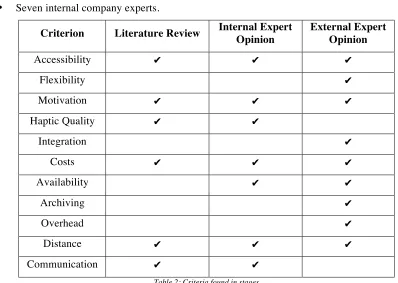
Nine company-internal experts were consulted; they helped to identify the problem, they gave input for criteria that were found during the literature study and were used as source for additional criteria that were not mentioned in literature.
Also five company-external experts were consulted as these experts are using the task board in their daily working lives; they know therefore from experience what works well and what doesn’t. Therefore, they were a valuable source for giving practice-relevant information.
Field Research
1.8.3
Four companies that are using Scrum in combination with either a paper-based or a software-based task board (or even an intermediary solution) were visited. During a period of two to four days, ten Scrum teams were studied in terms of how they were using their task board, be it a paper-based task board or a software-based one.
Additionally, the teams were asked whether they were satisfied with their current task board or not and what they liked or disliked when using it. If available, also the person in charge regarding the choice of the Scrum tool was asked.
Software evaluation
1.8.4
Finally, several software-based task board tools that are currently available on the market were evaluated. In order to do so, the results of the paper versus software analysis in chapter 3 were used in combination with new criteria that were more software-related, like the user interface, performance, etc. The outcome provided an evaluation for each tool based on the defined criteria.
Putting it all together
1.9
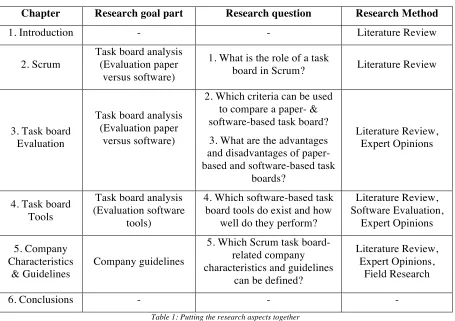
The previous section has introduced different research methods that are used to answer the research questions, that are described in section 1.7. The purpose of this section is putting all those aspects together to create a complete view. The following table shows how these aspects are linked to each other:
Chapter Research goal part Research question Research Method
1. Introduction - - Literature Review
2. Scrum
Task board analysis (Evaluation paper
versus software)
1. What is the role of a task
board in Scrum? Literature Review
3. Task board Evaluation
Task board analysis (Evaluation paper
versus software)
2. Which criteria can be used to compare a paper- & software-based task board? 3. What are the advantages and disadvantages of paper-based and software-paper-based task
boards?
Literature Review, Expert Opinions
4. Task board Tools
Task board analysis (Evaluation software
tools)
4. Which software-based task board tools do exist and how
well do they perform?
Literature Review, Software Evaluation, Expert Opinions 5. Company Characteristics & Guidelines Company guidelines
5. Which Scrum task board-related company characteristics and guidelines
can be defined?
Literature Review, Expert Opinions,
Field Research
[image:17.595.72.527.328.649.2]6. Conclusions - - -
Table 1: Putting the research aspects together
This master thesis has a total of six chapters and this table shows for each chapter the corresponding aspects that have been used.
Chapter 1 is the current chapter and introduces the master thesis project to the reader. It does not answer a research question, as this chapter is used in setting up those questions.
The third chapter sets up criteria for comparing both task board variants with each other, next to stating the advantages and disadvantages of both types. By doing so, the second and third research questions are answered by using the literature review as well as expert opinions as research methods. The first sub-part (evaluation paper versus software) of the task board analysis part of the research goal is reached by providing an answer to the first three research questions.
Chapter 4 zooms in on various Scrum software tools that are able to represent the task board artifact. This chapter is mainly based on software evaluation combined with the literature review and the expert opinions to define evaluation criteria. By doing so, chapter 4 provides an answer to research question four and so the second sub-part (evaluation software tools) of the task board analysis part of the research goal is reached.
Chapter 5 lists various usage scenarios, describes the companies that were visited and evaluates the company characteristics.
Finally, the guidelines are given by using the outcomes of chapter 2, 3, 4 & 5. The research methods used within this chapter are the literature review and the expert opinions next to the field research described previously to answer the last research question. As a result, the second half of the research goal (stating company guidelines) is reached.
Chapter 6 concludes the findings of this master thesis project. Since a conclusion does not introduce new information, neither a research question is answered nor a research method is used in this section.
Wrap Up
1.10
Scrum
2
This chapter will provide an answer to research question one by giving the reader a quick introduction to Scrum regarding its historical background, its roles, events and artifacts and how Scrum works. Finally, a more detailed description of the task board will be given. Readers who are already familiar with Scrum can skip this chapter with the exception of section 2.6, which describes both task board variants in a detailed manner.
Background
2.1
When researching the origins of Scrum, one becomes aware of the fact that the framework behind Scrum was developed way before this framework was actually called Scrum. Already back in 1986, Hirotaka Takeuchi & Ikujiro Nonaka (Hirotaka & Nonaka 1986) defined a new approach for developing products that has similarities with the characteristics of Scrum.
In the early 1990s, Ken Schwaber and Jeff Sutherland both developed simultaneously a software development approach that was practically the same although they were unaware of each other at first. When becoming aware of each other, they combined their ideas, resulting into a paper that was presented to the public at the OOPSLA (Object-Oriented Programming, Systems, Languages & Applications, a research conference) in 1995 (Sutherland & Schwaber 1995). After the first publication regarding Scrum during that conference, their collaboration continued over the years to collect best practices, findings and experiences.
All their efforts resulted into a series of publications in 2001 – one of them was the so-called Agile Manifesto (Agile Manifesto, 2001), which is a set of rules that were created to mark the begin of a new age in software development, namely the rise of the lightweight, agile software development frameworks. This Agile Manifesto was the result of a discussion of 17 software developers that had gathered at one place. It defines four principles:
Individuals and interactions over processes and tools
Working Software over comprehensive documentation
Customer collaboration over contract negotiation
Responding to change over following a plan
Those four principles were in contrast to what was common in these days. Instead of spending months to create an architecture that ought to cover each possible aspect, only a short amount of time was used to create an architecture that features the aspects that were needed when starting the project – new aspects that are needed later on are added dynamically, which results into an evolving architecture. Suddenly, the customer was embedded into the project instead of fighting with him regarding arbitrary contracting details. Thus, these principles introduced a fundamental change to the field of software development. Based on the Agile Manifesto, many other agile software development methodologies were created; one of the most popular ones next to Scrum is called eXtreme Programming (XP). Another important publication in 2001 was the one of Ken Schwaber and Mike Beedle – “Agile Software Development with Scrum” (Schwaber & Beedle 2001) which is considered as the breakthrough of Scrum (Gloger, p. 20, 2011).
Roles
2.2
The Scrum framework is build upon three pillars: roles, events and artifacts. Using those three pillars will enable one to understand how Scrum works (see 2.5). This section explains the different roles available in Scrum, namely the team, the ScrumMaster, the product owner, the customer, the management and the users. Note that within Scrum, roles are not positions and vice versa. A role is linked to a responsibility – which means that someone, who is taking a certain responsibility, can perform a certain role. As a result, Scrum ought to remove hierarchies, which is one of the reasons why it is quite hard to introduce Scrum in companies, especially if the companies are large. People are afraid of loosing their status - but in the end, status has no meaning at all when Scrum is introduced successfully. Coming back to the roles, one can differ between roles that belong to the project team (the team itself of course and the ScrumMaster), roles that affect the project team (the product owner) and more external roles (the customer, the management and the user).
Team
2.2.1
Within Scrum, one strives to create a cross-functional team, where cross-functional means that the team is built up on team members with different specialties. In the context of software development this means that for example testers form part of the team, which is often not the case, but also user interface designers. It is the team that has to deliver the actual project, e.g. the software. In Scrum, the focus is therefore on the team: they have to deliver the product, so they should be supported at its best. As a result, motivation and commitment play an important role. Nowadays, software developers often feel like their work is not valued, they don’t have the feeling that their work contributes to a greater cause. Scrum counters this by providing a clear goal that is formulated by the product owner (see below). Connected to motivation is commitment. The team has to commit to deliver the product, but it will only do so if they get the feeling that the goals are within reach of what is possible. Getting commitments is not easy as single persons are easy to blame when something goes wrong. Within Scrum, the commitment holds true for the whole team. If the team fails to hold the commitment, each team member is accountable; single team members cannot be blamed. Last but not least it is important to let the team perform their work in their own way. This does not mean that the team can do whatever they want to, but within defined boundaries they are free to choose how to work as long as they can hold their commitment. The team therefore organizes itself, every member may choose a piece of the product he or she likes to work on, there is no one who assigns certain tasks to certain team members. The ScrumMaster and the product owner (see the next two sections for both roles) support the team to make sure that they can reach their goals.
ScrumMaster
2.2.2
Product owner
2.2.3
The product owner does not directly belong to the project team like the ScrumMaster. Instead, the project team forms together with the ScrumMaster and the product owner the so-called Scrum team (Gloger, p. 108-109, 2011). The Scrum team can be seen as a mini start-up that is hosted under the roof of the main company. As a result, the product owner can be seen as an executive who has an idea that the team has to build and which he eventually wants to sell. As an example take Google. Google has a big product portfolio; think of the search engine, Gmail, Google Earth or the social network Google+. Each of these products can be seen as mini companies. The existence of such a mini company is dynamic – as long as the product generates profit it continues to evolve, but can be stopped at any day, as happened with Google Wave, for example. Therefore, the product owner works as an intermediary between the company and the project team. He creates projects that generate value for the company. At the beginning of such a project he creates what is called a vision. Such a vision describes the project and has to motivate the project team at the same time. Thus, the team has to be able to feel the vision, it has to identify itself with developing the vision and the team should get the feeling that it is developing something meaningful, something important. Writing a good vision is a crucial skill of the product owner. When the vision is clear to everybody, the product owner starts to make it more tangible by writing so-called user stories (see section 2.3.5). By doing so, the product owner makes sure that the team is able to transform his vision into a product – a product that generates a positive return of investment (ROI).
Customer
2.2.4
The customer is the person that funds the project and this is one of the key differences to the role of the product owner. In essence, the customer wants to get a certain problem solved and agrees to trade his money for a solution to his problem. In contrast to the product owner, the customer often does not really know what he wants. Although this sounds contradicting, it explains the role of the product owner, being an intermediary between business (the client who offers money) and the project teams (who can create a solution). One can distinguish two types of customers, internal customers and external customers. An internal customer is for example the navigation systems department of a car manufacturer that needs certain circuit boards from the electronics department. Therefore, the navigation systems department is the client who needs a solution to its problem, thus getting a circuit board that fulfills some requirements. Besides, also external customers exist; a matching example would be a shop owner who asks a software company to create a web-shop system according to his or her needs.
User
2.2.5
The user is the one who will work with the product in the end. To continue the example of the shop owner who wants to have a web-shop, it is unlikely that this shop owner will input all the articles he or she wants to sell into the web shop system. Most likely he or she will ask an employee to enter the details of the articles into the system. Using this example it becomes clear why the customer is not necessary the same person as the user. As the user is the main target of the product the team is developing, it is one of the principles of Scrum to embed the user into the project team, matching the approach of cross-functional teams as described above. However, this is often not possible. Still, the team has to get frequent feedback from the user as his or her point of view is of huge importance. One has to keep in mind that the user is the one who is using the product in the end.
Management
2.2.6
Artifacts
2.3
The second pillar of Scrum is about the artifacts. Artifacts are a medium of information; some of them are called information radiators, where others are more tangible and thus are called physical information radiators (Cockburn, p. 76-79, 2001). The following sections will explain the standard artifacts.
Vision
2.3.1
Briefly touched in the previous section, the vision is the starting point of all Scrum projects. The product owner forms the vision and its main purpose is to tell the team what has to be done in such a way that it is motivated. The team has to feel like it is on an important mission, a mission that is crucial for the company’s welfare. As a result, it is very important that the product owner is capable in creating good visions, since a vision’s quality decides whether the project might become successful or not. A good vision is short, but concise; some sentences are already sufficient. A vision can also be spread by using a presentation; the important aspect is that the team is aware of what has to be done.
Product Backlog
2.3.2
To create the product that is described by the vision, it is the job of the product owner to create slices of work. Such a piece of work is called a user story (see for explanation below). Different user stories represent different functionalities of the product. Next to creating those user stories to fill the product backlog (by product backlog a list of features is meant) the product owner has to prioritize them according to their business value. For example, when creating a web shop, it is much more valuable for the owner that the users can pay the products they buy instead of being able to print a certain product description. Therefore, the more important user stories are on top of the product backlog.
Sprint Backlog
2.3.3
Scrum is an iterative development approach. As a result the team has to work on different user stories during each iteration. In Scrum, such an iteration is called “sprint”. For each sprint, the product owner chooses a certain amount of users stories that are on the product backlog. These chosen user stories are put in the sprint backlog. Thus, a sprint backlog is a selection of user stories the team has to complete within the current sprint.
As stated in chapter 1, the sprint backlog is the Scrum artifact, which is the subject of this master thesis project – it is visualized using a task board. The purpose of section 2.6 is to get into detail regarding the task board.
Impediment Backlog
2.3.4
The impediment backlog is mainly used by the ScrumMaster to list all the impediments that influence the performance of the team. Again, this list is prioritized according to the needs of the team, e.g. the team tells the ScrumMaster which impediments are more critical than others. It is the main job of the ScrumMaster to make sure that all impediments are solved as soon as possible.
User Story
2.3.5
A user story is another representation of a product feature. In essence, a user story is one sentence that is based on a predefined structure:
As a user role, I need a functionality so that I get business value (Cohn, p. 25-26, 2005) e.g.:
As a shop owner, I need a payment option so that I can get the money of my clients.
for a software developer it is easier to write a “Hello World” application than to write a complex algorithm. Therefore, a “Hello world” application would have less story points than a complex algorithm, simply due to the fact that at the moment the story is written, the team knows better how to complete the former than the latter.
Task
2.3.6
Although a story can be classified by using story points, it is usually too big to complete without further splitting – work has to be refined (Parnin, Görg & Rugaber 2009). Therefore, a user story has to be split into several tasks, where the idea of a task is that it can be solved by one software developer within one day. Tasks help the team to grasp the aspects behind a story. Picking up the web shop example from the previous section some example tasks could be:
• Identify different types of payment
• Link a credit card to an user account
• Charge the credit card as soon as the payment process is complete
• ...
A finite amount of tasks belong to one user story. If all tasks belonging to a user story have been completed, the story is completed, too.
Burn Down Chart
2.3.7
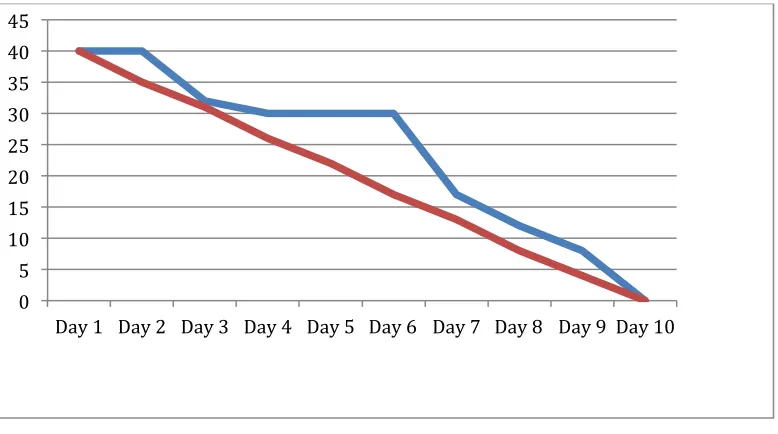
[image:23.595.103.492.418.635.2]The burn down chart is the main measurement metric that is used within Scrum. It is two dimensional, showing the amount of story points left of the current sprint on the y-Axis and the amount of days of the current sprint on the x-Axis. After each day, a line is drawn horizontally. As soon as a story gets completed, a line is drawn vertically – this line is as long as the amount of story points that have been completed. Ideally, that line reaches zero at the end of the sprint, indicating that all user stories have been completed within the estimated time.
Figure 5: Example of a burn down chart
Figure 5 shows an example of a burn down chart for a typical sprint, where the red line is how the burn down chart should look like in an ideal case and where the blue line is an example of a more realistic case.
The burn down chart can be used to determine the speed of a team (called velocity in Scrum), e.g. how many story points it can fulfill within one iteration. By using this outcome, the product owner can get a better estimation in terms of how much the team is capable to do for the next sprint.
0 5 10 15 20 25 30 35 40 45
Events
2.4
Events are the last pillar that have to be explained, before Section 2.5 will show how all three pillars are combined to explain the Scrum flow, e.g. how it works.
Sprint
2.4.1
Briefly touched in the previous section, a sprint is the Scrum terminology for an iteration. Commonly, a sprint lasts two weeks, but three or even four weeks are also possible. Before actually starting to work on the stories, the team has to do some planning that is done in Sprint Planning Meeting 1 & 2, see section 2.4.3. On each day, the team has to perform a little standup meeting that is called Daily Scrum (section 2.4.4) and at the end of each sprint, a sprint review (section 2.4.5) and finally a retrospective (section 2.4.6) has to be done. During the sprint, an estimation meeting (section 2.4.2) should be performed at least once, better twice.
Estimation Meeting
2.4.2
The idea of the estimation meeting is that the team gives the product owner some feedback regarding the amount of story points each story should have. The product owner collects that information and updates the product backlog accordingly. Different techniques (Grenning 2002, Gloger, p. 143-147, 2011) exist that support the team in estimating the stories. After having all stories estimated, the product owner has a perfect estimation, as only the team is able to tell him what they are capable of. By using that information in combination with the teams velocity (see burn down chart, section 2.3.7), the product owner knows how many finished stories he is most likely to receive at the end of a sprint.
Sprint Planning Meeting 1&2
2.4.3
Sprint planning meeting 1 and 2 are used to plan the work for the next sprint. For sprint planning 1, the team meets the product owner, who in turn presents the stories he would like to see finished after the end of the sprint. The team asks questions about everything that is unclear to them. At the end of this meeting, requirements, user acceptance criteria and tests are defined for each user story. Finally, the team has to commit themselves to the amount of stories they think they are able to finish within the sprint. The product owner asks whether the team wants to commit themselves to the first story, to the second story, to the third story and so on, until one team member cannot give his commitment anymore. The team has then created a deal with the product owner; it is their task to finish the user stories they committed to in time.
Sprint planning meeting 2 takes usually place without the product owner. The team comes together and discusses the user stories. For each user story, tasks will be created that help the team to make the user story more tangible and less complex. Next to creating tasks, architectural decisions will be made, classes will be designed and database tables discussed. At the end of this meeting, every single team member knows exactly how all user stories can be solved.
Daily Scrum
2.4.4
The daily scrum is a daily stand up session that lasts a maximum of 15 minutes. During this session, every team member will state what he or she has done, on what he or she is working on and what he or she is planning to do. Furthermore, if a team member struggles with a task, the daily scrum is the moment to get help from other team members.
Sprint Review
2.4.5
Retrospective
2.4.6
After having demonstrated the outcomes of the sprint, the team meets to do a retrospective, where each team member is asked to reflect on what has happened. The retrospective is divided into three parts:
1. Each team member tells the rest of the team which important events (for him or her) have occurred. By doing so, the team gets a different grasp on the whole situation; it is now able to understand the feelings and actions of each other team member.
2. After that, each team member has to state what went well during the sprint. The data is usually collected on Post-Its that are pinned on a board so that the whole team knows what they have accomplished.
3. Finally, the team is asked about what could be improved. This is the moment where the ScrumMaster can update his impediment backlog. Impediments have to be discussed whether they can be solved by the team itself or whether the ScrumMaster has to solve them.
By performing a retrospective, the team gets to know more about each other, and the ScrumMaster is able to uncover certain problems that have to be solved.
How Scrum is put together
2.5
With the help of the three pillars of Scrum described above, one is now able to comprehend the way of working when using Scrum.
At first, a vision is created and shared among the team that is now able to grasp the idea of the product they have to build. The product owner creates a product backlog with the corresponding user stories.
Figure 6: The Scrum flow
When starting the first sprint, the product owner presents some stories and the team commits to as much stories as it thinks it is capable of getting done. Those stories are then put onto the sprint backlog, which represents all the stories of the current sprint. In the sprint planning meeting 1 & 2, the team discusses the stories and creates tasks that are also added to the sprint backlog. After that, the actual development of the product starts.
The team members take the tasks they like to work on and at the beginning of each day, they perform the daily scrum standup meeting to discuss each others progress. While developing the product, the team as well as the product owner might get new ideas, which are formulated as stories and put into the product backlog for upcoming sprints.
After 2-4 weeks (the length of a sprint is a matter of choice), the sprint is at its end and the delivered user stories are demonstrated during the sprint review. As only fully working software is demonstrated, the customer gets a working increment of his or her software at the end of each sprint. Of course, the software has not all the functionalities that are required by the customer, but the functionalities that are delivered are fully working and can thus be used in a productive environment. As soon as the sprint review is finished, the team gets together to perform the retrospective, where they reflect on what has happened during the last sprint, what went well and what could be improved.
Backlog Item 1
Backlog Item 2
Backlog Item 3
Backlog Item 4
Backlog Item 5
Backlog Item 6
....
Backlog Item n
Backlog Item 1
Backlog Item 2 Task 1
Task 2
Task 3
Task 4
Task 1
Task 2 Sprint
Planning 1&2
Sprint Review & Retrospective
Product Backlog
Sprint Backlog