~
thesis presented for the degree of
GDoctor of GJ>hilosophy
in G£1ectrical 'Engineering ,
in the
G(Jniversity of Canterbury,
Christchurch, New Zealand
by
W.R. Fright
B.Eu(Hons
0
ABSTRACT
Theoretical and practical aspects of solving the Fourier phase prob-'if y~
lem are presented.
Reconstructing an image, or the phase of its Fourier transform
(visibility), when only the ·magnitude, or intensity, of its visibility
is given, presents what is called a phase problem. If it is to be a
Four-ier phase problem, then samples of the visibility magnitude must be
avail-able at at least twice the Nyquist rate in each direction in Fourier space.
The phase reconstruction algorithms which are discussed in this thesis can
then be employed.
The fields of technical science in which Fourier phase problems arise
are listed and commented on. Particular attention is paid to
high-resolu-tion optical astronomy, and to a lesser extent to radio astronomy. Recent
advances in astronomical imaging techniques are discussed and illustrated
with results obtained from optical laboratory simulations. The phase
prob-lem associated with X-ray crystallography is also discussed and is shown
not to be a Fourier phase problem.
The question of uniqueness of the solution to the phase problem is
considered. Practical constraints that can be placed on real-world images
are shown to reduce the ambiguity of the solution, especially in more than
one dimension. The constraint of non-negative realness, or positivity, of
the image, is particularly restrictive. Existing theory on the uniqueness
question is reviewed. One-dimensional phase problems usually have
ambigu-ous solutions, whereas in two (or more) dimensions it appears that
solu-tions are almost always unique.
Some phase reconstruction algorithms that have proved effective in
practice are explained. Algorithms for solving one-dimensional phase
problems are nearly all direct, but additional information is usually
necessary to resolve the inherent ambiguity of the solution. Two- (or more)
dimensional algorithms, on the other hand, are nearly all iterative.
The practical implementation of a discrete two-dimensional phase
reconstruction algorithm is described. The algorithm, called crude phase
phase. A method of optimising the fidei.li ty of the estimated phase is
described which requires no a priori information about the image.
Further improvement of the estimated phase is obtained by iterative
processing of the kind pioneered by Fienup. Certain kinds of image are
identified as being difficult to reconstruct unless CPE and the iterative
algorithms are supplemented by ancillary procedures. Two such procedures
are described. The first, called pre-filtering, is designed to reduce
noise. Although CPE and the iterative algorithms are not unstable with
noisy data, the quality of the reconstruction is shown to be enhanced by
pre-filtering. The second ancillary procedure has two stages called
defogging and refogging. They are shown to assist in reconstructing
images which are comprised of faint detail superimposed on large amplitude
backgrounds. Defogging modifies the visibility magnitude before the
actual reconstruction algorithms are invoked. Fine detail in the image is
usually recovered more effectively in this way. In a range of situations
of potential practical importance, the detail is often impossible to
recover without the aid of the ancillary procedures.
CPE, the iterative algorithms and the ancillary procedures are
com-bined into a composite reconstruction scheme. Examples are presented
using both computer-generated data and data measured in the optical
labora-tory. The composite scheme is shown to be particularly useful for
TABLE OF CONTENTS
ABSTRACT
ACKNOWLEDGEMENTS
PREFACE
GLOSSARY
CHAPTER 1
1.1 1.2 1.3 1.4 1.5 1.6 1.7
CHAPTER 2
2.1
2.2
2.3
2.4
CHAPTER 3
3.1 3.2
PRELIMINARIES
The Fourier transform
The Phase Problem
The Far-field
Compact Images
Sampling
~be Discrete Fourier Transform
Autocorrelation
HOW SOME PH.~E PROBLEMS ARISE The Astronomical Setting
2.1.1 Resolution
2.1.2 The Seeing Problem
Astronomical Optical Interferometry
2.2.1 Speckle
2.2.2 Labeyrie
2.2.3 2.2.4 2.2.5 2.2.6 2.2.7 Deconvolution Holography Knox-Thompson
Speckle masking
Shift-and-add
Radio Astronomy
2.3.1 The VLA
2.3.2 Closure phase
X-ray Crystallography
UNIQUENESS
Phase Dominance
Image-form and how i t is Constrained
3.3 Uniqueness in One Dimension
3.4 Uniqueness in Two or More Dimensions
3.5 Another Uniqueness Argument 3.6 Effect of Noise
CHAPTER 4 PHASE RECONSTRUCTION ALGORITHMS 4.1 Algorithms for 1-D
4.1.1 Apodisa·tion
4.1:.2 Zero-matching
4.1.3 Special cases 4.2 Algorithms for 2-D
4.2.1 Gerchberg and Saxton
4.2.2 Fienup
4.2.3 Phase recovery using phase closure
4.2.4 Maximum entropy 4.2.5 Special cases
CHAPTER 5 BATES' ALGORITHM AND ITS PRACTICAL IMPLEMENTATION 5.1 Bates' l-~.lgorithm
5.2 Crude Phase Estimation 5.3 Centro-symmetric objects
CHAPTER 6 ANCILLARY PROCEDURES
6.1 Pre-filtering 6.2 Fog
6.3 Defogging 6.4 Refogging
I CHAPTER 7 A COMPOSITE PHASE RECONSTRUCTION PROCEDURE
-THE 1
CANTERBURY ALGORITHM 1
7.1 Strategy
7.1.1 Pre-processing
7.1.2 Defogging
7.1.3 Crude phase estimation
7 .1. 4 Starting the iterative algorithm
7.1.5 Iterative processing 7.1.6 Enlarging the image mask
7.1.7 Refogging
7.2 Reconstruction from Visibility Data Measured in the Optical Laboratory
7.3 Reconstruction of a Foggy Image 142
7.4 Reconstruction from ASI Data
Simulated in the Optical Laboratory 144
7.5 Reconstruction of an Extended Object 145
CHAPTER 8 FUTURE PROSPECTS AND CONCLUSIONS 153
8.1 Future Prospects 153
8.1.1 Fringe magnification 153
8.1.2 Improvements to CPE 154
8.1.3 New iterative algorithms 157
8.2 Conclusions 160
ACKNOWLEDGEMENTS
I deeply appreciate the guidance and encouragement my supervisor,
Professor R.H.T. Bates, has extended to me thoughout the course of this
research. His prodigious energy has been and will remain a source of
inspiration.
I am grateful for what I have learned from interacting with visiting
scientists, especially Dr G.J. Berzins of the Los Alamos Scientific
Labora-tory, Professor B.R. Hunt of the Digital Image Analysis LaboraLabora-tory, University
of Arizona, Professor M.V. Berry of the Physics Department, University of
Bristol, Dr J.R. Fienup of the Environmental Research Institute of Michigan,
and Dr P.J. Napier, deputy site manager of the United States National Radio
Astronomy Observatory's Very Large Array. I would also like to thank
Professor J.C. Dainty of the Physics Department, the Imperial College of
Science of Technology, for corresponding with Professor Bates and myself
on aspects of the CPE algorithm.
I thank Dr P.T. Gough, Dr R.M. Hodgson, Mr W.K. Kennedy and Mr P.L.
Squires of the Electrical and Electronic Engineering Department, University
of Canterbury, for their guidance during my time as both an undergraduate
and postgraduate student. The willing assistance provided by our
techni-cians, especially Colin Brittenden and Bob Young, and by all of the
Engineering Library staff is gratefully acknowledged.
Special thanks are due to my fellow research student Kathryn L.
Garden and to my old friend Dr Brent
s.
Robinson, now at the BiodynamicsUnit of the Mayo Clinic, not forgetting Don Baily, Dr Jason H.T. Bates,
Dr Phil Bones, Nigel Brieseman, Dr Pat Heffernan, Steve McNeill, Dr Rick
Millane, Robert Minard, Dr Andrew Seagar, Yeo Tat Soon and other members,
past and present, of our Biomedical Engineering group.
I wish to thank Drs Eric Hamilton, Richard Duke and Keith Turner
who gladly wrote for me during examinations. on this note, I would like to
go back eight years and thank Professor J.K. Bargh (now our Head of
Depart-ment), Mr A.H. Barth and Ms R.A. Ballin CBE for having the foresight and
confidence in me, to encourage me to begin engineering despite my then very
Warwick A. Norton and Giles H.T. Bates (while they were Professor
Bates' research assistants during several summers) provided me with their
capable assistance in the optical laboratory; Tim Densem, Geoff Graham
and Alex Joosten helped me both in and out of ~~e laboratory. To these
people I extend my sincere thanks.
During my thesis I benefited greatly from the practical experience
gained by working with Richard D. Jones of the Medical Physics and
Bio-engineering Department, Christchurch Hospital, Grant Carroll and Dr I.M.
Donaldson of the Neurology Department, Christchurch Hospital, and Dr A.E.
McKinnon, formerly computer manager at the Christchurch Clinical School of
Medicine, and now a systems analyst at Lincoln College, Canterbury.
I am a grateful recipient of a New Zealand University Grants Committee
Scholarship.
Finally, I give my deepest thanks to my parents and family, and to
my dear friends Sue Evans and Geoff Cron. I am indebted to Sue, not just
PREFACE
The work that is reported in this thesis began in 1980 when I
en-rolled for a Ph.D. I was following in the footsteps of several Ph.D
graduates who had worked on aspects of various phase problems with my
supervisor, Professor R.H.T. Bates. They had established an optical
laboratory for simulating the atmospheric seeing conditions that plague
high-resolution optical astronomy. They had developed new imaging
tech-niques such as speckle holography, speckle masking and shift-and-add.
Professor Bates suggested to me that we work together on developing
a more'global' approach to phase problems than had previously been
feas-ible. We decided to concentrate on problems of interest in radio
engineer-ing and optical astronomy, keepengineer-ing X-ray crystallography in mind in case
anything promising arose. As things have turned out, my results are
prob-ably of most immediate use in astronomical contexts, but they have very
much wider potential application.
As a lead in to my main research, and as a preliminary study of his
ideas on optical synthesis telescopes, Professor Bates encouraged me to
look at ways of amalgamating different one:-dimensional phase recovery
algorithms. One of Professor Bates• previous students, Dr P.J. Napier,
now deputy site manager of the United States National Radio Astronomy
Observatory's Very Large Array at Socorro, Ne>v Mexico, had explored the
use of complex zero theory in one dimension to solve phase problems of
interest in radio engineering. I took his results and applied them to the
data I had recorded in our optical laboratory, relating to simulations of
astronomical speckle interferometry with a long, thin pupil. The results
have been reported inapaper by Professor Bates and my.self to the Monthly
Notices of the Royal Astronomical Society.
In August 1981 Professor Bates hit on an idea for a direct method of
approximately solving the two-dimensional phase problem. I worked with him
and developed a practical phase recovery algorithm that is the centre-piece
of this thesis. Nore ex-periments were carried out in the optical
labora-tory, this time involving two-dimensional images. The experience gained
led to the development of ancillary procedures to assist the main phase
As my research progressed i t became clear to Professor Bates and myself that no one algorithm would ever be likely to be capable of
success-fully recovering phases under all conditions of practical interest. It
seemed essential to develop an armoury of algorithms and to combine them
into a composite procedure, capable of adapting to the requirements of
the wide range of data which can be expected in any practical application.
The 'Canterbury Algorithm' reported in this thesis is just such a procedure.
There is plenty of room for further improvement of course, and I am already
collaborating with several of Professor Bates' more recent research
stu-dents, trying to help them and attempting to refine my own ideas.
A chapter-by-chapter synopsis of the thesis now follows. I make
clear which parts of each chapter report my own original contributions. I
wrote the software for all of the algorithms and data reductions referred
to in this thesis.
The thesis is written in eight chapters. Chapter 1 introduces the
Fourier transform and related Fourier theory that underlies the phase
reconstruction algorithms described in later chapters. The reader is
intro-duced to the Fourier phase problem which is placed in context with other
kinds of phase problems.
In Chapter 2, the fields of astronomy and x-ray crystallography are
examined in some depth. High-resolution optical and radio astronomy are
of interest here because they present the kinds of phase problems that
are solvable by algorithms described in later chapters. X-ray
crystallo-graphy, on the other hand, is mentioned for quite. the opposite reason. It
is instructive to exruldne this application which presents a non-Fourier
type of phase problem as explained in §2.4.
Chapter 3 is a bridge between the first part of the thesis, which
introduces phase problems, and the latter parts which attempt to solve
them. This chapter seeks to answer questions like: is it the magnitude or
is i t the phase of the Fourier transform that is dominant in determining
the appearance of an image?; how is the ph~se of the Fourier transform
con-strained by the magnitude?; where and in what respects can the solution to
the Fourier phase problem be expected to be unique? Most of this chapter
is of course a review of previous researchers' results. Significant parts
of it are, however, 'Canterbury contributions', the refinements of
collab-orative theoretical specula·tions and detailed analysis by Professor Bates
Several of the known phase•reconstruction algorithms that have been
proven to be effective in practice are reviewed in Chapter 4.
One-dimen-sional and two-dimenOne-dimen-sional approaches are treated. Particular attention
is paid to iterative two-dimensional phase reconstruction schemes,
espec-ially those due to Dr J.R. Fienup of the Environmental Research Institute
of Michigan.
Professor Bates' direct two-dimensional phase reconstruction algorithm
and its practical implementation is described in detail in Chapter 5. This
implementation is due to myself. Examples are presented to illustrate the
kinds of reconstruction that are possible for a range of different objects.
Certain kinds of images are identified in Chapter 6 as being difficult
to reconstruct by any one algorithm alone. Two ancillary procedures and
their remedial action are described. The underlying ideas were generated
jointly by Professor Bates and myself. The development of the procedure
is due to me. This is a short chapter which simply explains how to apply
the ancillary procedures.
Chapter 7 is where the whole phase reconstruction story comes
togethe~ A strategy is described which combines the pre-processing stages
introduced in Chapter 6, the direct phase estimation algorithm of Chapter
5, and the iterative techniques of Chapter 4. Several examples are
pre-sented to show how this composite phase reconstruction scheme performs with
data both computer generated and recorded in the optical laboratory. While
the overall strategy was hammered out in many prolonged discussions which
I had with Professor Bates, all of the actual development was done by
my-self.
In Chapter 8 a number of promising avenues for future research are
suggested. A summary of the thesis and conclusions follow at the end of
this chapter.
This is a convenient place to make some remarks about the diagrams
found throughout the thesis. Four different kinds of computer generated
graphics are used, namely, one-dimensional line plots, contour graphs,
relief maps and grey-scale displays that have been photographed. Whenever
~~ image is presented it is always the complete array that held the image
in the computer which is displayed. The size of this array for all phase
the true image in any example is never larger than 32 x 32 pixels to ensure an oversampling factor of at least 2 (§1.7). Whenever the visibility
mag-nitude is presented it is always the centre one-half that is displayed, with
the origin in the middle. In other words, the FFT array is displayed at
twice the scale used for displaying images, but is truncated to occupy the
same sized picture.
The amplitude range on nearly all figures is normalised since
compara-tive and not absolute amplitudes are usually of interest.
Papers and presentations prepared during the course of this research
are listed below in order of preparation:
Bates R.H.T., Fright W.R., Cady F.H., Berzins G.L. "Speckle processing,
shift-and-add and compensating for instrument aberrations", originally
published in Proc. Advanced Institute on Transformations in Optical
Signal Processing (held in Seattle, Feb. 1982) ; also in
".Transforma-tions in Optical Signal Processing" eds. 1'7. T. Rhodes, J. R. Fienup and
B.E.A. Saleh, SPIE, Bellingham, W.A. (1983).
Bates R.H.T. and Fright W.R. 1982. "Towards imaging with a speckle-inter-ferometric optical synthesis telescope", Hon. Not. R. astr. Soc. 198,
1017-1031.
Fright W.R. and Hinard R.A. 1983. "Optical and digital image processing",
presented at the IPENZ Conference (1982), Proc. IPENZ.
Bates R.H.T., Hunt B.R., Robinson B.S., Fright W.R., Gough P.T. ''Aspects
of speckle interferometric imaging", in Proc. International Conference
on Electronic Image Processing, University of York, U.K. (July 1982),
IEE Conference Publication 214, 164-168.
Fright W.R. and Bates R.H.T. 1982. "Fourier phase problems are uniquely
solvable in more than one dimension: III: computational examples for
two dimensions:, Optik 62, No. 3, 219-230.
Bates J.H.T., Fright W.R., Millane R.P., Seagar A.D., McKinnon A.E., Bates
R.H.T., Bates, G.H.T. and Norton W.A. "Subtractive image restoration.
III: some pratical applicatio:t1s", Optik 62, No. 4, 333-346.
Hunt B .R., Fright W .R., Bates R.H .T. 1983. "Analysis of the
shift-and-add method for imaging through turbulent media", J. Opt. Soc. Am.
73, No. 3, 456-465.
Bates R.H.T. and Fright W.R. 1984. "Reconstructing images from their
Fourier intensities", Chapter 5 of "Advances in Computer Vision and
Image Processing, Vol I: Signal and Image Reconstruction from
Incom-plete Data: Theory and Applications", ed. T.S. Huang, JAI Press, in
press.
Bates J.H.T., Fright W.R. and Bates R.H.T. 1984. "Wiener filtering and
CLEANing in a general image processing context", Mon. Not. R. astr.
Soc., in press.
Bates R.H.T. and Fright W.R. 1984. "Two-dimensional phase restoration",
in "Applied Fourier Analysis", Cambridge University Press, for the
Australian Mathematical Society, in press.
Bates R.H.T., Fright W.R. and Norton W.A. 1983. "Phase restoration is
successful in the optical as well as the computational laboratory",
GLOSSARY
All mathematics and symbols are typed in italics. Symbols
represent-ing vector quantities are underlined. Where special terms are first
defined they are also typed in italics. The first time a symbol or an
abbreviation appears it is defined, but for reference the main ones are
defined below. Note that image space quantities and their Fourier
trans-forms are denoted by lower- and upper-case symbols respectively, unless
other symbols are more appropriate.
(i)
++
Jrx;
J
drJ( )
I I
phase{*
f)
±
< >
u i
n
e
~Re
Im
EVEN Symbols 1 Ja Fourier pair
K-dimensional integral
K-dimensional volume element
magnitude of a complex quantity
phase of a complex quantity
complex conjugate
convolution
correlation. The symbol representing a function is
repeated to represent the function's autocorrelation,
eg
ff
=
f
:k
f
time average, ie T
s (x_, t)
; J
s(x,t)
dt
0
ensemble average, ie
<S (x)>
m
1 M
M
I
m=1
s (x)
m
union of sets identified by the subscript
i.
The subscript is omitted when there are only 2 sets, eg{zm}
U{zm*}
intersection of sets
member of the set
not a member of the set
real part of a complex quantity
imaginary part of a complex number
(ii)
ASI
CPE DFT
FT FFT
LHS
LO
LWH
MEM
OTF psf
RHS
rms
SAA
VLA
VLBI
Abbreviations
astronomical speckle interferometry
crude phase estimation
discrete Fourier transform
Fourier transform
fast Fourier transform
left hand side
local oscillator
Lynds, Worden, Harvey
maximum entropy method
optical transfer function
point spread function
right hand side
root-mean-square
shift-and-add
Very Large Array
Many activities in physics and engineering involve the determination
of one physical quantity from measurements of another. A relationship
between the quantities is formulated by considering the physics of the
situation and applying mathematical analysis. An effort is made to
express the relationship as a transformation which is inve~tible. In this
way it is possible to inverse transform the measurements to determine the
unknown quantity. This general description is familiar to anyone working
in astronomy, microscopy, radio engineering or crystallography. In these
fields, and others listed in Table 1.1, the transformation between
quan-tities is the
Fourier transform.
object
FT
~
visibility
FT
~
image
Figure 1.1. Diagram of Fourier transform (FT) relationships between
quantities.
In each field three quantities can be identified: They are often
given the names
object> visibility
andimageJ
shown diagrammatically inFigure 1.1. The name object is given to the physical quantity about
which information is being discovered. This is because the quantity is
often material, such as a star in astronomy or a microbe in microscopy.
The visibility, the quantity that is· often measured, or 'visible' as is
said in astronomical interferometry, is the Fourier transform of the
object. The inverse Fourier transform of the visibility called the
image. This is the inversion mentioned above. It is clear that the
'measurability' of the visibility affects the image obtained. It should
be noted that not all of the visibility can ever be measured. In addition,
the measuring instrument and environment may contain imperfections. In
an ideal situation, the image is a close facsimile of the object. Hence
form. In some applications the image can be partly measured. Also
there is often information available a priori to any measurement. All
this information can be incorporated into the calculation of the image.
Several schemes for doing this are discussed in Chapter 4. The
termin-ology of object, visibility and image is used throughout this thesis.
Alternative terms for the three quantities are listed in Table 1.1.
Table 1.1 Physical systems involving Fourier transforms.
Application
x-ray and neutron crystallography
microscopy
(acoustic, light and electron)
interferometry and spectroscopy
radio astronomical aperture synthesis
optical astronomical speckle imaging
radio engineering
ultrasonics
acoustics
communications
speech processing
Object
electron density of molecular structure
transmissivity or reflectivity of specimen (complex quantities in
general) "
spatially incoherent
radiating source distributions
coherently radia-ting or induced source distribu-tions
signal
1.1 THE FOURIER TRANSFOP~
Visibility
diffraction pattern
back focal plane field
interferometric visibility
spatial frequency spectrum far-field (Fraunhofer) radiating pattern temporal spectrum Image positive complex positive complex real
In this thesis an image and its visibility are described by complex
scalar functions, denoted by lower- and upper-case characters such as
f(~ and F(~~ where !£and ~are ]{-dimensional vectors in
image space
andspace.
The visibility is in general complex, so that i t possesses a magnitude and phase, both being functions ofu.
The magnitudeIF(u)
I
is called thevisibility magnitude
and the phase phase{F(~} is called thevisibility phase,
whereF(u)
=
IF(u)
I
exp(i phase{F(u)}
( 1.1)i
is the imaginary operator=/(-1).
The namevisibility intensity
is given to the quantity2
IF(u)
I
=F(u) F*(u)
(1. 2)where
*
denotes the complex conjugate. When speaking qualitatively, the name visibility intensity is often used interchangeably withvisi-bility magnitude since the latter is related to the former simply by a
positive square root. The image too is in general complex, although
i t is ne9essarily real in many important physical situations, as is
indicated in Table 1.1, and is illustrated by the examples presented in
Chapter 2.
The Fourier transform is defined by (Papoulis 1962 p.7)
co
F(u)
=
J
(X)f
f(g;;)exp(-i2nu.!E) da(x)
( 1. 3)-CO
where
frxJf
denotes a K-dimensional integral andda()
is a volume element inK-dimensional space. f(x) and F(~ are called a Fourier transform pairwhich is identified by
f(x) ++
F(u)
(1. 4)The inverse Fourier transform is defined by
co
f(:E
=
f
(K)J
F(~
exp(i2nu.?J_) da(u)
( 1. 5)Almost all of the physical quantities studied here are either one
or two dimensional. In these cases the position vectors x and u are
expressed in Cartesian coordinates. This is the most convenient
coordi-nate system for the kinds of computations invoked in later chapters.
co (
F(u)
=I
f(x)
exp(-i2~ux) dx) -co
and in two dimensions is
co
F(u~v)
=J J
f(x~y) exp(-i2~(ux
+
vy))
dxdy
_co
1.2 THE PHASE PROBLEM
( 1. 6)
( 1. 7)
It is a simple matter to reconstruct the image from the visibility,
using (1.5), when both the visibility magnitude and visibility phase are
known. The image thus formed is called the
true image.
An effort to compute the true image, when the visibility magnitude is given accurately,but the visibility phase is given only partially or not at all, presents
what is called a
phase problem.
This definition covers a broad range of problems. Each type of problem may require a different procedure forits solution. It is therefore useful to attempt to classify phase
problems.
To begin with, phase problems can be said to be either imposed or
inherent. In the former case, information is typically to be transmi t·ted
over a channel, or stored in some way. For the sake of storage efficiency
the visibility phase may be represented only partially, or not represented
at all. After receiving or retrieving the stored information, a phase
problem arises vlhen reconstructing the image. Procedures to solve this
type of phase problem are of interest in the fields of speech processing
(Nawab 1982) and image processing (Devaney, Gonsalves and Chidlaw 1977).
Inherent phase problems occur when an object is to be sensed.
Sens-ing involves either, or both, the detection of wave motion, or the formSens-ing
of an image from the wave motion. The measurements of wave motion
corre-spond to the visibility. Visibility phase may then be a problem for one
or more of sevey-al reasons, depending on the application. When detectinq
wave motion, the accuracy of phase measurements decreases with increasing
frequency of wave motion. At frequencies below, say, 10 MHz, the
measure-ment of phase is not difficult. At frequencies higher than this, however,
difficulties can arise in maintaining stable phase references, as occurs
in Very Long Baseline Interferometry (VLBI) (§2.3). In the main this is
due to instrument imperfections causing increasing amounts of phase
higher, it is impossible to directly measure the visibility phase, and
the best that can be done is to store the phase implicitly in some sort
of hologram. With light, however, i t is possible to form an image, and
avoid the problems of measuring the visibility. When wave motion has
to propagate through a distorting medium however, a phase problem
definitely arises. This is the difficulty in optical astronomy (§2.2)
and to a certain degree in radio astronomy, (§2.3), where the distorting
medium is the earth's atmosphere (§2.1.2) . . In electron microscopy, only
intensities can be measured, but in both visibility and image spaces
(Missell 1978). In X-ray crystallography, only the intensity in
visi-bility space can be measured (§2.4).
The causes of phase problems can be summarised as being:
- deliberate reduction of phase data for increased transmission
or storage efficiency,
- insensitivity of receivers to the phase of high frequency
wave motion,
- distortion of the phase of wave motion during propagation, or,
- distortion of the phase of wave motion due to instrument
imperfection.
It is useful to further divide all phase problems into two types.
(i) The
pure phase problem
is posed as: reconstruct ~~e true image, given only the accurate visibility intensity. Certain characteristics of ~~etrue image are irretrievably lost when solving a pure phase problem, but
the appearance, or form, of the true image can still be recovered. This
is discussed further in Chapter 3. (ii) The
partial phase problem
is posed as: reconstruct the true image, given the accurate visibilityintensity, and partial measurements of either, or both, the visibility
phase or the image.
The phase problem in X-ray crystallography, and any type of
inten-sity interferometry, is unarguably a pure phase problem. All of the other
phase problems mentioned above are most often partial phase problems. In
radio astronomy (§2.3), and radio engineering (Jordan and Balmain 1968),
phase measurements are usually feasible. In optical astronomy, extensions
to speckle interferometry (§§2.2.4-2.2.7) are gaining increasing popularity
for obtaining phase measurements. In electron microscopy, the intensity
of the image is partly measured. The imposed phase problems, mentioned
reconstruc-tion from 'Fourier amplitude' problem (van Hove 1982).
The more difficult, and therefore more interesting phase problem is
the pure phase problem. Procedures for solving the pure phase problem
can only be simplified when used to solve the partial phase problem.
This thesis is concerned mainly with procedures for solving the pure
phase problem, in a general context, ie given IF(~
I,
find the form off(x),
with one caveati sufficient measurement must be made of the visi-bility intensity, for Fourier transform techniques to be applied. Whenthis is so, the phase problem is called the
Fourier phase problem.
Thiscondition is discussed quantitatively in §§1.5-1.7. X-ray crystallography
presents a phase problem where this condition is not met, as is explained
in §2.4. Solutions to the crystallographic phase problem, and other
non-Fourier phase problems, are not treated in this thesis. Table 1.2
summarises the above discussion on causes ru,d types of phase problems.
Table 1.2 Causes and types of phase problems
Application
X-ray and neutron crystallography
electron microscopy
radio astronomical aperture synthesis
optical astronomical speckle interferometrJ
optical astronomical speckle imaging
radio engineering
ultrasonics
acoustics
communications
speech processing
Causes
wavelength too short for sensing
wavelength too short for sensing
instrument imperfections
turbulent medium
instrument instability
turbulent medium
turbulent medium
accuracy depends on wavelength
distorting medium
deliberate -), , optimisation
Type
pure, but non-Fourier
partial partial pure partial partial partial
[image:24.595.83.519.375.780.2]1~3 THE FAR-FIELD
Many of the examples of phase problems examined in Chapter 2
involve
wave motion,
such as ultrasonic waves, radio waves, light waves or electron waves. In these cases the Fourier transform relationshipbetween the object and visibility can be derived by considering the
underlying physics of wave propagation. The derivation can be found
in a number of works dealing with subjects like optics (Born and Wolf
1976 Chapter 8, Goodman 1968 Chapter 4) or antenna theory (Silver 1965 §6.2). The latter stages of such derivations, showing the Fourier
trans-form as the limiting case of the Fresnel transtrans-form, are summarised below
for later reference.
Consider a region containing sources of wave motion, called the
source region,
embedded in homogeneous free space. P is an arbitrarypoint within this region, which is shown shaded in Figure 1.2.
The source region is finite in size, or
extent,
and is described asbeing
localised.
Cartesian coordinates (x~y~z) are set up in this space, with the origin chosen arbitrarily to be within the source region.Figure 1.2 Coordinate systems for wave motion radiating from a localised
arbitrary point within the source region, which is shown
shaded.
Any planes, or lines, for which
z
is a constant, are described as beingtransverse.
The largest transverse dimension of the source region is denoted byD.
Wave motion radiating from the source region is des-cribed by the scalar linear wave function W(x~y~z~t). Suppose that thiswave motion is band-limited, and that the wavenumber k, wavelength
A,
and wave propagation speed a are related at a pa~·ticular angular frequency
k
=
2'1T/A ::::: W/c ( 1. 8)It is convenient to have special notation for the wave motion in two
transverse planes. Firstly, the
equivalent source plane
is defined as a plane positioned atz=zo,
such that all of the source region lies in the half space defined byz
<zo
(1. 9)The wave function ~o(xoJYo3t) is used to describe wave motion in the equivalent source plane, ,,vhere the arbitrary point
(xo
3yo)
is called theequivalent source point.
~o(xoJYoJt) is called theequivalent source
distribution,
and corresponds to the object. Hence the nameobject
plane
can be used for the equivalent source plane. Secondly, theobservation plane
is defined as a plane separated from the equivalent source plane by a positive distance z 1 • The '"ave function ~ 1 (x 111 y 1 J t)is used to describe wave motion in the observation plane, where the
arbitrary point
(xl>Yl)
is called theobservation point.
lPl(XlJYl_,t) is conveniently referred to as thediffracted field.
Now imagineequivalent surface sources, or
secondary
sot~ces, placed on theyo)
plane. Huygens' principle as expressed throug-h Green's theorems (Silver
1965 §4.1), confirms that equivalent sources can be chosen such that
the wave motion radiated from the equivalent sources is identical, for
z
>zo,
to that radiated from the source region. The exact expressionsfor the densities of the equivalent sources involve both ~o(xoJYo>t)
and its normal derivative (Silver 1965 §4.1).
The diffracted field corresponds to the visibility, which is the
quantity to be observed. It is impossible in practice to make
obser-vations over an entire plane. So it makes sense to restrict the
observation point to be within a circle, called the
obsel'Vat'ion cirele,
of diameter D1, ie
2
" D12!'4
X'l
+
y 1 ~ < ( 1.10)This limits the resolution with which the equivalent source distribution
can be imaged. Further, the image formed or computed, in any practical
instrument, is limited to a finite area in image space, called the
field
of view.
Since the source region is localised, rays from all pointsP
a finite part of the equivalent source plane. This finite region is
called the
equivalent source region,
and has a maximum transverse dimension denoted byDo.
Because D1 is usually different toD,
i t is clear thatDo
changes the further removed the equivalent source plane is from the source
region. It is usual, therefore, to choose
zo
to be the least value of z to satisfy (1.9). Hence forD
1 fixed, and Zl large enough, i t followsthat
Do ::! D (1.11)
When
z
1 is sufficiently large compared with D 2/A,
the density at anequivalent source point (xo~Yo) becomes effectively proportional to
~(x0,y0~z0, t) (Silver 1965 §4.6), provided (1.9) and (1.10) still hold.
In a practical instrument, the observation circle corresponds to the
aperture
orpupil.
Hence the observation plane can be called theaperture
plane
orpupil plane.
As an example of the use of equivalent sources, consider how they
arise in astronomy. The actual sources are stars, which, as well as being
three dimensional themselves, are at different distances from the earth.
Nevertheless, all stars are represented by two dimensional sources on one
celestial sphere
of very large radius centred on the earth. Stars are then conveniently described in terms of their angular extent andsepara-2
tion. Because
z
1 is extremely large, in this case, compared with D/A,
angular coordinates are effectively equivalent to Cartesian coordinates,
over the field of view.
The relationship between the diffracted field and the equivalent
source distribution can now be examined. To begin with, consider a
spatially coherent
source, for which the time dependence of ~(x,y,z~t) is, for all points(x,y,z) monochromatic
of the wave function can be written as
\j!(x,y~z~t)
=\j!(x,y_,z) e:x:p(iwt)
The functional dependence
( 1.12)
The harmonic time dependence is omitted from equations involving
mono-chromatic wave functions, and is to be 'understood'. From scalar
diffrac-tion theory, the exact reladiffrac-tionship between ~o(xo,yo) and \j!l(Xl~Yl) is
(xo.,yo)
exp(ikr) oos(z.,r)
I
r dxo dyo(1.13)
where ~is the vector shown in Figure 1.2 with magnitude r and oos(~£)
is the cosine of the angle between r and the z axis. If r is small, and
similar in magnitude to
D,
then no useful approximations can be made to (1.13). However in many situations r is much greater than Do~ D1 andA.
It is then feasible to make approximations to terms involving r in {1.13).
If the largest angle between r and the z axis is never greater than
8°, say, then no more than l% error is incurred by replacing cos(~£) by unity, and similarly by replacing the
1/r
term by1/zl.
Theexp(ikr)
term in (1.13) oscillates with period 2u. Because k may be very large,
the errors in a simple approximation to r may be multiplied up to be a
sizeable fraction of 2rr. The exact expression for r is
r (1.14)
which is conveniently expanded using the Binomial theorem. A useful
approximation to r is obtained by discarding terms in the expansion that
are higher than first order, and so
{1.15)
The simplified form of (1.13) that the substitution of (1.15) allows is
called the
Fresnel transform
orF1•esneZ approximation,
and is written as (Goodman 1968 p.60)(L 16)
The range of r over which this approximation is useful defines what is
called the
near field.
When r is large enough that quadratic terms in (1.16) can be discarded, and sufficient accuracy maintained, thethe
Fraunhofer
approximatio~ which is written as (Goodman 1968 p.6l)co
J
f
lJ;o(xo.,yo) exp(-i2rr(xoxl + yoy1JI
O.z1)) dxo dyo-co
( 1.17)
-The point of transition from the near- into the far-field is gradual,
but can be quantified as follows. At an observation point (x1_,y1) , the
maximum differenced in wavelengths between paths from all points (x
0_,y0)_,
is given approximately by
( 1.18)
If
d
=
A/16
is considered to be a small deviation from a plane wave, then the near- and far-field are delineated by (Jordan and Balmain 1968p.498)
( 1.19)
The relationship between the Fraunhofer approximation and the
Fourier transform is made evi_dent by the following approach. The
equiva-lent source distribution is confined to a finite region of the equivaequiva-lent
source plane. However, a function that is piecewise continuous across
the entire (x0_,y0 ) plane is given by (Silver 1965 §6.3)
-'
( l . 20)
Now f(xo.,yo) may be represented by the Fourier integral
co
f(xo.,yo)
=
JJ
F(x1.,y1J exp(i2rr(xoxl+ YoY1)) dx1 dy1 (1.21) -COLet the vector~ have components (Xl.,yl_,/(1- x12 - y12) ) , and the vector
r have components (x0_,y0_,z). The complex exponential function
exp(i2rr(xox 1 + yoy1JJ may then be thought of as the distribution across the plane z = 0 of a plane wave with unit amplitude travelling in the
exp (i21T q.
( 1. 22)z=O
Therefore, (1.21) is the superposition of many plane waves with amplitudes
F(x1.,y1).
Hence the nameanguZar speatrum of plane waves
(Booker and Clemmow 1950) is often given to the function F(x1~y 1), as expressed byF(x1.,y1J
=If
f(xo.,yo) exp(-i2Tr(xoxl
+
yoy1JJ dxo dyo
( 1. 23) -00Inspection of the right hand side (RHS) of (1.17) and (1.23) shows that
the Fraunhofer approximation is essentially a Fourier transform, with
some scaling of coordinates and a constant phase factor. Hence the
far-field diffraction pattern, for a monochromatic source, is the
Fourier transform of the equivalent source distribution.
Now consider a source that is
spatially inaoherent.
This means that the phase difference between the wave motion at any two points in thesource region varies randomly with time. Under these conditions, the
time variations of the equivalent source distribution are no longer of
interest. Instead, it is the distribution of intensity in the equivalent
source plane that is sought. The relative phases of the components in
the angular spectrum of the equivalent source distribution are randomly
distri~uted. Therefore, the wave motion must have a finite bandv1idth,
denoted in wavelengths by
6A.
If6A
is small compared with the meanwavelength
A,
ieA./6A.
»
1 (1.24)then the wave motion is called
quasi-monoahromatia.
The wave function ~(x.,y.,z) now represents the intensity of the wave motion in the band ofwidth 61.. centered at A.. The visibility is the Fourier transform of the
intensity distribution in the equivalent source plane (Goodman 1968
p. 106 ff). Hence the is also a.YJ. intensity distr:Lbution. The
is therefore real and non-negative when the source is spatially
1.4 COMPACT IMAGES
All real-world images are of finite extent. The size of the object
may be small enough to be within the field of view of the instrument. vJhen
the object is larger, however, the is truncated, because the field
of view is finite in any practical instrument. In either case, the
recorded image
f(x)
is inevitably contaminated by noise. The amplitudeand phase of the noise is assumed to be randomly distributed, with
root-mean-square (rms) amplitude denoted by the positive real number E. It
is pointless to worry about the amplitude of the image in regions where
If(~
I
~ E. Therefore the values ofx
for whichlf(x)
I
> s defines what is called thesupport
off(~. It is useful to define animage box
which has sides parallel to the Cartesian axes and which is just large
enough to encompass the support of the image. The image box of the image
f(x)
is denoted byB(f),
and has a kth side of lengthLk(f).
The termextent
is used to denote the size of the image box, ie the linear dimen-sions of the image.If
f(x)
is of finite extent and contains no infinities, which is truefor all real world images, ie
lf(x)
I
<co_, forxeB(fJ
(1.25)then
f(x)
is calledcompact.
An example for is shown in Figure 1.3 .y
Figure 1. 3
•
•
r---:----1
1
I
t I•
I .
I
L
2I
!L ______
..
-
L
I1. 5 SAMPLING
A compact image f(~ can be represented within B(f) to any desired
degree of accuracy by a trigonometric
Fourier series,
referred to here-after simply as a Fourier series. However, the Fourier series, ifpermitted, reproduces f(x) periodically in adjacent image boxes
through-out all of image space. The periodic version of f(~ is denoted by p(x)
and has a Fourier series representation which is written as
where
p(~
=
K
1
I
V(f) k=l
m =-M k kf(x)
=
p(~ _, xe
B(fJF
are complex constants given by mt,_,_,mKco
=
f
(K)J
and
V(f)
is the volume of the image box, defined asV(f)
=J
(KJ
J
1
da(x)B(f)
(1. 26)
(1.27)
(1.28)
( 1. 29)
The
Mk
are chosen in practice to be large enough so that f(~) isrepre-sented to the acc~racy limit set by the noise. The significance in
Fourier space, of the Fourier series in image space, is revealed by
substituting (1.28) into (1.3), thus
K
P(u)
=
I
k=1
( 1. 30)
where oK() is a K-dimensional delt.a function. This equation shows that
Positions of the delta functions in (1.30) define the set of sample points. The samples must be spaced in the kth dimension by aA, where
(1. 31)
which is known as the Whitaker, Shannon, or Nyquist rate (Bracewell 1978 Chapter 10). F(u) is said to be over-sampled when the sample points are spaced more finely than at the Nyquist rate, ie with spacing a~k' where
( 1. 32)
The effect in image space is to surround the image symmetrically
with empty space, which is called packing with zeros. The new image box size, B ... (f) , is larger than B (f) in proportion to the overs amp ling, ie
( 1. 33)
A single version of f(~ can be recovered from p(~) by multiplying by an appropriate window wd(~, thus
f(~ = p(~ wd(::c) ( 1. 34)
When F(u) is sampled at the Nyquist rate, the only possible choice of
wd( x) is the K-dimensional rectangular function rectK6~-/Li(f) ) )yt3JLK( f)))
defined by
K
reatK(xlJ::c2 J.n xK) = TI rect(xkjL
1
~(f)) (1.35)k=1
where (Bracewell 1978 p.52)
reat(::c) = 1 )
I
xI
<fz
(=fz
)lxl
= f§)=
0 )lxl
>fz
The shape of wd(::c) can be 'relaxed' when Ffu} is over-sampled. That is, providing wd( x) is unity within B (f) , and zero outside of B ~ (f) , then it
can take any smooth form in between.
the
sampZing function sp(u)
is introduced, wheresp(J:!} ++ wd(x) ( 1. 36)
It is now convenient to define the
convolution
of two functions, f(~) and g(x), by00
J
(KJJ
f(~g(!!!_- ~
do(s)
(1. 37)-CO
which is identified by
f(x) 0 g(~ ( 1. 38)
On defining G(u) and P(u) by G(u) ++ g(x) and P(J:!} ++ p(!!!), i t follows from substitution of (1.37) into (1.3) that
F(u) G(u) ++ f(~ fJ g(x) ( 1. 39)
which is known as the
convolution theorem
(Bracewell 1978 p.l08). There-fore,fJ sp(u)
=
F(u} ( 1. 40)which is the well known
sampling
theorem
(Bracewell 1978 Chapter 10). In the case of wd( uJ)=
rectK(!!!) , sp (u) sincK( u) , t.vhich is a K-dimensional sine function (Bracewell 1978 p.62), defined byK
( l. 41)
where
sinc(u)
=
(sin(nu))/ nu
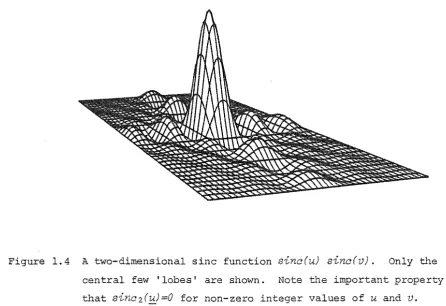
(1.42)The one-dimensional sine function is zero for non-zero integer arguments.
The K-dimensional sine function is the product of K one-dimensional si,nc
Oth column. This important property of sincK(~ is useful in later
chap-ters for explaining uniqueness of phase solutions (§3.5).
Figure 1.4 A two-dimensional sine function
sinc(u) sino{v).
Only the central few 1 lobes 1 are shown. Note t.l)e important propertythat sinc2{~=0 for non-zero integer values of
u
andv.
1.6 THE DISCRETE FOURIER TRANSFORM
In §1.5 it is shown that a compact image can be reconstructed, albeit
periodically repeated, when only samples of the visibility are given.
Similarly, if the visibility is band-limited and is permitted to be
peri-iodically repeated throughout all of visibility space then the visibility
can be reconstructed given only samples of the image. The special Fourier
transform relationship dealing with only samples of both the visibility
and the image is called the
discrete Fourier transform
(DFT) (Stanley 1975 Chapter 9) . The DFT is defined in one dimension byN
Fm
=
I
fn exp(-i2mnn/N)
(1.43)n=1
where
F
=
F(m/N)
andf
=
f(n/N)
so thatN,
which is both the number ofm n
visibility samples and the number of image samples, serves to define the
[image:35.595.67.514.140.446.2]N
f
= (
1/N)I
m
n=l
exp( i2rrmn/NJ ( 1. 44)
where
1/N
is necessa:ry to retain the correct amplitude of the image. The extension to K-dimensions is straightforward (cf (1.26)).The advantage of the DFT is that i t allows data to be Fourier
trans-formed by a digital computer. However the computation time grows as N2
with the number of samples N if the DFT is implemented as a direct
algorithmi.c translation of (1.43) and (1.44), thereby tending to be
impracticably slow, especially when evaluating two-dimensio.nal
trans-forms. A modified algorithmic form of the DFT called the
jast Fourier
transform
(FFT) (Brigham 1974) is more useful since the computation time grows as onlyNZog
2N.
The FFT is used extensively in the sorts ofphase reconstruction algorithms that are described in Chapter 4.
1.7 AUTOCORRELATION
Measurement of only the intensity of the visibility is equivalent in
image space to measuring ~~e
autocorrelation
of the image. That is, the visibility intensity as defined in (1.2) is a Fourier transformthe autocorrelation function
ff(x).
In symbols,IF
(u)
12=
F*(u) F(u)
+--+ff(x)
( 1.45)which is known as the
autocorrelation theorem
(Bracewell 1978 p.llS), whereff(x)
=
f
(K)J
f(!!) f(x +!!) da(s) ( 1. 46)_co
Autocorrelation is identified by
ff( x)
=
f(!!})±
f(iEJ
(1.47)with
Autocorrelation is a specific case of
correlation
(Papoulis 1962 p.244) between two functions,f(x)
andg(x),
defined byf(f!})
*
g(F£)=
f
(K)I
f(!!) g+
x) da(s) ( 1. 48)-CO
Inspection of the integral in (1.48) confirms that, if f(x) and g(F£)
extent of f(!E)
;k
g(x)
can be no greater than the sum of the extents off(x)
andg(!E), ie(1.49)
( 1. 50)
The support of
ff(x)
is a convex figure just fitting insideB(ff),
which is called the
autoaorreZation box.
From the sampling theorem (§1.5), the samples of jF(~!
2 must be spaced, in the kth dimension, by~\, where
( 1. 51)
Comparison of (1.31) ,with (1.51) confirms that samples of visibility
intensity must be spaced by at least twice the Nyquist rate.
A real function that has both positive and negative parts is called
bipoZar;
a real and non-negative function is calledpositive.
Restric-tions that are placed on the visibility, and on the autocorrelation, forcomplex, bipolar and positive images, are summarised in Table 1.3. Note
that a function F(~ is called
aonjugate symmetria
whenF(-u)
=
(u) (1.52)and is called
aentro-symmetric
whenTable 1.3 Restrictions on the visibility and on the autocorrelation.
complex bipolar positive
';) ~ \
F(u)
complex complex complexconjugate conjugate symmetric symmetric
jF(!£}!2
positive positive positivecentro-
centro-symmetric symmetric
ff(!E) complex bipolar positive
·conjugate centro-
CHAPTER 2
HOW SOME PHASE PROBLEMS ARISE
In this chapter, representative examples are given of physical systems
in which phase problems arise. Two types of examples are given. Firstly,
there are those phase problems which satisfy the definition of a Fourier
phase problem (§1.2). Possibly the most topical of these is the phase
problem encountered in astronomy. This is the sort of problem that is
solvable by the procedures introduced in this thesis. That is why many of
the objects used in examples given in later chapters have the appearance
of space objects. Sections 2.1 to 2.3 deal with the branch of astronomy
which is concerned with imaging stellar objects. The 'astronomical scene'
is set in §2.1. Then the principle of interferometry is discussed- a
principle shared in common by radio astronomy and high resolution optical
astronomy. It is usual to think of interferometry as involving the
reception of signals by separated telescopes or antennas. However, the
same process occurs in a single large aperture telescope, ie an
inter-ference pattern is produced. By appropriately processing the interference
information the size of a typical stellar object can be determined. \vith
some procedures, only the autocorrelation of the image is formed. With
other procedures, an estimate of the true image is formed. This depends
on how much phase information can be recovered. Just what can be achieved
in optical and radio astronomy is discussed respectively in §§2.2 and 2.3.
Secondly, there are those types of phase problems which do not satisfy
the definition of the Fourier phase problem given in §1.2. A specific
example of this second type of problem, which is outlined in §2.4, is the
phase problem encountered in X-ray crystallography. The physics behind
the use of the Fourier transform in crystallography is explained first.
From there it is shown why the phase problem for objects which are
repeti-tive structures, such as crystals, is not directly solvable by the
proce-dures with which this thesis is mainly concerned.
2.1 THE ~STRONOMICAL SETTING
The objects of interest in astronomy are planets and moons, the sun,
stars, nebulae, galaxies and other celestial objects. The first two are
either case, the sources of the wave motion are almost always
incoherent. Consequently, the kinds of astronomical images which are of
interest here are positive (§1.3). The majority of observations of these
phenomena involve wave motion at the wavelengths of visible light, infra
red, radio waves and X-rays. Because the objects are removed from the
earth by enormous distances, then at any of the above wavelengths a
Fourier transform relationship holds between the object and the wave motion
incident on the earth (§1.3). At a distance of less than lOkm from the
earth, which is miniscule relative to the distance the wave motion must
travel, is the earth's atmosphere (Figure 2.1). The density of water
vapour and gases in the atmosphere varies continuously, mainly because of
temperature fluctuations (Roddier 1981) . This means that the refractive
index of the atmosphere varies, and wave motion is distorted as it
propa-gates through. In turn this gives rise to what is known as a
problem
for ~bvious reasons. Detailed descriptions of the atmospheric seeing problem are found in the following articles and in the referencesquoted therein: Bates 1982b, 1983, Dainty 1975, 1982.
light
years
-10 kmi
\
\
\ I