DOES COLLABORATIVE GAMEPLAY
ENHANCE LEARING WITH AN
EDUCATIONAL COMPUTER GAME?
Ralf Platschkowski (s0137723)
Under supervision of Henny Leemkuil and Hans van der Meij
University of Twente Faculty of Social Sciences
3
Abstract
This research intends to find out if collaborative gameplay can enhance learning with an educational computer game. Motivational aspects (self-efficacy, flow) stand central in order to distinguish possible differences in learning outcomes between participants playing the educational computer game solitary or in dyads.
At the University of Twente, Netherlands, an experiment with 54 students playing an educational computer game had been conducted. Within the experimental condition, students were playing the game in dyads. The control group consisted of single students playing the educational computer game on their own. In order to measure the motivational conditions of each group, the questionnaire on current motivation (QCM) and the flow short scale (FSK) have been used to measure possible motivational differences between the conditions. After gameplay, each individual participant answered a knowledge test. The results of both conditions have been compared in order to find possible discrepancies.
4
Introduction
1Ever since the evolution of new media, computer games play an integral part in the daily flow of society, whether it is for pure enjoyment, relaxation or for educational purposes (Manovich, 2002). The popularity of computer games is unabated (van der Meij, Albers & Leemkuil, 2011). Researchers and laymen unanimously are astonished by the support computer games can give when it comes to the players motivation, involvement and endurance (Malone, 1981; Mitchell & Savill-Smith, 2004). These findings make computer games especially interesting for the field of education. The application of computer games in education, so-called digital game-based learning, is slowly being adopted into many educational settings (Johnson, Smith, Willis, Levine & Haywood, 2011). Recent research suggests digital game-based learning as “a sound instructional strategy that promotes students engagement” (Schaaf, 2012; see also Charles & McAlister, 2004).
Garris, Ahlers and Driskell (2002) describe “the application of motivational properties of computer games to enhance learning and to accomplish instructional objectives” as the “holy grail for training professionals”. Contemplating computer games for educational purposes nevertheless encounters severe problems. Computer games alone cannot satisfy educational purposes, but rather should be seen as tools to support learning. Leemkuil (as cited in Van der Meij et al., 2011) warns that there is “a serious risk that students never engage in the articulation and explanation that is critical for learning outcomes to appear”. One approach to avoid disengagement might be to stimulate or scaffold self-regulative actions by students to such an extent that knowledge and problem-solving skills are efficiently acquired. This stimulation could be provided by the introduction of collaborative gameplay into digital game-based learning.
Motivation and computer games
Csikszentmihalyi (as cited in McGonigal, 2003) is delighted by the “immersive power that games can have on the motivation of players that engage in games on such a degree that they relinquish basic needs for its sake”. This phenomenon is well known as intrinsic motivation (Malone, 1981; Deci & Ryan, 2000), which when activated in the learner, can result in high-quality learning and creativity (Ryan & Deci, 2000). Basing instruction on motivational factors is widespread among educators and not unique to game design. Keller’s ARCS Model of Motivational Design (Keller, 1987), for instance, has been successfully applied to distance learning and computer games and research suggests that it correlates strongly with generally accepted digital game design principles (Kenny & Gunter, 2007; see also Gunter, Kenny & Vick, 2006). To trigger a high degree of intrinsic motivation, Malone (1981; see also Randel, Morris & Wetzel, 1992) designates three important elements to be implemented into (computer) games: Challenge, fantasy and curiosity. Recent research by Malone and Lepper (as cited in Dickey, 2006) suggests the expansion of the concept of intrinsically motivating (computer) game elements with choice and control.
The research regarding intrinsic motivation led to the development of the concept of
flow: “the optimal psychological experience of becoming one with an activity” (McGonigal, 2003). According to Csikszentmihalyi (as cited in Rieber, 1996), in the state of flow “nothing else seems to matter; the experience is so enjoyable that people
1
5 will do it even at great cost, for the sheer sake of doing it." The exact role of stimulating elements for self-regulative actions in computer games on the flow experience is still vague to researchers. Inal and Cagiltay (2007) found that “challenge and complexity elements of games had mainly more effect than clear feedback on the flow experience”. Hwang, Sung, Hung, Yang and Huang (2012) argue that several studies pointed out that “without incorporating any educational theory or providing supportive tools, the effectiveness of educational computer games might not be as significant as expected”. Wouters and Van Oostendorp (2013) concur by implying that “without instructional support players may use their limited cognitive ability for ineffective activities at the expose of activities that contribute to learning”. It is still open to discuss which instructional features within computer games promote learning to a vast extent. Collaborative gameplay could be a reasonable feature to enhance the intrinsic motivation and flow experience of the player.
Collaborative gameplay (and learning) with computer games
Collaborative learning “describes a situation in which particular forms of interaction among people are expected to occur, which is supposed to trigger learning mechanisms” (Dillenbourg, 1999). Working collaboratively, however, does not in and of itself guarantee collaborative learning (González-González & Blanco-Izquierdo, 2012). A computer game must be sufficiently designed to provide a meaningful context to learning. Foko and Amory (as cited in Meluso, Zheng, Spires & Lester, 2012) found that “playing educational computer games in pairs (compared to playing individually) is more effective than playing individually, resulting in improved visualization, logical and numeric skills of students”. However, Mikropoulos and Natsis (2011) conclude that while “collaborative virtual environments find their place in education”, the direct effects of the different forms of collaboration remain incompletely understood. Collaboration is supposed to stimulate the learner to explicate their knowledge, however playing a game in a dyad does not guarantee the exchange of knowledge as supposed by the game task and eventually “does not significantly enhance learning” (Van der Meij, Albers & Leemkuil, 2011; see also Albers, 2008). Albers (2008) applied free collaboration to their study on collaboration in gameplay, which did not show the predicted beneficial effect (Van der Meij et al., 2011). Scripted collaboration therefore is seen as a next step in research, which could enhance learning with educational computer games (Wouters & Van Oostendorp, 2013; see also Van der Meij et al., 2011; Hummel, Van Houcke, Nadolski, Van der Hiele, Kurvers & Löhr, 2011).
Research questions
6 In order to examine the research question, the subsequent key questions will be tested throughout the research:
1. Does the collaborative group have significantly higher learning outcomes than the solitary group?
2. Does the motivation of the collaborative group differ from the individual group?
3. Does motivation correlate with the learning outcomes?
The key questions assume that when playing an educational computer game collaboratively, the student’s motivation differs from those playing a game solitary. Games that include educational objectives and goals are believed to make learning of curricular subjects more learner-centered, easier, more enjoyable, more interesting, and, consequently, more effective (Kafai, 2001; Papastergiou, 2009). To measure the (intrinsic) motivation of students playing an educational computer game, Csikszentmihalyi’s flow theory (cited in Abuhamdeh & Csikszentmihalyi, 2011) will be applied.
Method
Participants
Fifty-four students of the Faculty of Behavioral Science from the University of Twente in the Netherlands participated in this study. In total, 30 women and 24 men participated. The median age of the participants was 21 (Mean: 21,89). Forty-six students received study credits for their participation. The remainder of the participants volunteered. The participants were divided randomly into two conditions: Twenty-two participants played the game in solitary mode, 32 participants played the game collaboratively in dyads.
Materials
Game
The study has been conducted with the educational computer game De Zuivelmarktgame [milk market game]. This game simulates a milk market and aims at teaching the participants the operating principles of an economic market. It is developed as part of the Pincode method to teach pupils economics in the Dutch middle school. The game can be played online with a modern web browser and is developed to play collaboratively in dyads.
Game experience questionnaire
7 participants were asked to indicate their prior experience with collaborative learning on a 5-point Likert scale. An exact definition of collaborative learning was annotated.
Motivation questionnaire
[image:7.595.64.411.312.378.2]Following the game experience questionnaire, the current motivation was measured with the help of the questionnaire on current motivation, based on a validated instrument by Rheinberg, Vollmeyer and Burns (2001). The questionnaire is clearly directed at the participants motivation after having read the game instructions. The instruments includes 18 items, divided in four constructs: mastery confidence (e.g., ‘I think I am up to the difficulty of the task’); interest (e.g., ‘I like that I can learn new things with this task’); incompetence fear (e.g., ‘I’m afraid I’ll make a fool out of myself’) and challenge (e.g., ‘I am excited about how well I will perform with this task’). Several items have been deleted due to their respective low corrected item-total correlation (< .3). Out of 18 items, in total 13 items remain to be used for further analysis. The resulting reliability values for Cronbach’s α are reported in table 1.
Table 1: Cronbach’s α per current motivation questionnaire construct (pre-test)
Item construct Cronbach’s α
Mastery confidence (3/4)* .70
Interest (4/5) .48
Incompetence fear (4/5) .67
Challenge (2/4) .61
After having played the game, participants were presented a knowledge test consisting of seven open questions. Before answering the knowledge test, the questionnaire on current motivation had been filled in anew using the same validated instrument from Rheinberg et al. (2001). This time, the questionnaire has been clearly directed at the motivation of participants after those have been informed that a knowledge test had to be filled in. The resulting values for Cronbach’s α are reported in table 2. Out of 18 items, 1 item has been deleted due to its low reliability value.
Table 2: Cronbach’s α per current motivation questionnaire construct (post-test)
Item construct Cronbach’s α
Mastery confidence (4/4)* .79
Interest (5/5) .74
Incompetence fear (5/5) .76
Challenge (3/4) .53
* In parenthesis: amount of used (reliable) items / total items questionnaire
[image:7.595.64.412.542.609.2]8
Flow questionnaire
The flow short scale questionnaire is based on a validated instrument developed by Rheinberg, Vollmeyer and Engeser (2003). The questionnaire consists of 13 items (e.g. ‘I was deep in thought’). Ten items represent the flow short scale, while three items form a construct representing ‘concern’. Answers were given on a 5-point Likert scale. Cronbach’s α = .84 for the flow short scale and α = .73 for the ‘concern’ construct. Three items have been deleted due to low values of their resp. low corrected item-total correlation (< .3).
Knowledge test
After having played the game, participants were presented with a knowledge test consisting of seven open questions. The knowledge test measures the participant’s knowledge about principles, concepts and structures presented during gameplay (e.g. ‘during game-play, you experienced a transparent market. In economics, a market is transparent if much is known about (1) what products are available, (2) for what price and (3) where. What do you think would have happened during game-play if the market was not transparent?’). All knowledge was presented either in-game (in form of e.g. newspaper articles) or was supposed to be acquired during gameplay. For each question, a participant could receive between 0 and 3 points. The maximum score of the knowledge test is 21 points. Cronbach’s α = .74.
Procedure
At the beginning of the experiment, participant formed random dyads (in the experimental condition) or have been asked to play the game solitarily (control condition). Research took place in a computer classroom, thus different participants were sitting in the same classroom. It was, however, not possible to watch each others computer screens in order to avoid cheating.
After having filled in the questionnaire on their game experience, participants have been presented with a description of their gaming task. Each team of two became the virtual owner of a fictional company. Within the game, the players could compete within a virtual market against other teams who therefore lead their respective company. One player of a pair adopted the role of a sales manager. His task was make final decisions on the price for three different products (butter, cheese, yoghurt) in monthly intervals (rounds). The second player adopted the role of a product manager, keeping an eye on the demand of the products within the market, regulating the produced amount of the three different products for each round. During gameplay, unexpected events occurred (e.g. ‘Farmers on strike. Milk price reaches record low’). Players in the experimental condition could dicuss the events and eventually adjust their montly production and price to the new situation. Feedback was given quarterly through virtual TV news, presenting the companies financial circumstances and highscore in comparison to their concurrence.
9 environment. The following eleven rounds were played adaptively, which means players could play on their own pace. To avoid an endless playing time, a limit was set to a maximum of eight minutes per round. To finish a round, players had to send their product amounts as well as prices through a virtual mobile phone included into the game interface. The researcher was able to monitor these results through an administration interface. Within this interface, it was also possible to start or end the gaming rounds. If all teams sent in their results prior to the eight minute limit, they could immediately continue with the next round. Each round, all participants had to send in their results before the next round could have begun. This included possible waiting times of several minutes in order to continue to the next round, if one team already sent in their results after e.g. two or three minutes. These participants nevertheless could use the spare time to further analyse the market data. At the end of the game, a final high score was presented to show the ranking of their respective virtual company within the virtual market.
After playing the game, participants have been asked by the researcher to answer several questions of a knowledge test. Prior to filling in the knowledge test, participants filled in the flow short scale and the questionnaire on current motivation.
Analysis
Data gathered regarding the prior gaming experience, time spent (in hours/week) playing computer games as well as the prior collaborative learning experience of the participants has be analyzed with regard to equal distribution. The analyses revealed no statistically significant differences between the conditions presented. If not otherwise stated, the independend t-test has been sued to measure differences between the two conditions. Pearson’s correlations coefficient r has been used to report effect size (Field, 2009).
Results
Does the collaborative group have significantly higher learning outcomes than the solitary group?
10 Table 3: Individual total knowledge test results for the solitary and collaborative condition
* Sig. (2-tailed) = .072
Does the motivation of the collaborative group differ from the individual group?
Second, the question ‘does the motivation of the collaborative group differ from the individual group during the process?’ will be unraveled. At first, results of the questionnaire on current motivation before gameplay will be presented. These results relate to the motivation after having received the game instructions, but before starting to play the actual computer game. Second, the results of the questionnaire on current motivation after gameplay (with regard to the knowledge test) will be unveiled. At last, the results of the flow short scale questionnaire will be examined.
[image:10.595.68.547.407.524.2]The questionnaire on current motivation (before gameplay) consists out of four constructs: mastery, challenge, incompetence fear and interest. The differences between the conditions have been tested using an independent t-test (see table 4). The differences between the two conditions are not statistically significant for all four constructs.
Table 4: QCM results (before gameplay) for the solitary and collaborative condition
Construct Condition Mean SE
Mastery Solitary 10.64 .38
Collaborative 10.66 .35
Inc. fear Solitary 9.05 .56
Collaborative 9.19 .42
Interest Solitary 12.91 .39
Collaborative 12.65 .40
Challenge Solitary 6.50 .29
Collaborative 6.91 .22
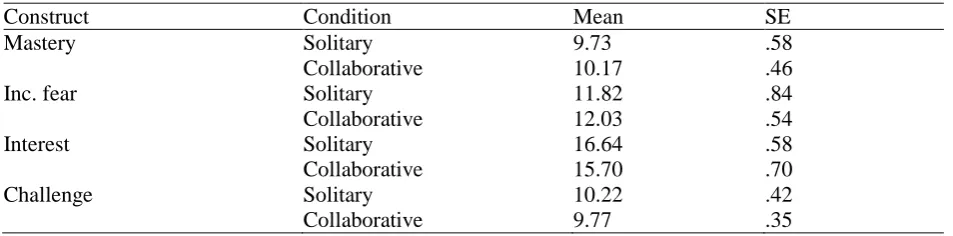
The questionnaire on current motivation conducted after gameplay (with regard to the knowledge test) as well consists of four constructs: mastery, incompetence fear, interest and challenge. The differences between the conditions have been tested using an independent t-test (table 5). The differences between the two conditions, however, are not statistically significant for all constructs.
Table 5: QCM results (before knowledge test) for the solitary and collaborative condition
Construct Condition Mean SE
Mastery Solitary 9.73 .58
Collaborative 10.17 .46
Inc. fear Solitary 11.82 .84
Collaborative 12.03 .54
Interest Solitary 16.64 .58
Collaborative 15.70 .70
Challenge Solitary 10.22 .42
Collaborative 9.77 .35
Condition Mean SD SE
Solitary (22) 13.0 3.75 .80
[image:10.595.69.546.638.756.2]11 At last, the questionnaire to measure the flow experience has been analyzed. The questionnaire consists of two constructs: the flow short scale (8 items) and the ‘concern’ construct (2 items). The differences between the two conditions have been tested using an independent t-test (table 6). The differences between the two conditions are not statistically significant for both constructs.
Table 6: Flow questionnaire results for the solitary and collaborative condition
Construct Condition Mean SE
Flow short scale Solitary 25.45 .97
Collaborative 24.00 1.03
Concern Solitary 5.45 .44
Collaborative 5.00 .28
Does motivation correlate with the learning outcomes?
In a final step, the third key question ‘does motivation correlate with the learning outcomes?’ will be answered. No statistically significant correlation has been found between the flow short scale construct and the knowledge test results (r = .244, p = .075). Likewise, no significant correlation has been found between the ‘concern’ construct and the knowledge test results (r = .186, p = .182).
The data for the ‘mastery’ construct of the questionnaire on current motivation (before gameplay) suggests that it correlates with the learning outcomes of the knowledge test (r = .268, p = .050). For the concepts of ‘incompetence fear’ (r = .008, p = .953) , ‘challenge’ (r = .138, p = .321) and interest (r = .06, p = .67) no significant correlation has been found.
With regard to the questionnaire on current motivation (before knowledge test), the ‘incompetence fear’ construct shows a statistically significant correlation with the learning outcomes (r = .40, p = .003). The data suggests that the level of incompetence fear of the participants correlates with their knowledge test results. The values for the ‘mastery’ (r = .22, p = .114) , ‘interest’ (r = .206, p = .142) and challenge (r = .12, p = .395) constructs have been found not to correlate significantly with the learning outcomes of the knowledge test.
Conclusion and Discussion
12 At first, each educational computer game differs significantly in terms of instructional design, topic, composition and execution. The game used throughout this study, de Zuivelmarktgame, made a first good step in providing a useful playground for collaborative gameplay in combination with playfully learning about a specific topic. However, the execution of the game gave limitations where in fact collaborative learning could have tickled out more than what was experienced during this study. Scripted collaboration within the game is used to give each player a specific task throughout gameplay, however the division was in fact so weak designed that players tended to immediately work together on both allocated roles, making it impossible for the participants to concentrate on their respective part in the story. This is not reprehensible in general, however designers of collaborative, educational computer games should be aware of the fact that divided roles throughout collaborative gameplay (behind one computer screen) might be immediately ignored by the player. Next to that, it seemed that the game environment at first was barely understood by a large part of the participants, except the extra time given to get acquainted with the game environment. Incidential observations during gameplay led to the theory that participants might have been in a state of experimental mode (Norman, 1993). This might have triggered u-mode learning which, according to Hayes and Broadbent (1988), “can lead to situations where players can successfully finish a game, but in retrospect are unable to describe the concepts, principles or structures they used to fulfill this goal”. Participants might have tended to such u-mode learning during gameplay, rather playing by trial and error than using their existing knowledge to guide them through the game.
Another, last observation made was that during gameplay, participants playing in the solitary condition were playing in silence, seemingly being more engaged into the gameplay then participants in the collaborative condition. It might have been even possible that the collaborative gameplay in dyads had a negative effect on the concentration of the participants, which in part could explain why the learning outcomes of the solitary gameplay condition have been significantly higher than those of the collaborative group. Unfortunately, no scientific observations had been made during gameplay with regard to the communication between participants or their engagement while playing. Further research might need to take into account these factors.
What had been measured were the current motivation and flow of each participant. No statistically significant differences between the two conditions (solitary and collaborative gameplay) have been found with regard to motivation. The question remains if a state of flow actually did occur. According to Csikszentmihalyi (as cited in Admiraal, Huizenga, Akkerman, & ten Dam, 2011), concentration, interest and enjoyment must be experienced simultaneously for flow to occur. Especially the factor of concentration, as mentioned earlier, might have been a disadvantage for the collaborative condition that subsequently led to lower results in the knowledge test when compared to the solitary condition.
13 learning with educational computer games. Otherwise, it is difficult to measure motivational aspects accordingly when attempting to find valuable scientific results. Nevertheless, some results have been found in regard with motivational elements correlating with learning outcomes. Maybe not surprisingly, though, did the data suggest that items of the incompetence fear construct correlate with the respective knowledge test results of the participants. Therefore, it can be concluded that inflated (or understated) fear of the participants regarding their own ability might influence on the results of a knowledge test. Consequently, educational computer games need to be designed to such an extent that they lead the learner through the material so much that he is in a state of comfort (or flow), building up self-confidence in order to be able to acquire sufficient knowledge. These findings are in conformity with the theory on the concept of flow, in which a player of (educational) computer games desirably would be placed in order to receive a maximum learning experience.
The mastery construct (before gameplay) as well showed a correlation (p-value of .05) between the participant’s confidence in success and their learning outcomes. The results suggest that the confidence with which a participant entered gameplay did influence the learning experience of the player and eventually resulted in better (or worse) learning results. Due to the marginal correlation value, however, further research needs to be conducted regarding the mastery construct and its possible influence on the learning outcomes to validate these findings.
Other constructs on current motivation as well as regarding the flow theory, however, did not show any correlation with regard to the knowledge test. As mentioned before, it might be difficult to establish desirable motivational conditions of an experimental study within a university context, which delivers rewards to its participants. It might be possible that if the educational computer game used would be studied within an actual classroom, different results could be expected when letting students play the game solitary or collaboratively.
15
References
Admiraal, W., Huizenga, J., Akkerman, S., & ten Dam, G. (2011). The concept of flow in collaborative game-based learning. Computers in Human Behavior, 27(3), 1185-1194. doi:10.1016/j.chb.2010.12.013
Albers, E. (2008). Het collaboratief spelen van een educatieve game. Retrieved from http://essay.utwente.nl/58135/
Charles, D., & McAlister, M. (2004). Integrating ideas about invisible playgrounds from play theory into online educational digital games. In M. Rauterberg (Ed.), ICEC (Vol. 3166, pp. 598-601). Springer. Retrieved from
http://dblp.uni-trier.de/db/conf/iwec/icec2004.html#CharlesM04
Deci, E. L., & Ryan, R. M. (2000). The “what” and “why” of goal pursuits : Human needs and the self-determination of behavior. Psychological Inquiry, 11(4), 227-268.
Dickey, M. D. (2006). Game design and learning: a conjectural analysis of how massively multiple online role-playing games (MMORPGs) foster intrinsic motivation. Educational Technology Research and Development, 55(3), 253-273. doi:10.1007/s11423-006-9004-7
Dillenbourg, P. (1999). What do you mean by collaborative learning? In P. Dillenbourg (Eds.), Collaborative-learning: Cognitive and computational approaches (pp. 1-19). Oxford: Elsevier.
Field, A. (2009). Discovering statistics using SPSS (3rd ed.). Thousand Oaks, CA: Sage Publications, Inc.
Garris, R., Ahlers, R., & Driskell, J. E. (2002). Games, motivation, and learning: A research and practice model. Simulation & Gaming, 33(4), 441-467. doi:10.1177/1046878102238607
González-González, C., & Blanco-Izquierdo, F. (2012). Designing social videogames for educational uses. Computers & Education, 58(1), 250-262.
doi:10.1016/j.compedu.2011.08.014
Gunter, G.A., Kenny, R.F., & Vick, E.H. (2006). A case for a formal design paradigm for serious games. The Journal of the International Digital Media and Arts Association, 3, 93-105.
Hayes, N. A., & Broadbent, D. E. (1988). Two modes of learning for interactive tasks.
Cognition, 28(3), 249-276. doi:10.1016/0010-0277(88)90015-7
Hummel, H.G.K., Van Houcke, J., Nadolski, R.J., Van der Hiele, T., Kurvers, H., & Löhr, A. (2011). Scripted collaboration in serious gaming for complex learning: effects of multiple perspectives when acquiring water management skills. British Journal of Educational Technology, 42(6), 1029-1041. doi: 10.1111/j.1467-8535.2010.01122.x
Hwang, G.-J., Sung, H.-Y., Hung, C.-M., Yang, L.-H. and Huang, I. (2012), A knowledge engineering approach to developing educational computer games for improving students' differentiating knowledge. British Journal of
16 Inal, Y., & Cagiltay, K. (2007). Flow experiences of children in an interactive social
game environment. British Journal of Educational Technology, 38(3), 455-464. doi: 10.1111/j.1467-8535.2007.00709.x
Johnson, L., Smith, R., Willis, H., Levine, A., & Haywood, K. (2011). The 2011 Horizon Report. Austin, Texas: The New Media Consortium.
Keller, J.M. (1987). Development and use of the ARCS model of instructional design.
Journal of Instructional Development, 10(3), 2-10. doi: 10.1007/BF02905780 Kenny, R.F., & Gunter, G.A. (2007). Endogenous fantasy-based serious games:
Intrinsic motivation and learning. International Journal of Human and Social Sciences, 2(1), 8-13.
Leemkuil, H., & de Jong, T. (2011). Instructional support in games. In S. Tobias, & D. Fletcher (Eds.), Computer Games and Instruction. New York: Routledge. Manovich, L. (2002). The language of new media. Cambridge, Ma: MIT Press.
McGonigal, J. (2003). A real little game: The Pinocchio effect in pervasive play. In M. Copier & J. Raessens (Eds.), Level Up Conference Proceedings: Proceedings of the 2003 Digital Games Research Association Conference. Utrecht: University of Utrecht.
Meluso, A., Zheng, M., Spires, H.A., & Lester, J. (2012). Enhancing 5th graders’ science content knowledge and self-efficacy through game-based learning.
Computers & Education, 59(2), 497-504. doi: 10.1016/j.compedu.2011.12.019 Mikropoulos, T.A., & Natsis, A. (2011). Educational virtual environments: a ten-year
review of empirical research (1999-2009). Computers & Education, 56(3), 769-780. doi: 10.1016/j.compedu.2010.10.020
Mitchell, A., & Savill-Smith, C. (2004). The use of computer and video games for learning: a review of the literature. London: Learning and Skills
Development Agency. Retrieved from http://www.lsda.org.uk/files/PDF/1529.pdf
Norman, D.A. (1993). Things that make us smart. Defending human attributes in the age of the machine. Reading MA: Addison-Wesley Publishing Company. Randel, J.M., Morris, B.A., & Wetzel, C.D. (1992). The effectiveness of games for
educational purposes: a review of recent research. Simulation and Gaming, 23(3), 261–276. doi: 10.1177/1046878192233001
Rheinberg, F., Vollmeyer, R., & Burns, B.D. (2001). QCM: a questionnaire to assess current motivation in learning situations. Diagnostica, 47(2), 57-66.
Rheinberg, F., Vollmeyer, R., & Engeser, S. (2003). Die Erfassung des Flow-Erlebens [The assessment of flow]. In J. Stiensmeier-Pelster & F. Rheinberg (Eds.),
17 Rieber, L. P. (1996). Seriously considering play: designing interactive learning
environments based on the blending of microworlds, simulations, and games.
Educational Technology Research and Development, 44(2), 43-58. doi:10.1007/BF02300540
Ryan, R.M., & Deci, E. L. (2000). Intrinsic and extrinsic motivations: Classic
definitions and new directions. Contemporary Educational Psychology, 25(1), 54-67. doi:10.1006/ceps.1999.1020
Schaaf, R. (2012). Does digital game-based learning improve student time-on-task behaviour and engagement in comparison to alternative instructional strategies? Canadian Journal of Action Research, 13(1), 50-64.
Van der Meij, H., Albers, E., & Leemkuil, H. (2011). Learning from games: Does collaboration help? British Journal of Educational Technology, 42(4), 655-664. doi:10.1111/j.1467-8535.2010.01067.x