ISSN Online: 2327-5227 ISSN Print: 2327-5219
DOI: 10.4236/jcc.2018.62003 Feb. 13, 2018 27 Journal of Computer and Communications
Phishing Techniques in Mobile Devices
Belal Amro
College of Information Technology, Hebron University,Hebron, Palestine
Abstract
The rapid evolution in mobile devices and communication technology has in-creased the number of mobile device users dramatically. The mobile device has replaced many other devices and is used to perform many tasks ranging from establishing a phone call to performing critical and sensitive tasks like money payments. Since the mobile device is accompanying a person most of his time, it is highly probably that it includes personal and sensitive data for that person. The increased use of mobile devices in daily life made mobile systems an excellent target for attacks. One of the most important attacks is phishing attack in which an attacker tries to get the credential of the victim and impersonate him. In this paper, analysis of different types of phishing at-tacks on mobile devices is provided. Mitigation techniques—anti-phishing techniques—are also analyzed. Assessment of each technique and a summary of its advantages and disadvantages is provided. At the end, important steps to guard against phishing attacks are provided. The aim of the work is to put phishing attacks on mobile systems in light, and to make people aware of these attacks and how to avoid them.
Keywords
Malware, Phishing, Anti-Phishing, Mobile Device, Mobile Application, Security, Privacy
1. Introduction
During the last 10 years, mobile devices technologies have grown rapidly due to the daily increase in the number of users and facilities. According to [1], the number of mobile users has become 4.92 billion global users in 2017. Current mobile devices can be used for many private and financial applications as Face-book, mobile bank, etc. Android and iOS are the two dominant operating sys-tems with 99.6% market share distributed as 81.7% for Android and 17.9% for iOS [2].
How to cite this paper: Amro, B. (2018) Phishing Techniques in Mobile Devices. Journal of Computer and Communications, 6, 27-35.
https://doi.org/10.4236/jcc.2018.62003
Received: January 14, 2018 Accepted: February 10, 2018 Published: February 13, 2018
Copyright © 2018 by author and Scientific Research Publishing Inc. This work is licensed under the Creative Commons Attribution International License (CC BY 4.0).
http://creativecommons.org/licenses/by/4.0/
DOI: 10.4236/jcc.2018.62003 28 Journal of Computer and Communications According to Symantec, phishing is defined as “an attempt to illegally gather personal and financial information by sending a message that appears to be from a well-known and trusted company”. The phishing message has a fake link to a crafted webpage similar to the legitimate page, the user is asked to provide his credentials to log into the page which causes his credentials to be transferred to the phisher. To stay hidden and un-noticed, the fake webpage then redirects the user to the legitimate page.
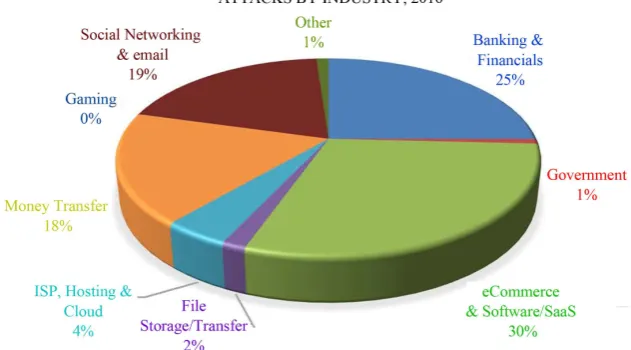
According to [3], at least 255,065 unique phishing attacks occurred world-wide. The increase is over 10% from the attacks identified during 2015. The dis-tribution of these attacks on industry is shown in Figure 1.
Due to the sensitivity of the data stored on mobile devices, these devices have become an excellent target for phisher to launch their attacks. The aim of the at-tacks is to gain access to credential that might benefit of using services a user is registered to. These services include dialing, SMS, payments, sensitive data lea-kage and connectivity. A phisher might impersonate the mobile user and use his mobile to perform these tasks without authorization from the user.
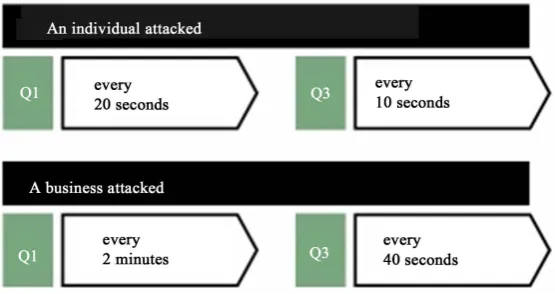
According to [4], more than 4000 ransomware attacks occurred daily during the year of 2016. PhishMeInc reported that ransomware and phishing attacks work together and that 97.2 of phishing emails in 2016 contain a form of ran-somware [5]. Figure 2 shows the frequency of a ransomware attack on individu-als in Q1 and Q3 of the year 2016. It is clearly shown that the frequency of the attack on individuals has doubled in Q3.
A study has been conducted by Dr. Zinaida Benenson at Friedrich-Alexander University (FAU) showed that 78% of people showed awareness of phishing at-tacks with unknown links and 45% of them clicked the link [6].
[image:2.595.217.533.513.688.2]According to the numbers and figures showed here we conclude that phishing attacks on mobile devices are increasing dramatically. Besides, attacks have spread to cover wide areas of services as shown in Figure 1. And bearing into
DOI: 10.4236/jcc.2018.62003 29 Journal of Computer and Communications Figure 2. Frequency of ransomware attacks on individuals in 2016.
mind that mobile users are not aware of this huge threat—and if so they still fol-low malicious links—it is very important to spot the light on this type of phish-ing attacks and to make mobile users ware of the size of the threat and the steps they might follow to mitigate this attack.
The rest of the paper is organized as follows, mobile phishing attacks are ex-plained in Section 2. Section 3 details Mobile anti-phishing techniques. Steps required to avoid phishing attacks are provided in Section 4. Section 5 summa-rizes the work done in this paper.
2. Mobile Phishing Attacks
Before talking about mobile phishing attacks, we have first to introduce the at-tractive properties of mobile devices that made malware creators target these de-vices, then we will talk about types of phishing attacks. Finally we will talk about distribution methods used in mobile applications with some statistics.
2.1. Properties of Mobile Device Usage
Mobile devices facilitate phishing attacks due to their following properties: The rapid increase of the number of mobile users worldwide as describes in [1]. This user shift to mobile devices has attracted phisher to shift their tech-nique to mobile devices.
The limited screen size makes it difficult for mobile users to pinpoint legiti-mate webpage from phishing one. Besides, the small screen size also makes browsers to hide the complete URL of the requested page, and hence help the phisher deceiving the mobile user.
Due to the mobility nature of the mobile usage, users tend to respond to inte-ractions with less concentration which might yield to approving a phishing process.
Because the mobile device is mostly near the mobile users, users tend to trust these devices. This in turn will leverage the possibility of being hacked and phished due to this trust.
DOI: 10.4236/jcc.2018.62003 30 Journal of Computer and Communications properties and hence have moved their efforts and techniques to mobile devices and their applications.
2.2. Methods of Mobile Phishing Attacks
The aim of phishing is to acquire credential that might be used to impersonate the person using his credentials. The basic idea to have a successful phishing at-tack is to deceive the user to provide his credentials. In mobile technology, there are different ways fishers used to launch their fishing attacks and deceive vic-tims, these methods are listed below:
2.2.1. Financial Fraud
As the name implies, financial fraud aims to gather financial credentials of a vic-tim, these credentials might then be used to impersonate the person and perform financial transactions on behalf of him. The report of MicroSave [7], provides details about financial mobile frauds. The report states that mobile financial fraud is becoming increasingly important with the extended use of financial mo-bile applications to perform electronic financial transactions.
CGAP [8] has conducted a research about financial fraud in different coun-tries. The key idea was that it is not possible to completely defend against this fraud. However, following some steps by providers with hints we will provide might help mitigating this fraud.
One example of financial fraud might be a false update for the internet bank-ing account. The user follows the link in the message which looks like legitimate and he will be directed to a page similar to the login page of his bank. To avoid such a scenario, service providers like banks usually perform two factor authen-tication techniques typically send a pin code as an SMS to the mobile of the user. If the entered PIN is not identical to the one sent, then login is prohibited.
2.2.2. Service Updates
In this method of attacks, fishers use registered services for users to collect their credentials and hence impersonate legitimate users and use the services instead. Different services are available over internet including Drop Box, Google Drive, Microsoft Account, etc. A user receives a message showing the necessity of ser-vice update, the user is required to supply his credential for the serser-vice to be up-dated. This in turn handles the credentials associated with this service to the fisher.
As in financial fraud, some service providers use two factor authentications. However, a fisher might bypass this by being online when launching the attack and will also receive the PIN code as well.
2.2.3. Promotional Offers
DOI: 10.4236/jcc.2018.62003 31 Journal of Computer and Communications same credentials.
2.2.4. Spear Phishing
This type of attack is more targeted to a person or an organization. This type of attack requires social engineering to gather correct data and then deceive the target person being someone who knows. This in turn enables the fisher to ex-tract information from that person pretending to be someone who knows.
An example of a real-life sphere attack reported by [9]. In 2010, a spear attack involved going after code on many machines using malware to access Google, Adobe, and other U.S. systems. The attack aimed at stealing intellectual property to an Executive Editor at https://www.darkreading.com/.
2.2.5. Whaling
Whaling is a special type of sphere phishing. The victim of the attack is of high profile person. A hacker spends large time gathering information about his tar-get, when sufficient information is available, the attacker will use his information to launch the attack. The attacker might need some time to build trust with his victim before starting his attack. Once trust is good enough, the attacker can ex-ploit this trust and perform his attack.
An example of whaling attack is reported by [10] where Leoni AG, Europe’s biggest manufacturer of wires and electrical cables, lost $44.6 million as a result of a whaling attack that tricked finance staff into transferring money to the wrong bank account.
2.3. Spreading Methods
By spreading method, we mean the origin of the mobile traffic used for phishing. According to [8], iOS is more targeted to phishing attacks than Android. The percentage of phishing attacks of iOS is 63% while it is only 37% for android. The justification is that Apple users are more prestigious and hence are better phishing targets than others.
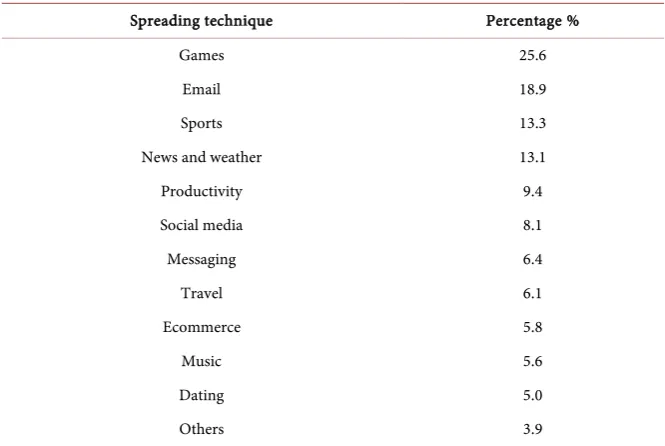
There are many distribution techniques used for phishing. The popularity of these techniques might be different in mobile application compared to other ap-plications. Table 1 below summarizes the popularity of spreading techniques according to [11].
As seen far, mobile phishing techniques are becoming more dedicated and technically well organized. The targets of phishing are becoming more specific and selected well. Social engineering is used intensively to make the phishing more effective. In the next section, we will talk about mobile anti-phishing tech-niques and their advantages and disadvantages.
3. Mobile Anti-Phishing Techniques
DOI: 10.4236/jcc.2018.62003 32 Journal of Computer and Communications Table 1. Phishing spreading methods.
Spreading technique Percentage %
Games 25.6
Email 18.9
Sports 13.3
News and weather 13.1
Productivity 9.4
Social media 8.1
Messaging 6.4
Travel 6.1
Ecommerce 5.8
Music 5.6
Dating 5.0
Others 3.9
browsers or applications. Different web anti-phishing techniques has been pro-posed, these techniques are content based techniques, black lists, and white lists. In content based techniques the content of the website is used to determine whether it is a phishing site or not [12]. While black lists and white lists com-pares the requested URL against either a black list of phishing URLs, or a white list of non-phishing ones [13][14][15].
In [16], the authors proposed a method built upon having the users registered to a website, the later generates a unique code for each user. The user is asked to input some digits of his unique code and the website has to respond with the complete code. Correct code means that the website is genuine. This method requires users to sign up and remember their code for different websites, fur-thermore, once a code is compromised, the phishing will easily be launched.
A framework for detection of phishing is provided in [17]. The proposed framework extracts features of a website and compares them to the original fea-tures of the genuine site. However, most phishing pages are very similar to the genuine ones and hence this might produce false positives. The framework also requires high computation to extract text, image, and color features of a website.
A user visual similarity is proposed in [18]. The method uses screenshot ex-traction to calculate the visual similarities. The authors proposed a metric called deception rate for calculating similarity. The method is dedicated for mobile apps login screens and does not work for web logins.
DOI: 10.4236/jcc.2018.62003 33 Journal of Computer and Communications In [20], a light weight technique is used. It uses some URL features to deter-mine legitimacy of a webpage based on frequency analysis of extracted features of phishing URLs. The method is not able to detect for phishing sites of new be-haviors with respect to phishing URL behavior depository.
Visual cryptography is used for phishing detection [21]. The proposed framework is an interactive method that uses captcha validation scheme based on visual cryptography. Both user and server own part of a captcha and both work together to reconstruct the complete captcha image. The time spent for captcha reconstruction is recorded and used in the process of phishing detec-tion. The framework is vulnerable to man-in-the-middle attack. Besides, it re-quires the user to share the secret with the server.
In [22], an MP-shield method is proposed. The method relies on searching Google for blacklisted URL, besides it extracts features of URL and passes them to the proper classifier model. The method might generate false positives and re-lies on Google for internet search and not on a dedicated trusted blacklist.
4. Avoiding Phishing
To avoid phishing a user must be aware of the URL, the URL can give an indica-tion of being a target of a phishing attack. However, as we menindica-tioned before, the small screen of a mobile device make it difficult for users to check for URLs. Here we provide some hints that might be useful for mobile users to avoid phishing attacks.
1) The most important issue is to install and use genuine applications pro-vided by trusted vendors. This will make a user trust his applications of not be-ing part of any phishbe-ing attack. Accordbe-ing to [23], PhishLabs company reported that 11 malicious applications claiming to be genuine mobile payment apps were on the official Google Play application store.
2) A user might also use an anti-phishing tool from trusted vendors, this will enable him to detect phishing attacks and avoid them.
3) Never reply to any suspicious emails or SMSs. If you are suspicious of why this is delivered to you then you might be at high risk of being a target of phish-ing attack. Do not reply to such messages at all.
4) A good practice to avoid phishing is to use bookmarks for your frequently visited websites. This will make it difficult to land unwanted webpages that might be phishing sites.
5) A user must follow up security notes and train himself on secure mobile usage.
6) It is important to highly secure a mobile device by a password and other access control methods. This will protect identity theft once the mobile device is lost.
7) Use Anti-Theft security services like Remote Lock, Remote Wipe, and Lo-cate to protect your device and the data it contains.
DOI: 10.4236/jcc.2018.62003 34 Journal of Computer and Communications
5. Summary
In this paper, we provided a summary of anti-phishing techniques used for mo-bile device. These techniques relied on some features of momo-bile devices that made phishing more likely to happen. Some of these features were small screen size and the feel of trust by most users in mobile devices. We have explained an-ti-phishing techniques and methods that were proposed for mobile devices. These techniques have their pros and cons. Our investigation showed that all these techniques have some shortcomings that reduce their efficiency in detect-ing phishdetect-ing attacks. Hence, the most burden as we believe falls onto mobile us-ers to follow some steps that might help them avoid phishing. These steps and best practices were also provided in the last section of our paper. The aim of our paper as mentioned in the abstract is to put phishing attacks on mobile systems in light, and to make people aware of these attacks and how to avoid them.
References
[1] https://wearesocial.com/special-reports/digital-in-2017-global-overview
[2] http://www.gartner.com/newsroom/id/3609817
[3] Aijaz Ahmad, S., et al. (2013) Smartphone: Android vs IOS. The SIJ Transactions on Computer Science Engineering & Its Applications (CSEA), 1, 141-148.
[4] US Government (2016) How to Protect Your Network from Ransomware. Technic-al Guidance Interagency Document. US Government, Washington, DC.
[5] PhishMe, Inc. (2016) Malware Review Q3. PhishMe, Inc., Leesburg, VA.
[6] https://www.fau.eu/2016/08/25/news/research/one-in-two-users-click-on-links-fro
m-unknown-senders/
[7] Luminzu Mudiri, J. (2012) Fraud in Mobile Financial Services. MicroSave, Luck-now.
[8] Buku, M.W. and Mazer, R. (2015) Fraud in Mobile Financial Services: Protecting Consumers, Providers, and the System. CGAP,Washington, DC.
[9] http://resources.infosecinstitute.com/spear-phishing-real-life-examples/#gref
[10] https://www.scmagazineuk.com/leoni-ag-suffers-34-million-whaling-attack/article/
530694/
[11] WANDERA (2017) Mobile Data Report: Focus on Phishing.
[12] Yoon, J.W., et al. (2010) Hybrid Spam Filtering for Mobile Communication. Com-puters and Security, 29, 446-459.https://doi.org/10.1016/j.cose.2009.11.003
[13] Memon, I.K. and Khan, M.K. (2013) Anti Phishing for Mid-Range Mobile Phones.
International Journal of Computer and Communication Engineering, 2, 115-119. [14] Singh, D., et al. (2011) Telephony Fraud Prevention. US Patent.
[15] Mahmoud, T.M. and Mahfouz, A.M. (2012) SMS Spam Filtering Technique Based on Artificial Immune System. IJCSI International Journal of Computer Science Is-sues, 9, 589-597.
[16] Mishra, M., et al. (2012) A Preventive Anti-Phishing Technique using Code Word.
International Journal of Computer Science and Information Technologies, 3, 4248-4250.
In-DOI: 10.4236/jcc.2018.62003 35 Journal of Computer and Communications
ternet. International Journal of Computer Science and Information Technologies, 2, 1297-1299.
[18] Malisa, L., et al. (2015) Technical Report: Detecting Mobile Application Spoofing Attacks by Leveraging User Visual Similarity Perception.
[19] Kumar, N. and Chaudhary, P. (2017) Mobile Phishing Detection using Naive Baye-sian Algorithm. International Journal of Computer Science and Network Security, 17, 142-147.
[20] Orunsolu, A.A. (2017) A Lightweight Anti-Phishing Technique for Mobile Phone.
Acta Informatica Pragensia, 6, 114-123.
[21] Yenurkar, B. and Zade, S. (2014) An Anti-Phishing Framework with New Valida-tion Scheme Using Visual Cryptography. International Journal of Computer Science and Mobile Computing, 3, 739-744.
[22] Bottazzi, G. (2015) MP-Shield: A Framework for Phishing Detection in Mobile De-vices. IEEE International Conference on Computer and Information Technology;
Ubiquitous Computing and Communications; Dependable, Autonomic and Secure Computing; Pervasive Intelligence and Computing, Liverpool, 26-28 October 2015, 1977-1983.https://doi.org/10.1109/CIT/IUCC/DASC/PICOM.2015.293
[23] http://onlinesecurity.trendmicro.com.au/blog/2016/06/22/phishlabs-warns-of-malw