ISSN Online: 2160-5629 ISSN Print: 2160-5440
DOI: 10.4236/oju.2018.81004 Jan. 30, 2018 25 Open Journal of Urology
Men without Sperms
Abayomi B. Ajayi
1, Bamgboye M. Afolabi
2*, Victor D. Ajayi
1, Ifeoluwa Oyetunji
1,
Oluwafunmilola Biobaku
1, Adedamilola Atiba
11Nordica Fertility Centre, Lagos, Nigeria
2Health, Environment and Development Foundation, Lagos, Nigeria
Abstract
Introduction: Men without sperm (azoospermic) make up about 15% of all infertile men in reproductive age of fatherhood. Male infertility is a health and
social problem in many communities. Subjects and Methods: This
retrospec-tive study was carried from 2010 to 2015. Initially, 907 men were included in the study among whom 109 (12.02%), 346 (38.15%) and 452 (49.83%) were azoospermic, oligospermic and normospermic, respectively. This study only investigated the association between age, BMI, semen volume, liquefaction time and pus cells among normospermic and azoospermic men. Standard se-men analysis was performed and subjects were categorized by age into <30, 30 - 39.9, 40 - 49.9, 50 - 59.9 and ≥60 years and by body mass index into normal
(18.5 - 24.9), overweight (25.0 - 29.9) and obese (≥30). Results:The 562
sub-jects of the study had means (±sd) age of 42.6 (±7.10) years and BMI of 27.0
(4.1) kg/m2 respectively. In all, 109 (19.4%) were azoospermic. Overweight
and obese men were, respectively, more than 1½ and about 2½ times more likely to be azoospermic compared to normal weight men. Azoospermic men were significantly heavier than men with normal sperm count (t = −0.34; P-value = 0.003). Among those with normal weight, liquefaction time was sig-nificantly shorter (t = 5.49, P-value = 0.000001) in azoospermic (28.70 min.) than in men with normal sperm count (31.82 min.). Obese azoospermic men were about 4 times as likely to have high pus cells in semen than normal weight azoospermic men (OR = 3.82; 95% CI: 0.39, 37.01). Multivariate re-gression analysis shows a strong but negative coefficient correlation between sperm concentration and BMI (coef. = −0.48, Std Err. = 0.25, P-value = 0.05,
95% CI: −0.96, 0.10). Conclusion: Our findings suggest that high BMI is
as-sociated with azoospermia. Azoospermia also did not seem to negatively im-pact liquefaction time.
Keywords
Azoospermia, Normal Sperm Concentration, Age, Body Mass Index, Male How to cite this paper: Ajayi, A.B.,
Afola-bi, B.M., Ajayi, V.D., Oyetunji, I., Biobaku, O. and Atiba, A. (2018) Men without Sperms. Open Journal of Urology, 8, 25-42.
https://doi.org/10.4236/oju.2018.81004
Received: October 17, 2017 Accepted: January 27, 2018 Published: January 30, 2018
Copyright © 2018 by authors and Scientific Research Publishing Inc. This work is licensed under the Creative Commons Attribution International License (CC BY 4.0).
http://creativecommons.org/licenses/by/4.0/
DOI: 10.4236/oju.2018.81004 26 Open Journal of Urology
Infertility, Sub-Sahara Africa
1. Introduction
Male infertility, from African perspective, is not just male infertility from the viewpoint of the developed countries. Infertility, especially of the male, is a more serious cause of anxiety and concern which affect married couples resulting in quiet stigmatization and loss of status within the family circuit and in the com-munity at larger. Infertility of either male or female or of both is becoming a
se-rious health problem affecting about 10% of all families worldwide [1] and
pos-sibly more in developing countries [2], probably as high as 25%. Infertility is the
inability of a sexually active, non-contracepting couple to achieve spontaneous
pregnancy in one year [3] and azoospermia, broadly speaking, is the absence of
sperm in the ejaculate [4]. The World Health Organization recommends that in
such cases of absence of spermatozoa in wet preparation(on microscopic exami-nation), the seminal fluid from which the sample came should be centrifuged at
3000× or more for 15 minutes and then examined again [3]. If a minimum
quan-tity of spermatozoa is observed in either of the centrifuged samples, this is referred to as cryptozoospermia while the complete absence of spermatozoa is defined as azoospermia. Both sexes are affected by infertility, a health burden of some epide-miological proportion. In approximately 50% of couples with involuntarily chil-dlessness, male-infertility-associated factor is observed together with abnormal
semen parameters [5]. Fertile partners may recompense for fecundity problem of
the man and thus infertility usually manifests if both partners are sub-fertile [3]. Recently, an exponential increase in the responsibility of male factor in couple’s infertility has been observed and this could be attributed to comprehensive evalua-tion of the entire reproductive system of the male, the funcevalua-tion of each part of
that system and improved diagnostic tools [6]. There are a variety of conditions
that may inhibit spermatogenesis and diminish the production and quality of sperm thus causing azoospermia. Azoospermia may also occur because of a re-productive tract obstruction. A study has classified azoospermia into three pri-mary categories: 1) pre-testicular, 2) testicular, and 3) post-testicular, speculating that, though 1) and 3) etiology of azoospermia are generally manageable, 2) is
gener-ally not [7]. Other studies suggested causes of male infertility, including
azoos-permia, as urogenital infections such as genito-urinary tract tuberculosis [8], or
filarial orchitis [9]. It is claimed that male infertility, including azoospermia, also results from: 1) congenital or acquired urogenital abnormalities, 2) malignancies, 3) increased scrotal temperature (e.g. as a consequence of varicocele), 4)
endo-crine disturbances, 5) genetic abnormalities, and 6) immunological factors [3]. It
is established that overweight and obesity have a negative impact on female
fer-tility profile [10] but few studies have been able to track the fertility profile of
DOI: 10.4236/oju.2018.81004 27 Open Journal of Urology
reproductive failure and concluded that evolving therapies have allowed the use of sperm from men with spermatogenic compromise, obstructive azoospermia, and sperm functional deficiency, enabling these men to procreate when unable to do so naturally. In sub-Saharan Africa, women are most often blamed for in-fertility in matrimonial relationships where the occurrence of inin-fertility is
invo-luntary and where hardly is the fault laid on both or on the male [12]. In most
African societies, the attitude, beliefs and cultural practices tend to exonerate men from inability to bear children. One of the most important aspects of life in most, if not all, African settings is the ability to father a child, or to be called a “mother”, to continue the human lineage. Not being able to father a child from one woman often leads to serial relationships with other women. It is also a gen-eral but erroneous notion that the ability to have and sustain an erection and to engage in a heterosexual coitus with a woman means that men are fertile. Some men believe that just having penile erection or producing ejaculate of semen dur-ing sexual intercourse is enough to father a child which, in some cases, is con-trary to the expected. That a man may not produce enough sperm is well
docu-mented [5] but not having sperm at all is a serious trepidation not only for the
man but also for the family, the community and the physician. Sermondade, et
al. [13] reported overweight and obesity as risk factors for azoospermia while
Mac-donald, et al. [14] believed no significant correlation exists between BMI and the
semen parameters with the exception of normal sperm morphology and that over-weight and obese men showed no significantly increased relative risk of abnor-mal semen parameters.
Infertility, in general, is a huge public health problem which has not been adequately addressed in Nigeria. Because infertility is a public health burden which affects the mental and social well-being of individuals and the family, it has been included in the national program for reproductive and child health in
India [15] though not in many African countries. Studies have shown that about
1% of all men in the general population suffer from azoospermia, and
azoos-permic men constitute approximately 10% to 15% of all infertile men [7].
Stu-dies have incriminated obesity (high body mass index) in adult male infertility
[16][17][18] while others claim no significant correlation between body mass
in-dex and semen quality [19][20][21]. Azoospermia and oligospermia, relative to age
DOI: 10.4236/oju.2018.81004 28 Open Journal of Urology
sperm concentration and on those who have no sperms.
2. Subjects and Methods
This study was approved by the State Ethics Committee. The study took place at Nordica fertility Center in Lagos from 2010 to 2015. The Medical records of men aged 23 - 73, who presented because of infertility at three Nigerian cities—Lagos, Asaba and Abuja—were retrieved, entered into a laptop computer, cleaned and analyzed. Of the initial 602 couples 571 (94.8%) males escorted their female spouses at their first consultation, and although all 571 were requested to produce semen for examination, only 562 (98.4%) did, under stringent compliance with World
Health Organization regulations for semen analysis [22]. Of the remaining 9, 4
(44.4%) traveled out of the country, 2 (22.2%) refused semen production due to fasting period at the duration of study; 2 (22.2%) persons absconded and 1 (11.1%) sperm sample was discarded because time of collection and days of abstinence were not provided. All the couples presented to the clinician because their wives were not getting pregnant after regular and constant unprotected sexual inter-course.
Semen samples were collected by masturbation, in a comfortable room pro-vided with electricity, water, bathroom and air-conditioner, within a maximum of 3 - 5 minutes’ walk to the laboratory and according to WHO specification
[22]. The man was counseled to abstain from sex for a minimum/maximum
du-ration of 2 - 5 days. The collected sterile semen sample was transported almost immediately to the laboratory for analysis within 30 minutes of production. Other relevant information given to each patient included: 1) accuracy in the semen collection, 2) semen should be collected in a wide-mouth measuring cylinder that was provided, and 3) the importance of reporting any loss of semen sample dur-ing collection. For this semen collection process, each patient was provided with a medical record form where data such as name, age (or date of birth), days of ab-stinence, date and time of collection, if there was any loss in semen volume dur-ing collection (incomplete collection) and the time of commencement of seminal fluid analysis in the laboratory were appropriately filled in by the patient and the laboratory staff who collected the semen sample.
Other anthropometric, social and medical/surgical records were also collected from the patients. These included weight (in kg) and height (in cm) for the de-termination of body mass index (BMI), marital status, occupation, smoking and alcohol use, groin operation, sexually transmitted diseases, as well as family and social history.
Within 30 minutes of production and collection at the laboratory and after li-quefaction, semen samples were analyzed strictly according to WHO guidelines
[22] to detect semen volume, total sperm concentration, motility, and
DOI: 10.4236/oju.2018.81004 29 Open Journal of Urology
mean progressive motility was determined using light microscope (×40) and was performed in 10 squares of the chamber, counting at least 200 spermatozoa and
expressed as 106 spermatozoa/ml. The total sperm count is the end
concentra-tion, expressed as 106 spermatozoa/ml. After assessing sperm progressive
motil-ity in 100 random spermatozoa, these were described as 1) rapidly forward, fast progressive motility, 2) moderately forward, slow progressive motility, 3) jerky non-progressive motility, and 4) immotile/no movement. Other parameters as-sessed in the semen samples were color, viscosity, liquefaction time, pus cells per high power field and morphology. Age (years) was stratified into <30, 30 - 39.9, 40 - 49.9, 50 - 59.9 and ≥60 and BMI was categorized according to WHO
classi-fication [23] as underweight (BMI < 18.5), normal weight (BMI 18.5 - 24.9),
over-weight (BMI 25.0 - 29.9) and obese (BMI ≥ 30). Patients who were not on any me-dication that would interfere with spermatogenesis, those not consuming herbal medication and who gave consent for their semen to be analyzed were included into the study. Non-indigenes, those with history of fulminant infections or pa-tients with neoplasm were excluded from the study. At further analysis stage, this study specifically focused on men with normal sperm count and those with azoospermia. Patients’ confidentiality was assured by excluding any information such as age, address which could identify any patient with the study. Data were also coded and stored in a computer with password known only to the Principal Investigator.
Data were analyzed using STATA 13; associations between Age, BMI and Age-for-BMI with normal sperm concentration and with azoospermia were as-sessed using chi-square, Odds Ratio and 95% Confidence Interval. Spearman correlation and analysis of variance (ANOVA), and a multiple linear regression analysis was performed to determine correlation coefficients and significance of means of two variables. In addition, the relative risks for men having
azoosper-mia, giving reference range of the WHO [3], were calculated. A P-value of ≤0.05
was taken as significant. Data were presented as Tables and bar charts.
3. Results
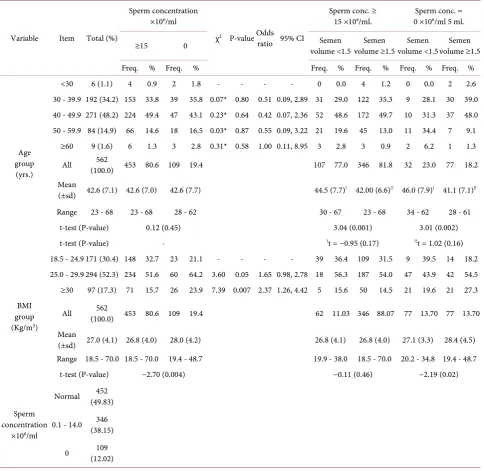
A total of 562 men, whose means (±sd) of age (years) and BMI (kg/m2) were 42.6
(7.1) and 27.0 (4.1) respectively, were included in the study. Those aged 40 - 49 years were in the highest proportion (48.2%) while the least were those aged < 30 years (1.1%). None was classified as underweight while 171 (30.4%), 294 (52.3%) and 97 (17.3%) were categorized as normal weight, overweight and obese
respec-tively (Table 1). In all, 109 (19.4%) of the 562 men were azoospermic, the majority
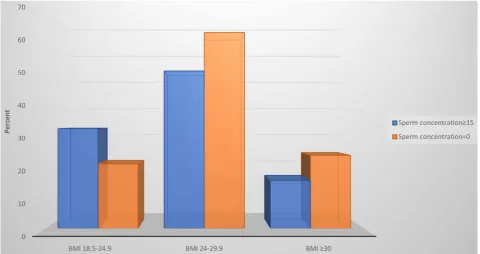
of whom were aged 40 - 49.9 years (47, 43.1%) (Figure 1) or overweight (60, 64.2%).
Table 1 and Figure 2 also show a significant difference (t = −2.70, P-value =
0.004) in the BMI of azoospermic men (28.0 ± 4.2 kg/m2) compared to the BMI
DOI: 10.4236/oju.2018.81004 30 Open Journal of Urology Table 1. Anthropometric and sperm concentration characteristics of study participants.
Variable Item Total (%)
Sperm concentration ×106/ml
χ2 P-value Odds
ratio 95% CI
Sperm conc. ≥
15 ×106/ml. 0 ×10Sperm conc. = 6/ml 5 ml.
≥15 0 volume <1.5 Semen volume ≥1.5 Semen volume <1.5 Semen volume ≥1.5 Semen
Freq. % Freq. % Freq. % Freq. % Freq. % Freq. %
Age group (yrs.)
<30 6 (1.1) 4 0.9 2 1.8 - - - - 0 0.0 4 1.2 0 0.0 2 2.6 30 - 39.9 192 (34.2) 153 33.8 39 35.8 0.07* 0.80 0.51 0.09, 2.89 31 29.0 122 35.3 9 28.1 30 39.0 40 - 49.9 271 (48.2) 224 49.4 47 43.1 0.23* 0.64 0.42 0.07, 2.36 52 48.6 172 49.7 10 31.3 37 48.0 50 - 59.9 84 (14.9) 66 14.6 18 16.5 0.03* 0.87 0.55 0.09, 3.22 21 19.6 45 13.0 11 34.4 7 9.1
≥60 9 (1.6) 6 1.3 3 2.8 0.31* 0.58 1.00 0.11, 8.95 3 2.8 3 0.9 2 6.2 1 1.3
All (100.0) 453 80.6 109 19.4 562 107 77.0 346 81.8 32 23.0 77 18.2
Mean
(±sd) 42.6 (7.1) 42.6 (7.0) 42.6 (7.7) 44.5 (7.7)! 42.00 (6.6)!! 46.0 (7.9)! 41.1 (7.1)!!
Range 23 - 68 23 - 68 28 - 62 30 - 67 23 - 68 34 - 62 28 - 61
t-test (P-value) 0.12 (0.45) 3.04 (0.001) 3.01 (0.002)
t-test (P-value) - !t = −0.95 (0.17) !!t = 1.02 (0.16)
BMI group (Kg/m2)
18.5 - 24.9 171 (30.4) 148 32.7 23 21.1 - - - - 39 36.4 109 31.5 9 39.5 14 18.2 25.0 - 29.9 294 (52.3) 234 51.6 60 64.2 3.60 0.05 1.65 0.98, 2.78 18 56.3 187 54.0 47 43.9 42 54.5 ≥30 97 (17.3) 71 15.7 26 23.9 7.39 0.007 2.37 1.26, 4.42 5 15.6 50 14.5 21 19.6 21 27.3
All (100.0) 453 80.6 109 19.4 562 62 11.03 346 88.07 77 13.70 77 13.70
Mean
(±sd) 27.0 (4.1) 26.8 (4.0) 28.0 (4.2) 26.8 (4.1) 26.8 (4.0) 27.1 (3.3) 28.4 (4.5) Range 18.5 - 70.0 18.5 - 70.0 19.4 - 48.7 19.9 - 38.0 18.5 - 70.0 20.2 - 34.8 19.4 - 48.7
t-test (P-value) −2.70 (0.004) −0.11 (0.46) −2.19 (0.02)
Sperm concentration
×106/ml
Normal (49.83) 452
0.1 - 14.0 (38.15) 346
0 (12.02) 109
7.9 vs. 41.1 ± 7.1 years) and significantly (t = −2.19, P-value = 002) lighter (27.1 ±
3.3 vs. 28.4 ± 4.5 kg/m2) than those who produced semen volume of ≥1.5 ml.
Men with normal sperm concentration who produced semen volume < 1.5 ml were also significantly older (44.5 ± 7.7 years) than men who produced semen volume ≥ 1.5 ml (t = 3.04, P-value = 0.001).
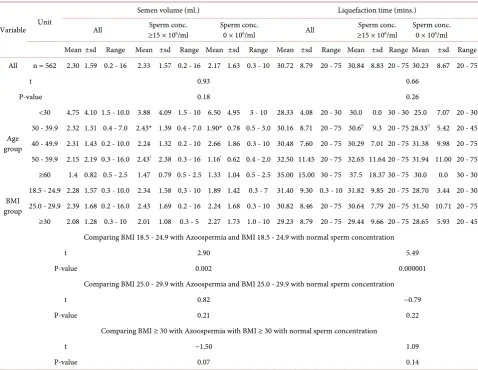
The mean semen volume (ml.) and liquefaction time (mins.) among the
azoos-permic men and those with normal sperm concentration is illustrated in Table
2. Overall, there was no significant difference in the mean semen volume or
DOI: 10.4236/oju.2018.81004 31 Open Journal of Urology Figure 1. Percent distribution of proportion of men with normal sperm concentrations and with azoospermia by age (years). Compared with patients aged < 30 years, there was no significant difference in the proportion of patients aged 30 - 39.9 years (χ2 =
0.07, P-value = 0.80), those aged 40 - 49.9 years (χ2 = 0.23, P-value = 0.64), those age 50 - 59.9 years (χ2 = 0.03, P-value = 0.87) and
[image:7.595.57.543.70.317.2]those aged ≥ 60 (χ2 = 0.31, P-value = 0.58) with sperm concentration of 15 × 106/ml and those with azoospermia.
Figure 2. Percent distribution of proportion of men with normal sperm concentrations and with azoospermia by BMI. Over-weight patients (BMI 25 - 29.9) and obese patients (BMI ≥ 30) were, respectively, 1.65 times (χ2 = 3.60, P-value = 0.05, OR = 1.65)
and 2.37 times (χ2 = 7.39, P-value = 0.007; OR 2.37) more likely to be azoospermic than patients with normal BMI (18.5 - 24.9).
[image:7.595.58.539.384.638.2]DOI: 10.4236/oju.2018.81004 32 Open Journal of Urology Table 2. Mean semen volume (mls.) and liquefaction time (mins.) of azoospermic and normal men by age and by BMI of partici-pants.
Variable Unit
Semen volume (ml.) Liquefaction time (mins.)
All ≥15 × 10Sperm conc. 6/ml Sperm conc. 0 × 106/ml All ≥15 × 10Sperm conc. 6/ml Sperm conc. 0 × 106/ml
Mean ±sd Range Mean ±sd Range Mean ±sd Range Mean ±sd Range Mean ±sd Range Mean ±sd Range
All n = 562 2.30 1.59 0.2 - 16 2.33 1.57 0.2 - 16 2.17 1.63 0.3 - 10 30.72 8.79 20 - 75 30.84 8.83 20 - 75 30.23 8.67 20 - 75
t 0.93 0.66
P-value 0.18 0.26
Age group
<30 4.75 4.10 1.5 - 10.0 3.88 4.09 1.5 - 10 6.50 4.95 3 - 10 28.33 4.08 20 - 30 30.0 0.0 30 - 30 25.0 7.07 20 - 30
30 - 39.9 2.32 1.31 0.4 - 7.0 2.43* 1.39 0.4 - 7.0 1.90* 0.78 0.5 - 3.0 30.16 8.71 20 - 75 30.6!! 9.3 20 - 75 28.33!! 5.42 20 - 45
40 - 49.9 2.31 1.43 0.2 - 10.0 2.24 1.32 0.2 - 10 2.66 1.86 0.3 - 10 30.48 7.60 20 - 75 30.29 7.01 20 - 75 31.38 9.98 20 - 75 50 - 59.9 2.15 2.19 0.3 - 16.0 2.43! 2.38 0.3 - 16 1.16! 0.62 0.4 - 2.0 32.50 11.45 20 - 75 32.65 11.64 20 - 75 31.94 11.00 20 - 75
≥60 1.4 0.82 0.5 - 2.5 1.47 0.79 0.5 - 2.5 1.33 1.04 0.5 - 2.5 35.00 15.00 30 - 75 37.5 18.37 30 - 75 30.0 0.0 30 - 30
BMI group
18.5 - 24.9 2.28 1.57 0.3 - 10.0 2.34 1.58 0.3 - 10 1.89 1.42 0.3 - 7 31.40 9.30 0.3 - 10 31.82 9.85 20 - 75 28.70 3.44 20 - 30 25.0 - 29.9 2.39 1.68 0.2 - 16.0 2.43 1.69 0.2 - 16 2.24 1.68 0.3 - 10 30.82 8.46 20 - 75 30.64 7.79 20 - 75 31.50 10.71 20 - 75
≥30 2.08 1.28 0.3 - 10 2.01 1.08 0.3 - 5 2.27 1.73 1.0 - 10 29.23 8.79 20 - 75 29.44 9.66 20 - 75 28.65 5.93 20 - 45
Comparing BMI 18.5 - 24.9 with Azoospermia and BMI 18.5 - 24.9 with normal sperm concentration
t 2.90 5.49
P-value 0.002 0.000001
Comparing BMI 25.0 - 29.9 with Azoospermia and BMI 25.0 - 29.9 with normal sperm concentration
t 0.82 −0.79
P-value 0.21 0.22
Comparing BMI ≥ 30 with Azoospermia with BMI ≥ 30 with normal sperm concentration
t −1.50 1.09
P-value 0.07 0.14
*(t = 3.15, P-value = 0.001); !(t = 3.88, P-value = 0.0001); !!(t = 1.98, P-value = 0.03).
with mean semen volumes of normal men aged 30-39.9 years (2.43 ± 1.39) and those aged 50 - 59.9 years (2.43 ± 2.38).
Also, overall, there was no significant difference in the mean liquefaction time of azoospermic and normal men but when categorized by age group, the mean liquefaction time of azoospermic men aged 30-39.9 years (28.33 ± 5.42) was sig-nificantly lower (t = 1.98, P-value = 0.03) than that of normal men in the same age group.
Furthermore, the mean semen volume of normal weight azoospermic men (1.89 ± 1.42 mls) was significantly lower (t = 2.90, P-value = 0.002) than that of their counterparts with normal sperm concentration (2.34 ± 1.58 ml.) and the mean liquefaction time of normal weight azoospermic men (28.70 ± 3.44 mins.) was significantly lower (t = 5.49, P-value = 0.000001) than that of their counter-parts with normal sperm concentration (31.82 ± 9.85 mins.).
DOI: 10.4236/oju.2018.81004 33 Open Journal of Urology
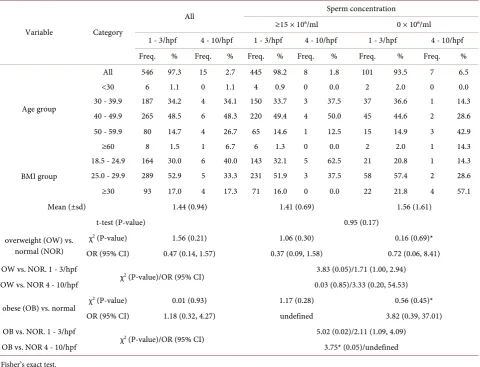
no sperm were 2.11 times and 3.75 times as likely to have pyospermia of 1 - 3/hpf and of 4 - 10/hpf respectively compared to men with normal sperm con-centration. Overweight men with no sperm were 1.71 times and 3.33 times more likely to have pyospermia of 1 - 3/hpf and of 4 - 10/hpf respectively, compared to
men with normal sperm concentration (Table 3).
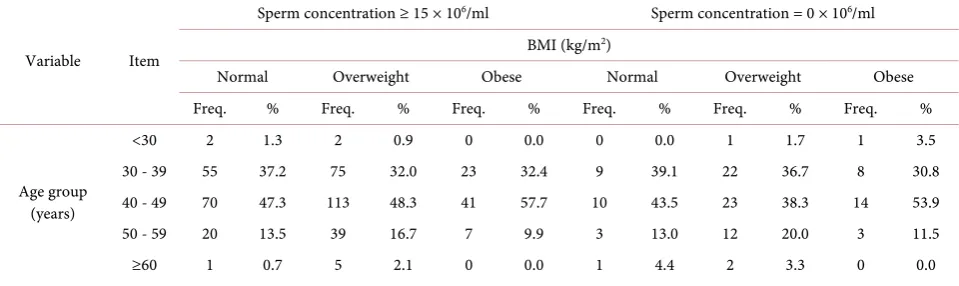
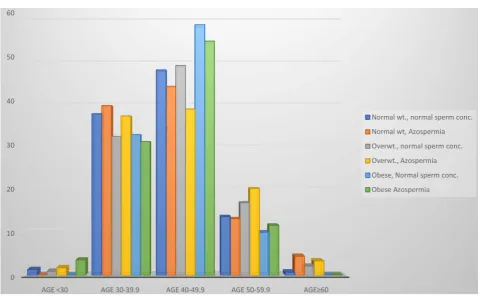
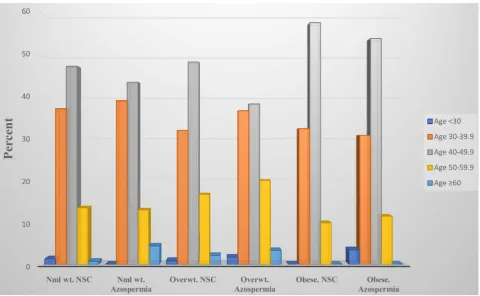
The proportion of men in each age group that presented with azoospermia relative to their body mass index is as illustrated in Table 4 and in Figure 3 and
[image:9.595.59.540.355.722.2]Figure 4. In age group < 30, overweight men were approximately twice as likely to have azoospermia (OR = 1.79, 95% CI: 0.77, 4.19) and were at higher risk (RR = 1.61, 95% CI: 0.79, 3.27) compared to normal weight man. In the same age group, obese men were 2.13 times as likely to develop azoospermia (OR = 2.13, 95% CI: 0.73, 6.19) and were at even higher risk (RR = 1.84, 95% CI: 0.78, 4.29) than normal weight men in the same age group. The risk of azoospermia in those aged 40 - 49 years increased from 1.35 among overweight men (RR=1.35, 95% CI: 0.68, 2.70) to 2.04 (RR = 2.04, 95% CI: 0.97, 5.87) among the obese. Ob-ese men in this age group were approximately 2½ times more likely to develop
Table 3. Proportion of patients with low and high levels of pus cells per high power field among those with normal and no sperm cells relative to their age and BMI.
Variable Category
All Sperm concentration
≥15 × 106/ml 0 × 106/ml
1 - 3/hpf 4 - 10/hpf 1 - 3/hpf 4 - 10/hpf 1 - 3/hpf 4 - 10/hpf Freq. % Freq. % Freq. % Freq. % Freq. % Freq. %
Age group
All 546 97.3 15 2.7 445 98.2 8 1.8 101 93.5 7 6.5
<30 6 1.1 0 1.1 4 0.9 0 0.0 2 2.0 0 0.0
30 - 39.9 187 34.2 4 34.1 150 33.7 3 37.5 37 36.6 1 14.3 40 - 49.9 265 48.5 6 48.3 220 49.4 4 50.0 45 44.6 2 28.6 50 - 59.9 80 14.7 4 26.7 65 14.6 1 12.5 15 14.9 3 42.9
≥60 8 1.5 1 6.7 6 1.3 0 0.0 2 2.0 1 14.3
BMI group
18.5 - 24.9 164 30.0 6 40.0 143 32.1 5 62.5 21 20.8 1 14.3 25.0 - 29.9 289 52.9 5 33.3 231 51.9 3 37.5 58 57.4 2 28.6
≥30 93 17.0 4 17.3 71 16.0 0 0.0 22 21.8 4 57.1
Mean (±sd) 1.44 (0.94) 1.41 (0.69) 1.56 (1.61)
t-test (P-value) 0.95 (0.17)
overweight (OW) vs. normal (NOR)
χ2 (P-value) 1.56 (0.21) 1.06 (0.30) 0.16 (0.69)*
OR (95% CI) 0.47 (0.14, 1.57) 0.37 (0.09, 1.58) 0.72 (0.06, 8.41) OW vs. NOR. 1 - 3/hpf
χ2 (P-value)/OR (95% CI) 3.83 (0.05)/1.71 (1.00, 2.94)
OW vs. NOR 4 - 10/hpf 0.03 (0.85)/3.33 (0.20, 54.53)
obese (OB) vs. normal χ
2 (P-value) 0.01 (0.93) 1.17 (0.28) 0.56 (0.45)*
OR (95% CI) 1.18 (0.32, 4.27) undefined 3.82 (0.39, 37.01) OB vs. NOR. 1 - 3/hpf
χ2 (P-value)/OR (95% CI) 5.02 (0.02)/2.11 (1.09, 4.09)
OB vs. NOR 4 - 10/hpf 3.75* (0.05)/undefined
DOI: 10.4236/oju.2018.81004 34 Open Journal of Urology Table 4. Proportion of men in each age group that presented with azoospermia relative to their BMI.
Variable Item
Sperm concentration ≥ 15 × 106/ml Sperm concentration = 0 × 106/ml
BMI (kg/m2)
Normal Overweight Obese Normal Overweight Obese
Freq. % Freq. % Freq. % Freq. % Freq. % Freq. %
Age group (years)
<30 2 1.3 2 0.9 0 0.0 0 0.0 1 1.7 1 3.5
30 - 39 55 37.2 75 32.0 23 32.4 9 39.1 22 36.7 8 30.8
40 - 49 70 47.3 113 48.3 41 57.7 10 43.5 23 38.3 14 53.9
50 - 59 20 13.5 39 16.7 7 9.9 3 13.0 12 20.0 3 11.5
≥60 1 0.7 5 2.1 0 0.0 1 4.4 2 3.3 0 0.0
Comparing azoospermia in age group < 30
Overweight vs. normal χ2 = 0.05*, P-value = 0.82, OR = undefined, 95% CI: undefined
Obese vs. normal χ2 = 0.19*, P-value = 0.67, OR = undefined, 95% CI: undefined
Comparing azoospermia in age group 30 - 39.9
Overweight vs. normal χ2 = 1.84, P-value = 0.17, OR = 1.79, 95% CI: 0.77, 4.19; RR = 1.61, 95% CI: 0.79, 3.27
Obese vs. normal χ2 = 1.96, P-value = 0.16, OR = 2.13, 95% CI: 0.73, 6.19; RR = 1.84, 95% CI: 0.78, 4.29
Comparing azoospermia in age group 40 - 49.9
Overweight vs. normal χ2 = 0.76, P-value = 0.38, OR = 1.42, 95% CI: 0.64, 3.17; RR = 1.35, 95% CI: 0.68, 2.70
Obese vs. normal χ2 = 3.74, P-value = 0.05, OR = 2.39, 95% CI: 0.97, 5.87; RR = 2.04, 95% CI: 0.98, 4.25
Comparing azoospermia in age group 50 - 59.9
Overweight vs. normal χ2 = 0.53*, P-value = 0.47, OR = 2.05, 95% CI: 0.52, 8.11; RR = 1.80, 95% CI: 0.56, 5.79
Obese vs. normal χ2 = 0.45*, P-value = 0.50, OR = 2.86, 95% CI: 0.46, 17.58; RR = 2.30, 95% CI: 0.56, 9.49
Comparing azoospermia in age group ≥ 60
Overweight vs. normal χ2 = 0.08*, P-value = 0.78, OR = 0.40, 95% CI: 0.02, 10.02; RR = 0.57, 95% CI: 0.09, 3.51
Obese vs. normal χ2 = 0.26*, P-value = 0.61, OR = undefined, 95% CI: undefined; OR = undefined, 95% CI: undefined
azoospermia compared to normal weight men in the same age group. Likewise, the risk of azoospermia in those aged 50 - 59 years was higher among the over-weight patients (RR = 1.80, 95% CI: 0.56, 5.79) and among obese patients (RR = 2.30, 95% CI: 0.56, 9.49) when compared with normal weight men in the same age category. There was no statistically significant difference in the proportion of men aged 60 years and above with and without azoospermia regardless of their BMI.
Multivariate regression analysis (Table 5) shows that Age, BMI, Semen
vo-lume and Pus cells, explained an insignificant 0.71% of the differences observed in sperm concentration of study subjects and only BMI had a negative but signifi-cant correlation coefficient with sperm concentration (Coef. = −0.48, Std. Err. = 0.25, F-statistics = −1.92, P-value = 0.05, 95% CI: −0.96, 0.10).
4. Discussion
DOI: 10.4236/oju.2018.81004 35 Open Journal of Urology Figure 3. Percent distribution of patients with normal sperm concentration (conc.) and with azoospermia in each age group rela-tive to BMI of normal weight (wt.), overweight (overwt.) and obese. Overweight patients aged 30 - 39.9 years were 1.70 more likely to be azoospermic compared to normal weight patients in the same age (χ2 = 1.84, P-value = 0.17, OR = 1.79, 95% CI: 0.77, 4.19).
Obese patients aged 30 - 39.9 years were 2.13 times more likely to be azoospermic compared to normal patients in the same age (χ2 =
1.96, P-value = 0.16, OR = 2.13, 95% CI: 0.73, 6.19). Similar pattern in seen in other age groups except age < 30 and age ≥ 60 years.
it may seem that sub-Saharan Africa is faced with over-population, which should be tackled instead of infertility which is expensive in its management, however, the burden of male infertility affects not only the man concerned but extends to his spouse and touches upon the male ego, the deepest being of the couple, their family members, their community and other institutions. The consequences of male infertility include severe economic depression, social isolation, mental dis-turbance, discrimination, stigmatization, suicide and murder. This problem is so intense that it is not often talked about openly though many men need medical support in this regard so as to help themselves and help their wives.
There are a number of major findings in this study which, as far as we know, may be the first of its kind in sub-Saharan Africa. Firstly, the 12.0% prevalence of azoospermia in the overall study group accords with the 10% - 15% quoted by
Gudeloglu and colleague [7] but much less than the 40% reported by Bashed et
al. [24] in Bangladesh. Earlier and recent studies have also shown decline in
some semen quality with age [25][26] such as lower ejaculate volume and sperm
motility [27][28] and increased paternal age with sperm quality [29]. There
ap-pears to be a phenomenon of gradual reduction in sperm quality of Africans as reported in a recent study [30].
DOI: 10.4236/oju.2018.81004 36 Open Journal of Urology Figure 4. Percent distribution of patients with normal sperm count (NSC) and with azoospermia in each BMI category of normal weight (Nml wt.), overweight (Overwt.) and obese relative to age group. The risk of azoospermia in those aged 40 - 49 years increased from 1.35 among overweight men (RR = 1.35, 95% CI: 0.68, 2.70) to 2.04 (RR = 2.04, 95% CI: 0.97, 5.87) among the obese.
Table 5. Multivariate regression analysis with sperm concentration as dependent va-riable and age, BMI, volume and pus cells as independent vava-riables.
Equation Obs R2 F-statistics P-value
Sperm concentration 561 0.0071 0.9900 0.4124
Coef. Std. Err. t P-value 95% CI
Age −0.03 0.14 −0.20 0.84 −0.31, 0.25
BMI −0.48 0.25 −1.92 0.05 −0.96, 0.10
Semen volume −0.00 0.64 −0.00 1.00 −1.26, 1.26
Pus cells −0.46 1.09 −0.42 0.67 −2.60, 1.68
_cons 47.47 9.30 5.11 0.000 29.21, 65.73
developed world since 1970s, with particular reference to sperm count [31][32]. A
recent study has suggested that altered seminal parameters in middle aged men are correlated with lower urinary tract syndrome, prostate enlargement and/or
bladder outlet obstruction [33]. The possible causes for azoospermia among
[image:12.595.210.538.463.589.2]DOI: 10.4236/oju.2018.81004 37 Open Journal of Urology
lifestyle factors (such as obesity, smoking, drugs, anabolic steroids) and idiopathic
factors [34]. Incidentally, there was no significant alteration in the ages of men
with normal sperm concentration and those with no sperm. However, when BMI in each age group was calculated, it was obvious that there were significant alterations in those with and without sperms. Studies should not conclude on either age or BMI alone but take both into consideration when assessing sperm parameters.
Another key finding in this study, similar to what some other studies reported, was the significant difference, not only in age specifically, but in the combination of Age and BMI of men with no sperm compared to those with normal sperm concentration. Obese men between the ages of 30 - 59.9 years were 2.13 - 2.86 times more likely to have no sperms while overweight men in the same range were between 1.42 - 2.05 as likely to have no sperms compared to their younger counterparts. The 1.84 relative risk of azoospermia observed among obese men aged 30 - 39.9 years observed in this study was slightly higher than the 1.81
re-ported by Sermondale, et al. [35] and the relative risk of 2.04 observed among
obese men aged 40 - 49.9 years in our study was even higher. This suggests that obesity and azoospermia are both probably Age/BMI-dependent. It is likely that obesity fast-tracks reduction in sperm count as age advances to about 60 years, at least in indigenous Black Africans, after which no statistical difference was ob-served between age, body mass index and azoospermia. Obesity impacts male
infertility in more than one way such as elevated risk of erectile dysfunction [35]
[37]; hypogonadotropic hyperestrogenic hypogonadism due to aromatization of
steroids in estrogens in peripheral tissues [38]; direct alterations of
spermatoge-nesis and Sertoli cell function [39]; hip, abdominal and scrotal fat tissue
accu-mulation leading to the increase of scrotal temperature [40] and accumulation of
toxic substances and liposoluble endocrine disruptors in fatty tissue [41].
One of the most interesting findings in this study was the gradual increase in relative risk of azoospermia as age and BMI increases. The RR (OR) of 1.11 (1.01, 1.21) among overweight men and of 1.28 (1.06, 1.55) among obese reported by
Sermondale et al.[42] were lower than the 1.61 (0.79, 3.27) and 1.84 (0.78, 4.29)
observed among overweight men aged < 30 years in our study or the 1.84 (0.78, 4.29) among obese men in the same age group. This risk was even higher at 2.04 (0.97, 5.87) among obese men aged 40 - 49 years. There is a probability that as-sociation between obesity and azoospermia is multifactorial. Studies have pro-posed varying pathophysiological hypotheses for such derangement in sperm parameter among which are the changes in the hypothalamic-pituitary-gonadal axis, the aromatization of steroids to estrogens in peripheral tissue leading to
hypogonadotropic hyperestrogenic hypogonadism [38], significant decrease in
total and free testosterone levels and increase in estradiol (E2) that combine to
have deleterious effects on spermatogenesis [42]. Other studies have illustrated a
DOI: 10.4236/oju.2018.81004 38 Open Journal of Urology
E2 levels [43]. Obesity is also associated with an increase in endorphins leading
to both lower LH pulse amplitude and GnRH production [44].
Finally, the mean pyospermia of 1.56 ± 1.61 found among men with no sperm in this study was much lower than the 3.25 ± 0.26 found among azoospermic men in Pakistan and the 1.41 (0.69) found in men with normal sperm count was
also lower than the 2.98 ± 0.04 found in proven fathers [45]. Pus in semen is not
often considered in fertilization work-up but it could be one of the most
impor-tant causes of male infertility, though its role remains contentious [45].
Pyos-permia possibly has a deleterious effect not only on semen parameters but also in Artificial Reproduction Technique such as In-vitro fertilization (IVF),
espe-cially when pus in sperm is not considered. The report of Schirren [46] suggests
that pus in sperm increases reactive oxygen species (ROS) which may trigger sperm damage or DNA fragmentation, causing substantial increase in male in-fertility.
5. Conclusion
To conclude, this study finds that the relatively high prevalence and risk of azoos-permia among indigenous Black Africans is associated more with overweight and obesity and probably less with age. Liquefaction time was shorter among men with-out sperm compared with those with normal sperm concentration. These data strongly suggest that excessive increase in body weight possibly plays a key role in sperm non-production. Obese azoospermic men were about 4 times as likely to have high pus cells in semen than normal weight azoospermic men. The pathophysi-ology of azoospermia in men aged < 30 may be different from that in older men. Periodic national longitudinal studies and randomized controlled trials on male infertility are urgently required.
6. Strengths and Limitations
This study has some strengths and weaknesses that need to be discussed. One of the strengths is that collection of semen samples was strictly adhered to by eve-ryone. This may be because each couple was well-counseled by experts on at least two occasions before sample collection. Most of the patients gained the confidence of the consultants and felt free to abide by the regulations of the Fer-tility Center. Also, the height and weight of each patient was measured and the body mass index was calculated, not volunteered by the patients. The Fertility Center uses up-to-date laboratory equipment for semen analysis and in almost all cases each analysis was on two consecutive samples. Another strength of the paper is that there were ample number of patients with overweight and obesity. The same study criteria were used for all the patients.
DOI: 10.4236/oju.2018.81004 39 Open Journal of Urology
the results. Also, the study was facility-based and may not have reflected the ex-act prevalence of azoospermia in the population. Because confounding fex-actors were many—tobacco use, narcotic drug use, alcohol consumption, caffeine intake, current or past herbal or orthodox medication use, current or past lower urinary tract infection, current or past systemic illnesses such as renal, cardiac and me-tabolic diseases, current or previous occupational exposure to petrochemicals, long distance driving etc.—they were not singly or collectively taken into con-sideration in the study. In addition, there were no underweight men or morbidly obese men in the study.
Authors Contribution
ABA conceived of the study, participated in its design, and helped to draft the manuscript. BMA participated in its design, performed the statistical analysis, and drafted the manuscript. VDA, IO, OB, HA, and AA handled the recruitment of patients, sample collection, and supervised the clinical aspects of the work. AA supervised all laboratory work. All authors read and approved the final ma-nuscript.
Competing Interest
All authors declare no competing interests.
References
[1] Boivin, J., Bunting, L., Collins, J.A. and Nygren, K.G. (2007) International Estimates of Infertility Prevalence and Treatment-Seeking: Potential Need and Demand for Infertility Medical Care. Human Reproduction, 22, 1506-1512.
https://doi.org/10.1093/humrep/dem046
[2] Bashed, M.A. (2011) Male Infertility. Bangladesh Institute of Medical Science (BIMS), Dhaka, Bangladesh. http://www.bims-bd.com/male_infertility.htm
[3] World Health Organization (2000) WHO Manual for the Standardized Investiga-tion and Diagnosis of the Infertile Couple. Cambridge University Press, Cambridge. [4] Jarow, J.P., Espeland, M.A. and Lipshultz, L.I. (1989) Evaluation of the Azoospermic
Patient. Journal of Urology, 142, 62-65.
https://doi.org/10.1016/S0022-5347(17)38662-7
[5] Jungwirth, A., Diemer, T., Dohle, G.R., Giwercman, A., Kopa, Z., Krausz, C. and Tournaye, H. (2014) Guidelines on Male Infertility. European Association of Urol-ogy, Arnhem. http://www.uroweb.org/guidelines/online-guidelines/
[6] Cocuzza, M., Alvarenga, C. and Pagani, R. (2013) The Epidemiology and Etiology of Azoospermia. Clinics, 68, 15-26. https://doi.org/10.6061/clinics/2013(Sup01)03
[7] Gudeloglu, A. and Parekattil, S.J. (2013) Update in the Evaluation of the Azoosper-mic Male. Clinics, 68, 27-34. https://doi.org/10.6061/clinics/2013(Sup01)04
[8] Kumar, R. (2008) Reproductive Tract Tuberculosis and Male Infertility. Indian Journal of Urology, 24, 392-395. https://doi.org/10.4103/0970-1591.42624
DOI: 10.4236/oju.2018.81004 40 Open Journal of Urology and Reproductive Disorders in Women. Human Reproduction Update, 9, 359-372.
https://doi.org/10.1093/humupd/dmg024
[11] Oates, R.D. (2008) The Genetic Basis of Male Reproductive Failure. Urologic Clinics of North America, 35, 257-270.https://doi.org/10.1016/j.ucl.2008.01.015
[12] Ajayi, A., Ajayi, V., Biobaku, O., Oyetunji, I., Aikhuele, H. and Afolabi, B.M. (2017) Awareness, Knowledge and Perception of in Vitro Fertilization among Final-Year Medical Students in South-West Nigeria. International Journal of Pregnancy & Child Birth, 2, Article ID: 00007.
[13] Sermondade, N., Faure, C., Fezeu, L., Levy, R. and Czernichow, S. (2012) Obesity and Increased Risk for Oligozoospermia and Azoospermia. Archives of Internal Medicine, 172, 440-442.https://doi.org/10.1001/archinternmed.2011.1382
[14] Macdonald, A.A., Stewart, A.W. and Farquhar, C.M. (2013) Body Mass Index in Relation to Semen Quality and Reproductive Hormones in New Zealand Men: A Cross-Sectional Study in Fertility Clinics. Human Reproduction, 28, 3178-3187.
https://doi.org/10.1093/humrep/det379
[15] Gupta, N. (2002) Infertility: Planning a Prototype Action Plan in the Existing Health Care System. Journal of the Indian Medical Association, 100, 391-394. [16] Nguyen, R.H., Wilcox, A.J., Skjaerven, R. and Baird, D.D. (2007) Men’s Body Mass
Index and Infertility. Human Reproduction, 22, 2488-2493.
https://doi.org/10.1093/humrep/dem139
[17] Ramlau-Hansen, C.H., Thulstrup, A.M., Nohr, E.A., Bonde, J.P., Sorensen, T.I., et al. (2007) Subfecundity in Overweight and Obese Couples. Human Reproduction, 22, 1634-1637.https://doi.org/10.1093/humrep/dem035
[18] Sallmen, M., Sandler, D.P., Hoppin, J.A., Blair, A. and Baird, D.D. (2006) Reduced Fertility among Overweight and Obese Men. Epidemiology, 17, 520-523.
https://doi.org/10.1097/01.ede.0000229953.76862.e5
[19] Duits, F.H., van Wely, M., van der Veen, F. and Gianotten, J. (2010) Healthy Over-weight Male Partners of Subfertile Couples Should Not Worry about Their Semen Quality. Fertility and Sterility, 94, 1356-1359.
https://doi.org/10.1016/j.fertnstert.2009.05.075
[20] Eskandar, M., Al-Asmari, M., BabuChaduvula, S., Al-Shahrani, M., Al-Sunaidi, M.,
et al. (2012) Impact of Male Obesity on Semen Quality and Serum Sex Hormones.
Advances in Urology, 2012, Article ID: 407601.
https://doi.org/10.1155/2012/407601
[21] Relwani, R., Berger, D., Santoro, N., Hickmon, C., Nihsen, M., et al. (2011) Semen Parameters Are Unrelated to BMI But Vary with SSRI Use and Prior Urological Surgery. Reproductive Sciences, 18, 391-397.
https://doi.org/10.1177/1933719110385708
[22] World Health Organization (2010) WHO Laboratory Manual for the Examination and Processing of Human Semen. 5th Edition, World Health Organization, Geneva. [23] WHO. BMI Classification.
http://www.who.int/gho/ncd/risk_factors/bmi_text/en/
[24] Bashed, M.A., Alam, G.M., Kabir, M.A. and Al-Amin, A.Q. (2012) Male Infertility in Bangladesh: What Serve Better-Pharmacological Help or Awareness Programme? International Journal of Pharmacology, 8, 687-694.
https://doi.org/10.3923/ijp.2012.687.694
DOI: 10.4236/oju.2018.81004 41 Open Journal of Urology [26] Nieschlag, E., Lammers, U., Freischem, C.W., Langer, K. and Wickings, E.J. (1982)
Reproductive Functions in Young Fathers and Grandfathers. The Journal of Clinical Endocrinology & Metabolism, 55, 676-681.https://doi.org/10.1210/jcem-55-4-676
[27] Kuhnert, B. and Nieschlag, E. (2004) Reproductive Functions of the Ageing Male.
Human Reproduction, 10, 327-339.https://doi.org/10.1093/humupd/dmh030
[28] Wyrobek, A.J., Eskenazi, B., Young, S., Arnheim, N., Tiemann-Boege, I., Jabs, E.W.,
et al. (2006) Advancing Age Has Differential Effects on DNA Damage, Chromatin
Integrity, Gene Mutations, and Aneuploidies in Sperm. Proceedings of the National Academy of Sciences of the United States, 103, 9601-9606.
https://doi.org/10.1073/pnas.0506468103
[29] Sharma, R., Agarwal, A., Rohra, V.K., Assidi, M., Abu-Elmagd, M. and Turki, R.F. (2015) Effects of Increased Paternal Age on Sperm Quality, Reproductive Outcome and Associated Epigenetic Risks to Offspring. Reproductive Biology and Endocri-nology, 13, 35.https://doi.org/10.1186/s12958-015-0028-x
[30] Ajayi, B.A., Ajayi, V.D., Oyrtunji, I., Biobaku, O., Aikhuele, H., Adedamilola, A., Ayelehin, I. and Afolabi, B.M. (2017) Are Semen Parameters Worsening? Compar-ing Semen Parameters Ten Years Apart. Nigerian Medical Journal, 58, 72-75.
http://www.nigeriamedj.com/aheadofprint.asp
[31] Carlsen, E., Giwercman, A., Keiding, N. and Skakkebaek, N.E. (1992) Evidence for Decreasing Quality of Semen during Past 50 Years. British Medical Journal, 305, 609-613.https://doi.org/10.1136/bmj.305.6854.609
[32] Swan, S.H. and Elkin, E.P. (1999) Declining Semen Quality: Can the Past Inform the Present? Bioessays, 21, 614-621.
https://doi.org/10.1002/(SICI)1521-1878(199907)21:7<614::AID-BIES10>3.0.CO;2-B
[33] Ausmees, K., Korrovits, P., Timberg, G., Punab, K. and Mändar, R. (2013) Decline of Seminal Parameters in Middle-Aged Males Is Associated with Lower Urinary Tract Symptoms, Prostate Enlargement and Bladder Outlet Obstruction. Interna-tional Brazilian Journal of Urology, 39, 727-740.
https://doi.org/10.1590/S1677-5538.IBJU.2013.05.16
[34] Jungwirth, A., Diemer, T., Dohle, G.R., Giwercman, A., Kopa, Z., Krausz, C. and Tournaye, H. (2012) Guidelines for the Investigation and Treatment of Male Infer-tility. European Urology, 61, 159-163.
[35] Sermondade, N., Faure, C., Fezeu, L., Lévy, R., Czernichow, S. and on Behalf of the Obesity-Fertility Collaborative Group (2012) Obesity and Increased Risk for Oligo-zoospermia and AOligo-zoospermia. Archives of Internal Medicine, 172, 440-442.
https://doi.org/10.1001/archinternmed.2011.1382
[36] Pasquali, R., Patton, L. and Gambineri, A. (2007) Obesity and Infertility. Current Opinion in Endocrinology, Diabetes and Obesity, 14, 482-487.
https://doi.org/10.1097/MED.0b013e3282f1d6cb
[37] Bacon, C.G., Mittleman, M.A., Kawachi, I., Giovannucci, E., Glasser, D.B., et al. (2006) A Prospective Study of Risk Factors for Erectile Dysfunction.Journal of Urology, 176, 217-221.https://doi.org/10.1016/S0022-5347(06)00589-1
[38] Schneider, G., Kirschner, M.A., Berkowitz, R. and Ertel, N.H. (1979) Increased Es-trogen Production in Obese Men. The Journal of Clinical Endocrinology & Meta-bolism, 48, 633-638. https://doi.org/10.1210/jcem-48-4-633
DOI: 10.4236/oju.2018.81004 42 Open Journal of Urology Sertoli Cells? Journal of Andrology, 27, 560-564.
https://doi.org/10.2164/jandrol.05193
[40] Shafik, A. and Olfat, S. (1981) Scrotal Lipomatosis. British Journal of Urology, 53, 50-54.https://doi.org/10.1111/j.1464-410X.1981.tb03128.x
[41] Magnusdottir, E.V., Thorsteinsson, T., Thorsteinsdottir, S., Heimisdottir, M. and Olafsdottir, K. (2005) Persistent Organochlorines, Sedentary Occupation, Obesity and Human Male Subfertility. Human Reproduction, 20, 208-215.
https://doi.org/10.1093/humrep/deh569
[42] Sermondade, N., Faure, C., Fezeu, L., Shayeb, A.G., Bonde, J.P., Jensen, T.K., et al. (2013) BMI in Relation to Spermcount: An Updated Systematic Review and Colla-borative Meta-Analysis. Human Reproduction, 19, 221-231.
https://doi.org/10.1093/humupd/dms050
[43] Stellato, R.K., Feldman, H.A., Hamdy, O., Horton, E.S. and McKinlay, J.B. (2000) Testosterone, Sex Hormone-Binding Globulin, and the Development of Type 2 Di-abetes in Middle-Aged Men: Prospective Results from the Massachusetts Male Ag-ing Study. Diabetes Care, 23, 490-494. https://doi.org/10.2337/diacare.23.4.490
[44] Blank, D.M., Clark, R.V., Heymsfield, S.B., Rudman, D.R. and Blank, M.S. (1994) Endogenous Opioids and Hypogonadism in Human Obesity. Brain Research Bulle-tin, 34, 571-574.https://doi.org/10.1016/0361-9230(94)90142-2
[45] Khan, M.S., Mohammad, S.H., Deepa, F. and Tahir, F. (2012) Association between Pus Cells and Semen Parameters in Infertile Pakistani Males. Sultan Qaboos Uni-versity Medical Journal, 12, 479-484.https://doi.org/10.12816/0003174