Nat. Hazards Earth Syst. Sci., 15, 119–134, 2015 www.nat-hazards-earth-syst-sci.net/15/119/2015/ doi:10.5194/nhess-15-119-2015
© Author(s) 2015. CC Attribution 3.0 License.
Evaluating snow weak-layer failure parameters through inverse
finite element modelling of shaking-platform experiments
E. A. Podolskiy1, G. Chambon1, M. Naaim1, and J. Gaume2
1IRSTEA (UR ETGR) – Centre de Grenoble, 2 rue de la Papeterie, BP 76, 38402 St.-Martin-d’Hères CEDEX, France 2WSL/SLF, Swiss Federal Institute of Snow and Avalanche Research, 7260 Davos Dorf, Switzerland
Correspondence to: E. A. Podolskiy ([email protected])
Received: 25 April 2014 – Published in Nat. Hazards Earth Syst. Sci. Discuss.: 3 July 2014 Revised: – – Accepted: 17 December 2014 – Published: 15 January 2015
Abstract. Snowpack weak layers may fail due to excess stresses of various natures, caused by snowfall, skiers, ex-plosions or strong ground motion due to earthquakes, and lead to snow avalanches. This research presents a numeri-cal model describing the failure of “sandwich” snow sam-ples subjected to shaking. The finite element model treats weak layers as interfaces with variable mechanical parame-ters. This approach is validated by reproducing cyclic loading snow fracture experiments. The model evaluation revealed that the Mohr–Coulomb failure criterion, governed by cohe-sion and friction angle, was adequate to describe the exper-iments. The model showed the complex, non-homogeneous stress evolution within the snow samples and especially the importance of tension on fracture initiation at the edges of the weak layer, caused by dynamic stresses due to shaking. Accordingly, a simplified analytical solution, ignoring the in-homogeneity of tangential and normal stresses along the fail-ure plane, may incorrectly estimate the shear strength of the weak layers. The values for “best fit” cohesion and friction angle were ≈1.6 kPa and 22.5–60◦. These may constitute valuable first approximations in mechanical models used for avalanche forecasting.
1 Introduction
Dry snow avalanche release mechanics present a key re-search question. Various mechanical models that have been used to address the dry snow slab avalanche release problem focused on weak layer failure: e.g. crack models inspired by the over-consolidated clay theory (McClung, 1979), cellular-automata models (Fyffe and Zaiser, 2004), fibre-bundle
model (Reiweger et al., 2009), physical-statistical models (Chiaia and Frigo, 2009), multiple finite element method, FEM (Stoffel, 2005; Podolskiy et al., 2013), and analytical and empirical models (Zeidler and Jamieson, 2006). Recent studies, based on FEM with interfacial constitutive laws for weak layers, have shown that one of the key uncertainties in avalanche forecasting, spatial heterogeneity of weak lay-ers, can be treated by statistical methods and that its impor-tance is reduced for greater snow slab depths (Gaume, 2012; Gaume et al., 2012, 2013). Moreover, merging of FEM with terrestrial laser scanning input data (e.g. Teufelsbauer, 2009, 2011) and the growth of computer performance promise that this decade will see the possibility of precise estimation in terms of statistical distributions of potentially unstable snow masses for feeding into models of avalanche dynam-ics (Naaim et al., 2003). Accordingly, further investigation concerning the weak layer mechanical behaviour and con-stitutive law, along with their implementation in FEM, are certainly needed for better quantitative understanding of the avalanche formation process.
For studying dry snow slab avalanches, various ap-proaches have emerged and have been employed in FEM models to represent a snow weak layer under a cohesive slab; for detailed review refer to Podolskiy et al. (2013). Pre-vious studies were mainly designed to investigate: (1) the stress state of a snow slab on a slope (Smith et al., 1972; Curtis and Smith, 1974; Smith and Curtis, 1975; McClung, 1979), (2) snow deformation (Lang and Sommerfeld, 1977), (3) skier loading (Schweizer, 1993; Wilson et al., 1999; Jones et al., 2006; Habermann et al., 2008; Mahajan et al., 2010), (4) weak layer heterogeneity, super weak zone length and stress concentration, as well as avalanche release slope
120 E. A. Podolskiy et al.: Evaluating snow weak-layer failure parameters angles (Bader and Salm, 1990; Stoffel, 2005; Stoffel and
Bartelt, 2003; Gaume et al., 2011, 2012, 2013; Gaume, 2012), (5) fracture propagation properties (energy release or crack propagation velocity) (Mahajan and Senthil, 2004; Sigrist et al., 2006; Sigrist and Schweizer, 2007; Mahajan and Joshi, 2008), (6) coupled stress-energy model (Chiaia et al., 2008); anticrack energy release from slope-normal (vertical) collapse (Heierli et al., 2008), (7) structural size effect law (Bazant et al., 2003), (8) evaluation of field shear frame experiments (Jamieson and Johnston, 2001); and, fi-nally, (9) snowpack response to explosive air blasts (Miller et al., 2011). To the best of our knowledge, no study has at-tempted to predict critical inertial loads for failure of snow weak layers in the case of cyclic loading, which presents a basis for model validation for an assessment of the effect of earthquakes on slope failure (Podolskiy et al., 2010a).
Previous FEM studies may roughly be classified into three principally different numerical approaches in terms of rep-resentation of weak layers (or potential failure surfaces): (1) a thin isotropic (or anisotropic) continuum (Bader and Salm, 1990; Jamieson and Johnston, 2001; Miller et al., 2011), (2) an interface with zero thickness, which may be vertically “collapsible” or not (McClung, 1979; Stoffel and Bartelt, 2003; Gaume et al., 2012) or (3) a combination of the first two methods as a thin collapsible/non-collapsible layer with interfaces at the bottom and the top of it (Mahajan and Senthil, 2004; Mahajan and Joshi, 2008; Mahajan et al., 2010). The above-mentioned approaches are chosen based on the objectives of the study, and at the same time it may be noted that there is no universal, generally accepted frame-work for treatment of the “slab–failure surface” system. Due to computational difficulties related to the size of avalanche release zone, it generally appears preferable to represent the weak layer by an interface, since its thickness is significantly smaller than the total snow height. Furthermore, by referring to volumetric layers, the FEM mesh size in the weak layer would have to be smaller than the size of the crystals and thus may put the validity of the continuous approach into question. More importantly, it is known from fracture line studies that poor bonding between layers may be a more sig-nificant cause of avalanching than low strength within weak layers (McClung and Schaerer, 2006). Accordingly, the idea of treating weak layers as interfaces appears attractive for large-scale applications and will be explored further in this paper.
2 Objectives and scope of the study
The aims of the present work are two-fold. First, we re-visit the mechanical behaviour of weak layers through FEM simulations of previous experiments on failure of layered snow by Podolskiy et al. (2010b). Second, we show that the well known Mohr–Coulomb failure criterion with cohesion, which includes normal pressure effects and tensile strength
(one of the most common approaches in mechanics of gran-ular materials), may be used as a first approximation to re-produce these dynamic experiments. Accordingly, this paper reports on an evaluation of the performance of this failure criterion, as well as an evaluation of associated parameters (cohesion and angle of internal friction), through a detailed numerical-experimental cross-comparison.
The idea of describing the failure of snow according to the Mohr–Coulomb failure criterion emerged since the pio-neering studies of Haefeli (1963), Roch (1966), and Mellor (1975). According to Mellor’s review (Mellor, 1975) cohe-sion can be associated with time-dependent inter-crystalline bonding (sintering), while the angle of internal friction can be imagined as initial or residual strength of snow with bro-ken bonds. Recently, this criterion was used, for example, for modelling snow erosion by flowing avalanches (Louge et al., 2011), for predicting critical inertial loads for failure of weak layers in seismically active regions (Matsushita et al., 2013; Pérez-Guillén et al., 2013), or for analysing the pack-ing of snow against sensor surfaces caused by wet avalanche (Baroudi et al., 2011).
One important prediction of Mohr–Coulomb failure cri-terion is the dependence of shear strength on the normal stress imposed to the sample. Mellor (1975) suggested that this criterion could be problematic for snow due to changes of the material state under pressure. Since then, numerous experimental studies investigated the effects of normal load on shear strength of snow and snow weak layers, mainly through shear frame or shear vane tests. Results showing an influence of normal stress on various snow types were re-ported by Roch (1966), DeMontmollin (1978, 1982), Mc-Clung (1977), Perla and Beck (1983) and Navarre et al. (1992). Jamieson and Johnston (1998) reported similar in-fluence on non-persistent weak layers, but found no signifi-cant effect on persistent weak layers, thus proposingφ=0◦. Recently Matsushita et al. (2012) conducted tests with arti-ficial precipitation snow to investigate temporal variation of the shear strength and concluded that the influence of normal load on the strength was more significant than temperature. Overall, most of these studies investigated the influence of normal pressure using shear-frames. Results obtained with alternative methods, like shaking-platform tests (Nakamura et al., 2010; Podolskiy et al., 2010b), may provide valuable new insights on these issues of normal stress influence and applicability of Mohr–Coulomb criterion, and thus still re-main to be analysed in that context.
3 Experimental and theoretical background 3.1 Shaking-platform experiments
This paper is based on a series of experiments using the shaking platform as described by Nakamura et al. (2010) and Podolskiy et al. (2010b). The procedure can be briefly
E. A. Podolskiy et al.: Evaluating snow weak-layer failure parameters 121 summarised as follows: snow samples were frozen to the
platform and loaded via inertia through horizontal oscilla-tions with a constant amplitude of 1.65 cm and with grow-ing frequency (see Sect. 4.1.4 for details). The frequency increase caused gains in velocity, acceleration, and thus stresses within the samples; at the point when the stress ex-ceeded the strength of snow, the sample failed. High-speed video records, accelerometers and measurement of the frac-tured mass revealed the instant of failure and the correspond-ing peak acceleration (in the range of 2.23–6.36 g) (Naka-mura et al., 2010; Podolskiy et al., 2010b). Originally, this dynamic experimental approach was developed for study-ing the shear strength properties of snow and their relation-ship to vibrations (Abe and Nakamura, 2000, 2005; Naka-mura et al., 2000a, b, 2010). These previously reported tests were performed on homogeneous blocks of snow. Podolskiy et al. (2010b) introduced a weak layer into the blocks and the possibility to incline the platform at 0, 25 and 35◦; these two points make the study more relevant to dry snow slab avalanche release. Nevertheless, free surfaces on five sides of the sample and the probable occurrence of stress hetero-geneities in the snow block due to edge effects restrict the possibility of simple stress assessments and relating the perimental results to a real snowpack at slope scales. For ex-ample, an attempt by Nakamura et al. (2010) to calculate de-pendence of shear strength on presumably constant overbur-den pressure produced surprisingly high values of internal friction angle (73.4–83.1◦) with zero cohesion, thus exem-plifying the importance of understanding normal stress vari-ations in the experiments for reliable interpretvari-ations.
The experiments, considered in this study, were performed in a cold laboratory (with an ambient air temperature of −10◦C) on artificial “sandwich” snow samples constituted of two blocks of snow, with a weak layer made of low den-sity snow placed approximately at mid height. The samples were prepared by sieving artificial precipitation snow over a cohesive slab with a density around 234 kg m−3, covering it with another slab, leaving for 74 h of sintering, and later ver-tically cutting the resulting structure into smaller blocks. The resulting weak layer density was around 100 kg m−3, and its thickness was around 1–2 cm. If we attempt to identify the closest type of natural weak layer to the artificially created horizons in the middle of snow samples, it would be a non-persistent precipitation layer, made of low density, partly de-composed dendrite crystals, or DFdc according to classifica-tion by Fierz et al. (2009). The length, width and height of specimens were 0.3, 0.2, and 0.2–0.45 m, respectively. The masses overlaying the weak layers ranged between 1.3 and 4.6 kg. This difference in mass was created by varying the height of the upper block. For the inclined tests, the geome-try of the sample side cuts was always kept vertical.
From the different types of tests performed by Podolskiy et al. (2010b), we selected here only the weak layer fracture tests made with horizontal single-degree-of-freedom
oscil-lations (at the same time we recall that a sample can have various inclinations: 0, 25 or 35◦).
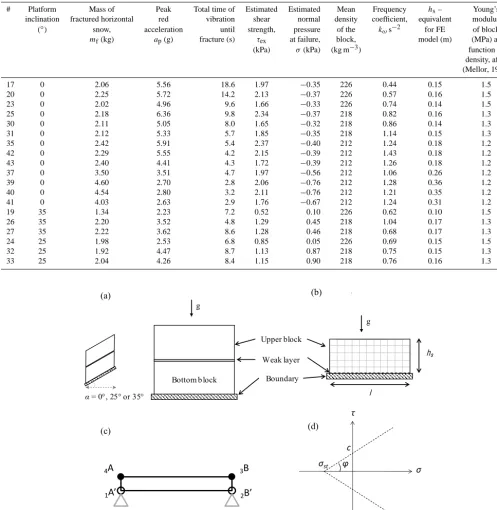
In total, 19 individual tests with varying properties were modelled. Most relevant parameters and results of experi-ments are indicated in Table 1; for more details refer to Podolskiy et al. (2010b).
3.2 Some further experimental conditions relevant to construction of the model
Four specific points, relevant to the construction of the nu-merical model, need to be highlighted. First, in the major-ity of experiments weak layer fractures were observed at the lower interface (between the weak layer and the lower block). No significant vertical collapse within the weak layer could be recognised during tests (based on video quality we could only restrict the maximum possible collapse as less than 1 mm) (Podolskiy, 2010). Moreover, with the particu-lar inertial loading considered in this study, we do not expect vertical collapse to play a major role in the failure process. Hence, for the purpose of simplification, the possibility of vertical collapse was not considered in the modelling and the weak layer was represented as a non-collapsible interface.
Second, analysis of video records shows no noticeable hor-izontal strains in the two snow blocks surrounding the weak layer; with the available video quality, the upper bound for strain is less than 0.33 % (Podolskiy, 2010). This means that the whole blocks can be regarded, as a first approximation, as rigid bodies. Such assumption amounts to considering that most of the possible deformation is concentrated within the weak layer, in agreement with previous studies (Reiweger and Schweizer, 2010; van Herwijnen and Jamieson, 2005; van Herwijnen et al., 2010). For the purpose of reducing computing costs, we will thus omit the lower block in the model and only consider a system made of an upper block and an interface (Fig. 1). Furthermore, in agreement with this discussion, it will be shown (Sect. 5.3) that the elastic prop-erties of the upper block do not influence failure propprop-erties.
Third, we note that the size of the samples used in the ex-periments is much smaller than the critical crack length re-quired for failure self-propagation (McClung, 2011; Gaume et al., 2013). In other words, weak layer failure in the experi-ments is driven only by the applied loading and not by stress redistributions, which remain negligible at the scale consid-ered. Global sample failure occurs when the inertial stresses induced by the oscillations reach the failure criterion in the whole weak layer. Therefore, there is no need for consider-ing the post-failure behaviour of this layer or the progres-sive accumulation of damage during the succesprogres-sive loading cycles. In this sense, these experiments appear particularly well-suited to focusing on the weak layer failure criterion, independently of post-failure propagation phenomena.
Lastly, since the experiments had high rates of loading (failure occurred within a second; strain rates were higher than 10−3s−1), we do not consider viscous behaviour of
122 E. A. Podolskiy et al.: Evaluating snow weak-layer failure parameters
Table 1. List of tests referred for validation of the model, after Podolskiy et al. (2010b) and prescribed modelling parameters for each test.
# Platform Mass of Peak Total time of Estimated Estimated Mean Frequency hs– Young’s inclination fractured horizontal red vibration shear normal density coefficient, equivalent modulus (◦) snow, acceleration until strength, pressure of the kωs−2 for FE of block mf(kg) ap(g) fracture (s) τex at failure, block, model (m) (MPa) as
(kPa) σ(kPa) (kg m−3) function of
density, after (Mellor, 1975)
17 0 2.06 5.56 18.6 1.97 −0.35 226 0.44 0.15 1.5
20 0 2.25 5.72 14.2 2.13 −0.37 226 0.57 0.16 1.5
23 0 2.02 4.96 9.6 1.66 −0.33 226 0.74 0.14 1.5
25 0 2.18 6.36 9.8 2.34 −0.37 218 0.82 0.16 1.3
30 0 2.11 5.05 8.0 1.65 −0.32 218 0.86 0.14 1.3
31 0 2.12 5.33 5.7 1.85 −0.35 218 1.14 0.15 1.3
35 0 2.42 5.91 5.4 2.37 −0.40 212 1.24 0.18 1.2
42 0 2.29 5.55 4.2 2.15 −0.39 212 1.43 0.18 1.2
43 0 2.40 4.41 4.3 1.72 −0.39 212 1.26 0.18 1.2
37 0 3.50 3.51 4.7 1.97 −0.56 212 1.06 0.26 1.2
39 0 4.60 2.70 2.8 2.06 −0.76 212 1.28 0.36 1.2
40 0 4.54 2.80 3.2 2.11 −0.76 212 1.21 0.35 1.2
41 0 4.03 2.63 2.9 1.76 −0.67 212 1.24 0.31 1.2
19 35 1.34 2.23 7.2 0.52 0.10 226 0.62 0.10 1.5
26 35 2.20 3.52 4.8 1.29 0.45 218 1.04 0.17 1.3
27 35 2.22 3.62 8.6 1.28 0.46 218 0.68 0.17 1.3
24 25 1.98 2.53 6.8 0.85 0.05 226 0.69 0.15 1.5
32 25 1.92 4.47 8.7 1.13 0.87 218 0.75 0.15 1.3
33 25 2.04 4.26 8.4 1.15 0.90 218 0.76 0.16 1.3
!"#"$%&'()*+),$!"
"#"$%&'()*"#+,-!
"#! !
Figures and Figure Legends.
#$"! #$%!
Fig. 1(a) 2-D geometry of the discussed experiments and (b) an example of corresponding geometry in
#$$!
Finite Element model; (c) schematic of the joint element
#$&!
#$'!
#$(! #$#! #&)! #&*!
g
(a) (b)
Upper block
Bottom b lock
Weak layer hs
l Boundary
g
= 0°, 25° or 35°
+ ", %
-*
!"
#
(c)! (d)!
(a)! (b)!
Figure 1. (a) 2-D geometry of the discussed experiments and (b) an example of corresponding geometry in the finite element model; (c) schematic of the joint element; (d) Mohr–Coulomb failure criterion.
snow. High loading rates guarantee a brittle range for all ob-served fractures. Such high loading rates are representative of stress variations involved in natural avalanche releases, load-ing produced by skiers/snowmobilers, explosive air blasts, as well as strong ground motion due to earthquakes or mine blasting (Podolskiy et al., 2010a).
4 FEM modelling
Our FEM computations are performed using Cast3M open-source software (http://www-cast3m.cea.fr), a code devel-oped by the French Atomic Research Center (Laborderie and Jeanvoine, 1994), and employed in previous studies on
E. A. Podolskiy et al.: Evaluating snow weak-layer failure parameters 123
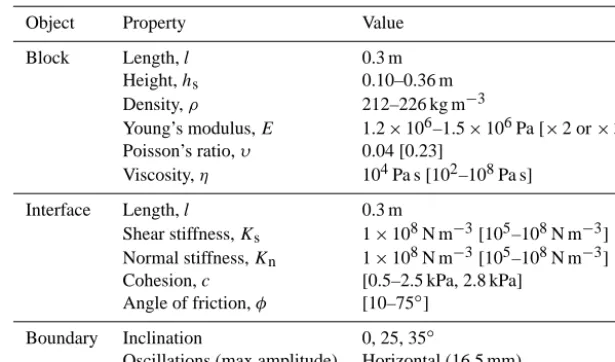
Table 2. Properties of FEM model (values in square brackets correspond to sensitivity tests).
Object Property Value
Block Length,l 0.3 m
Height,hs 0.10–0.36 m
Density,ρ 212–226 kg m−3
Young’s modulus,E 1.2×10⁶–1.5×10⁶Pa[×2 or×3]
Poisson’s ratio,υ 0.04[0.23]
Viscosity,η 104Pa s[102–108Pa s]
Interface Length,l 0.3 m
Shear stiffness,Ks 1×10⁸N m−3[105–108N m−3] Normal stiffness,Kn 1×10⁸N m−3[105–108N m−3]
Cohesion,c [0.5–2.5 kPa, 2.8 kPa]
Angle of friction,φ [10–75◦]
Boundary Inclination 0, 25, 35◦
Oscillations (max amplitude) Horizontal (16.5 mm)
snow avalanche release (Gaume et al., 2011, 2012, 2013; Gaume, 2012). The code (Education and Research Release of 2010) employs an implicit time integration scheme; gov-erning equations are solved incrementally, thus enabling non-linear computations, and taking into account dynamic ef-fects.
4.1 Model description 4.1.1 Model geometry
The upper block is represented by a rectangle or parallel-ogram (for inclined tests), which is 0.3 m long and 0.14– 0.36 m high. A 1 cm×1 cm quadrilateral element shape with four nodes is used for the mesh (QUA4); there are about 14– 36 elements in the vertical dimension (depending on the sam-ple height) and 30 in the horizontal dimension. We noted that sensitivity tests with twice as many elements produced simi-lar, but much more computationally costly results.
The weak layer is treated as an interface, modelled by joint elements with four nodes (JOI2) and zero thickness, i.e. an element is created between two segments of two points (Fig. 1c). There are 30 joint elements (each 1 cm long). The “lower” part of the joint (1A0–2B0; Fig. 1c) is fixed to the bot-tom boundary, meaning that there are no vertical or horizon-tal displacements relative to the boundary. Displacements on the upper part (4A–3B) are not restricted, thus allowing free deformation.
4.1.2 Constitutive laws of the block
The upper block is considered as a uniform and isotropic elastic material similar to many slab models presented in lit-erature (Mahajan et al., 2010; Heierli et al., 2008; Bazant et al., 2003; Borstad and McClung, 2011). Accordingly, its behaviour is controlled by Young’s modulus, E, and Pois-son ratio,υ(Table 2). We use Young’s modulus values
vary-ing with density after Mellor (1975), in the range of 1.2– 1.5 MPa. We follow the study by Teufelsbauer (2011) and select a Poisson’s ratio to be equal to 0.04 (for tempera-ture −10◦C). Also we note that since the problem deals with dynamics and vibration, non-physical viscosity of the block,η, is introduced into the damping matrix of the model for numerical stability reasons. Sensitivity tests to Young’s modulus,E, Poisson ratio,υ, and viscosity,η, showed that they have a negligible influence on failure properties (see Sect. 5.3).
4.1.3 Constitutive laws of the interface
The interface is governed by a Mohr–Coulomb failure cri-terion, with an angle of internal friction,φ, and a cohesion,
c:
τ=σtan(φ)+c, (1)
where τ is shear stress and σ is normal stress (Fig. 1d). The cohesion is related to the tensile strength,σst, as follows (Fig. 1d):
c=σsttan(φ). (2)
Accordingly, we may refer in the following text to both ten-sile strength (σst) and cohesion (c), depending on the context. We note that considering an interface law that includes a ten-sile strength is crucial to reproduce our experimental tests, since these may involve significant tension stresses. Addi-tionally to failure criterion, for joint elements we also specify values of shear and normal stiffness,KsandKn(Table 2). To the best of our knowledge, there are hardly any experimen-tal data for weak layer elastic properties (Föhn et al., 1998; Jamieson and Schweizer, 2000). After conducting sensitivity tests for different couplings ofKs andKn(within the range 105–108N m−3) for a full set of experiments, the shear and
124 E. A. Podolskiy et al.: Evaluating snow weak-layer failure parameters normal interface stiffnesses were set to 108N m−3. We found
negligible effects ofKsandKnon failure, which will be dis-cussed later in Sect. 5.3.
4.1.4 Cyclic displacements, inertial loadings and gravity
Before initiating inertial loading for a particular set of pa-rameters, we subject the system to its actual weight. Gravity is applied gradually at a rate of 2.45 g s−1 during 4 s until reaching its 100 % value, in order to avoid numerical insta-bilities. Furthermore, the Poisson ratio of the block,υ, is set to 0 during this initial phase in order to obtain homogeneous normal stresses within the sample, i.e. without any stress con-centrations at the edges. In the next procedural step, the value
υ=0.04 is introduced and the system is allowed to stabilise during 0.4 s.
Next, we reproduce horizontal shaking of the platform by imposing displacements onto the lower boundary. Consis-tently with the experimental conditions, the system base is subjected to the following cyclic displacement:
s(t )=0.0165(1−cos(ω(t )t )), (3)
where 0.0165 is the displacement amplitude in metres. The angular frequency,ω, increases linearly as a function of time (after initial sample preparation):
ω(t )=
0 if 0< t <4.4 s, kωπ(t−4.4) if 4.4≤t≤25.0 s
, (4)
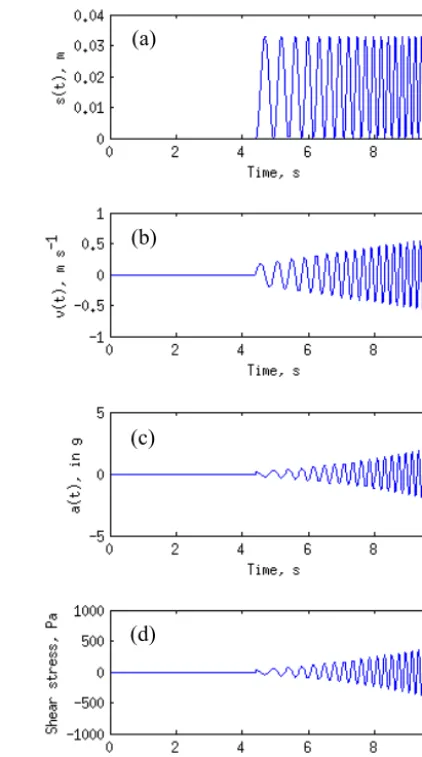
where the coefficient kω varies between 0.44 and 1.43 s−2 (see below). This angular frequency increase introduces the gradual growth of velocities and accelerations, and thus stresses, with every oscillation (Fig. 2).
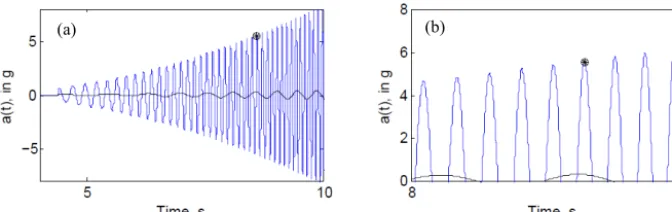
Since a sample’s failure always occurs at an instant when acceleration reaches a peak (caused by a change of the plat-form’s direction of movement), and since the corresponding peak acceleration is known from the experimental measure-ments, we individually adjusted the coefficientkω for each test in order to recover the right value of peak acceleration at the instant of failure. An example ofkω adjustment for one test is provided in Fig. 3a and b. Values ofkωobtained for all tests are listed in Table 1.
Here, it is also appropriate to recall the simplified analyt-ical evaluation of the shear force evolution (τex) previously used, in the horizontal case, to estimate weak layer shear strength during experiments (Nakamura et al., 2010; Podol-skiy et al., 2010b):
τex(t )= mfa(t )
A , (5)
wheremfis the mass of the upper block,a(t )is block accel-eration (second derivative ofs(t )with respect to time), and
Ais the area of the failure plane. This analytical approxima-tion corresponds to a purely static model, since it does not
!"#"$%&'()*+),$!"±
"#"$%&'()*"#+,-!
"#!
!
Fig. 2
Examples of imposed displacements,
s
(
t
), its derivatives and analytical estimation of shear stress.
$%&!
(a)
Imposed displacements,
s
(
t
) (
k
Ȧ=0.74 sí2);
(b)
velocity,
s
'(
t
);
(
c
)
acceleration,
s
''(
t
);
(d)
analytical shear
$%'!
stress,
IJa
(for
h
s= 0.1 m,
ȡ
= 200 kg m
í3)!
$%"!
$%(!
$%%!
$%)!
(a)!
(b)!
(c)!
(d)!
Figure 2. Examples of imposed displacements, s(t ), its deriva-tives and analytical estimation of shear stress. (a) Imposed dis-placements, s(t ) (kω=0.74 s−2); (b) velocity, s0(t ); (c) accel-eration, s00(t ); (d) analytical shear stress, τex (for hs=0.1 m,
ρ=200 kg m−3).
account for dynamic stress inhomogeneities caused by iner-tia and geometry. Sincemf=hsA ρs, wherehs is the height of the block andρsis its density, Eq. (5) can be rewritten for further comparisons as:
τex(t )=hsρsa(t ). (6)
In the inclined case, gravity effect should also be taken into account so that:
τex(t )=hsρsa(t )cosα+hsρsgsinα, (7) whereαis the inclination of the boundary.
E. A. Podolskiy et al.: Evaluating snow weak-layer failure parameters 125
!"#"$%&'()*+),$!"±
"#"$%&'()*"#+,-!
"#! !
Fig. 3 Examples of fitting angular frequency by adjusting kȦ: (a) kȦ = 0.33 sí2 and1.43 sí2, (b) same
$%&!
zoomed; Markers indicate an example of observed peak acceleration reached at observed failure time
$%$!
$'(!
$'#!
$')!
(a)! (b)!
Figure 3. Examples of fitting angular frequency by adjustingkω: (a)kω=0.33 s−2(in black) and 1.43 s−2(in blue), (b) the same zoomed. The markers indicate an example of observed peak acceleration reached at observed failure time.
4.1.5 Definition of sample failure
We define sample failure as the first instant when all nodes of the interface,N, satisfy the Mohr–Coulomb failure criterion:
[nodal failure] ≡|τ| −σtanφ
c =0.99999, (8)
[total failure] ≡Nf=N, (9)
whereNfis a number of failed nodes. This instant is denoted tm. We emphasise here that when the stresses decrease dur-ing the loaddur-ing cycles, the interface nodes recover their initial elastic behaviour and strength, and that no progressive accu-mulation of damage is considered (see Sect. 3.2).
4.2 Search for optimal failure parameters
Systematic numerical simulations were run to find values of cohesion cand friction angleφ that minimise the time dif-ference between instants of failure predicted by the model (tm) and those measured in the experiments (te). By adjust-ing these two degrees of freedomcandφ, we investigated the ability of the assumed weak layer failure threshold to predict correct failure time values. The adjustment was performed on all tests, involving a variety of experimental conditions (different masses and inclination angles), since all used sam-ples were expected to be characterised by similar weak layer properties. Accordingly, we defined a numerical optimisation search procedure based on the following constrained single-objective cost function,CFEM:
CFEM(c, φ)= v u u u t
n
P
i=1
|tm,i−te,i|2
n (10)
for a number of simulated tests n. We consider a parame-ter space where cohesion, c, is limited to a range between 0.5 and 2.8 kPa (Föhn et al., 1998), and the internal friction coefficient range is to 0.18–3.73, or 10–75◦(e.g. Keeler and Weeks, 1968; Nakamura et al., 2010); more detailed discus-sion is provided in Sect. 6.
In order to reduce computational costs, instead of cover-ing thec–φparameter space by all possible discrete
combi-nations and for the whole ensemble of 19 tests, we followed cost function gradients manually by selecting a smaller rep-resentative sample of experiments. This reduced “calibra-tion” sample consisted of 5 (or 9) individual tests selected with different inclinations, masses and sizes to avoid possi-ble biases. The results obtained with the “calibration” sample would then be verified on the complete “validation” sample (as will be explained in Sect. 5.2).
5 Results
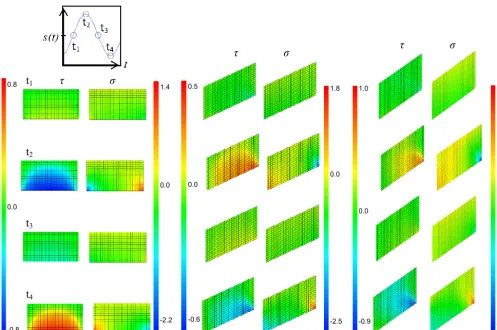
5.1 Mechanical behaviour of samples and failure Figure 4 provides examples of stress fields within the blocks caused by motion and the geometry of the system. Two prin-cipal observations can be made for all inclinations. First, as the block changes its direction of movement and thus experi-ences high accelerations, we observe the expected emergence of maximum shear stress (see instant t2 at Fig. 4). These stresses then decay as the block moves backward and passes through the central position of its trajectory (t3). At the op-posite side of the oscillation (t4), shear stresses re-peak with an opposite sign (Fig. 4). Second, we see that at the critical points (t2andt4), normal stress remains quasi-constant in the middle of the block, but shows important variations of oppo-site signs at the edges. Due to the inertia of the mass, one side will experience an increase in normal stress, while the other a decrease. With higher accelerations, these decreasing normal stresses progressively turn into tension. As the block leaves the pointt2and reaches the opposite critical point (t4), signs of normal pressure reverse.
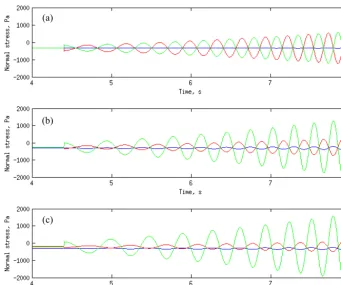
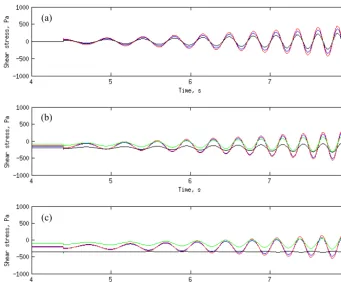
Similarly, in the interface the imposed oscillations produce shear stresses with changing directions and strong oscilla-tions of normal stress at the edges of the joint (Figs. 5 and 6). Tensile stresses appearing at the edges clearly illustrate that tensile strength of the weak layer needs to be taken into ac-count for realistic representation of tests (Fig. 5). Figure 6 also shows the differences between the analytical (Eqs. 8 and 9) and FEM solutions for shear stresses. In general, the FEM gives larger shear stresses, by about 20 % in the middle of the horizontally inclined joint, thus clearly indicating the
126 E. A. Podolskiy et al.: Evaluating snow weak-layer failure parameters
0.8
0.0
-0.8
1.4
0.0
-2.2
1.8
0.0
-2.5 0.5
0.0
-0.6
1.0
0.0
-0.9
1.4
0.0
-2.3
τ σ
τ σ
τ σ
t
1t
2t
3t
4Figure 4. Shear and normal stress concentrations within blocks (inclined to 0, 25 or 35◦) at different consequent phases of oscillations (time increases downward; the inset of the figure shows an example of corresponding instants on the trajectory, i.e. time–displacement plane). (For each inclination left side corresponds to shear,τ, right side – to normal pressure,σ. Note that colour intensity is not normalised in order to highlight specific concentrations for each case; in 103Pa).
limitations of the analytical approach for samples of limited length. For the inclined tests (25 and 35◦), the differences between the analytically and FE-derived shear stresses in the middle of the interface are slightly smaller (Fig. 6b and c). However, edge effects are more significant for these inclined tests (Figs. 5 and 6).
Figure 7 shows the growth of the number of nodes, Nf, that have reached failure criterion with time. As expected, as the block passes the critical point and reverses its direction, the stresses start dropping so that the number of failed nodes
Nfprogressively diminishes and is always zero at the central position of the trajectory. The next peak is then larger than the previous one, because of the progressive acceleration in-crease. Accordingly, we observe progressive enlargement of the failure zone, purely driven by the external loading, dur-ing the successive oscillations (Fig. 7). The time difference between the instant of “total failure” (tm) and experimental failure (te) is also indicated in Fig. 7.
5.2 Mohr–Coulomb parameter optimisation
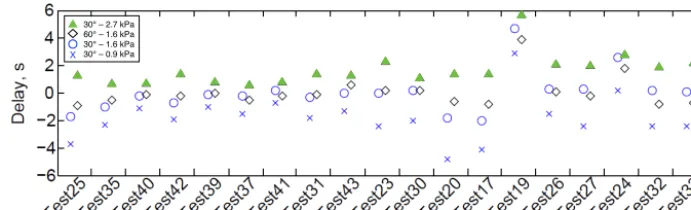
The failure time delaytm−te obtained for all tests and for different pairs (c,φ) is indicated in Fig. 8. For the consid-ered range of parameters, experimental time-to-failure,te, is reproduced within 20 % for the majority of tests with only a few outliers. The figure shows that if the modelled joint has a cohesion that is too high, failure will be delayed compared tote; on the contrary, if it is too low, failure will occur earlier. In general, the responses of all individual tests to changes in
candφappear similar, thus justifying the choice of a smaller sample for adjusting these parameters.
More specifically, Fig. 9 shows cost function,CFEM, sen-sitivity to a selection of a different number of tests and illus-trates that earlier introduced sub-sampling (Sect. 4.2) is rea-sonable for the optimal parameter search. For particular vari-ations in parameters the sample’sCFEM5(where subscript 5 indicates the number of tests considered) responds similarly toCFEM computed for the complete population of tests. In the following, two validations samples will be considered,
E. A. Podolskiy et al.: Evaluating snow weak-layer failure parameters 127
!"#"$%&'()*+),$!"±
"#"$%&'()*"#+,-!
"#! !
Fig. 5 (a) Example of evolution of normal stresses in the middle and at edges of the interface (blue and
$%&!
red/green curves, respectively) for a horizontal test (Test 23). Evolution of normal stresses in the middle
$%'!
and at edges of the interface for inclined tests (25° and 35°; Tests 33 and 27) are shown at (b) and (c),
$%#!
respectively (blue corresponds to the middle of the interface; red ± to the lower edge; green ± to the upper
$%"!
edge)
$%(!
$%)!
$%*!
$%%!
$%$!
$$+!
$$&!
(a)!
(b)!
(c)!
Figure 5. Example of evolution of normal stresses in the middle and at edges of the interface (blue corresponds to the middle of the interface; red – to the left edge; green – to the right edge). (a) Horizontal test (Test 23); (b) and (c) – inclined tests (25 and 35◦; Tests 33 and 27).
corresponding toCFEM5(tests 27, 30, 33, 35, 41) andCFEM9 (idem with also tests 23, 26, 32, 39).
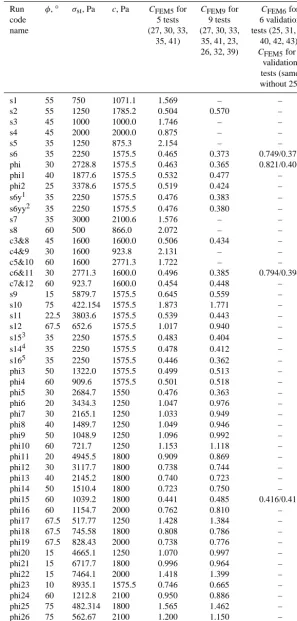
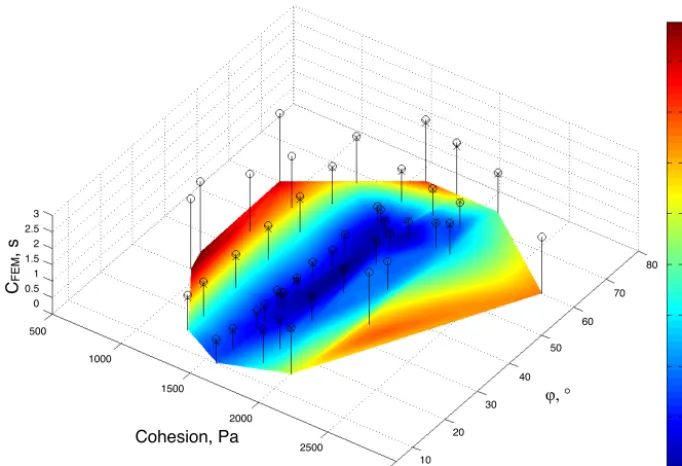
The variations ofCFEM5with cohesion and friction angle, c andφ, are shown in Fig. 10 (and in Table 3). The figure shows all tested combinations ofcandφtogether with some sensitivity tests. The most important outcome of the param-eter optimisation (Fig. 10) is the lack of a clear global min-imum inCFEM5. Instead we can observe a valley, which is narrow in cohesionc, but wide in φ, and which is charac-terised by very close values ofCFEM5 (this is more clearly seen in the colour contours based on a cubic interpolation). Accordingly, simulation results appear more sensitive to the cohesion than to the angle of friction.
Following this finding that simulations with different pairs ofc–φresulted in comparable values of cost function, a sim-ilar study was performed onCFEM9(Fig. 10, Table 3). How-ever, even with additional tests a minimum inφdid not be-come evident. We could nevertheless identify the three pairs of c–φ corresponding to the lowest computed cost func-tion values: 1.57 kPa–30◦, 1.57 kPa–35◦, 1.6 kPa–30◦ with
CFEM9=0.365, 0.373 and 0.385 s, respectively.
Three “validation” sample simulations (including the re-maining tests: 25, 31, 37, 40, 42, 43) were run with these parameters resulting from the optimisation of the calibration sample. Excluding test 25, which behaved as an outlier for the three cases, the “validation” samples produced similarly
lowCFEM values to those that were obtained with the “cali-bration” sample (Table 3;CFEM5v=0.406, 0.377 and 0.394 s, respectively). For example, for simulations withc=1.57 kPa andφ=35◦, the time difference between modelled and ob-served failures correspond, on average, to 5 % of the total duration of each individual test.
5.3 Sensitivity analysis
In this section we briefly describe the sensitivity tests that were performed in order to confirm that none of the results provided in this study were affected by other parameters of the model. These tests were performed during different stages of the model development and testing, therefore here we just summarise the main conclusions. The ranges of val-ues used for this sensitivity analysis are specified in Table 2. Sensitivity tests with a higher Young’s modulus,E, of the block have shown negligible increase in the magnitude of stresses within the joint (about 1–2 %), and negligible ef-fects on computed time-to-failure (tm). Numerical experi-ments (s6y; for nine tests) with the same cohesion,c, and angle of internal frictionφas in the s6 simulations (Table 3), but with a Young’s modulus twice or thrice as high produced similarCFEM9values (0.383 and 0.380 s compared to 0.373 s in the s6 simulations; see Fig. 10 with details also shown in Table 3).
128 E. A. Podolskiy et al.: Evaluating snow weak-layer failure parameters
Table 3. Sample response to adjustment parameters (see also Fig. 10)1.
Run φ,◦ σst, Pa c, Pa CFEM5for CFEM9for CFEM6for
code 5 tests 9 tests 6 validation
name (27, 30, 33, (27, 30, 33, tests (25, 31, 37,
35, 41) 35, 41, 23, 40, 42, 43)/
26, 32, 39) CFEM5for 5
validation tests (same without 25)
s1 55 750 1071.1 1.569 – –
s2 55 1250 1785.2 0.504 0.570 –
s3 45 1000 1000.0 1.746 – –
s4 45 2000 2000.0 0.875 – –
s5 35 1250 875.3 2.154 – –
s6 35 2250 1575.5 0.465 0.373 0.749/0.377
phi 30 2728.8 1575.5 0.463 0.365 0.821/0.406
phi1 40 1877.6 1575.5 0.532 0.477 –
phi2 25 3378.6 1575.5 0.519 0.424 –
s6y1 35 2250 1575.5 0.476 0.383 –
s6yy2 35 2250 1575.5 0.476 0.380 –
s7 35 3000 2100.6 1.576 – –
s8 60 500 866.0 2.072 – –
c3&8 45 1600 1600.0 0.506 0.434 –
c4&9 30 1600 923.8 2.131 – –
c5&10 60 1600 2771.3 1.722 – –
c6&11 30 2771.3 1600.0 0.496 0.385 0.794/0.394
c7&12 60 923.7 1600.0 0.454 0.448 –
s9 15 5879.7 1575.5 0.645 0.559 –
s10 75 422.154 1575.5 1.873 1.771 –
s11 22.5 3803.6 1575.5 0.539 0.443 –
s12 67.5 652.6 1575.5 1.017 0.940 –
s153 35 2250 1575.5 0.483 0.404 –
s144 35 2250 1575.5 0.478 0.412 –
s165 35 2250 1575.5 0.446 0.362 –
phi3 50 1322.0 1575.5 0.499 0.513 –
phi4 60 909.6 1575.5 0.501 0.518 –
phi5 30 2684.7 1550 0.476 0.363 –
phi6 20 3434.3 1250 1.047 0.976 –
phi7 30 2165.1 1250 1.033 0.949 –
phi8 40 1489.7 1250 1.049 0.946 –
phi9 50 1048.9 1250 1.096 0.992 –
phi10 60 721.7 1250 1.153 1.118 –
phi11 20 4945.5 1800 0.909 0.869 –
phi12 30 3117.7 1800 0.738 0.744 –
phi13 40 2145.2 1800 0.740 0.723 –
phi14 50 1510.4 1800 0.723 0.750 –
phi15 60 1039.2 1800 0.441 0.485 0.416/0.411
phi16 60 1154.7 2000 0.762 0.810 –
phi17 67.5 517.77 1250 1.428 1.384 –
phi18 67.5 745.58 1800 0.808 0.786 –
phi19 67.5 828.43 2000 0.738 0.776 –
phi20 15 4665.1 1250 1.070 0.997 –
phi21 15 6717.7 1800 0.996 0.964 –
phi22 15 7464.1 2000 1.418 1.399 –
phi23 10 8935.1 1575.5 0.746 0.665 –
phi24 60 1212.8 2100 0.950 0.886 –
phi25 75 482.314 1800 1.565 1.462 –
phi26 75 562.67 2100 1.200 1.150 –
phi27 57.5 1075.2 1687.8 0.467 0.510 –
1Sensitivity tests to higherE,×2;2sensitivity tests to higherE,×3;3sensitivity tests to higherη,×102; 4sensitivity tests to higherη,×104;5sensitivity tests to lowerη,×10−2.
E. A. Podolskiy et al.: Evaluating snow weak-layer failure parameters 129 !"#"$%&'()*+),$!"±"#"$%&'()*"#+,-
!
""! !
Fig. 6 Examples showing shear stress differences between simple analytical and FEM solutions. (a) ##$!
KRUL]RQWDOWHVW7HVWK Pȡ NJPí3); (b) LQFOLQHGWHVW7HVWK Pȡ NJ
##%!
mí3); (c) LQFOLQHGWHVW7HVWK Pȡ NJPí3). Analytical solutions are shown in blue;
##"!
FEM ± in red (for the middle of the joint), green (left or upper edge), and black (right or lower edge) ##&!
##'!
##(!
##)!
###!
*+++!
(a)!
(b)!
(c)!
Figure 6. Examples showing shear stress differences between simple analytical and FEM solutions. (a) Horizontal test, 0◦ (Test 23,
h=0.14 m,ρ=226 kg m−3); (b) inclined test, 25◦ (Test 33: h=0.16 m,ρ=218 kg m−3); (c) inclined test, 35◦(Test 27: h=0.17 m,
ρ=218 kg m−3). Analytical solutions are shown in blue; FEM – in red (for the middle of the joint), green (right or upper edge), and black (left or lower edge).
!"#"$%&'()*+),$!"
"#"$%&'()*"#+,-!
Fig. 7 Example of Nfgrowthwith simulation time (for test 30: c = 1.6 kPa, = 30°, (tm te) = 0.3 s): i.e.,
$%%$!
instantaneous number of nodes under failure criterion, Nf (te is shown by a blue asterisk, tm by a red $%%&!
circle). Illustrations below indicate which nodes along the length of the interface satisfy failure criterion
$%%'!
(i.e. yes , no ) at particular instants
$%%"!
$%%#!
$%%(!
$%%)!
Figure 7. Example ofNf growth with simulation time (for test 30:c=1.6 kPa,φ=30◦, (tm−te)=0.3 s): i.e. instantaneous number of nodes under failure criterion,Nf(teis shown by a blue circle,tmby a red circle). Illustrations below indicate which nodes along the length of the interface satisfy failure criterion (i.e. yes – “1”, no – “0”) at particular instants.
Sensitivity calculations with respect to Poisson’s ratio,υ, in the block showed that a value of 0.23 instead of 0.04 pro-duces slightly higher normal stresses within the joint (1.1 % at the largest), and thus may delay the timing of total failure but for only one time step at the most.
Variations in the numerical viscosity of the block, η, by two or four orders of magnitude (from 104Pa s up to 106 or 108Pa s or down to 102Pa s) have a negligible effect on
failure time. The baseline value of 104Pa s was found to be optimal for the overall stability of the model (no artificial high-frequency stress oscillations).
Finally, a relatively low sensitivity of model results to dif-ferent combinations of joint stiffnessKs andKnwas found. For example, three sensitivity simulation sets performed for all 19 tests with the samec=1.6 kPa andφ=45◦, but
130 E. A. Podolskiy et al.: Evaluating snow weak-layer failure parameters !"#"$%&'()*+),$!"
"#"$%&'()*"#+,-!
"#! !
Fig. 8 Example of delays between observed and modeled failures (tm te) for different tests as a function
$%%&!
of adjustment parameters ( ). Blue circles correspond to 30° 1.6 kPa, blue crosses to 30° 0.9 kPa; $%%'!
black triangles to 30° 2.7 kPa, black diamonds to 60° 1.6 kPa $%$%!
$%$$!
$%$(!
30° – 2.7 kPa ! 60° – 1.6 kPa ! 30° – 1.6 kPa ! 30° – 0.9 kPa
Figure 8. Example of delays between observed and modelled failures (tm−te) for different tests as a function of adjustment parameters (φ,
c). Blue circles correspond to 30◦–1.6 kPa, blue crosses to 30◦–0.9 kPa; black triangles to 30◦–2.7 kPa, black diamonds to 60◦–1.6 kPa.
Figure 9. Comparison betweenCFEMobtained for (1) whole pop-ulation of tests with stiffness Ks andKn=108N m−3 (CFEM19; 19 tests), (2) for a population excluding outliers and computation-ally expensive tests (CFEM15; 15 tests: i.e. without 17, 19, 20, 24), and (3) for a sample of the population (CFEM5; 5 tests: only 27, 30, 33, 35, 41).
ing stiffness values (between 103and 108N m−3), produced very similar cost function values.
Thus, in short, none of the parameters tested in this sen-sitivity analysis have effects on the computed failure time comparable to the impact of the failure criterion parametersc
andφ.
6 Discussion
Interpretation of observed behaviour
The main objective of the study was to investigate the appli-cability of the Mohr–Coulomb failure criterion, which is one of the most common failure criteria in mechanics of granu-lar material, in relatively complex experiments performed on sandwich snow samples. A first important result is that FEM modelling appeared necessary to capture the stress inhomo-geneities arising within the sample that were disregarded by previous analytical analyses (Podolskiy et al., 2010b). Our results also show that even with a simple set of model as-sumptions, it was possible to reproduce correct failure times for very different experimental cases (i.e. with various incli-nations, masses and sizes). Importantly, it appears that the
normal stress dependence of the failure criterion is an im-portant ingredient that should be taken into account. In par-ticular, criteria involving only a cohesion cannot reproduce as well the considered set of experiments. We also recall that the occurrence of normal stress oscillations impose a require-ment of the interface to have tensile strength,σst. This means that the weak layer cannot be described by a purely cohesive form of the Mohr–Coulomb failure criterion.
To illustrate the meaning of the cost functionCFEM re-sults indicated in Fig. 10, all corresponding Mohr–Coulomb failure envelopes are represented in Fig. 11. In Fig. 11 we have used green shading and red lines to highlight results for which theCFEM is lower than 0.5 s (for both sample sizes, i.e. with 5 or 9 tests). It clearly appears that these optimal simulations provide strong constraints on the value of co-hesionc, which lies in the range 1.6–1.8 kPa. These cohe-sion values derived through our inverse simulations fall well within the range of measurements reported for weak layers composed of precipitation particles or interfaces (Föhn et al., 1998).
Unlike for cohesion, the simulations do not provide strong constraints on the values of friction angleφ(Figs. 10 and 11). Thus the overall behaviour of the observed failures in the considered experiments appears mostly controlled by cohe-sion,c, while friction angleφ plays only a secondary role (in the range 20 to 60◦). It is probable that this behaviour is partly due to a limited range of sample heights and in-clinations, and thus to insufficient variations of the normal stresses between the different experiments. Slight variability between the tests may further enhance the poor localisation of the minimum inφ.
An additional effect may also contribute to relatively poor resolution in friction angle provided by our numerical opti-misation. For a fixed value of cohesion,c, the friction an-gle,φ, controls both the value of the tensile strength,σst, and the linear “strengthening” of the interface with higher nor-mal stress (e.g. Fig. 11). Hence, with a higher (resp. lower) friction angle, the tensile strength of the interface becomes smaller (resp. higher) than the cohesion, and at the same time, the compressive part of the criterion has a steeper (resp. lower) inclination and requires higher (resp. lower)
E. A. Podolskiy et al.: Evaluating snow weak-layer failure parameters 131 !"#"$%&'()*+),$!"
"#"$%&'()*"#+,-!
"#! !
Fig. 10 Effects of c and adjustments on time delay between modeled and experimental failures (CFEM, or
$%&%!
RMSE; shown for a sample of 5 tests $%&$!
modulus sensitivity tests, s6y & s6yy, by pentagrams). Color contours are based on cubic interpolation for $%&&!
generalization of results (CFEM5)
$%&'!
$%&"!
$%&(!
Cohesion, Pa
φ, °
500
1000
1500
2000
2500
3000 10
20 30
40 50
60 70
80
0.4 0.6 0.8 1 1.2 1.4 1.6 1.8 2
3! 2.5! 2! 1.5! 1! 0.5! 0
CF
EM
, s
Figure 10. Effects ofcandφadjustments on time delay between modelled and experimental failures (CFEM, or RMSE; shown for a sample of five tests by empty circles, for a sample of nine tests by crosses, and for Young’s modulus sensitivity tests, s6y and s6yy, by pentagrams). Colour contours are based on cubic interpolation for generalisation of results (CFEM5).
shear stress for failure. Due to stress inhomogeneity along the interface the above described dual effects are always su-perimposed in simulations. Thus, for an instance of highφ, if some edge nodes easily “failed” in tension at a given oscil-lation, the rest of the nodes will be stronger in compression. This could explain the comparable times of model failure ob-tained for some tests computed with fixed cohesion, but dif-ferent values ofφ(e.g. Fig. 8). In this respect, we can expect the friction angle to play a stronger role for the inclined tests, in which the tensile component of stress is higher. As shown in Fig. 12, this suggestion is supported by computations of the cost function performed only on inclined tests (26, 27, 32, 33). Values ofCFEMdisplay more pronounced variations withφ in this case, with a clear minimum forφ=30–35◦. This range may be considered as the optimal friction angles resulting from our simulations.
Experimental data on the angle of internal friction of snow are very scarce. Previously published values ofφvary strongly depending on the literature source (Fig. 13a and b). Approximately 30◦is commonly reported (Schweizer et al., 2004; Gaume et al., 2012), but the value may range from 5.7 to 57.7◦ in experimental data or fracture line analy-sis (Keeler and Weeks, 1968; Mellor, 1975; McClung and Schaerer, 2006; Jamieson et al., 2001). This wide range prob-ably indicates that further clarification and distinction be-tween different snow types will be necessary. Nevertheless, the value around 30–35◦derived from our analysis appears consistent with these previous experimental data, and we
ar-−50000 −4000 −3000 −2000 −1000 0 1000 2000 500
1000 1500 2000 2500 3000
, Pa
, Pa
Figure 11. Illustration of all tested pairs ofc and φas parame-ters of the Mohr–Coulomb failure criterion (blue dashed lines); red lines (with green shading) indicate the most successful simulations (i.e. when bothCFEM, for the representative sample of 5 or 9 tests, are≤0.5 s).
gue that it represents the most physically realistic value for weak layers of the type and density used in our experiments. Finally, we note that while our results stress the im-portance of accounting for a normal stress dependence of snow failure criterion, the linear shape assumed with Mohr– Coulomb criterion is just an approximation at this stage. Re-finements of the criterion by testing more complex envelope shapes (e.g. Haefeli, 1963) or including a closure in compres-sion remain open issues for future work.
132 E. A. Podolskiy et al.: Evaluating snow weak-layer failure parameters
!"#"$%&'()*+),$!"±
"#"$%&'()*"#+,-!
"#! !
Fig. 12 Effect of the angle of friction, ij, on CFEM for simulations with the same cohesion 1.57 kPa (shown $#%&!
for a sample of 5 tests by blue empty circles, for a sample of 9 tests by red crosses, for a sample of 4 $#%%!
inclined tests by black diamonds) $#%'!
$#%"!
$#%(!
Angle of friction, °!
Figure 12. Effect of the angle of friction,φ, onCFEMfor simula-tions with the same cohesion 1.57 kPa (shown for a sample of 5 tests by blue empty circles, for a sample of 9 tests by red crosses, for a sample of 4 inclined tests by black diamonds).
7 Conclusions
This paper presents a FEM study to simulate snow weak-layer failure under cyclic acceleration loading and to analyse the performance of the Mohr–Coulomb failure criterion. The model is tested by comparison with previous cold-laboratory results for shaking-platform experiments (Podolskiy et al., 2010b). An ensemble of individual experiments is simulated and analysed for overall sensitivity to the adjustment of the constitutive parameters. Based on more than 500 simulations, we found that the Mohr–Coulomb failure criterion for the weak layer is sufficient and adequate for the analysis of the experiments. The best couplings of cohesion and friction an-gle,candφ, were found to be [1.6 kPa, 22.5–60◦]. The wide range ofφhighlights the fact that the reproduction of exper-iments is largely controlled by the value of cohesion and has relatively low sensitivity to friction angle (within the limit shown above). Based on values of the cost function for a lim-ited sample of inclined tests (Fig. 12) and on previous exper-imental evidence, we could suggest thatφaround 30–35◦is the most optimal value, which may be further clarified with follow-up studies. In addition, the requirements to consider effects of normal stress on failure and to include the tensile strength of the interface were evident, meaning that a purely cohesive form of the Mohr–Coulomb failure criterion is not applicable. The tensile strength could be limited to a range between 0.9 and 3.8 kPa (Table 3), which is comparable to previously reported results (Gaume, 2012).
The FE results were also compared with the previously used analytical solution (Nakamura et al., 2010; Podolskiy et al., 2010b), which was found to be inadequate for estimat-ing shear stresses along the failure plane; in particular, for cases with an inclination of the platform. Shear stresses pro-duced during the inclined tests (25 or 35◦) were found to be highly non-homogeneous and thus poorly represented by the analytical approach. Accordingly, the interpretation of exper-iments through the previously used analytical (or “static”) solution is limited.
Figure 13. (a, b) Values of the angle of friction obtained from dif-ferent studies.Y axis in a corresponds to tanφ(it is equal toc/σst and shown as a blue curve); it visualises the ratio between cohesion and tensile strength).
Finally, we are aware that our model with the weak layer representation employed here is only one of many possible approaches, which could have been used to fit the data, and that we confronted the method against only one type of weak layer (composed from precipitation particles) used in pre-vious experiments. Nevertheless, the reasonable results de-scribed in this paper suggest that our approach may be further verified and developed (for instance, for non-linear shapes of the failure criterion) and may be also applied to other types of loadings and weak layers. Such work, along with compu-tationally expensive comparison against other failure criteria, could constitute follow-up studies.
Acknowledgements. The research leading to these results has received funding from the International Affairs Directorate of IRSTEA, INTERREG ALCOTRA (MAP3), from the People Programme (Marie Curie Actions) of the European Union’s Seventh Framework Programme (FP7/2007-2013) under REA grant agreement #298672 (FP7-PEOPLE-2011-IIF, “TRIME”), and from LabEx OSUG@2020 (Investissements d’avenir – ANR10 LABX56). EAP is grateful for all the support, also to E. A. Hard-wick, N. Hadda, P. Hagenmuller, T. Faug, and M. Schneebeli for help and for comments on initial version of the manuscript. The quality of the paper was improved thanks to remarks by A. van Herwijnen and the two anonymous reviewers.
Edited by: P. Bartelt
Reviewed by: A. van Herwijnen and two anonymous referees
E. A. Podolskiy et al.: Evaluating snow weak-layer failure parameters 133 References
Abe, O. and Nakamura, T.: A new method of measurements of the shear strength of snow, horizontal vibration method, Snow Life Tohoku, 15, 13–14, 2000.
Abe, O. and Nakamura, T.: Shear fracture strength of snow mea-sured by the horizontal vibration method, J. Snow Eng., 21, 11– 12, 2005.
Bader, H. and Salm, B.: On the mechanics of snow slab release, Cold Reg. Sci. Technol., 17, 287–300, 1990.
Baroudi, D., Sovilla, B., and Thibert, E.: Effects of flow regime and sensor geometry on snow avalanche impact-pressure measurements, J. Glaciol., 57, 277–288, doi:10.3189/002214311796405988, 2011.
Bazant, Z. P., Zi, G., and McClung, D.: Size effect law and frac-ture mechanics of the triggering of dry snow slab avalanches, J. Geophys. Res., 108, 2119, doi:10.1029/2002JB001884, 2003. Borstad, C. P. and McClung, D.: Numerical modeling of tensile
fracture initiation and propagation in snow slabs using nonlo-cal damage mechanics, Cold Reg. Sci. Technol., 69, 145–155, doi:10.1016/j.coldregions.2011.09.010, 2011.
Chiaia, B., Cornetti, P., and Frigo, B.: Triggering of dry snow slab avalanches: stress vs. fracture mechan-ical approach, Cold Reg. Sci. Technol., 53, 170–178, doi:10.1016/j.coldregions.2007.08.003, 2008.
Chiaia, B. and Frigo, B.: A scale-invariant model for snow slab avalanches, J. Stat. Mech., P02056, doi:10.1088/1742-5468/2009/02/P02056, 2009.
Curtis, J. O. and Smith, F. W.: Material property and boundary con-dition effects on stresses in avalanche snow-packs, J. Glaciol., 13, 99–108, 1974.
DeMontmollin, V.: Introduction a la rheologie de la neige, PhD the-sis, Universite Scientifique et Medicale de Grenoble, France, 1978.
DeMontmollin, V.: Shear tests on snow explained by fast metamor-phism, J. Glaciol., 28, 187–198, 1982.
Fierz, C., Armstrong, R. L., Durand, Y., Etchevers, P., Greene, E., McClung, D. M., Nishimura, K., Satayawali, P. K., and Sokra-tov, S. A.: The international classification for seasonal snow on the ground, IHP-VII Technical Documents in Hydrology #83, IACS Contribution #1, Tech. rep., UNESCO – International Hy-drological Programme, Paris, 2009.
Föhn, P., Camponovo, C., and Krüsi, G.: Mechanical and structural properties of weak snow layers measured in situ, Ann. Glaciol., 26, 1–6, 1998.
Fyffe, B. and Zaiser, M.: The effects of snow variability on slab avalanche release, Cold Reg. Sci. Technol., 40, 229–242, doi:10.1016/j.coldregions.2004.08.004, 2004.
Gaume, J.: Evaluation of avalanche release depths. Combined sta-tistical – mechanical modeling, Ph D thesis, IRSTEA/Universite de Grenoble, St.-Martin-d’Hères, France, 2012.
Gaume, J., Chambon, G., Naaim, M., and Eckert, N.: Influence of Weak Layer Heterogeneity on Slab Avalanche Release Using a Finite Element Method, in: Advances in Bifurcation and Degra-dation in Geomaterials, edited by: Bonelli, S., Dascalu, C., and Nicot, F., vol. 11 of Springer Series in Geomechanics and Geo-engineering, Springer Netherlands, 261–266, doi:10.1007/978-94-007-1421-2_34, 2011.
Gaume, J., Chambon, G., Eckert, N., and Naaim, M.: Relative in-fluence of mechanical and meteorological factors on avalanche
release depth distributions: an application to French Alps, Geo-phys. Res. Lett., 39, L12401, doi:10.1029/2012GL051917, 2012. Gaume, J., Chambon, G., Eckert, N., and Naaim, M.: Influence of weak-layer heterogeneity on snow slab avalanche release: appli-cation to the evaluation of avalanche release depths, J. Glaciol., 59, 423–437, doi:10.3189/2013JoG12J161, 2013.
Habermann, M., Schweizer, J., and Jamieson, J. B.: Influ-ence of snowpack layering on human-triggered snow slab avalanche release, Cold Reg. Sci. Technol., 54, 176–182, doi:10.1016/j.coldregions.2008.05.003, 2008.
Haefeli, R.: Stress transformations, tensile strengths, and rupture processes of the snow cover, in: Ice and Snow: Properties, Pro-cesses, and Applications, edited by: Kingery, W., M.I.T. Press, Cambridge, Mass., 560–575, 1963.
Heierli, J., Gumbsch, P., and Zaiser, M.: Anticrack nucleation as triggering mechanism for snow slab avalanches, Science, 321, 240–243, doi:10.1126/science.1153948, 2008.
Jamieson, B. and Johnston, C. D.: Evaluation of the shear frame test for weak snowpack layers, Ann. Glaciol., 32, 59–69, doi:10.3189/172756401781819472, 2001.
Jamieson, B., Geldsetzer, T., and Stethem, C.: Forecasting for deep slab avalanches, Cold Reg. Sci. Technol., 33, 275–290, doi:10.1016/S0165-232X(01)00056-8, 2001.
Jamieson, J. B. and Johnston, C. D.: Refinements to the stability index for skier-triggered dry-slab avalanches, Ann. Glaciol., 26, 296–302, 1998.
Jamieson, J. B. and Schweizer, J.: Texture and strength changes of buried surface-hoar layers with implications for dry snow-slab avalanche release, J. Glaciol., 46, 151–160, doi:10.3189/172756500781833278, 2000.
Jones, A., Jamieson, J., and Schweizer, J.: The effect of slab and bed surface stiffness on the skier-induced shear stress in weak snow-pack layers, Proceedings of International Snow Science Work-shop (ISSW-2006), Telluride, CO, USA, 157–164, 2006. Keeler, C. M. and Weeks, W. F.: Investigations into the mechanical
properties of alpine snow-packs, J. Glaciol., 7, 253–271, 1968. Laborderie, C. and Jeanvoine, E.: Beginning with Castem 2000,
Tech. Rep. DMT/94-356, CEA, Saclay, France, 1994.
Lang, T. and Sommerfeld, R.: The modeling and measurement of the deformation of a sloping snow-pack, J. Glaciol., 19, 153–163, 1977.
Louge, M. Y., Carroll, C. S., and Turnbull, B.: Role of pore pressure gradients in sustaining frontal particle entrainment in eruption currents: The case of powder snow avalanches, J. Geophys. Res., 116, F04030, doi:10.1029/2011JF002065, 2011.
Mahajan, P. and Joshi, S.: Modeling of interfacial crack ve-locities in snow, Cold Reg. Sci. Technol., 51, 98–111, doi:10.1016/j.coldregions.2007.05.008, 2008.
Mahajan, P. and Senthil, S.: Cohesive element modeling of crack growth in a layered snowpack, Cold Reg. Sci. Technol., 40, 111– 122, doi:10.1016/j.coldregions.2004.06.006, 2004.
Mahajan, P., Kalakuntla, R., and Chandel, C.: Numerical simu-lation of failure in a layered thin snowpack under skier load, Ann. Glaciol., 51, 169–175, doi:10.3189/172756410791386436, 2010.
Matsushita, H., Matsuzawa, M., and Abe, O.: The influences of temperature and normal load on the shear strength of snow consisting of precipitation particles, Ann. Glaciol., 53, 31–38, doi:10.3189/2012AoG61A022, 2012.
134 E. A. Podolskiy et al.: Evaluating snow weak-layer failure parameters
Matsushita, H., Ikeda, S., Ito, Y., Matsuzawa, M., and Naka-mura, H.: Avalanches induced by earthquake in North Tochigi prefecture on 25 February 2013, in: Proceedings of Interna-tional Snow Science Workshop, ISSW’13, Grenoble-Chamonix, France, 1122–1129, 2013.
McClung, D. M.: Direct simple shear tests on snow and their rela-tion to slab avalanche formarela-tion, J. Glaciol., 19, 101–109, 1977. McClung, D. M.: Shear fracture precipitated by strain softening as a mechanism of dry slab avalanche release, J. Geophys. Res., 84, 3519–3526, doi:10.1029/JB084iB07p03519, 1979.
McClung, D. M.: The critical size of macroscopic imperfections in dry snow slab avalanche initiation, J. Geophys. Res., 116, F03003, doi:10.1029/2010JF001866, 2011.
McClung, D. M. and Schaerer, P.: The Avalanche Handbook, 3rd Edn., The Mountaineers Books, Seattle, Wash, 2006. Mellor, M.: A review of basic snow mechanics, in: Publ. 114,
Int. Assoc. of Hydrol. Sci., Geneva, Switzerland, 251–291, 1975. Miller, D., Tichota, R., and Adams, E.: An explicit nu-merical model for the study of snow’s response to ex-plosive air blast, Cold Reg. Sci. Technol., 69, 156–164, doi:10.1016/j.coldregions.2011.08.004, 2011.
Naaim, M., Faug, T., and Naaim-Bouvet, F.: Dry granular flow mod-elling including erosion and deposition, Surv. Geophys., 24, 569– 585, doi:10.1023/B:GEOP.0000006083.47240.4c, 2003. Nakamura, T., Abe, O., Nohguchi, M., and Kobayashi, T.: Basic
studies on the behavior of roof snow in vibration in a snow season at earthquakes, Snow Life Tohoku, 15, 19–22, 2000a.
Nakamura, T., Hashimoto, R., Abe, O., and Ohta, T.: Experience with shear frames, Snow Life Tohoku, 15, 15–18, 2000b. Nakamura, T., Abe, O., Hashimoto, R., and Ohta, T.: A dynamic
method to measure the shear strength of snow, J. Glaciol., 56, 333–338, doi:10.3189/002214310791968502, 2010.
Navarre, J. P., Taillefer, A., and Danielou, Y.: Fluage et rhéolo-gie de la neige, Actes de Conférence Chamonix, 14–25 Septem-bre 1992, Chamonix, 377–388, 1992.
Pérez-Guillén, C., Tapia, M., Suriñach, E., Furdada, G., and Hiller, M.: Evaluation of an avalanche triggered by a local earth-quake at the Vallée de la Sionne (Switzerland) experimental site, in: Proceedings of International Snow Science Workshop, ISSW’13, Grenoble-Chamonix, France, 183–190, 2013. Perla, R. and Beck, T. M. H.: Experience with shear frames, J.
Glaciol., 29, 485–491, 1983.
Podolskiy, E. A.: Experimental studies on earthquake-induced snow avalanches, PhD thesis, Nagoya University, Japan, 2010. Podolskiy, E. A., Nishimura, K., Abe, O., and Chernous, P. A.:
Earthquake-induced snow avalanches: I. Historical case stud-ies, J. Glaciol., 56, 431–446, doi:10.3189/002214310792447815, 2010a.
Podolskiy, E. A., Nishimura, K., Abe, O., and Chernous, P. A.: Earthquake-induced snow avalanches: II. Experimental study, J. Glaciol., 56, 447–458, doi:10.3189/002214310792447833, 2010b.
Podolskiy, E. A., Chambon, G., Naaim, M., and Gaume, J.: A re-view of finite element modelling in snow mechanics, J. Glaciol., 59, 1189–1201, doi:10.3189/2013JoG13J121, 2013.
Reiweger, I. and Schweizer, J.: Failure of a layer of buried surface hoar, Geophys. Res. Lett., 37, L24501, doi:10.1029/2010GL045433, 2010.
Reiweger, I., Schweizer, J., Dual, J., and Herrmann, H. J.: Mod-elling snow failure with a fibre bundle model, J. Glaciol., 55, 997–1002, doi:10.3189/002214309790794869, 2009.
Roch, A.: Les variations de la résistance de la neige, in: Interna-tional Association of Scientific Hydrology Publication 69, Sym-posium at Davos, 5–10 April 1965, Scientific Aspects of Snow and Ice Avalanches, Davos, 86–99, 1966.
Schweizer, J.: The influence of the layered character of snow cover on the triggering of slab avalanches, Ann. Glaciol., 18, 193–198, 1993.
Schweizer, J., Michot, G., and Kirchner, H.: On the fracture toughness of snow, Ann. Glaciol., 38, 1–8, doi:10.3189/172756404781814906, 2004.
Sigrist, C. and Schweizer, J.: Critical energy release rates of weak snowpack layers determined in field experiments, Geophys. Res. Lett., 34, L03502, doi:10.1029/2006GL028576, 2007.
Sigrist, C., Schweizer, J., Schindler, H.-J., and Dual, J.: The energy release rate of mode II fractures in layered snow samples, In-ternat. J. Fract., 139, 461–475, doi:10.1007/s10704-006-6580-9, 2006.
Smith, F. and Curtis, J.: Stress analysis and failure prediction in avalanche snowpacks, in: Publ. 114, Int. Assoc. of Hydrol. Sci., Geneva, Switzerland, 332–340, 1975.
Smith, F., Sommerfeld, R. A., and Bailey, R. O.: Finite-element stress analysis of avalanche snowpacks, J. Glaciol., 10, 401–405, 1972.
Stoffel, M.: Numerical modelling of snow using finite elements, PhD thesis, Swiss Fed. Inst. of Technol., Zürich, Switzerland, 2005.
Stoffel, M. and Bartelt, P.: Modelling snow slab release using a temperature-dependent viscoelastic Finite Element model with weak layers, Surv. Geophys., 24, 417–430, doi:10.1023/B:GEOP.0000006074.56474.43, 2003.
Teufelsbauer, H.: Linking laser scanning to snowpack modeling: data processing and visualization, Comput. Geosci., 35, 1481– 1490, doi:10.1016/j.cageo.2008.10.006, 2009.
Teufelsbauer, H.: A two-dimensional snow creep model for alpine terrain, Nat. Hazards, 56, 481–497, doi:10.1007/s11069-010-9515-8, 2011.
van Herwijnen, A. and Heierli, J.: Measurement of crack-face fric-tion in collapsed weak snow layers, Geophys. Res. Lett., 36, L23502, doi:10.1029/2009GL040389, 2009.
van Herwijnen, A. and Jamieson, B.: High-speed photography of fractures in weak snowpack layers, Cold Reg. Sci. Technol., 43, 71–82, 2005.
van Herwijnen, A., Schweizer, J., and Heierli, J.: Measurement of the deformation field associated with fracture propagation in weak snowpack layers, J. Geophys. Res., 115, F03042, doi:10.1029/2009JF001515, 2010.
Wilson, A., Schweizer, J., Johnston, C., and Jamieson, J.: Effects of surface warming of a dry snowpack, Cold Reg. Sci. Technol., 30, 59–65, doi:10.1016/S0165-232X(99)00014-2, 1999.
Zeidler, A. and Jamieson, B.: Refinements of empirical models to forecast the shear strength of persistent weak layers, Part A: Lay-ers of faceted crystals., Cold Reg. Sci. Technol., 44, 194–205, 2006.