Adolescent Mental Health Program
Components and Behavior Risk
Reduction: A Meta-analysis
Sarah Skeen, PhD,aChristina A. Laurenzi, MSc,aSarah L. Gordon, MA,aStefani du Toit, MA,aMark Tomlinson, PhD,a,b Tarun Dua, MD,cAlexandra Fleischmann, PhD,cKid Kohl, PhD,cDavid Ross, PhD,cChiara Servili, PhD,cAmanda S. Brand, PhD,a Nicholas Dowdall, MSc,dCrick Lund, PhD,eClaire van der Westhuizen, PhD,eLiliana Carvajal-Aguirre, MSc,f
Cristina Eriksson de Carvalho, PhD,gG.J. Melendez-Torres, DPhilh
abstract
CONTEXT:Although adolescent mental health interventions are widely implemented, littleconsensus exists about elements comprising successful models.
OBJECTIVE:We aimed to identify effective program components of interventions to promote mental health and prevent mental disorders and risk behaviors during adolescence and to match these components across these key health outcomes to inform future multicomponent intervention development.
DATA SOURCES:A total of 14 600 records were identified, and 158 studies were included.
STUDY SELECTION:Studies included universally delivered psychosocial interventions administered to adolescents ages 10 to 19. We included studies published between 2000 and 2018, using PubMed, Medline, PsycINFO, Scopus, Embase, and Applied Social Sciences Index Abstracts databases. We included randomized controlled, cluster randomized controlled, factorial, and crossover trials. Outcomes included positive mental health, depressive and anxious
symptomatology, violence perpetration and bullying, and alcohol and other substance use.
DATA EXTRACTION:Data were extracted by 3 researchers who identified core components and relevant outcomes. Interventions were separated by modality; data were analyzed by using a robust variance estimation meta-analysis model, and we estimated a series of single-predictor meta-regression models using random effects.
RESULTS:Universally delivered interventions can improve adolescent mental health and reduce risk behavior. Of 7 components with consistent signals of effectiveness, 3 had significant effects over multiple outcomes (interpersonal skills, emotional regulation, and alcohol and drug education).
LIMITATIONS:Most included studies were from high-income settings, limiting the applicability of thesefindings to low- and middle-income countries. Our sample included only trials.
CONCLUSIONS:Three program components emerged as consistently effective across different outcomes, providing a basis for developing future multioutcome intervention programs.
aInstitute for Life Course Health Research, Department of Global Health, Faculty of Medicine and Health Sciences, Stellenbosch University, Cape Town, South Africa;bSchool of Nursing and
Midwifery, Queens University, Belfast, United Kingdom;cWorld Health Organization, Geneva, Switzerland;dDepartment of Social Policy and Interventions, Oxford University, Oxford, United Kingdom;eAlan J Flisher Centre for Public Mental Health, Department of Psychiatry and Mental Health, University of Cape Town, Cape Town, South Africa;fData and Analytics Section, Division of Data Research and Policy andgDepartment of Maternal, Newborn, Child and Adolescent Health, United Nations Children’s Fund, New York, New York; andhCentre for the Development and Evaluation of Complex Interventions for Public Health Improvement, School of Social Sciences, Cardiff University, Cardiff, United Kingdom
To cite:Skeen S, Laurenzi CA, Gordon SL, et al. Adolescent Mental Health Program Components and Behavior Risk Reduction: A Meta-analysis.Pediatrics. 2019;
Globally, many adolescents live in environments in which poverty, conflict, or abuse is common, placing them at risk for developing mental disorders1or engaging in co-occurring risky behaviors such as substance use and physical violence.2 These behaviors have implications for adolescent health and development and contribute to the disease burden in this age group.3Adolescence is also a time when chronic mental disorders may develop,4which can place adolescents at further risk for unhealthy behaviors, injuries, and diseases and contribute to poor physical and mental health in later years.5Young people suffering from mental health problems have more difficulty forming interpersonal relationships, performing in school, and contributing productively in work environments.1
However, adolescence is also a time of rapid physical, social, and
psychological development, and as a result, it offers multiple
opportunities for health promotion and disease prevention.6Authors of previous systematic reviews on interventions to promote mental health and prevent mental disorders and risk behaviors during
adolescence have concluded that psychosocial interventions can be effective in improving youth mental health.7,8These interventions can provide foundational skills for the promotion of healthy behaviors and prevention of risk behaviors, such as violence (including bullying), tobacco use, and alcohol and substance abuse, through further generalizing behavior change improvements to other domains.9Authors of past reviews have tended to focus on single-issue interventions and outcomes only, such as delaying alcohol use or preventing depression.10–12In real-life settings, single-issue
interventions are more likely to be
“crowded out”by other new programs when funding or policy priorities shift; this approach also
ignores the fact that risk and protective factors for health and development often overlap.9,13
The process of synthesizing evidence for programming purposes should thus be reframed; rather than devoting time to developing single-issue interventions, more attention should be paid to identifying common features of proven interventions for use across multiple outcome areas. The use of key component profiles has been used in process evaluation and best practices research, including in mental health case management.14 This strategy improves
cost-effectiveness, expands an intervention’s reach and sustainability, and may also cull ineffective or harmful components. It is also of particular interest for low-resource settings in which multi-outcome interventions may be more attractive to policymakers because of their potential to have a broad effect for the cost of a single program.15
“Helping Adolescents Thrive” is a World Health Organization and United Nations Children’s Fund initiative used to develop a package of evidence-based psychological interventions to promote adolescent mental health and prevent mental disorders and risk behaviors among adolescents. As a part of this project, we conducted a systematic review, meta-analysis, and program components analysis of universally delivered interventions that sought these aims. Our purpose of this review was to inform the development of the intervention package. Specifically, we wanted to identify content-related features of programs (known as program or practice components) that consistently predict larger effect sizes in these programs across a range of outcomes.
METHODS
A protocol for this systematic review was agreed with the World Health Organization as the version of record
(see Supplemental Information). We presentfindings relating to universal interventions only in this article (programs that are targeted at the whole adolescent population and are designed to benefit everyone, not only specific at-risk groups).
Search Strategy and Selection Criteria
We included (1) randomized controlled trials (RCTs) of
psychosocial interventions (2) with adolescent participants between the ages of 10 to 19 (3) in which trial interventions had the primary or secondary aims of promoting mental health or preventing mental
disorders, reducing risk behaviors, or reducing self-harm and suicide; additionally, (4) the programs were aimed at the whole adolescent population and were designed to benefit everyone regardless of setting or delivery and (5) published between January 2000 and February 2018 in any language. Studies in which authors compared outcomes between groups who received an intervention and those who received usual or no care and/or those who received a different intervention were included. We included studies if the mean age was between 10 and 19 years or.50% of the participants were between 10 and 19 years old. Outcomes included positive mental health (mental well-being, resilience, coping, emotional regulation), depressive and anxious symptomatology, violence perpetration and bullying, and alcohol and other substance use. We included different time points and coded outcomes according to short (,2 months after intervention completion), medium (2–6 months), and long-term (.6 months).
assessed against inclusion criteria by 2 independent reviewers. Any disagreements were resolved by discussion between the 2 reviewers or resolved by the arbitration of a third reviewer. Subsequently, full-text reports were accessed and assessed. Pairs of reviewers working independently completed this screening process. Data were extracted by using a standardized form and included trial
characteristics, setting, sampling, population characteristics, intervention details, outcome
measures, study quality (assessed by using the Cochrane risk-of-bias tool), and treatment effects. In addition, each intervention was coded according to the presence of specific practice components. Details were gathered directly from the study publications and directly from intervention manuals when available. We relied on authors’explicit description of components whenever possible; for example, the presence of
“stress management”would not be inferred from a coping skills intervention unless the authors
discussed stress specifically. In many cases, authors expounded on program elements in tables orfigures. Program content components were coded according to a system based on the work of Boustani et al16in which the PracticeWise Clinical Coding
System17was used to identify common practices across a range of prevention programs. We also added other program components relating to theoretically relevant methods.18 Finally, on the basis of the
PracticeWise recommendations and as implemented by Brown et al19in
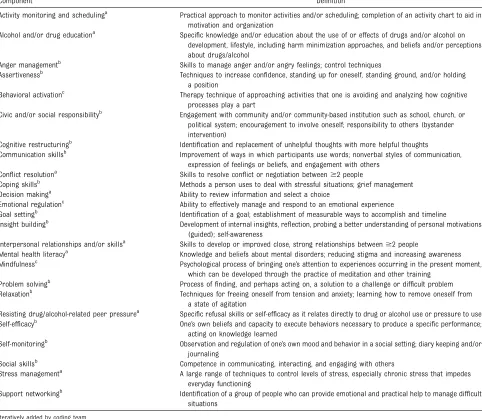
TABLE 1Included Components
Component Definition
Activity monitoring and schedulinga Practical approach to monitor activities and/or scheduling; completion of an activity chart to aid in
motivation and organization
Alcohol and/or drug educationa Specific knowledge and/or education about the use of or effects of drugs and/or alcohol on
development, lifestyle, including harm minimization approaches, and beliefs and/or perceptions about drugs/alcohol
Anger managementb Skills to manage anger and/or angry feelings; control techniques
Assertivenessb Techniques to increase confidence, standing up for oneself, standing ground, and/or holding
a position
Behavioral activationc Therapy technique of approaching activities that one is avoiding and analyzing how cognitive
processes play a part
Civic and/or social responsibilityb Engagement with community and/or community-based institution such as school, church, or
political system; encouragement to involve oneself; responsibility to others (bystander intervention)
Cognitive restructuringb Identification and replacement of unhelpful thoughts with more helpful thoughts
Communication skillsb Improvement of ways in which participants use words; nonverbal styles of communication,
expression of feelings or beliefs, and engagement with others
Conflict resolutiona Skills to resolve conflict or negotiation between$2 people
Coping skillsb Methods a person uses to deal with stressful situations; grief management
Decision makinga Ability to review information and select a choice
Emotional regulationc Ability to effectively manage and respond to an emotional experience
Goal settingb Identification of a goal; establishment of measurable ways to accomplish and timeline
Insight buildingb Development of internal insights, reflection, probing a better understanding of personal motivations
(guided); self-awareness
Interpersonal relationships and/or skillsa Skills to develop or improved close, strong relationships between$2 people
Mental health literacya Knowledge and beliefs about mental disorders; reducing stigma and increasing awareness
Mindfulnessc Psychological process of bringing one’s attention to experiences occurring in the present moment,
which can be developed through the practice of meditation and other training
Problem solvingb Process offinding, and perhaps acting on, a solution to a challenge or difficult problem
Relaxationb Techniques for freeing oneself from tension and anxiety; learning how to remove oneself from
a state of agitation
Resisting drug/alcohol-related peer pressurea Specific refusal skills or self-efficacy as it relates directly to drug or alcohol use or pressure to use
Self-efficacyb One’s own beliefs and capacity to execute behaviors necessary to produce a specific performance;
acting on knowledge learned
Self-monitoringb Observation and regulation of one’s own mood and behavior in a social setting; diary keeping and/or
journaling
Social skillsb Competence in communicating, interacting, and engaging with others
Stress managementa A large range of techniques to control levels of stress, especially chronic stress that impedes
everyday functioning
Support networkingb Identification of a group of people who can provide emotional and practical help to manage difficult
situations
a similar activity, we recorded other frequently occurring components as free text and ultimately integrated them as new codes into the
framework (Table 1). Some of these included decision-making,20conflict resolution,21mindfulness,22,23and alcohol and drug education.24
Data Analysis
For reporting and analysis, we categorized all universally delivered programs into face-to-face, digital, or combined modality interventions. Face-to-face interventions consisted of all interventions delivered in
schools, communities, or health centers; digital and combined modality interventions consisted of interventions that were solely digitally delivered content or digital content in combination with other modes of delivery.
Effect estimates from included studies were converted to standardized mean differences by using available published formulas.26 A common problem in meta-analyses of complex interventions is that study authors report multiple effect estimates from the same domain (ie, conceptually exchangeable and thus
equally valid) in respect to an outcome and often report outcomes from multiple time points. To address this, we used a robust variance estimation meta-analysis model27to include all relevant information from included studies. We estimated all models using random effects, given high anticipated levels of statistical heterogeneity and an intercorrelation parameter of 0.8, which is standard, to estimate how closely effect estimates within a study are related. Given the number and diversity of components we sought to analyze, we estimated a series of single-predictor meta-regression models. Predictors were entered into models as the study-level mean of a component. In standard 2-arm trials and trials in which components were binary, this variable took on the value of 1 or 0. In multiarm trials in which the$2 active arms differed as to the presence of a component, the variable took on the value of the proportion of effect estimates with a specific component. We estimated all models
first with effect estimates corresponding to#2 months of follow-up and then with effect estimates over all follow-up times. We noted when models could not provide usable evidence because of model instability. We did not formally test publication bias given that these tests are not understood in the context of robust variance estimation meta-analysis. In assessing
differences in effect sizes, we used standard thresholds of 0.2 for small effect size, 0.5 for medium effect size, and 0.8 for large effect size.28
RESULTS
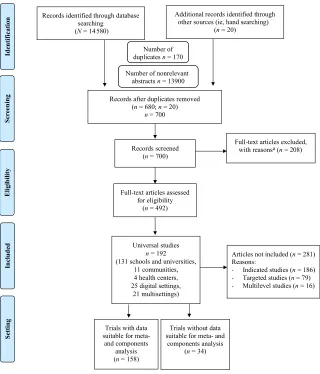
We identified 14 600 records through database searches and hand
searching, of which 158 were suitable and reported data suitable for components analysis (Fig 1).
The characteristics of studies that met the inclusion criteria and FIGURE 1
contributed data to the components analysis are summarized in Table 2, and all included studies are listed in Supplemental Information 2. The average intervention duration was 13.88 hours for face-to-face interventions and 6.05 hours for digital interventions (see
Supplemental Information 4 and 5). The average number of components per intervention was 5.4 for face-to-face interventions and 5.9 for digital
interventions (further details in Supplemental Information 4 and 5).
In general, risk of bias was low across most categories, with the exception of allocation concealment and random sequence generation (see Fig 2 and Supplemental Information 3 for full details). In the majority of studies, it was unclear who had been
responsible for randomization as
well as how the randomization sequence was generated. It was also unclear if this sequence was protected sufficiently to prevent the research team from predicting the next treatment allocation during the process. Furthermore, in many studies, blinding of participants and outcome assessment was not possible because of the study design, particularly in school-based settings in which whole schools or specific classes were allocated to the intervention status. Outcome data assessment largely presented a low risk of bias, but approximately one-third of studies had unclear risk of attrition or other biases. Almost 90% of studies had a low risk of bias for selective
reporting.
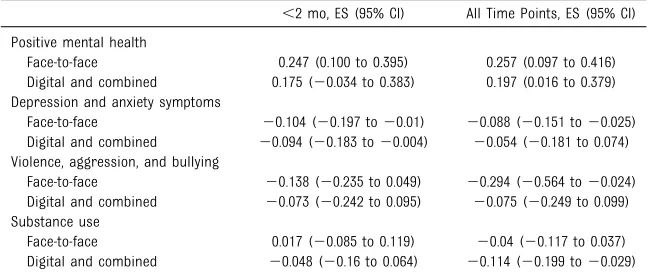
The overall effect sizes of
universally delivered interventions on each of the study outcomes are reported in Table 3. Self-harm and suicide were not included in the analyses reported here because there were only 2 universally delivered interventions located in which these outcomes were reported. For face-to-face interventions in the short-term, there were significant differences between intervention and control groups for positive mental health and depression and anxiety symptoms. Across all time points, there were significant differences between intervention and control groups for positive mental health, depression and anxiety symptoms, and violence, aggression, and bullying. For digital or combined modality interventions, only depression and anxiety outcomes improved in the short-term, but this was not evident across all time points. For all time points, there were significant differences between intervention and control for positive mental health and substance use. All overall significant effect sizes were small to moderate and indicated beneficial effects of
TABLE 2Descriptors of the Included Universal Interventions
Descriptor Face-to-face Prevalence (n5
129 Studies)
Digital and Combined Prevalence (n5
29 Studies)
Design,n(%)
RCT 47 (36.4) 14 (46.7)
Cluster RCT 80 (62.0) 15 (53.3)
Crossover RCT 2 (1.6) 0 (0.0)
High-income setting,n(%) 115 (89.1) 28 (96.7)
United States 72 (55.8) 13 (46.7)
Australia 16 (12.4) 9 (30.0)
LMIC,n(%) 14 (10.9) 1 (3.3)
Age in categories,n(%)
10–14 y 90 (69.8) 17 (56.7)
15–19 y 24 (18.6) 9 (33.3)
Across both categories 12 (9.3) 3 (10.0)
Missing data 3 (2.3) 0 (0.0)
Setting,n(%)
School 111 (86.0) N/A
Community 8 (6.2) N/A
Multisetting 5 (3.9) N/A
Health center 4 (3.1) N/A
University 1 (0.8) N/A
Digital only N/A 20 (70.0)
Combined digital N/A 9 (30.0)
Sex
n 113 28
Girls, % 51.8 55.9
Boys, % 48.4 44.1
Sample size, average (SD) 1415 (2341.86) 1650 (2111.94)
N/A, not applicable.
FIGURE 2
interventions. There were no differences for face-to-face interventions for substance use at any time point or for violence, aggression, and bullying in the short-term. There were no
differences for digital and combined modality interventions for short-term positive mental health and substance use outcomes, depression and anxiety beyond the short-term, or for aggression, violence, and bullying across any time point.
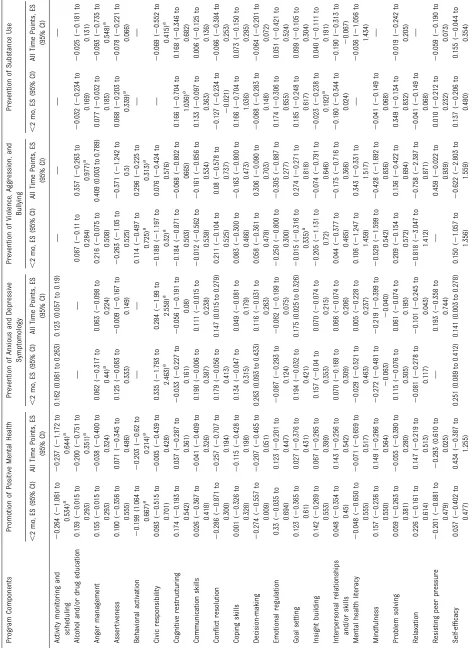
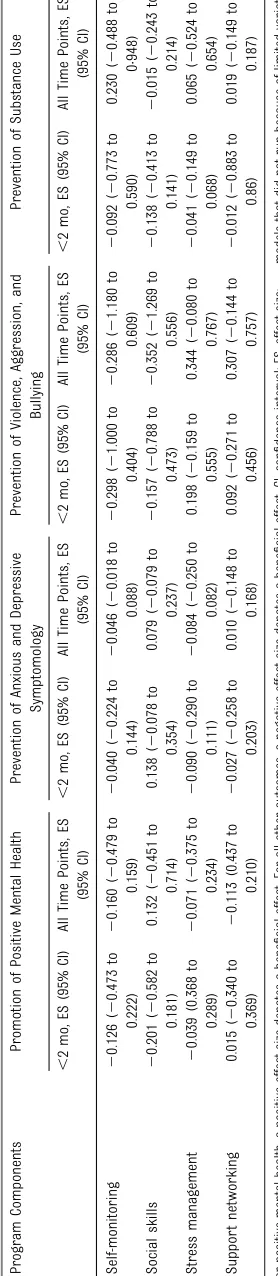
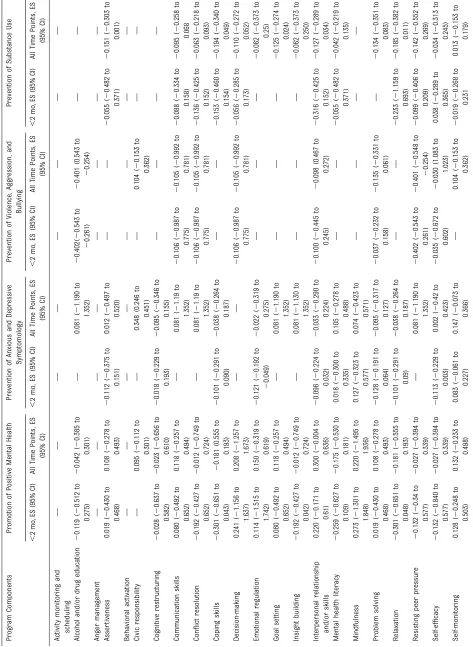
Seven intervention components predicted only positive effects, that is, their presence was associated with more successful programs (see Tables 4 and 5). These were interpersonal skills, emotional regulation, alcohol and drug education, mindfulness, problem solving, assertiveness training, and stress management. The presence of interpersonal skills was most consistently associated with larger effect sizes, yielding improved effects for positive mental health, depression and anxiety prevention, and prevention of substance use. Emotional regulation was associated with greater effectiveness in
improving positive mental health and greater reductions in depressive and anxious symptomatology. Alcohol and drug education predicted positive outcomes for non–alcohol- and non–drug-related outcomes, namely, positive mental health in face-to-face
interventions and aggression in digital interventions. The remaining components were associated with larger effect sizes in 1 outcome category only. Mindfulness was associated with a decrease in anxiety and depression symptoms in face-to-face interventions. Problem solving was associated with a decrease in depression and anxiety symptoms in digital and combined interventions. Assertiveness and stress management predicted larger effect sizes for the prevention of substance use in digital interventions. See Supplemental Information 2 for full details of the presence of program components in interventions.
Six practice components revealed mixed results across the different outcomes; these components were conflict resolution, coping skills, goal setting, relaxation, skills to resist peer pressure, and self-efficacy training. In face-to-face interventions, conflict resolution predicted larger effects for substance use but smaller effects for depression and anxiety symptoms. Coping skills content did not predict any outcomes for face-to-face interventions but predicted
diminished effectiveness for positive mental health and stronger
effectiveness for substance use for digital interventions. Goal setting was predictive of smaller program effects for depression and anxiety in face-to-face interventions but larger effects
for digital substance use interventions. Relaxation was associated with smaller effect sizes for digital positive mental health outcomes but stronger effectiveness for substance use. Skills to
resist peer pressure predicted larger effects for violence outcome in digital interventions but smaller effects for aggression and positive mental health outcomes in face-to-face interventions. For
depression and anxiety symptoms, self-efficacy predicted smaller effect sizes for face-to-face interventions but larger effects for digital interventions.
Across all meta-regressions, 6 components were associated with either attenuated effectiveness or minimal difference in effectiveness, depending on the outcome; these components were activity monitoring and scheduling, anger management, civic responsibility, communication skills, decision-making, and insight building. Communication skills and activity monitoring and scheduling were associated with smaller effect sizes for depression and anxiety outcomes in face-to-face
interventions. Digital and combined interventions that included civic responsibility were less effective at reducing depressive and anxious symptomatology. In face-to-face interventions, the inclusion of decision-making activities was associated with smaller effect sizes on positive mental health and depressive and anxious symptomatology. Insight building predicted a smaller effect size for positive mental health when included in digital and combined interventions.
Afinal set of practice components that did not have a clear relationship to effectiveness in either direction included cognitive restructuring, mental health literacy, self-monitoring, social skills, support networking, and behavioral activation.
TABLE 3Overall Effect Sizes per Outcome
,2 mo, ES (95% CI) All Time Points, ES (95% CI)
Positive mental health
Face-to-face 0.247 (0.100 to 0.395) 0.257 (0.097 to 0.416)
Digital and combined 0.175 (20.034 to 0.383) 0.197 (0.016 to 0.379)
Depression and anxiety symptoms
Face-to-face 20.104 (20.197 to20.01) 20.088 (20.151 to20.025)
Digital and combined 20.094 (20.183 to20.004) 20.054 (20.181 to 0.074)
Violence, aggression, and bullying
Face-to-face 20.138 (20.235 to 0.049) 20.294 (20.564 to20.024)
Digital and combined 20.073 (20.242 to 0.095) 20.075 (20.249 to 0.099)
Substance use
Face-to-face 0.017 (20.085 to 0.119) 20.04 (20.117 to 0.037)
Digital and combined 20.048 (20.16 to 0.064) 20.114 (20.199 to20.029)
DISCUSSION
This is thefirst global review of active components present in interventions that are aimed to improve adolescent health across a range of interrelated mental health outcomes. With the results of this review, we indicate,first, that universally delivered
interventions can improve adolescent mental health and reduce risk behavior and, second, that there are several content-related program components that are associated with larger or smaller effect sizes. Of these components, however, only 3
predicted positive effects across multiple outcomes: interpersonal skills training, emotional regulation, and alcohol and drug education. This
finding reflects those in a review by Singla et al25which also found that interpersonal and emotional elements had the strongest associations with overall effectiveness across mental health interventions delivered by lay health workers in low- and middle-income countries (LMICs).
Developing skills to improve interpersonal relationships is highly relevant for improving adolescent mental health outcomes, and ourfindings indicate that including these skills in multioutcome interventions designed to promote mental health and prevent mental disorders and risk behaviors is a valuable strategy. Previous research has revealed that poor-quality relationships consistently predict poor mental health outcomes for
adolescents,29,30whereas positive relationships are associated with better mental health outcomes.31In this review, intervention content commonly included verbal and nonverbal communication skills16and was often combined with broader social skills training focusing on how an individual engages in a social setting or larger group.32–34
Activities used to develop emotional regulation skills were common in interventions that were aimed to
reduce depression and promote positive mental health, as well as those that were aimed to reduce aggression. Intervention programs that included emotional regulation encompassed whole-class
interventions, cognitive behavioral interventions,35antibullying interventions,36and guided
expressive writing interventions,37as well as more broadly focused, integrated interventions.38Many yoga and mindfulness-based interventions also employed an emotional
regulation component, as practitioners guided adolescents through meditative sessions in which observing as well as engaging with emotions was encouraged.23,39
Alcohol and drug education predicted larger effect sizes for mental health promotion and interventions addressing violence. This term covered a broad range of topics, including facts about alcohol, cannabis, and other illicit drugs, discussion about the risks of using illegal substances, social influences associated with alcohol use,32,40–42 media influences and pressures to use substances,43–45and parent education about engaging their children in conversations about alcohol.24,46,47 Certain interventions also took a harm minimization approach, teaching adolescents about less harmful ways to use alcohol or ways to reduce risk for themselves or others.48–50Delivery methods also differed. For example, in 1 digital intervention, participants are walked through the consequences of a virtual night of binge drinking.51However, the reasons for the effect of alcohol and drug use on outcomes beyond substance use are unknown. It may be because of shared risk and protective factors between these outcomes and shared pathways to effective prevention between
different types of outcomes that have been“triggered”by teaching
adolescents drug use prevention content.
For“Helping Adolescents Thrive,”it is evident that intervention content that is strongly centered on interpersonal and emotional skills is most likely to be effective across multiple outcome domains. It is also possible that the active components identified in this review, particularly interpersonal skills and emotional regulation, may have effects that extend beyond our defined scope of mental health outcomes to broader mental health domains. For example, in other research, improvements in emotional regulation have been shown to reduce risky sexual behavior during adolescence52–54because these skills may help adolescents develop stronger and more equitable relationships.52
Given that the evidence base is almost entirely from high-income countries (HICs), it will be essential to track implementation efforts if and when these interventions are adapted for use in LMICs to ensure that they are implemented in a culturally and contextually valid and appropriate manner.7Specifically, developing an intervention package on the basis of thesefindings will require active engagement with adolescents, particularly in low-resource settings, to translate relevant evidence-based principles into feasible and
acceptable intervention programs that appeal to and effectively engage adolescents. Pursuing a user-centered design approach by employing multiple stages of engagement and prototyping with adolescents, their parents, their teachers, and other community stakeholders to
coproduce the intervention package55 will significantly strengthen the development of the program and its adaptability to different settings.
Again, although this was a global review, the publications eligible for inclusion were overwhelmingly based in HICs. In studies from LMICs, adapted versions of evidence-based interventions from HICs are often used, which may affect the validity
TABLE
5
Continued
Pr
ogr
am
Compo
nents
Pr
omotion
of
P
ositive
Ment
al
Health
Pr
event
ion
of
Anxious
and
Dep
ressiv
e
Sym
ptomo
logy
Pr
event
ion
of
Violen
ce,
Aggr
es
sion,
and
Bullying
Pr
event
ion
of
Substan
ce
Use
,
2
mo
,
ES
(95%
CI)
All
Time
P
oints,
ES
(95%
CI)
,
2
mo
,
ES
(95%
CI)
All
Time
P
oin
ts,
ES
(95%
CI)
,
2
mo
,
ES
(95%
CI)
All
Time
P
oin
ts,
ES
(95%
CI)
,
2
mo
,
ES
(95%
CI)
All
Time
P
oints,
ES
(95
%
CI)
Soc
ial
sk
ills
2
0.132
(
2
0.840
to
0.577
)
2
0.027
(
2
0.394
to
0.339
)
—
0.081
(
2
1.19
to
1.352)
0.177
(
2
0.326
to
0.681)
0.182
(
2
0.361
to
0.725)
—
2
0.097
(
2
0.294
to
0.1
01)
Str
es
s
man
agement
2
0.265
(
2
0.628
to
0.098
)
2
0.250
(
2
0.608
to
0.108
)
2
0.038
(
2
0.206
to
0.1
3)
2
0.126
(
2
0.407
to
0.155)
——
2
0.233
(1.15
9
to
0.693)
2
0.248
(
2
0.446
to
0.0
49)
Sup
por
t
netwo
rking
0.114
(
2
1.515
to
1.742
)
0.150
(
2
0.319
to
0.619
)
—
0.081
(
2
1.19
to
1.352)
0.177
(
2
0.326
to
0.681)
0.182
(
2
0.361
to
0.725)
2
0.056
(0.48
2
to
0.371)
2
0.103
(
2
0.273
to
0.0
68)
For
positive
mental
health,
a
positive
effect
size
denotes
a
bene
fi
cial
effect.
For
all
other
outcomes,
a
negative
effect
size
denotes
a
bene
fi
cial
effect.
CI,
con
fi
dence
interval;
ES
,
e
ffect
size;
—
,
m
odels
that
did
n
ot
run
b
ecause
of
limited
and reliability of their results. In addition, studies with randomized designs are more likely to be used to evaluate research program
interventions, whereas quasi-experimental and other designs are often used for real-life interventions, meaning that restricting our
screening to RCTs only may have limited the applicability of these
findings to nonresearch settings.56
The program components approach depends on the quality of reporting in publications. Brown et al19note that essential details required to
understand content and
implementation are often missing from these publications. In the review by Singla et al,25the authors further noted the lack of reporting about dosage for each component present. It was not always possible to determine programfidelity or mean
dosage across participants, limiting the strength of their analyses.57In this review, few study authors reported intervention components in enough detail to allow for replication; even fewer provided any form of guidance as to how interventions could be scaled up. Finally, a further limitation to be considered is the risk of bias in the included studies. Although considered to be low across most categories, allocation
concealment and random sequence generation were high or unclear for the majority of studies, whereas in some cases, the nature of feasible study designs for universally delivered interventions (such as in schools) precluded blinding of participants and outcome
assessment. Furthermore, the quality of the body of evidence was not assessed by using the Grading of
Recommendations, Assessment, Development and Evaluation tool.
CONCLUSIONS
These are novel results that will be used to design a universally delivered intervention as a part of the“Helping Adolescents Thrive” initiative. Further work should be undertaken to develop and test interventions that use these core components, especially in underresourced settings in which multiple risk factors for poor adolescent health are present.
ABBREVIATIONS
HIC: high-income country LMIC: low- and middle-income
country
RCT: randomized controlled trial
Dr Skeen designed the research plan, oversaw the full review process, and wrote thefinal study report; Drs Ross, Servili, Dua, and Tomlinson designed the research
plan; Ms Laurenzi, Ms Gordon, and Ms du Toit completed all qualitative and quantitative data extraction and contributed toward drafting, reviewing, and revising the
report; Ms Carvajal-Aguirre and Drs Eriksson de Carvalho, van der Westhuizen, Fleischmann, Kohl and Lund provided thorough input and feedback on the report at
various stages, as well as reviewed the manuscript; Dr Brand conducted all risk-of-bias assessments on the included studies, generated the relatedfigure, and
reviewed the manuscript; Mr Dowdall contributed to the search strategy design and reviewed the manuscript; Dr Melendez-Torres conducted the meta-regression
analyses and contributed toward designing, drafting, reviewing, and revising the manuscript; and all authors approved thefinal manuscript as submitted and
agree to be accountable for all aspects of the work.
DOI:https://doi.org/10.1542/peds.2018-3488
Accepted for publication Apr 30, 2019
Address correspondence to Sarah Skeen, PhD, Institute for Life Course Health Research, Department of Global Health, Faculty of Medicine and Health Sciences, Stellenbosch University, Education Building, Francie van Zijl Dr, Cape Town 7505, South Africa. E-mail: [email protected]
PEDIATRICS (ISSN Numbers: Print, 0031-4005; Online, 1098-4275).
Copyright © 2019 by the American Academy of Pediatrics
FINANCIAL DISCLOSURE:The authors have indicated they have nofinancial relationships relevant to this article to disclose.
FUNDING:Funded by the World Health Organization.
POTENTIAL CONFLICT OF INTEREST:The authors have indicated they have no potential conflicts of interest to disclose.
REFERENCES
1. Patel V, Flisher AJ, Nikapota A, Malhotra S. Promoting child and adolescent mental health in low and middle income countries.J Child Psychol
Psychiatry. 2008;49(3):313–334
2. Dick B, Ferguson BJ. Health for the world’s adolescents: a second chance in the second decade.J Adolesc Health. 2015;56(1):3–6
3. Patton GC, Sawyer SM, Santelli JS, et al. Our future: a Lancet commission on adolescent health and wellbeing.
Lancet. 2016;387(10036):2423–
2478
4. Kessler RC, Aguilar-Gaxiola S, Alonso J, Chatterji S, Lee S, Ustün TB. The WHO World Mental Health (WMH) surveys.
Psychiatrie (Stuttg). 2009;6(1):5–9
5. Prince M, Patel V, Saxena S, et al. No health without mental health.Lancet. 2007;370(9590):859–877
7. Barry MM, Clarke AM, Jenkins R, Patel V. A systematic review of the effectiveness of mental health promotion
interventions for young people in low
and middle income countries.BMC
Public Health. 2013;13(1):835
8. O’Mara L, Lind C. What do we know about school mental health promotion programmes for children and youth? Adv Sch Ment Health Promot. 2013;6(3): 203–224
9. Rotheram-Borus MJ, Swendeman D, Chorpita BF. Disruptive innovations for designing and diffusing evidence-based interventions.Am Psychol. 2012;67(6): 463–476
10. Calear AL, Christensen H. Systematic review of school-based prevention and early intervention programs for depression.J Adolesc. 2010;33(3): 429–438
11. Faggiano F, Minozzi S, Versino E, Buscemi D. Universal school-based prevention for illicit drug use.Cochrane Database Syst Rev. 2014;(12):CD003020
12. Foxcroft DR, Tsertsvadze A. Universal school-based prevention programs for alcohol misuse in young people. Cochrane Database Syst Rev. 2011;(5): CD009113
13. Rotheram-Borus MJ, Ingram BL, Swendeman D, Flannery D. Common principles embedded in effective adolescent HIV prevention programs.
AIDS Behav. 2009;13(3):387–398
14. Cousins JB, Aubry TD, Fowler HS, Smith M. Using key component profiles for the evaluation of program implementation in intensive mental health case
management.Eval Program Plann.
2004;27(1):1–23
15. Murray LK, Dorsey S, Haroz E, et al. A common elements treatment approach for adult mental health problems in low- and middle-income countries.
Cognit Behav Pract. 2014;21(2):111–123
16. Boustani MM, Frazier SL, Becker KD, et al. Common elements of adolescent prevention programs: minimizing
burden while maximizing reach.Adm
Policy Ment Health. 2015;42(2):209–219
17. PracticeWise.Psychosocial and Combined Treatments Coding Manual. Satellite Beach, FL: PracticeWise; 2009
18. Graves KD. Social cognitive theory and cancer patients’quality of life: a meta-analysis of psychosocial intervention components.Health Psychol. 2003;22(2): 210–219
19. Brown FL, de Graaff AM, Annan J, Betancourt TS. Annual Research Review: breaking cycles of violence
-a system-atic review -and common practice elements analysis of psychosocial interventions for children and youth affected by armed conflict. J Child Psychol Psychiatry. 2017;58(4): 507–524
20. Caria MP, Faggiano F, Bellocco R, Galanti MR. The influence of socioeconomic environment on the effectiveness of alcohol prevention among European students: a cluster randomized controlled trial.BMC Public Health. 2011;11(1):312
21. Roberts C, Williams R, Kane R, et al. Impact of a mental health promotion program on substance use in young adolescents.Adv Ment Health. 2011; 10(1):72–82
22. Sibinga EM, Webb L, Ghazarian SR, Ellen JM. School-based mindfulness instruction: an RCT.Pediatrics. 2016; 137(1):e20152532
23. Bluth K, Gaylord SA, Campo RA, Mullarkey MC, Hobbs L. Making friends with yourself: a mixed methods pilot study of a mindful self-compassion program for adolescents.Mindfulness
(N Y). 2016;7(2):479–492
24. Spoth R, Trudeau L, Shin C, Redmond C. Long-term effects of universal preventive interventions on prescription drug misuse.Addiction. 2008;103(7):1160–1168
25. Singla DR, Kohrt BA, Murray LK, Anand A, Chorpita BF, Patel V. Psychological treatments for the world: lessons from low- and middle-income countries.
Annu Rev Clin Psychol. 2017;13:149–181
26. Wilson DB. Practical meta-analysis effect size calculator [online calculator]. Available at: https:/ www.campbellcollaboration.org/ research-resources/research-for-resources/effect-size-calculator.html. Accessed March 1, 2019
27. Tanner-Smith EE, Tipton E. Robust variance estimation with dependent effect sizes: practical considerations
including a software tutorial in Stata and spss.Res Synth Methods. 2014;5(1): 13–30
28. Cohen J.Statistical Power Analysis for the Behavioral Sciences. Abingdon, United Kingdom: Routledge; 2013
29. Branje SJ, Hale WW III, Frijns T, Meeus WH. Longitudinal associations between perceived parent-child relationship quality and depressive symptoms in adolescence.J Abnorm Child Psychol. 2010;38(6):751–763
30. Hair EC, Moore KA, Garrett SB, Ling T, Cleveland K. The continued importance of quality parent-adolescent
relationships during late adolescence.
J Res Adolesc. 2008;18(1):187–200
31. Majd Ara E, Talepasand S, Rezaei AM. A structural model of depression based on interpersonal relationships: the mediating role of coping strategies and loneliness.Noro Psikiyatri Arsivi. 2017; 54(2):125–130
32. Caria MP, Faggiano F, Bellocco R, Galanti MR; EU-Dap Study Group. Effects of a school-based prevention program on European adolescents’patterns of alcohol use.J Adolesc Health. 2011; 48(2):182–188
33. Kärnä A, Voeten M, Little TD, Poskiparta E, Kaljonen A, Salmivalli C. A large-scale evaluation of the KiVa antibullying program: grades 4-6.Child Dev. 2011; 82(1):311–330
34. Rose K, Hawes DJ, Hunt CJ. Randomized controlled trial of a friendship skills intervention on adolescent depressive symptoms.J Consult Clin Psychol. 2014; 82(3):510–520
35. Stallard P, Sayal K, Phillips R, et al. Classroom based cognitive behavioural therapy in reducing symptoms of depression in high risk adolescents: pragmatic cluster randomised controlled trial.BMJ. 2012;345:e6058
36. Espelage DL, Low S, Van Ryzin MJ, Polanin JR. Clinical trial of second step middle school program: impact on bullying, cyberbullying, homophobic teasing, and sexual harassment perpetration.School Psych Rev. 2015; 44(4):464–479
school-based programme.J Health Psychol. 2011;16(2):258–273
38. Kehoe CE, Havighurst SS, Harley AE. Tuning in to teens: improving parent emotion socialization to reduce youth internalizing difficulties.Soc Dev. 2014; 23(2):413–431
39. Noggle JJ, Steiner NJ, Minami T, Khalsa SB. Benefits of yoga for psychosocial well-being in a US high school curriculum: a preliminary randomized controlled trial.J Dev Behav Pediatr. 2012;33(3):193–201
40. Gabrhelik R, Duncan A, Miovsky M, Furr-Holden CD, Stastna L, Jurystova L.
“Unplugged”: a school-based
randomized control trial to prevent and reduce adolescent substance use in the Czech Republic.Drug Alcohol Depend. 2012;124(1–2):79–87
41. Miovský M, Vonkova H,Cablová L, Gabrhelík R. Cannabis use in children with individualized risk profiles: predicting the effect of universal prevention intervention.Addict Behav. 2015;50:110–116
42. Spoth R, Redmond C, Shin C, Greenberg M, Feinberg M, Schainker L. PROSPER community-university partnership delivery system effects on substance misuse through 6 1/2 years past baseline from a cluster randomized controlled intervention trial.Prev Med. 2013;56(3–4):190–196
43. Kupersmidt JB, Scull TM, Benson JW. Improving media message
interpretation processing skills to promote healthy decision making about substance use: the effects of the middle school media ready curriculum.
J Health Commun. 2012;17(5):546–563
44. Longshore D, Ghosh-Dastidar B, Ellickson PL. National Youth Anti-Drug Media Campaign and school-based drug prevention: evidence for a synergistic effect in ALERT Plus.Addict
Behav. 2006;31(3):496–508
45. Perry CL, Komro KA, Veblen-Mortenson S, et al. A randomized controlled trial of the middle and junior high school D.A.R.E. and D.A.R.E. Plus programs. Arch Pediatr Adolesc Med. 2003;157(2): 178–184
46. Ichiyama MA, Fairlie AM, Wood MD, et al. A randomized trial of a parent-based intervention on drinking behavior among incoming college freshmen. J Stud Alcohol Drugs Suppl. 2009;(16): 67–76
47. LaBrie JW, Earle AM, Boyle SC, et al. A parent-based intervention reduces heavy episodic drinking amongfi rst-year college students.Psychol Addict
Behav. 2016;30(5):523–535
48. Midford R, Mitchell J, Lester L, et al. Preventing alcohol harm: early results from a cluster randomised, controlled trial in Victoria, Australia of
comprehensive harm minimisation school drug education.Int J Drug
Policy. 2014;25(1):142–150
49. Newton NC, Andrews G, Champion KE, Teesson M. Universal Internet-based prevention for alcohol and cannabis use reduces truancy, psychological distress and moral disengagement: a cluster randomised controlled trial.
Prev Med. 2014;65:109–115
50. Vogl L, Teesson M, Andrews G, Bird K, Steadman B, Dillon P. A computerized harm minimization prevention program for alcohol misuse and related harms:
randomized controlled trial.Addiction. 2009;104(4):564–575
51. Jander A, Crutzen R, Mercken L, Candel M, de Vries H. Effects of a Web-based computer-tailored game to reduce binge drinking among Dutch adolescents: a cluster randomized controlled trial.J Med Internet Res. 2016;18(2):e29
52. Jewkes R, Nduna M, Levin J, et al. Impact of stepping stones on incidence of HIV and HSV-2 and sexual behaviour in rural South Africa: cluster
randomised controlled trial.BMJ. 2008; 337:a506
53. Messman-Moore TL, Walsh KL, DiLillo D. Emotion dysregulation and risky sexual behavior in revictimization.Child Abuse
Negl. 2010;34(12):967–976
54. Pillai VK, Barton TR. Sexual activity among Zambian female teenagers: the role of interpersonal skills.
Adolescence. 1999;34(134):381–387
55. Hawkins J, Madden K, Fletcher A, et al. Development of a framework for the co-production and prototyping of public health interventions.BMC Public Health. 2017;17(1):689
56. Kaminski JW, Valle LA, Filene JH, Boyle CL. A meta-analytic review of components associated with parent training program effectiveness. J Abnorm Child Psychol. 2008;36(4): 567–589
57. de Vries SL, Hoeve M, Assink M, Stams GJ, Asscher JJ. Practitioner review: effective ingredients of prevention programs for youth at risk of persistent juvenile delinquency–recommendations for clinical practice.J Child Psychol
DOI: 10.1542/peds.2018-3488 originally published online July 1, 2019;
2019;144;
Pediatrics
Liliana Carvajal-Aguirre, Cristina Eriksson de Carvalho and G.J. Melendez-Torres
Servili, Amanda S. Brand, Nicholas Dowdall, Crick Lund, Claire van der Westhuizen,
Tomlinson, Tarun Dua, Alexandra Fleischmann, Kid Kohl, David Ross, Chiara
Sarah Skeen, Christina A. Laurenzi, Sarah L. Gordon, Stefani du Toit, Mark
A Meta-analysis
Adolescent Mental Health Program Components and Behavior Risk Reduction:
Services
Updated Information &
http://pediatrics.aappublications.org/content/144/2/e20183488 including high resolution figures, can be found at:
References
http://pediatrics.aappublications.org/content/144/2/e20183488#BIBL This article cites 50 articles, 3 of which you can access for free at:
Subspecialty Collections
dicine_sub
http://www.aappublications.org/cgi/collection/adolescent_health:me Adolescent Health/Medicine
following collection(s):
This article, along with others on similar topics, appears in the
Permissions & Licensing
http://www.aappublications.org/site/misc/Permissions.xhtml in its entirety can be found online at:
Information about reproducing this article in parts (figures, tables) or
Reprints
DOI: 10.1542/peds.2018-3488 originally published online July 1, 2019;
2019;144;
Pediatrics
Liliana Carvajal-Aguirre, Cristina Eriksson de Carvalho and G.J. Melendez-Torres
Servili, Amanda S. Brand, Nicholas Dowdall, Crick Lund, Claire van der Westhuizen,
Tomlinson, Tarun Dua, Alexandra Fleischmann, Kid Kohl, David Ross, Chiara
Sarah Skeen, Christina A. Laurenzi, Sarah L. Gordon, Stefani du Toit, Mark
A Meta-analysis
Adolescent Mental Health Program Components and Behavior Risk Reduction:
http://pediatrics.aappublications.org/content/144/2/e20183488
located on the World Wide Web at:
The online version of this article, along with updated information and services, is
by the American Academy of Pediatrics. All rights reserved. Print ISSN: 1073-0397.