An Enhanced Study on Users Privacy with
Anonymous Password Based Authentication
towards Cloud Storage
M. V. Bhanu Prakash
Assistant Professor, Department of Information Technology, CBIT, Hyderabad, Telangana, India
ABSTRACT
Cloud computing offers its flexibility and dynamic nature as far as its entrance to assets whenever and anyplace. All information and different assets in cloud stockpiling are overseen and controlled by the Cloud Service Provider. They give security and guarantee that the information is shielded and free from any powerlessness. Be that as it may, giving privacy through authentication component is a major test. The greater part of the present authentication plans depend on trusted third party to distinguish and confirm user's qualification which can prompt straightforwardness issue. Keeping in mind the end goal to guarantee for a secured exchange, they need to protect user's privacy from being uncovered. The uncover data of user's qualification will make it less demanding for aggressor to pick up the data for getting to ordered information. They can block and control user's identity to access touchy information of user in the cloud stockpiling. This issue can be comprehended by presenting anonymity includes in the authentication conspire by concealing the user's data and to shield the user's identity from getting manhandled. Anonymity will secure user's identity by concealing the genuine users' identity amid the authentication procedure particularly when users host to manage third gathering in their correspondence. The risk does originate from outside aggressor as well as originates from interior party who has full specialist access to the server. This paper proposed an unknown authentication conspire which is a blend of password-based authentication and anonymity include so as to safeguard user's privacy without including the trusted third party amid the authentication procedure. Subsequently, it can ensure a secured exchange with anonymity highlights to secure user's privacy. This paper additionally displays the depiction of information privacy and security which can impact user's trust in utilizing cloud services. Security investigation depictions of conceivable attacks to the proposed conspire are additionally introduced in this paper. The Secure Remote Password (SRP) convention is utilized for this venture with some improvement to calculation. Later on, the proposed plan will be tried with a portion of the conceivable assault dangers to demonstrate that it is secured against the assault. The noteworthy of this exploration is to protect user's privacy with unknown password-based authentication in the cloud condition with no necessity to trusted third party which can oppose from powerlessness to attacks.
Keywords: Privacy, Anonymity, Key Exchange, Password-Based Authentication.
I.
INTRODUCTION
The development of cutting edge innovation in systems administration and related territories has required specialized specialists to rebuild their
essential spotlight on government and business associations, for example, IBM, Apple, Google, Amazon and others to create and convey their framework application keeping in mind the end goal to give a quick and solid services to their customers. Nonetheless, security is one of the essential regions that should be given earlier consideration particularly during the time spent validating the genuine user inside the cloud area. The cloud service provider should save the user's privacy and give information insurance in the cloud stockpiling from being assaulted by the enemy. A large portion of the current authentication plots typically included a third party to check and screen the exchange procedure between the cloud service provider and the users [2]. It could prompt issues of straightforwardness, and might be one-sided in specific circumstances in which the user can't quantify and control the security level and privacy of their cloud area.
The users believe their service providers based on their experience, demonstrable skill, number of ventures handled and faculty in-control. Be that as it may, the trust issue is one of the best dangers in giving services in cloud condition [4]. Trust turns into a significant component to ensure a very much arranged improvement of cloud condition, to give assurance and privacy control, to give the security strategy and to guarantee the correct access to cloud information. With a specific end goal to give privacy of the user's qualification, the framework ought to give solid authentication system to ensure the data and in addition to verity the approved user. By and by, the assignment of giving privacy through a secure authentication instrument is one major test. The framework designer ought to understand the framework and system engineering, party included, user's entrance, area of capacity/server, and potential hacking. This paper will additionally talk about points of interest in giving solid authentication plan to save user's privacy in cloud condition.
This paper is sorted out in the accompanying segments. Issue Background Section introduces the exploration issues and commitments of the examination. Related Works Section presents writing study related research work. The Proposed Authentication Scheme Section introduces the proposed arrangement with a specific end goal to give
anonymity in password-based authentication.
Security Analysis Section quickly depicts the confirmations of conceivable assault to the proposed conspire. At last, segment for Conclusion makes the determination of the proposed plan and future works.
II.
PROBLEM BACKGROUND
Authentication and key exchange convention course of action are essential procedures in building up a
secure correspondence. Password-based
prerequisite to help the plan. In any case, the solid technique is required in the password-based plan to guarantee that it is sealed from any assault (insider and outcast) either in a secure or insecure system.
Another test to give solid authentication conspires in cloud condition is to guarantee that user's
qualification isn't being manhandled amid
authentication process. User's identity ought to be kept covered up by giving anonymity highlights to secure user's privacy against an insider or pariah programmer. To give anonymity in authentication component turns into a greater issue these days. The cloud users were frequently presented to uncover their identity since they have no strategy to control and screen the data put away in cloud stockpiling. They can't depend on a secure channel since a portion of the cloud users were given access in various stage and space which are less ensured on their correspondence channel. The utilization of anonymity component can enhance reliable of the framework and will in the long run persuade the user to utilize that framework [5]. The dependability and notoriety of the framework can be expanded by these 'trust' and it likewise demonstrates the responsibility of the cloud service provider by giving the services. Joining password-based authentication with anonymity highlight will prompt trust, solid and secure cloud foundation.
Our commitment of this paper can be outlined as take after:
1.The proposed mysterious password-based
authentication demonstrates that it can protect the user's privacy by concealing the user's certification. The blend of secure remote password (SRP) convention and anonymity highlight will improve the confide in level among the cloud users.
2.The trusted third party isn't required amid the authentication procedure. The user and server can be verified in a shared authentication process. This measure will diminish correspondence overhead
from server and correspondence cost on the third party.
3.The proposed plan can oppose helpless assault, for example, word reference attacks, replay assault, Man-in-the-Middle assault and numerous others. The upside of this plan is that password won't be transmitted over the system and user's identity will be supplanted by a mysterious identity before it was sent to the server.
III.
RELATED WORKS
Various investigations have been directed as of late on securing user information in cloud computing. Authentication and approval turn into a key establishment in giving secure correspondence among the cloud users. All things considered, in spite of different arrangements being prescribed there were still provisos in their examinations that should be filled in.
Authentication schemes
Authentication implies appropriate confirmation and ID procedure of user's accreditation through username and password. The two procedures are intended to guarantee that the user is real. This procedure is to permit or give the privilege to get to the framework and any assets in cloud area. Solid authentication conspire is required to shield cloud assets from defenseless assault and other security ruptures. Authentication is the most vital key issues among security issues of cloud computing [6]. Key foundation during the time spent authentication is a key system to upgrade the level of security in arrange correspondence over an insecure stage. The user will exchange mystery key over the system for check amid the authentication procedure.
authentication, keen card authentication and
numerous others [6][7][8]. Password-based
authentication conspire has been broadly utilized over years. It has turned into a typical strategy
utilized for authentication due to its
straightforwardness and is anything but difficult to be actualized.
In 1981, Lamport's work has first proposed the remote user authentication over insecure system by giving the password table in the server for putting away the user's password [9]. Nonetheless, Lamport's plan has confronted numerous issues in dealing with the password table and experienced high hash overhead, need of counter resetting and increment the capacity limit. In addition, they require more space to store a password table. This plan can in any case be bargained if programmer figures out how to access the password table which could prompt information spillage. It was additionally powerless against numerous attacks, for example, answer assault, lexicon assault, listening stealthily and Man in the Middle assault. Due to above reason, numerous specialists have proposed another strategy for remote user authentication by utilizing brilliant card [8]. Brilliant card authentication does not require the server to keep password table along these lines it can spare more space away. Nonetheless, this plan requires extra gadget, for example, shrewd peruser and it will cause cost for this gadget. There is likewise another issue if the brilliant card is stolen, the assailant can imitate the user to login the framework unlawfully. Here are a portion of the issues identified with the plan:
1. They need mastery to setup and introduce extra gadgets, for example, a unique finger impression scanner, which require additional cost and vitality amid establishment and investigating; 2. Dynamic and colossal number of users will
prompt limitations of execution and exchange time when every one of the users are being
confirmed in the meantime;
3. Some different gadgets, for example, cell phones are not reasonable with the present setting and need more work to reset and reconfigure;
4. Not all machines can bolster brilliant card peruser and some different machines are not upheld by any stretch of the imagination. It gets confused when managing open terminal, for example, lodging or airplane terminal.
Diffie-Hellman convention is a strategy that empowers two users to share a mystery key and consent to exchange the data over insecure system [10]. This technique enables user's qualification to be transmitted over the system which can cause assault, for example, Man-in-the-Middle assault. It can likewise trade off a user's privacy by uncovering the user's qualification with no insurance. Password-Authenticated Key Exchange (PAKE) has been presented by consolidating key exchange plan and password-based authentication method [11]. This plan utilizes one-path capacity to create verifier and all party required to figure the mystery key. In any case, this plan experiences on ensuring the verifier malevolent assailant and the relating mystery password is as yet required.
imitate assault. Our proposed plot utilize key generator to process the private key. Every customer and server will register the private key alone and won't be sent over the system. This will keep the imitate assault to our proposed conspire. In 2006, Das et al. proposed a dynamic ID-based remote user authentication plot utilizing shrewd cards [15]. In any case, this plan is vulnerable to different attacks which can prompt the security rupture. This plan likewise does not give common authentication amongst user and server which can trade off the straightforwardness of correspondence and is available to the man-in-the-center assault. Table-1 demonstrates the outline of usefulness correlation between the proposed plot and the related works.
Data privacy and security
Sharing and dynamic foundation is one of the cloud computing qualities. All assets including database,
framework application, and reinforcement
information are put away in a mutual domain. This circumstance is dangerous to the information since they can be unveiled and gotten to by unapproved user. It is really a test to secure the user's privacy particularly in a sharing domain. Privacy alludes to insurance of individual identity data as well as to delicate and classified business data which can be gotten to specifically from cloud framework application. The introduction of the user's privacy will likewise influence security procedure of the business activity [1]. Numerous associations still don't have the trust and decline to utilize cloud services not due to the aggregate cost proprietorship but rather as a result of information privacy and security issues [16]. In the Cisco's CloudWatch 2012 [17] report demonstrates that the security and privacy still remain the greatest obstruction to more
extensive appropriation of cloud computing which is 54% respondents when contrasted with 2011 with 76% respondents.
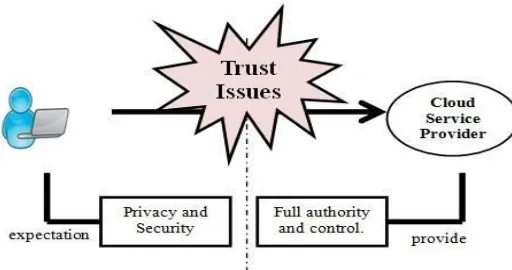
Figure-1. Overview of relationship of trust issues.
Table 1. Functionality comparison of related schemes.
The choice to choose trusted third party in authentication process hazards an association which could prompt security break. Users will send their user's qualification to the trusted third party for check process before they can enable them to utilize the framework. Now and again, cloud service provider is enlisted to be a trusted third party which could be predisposition for them to control and oversee information privacy and security. This progression is
additionally powerless against insider and
untouchable assault since cloud service provider has full access including security control on the users' information. Users need to go out on a limb of accepting that the trusted third party will go about as what they expected despite the fact that they don't get any full investigate security examination. Users will lost control of their own information and host to depend the trusted third get-together to handle the security approaches, user's entrance principles, checking and implementation. The absence of trust among the cloud user by going out on a limb of employing the third party will compound the situation. In this manner it is essential for user to know who made the information, who changed it and when the information is made. Provenance data (authentic information) could be utilized to follow the information data, examining and criminological exercises. Because of this reason, information provenance and privacy component ought to be adjusted together in clouds to accomplish trust among the gatherings included. Framework administrator should take a gander at this unmistakably so as to save the user's privacy in cloud condition.
IV.
SECURE REMOTE PASSWORD (SRP)
PROTOCOL
Following the dialog above, it demonstrates that password-based authentication is as yet pertinent to be connected yet it needs to experience some alteration and upgrade to guarantee both security and privacy are ensured. In this exploration, Secure Remote Password (SRP) convention will be utilized to build up correspondence by utilizing password-based authentication component. Secure Remote Password (SRP) [18] is a password-based authentication convention that gives zero-information verification and it is a well known decision by the IETF for solid password conventions. This convention utilizes an unbalanced calculation to demonstrate learning of a password without uncovering the real information. The SRP offers solid answer for secure the authentication procedure. It doesn't require any outside or extra foundation/gadget and can be worked securely finished insecure systems. This convention can guarantee that:
2.Its verifier is values that substitute the password for check reason amid the login procedure. This is the thing that they called as "verifier-based" which shield from password being stolen if there is any hacking or assault endeavor. The server will utilize verifier incentive to demonstrate learning of the real user. Hence, the password is never sent through system. On the off chance that the assailants gain admittance to the server, they can't utilize verifier incentive to confirm in light of the fact that it requires the two sides to check the procedure which is called as common authentication process.
3.It gives solid session key foundation without uncovering the key out in the open. Both user and server will set up another session key each login session. Along these lines, there is no helpful to spy in light of the fact that the session key is diverse for each handling assignment.
4.Both gatherings need to confirm each other before they can begin to convey. This is the thing that they called "shared authentication" by sending the confirmation message for check purposed. The upside of common authentication is to enable the user to speak with the server even in an insecure system.
5.It does not require trusted third party: It doesn't include any third party for confirmation or distinguishing proof of user accreditation. It can likewise stay away from overhead that identical with PKI-based plan [19].
The SRP has favorable circumstances from specialized view and useful execution. Consequently, it is appropriate to be connected in a dynamic and adaptable condition, for example, cloud computing. The upsides of SRP are as per the following :
1.SRP is a basic and simple convention to be actualized in framework correspondence since it doesn't include a complex scientific count yet
straightforward exponentiation, expansion, increase,
and hashing, which are effectively to be
comprehended.
2.SRP has a low calculation cost which can give quick authentication process. It can work as quick as regular convention, for example, Diffie-Hellman which can limit user-unmistakable postponement.
SRP likewise gives the proficient investigating and is anything but difficult to be adjusted and executed to any standard of use framework. With a basic activity and crypto rationale calculation, this convention empowers user to play out the part capacities and coordinate the current calculation to suit with the customer necessity.
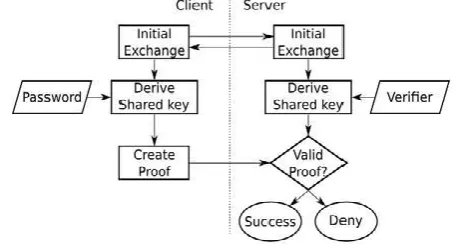
Figure 2. SRP workflow.
Figure-2 delineates the work process of the SRP procedure. The convention utilizes its own particular SRP diagram for key exchange that is based on username and password data. Introductory exchange stage is a procedure of making the verifier esteem and trading it between the user and server. The server processes the verifier esteem v for a user identity I and password P as takes after [20] as condition (1) and (2):
x = H(s,I,P) (1)
v=gx (2)
utilize this data as a customer to validate it to the server. Subsequent to setting up session key at the two sides, customer will produce message M1 and server create message M2 for confirmation. This is the thing that they called as authentication. The M2 is a discretionary for improvement of message arrange. It can lessen one stage of handshaking process that will accelerate the authentication time.
Beside focal points of the SRP, there are some essential issues that should be considered. On the login stage, the user's name is sent to server as plain content. It is available to aggressor to think about who is the user and its accreditation. Based on that data, the assailant can apply speculating assault to keep track the user password. Because of that reason, anonymity highlight ought to be connected for concealing the user certifications and to keep from different assault. Unknown authentication can be connected by hashing the username with random salt number before it is transmitted over the system. Besides, the assailant can take in user's verifier that has been put away in server to take on the appearance of a genuine server. Another way is an aggressor can likewise over and again complete an experimentation to figure the user's password. For this situation, presenting a period stamp highlight and set the point of confinement on number of login endeavor can diminish such assault.
V.
THE PROPOSED AUTHENTICATION
SCHEME
In cloud computing, there are a couple of gatherings included straightforwardly or in a roundabout way to the framework, for example, cloud user, information proprietor, cloud service provider and reviewer. Every one of these gatherings has their own part in the framework. Correspondence in a dynamic, sharing and multi-party condition will uncover user's identity data particularly when they are imparting over insecure channel. Based on this
reason, anonymity highlight is outstanding amongst other arrangements that can be connected in authentication procedure to secure and save user's privacy. Mysterious authentication as of late turns into an intriguing issue for its utilization sequestered from everything user's certification when user login into a framework over a system. This instrument can save user's privacy by applying anonymity highlight
into authentication process. In addition,
anonymization of identity data gives assurance against identity burglary and diverse kinds of connecting attacks. In [12] has specified that keeping in mind the end goal to accomplish a solid, dependable and secure framework design, the framework must be flexible to such attacks and have the capacity to conceal characters of correspondence members from third gatherings.
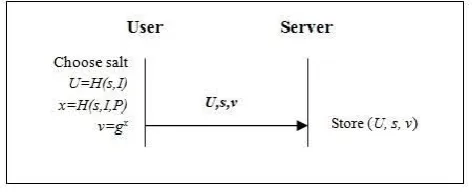
In the SRP convention, mysterious identity could be figured in the enlistment procedure. User will register the mysterious identity (U) by hashing mix of user identity (I) and random salt number (s).
Figure 3. Registration phase
Figure-3 demonstrates the enrollment stage which requires username and password from user to process the mysterious identity (U) and verifier (v). At that point, the three esteems (U, s, v) will be sent to server over the system. Based on this figuring, we push that username (I) and password (p) won't be put away in the server or even sent over the system. A functional figuring to process of U as condition (3) is as per the following:
Subsequent to finishing the enrollment, user can perform authentication with parameter distinguished. The handshaking procedure and building up the session key (K) will be made by the two gatherings for a shared authentication method. By concealing the user's identity through this count, we could guarantee that the user's privacy is ensured and the exchange is dependable all through the mysterious authentication. This will give longer time for aggressor to break or hack the password since they need to discover the identity of record first before they can continue to the subsequent stage.
The benefits of the proposed plot are as per the following :
1. Prevent the spilling of user's identity or identity hoodlum amid the authentication procedure with anonymity include.
2. Protect user's qualification powerlessness to noxious attacks from an insecure and secure system.
3. Provide quick and productive authentication time due to low calculation cost.
Does not require extra gadgets or third party association amid the transaction session
VI.
SECURITY ANALYSIS
This segment displays how the proposed plan will give the arrangement on the off chance that they were be assaulted. The proposed unknown authentication plan ought to be secured against any vindictive assault. Here are a few depictions of verification for some conceivable attacks to this plan:
1.Dictionary attack is trying to determine its unscrambling key or username/password. It can partition into two situations; disconnected attack and on-line attack. For disconnected attack the attacker will endure in trying all the conceivable random
estimation of private key (an) and (b) which isn't uncovered freely. For on-line attack, the attack will go about as a user and will endeavor to figure the username and password. The system can constrain the quantity of password endeavor to hinder the attacker from trying continually. In addition, this component utilizes an alternate session key for each login to authenticate with server.
2.Impersonate attack is an attacker trying to accept the honest to goodness user identity to play out an attack. It won't have the capacity to impersonate the user on the off chance that they don't have a session key (K). They can't process the confirmation message (M1) and (M2) to demonstrate that they are a honest to goodness user without having a session key (K). It turns out to be more muddled on the grounds that the session key isn't exchanged over the system. User and server will register their own session key (K) and won't share the key in broad daylight.
3.Replay attack is a type of system attack to the legitimate information transmission more than once. This is completed either by the originator or by an enemy who intercepts the information and retransmits it, potentially as a feature of a disguise attack by IP parcel substitution, (for example, stream figure attack). It is impossible for this instrument on the grounds that the age of key is randomness and it continues changing for each login session.
4.Man-in-the-middle attack is when attacker covertly intercepts/tapping the correspondence between two gatherings and attempt to change and gather the information. It can just happen if the password and verifier are both known. The two esteems are required to direct the attack. Notwithstanding, for this situation it is hard to get the two esteems in the meantime and it requires costly work to do it
6. Anonymity protection is to save user's privacy by replacing user's identity to be an unknown identity. With a mysterious identity, attack from outcast as well as insider can't manipulate the estimation of identity. Anonymity esteem can't be followed in light
of the fact that it is a restricted hashing esteems which can't be essentially changed to its original esteem. Table-2 demonstrates the synopsis of the depictions and confirmation of every conceivable attacks.
Table-2. Summary of security analysis
VII.
CONCLUSIONS
The real hindrance of providing reliable in cloud services is a security issues. This paper has examined related issues so as to protect user's privacy and give abnormal state of security by means of authentication process. Authentication turns into a key issue among the security issues which ought to be given more concern. There are many inquires about completed to guarantee that the authentication of honest to goodness user is legitimately done in a secured procedure. The leaking of user's information and identity cheat issues could prompt security rupture. The intruder can manipulate the user's identity to illicitly get to the server or cloud stockpiling. In this exploration, the Secure Remote Password (SRP) will
be utilized to set up the authentication procedure with zero-information confirmation. The SRP strategy has given a solid answer for check genuine user without extra gadget or infrastructure necessity. It can likewise work in an insecure system.
user's privacy with a specific end goal to accomplish abnormal state of trust among the cloud domain.
At present the work is in advance to formalize a more exact terms to demonstrate its security highlights. The mysterious authentication plan will be produced and performed for an exploratory test to evidence conceivable attacks as specified previously. The finding and consequence of this test will be distributed soon.
VIII.
REFERENCES
[1]. Bowen J. A. 2011. Cloud computing: Issues in information privacy/security and business contemplations. The Computer and Internet Lawyer, Vol. 28, No. 8, pp. 1-8.
[2]. Huang J. and Nicol, D. M. 2013. Confide in instruments for cloud computing. Diary of Cloud Computing, Vol. 2, No. 1, pp. 1-14. [3]. Ko R. K. L., Jagadpramana P., Mowbray M.,
Pearson, S., Kirchberg M., Liang Q. and Lee B. S.
2011. TrustCloud: A Framework for
Accountability and Trust in Cloud Computing. 2011 IEEE World Congress on Services. pp. 584– 588.
[4]. Yassin A. A., Jin H., Ibrahim A., Qiang W. and Zou D. 2013. Cloud authentication based on mysterious one-time password. In Ubiquitous Information Technologies and Applications. pp. 423-431.
[5]. Khattak Z. A., Manan J. A. and Sulaiman S. 2011. Examination of Open Environment Sign-in Schemes-Privacy Enhanced and Trustworthy Approach. Diary of Advances in Information Technology. Vol. 2, No. 2, pp. 109– 121.
[6]. Jaidhar C. D. 2013. Improved shared
authentication plot for cloud engineering. In Advance Computing Conference (IACC), 2013 IEEE third International. pp. 70-75.
[7]. Hasan R. and Khan R. 2014. Interaction
provenance show for brought together
authentication factors in service arranged computing. In Proceedings of the fourth ACM gathering on Data and application security and privacy. pp. 127-130.
[8]. Mun J., Jin Q., Jeon W. and Won D. 2013. An
Improvement of Secure Remote User
Authentication Scheme Using Smart Cards. In International Conference on IT Convergence and Security (ICITCS). pp. 1-4.
[9]. Lamport L. 1981. Password authentication with insecure correspondence. Interchanges of the ACM. Vol. 24, No. 11, pp. 770-772.
[10]. Rescorla E. 1999. Diffie-Hellman key
understanding technique.
[11]. Bellovin S. M. and Merritt M. 1992. Encoded key exchange: Password-based conventions secure against dictionary attacks. In Research in Security and Privacy. pp. 72-84.
[12]. Khalid U., Ghafoor An., Irum M. and Shibli M. A. 2013. Cloud based secure and privacy
upgraded authentication and approval
convention. Procedia Computer Science. Vol. 22, pp. 680-688.
[13]. Slamanig D. 2011. Unknown authentication from open key encryption returned to. In Communications and Multimedia Security. pp. 247-249.
[14]. Mishra R. 2014. Unknown Remote User
Authentication and Key Agreement for Cloud Computing. Vol. 258, pp. 899– 913.
[15]. Das M. L., Saxena A. and Gulati V. P. 2004. A dynamic ID-based remote user authentication conspire. IEEE Transactions on Consumer Electronics. Vol. 50, No. 2, pp. 629-631
[16]. Kshetri N. 2013. Privacy and security issues in cloud computing: The part of institutions and
institutional development. Broadcast
communications Policy. Vol. 37, No. 4, pp. 372-386.
[17]. Cisco CloudWatch Report 2012. Summer 2012.
http://www.cisco.com/cisco/web/UK/resources/c isco_clo udwatch_2012_2606.pdf
[18]. Thomas Wu. 1998. The Secure Remote
Password Protocol. Proceedings of the
Symposium on Network and Distributed Systems Security NDSS 98. Pp. 97– 111.
Recovered from
ftp://srp.stanford.edu/bar/srp/srp.ps.
[19]. Sajjad A., Rajarajan M., Zisman A. and Dimitrakos, T. 2015. An adaptable and dynamic application-level secure correspondence system for inter-cloud services. Future Generation Computer Systems. Vol. 48, pp. 19– 27.