University of Pennsylvania
ScholarlyCommons
Publicly Accessible Penn Dissertations
1-1-2014
Treatment and Program Effects in a Violence
Reduction Program
Wendy McClanahan
University of Pennsylvania, [email protected]
Follow this and additional works at:
http://repository.upenn.edu/edissertations
Part of the
Criminology Commons
, and the
Criminology and Criminal Justice Commons
This paper is posted at ScholarlyCommons.http://repository.upenn.edu/edissertations/1362
For more information, please [email protected].
Recommended Citation
McClanahan, Wendy, "Treatment and Program Effects in a Violence Reduction Program" (2014).Publicly Accessible Penn Dissertations. 1362.
Treatment and Program Effects in a Violence Reduction Program
Abstract
Because serious crime has widespread negative effects on communities, families and our nation's young people--we must make our "go to" responses--such as policing, probation and incarceration--more effective. The current study will examine an intervention that aims to reduce recidivism through support and
supervision of serious youthful offenders who live in high-crime urban neighborhoods. The program aims to bridge a critical tension faced by probation--the dueling goals of social control and social welfare (i.e., punishment and rehabilitation). Specifically, this research will aim to 1) determine the extent to which the program causes decreases in recidivism and 2) explore if level of contact with program staff (street workers) is related to recidivism outcomes. The information gleaned from this study will be useful to both researchers interested in serious and persistent youthful offenders and to practitioners and policy makers aiming to reduce serious crime and optimize community corrections.
Degree Type
Dissertation
Degree Name
Doctor of Philosophy (PhD)
Graduate Group
Criminology
First Advisor
John MacDonald
Keywords
Community Corrections, Crime, Evaluation, Intervention, Serious and Persistent Offenders, Violence Prevention
Subject Categories
TREATMENT AND PROGRAM EFFECTS IN A VIOLENCE REDUCTION PROGRAM
Wendy McClanahan
A DISSERTATION
in
Criminology
Presented to the Faculties of the University of Pennsylvania
in
Partial Fulfillment of the Requirements for the
Degree of Doctor of Philosophy
2014
Supervisor of Dissertation
_________________________________________________________________ John M. MacDonald
Associate Professor of Criminology and Sociology
Graduate Group Chairperson
__________________________________________________________________
Charles Loeffler
Jerry Lee Assistant Professor of Crimnology
Dissertation Committee
Paul D. Allison, Professor of Sociology
TREATMENT AND PROGRAM EFFECTS IN A VIOLENCE REDUCTION PROGRAM
COPYRIGHT
2014
Dedication page
I dedicate this to my father, Dr. John Henry Thomas III. I wish he was still here to experience the end of this journey with me (and remind me that I am not a “real”
ACKNOWLEDGMENTS
I would like to thank the many individuals that supported this work. First, I thank Dr. John
MacDonald for his expertise, advice and patience. My other committee members, Dr. Robert
Borusch and Dr. Paul Allison, also provided excellent critique and guidance. Second, I wish to
thank Dr. Sarah Pepper; whose SAS programming and organizational skills were paramount to
my success. Third, I thank my husband and children for letting me ignore them in order to
complete my studies. Don, your support and encouragement has been crucial to my success,
both academically and professionally. I am glad I chose you for this journey. And Kayleigh and
Ethan, I apologize for the child care and appreciate the sacrifices you have made (e.g., losing
time with your awesome mom) so that I could finish my education. Fourth, I thank Melissia
McKittrick, the most amazing copy editor on earth (and a good friend too). Fifth, I thank Gary
Walker, Nadya Shmavonian, and the board of Public/Private Ventures: without your inspiration
and backing I would not have headed down this path. Next, I want to thank the staff of YVRP for
sharing this data with me and taking the risk that is inherent in all evaluation. Finally, I want to
thank my friends. In particular, Dr. Janine M. Zweig and Dr. Corinna J. Tucker who provided
much needed distraction and love. Meridith Polin and Eric McClanahan listened to me complain
over and over about writing. And Dr. Tina J. Kauh bestowed upon me essential words of wisdom,
ABSTRACT
TREATMENT AND PROGRAM EFFECTS IN A VIOLENCE REDUCTION PROGRAM
Wendy McClanahan
John MacDonald
Because serious crime has widespread negative effects on communities, families and
our nation’s young people—we must make our “go to” responses—such as policing,
probation and incarceration—more effective. The current study will examine an
intervention that aims to reduce recidivism through support and supervision of serious
youthful offenders who live in high-crime urban neighborhoods. The program aims to
bridge a critical tension faced by probation—the dueling goals of social control and
social welfare (i.e., punishment and rehabilitation). Specifically, this research will aim to
1) determine the extent to which the program causes decreases in recidivism and 2)
explore if level of contact with program staff (street workers) is related to recidivism
outcomes. The information gleaned from this study will be useful to both researchers
interested in serious and persistent youthful offenders and to practitioners and policy
TABLE OF CONTENTS
ACKNOWLEDGMENTS... IV
LIST OF TABLES ... VIII
LIST OF FIGURES ... IX
CHAPTER 1: THE PROBLEM OF SERIOUS CRIME AND VIOLENCE ... 1
The Impact of Serious Crime ... 2
An Overview of the Study... 5
Structure of this Paper ... 6
CHAPTER 2: SUBSTANTIVE BACKGROUND ... 7
Prevention: Non-Criminal Justice Efforts to Reduce Serious Crime and Violence ... 7
Family focused programs. ... 8
School-based programs. ... 9
Community-based programs and other related approaches. ... 10
Summary. ... 11
Intervention: Criminal/Juvenile Justice Efforts to Reduce Serious Crime and Violence ... 12
Policing. ... 13
Courts. ... 16
Corrections. ... 18
Criminal justice hybrids. ... 25
Summary ... 26
CHAPTER 3: THE CURRENT STUDY ...28
How is the Frequency of Contact with Street Workers Related to Recidivism Outcomes? ... 31
The promise and challenge of coordinating supervision and treatment. ... 31
Dually focused probation: The interplay with probation type. ... 33
Contribution to the Field ... 35
CHAPTER 4: METHODOLOGY AND OVERVIEW OF CAUSALITY ...37
Sample ... 37
Geography. ... 39
The profile of juvenile probationers in the sample. ... 41
The profile of adult probationers in the sample. ... 42
Summary. ... 43
Data Collection ... 44
Court and probation-records data. ... 44
Program data. ... 47
Measures ... 48
Missing data. ... 50
Other covariates. ... 50
Design ... 51
Background on causal inference. ... 51
Propensity score balancing: One approach to estimating average treatment effects from observational data. ... 54
Analytical Strategy ... 56
Research question 1: Does participating in YVRP lead to lower recidivism? ... 56
Research question 2. How is the frequency of contact with street workers related to recidivism outcomes? ... 59
Sensitivity analysis. ... 59
CHAPTER 5: PROPENSITY SCORES ...60
The Models ... 60
Assessment of Propensity Score Models ... 61
Summary ... 69
CHAPTER 6: RESULTS ...71
Recidivism Outcomes ... 71
Does Participation in YVRP Result in Reduced Recidivism? ... 73
Incidence. ... 73
Hazard Rate. ... 86
How is the Frequency of Contact with Street Workers Related to Recidivism Outcomes? ... 94
CHAPTER 7: DISCUSSION ... 100
Limitations ... 102
Policy Implications ... 109
Programmatic Implications ... 111
LIST OF TABLES
Table 1: Average Socioeconomic Indicators for YVRP Police Districts versus Police
Districts where Comparison Group Members Live, 2000 ...40
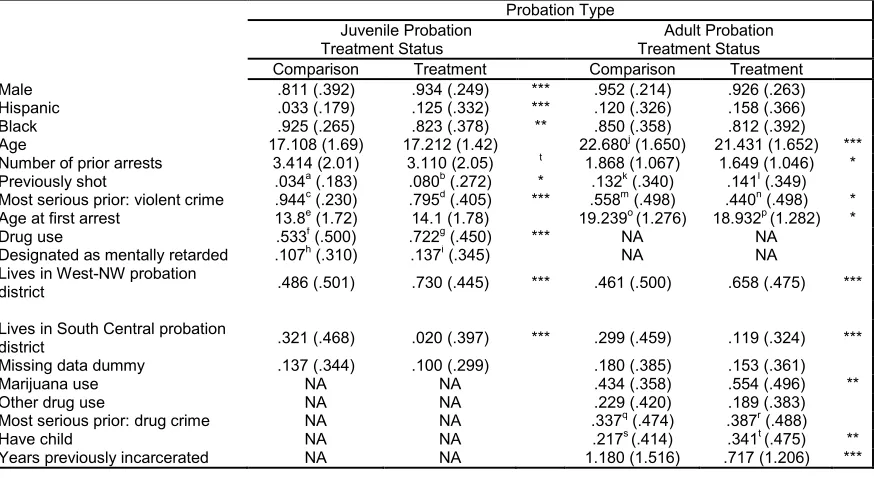
Table 2: Baseline Differences between Treatment and Comparison Group on Measured Potential Confounders ...40
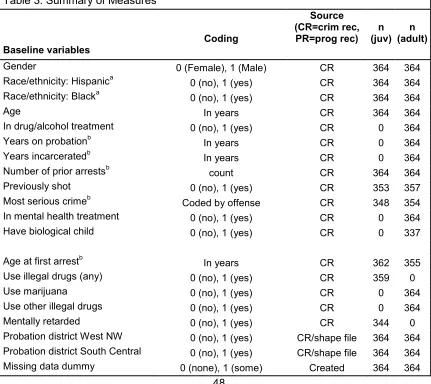
Table 3: Summary of Measures ...48
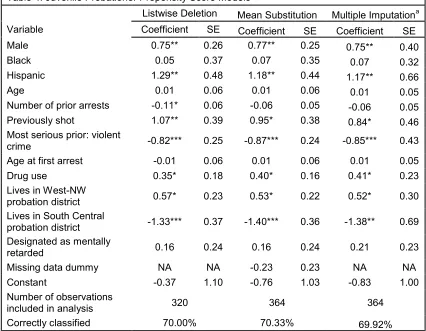
Table 4: Juvenile Probationer Propensity Score Models ...60
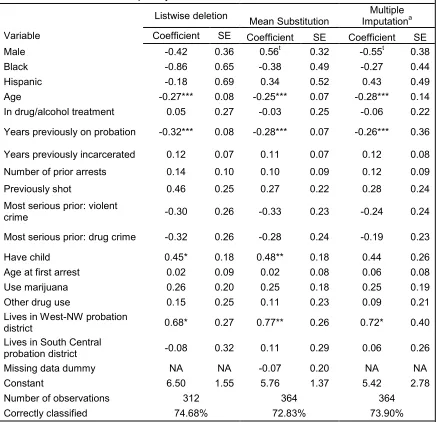
Table 5: Adult Probationer Propensity Score Models ...61
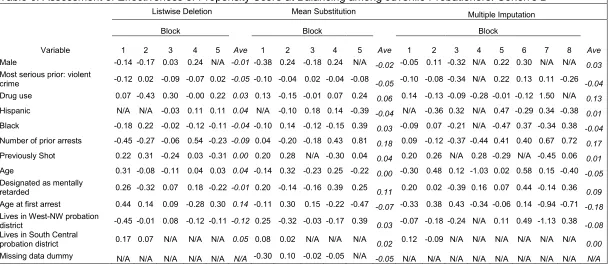
Table 6: Assessment of Effectiveness of Propensity Score at Balancing among Juvenile Probationers: Cohen's D ...67
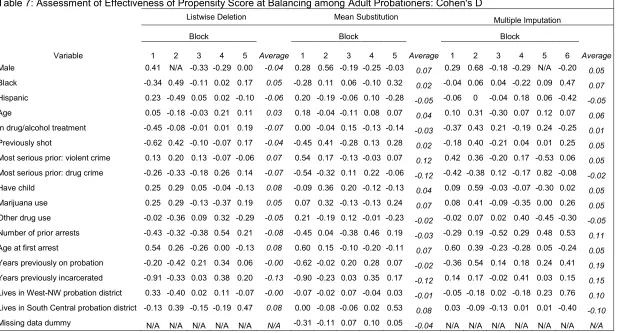
Table 7: Assessment of Effectiveness of Propensity Score at Balancing among Adult Probationers: Cohen's D ...68
Table 8: Number of Study Participants Falling into Strata by Probation Type and Treatment Status ...69
Table 9: Proportion of Treatment and Comparison Group Members Experiencing Recidivism Outcomes ...72
Table 10: Juvenile Probationer Logistic Regression Predicting Recidivism ...74
Table 11: Adult Probationer Logistic Regression Predicting Recidivism ...76
Table 12: Estimate of the Average Treatment Effect on the Treated Among Juvenile Probationers: YVRP Participation and Recidivism ...82
Table 13: Estimate of the Average Treatment Effect on the Treated Among Adult Probationers: YVRP Participation and Recidivism ...82
Table 14: Estimate of the Treatment Effect Using Propensity Score as a Covariate in a Logistic Regression Among Juvenile Probationers: YVRP Participation and Recidivism ...83
Table 15: Estimate of the Treatment Effect Using Propensity Score as a Covariate in a Logistic Regression Among Adult Probationers: YVRP Participation and Recidivism ....84
Table 16: Comparison of Treatment Effect Estimates From Logistic Regression Using Individual Covariates Versus Propensity Score ...85
Table 17: Comparison of Direction of Treatment Effect Estimates From Three Analytical Approaches ...86
Table 19: Adult Probationer Cox Regression Predicting Recidivism Failure Rate ...89
Table 20: Estimate of the Treatment Effect Using Propensity Score as a Covariate in a Logistic Regression Among Juvenile Probationers: YVRP Participation and Time to Recidivism ...92
Table 21: Estimate of the Treatment Effect Using Propensity Score as a Covariate in a Logistic Regression Among Adult Probationers: YVRP Participation and Time to Recidivism ...93
Table 22: Comparison of Treatment Effect Estimates From Logistic Regression Using Individual Covariates Versus Propensity Score ...94
Table 23: Association between Probation and Street Worker Contacts and Recidivism: Juvenile Probationers ...98
Table 24: Association between Probation and Street Worker Contacts and Recidivism: Adult Probationers ...99
Table 25: Summary of Analytic Approaches Used in This Study ... 101
LIST OF FIGURES
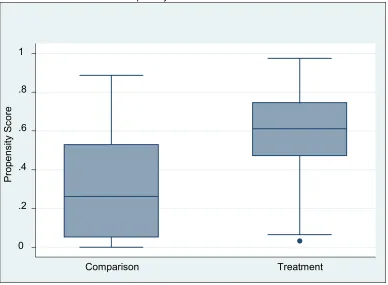
Figure 1: Possible model by which YVRP results in reduced involvement in violence and serious crime ...30Figure 2: Juvenile Probationer Propensity Score Distribution Listwise Deletion ...62
Figure 3: Juvenile Probationer Propensity Score Distribution Mean Substitution ...63
Figure 4: Juvenile Probationer Propensity Score Distribution Multiple Imputation ...63
Figure 5: Adult Probationer Propensity Score Distribution Listwise Deletion ...64
Figure 6: Adult Probationer Propensity Score Distribution Mean Substitution ...64
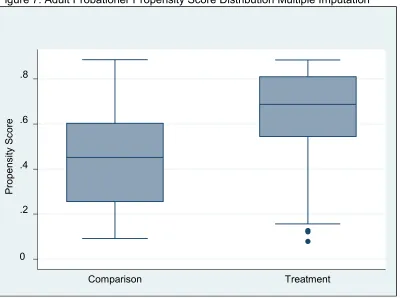
Figure 7: Adult Probationer Propensity Score Distribution Multiple Imputation ...65
Figure 8: Distribution of Probation Contacts Among Treatment and Comparison Group Members Juvenile Probationers ...95
Figure 9: Distribution of Probation Contacts Among Adult Probationers ...96
1
CHAPTER 1: THE PROBLEM OF SERIOUS CRIME AND VIOLENCE
Despite declines in crime nationally over the past eight years (FBI, 2010),
citizens and leaders of urban areas across the nation still routinely cite crime and its
related disorder as one of the most significant problems facing their cities and
neighborhoods (see for instance, E-town Panel, 2006; Futrell et al., 2010): robberies,
aggravated assaults, homicides, drug use and dealing and other crimes still number in
the hundreds of thousands across our urban areas every year and place residents and
their communities in jeopardy.
Historically to address this problem, Americans have relied primarily on criminal
justice responses to improve public safety and reduce crime. In fact, due to increasingly
punitive criminal justice policies over the last part of the 20th century, today there are
more than 7.3 million Americans under some form of criminal justice supervision (The
Pew Center on the States, 2009) at a cost of more than $185 billion per year on police,
courts and corrections (Hughes, 2006). Yet, many experts believe that the “get tough on
crime” movement of the 1980s, including harsher sentencing and, therefore, increased
incarceration, did not result in benefits that justify its cost (both financially and to
communities; Lynch & Sabol, 1997; The Pew Center on the States, 2011). In fact, there
is evidence that traditional reactive policing methods have not produced as much
success as proactive and place-base approaches designed to prevent serious crime
(Braga, 2001; Braga et al., 1999; Cohen, Gorr, & Singh, 2003; Cohen & Ludwig, 2003;
Sampson & Cohen, 1988; Sherman & Weisburd, 1995). Conventional approaches to
probation and parole have met with criticism from experts, primarily because they do not
offenders (Gill, 2010; Petersilia, 1997; Solomon, Kachnowski & Bhati, 2005).1 Mass
incarceration, arguably the most common result of the implementation of “get tough”
policies, comes at a high cost to governments and taxpayers; yet, still about 40 percent
of inmates return to incarceration within three years of release (The Pew Center on the
States, 2011) —a dismal outcome if the goal is to reduce recidivism as well as crime.
Recently, budget shortfalls dictated by the recession of 2008-2009, as well as building
evidence that “traditional” criminal justice approaches are resulting in moderate impacts
on national crime rates while requiring huge expenditures (see Anderson, 1999 and
Levitt, 2004 for some estimates), has resulted in a shift in thinking about how to best
structure responses to crime, both criminal justice, and non-criminal justice. Efforts are
underway to reform policing, community corrections, and incarceration. Furthermore,
more attention is being paid to prevention as an alternative approach (although it should
be viewed as a complimentary approach) to reducing crime.
The Impact of Serious Crime
While changes are afoot, our nation’s inability to effectively control and reduce
crime, particularly serious crime, has resulted in vulnerable communities and families;
individuals, both victims and perpetrators of these crimes, also face serious negative
outcomes. For instance, street violence is an epidemic among our nation’s poor urban
male youth: murder is the second leading cause of death for males 15 to 24 years old
and the number one cause of death for African American males in this age group (CDC,
2007, 2009). According to the Federal Bureau of Investigation, in 2010 there were an
estimated 87,771 robberies in the U.S., and approximately 4 in 10 involved a firearm; 60
1 In the last year, states nationwide began initiatives to increase their efforts for stricter parole enforcement. For instance,
percent were committed by young people between 15 and 24 years old, almost all of
whom were males. Perpetrators of serious crimes will face deserved criminal justice
sanctions, including prison time; if they are ever released (and most are), they will likely
still have unmet needs and will therefore face a myriad of reentry challenges likely to
perpetuate their involvement in crime. Those who are supervised in the community will
face similar challenges. This is because young people who get involved in serious and
persistent crime often live in impoverished, high-crime, urban neighborhoods, where
there are limited services and resources to meet their needs. Furthermore, the reasons
youth become involved in serious crime to begin with are multifaceted and run deep in
families and communities. In addition to a host of personal characteristics that may
contribute to early, frequent and persistent involvement in crime, some of these youth
come from families that participate in or accept criminal behavior; they may suffer from
child abuse, neglect or other family conflict. They often struggle throughout childhood
with economic disadvantage and the ramifications of living in high-poverty
neighborhoods. And, they are often witness to or victims of violence or serious crime,
experience high rates of academic failure and have criminally involved or delinquent
peers or siblings (Hawkins et al., 2000). As teens and young adults, some (not all) of
these young men become involved crime and acquire a history of persistent and early
delinquency. In some ways, they are our nation’s “throw away” youth—many are urban
males of color who become engaged in crime at an early age, drop out of school, and
withdraw from the formal labor market (see, for example, Farrington, 1998).
Many of these young people have children and families of their own and
therefore, the impact of their involvement in crime not only threatens their own
well-being, but also affects their family through loss of income, fear and potentially loss of or
the worst—experiencing poor school performance, separation and potential changes in
caregiving arrangements due to incarceration of a parent, and even continued
perpetuation of crime (Bloom & Steinhart, 1993; Boswell & Wedge, 2002; Davis, 1993;
McDermott & King, 1992; Murray & Farrington, 2005; Murray, Janson, & Farrington,
2007; Shaw, 1987, 1992). Neighborhoods, especially our nation’s already fragile
inner-city low-income neighborhoods, are also impacted by high concentrations of serious and
violent crime (Krivo & Peterson, 1993). High rates of neighborhood violence and crime
have led to urban flight (Morenoff & Sampson, 1997) and fear among residents that can
hamper a community’s ability to organize to fight against crime and violence (Skogan,
1986) which will, in turn, increase the opportunity for local youth to get and stay involved
in crime. Furthermore, high crime communities have fewer strong social institutions—
and as a result, youth experience unsafe schools and limited employment opportunities.
This can lead to further neighborhood economic decline as residents who cannot or
chose not to leave become increasingly impoverished and, possibly dependent upon
crime (see, for instance, Wilson, 1987).
Finally, violence and other serious crime also have significant economic
implications for society beyond just criminal justice costs. For instance, according to
Corso and colleagues (2007), in 2000 in the US the costs of lethal and non-lethal
interpersonal violence society accrued medical and lost-productivity costs of $59 billion
due to lethal and non-lethal interpersonal violence. Some of the medical costs accrue to
uninsured individuals, and while lost employment is the most obvious way productivity is
impacted by violent crime, tax revenue, volunteerism, spending and other contributions
to the economy are also affected. Anderson (1999) estimates a more comprehensive
cost of crime to society. He found that total annual costs of crime, including direct costs,
spent on health care per year. His estimated cost, in 1997 dollars, totaled $4,118 per
capita.
An Overview of the Study
Because crime, especially serious crime, has widespread negative effects on
governments, communities, families and our nation’s young people—we must make our
“go to” responses—such as policing, probation and incarceration—more effective as
years of increased spending on imprisonment and policing,2 as well as increased
probation rolls, have not solved the crime or violence problem. This study examines an
intervention that aims to break the cycle of persistent criminal offending by reducing
recidivism, particularly for violent offenders, through enhancing probation. The program,
the Youth Violence Reduction Partnership (YVRP), is specifically targeted to serious and
persistent youthful (between the ages of 14 and 24) offenders who live in high crime
urban neighborhoods. The program aims to bridge a critical tension faced by
probation—the dueling goals of social control and social welfare (i.e., punishment and
rehabilitation)--by providing participants with both intensive supervision from probation
and police/probation patrols and support/connection to services from a street worker
who works in close partnership with the probation officer. Specifically, the research aims
to 1) determine the extent to which YVRP causes decreases in recidivism among
participants and 2) explore if contacts with program staff, specifically, street workers, is
related to recidivism outcomes for participants. The information gleaned from this study
will be useful to both researchers interested in youth violence and to policy makers
looking for programmatic efforts that practitioners can use to reduce it.
2 Levitt (2004) found that increasing policing and imprisonment rates explained only about half of the decline in crime rates
Structure of this Paper
In the following sections I provide more background on and information about the
proposed study. First, I provide a literature review presenting the current state of
knowledge about efforts to reduce serious crime and violence, emphasizing prevention
approaches, where we most commonly employ social welfare programs, and
intervention approaches, where we most commonly employ social control efforts through
the criminal or juvenile justice systems. The third chapter provides details on the study
presented herein, as well as background on the Youth Violence Reduction Partnership,
the program that is the topic of this research. The fourth chapter explains the
methodology and provides an overview of causality, focusing particularly on the potential
outcomes framework. Chapter five presents the analyses associated with creating the
propensity scores used in many of the analyses. Chapter six includes results of the
main analyses, answering the two main research questions of interest. The final chapter
is a discussion section, which includes a summary of findings, study limitations, and
7
CHAPTER 2: SUBSTANTIVE BACKGROUND
Efforts to reduce serious crime and violence fall into two main camps—criminal
justice responses which emphasize social control though supervision and punishment,
and non-criminal justice efforts which have focused on social welfare programs.
Criminal justice responses fill the intervention space—attempting to reverse the
undesirable behavior. Non-criminal justice responses have most often taken the form of
prevention efforts, where the targets of the program are youth who have not yet engaged
in crime or have not been officially sanctioned for engaging in crime (and therefore are
not yet engaged in the juvenile or criminal justice systems) and the goal of the program
is to keep or prevent them from engaging in it in the future.
Traditionally, criminal justice responses have been largely reactive and based on
the premise that increasing supervision, removing criminals from the community and
punishing them will lead to reduced crime—in part by making other would-be criminals
think twice before breaking the law. As opposed to the prevailing mantra in the 1970s
and 1980s, more recent research has suggested that rehabilitation can work and
therefore, recent best practices in criminal and juvenile justice include a myriad of
alternatives that include rehabilitation and treatment principles as well as supervision,
punishment and control (see, for instance, Andrews, Bonta & Hoge, 1990). This section
summarizes the current state of knowledge about what works to reduce serious crime in
each arena.
Prevention: Non-Criminal Justice Efforts to Reduce Serious Crime and Violence
In general, there is more confidence among practitioners and researchers in the
involved in serious crime (Caldwell & Van Rybroek, 2005) than in intervention and
criminal justice responses. Multi-strategy programs that incorporate elements of the
many ecological environments in which youth are immersed, such as family, school, and
community, seem particularly successful in preventing crime and violence (Dusenbury,
Falco, Lake, Brannigan, & Bosworth,1997; Greenberg, 2001; National Institutes of
Health, 2006; US Department of Health and Human Services, 2001). Crossing over
these contexts provides reinforcement of prevention efforts and messages.
Family focused programs. First, theories of crime and delinquency point to
parenting and family characteristics as key factors in negative outcomes for youth (social
control theories: Gottfredson & Hirschi, 1990; Hirschi, 1969; social learning theory:
Burgess & Akers, 1966; developmental: Laub, Sampson & Allen, 2001; Sampson &
Laub, 1990; Sampson & Laub, 1992; Sampson & Laub, 1993), yet research to
substantiate these theories has mixed results. While some studies have shown that
family can be a key protective factor among youth at risk for engaging in serious crime
and violence (see for instance, Gorman-Smith, Henry & Tolan, 2004), others have
shown that family may not have as large of a direct impact as these criminological
theories would suggest (Derzon, 2010). Nonetheless, a review conducted by Piquero
and colleagues (2009) shows strong support for family and parenting programs as an
efficacious approach to delinquency and problem behavior reduction (Piquero,
Farrington, Welsh, Tremblay, & Jennings, 2009). And individual evaluations of some
programs have shown significant and long term impacts of family focused programs (see
for instance, Alexander et al, 1998; Borduin et al., 1995; Henggeler, Melton & Smith,
1992; Henggeler, Melton, Smith, Schoenwald, & Hanley., 1993; Olds et al., 1998;
Reynolds et al., 2007; Reynolds, Magnuson & Ou, 2010;Schaeffer & Borduin, 2005;
School-based programs. School is a context the presents both opportunity for
crime and violence as well as for preventing or intervening in it. Moreover, a
commitment to school has been shown to provide protection against factors that place a
child at risk for engaging in serious crime (US Department of Health and Human
Services, 2001). And therefore, perhaps not surprisingly, school-based programs have
also shown promise in reducing delinquency and violence (see for example,
FindYouthInfo, n.d.; Barnoski 2004, Botvin, Griffin & Nichols, 2006; Bruene-Butler,
Hampson, Elias, Clabby, & Schuyler, l997; Conduct Problems Prevention Research
Group, 1999, 2002; Glick & Goldstein, 1987; Hawkins, Catalano, Kosterman, Abbott &
Hill, 1999; OJJDP n.d; Olweus, 1994; Webster-Stratton, Reid & Hammond, 2004;
Webster-Stratton & Hammond, 1997; Webster-Stratton & Reid, 1999 a,b; U.S.
Department of Education 2001). School based programs adopt one of two approaches:
they can aim to reach all youth in the school irrespective of their risk of delinquent
behavior, or they can be targeted at students who are presenting with behaviors or
characteristics that place them at high risk of engaging in crime. Overall, targeted
school based programs have larger violence-reduction effects than prevention programs
that focus on all students (Wilson & Lipsey 2007; Wilson, Gottfredson & Najaka, 2001).
These programs almost always have higher doses than universal or primary prevention
strategies (Fields & McNamara, 2003) and also have a greater potential to reduce
negative behavior if targeting is done correctly (e.g., youth who are targeted for the
program are actually youth who are going to engage in the behavior of interest).
Furthermore, prevention programs that target the school’s culture seem to perform
favorably when compared to curricular approaches (U.S. Department of Health and
with greater fidelity than curriculum-based programs (Crosse et al., 2001; Gottfredson et
al., 2000) and are often longer-term and more intensive (Mihalic & Irwin, 2003).
Although targeted interventions tend to have larger effect sizes than programs
serving all students, these “universal” prevention strategies can also produce impacts,
albeit smaller in size. Furthermore, there are clear advantages to universally
school-based programs: all youth are included in the program and may benefit, they can be
implemented in a natural setting and with a typical school process, since youth are not
targeted, they will not be subjected to stigma or labeling (Fields & McNamara 2003); and
youth are not served in groups bringing together at-risk youth and reinforcing negative
behaviors through “deviancy training” (Dishion & Dodge, 2005; Dishion, McCord &
Poulin, 1999).
While holding great promise, not all school based programs have demonstrated
impacts. Programs that are seen as add‐ons or mandated by external forces are likely
to be implemented inconsistently or possibly not at all, resulting in poor student
outcomes. Similarly, successful school based prevention programs should involve long
term efforts(Dusenbury, Falco, Lake, Brannigan & Bosworth, 1997; Greenberg, 2001).
Ideally, prevention strategies should be implemented beginning in early elementary
school and reinforced through high school. Starting prevention activities early allows
children to develop the skills and attitudes they need to avoid serious crime and violence
before its peak in adolescence. Finally, the downside of school based programs is that
youth who are chronically absent or have dropped out of school—many of whom may be
among the youth most at risk for engaging in serious crime—will not be touched by the
program.
Community-based programs and other related approaches. Although community
serious crime and violence prevention have been evaluated. Communities that Care is
one notable exception; it combines proven effective prevention programs specific to the
needs of each implementing community. Early results of the evaluation suggest that the
approach is effective in preventing delinquency at seventh grade—but its impact on later
serious crime or violence has not been assessed (Hawkins et al., 2008).
Finally, there are other approaches that have been shown to prevent serious
crime; approaches that involve adults in the lives of youth. Mentoring has demonstrated
violence and crime prevention effects (Tierney, Grossman & Resch, 2001). It is posited
that mentors help because youth without strong and supportive adults in their lives are at
greater risk for negative outcomes, including engaging in crime and violence (Walker &
Freedman, 1996). Borowsky and colleagues (2004) demonstrated that primary care
physicians have the ability to take steps that will reduce violence among youth. In their
study, randomly selected children and adolescents who received a psychosocial
screening and whose parents were offered a parent training had reduced levels of
violence as compared with those were who not selected to receive the intervention.
Finally, a comparison group evaluation of a gang prevention program implemented in
Boys and Girls Clubs also demonstrated delays in deviant behavior (Arbreton &
McClanahan, 2002).
Summary. Taken as a whole, several prevention efforts have undergone
rigorous evaluation and have established effectiveness in preventing serious crime and
violence. However, with the exception of some therapeutic interventions, like
multisystemic therapy, they have not been designed to reduce crime among those
already deeply engaged in the justice system, and therefore, do not work to reduce
recidivism among existing serious offenders. Nonetheless, the promise of prevention
claim that rehabilitation does not work, has ignited interest in finding programs that will
meet the criminogenic needs of offenders. Emphasis has been placed on employment
programs, housing options, reunification support, and treatment for mental health,
physical health and drug/alcohol problems. However, the main point of intervention for
serious and violent young offenders remains the juvenile or criminal justice system,
which I turn to in the next section.
Intervention: Criminal/Juvenile Justice Efforts to Reduce Serious Crime and
Violence
The decision to intervene to reduce crime is premised on the notion that it is
possible to change criminal behavior within individuals. And despite ample evidence of
stability of antisocial behavior in some populations (Caspi, Elder & Bern, 1987;
Huesmann, Eron & Lefkowitz, 1984, Jessor, Donovan, & Costa, 1991; Loeber, 1987;
Olweus, 1979), policy makers continue to search for ways to reduce offending behavior
in criminal populations or those at high risk for committing criminal acts. Indeed, our
earliest notions of the criminal justice system were steeped in the belief that certainty,
celerity (speed) and severity of punishment would deter would-be criminals and potential
recidivists from committing offenses (Beccaria, 1986/1767). And we are currently in a
policy environment where more attention than ever is being paid to rehabilitation of
offenders, and not just punishment.
In the criminological literature there has been great debate about the nature of
stability in antisocial and criminal behavior over the life course (see Sampson & Laub,
1990 for an excellent review). Some criminologists believe that childhood antisocial
behavior does not affect adult antisocial behavior directly, but the relationship operates
through an innate propensity for crime shown through self-control developed early in life
argument in favor of a causal impact of childhood antisocial behavior on adult criminal
behavior. Nonetheless, much of the historic literature on continuity and stability comes
from offender studies, and in reality, many antisocial children and adolescents go on to
live crime-free lives as adults. Others engage in criminal behavior across their lifetime,
but at varying levels. Indeed, evidence suggests that even as very serious and
persistent offenders age they are significantly less likely to engage in criminal activity.
Because of this evidence and our deep-rooted societal belief that intervening to change
trajectories should be successful, we have a myriad of policies designed to intervene to
reduce recidivism even after an individual has committed one, or several, crimes.
Intervention programs, that is activities designed to reduce violence or serious
crime among youth who have been or are currently engaged crime are most often
criminal justice responses3 and include policing, courts and corrections, including
community corrections and incarceration. Innovations and new programmatic
approaches have been employed in all arms of the juvenile and criminal justice systems
in recent years in an effort to promote better outcomes for criminals and victims;
however, Taxman (2002) suggests that there has been more interest in innovation than
there has been effort trying to document what works and doesn’t within the system itself.
Below I focus on explicitly on the workings of the various justice entities responsible for
public safety and crime reduction.
Policing. A landmark study in the 1970’s convinced many scholars and
practitioners that policing did not deter or reduce crime (Kelling et al., 1974). Although
the conclusions drawn from that study were challenged by other research demonstrating
policing could work, skepticism ensued, and with good reason. A review by Weisburd
and Eck (2004) finds little empirical support for “traditional” policing efforts, such as rapid
3 Lipsey’s 2009 review of programs for juvenile offenders found that only 18 percent of the evaluated programs serving
response to 911 calls, large scale community patrol, and marginally increasing the
numbers of police (assuming they focus on arrest and punishment).
After the rapid growth of serious crime in the 1980s, the 1990s brought a call for
policing reform that would result in safer neighborhoods. More tailored, focused and
proactive strategies were tested, such as problem-oriented policing, hot spots policing
and crackdowns, and community policing (Weisburd & Eck, 2004). These approaches
often overlap in execution, and there are some commonalities that are worth noting.
First, both problem-oriented and community policing utilize partnerships. In traditional
policing models, little information was gathered from or shared with other community
institutions or residents. Full implementation of problem-oriented or community policing
often results in partnerships that help identify needs and solve community issues related
to crime. Despite the theoretical importance of partnership, a 1998 study by Mazerolle
and colleagues found that “place managers” —those individuals who discourage crime in
particular geographic areas, like landlords—were no more effective in areas where they
collaborated with police then where traditional policing occurred. But later research by
Mazerolle suggested that partnerships with third-parties can be critical to policing
success (Mazerolle, Kadleck, & Roehl, 1998; Mazerolle, Soole, & Rombouts, 2006).
Hot spots and problem-oriented policing are two strategies that grew out of the
1990’s call to action. They are both tailored to specific geographic areas—ideally areas
much smaller than traditional patrol units. And, research suggests that both hot spots
and problem-oriented policing can be effective strategies to reduce crime in target areas
(Berk & MacDonald, 2010; Braga, 2001; Braga & Bond, 2008; Braga, Kennedy, Warring,
& Piehl, 2001; Cohen, Gorr & Singh, 2003; Cohen & Ludwig, 2003; Green 1995;
Sherman & Weisburd, 1995; Weisburd, Waring, Mazerolle, Spelman & Gajewski, 1999).
is often a component of problem-oriented approaches (Weisburg & Eck, 2004). For
instance, research on the SMARTS program by Green (1995) shows that enforcing code
violations reduced drug crime in the targeted area. Other claims are more anecdotal
than evidence-based; Kelling and Bratton (1998) believe that policing disorder was
related to the steep decreases in crime experienced by NYC in the 1990s. An early
study by Sampson and Cohen (1988) showed that aggressive policing on disorder,
defined as DUI and disorderly arrests per officer, reduced crime.
One of the central questions when place-based police strategies do work in
reducing crime is if the crime simply displaced to another geographic area. In other
words, is it a zero-sum game (Cohen, Gorr & Singh, 2003; Sherman & Weisburd, 1995;
Weisburd & Eck, 2004)? Research suggests that displacement of crime is not common;
more often there are diffusion effects of the crime control effort that result in safer
surrounding geographies as well as the primary geographical targets of the policing
intervention.
Finally, a considerable investment has been made in community policing efforts.
Community policing is not a single model, but comprised of multiple approaches to
proactive policing in partnership with community leaders, residents and institutions. A
review of the literature suggests that community policing efforts are difficult to evaluate
because of their heterogeneity; but that they have most often demonstrated success not
in crime reduction per se, but in reducing residents’ fear of crime. Furthermore, although
question remain about the extent to which funding was used to implement community
policing models, research suggests that the COPS program did result in crime reduction
benefits for many grantees (Evans and Owens, 2006; Zhao, Scheider & Thurman,
Courts. As with policing, courts have employed new approaches and techniques.
After the first problem-oriented court, the Miami Drug Treatment Court, was started in
1989 as an alternative to incarceration to treat the root cause of the crime and not simply
impose punishment, problem-oriented courts have proliferated, as drug courts, reentry
courts, and domestic violence courts have been developed, evaluated and replicated
throughout the country. The goals of problem-oriented courts are to address the
criminogenic needs of offenders through treatment or rehabilitative services while
providing supervision.
Drug courts, as a subset of specialty courts, have received the most research
attention. As such, several meta-analyses of drug courts have been disseminated in
recent years. Overall, they seem to suggest that drug courts in aggregate reduce
recidivism about 10 percentage points (Aos, Miller, and Drake 2006; MacKenzie, 2006;
Shafer, 2006; Wilson, Mitchell, and MacKenzie, 2006). More rigorous studies of drug
courts have yielded smaller effect sizes (see, for instance, GAO, 2005), but still report
positive crime reduction benefits among participants. Furthermore, Farole, Remple,
Byrne and Chang (2008) found in their survey of over 1000 judges that they support
problem-solving courts and embrace many of the associated principles. Despite the
positive impacts of the approach in general, Downey and Roman (2010) conclude from
their cost-benefit study of the courts that drug court costs seem to outweigh the benefits
of the program from a monetary perspective. In part, this is due to the fact that drug
courts seem to have effects on lower risk and cost crimes. Furthermore, in order to
achieve the arguably modest benefits touted in previous studies, the drug court must be
implemented with high quality—no small feat for programs of this nature. The literature
Other court innovations include diversion programs. Diversion programs
“attempt to divert, or channel out, youthful offenders from the juvenile justice system"
(Bynum & Thompson, 1996: p.430). This approach is based on the notion that engaging
youth in “the system” may do more harm than good—both for the youth himself and for
the system more broadly (Lundman, 1976). Research on the efficacy of diversion
programs has shown that they can be effective. Pogrebin, Poole, and Regoli (1984)
demonstrated reduced recidivism among diversion program participants as compared to
an experimental control group. Furthermore, research on the Adolescent Diversion
Project in Michigan suggests that diversion programs may be effective for more serious
juvenile delinquents, and not only for status or first time offenders (Davidson, Redner,
Amdur & Mitchell, 1990). However, a recent meta-analysis of diversion programs for
juvenile offenders indicates that taken as a whole they are not effective in reducing
recidivism; yet, the same study suggests that family involvement in a diversion program
may be the key to its success (Schwalbe, Gearing, MacKenzie, Brewer & Ibrahim,
2011).
Finally, reform in sentencing has also taken center stage in recent years. During
the “get tough” era, the Sentencing Reform Act of 1984 was passed and federal
sentencing guidelines were put into place in order to reduce discretion of judges and
increase uniformity in sentencing. Furthermore, since recent research suggested that
rehabilitation did not work, sentencing and corrections were now focused on retribution
and not treatment. Possibly because of “get tough” policies, the United States has the
highest incarceration rate of any industrialized nation, and convicts in the US are
sentenced to longer sentences for similar crimes than peers in other countries. Because
acknowledgement that rehabilitation can work for some offenders, there have been
recent calls for sentencing reform.
Unfortunately, there is little robust research on the effects of sentencing reforms
on crime reduction because of design and data limitations (Wellford, 2007). We do know
that sentencing reform has not solved the problem of disparate sentencing, but some
have argued it has created modest improvements (Anderson, Kling & Stith, 1999; Hofer,
Blackwell & Ruback, 1999). Others believe that these improvements don’t exist, or have
been offset by increased prosecutorial discretion. The 2005 Supreme Court decision in
United States v Booker has resulted in increased in judicial discretion, but there remain
questions about how the decision impacts racial disparity and, ultimately, crime rates
(Hofer, 2007). Other changes in sentencing guidelines have appeared in recent years—
and more, particularly a reconsideration of some harsher guidelines and
mandatory-minimums, have been called for in a new report by the US Sentencing Commission (US
Sentencing Commission, 2011).
Corrections. Corrections, which encompasses both incarceration and
community-based supervision, is the final component of the criminal justice system. And
like policing and courts, corrections has seen a shift in philosophy over the past 50 years
that has resulted in significant reform. In the mid-1900’s corrections was seen as a
means to reduce crime through a myriad of approaches, including deterrence,
incapacitation, punishment (just desserts), and rehabilitation (MacKenzie, 2006). In
1974, a seminal study declared that rehabilitation did not work (Martinson, 1974). Some
experts assert that as a result of this claim, and the increase in the 1980s and 1990s in
serious crime, corrections abandoned its rehabilitative goals in favor of a system driven
The result of this “get tough on crime” approach was mass incarceration and a dearth of
efforts to provide services that would address criminals’ criminogenic needs. The theory
behind the movement was that harsher sentences would reduce crime in three ways.
First, criminals, particularly the most active and serious, would be off the streets for
longer and would not be able to commit crimes during that time. Second, the greater
severity of the punishment would serve to further deter the offender from continuing to
engage in crime once he was released. And finally, harsher sentencing and conditions
would have a stronger deterrent effect on other would-be criminals than the shorter
sentences of the past.
Recently, “get tough” corrections’ (and sentencing) policies have been facing
scrutiny, not only because the recent recession has placed undeniable pressure on
governments to reduce spending on prisons and jails, but also because mass
incarceration as a long term strategy might be untenable for social reasons. At the same
time, there has been growing recognition that Martinson’s claim that “nothing works” was
inaccurate; some offenders predisposed to recidivate can be diverted from a life of
crime. With rehabilitative supports, like drug treatment, and services, like employment
training and placement, they will be able to live a crime-free life. And, finally, the results
of the mass incarceration “experiment” are unclear. Researchers have struggled to
ascertain with certainty how much, if any, of the recent decreases in crime are a result of
“get tough” policies (versus other factors, like the aging population; Donohue, 1998;
MacKenzie, 2006; Rosenfeld, 2000; Spelman, 2000;); nonetheless, most scholars agree
that increases in incarceration and changes in sentencing probably did result in a
decrease in crime. But there remain skeptics; some scholars believe that there is no
impact on crime, particularly for those policies involving harsher sentences. For
severity of punishment—the cornerstone of the “get tough” movement. What seems to
matter more in deterrence efforts is the certainty of punishment (Wright, 2010).
Mandatory minimums (and other related sentencing policies), longer incarceration or
supervision, and harsher confinement conditions seem unlikely to result in the
perception of greater certainty of punishment—especially since there remains ample
room for prosecutorial discretion. In this spirit, Durlauf and Nagin (2011) suggest that
prison sentences should be made shorter in favor of additional funding for police, who
can assure certainty, over corrections, which can only assure severity.
Overall, the crime reducing effects of incarceration are unclear. A review
conducted by Donohue (2009), suggests that estimates of the impact of incarceration on
crime rates has varied widely from study to study. This is, in part, due to different
assumptions and model specifications (Donahue, 2009; MacKenzie, 2006).
Furthermore, research shows that the relationship between incarceration and crime
reduction is not linear; in other words it is not as simple as, “the imprisonment of an
individual (x) leads to a reduction of y crime.” This is because incarcerating low rate
offenders is likely to result in a smaller impact on crime than the incarceration of high
rate offenders (MacKenzie, 2006). And when incarceration rates are high, individuals
entering prison have lower rates of criminal offending (Miranne & Geerken, 1991) which
means that the benefit of incarceration will be lower (see Donahue, 2009 for estimates).
Also, researchers have argued that the social impacts of mass incarceration outweigh
any potential crime reduction benefits (Liedka, Piehl & Useem, 2006; Rose & Clear,
1998), and that a real assessment of the benefit of incarceration needs to take factors
other than the crime rate into consideration. Researchers attempting to assess the
estimating the rate, likelihood and duration of offending among prisoners has produced
estimates that vary widely from study to study.
Despite the “get tough” mentality and Martinson’s conclusion that nothing works,
corrections have adopted or maintained several core programming efforts: education,
vocation/employment, and therapy. Surprisingly, few high quality studies of corrections
programming in these three areas exist, but utilizing those that do, MacKenzie (2006)
has summarized “what works” in an effort to promote a culture of evidence based
corrections. Overall, her meta-analyses conclude:
Education programming in the form of GED training, adult basic
education, and post-secondary education does reduce recidivism. The
scope of the impact is moderate to small, depending on the type or
combination of classes attended. Life skills education does not seem to
have an impact on future crime.
In the employment realm, only vocational education has an impact on
recidivism; prison employment and work release do not have evidence of
effectiveness.
Therapy, specifically cognitive behavioral therapy, does reduce criminal
behavior among offenders.
Like policing, where crime analysis is used to assesses risk and at the
neighborhood or community level, corrections experts and researchers have also begun
to explore the efficacy of risk assessment in corrections. Some have argued for
incarceration only of those who present a high risk to public safety, utilizing community
corrections for those who can be safely, and perhaps more effectively, supervised and
rehabilitated in the community (Blumstein, 2011; The Pew Center on the States, 2009).
based on risk level. However, predicting who is at highest risk has presented a
challenge to practitioners and researchers alike; clinical evaluations, the standard in risk
assessment, have not demonstrated overwhelming accuracy, despite their wide-spread
use. Newer actuarial assessments, which generate a risk score or categorization based
on an algorithm generated by identifying the factors that are predictive of reoffending in a
population (like age, gender, criminal history, academic achievement, etc.) have shown
greater success (MacKenzie, 2006), but accuracy is still not as high as desired. Not
surprisingly perhaps, few studies demonstrate support for these risk-based approaches.
Finally, prisons and jails have been facing increasing pressure to do more to
meet the criminogenic needs of their prisoners to reduce the barriers they will face upon
return to the community. Because of this pressure, in the past 15 years, corrections has
focused more than ever on the transition from incarceration to the community—the
reentry period
—
as research has shown that the first few months post-incarceration iswhen the formerly incarcerated are at the highest risk for recidivism (Grattet, Petersilia &
Lin, 2008; Petersilia, 2003; Turner & Petersilia, 2011). With corrections playing an active
role in this transition, including pre-release planning and post-release programming and
continuity of services, research suggests that recidivism might be reduced (see, for
instance, Petersilia, 2004; Seiter & Kadela, 2003). It is important to note that this effort
is particularly difficult for jails, who most often hold inmates for only a short period of time
(according to the Solomon, et al., 2008, 80 percent remain less than one month and of
those sentenced to jail, the average length of stay is about 9 months).
Arguably, between community corrections’ responsibility for upholding public
safety as well as the increased need for its success due to the diversion of would-be
prisoners from incarceration in prison or jail, effective community corrections could be
critical, as those on community corrections outnumber those who are incarcerated by
more than double (The Pew Center on the States, 2009) and probation and parole, once
reserved for low level offenders, is now expected to meet the needs of higher risk
offenders. However, research suggests that probation and parole do not seem to have
strong crime-reducing effects among the most serious offenders (Petersilia, 1997;
Petersilia & Turner, 1993; Solomon, Kachnowski & Bhati, 2005).4 Despite recent
concerns about the effectiveness of community corrections, it is important to note that
the majority of offenders do not reoffend while on probation (BJS, as cited in Taxman,
2002).
One theory as to why probation and parole are not more effective is the “dual
responsibility” and seeming impossibility of delivering both rehabilitation and punishment
successfully. In fact, a 1997 review of probation impact shows that probation can work,
and that its success is partially contingent upon providing treatment for probationers as
well as supervision (Sherman et al., 1997). In a subgroup analysis that did not take
advantage of their randomized design, Petersillia and Turner (1993) found that intensive
probation was more effective when probationers received some form of counseling, like
employment counseling. Other research has also demonstrated that intensive probation
alone is not effective in reducing recidivism, but that it is more effective when combined
with rehabilitative efforts (Byrne & Kelly, 1989; Paparozzi & Gendreau, 2005; Pearson &
Harper, 1990; ). Despite the myriad of studies on intensive probation, not much
attention has been paid to the quality, nature, duration, or frequency of supervision
(Taxman, 2002). At the time of their inquiry into probation and parole practice,
4 In the last year, states nationwide began initiatives to increase their efforts for stricter parole enforcement. For instance,
Paparozzi and Gendreau (2005) could find only one study of the nature of supervision,
despite the common-sense notion that a punishment versus caseworker approach to
supervision may result in different probationer outcomes.
While research has demonstrated that, as a whole, intensive probation programs
do not reduce recidivism (in fact, they may increase incarceration because increased
supervision means the increased detection of probation violations), there has been little
research attempting to determine how much supervision is ideal under what
circumstances (for instance, criminal history, age, geography, employment status or risk
level). One recent departure is a study by Barnes et al. (2010) which demonstrated that
outcomes for low risk probationers were not impacted negatively by lower levels of
probation contacts. One criticism of intensive probation is that it all too often focuses on
low-risk offenders and not those who might benefit from it most. Investigating this claim,
Paparozzi and Gendreau (2005) found that in a high risk group of parolees, intensive
supervision did reduce recidivism.
Because of this research, and the fact that more high risk offenders are being
supervised in the community, experts have called for research into and implementation
of best practices in probation and parole to reduce recidivism among serious offenders.
For instance, Andrews, Bonta and Hoge (1990) suggested best practice principles for
the treatment/rehabilitation aspect of the probation effort. They posited that the
effectiveness of community corrections could be maximized though an explicit focus on
risk, need and responsivity in treatment efforts.
The Risk Principle states that the level of service should be matched to the risk
level of the offender with higher risk offenders receiving more treatment. The Need
Principle states that the targets for intervention should be factors related to offending
interventions should be delivered in a manner that is appropriate to the learning styles of
offenders (Bonta, Rugge, Scott, Burgoyne & Yessine, 2008, p.252). According to
Andrews and Bonta (2006) implementing these three principles simultaneously can cut
recidivism in half.
Criminal justice hybrids. In the absence of strict criteria for evidence based
practice in probation—both supervision and treatment goals, as well as their
intersection---several programmatic hybrids, where juvenile and/or criminal justice
entities collaborate with non-justice programs and organizations, have been developed
and implemented. The most widespread are programs based on the Cease Fire model;
Los Angeles and Boston (both through Operation Ceasefire), Indianapolis (through the
Indianapolis Violence Reduction Partnership) and Boston (through Safe Streets) have
implemented interagency initiatives involving criminal justice and other officials, as well
as community leaders and representatives from faith, educational and employment
organizations. These collaboratives have provided both supervision of serious offenders
as well as conveyance of the basic message that continuing violence will not be
tolerated and that supports, such as employment assistance and educational programs,
are available in their communities to help them move out of a life of violence and crime.5
And many, but not all, evaluations of these initiatives have yielded some promising
findings. For instance, the implementation of Operation Ceasefire was associated with
significant reductions in youth homicide and gun assaults in Boston (Braga, Kennedy,
Waring, & Piehl, 2001) and Skogan and colleagues (2008) found that Chicago’s
Ceasefire was associated with reductions in shootings in targeted neighborhoods. Yet
the weak research design of the study makes it difficult to determine the true impact of
5 The implementation of these initiatives has differed depending on the goals and characteristics of each city. For details
Ceasefire efforts on crime reduction, particularly amidst significant broader reductions in
crime throughout Chicago since 1992. Only one of the evaluations, of The Indianapolis
Violence Reduction Partnership (Chermak & McGarrell, 2004), examined the
individual-level outcomes of the participants. This study found the program had an impact on the
attitudes and beliefs of participants but did not result in reductions in recidivism as
compared to a matched comparison group of probationers. Finally, a recent study of a
Pittsburgh violence reduction program, One Voice One Life, fashioned after Boston and
others, found that the program did not reduce (and in some cases was associated with
increases) in violence in the implementing neighborhoods (Wilson, McGarrell &
Chermak, 2010).
Summary
The review of the literature presented here demonstrates that there are
approaches, models and programs---both prevention and intervention-based—that work
to reduce crime. There are several prevention programs that appear to keep youth from
becoming engaged in the criminal or juvenile justice systems or from engaging in
behaviors that will increase their risk of offending. There are many fewer programs that
have been shown to be effective in the intervention social welfare space (preventing
future offending/recidivism) for serious and persistent offenders, such as cognitive
behavioral therapy, some education programs offered to incarcerated individuals, and
vocational training.
On the intervention side, recent years have seen many criminal justice reforms.
Perhaps the most successful have been in the realm of policing, where problem-oriented
and hot-spots policing have proven reductions in crime in urban communities. Less is
known about how to best structure community corrections. Attempts at intensive
supervision style, duration and frequency are scarce. Courts have also implemented
innovations, most notably, problem-oriented court models. These models utilize
community supervision partnered with rehabilitative social welfare programming, like
drug therapy and vocational training, aim to address the criminogenic needs of offenders
while simultaneously focusing on supervision and public safety. Yet the benefits of
these programs seem not to outweigh their costs, and they have not been implemented
with young people living in the community at high risk for continued engagement in
serious crime or violence.
In the next section I describe my proposed study, which aims to add to the
literature about best practices in community supervision for probationers who have
extensive criminal histories and live in high crime communities. I will evaluate the
effectiveness of a probation program that attempts to marry social welfare-oriented
programming with intensive probation supervision for young people who are serious and
persistent offenders, and attempt to understand how contact with line staff, including
CHAPTER 3: THE CURRENT STUDY
The current study seeks to add to the current body of literature about how
probation can prevent future offending among serious adolescent and young adult
offenders. Yet, as noted previously, probation often struggles to successfully deliver
critical therapies/rehabilitation while simultaneously providing required or needed
punishment/supervision. Philadelphia’s Youth Violence Reduction Partnership (YVRP)
is an explicit programmatic attempt to do both—reduce ongoing involvement in serious
crime among persistent youthful offenders by addressing the root causes of crime
(rehabilitation) while simultaneously reducing opportunity and maximizing deterrence
(supervision) through intensive probation. YVRP achieves this by steering
participants---young serious and persistent offenders living in high crime areas of Philadelphia who are
on probation and between the ages of 14 and 24
—
away from crime through careful andconstant supervision and providing them with the necessary supports to change their
criminal trajectories and set them on the path to productive adulthood.6 The model is
implemented by teams of probation officers and community-based street workers (who
are not tied to or funded by the criminal/juvenile justice system), and police. Street
workers outreach to participants, aim to develop mentoring relationships with them, and
strive to connect them with critically needed social supports ranging from mental health
counseling to jobs. The bulk of in-person contacts occur in the participant’s home,
school or neighborhood. YVRP probation officers utilize an intensive probation model;
they have much smaller caseloads than typical probation officers, allowing them time to
more closely supervise participants, and they aim to meet with them in their homes and
6 While YVRP is a community based program that was modeled loosely on Operation Ceasefire in Boston, YVRP is
neighborhoods
—
even during evening and weekend hours—
rather than reservingmeetings for the probation office, the approach employed in traditional probation. Police
conduct targeted patrols with probation officers to the homes and hangouts of
participants, aiming to not only keep tabs on the YVRP probationers’ activity and
whereabouts, but to bolster their relationships with participants, their families and
community members. These paired targeted patrols also permit information sharing
between probation and police that before YVRP did not occur routinely. Most
importantly, YVRP probation officers work collaboratively with street workers. Probation
officers and street workers share responsibility for a caseload of probationers, informally
discuss cases weekly to share information, create joint treatment plans, and are jointly
held accountable for keeping the probationer on track. Although YVRP does not have
an explicit logic model7, nor was it developed based on criminological theory, in Figure 1,
I present a possible model by which the program operates and achieves its outcome (at
the participant level).
7 A logic model is a depiction of how the programmatic model works: the context in which it operates, and
This study aims to answer two main research questions of interest to the field:
• Does participating in a program that attempts to explicitly coordinate both
supervision/punishment and rehabilitation/treatment result in reduced recidivism
for serious and persistent youthful offenders on probation? Using multiple
techniques, this study estimates the impact of YVRP on participants’ arrests and
convictions, arrests and corrections for violent crime, and time to recidivism over the 18
months post study enrollment. Logistic regression techniques are also be utilized and
outcomes between the two approaches compared. Finally, the time to recidivism is also
explored.
Supervision by probation
officer (juvenile or
adult) and police Interaction with street
worker (positive adult role
model)
Supervision to deter crime
Less positive attitudes towards crime
Stronger skills
More pro-social behavior Reduced criminal opportunity
Reduced recidivism
Program Inputs
Services to meet criminogenic
needs