4967
Design Of Student Worksheet According To Pbl
Learning Model To Improve Problem-Solving Skills
Lalu Indar Anggara Putra, Suparman
Abstract: The ability to solve mathematical problems is one of the skills students need to have in facing the era of the industrial revolution 4.0. Students who have low problem-solving skills will have difficulty solving HOTS type problems. This study aims to describe teaching materials that are appropriate to the learning model to improve problem-solving skills. The method used in this study is a survey, student interviews, teacher interviews, questions, and literature. The design development model used is the ADDIE model (Analysis, Design, Development, Implementation, Evaluation). The research subjects were students of Muhammadiyah Pakem Middle School. Research objects include problem-solving abilities, learning models, and learning resources. This research provides several results. First, students' mathematical problem-solving skills are relatively low. Second, many cannot understand the problem, cannot plan the solution to the question, cannot solve it, and do not re-examine the results of the work. Third, PBL is one of the learning models that can improve the skills of mathematical problem-solving abilities. Fourth, teachers need Student Worksheet (LKPD) that is in line with PBL learning models and student characteristics. Fifth, no Student Worksheet (LKPD) integrates students' mathematical problem-solving skills. The six students have difficulty learning the material to build flat side spaces. This research can be developed in the development of the Student Worksheet (LKPD) based on PBL models to improve students' mathematical problem-solving abilities.
Index Terms: Design, Development, Student Worksheet (LKPD), Problem Solving, Problem Based Learning
—————————— ——————————
1 INTRODUCTION
Mathematics is a basic science that has a vital role in the development of science and technology [1]. Mathematics is a field of study that is studied at every level of education, starting from elementary school to college [2]. Also, mathematics is a subject that plays a vital role in the success of the Junaedi & Asikin education program (2012) [3]. Some students consider mathematics as a science that is difficult to understand because they have to deal with numbers and formulas (Setyaningrum, 2012) [4]. Mathematical characteristics are the cause of students' perception that mathematics is a tricky subject (Yong & Kiong, 2012: 1) [5]. Maftukhah (2018) NCTM (National Council of Mathematics Teachers) also stated that the general purpose of learning mathematics is learning to communicate, learning to reason, learning to connect ideas (connections), having a positive attitude towards mathematics and learning objectives of mathematics to learn to solve problems (problem-solving) [6 ]. Problem-solving is an activity that must be done by someone to choose a solution based on the ability possessed by someone itself, (Lucenario, Yangco, Punzalan, & Espinosa, 2016; Nuzliah, 2015; Sudarmo & Mariyati, 2017; Winarso, 2014) [7] .Whereas according to Lintang, Masrukan, and Wardani (2017), problem-solving requires an attitude of confidence to determine the steps in solving a problem [8]. Also, the ability to solve problems needs to be trained gradually and continuously so that they can solve their problems (Hikmasari, Kartono, and Mariani, 2018) [9]. Based on the opinions above, conclusions can be drawn about solving the problem is a real effort to find solutions or ideas about the objectives to be achieved.Researchers can find out the level of students' ability to solve mathematical problems through each given problem. Then the data from the results of the problem solving are analyzed based on indicators of problem-solving ability. Indicators of problem-solving, according to several experts, include:Polya (1973) describes students' problem solving, among other things, (a) problem solving; (b) formulate a plan; (c) Carry out the plan; and (d) look back. Then, Polya (Orton, 2004: 86) increases four steps in solving problems such as understanding problems; draw up a plan; carry out the project; look back [10]. Based on the opinion above, it can be concluded that the indicators of students' mathematical problem-solving abilities are:
Understand the issues that include:
(a). Identifying the elements that are known and asked. (b). Plan problem-solving.
(c). Carry out problem-solving planning.
(d). Explain and check the correctness of the answers obtained, including the ability to identify errors in calculations, misuse of formulas, check compatibility between what has been found with what was asked, and can explain the correctness of the answers.
The ability to solve problems must be possessed by every student. Because, this ability is not only used to solve mathematical concepts, answering questions about learning that only requires cognitive aspects, but is used by students as a provision to solve all problems in daily life, which involve various complex elements and issues. Therefore, this ability is essential to be mastered by students. But in reality, the competence of problem-solving skills has not been learned by students.Based on the results of the International Mathematics and Science Trends (TIMSS) in 2011 Indonesia was ranked 38th out of 42 countries with an average score of 386 and the results of a survey for the International Student Assessment Program (PISA), in 2015 Indonesia rose by six places to 64 of 72 countries. Meanwhile, if we compare the quality of education in Indonesia with the quality of education in 12 countries in Asia. The quality of education in Indonesia is ranked 12th or the lowest. The data refers to the results of world bank surveillance. [11]. This shows that learning ______________________________________
• Lalu Indar Anggara Putra is currently pursuing master’s degree program in mathematics education at Ahmad Dahlan University, Indonesia, PH-+6285954794451. E-mail: [email protected] • Suparman is an associate professor in mathematics at Ahmad
4968 mathematics in Indonesia needs to be improved. Based on the
Decree of the Minister of Education and Culture of the Republic of Indonesia No.21 of 2016 concerning basic and secondary education standards, which states that one of the competencies that must be achieved by students in the mathematics learning process is the ability to solve problems [12]. The deteriorating performance of Indonesia on the international scene in mathematics is caused by many factors, one of which is the low ability of students to solve mathematical problems [13]. Most students have difficulty in solving mathematical problems, especially problem stories. The problem is one of the factors causing the low ability to solve mathematical problems in students [14].When students are less able to understand the questions given, there will be mistakes in making plans that will be applied in solving problems so that it will produce the wrong answer. The same thing happened to Muhammadiyah Pakem Middle School students. Based on the results of the test description given by the researcher to several students to find out the ability to solve mathematical problems, it was found that there are still many students who have not been able to identify problems, make problem-solving plans, carry out problem planning and check the results of problem-solving. From the description that has been explained, further action is needed to overcome this problem by applying one of the Problem Based Learning models [15]. The appropriate learning methods to overcome the above issues by using the Problem-based learning (PBL) learning model [16]. According to Khairyah, PBL is learning that focuses on a learning approach where students expand prior knowledge to new problems through reflection, research, and problem-solving practices [17]. PBL involves students solving problems that occur in their daily lives. PBL learning models help students develop the ability to use fundamental knowledge to solve real-life problems and work together with others.The learning steps in the PBL model are as follows (a). Student orientation to the problem, (b). Organizing students for learning, (c). They are guiding the completion of individuals and groups, (d). Develop and present the work or group (e). Analyze and evaluate problem-solving [18]. Learning resources are an essential part of implementing education in schools. Because learning resources can be used as learning media and become a guide for teachers and students. Learning resources need to be well organized to be useful for students and teachers. Organizing learning resources can be through a learning plan that can be used as a learning resource. According to the Ministry of National Education (2008), student worksheets or student worksheets are one of the teaching materials that can be used [19]. Based on observations at SMP Muhammadiyah Pakem, it can be seen that the Student Worksheet (LKPD) used by the teacher is not the result of the teacher's design. The Student Worksheet (LKPD) used in the learning process uses the finished Student Worksheet (LKPD). Based on observations made on Student Worksheet (LKPD), there are some shortcomings. These deficiencies include: the presentation of incomplete material, activities for students are not available, and the questions presented are not a matter of development.The Student Worksheet (LKPD) that was used also did not contain the steps of the learning model used. Researchers also conducted interviews with mathematics teachers at SMP Muhammadiyah Pakem School. The teacher said that the LKPD used in learning had not encouraged students to be able to solve problems. The problem-solving ability of students is still
relatively low. Teachers have not been able to be able to make and design Student Worksheet (LKPD) that can meet the learning needs. The teacher has not been able to create and design LKPD that can improve students' mathematical problem-solving abilities.On the other hand, the authors conducted an assessment of the learning resources in the form of LKPD used in the SMPN 1 Banguntapan Bantul school. The average score for the evaluation of media experts and material experts is 76. While the results of the description of observations made on Student Worksheet (LKPD), there are some deficiencies. These deficiencies include: (a). At the Student Worksheet (LKPD), they still lack examples of questions for students' practice, (b). Lack of learning literacy only focuses on formulas and examples of existing problems, (c). Lack of material connection with moral and social values, (d). At the Student Worksheet (LKPD), there is still a lack of presentation of sample questions on each material (e). The questions presented do not include the answer key (f). At the Student Worksheet (LKPD), the level of conformity with Indonesian rules is still not standard, (g). The Student Worksheet (LKPD) does not present tricks that can motivate and attract students (h). The Student Worksheet (LKPD) that used also did not contain the steps of the learning model used (i). In the Student Worksheet (LKPD), some instructions are not by the presentation of the questions (j). The Student Worksheet (LKPD) still lacks punctuation, and the language used is not standard (k). The Student Worksheet (LKPD) does not include clear indicators and does not present the Student Worksheet (LKPD) structure in order, (l). It does not include illustrations that are interesting to students, (m). Layout colors are less attractive and placement of colors and images that do not match.The research conducted at SMP Muhammadiyah Pakem this time aims to examine what material is still trying to learn by students, the level of students' ability to solve mathematical problems, appropriate learning models to improve their mathematical problem-solving skills, and what learning resources are needed to improve their ability to solve student problem.
2
RESEARCH
METHODS
4969 mathematical problem-solving abilities is by providing two
instruments in the form of tests and non-tests. The test instrument was in the way of a description test in the kind of a mathematical story problem on the material of the flat side spaces of cubes and beams. While the non-test instrument in the form of an interview. The objects interviewed were mathematics teachers and Muhammadiyah Pakem Middle School students. The purpose of the meeting is to find out the material that is most difficult for students to understand, which makes it difficult for students to understand, the learning methods used by the teacher in delivering learning material. In this study, the researchers obtained data in the form of qualitative data and quantitative data. To make it easier to analyze the data collecte d. Researchers used the Miles Huberman technique, namely data reduction, data presentation, and conclusions.
A. Non-Test Instrument
In the form of interviews with students in the way of giving observation sheets to class VIII students by taking three samples from the number of students of each class, which is the number of class VIII in Muhammadiyah Middle School Pakem four classrooms namely classes VIIIA, VIIIB, VIIIC, VIIID. An example questionnaire for retrieval material.
Data with non-tests can be seen in Figure 1.
B. Test Instruments
questions used by researchers to determine the ability of students to solve mathematical problems, in the form of precise description questions in the way of story problems. Examples of items in the form of tests for data retrieval can be seen in Figure 2.
3 RESULT
AND
DISCUSSION
The ability of students to solve mathematical problems can be seen by applying the indicators proposed by Polya (Orton, 2004: 86) (a). Students can understand difficulties; (2). Students can draw up a problem-solving plan; (3). Students carry out problem-solving strategies; (4). Students review the results of problem-solving. [21]. After researchers obtain data on student test results in solving mathematical problems. The data is then grouped based on the level of student ability, namely students who have high skills, students who have medium abilities and, students who have low skills. Then the researcher will analyze the level of students' mathematical problem-solving skills based on indicators of problem-solving. Here the authors show one example of student work in solving story problems given. The picture can be seen in figure 3.
After the researchers analyzed students' mathematical problem-solving abilities on each indicator, they obtained the average level of students' mathematical problem-solving skills. The results of the analysis can be seen in the following table 1.
Table: 1
Percentage of the average value of all students analyzed on each indicator of the ability to solve mathematical problems.
No Problem-solving indicator
Level Perce
ntage (%)
Category
1. Understand the Problem
High 0 Very less
Medium 0 Very less
Low 0,61 Very less
2. Make a plan for solving the problem.
High 0 Very less
Medium 0 Very less
Low 0 Very less
3. Implement a problem-solving plan
High 0 Very less
Medium 0 Very less
Low 0,36 Very less
4. Re-check results High 0 Very less
Medium 0 Very less
Low 0 Very less
Furthermore, researchers will describe each indicator of students 'ability to solve students' mathematical problems.
a. First indicator: Students can understand the problem For signs understanding the problem. We can see from table 1 above, that students who have high ability, students who have the medium ability, and students who have the low ability are in the same category that is very less (0%, 0%, 0.61%). This shows that there are still many students who cannot understand the questions given related to what is known and asked.
4970 plan. For signs, make a problem-solving plan. We can see
from table 1 above, that students who have high ability, students who have the medium ability, and students who have the low ability are in the same category that is very less (0%, 0%, 0%). This shows in solving problems; all students do not do the planning before doing mathematical problem-solving. Some students are still many who, in solving mathematical problems, only identify issues related to what is known and asked to do calculations without planning.
c. Third indicator: Students can carry out problem-solving plansFor signs of implementing the problem-solving method. We can see from table 1 above, that students who have high abilities, students who have ordinary skills, and students who have low skills are in the same category that is very less (0%, 0%, 0.36%). This shows that there are still many students who carry out problem-solving as planned. Some students are still many in the process of solving problems doing calculations correctly, but the results are different, some are not according to the formula in solving problems.
d. Fourth indicator: Students can check results.
For the re-examination indicator, the results of the answers. We can see in table 1 above, that students who have high ability, students who have the medium ability, and students who have the low ability are in the same category that is very less (0%, 0%, 0%). This data shows that all students who solve mathematical problems in the form of given story problems, do not re-examine the answers that have been done. The average value of the results of the analysis of the ability level of all students in solving mathematical problems, which are categorized based on students who have high abilities, students who have ordinary skills, and students who have low skills, we can see in the following table 2.
Table: 2
The value of students 'ability to solve students' mathematical problems
No Student Ability Level Average value Category
1. High 0 % Very less
2. Medium 0 % Very less
3. Low 0,24 % Very less
From table 2 above, we can see that the level of ability of students who have high skills is in the inferior category (0%). Similarly, the level of knowledge of students who have moderate skills is in the substandard category (0%). Likewise, the level of ability of students who have low skills is in the same category as students with high and moderate skills, namely the deficient type (0.24%). This data is an illustration that the level of students' ability to solve mathematical problems is relatively low. It also shows the inability of students to apply the indicator of problem-solving skills in solving the given story problem. After seeing the results of Muhammadyah Pakem Middle School students' ability to solve mathematical problems provided by researchers, it can be said that the level of problem-solving ability is still low. Therefore the researcher follows up with the development of teaching materials in the form of Student Worksheet (LKPD), which is expected to help students improve their mathematical problem-solving abilities.
3.1. Product Design
a. Cover Design
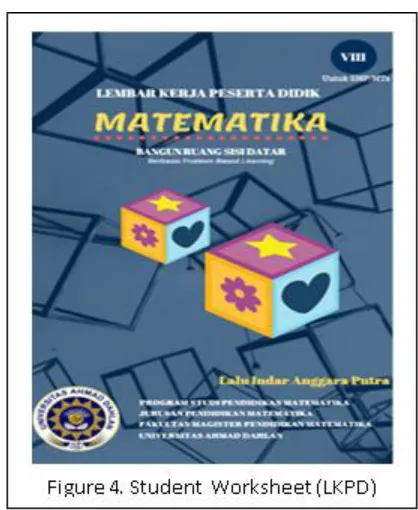
The scope of the coper design includes the title Student Worksheet (LKPD), subjects, flat side building materials, problem-based learning models, writer identity, and university logo. The cover design can be seen in Figure 4.
b.The preface contains the author, thank you greeting to all parties involved in the manufacture of Student Worksheet (LKPD). The form of the picture can be seen in the following figure 5.
c. Basic Competency (KD) and Core Competency (KI)
4971 The development of teaching materials in the form of Student
Worksheet (LKPD) has been validated for the feasibility of the media by two mathematics teachers. The results of the Student Worksheet (LKPD) validation by the media experts can be seen in the following table 3.
Table: 3
Student Worksheet (LKPD) Evaluation Results By Validator
No Items Score Category
1 Content Feasibility 3,75 Worthy
2 Presentation
Feasibility 3,8 Worthy
3 Feasibility of Graphic 3,58 Worthy
Based on the above table, the Student Worksheet (LKPD) developed by researchers can be concluded feasible to use. However, the Student Worksheet (LKPD) must be revised in advance based on input and suggestions from the validators of media experts.
3.2. Comments and suggestions from the validator
Invalidating the Student Worksheet (LKPD) that the researchers developed by the validator, there were several comments and suggestions. Among them can be seen from the following table 4.
The parts of the Student Worksheet (LKPD) that were repaired after receiving comments and suggestions from the validator are shown in the following figure.
1. Preface
Correcting the writing of uneven prefixes left and right.
2. Laying page numbers.
4972
3. Bibliography
Improved writing reference books used in literature. Writing references using italics.
While the results of the calculation of the teacher questionnaire regarding the design developed can be seen in the following table 5.
Based on Table 5, the average score for the assessment of media experts is 77. So it can be concluded that the learning media are in a good category. The student worksheet has
been validated by the validator and declared eligible with a revision, and the student worksheet revision has been done.
4
CONCLUSION
Based on the description above, it can be concluded that (a) material to build flat side spaces is still considered difficult by students, (b) students ' problem-solving abilities are still low, (c) PBL learning models can be used to improve students' problem-solving skills, (d) Student Worksheet (LKPD) that are by the characteristics of students and are intimidated by the problem-solving abilities required by the teacher and students. (e) learning resources that fit the PBL learning model are not yet available, and learning resources that instill students' mathematical problem-solving abilities are also not however available. (f) ADDIE development models are used to produce Student Worksheet (LKPD) designs that are appropriate to the PBL learning model and integrate problem-solving skills. (g) The resulting LKPD design is classified as feasible, with an average score of 89.5. Student Worksheet (LKPD), which is used as a learning resource according to the PBL model, needs to be well designed and developed. Designing and developing Student Worksheet (LKPD) is emphasized to improve students' problem-solving abilities. The Student Worksheet (LKPD) results that are designed in accordance with the PBL model are expected to be one of the solutions for teachers and grade VIII students of SMP Muhammadiyah Pakem to improve problem-solving skills. The results of the field study that have been carried out are expected to have several benefits, namely: (a) as input and advice to the school in improving the learning process and mathematics learning for students, (b) as a basis for developing Student Worksheet (LKPD) according to the PBL model in order to improve the ability of solving the problem of students of class VIII of SMP Muhammadiyah Pakem.
5
ACKNOWLEDGMENT
Thanks to Allah SWT. for His grace and gifts, so that this study can be completed well. I would also like to thank parents, brothers, sisters, families, validators, teachers, learners in junior Muhammadiyah Pakem, UAD MPMAT lecturers, friends, and all those who could not be written one by one. Because the completion of this study cannot be separated from all of your support and assistance.
6
REFERENCES
[1] Marifatun, Marifatun, Sri Sulistyorini, and Farid Ahmadi. "The Effectiveness of the Problem Based Learning Model Assisted by Interactive CD on Mathematical Problem Solving Ability Reviewed from Students' Cognitive Style." Innovative Journal of Curriculum and Educational Technology 7.2 (2018): 78-85.
[2] Naimnule, Maria, Kartono Kartono, and Mohammad Asikin. "Mathematics Problem Solving Ability in Terms of Adversity Quotient in Problem Based Learning Model With Peer Feedback." Unnes Journal of Mathematics Education Research (2019).
4973 Quotient." Unnes Journal of Mathematics Education
Research 7.1 (2018): 1-8.
[4] ARDANI, Riska Ayu, et al. The Perceptions of Students and Teachers About The Use of Edutainment Instructional Media in Mathematics Learning. In: University of Muhammadiyah Malang's 1st International Conference of Mathematics Education (INCOMED 2017). Atlantis Press, 2018. [5] Widiyaningsih, Endang, Zaenuri Zaenuri, and
Dwijanto Dwijanto. "Problem-Solving Ability and Self-Efficacy Based On Geometry Thinking Level In Van Hiele Learning." Unnes Journal of Mathematics Education Research (2019).
[6] Ramadhani, Athirah Nur, Mulyono Mulyono, and Agus Yulianto. "The Mathematical Problem-solving Ability of Elementary Students Using Problem-based Learning Model with Open-Ended Approach." Journal of Primary Education (2020): 276-281.
[7] Khoiriyah, Anna Jarrotul, and Husamah Husamah. "Problem-based learning: Creative thinking skills, problem-solving skills, and learning outcome of seventh grade students." Jurnal Pendidikan Biologi Indonesia 4.2 (2018): 151-160.
[8] Hidayat, Praba Wahyu, Sri Mulyani Endang Susilowati, and Ellianawati Ellianawati. "Analysis of Problem-Solving Abilities of Elementary School Students Through Problem-Based Learning Model Based on Self Confidence." Journal of Primary Education (2019): 8-15.
[9] Fauziah, Fauziah, Endang Retno Winarti, and Kartono Kartono. "The Effectiveness of SAVI Learning in Achieving Communication Ability and Mathematical Disposition for Eighth Grader." Unnes Journal of Mathematics Education 6.1 (2017): 1-9.
[10] Nursasongko, Aditya, Scolastika Mariani, and Dwijanto Dwijanto. "The Ability of Problem-Solving for Eighth Grade Student on Cooperative Problem Solving Learning Assisted by GeoGebra 3D." Unnes Journal of Mathematics Education Research (2019) [11] Nursasongko, Aditya, Scolastika Mariani, and
Dwijanto Dwijanto. "The Ability of Problem-Solving for Eighth Grade Student on Cooperative Problem Solving Learning Assisted by GeoGebra 3D." Unnes Journal of Mathematics Education Research (2019). [12] Permendikbud No. 21 of 2016 concerning Basic and
Secondary Education Process Standards.
[13] Setiyadi, Desi, Zaenuri Zaenuri, and Mulyono Mulyono. "The Problem Based Learning Model with Etnomatematics Nuance by Using Traditional Games to Improve Problem Solving Ability." Journal of Primary Education 7.2 (2018): 176-186.
[14] Maulidia, Farrah, Rahmah Johar, and Andariah Andariah. "A Case Study Of Students'creativity In Solving Mathematical Problems Through Problem-Based Learning." Infinity Journal 8.1 (2019): 1-10. [15] Wong, Hai Ming, et al. "Dental Students’ Attitude
towards Problem-Based Learning before and after Implementing 3D Electronic Dental Models." International Journal of Educational and Pedagogical Sciences (2017).
[16] Harahap, Arifin Azhari, and Sahat Saragih. "Improved Ability Difference Resolution Math Students Using Pbl Learning Model With Inkuiri On Materials Cube And
Beam In Smp 6 Medan." Inspiration: Jurnal Pendidikan Matematika 5.1 (2019).
[17] Khoiriyah, Anna Jarrotul, and Husamah Husamah. "Problem-based learning: Creative thinking skills, problem-solving skills, and learning outcome of seventh-grade students." Jurnal Pendidikan Biologi Indonesia 4.2 (2018): 151-160.
[18] Bahri, Silvi Prisha, Zaenuri Zaenuri, and Y. I. Sukestiyarno. "K Problem Solving Ability on Independent Learning and Problem Based Learning with Based Modules Ethnomatematics Nuance." Unnes Journal of Mathematics Education Research 7.1 (2018): 218-224.
[19] Arini, Affita Nur, Hartono Hartono, and Khumaedi Khumaedi. "Analysis of Problem Solving Skills and Students Scientific Attitudes through the Implementation of Problem Based Learning Module." Journal of Innovative Science Education 8.1 (2019): 312-319.
[20] B. P. Syafina and Suparman, "Designing student worksheets to improve critical thinking ability based on problem-based learning," Int. J. Sci. Technol. Res., vol. 8, no. 10, pp. 1194–1199, 2019.
[21] Julita, Julita. "The Enhancement Of Mathematical Problem-Solving Ability Of Senior High School Students Through Quantum Learning." Infinity Journal 6.1 (2017): 37-50.
[22] A. Sulistyaningsih, Suparman, and E. Rakhmawati, "Mathematics Module Development Design Based On PBL To Improve Mathematics Problem-Solving Ability", International Journal of Scientific and Technology Research Vol. 8, Issue 11, pp. 2508-2516, 2019.
[23] F. Andrianingrum and Suparman, "Design Of Interactive Learning Media Based On Contextual Approach To Improve Problem-Solving Ability In Fourth Grade Students", International Journal of Scientific and Technology Research Vol. 8, Issue 11, pp. 3906-3911, 2019.
[24] I. Amirin and Suparman, "Worksheet Development Design To Improve Student Problem Solving Ability And Learning Motivation", International Journal of Scientific and Technology Research Vol. 8, Issue 12, pp. 3965-3970, 2019.
[25] Susiana and Suparman, "Design Of Mathematics Module For Mental Retardation Students In Mathematical Problem-Solving", International Journal of Scientific and Technology Research Vol. 8, Issue 11, pp. 3900-3905, 2019.