University of Pennsylvania
ScholarlyCommons
Publicly Accessible Penn Dissertations
2019
Embodied Visual Perception Models For Human
Behavior Understanding
Gediminas Bertasius
University of Pennsylvania, [email protected]
Follow this and additional works at:
https://repository.upenn.edu/edissertations
Part of the
Artificial Intelligence and Robotics Commons
Recommended Citation
Bertasius, Gediminas, "Embodied Visual Perception Models For Human Behavior Understanding" (2019).Publicly Accessible Penn Dissertations. 3344.
Embodied Visual Perception Models For Human Behavior Understanding
Abstract
Many modern applications require extracting the core attributes of human behavior such as a person's attention, intent, or skill level from the visual data. There are two main challenges related to this problem. First, we need models that can represent visual data in terms of object-level cues. Second, we need models that can infer the core behavioral attributes from the visual data. We refer to these two challenges as ``learning to see'', and ``seeing to learn'' respectively. In this PhD thesis, we have made progress towards addressing both challenges.
We tackle the problem of ``learning to see'' by developing methods that extract object-level information directly from raw visual data. This includes, two top-down contour detectors, DeepEdge and Hf L, which can be used to aid high-level vision tasks such as object detection. Furthermore, we also present two semantic object segmentation methods, Boundary Neural Fields (BNFs), and Convolutional Random Walk Networks (RWNs), which integrate low-level affinity cues into an object segmentation process. We then shift our focus to video-level understanding, and present a Spatiotemporal Sampling Network (STSN), which can be used for video object detection, and discriminative motion feature learning.
Afterwards, we transition into the second subproblem of ``seeing to learn'', for which we leverage first-person GoPro cameras that record what people see during a particular activity. We aim to infer the core behavior attributes such as a person's attention, intention, and his skill level from such first-person data. To do so, we first propose a concept of action-objects--the objects that capture person's conscious visual (watching a TV) or tactile (taking a cup) interactions. We then introduce two models, EgoNet and Visual-Spatial Network (VSN), which detect action-objects in supervised and unsupervised settings respectively. Afterwards, we focus on a behavior understanding task in a complex basketball activity. We present a method for evaluating players' skill level from their first-person basketball videos, and also a model that predicts a player's future motion trajectory from a single first-person image.
Degree Type
Dissertation
Degree Name
Doctor of Philosophy (PhD)
Graduate Group
Computer and Information Science
First Advisor
Jianbo Shi
Keywords
Subject Categories
EMBODIED VISUAL PERCEPTION MODELS FOR HUMAN BEHAVIOR UNDERSTANDING
Gediminas Bertasius
A DISSERTATION
in
Computer and Information Science
Presented to the Faculties of the University of Pennsylvania
in
Partial Fulfillment of the Requirements for the
Degree of Doctor of Philosophy
2019
Supervisor of Dissertation
Jianbo Shi, Professor of Computer and Information Science
Graduate Group Chair
Rajeev Alur, Zisman Family Professor of Computer and Information Science
Dissertation Committee
Kostas Daniilidis, Ruth Yalom Stone Professor of Computer and Information Science
Camillo J. Taylor, Professor of Computer and Information Science
ACKNOWLEDGEMENT
For many students, PhD can be a frustrating and a lonely experience. Not only does it
require extraordinary amounts of persistence, but also a substantial amount of luck. Over
my five years, I observed that students who make it through their PhD typically have a very
strong support system around them. I am no exception in this regard, and I attribute my
overwhelmingly positive PhD experience to all the people who helped me reach this point.
First, I would like to thank my advisor Jianbo Shi for giving me full intellectual freedom to
pursue any research interests that I was drawn to during the last five years. Jianbo’s faith in
me allowed me to work on many new and interesting problems, most of which later resulted
in solid publications. Jianbo also taught me how to approach and formulate new research
problems, which I think is one of the most invaluable skills that I learned throughout my
PhD. Finally, I am thankful to Jianbo for always being supportive, especially after the
negative paper reviews. His positivity during those times pushed me to work harder and
eventually get those papers accepted to subsequent conferences. Overall, my PhD journey
has been very fulfilling, and I am grateful to Jianbo for this experience.
I would also like to give a big thanks to Lorenzo Torresani, who is one of the main reasons
why I pursued a PhD in the first place. Lorenzo sparked my interest in computer vision
re-search during my undergraduate years at Dartmouth, and I’ve stayed in the field ever since.
I was lucky to continue collaborating with Lorenzo during my PhD years, and I learned a
great deal from Lorenzo about various research methodologies, experimental design, and
technical writing. His guidance over all these years significantly contributed to my success,
and I will always be grateful for his mentorship.
I am also grateful to Hyun Soo Park, and Stella Yu. I learned a lot from both of them.
Hyun Soo taught me how to effectively sell my research ideas to other people both in writing
and in presentation. I think these were truly invaluable lessons, that allowed me to publish
my research from a different perspective, and how to present it more effectively to broader
audiences who have different backgrounds than my own.
I would also like to express my gratitude for everybody involved in the IGERT program.
Being part of IGERT weekly meetings, allowed me to broaden my research horizons and
think about my research in the context of other fields such as psychology, robotics, and
human vision. During IGERT meetings, I had a great pleasure to observe Kostas Daniilidis’,
and David Brainard’s discussions about research, and learn from both of them. Kostas
and David consistently gave me useful feedback, and helped me to think critically about
the broader impact of my work. A special thanks to Kostas for the basketball related
discussions, which always brightened my mood.
I am also thankful to my other dissertation committee member CJ Taylor for his insightful
comments and suggestions in regards to my research. I appreciated CJ’s attention to detail,
his thought provoking questions, and his kind personality. It was truly a pleasure having
him on my dissertation and my WPE II committees.
Another big thanks goes to the Facebook’s AI Applied Research team, who made my
summer internship experience fruitful and enjoyable. In particular, I want to thank Lorenzo,
Du Tran, and Christoph Feichtenhofer who were my mentors during the internship. Each
of them has taught me something unique about video understanding research, and helped
me to become a better researcher. I’d also like to give a special thanks to a fellow intern
Antoine Miech who kept both of our spirits high throughout the internship.
Finally, I wanted to thank my parents Rima, and Gintaras, and my wife Alex for always
supporting me. From the early age when my main priority was basketball, my parents
always stressed the importance of education and encouraged me to excel in both of these
areas, which led me to where I am now. Additionally, my wife Alex was the most ardent
believer of my success, which inspired me to accomplish any goals that I set out for myself.
ABSTRACT
EMBODIED VISUAL PERCEPTION MODELS FOR
HUMAN BEHAVIOR UNDERSTANDING
Gediminas Bertasius
Jianbo Shi
Many modern applications require extracting the core attributes of human behavior such
as a person’s attention, intent, or skill level from the visual data. There are two main
challenges related to this problem. First, we need models that can represent visual data
in terms of object-level cues. Second, we need models that can infer the core behavioral
attributes from the visual data. We refer to these two challenges as “learning to see”, and
“seeing to learn” respectively. In this PhD thesis, we have made progress towards addressing
both challenges.
We tackle the problem of “learning to see” by developing methods that extract object-level
information directly from raw visual data. This includes, two top-down contour detectors,
DeepEdge [1] and HfL [2], which can be used to aid high-level vision tasks such as
ob-ject detection. Furthermore, we also present two semantic obob-ject segmentation methods,
Boundary Neural Fields (BNFs) [3], and Convolutional Random Walk Networks (RWNs) [4],
which integrate low-level affinity cues into an object segmentation process. We then shift
our focus to video-level understanding, and present a Spatiotemporal Sampling Network
(STSN), which can be used for video object detection [5], and discriminative motion
fea-ture learning [6].
Afterwards, we transition into the second subproblem of “seeing to learn”, for which we
leverage first-person GoPro cameras that record what people see during a particular activity.
We aim to infer the core behavior attributes such as a person’s attention, intention, and
action-objects–the objects that capture person’s conscious visual (watching a TV) or tactile (taking
a cup) interactions. We then introduce two models, EgoNet [7] and Visual-Spatial Network
(VSN) [8], which detect action-objects in supervised and unsupervised settings respectively.
Afterwards, we focus on a behavior understanding task in a complex basketball activity.
We present a method for evaluating players’ skill level from their first-person basketball
videos [9], and also a model that predicts a player’s future motion trajectory from a single
TABLE OF CONTENTS
ACKNOWLEDGEMENT . . . iii
ABSTRACT . . . v
LIST OF TABLES . . . xxi
LIST OF ILLUSTRATIONS . . . xlii I Introduction 1 CHAPTER 1 : Problem Overview . . . 2
II Learning to See 6 CHAPTER 1 : DeepEdge: A Multi-Scale Bifurcated Deep Network for Top-Down Contour Detection . . . 7
1.1 Introduction . . . 7
1.2 Related Work . . . 9
1.3 The DeepEdge Network . . . 11
1.3.1 Single-Scale Architecture . . . 11
1.3.2 Multi-Scale Architecture . . . 15
1.3.3 Implementation Details . . . 15
1.4 Experiments . . . 17
1.4.1 Comparison with Other Methods . . . 18
1.4.2 Ablation Studies . . . 18
1.4.3 Qualitative Results . . . 21
1.5 Conclusions . . . 22
CHAPTER 2 : High-for-Low and Low-for-High: Efficient Boundary Detection from Deep Object Features and its Applications to High-Level Vision . . . 24
2.1 Introduction . . . 24
2.2 Related Work . . . 25
2.3 Boundary Detection . . . 28
2.3.1 Technical Approach . . . 28
2.3.2 Implementation Details . . . 30
2.3.3 Boundary Detection Results . . . 30
2.4 High-Level Vision Applications . . . 33
2.4.1 Semantic Boundary Labeling . . . 34
2.4.2 Semantic Segmentation . . . 36
2.4.3 Object Proposals . . . 40
2.5 Conclusions . . . 42
CHAPTER 3 : Semantic Segmentation with Boundary Neural Fields . . . 43
3.1 Introduction . . . 43
3.2 Related Work . . . 44
3.3 Boundary Neural Fields . . . 47
3.3.1 FCN Unary Potentials . . . 48
3.3.2 Boundary Pairwise Potentials . . . 48
3.3.3 Global Inference . . . 54
3.4 Experimental Results . . . 57
3.4.1 Comparing Affinity Functions for Semantic Segmentation . . . 58
3.4.2 Comparing Inference Methods for Semantic Segmentation . . . 59
3.4.3 Semantic Boundary Classification . . . 61
CHAPTER 4 : Convolutional Random Walk Networks for Semantic Image
Segmen-tation . . . 63
4.1 Introduction . . . 63
4.2 Related Work . . . 65
4.3 Background . . . 67
4.4 Convolutional Random Walk Networks . . . 69
4.4.1 Semantic Segmentation Branch . . . 69
4.4.2 Pixel-Level Affinity Branch . . . 69
4.4.3 Random Walk Layer . . . 71
4.4.4 Random Walk Prediction at Testing . . . 72
4.4.5 Implementation Details . . . 75
4.5 Experimental Results . . . 76
4.5.1 Semantic Segmentation Task . . . 77
4.5.2 Scene Labeling . . . 79
4.5.3 Runtime Comparisons . . . 79
4.5.4 Ablation Experiments . . . 80
4.6 Conclusion . . . 82
CHAPTER 5 : Object Detection in Video with Spatiotemporal Sampling Networks 83 5.1 Introduction . . . 83
5.2 Related Work . . . 84
5.3 Background: Deformable Convolution . . . 86
5.4 Spatiotemporal Sampling Network . . . 87
5.4.1 Implementation Details . . . 92
5.5 Experimental Results . . . 93
5.6 Conclusion . . . 99
CHAPTER 6 : Learning Discriminative Motion Features Through Detection . . . . 102
6.2 Related Work . . . 103
6.3 Learning Discriminative Motion Features . . . 106
6.4 Interpreting DiMoFs . . . 108
6.4.1 Human Motion Localization and Estimation . . . 109
6.5 Detection and Recognition with DiMoFs . . . 110
6.5.1 Spatiotemporal Action Localization . . . 111
6.5.2 Fine-Grained Action Recognition . . . 112
6.6 Experiments . . . 113
6.6.1 Pose Detection and Tracking on PoseTrack . . . 114
6.6.2 Results of Action Localization on JHMDB . . . 116
6.6.3 Fine-Grained Action Recognition on Diving48 . . . 118
6.7 Conclusions . . . 120
III Seeing to Learn 121 CHAPTER 1 : First-Person Action-Object Detection with EgoNet . . . 122
1.1 Introduction . . . 122
1.2 Related Work . . . 125
1.3 First-Person Action-Object RGBD Dataset . . . 129
1.4 EgoNet . . . 129
1.4.1 RGB Pathway . . . 130
1.4.2 DHG Pathway . . . 130
1.4.3 Joint Pathway . . . 131
1.4.4 Implementation Details . . . 133
1.5 Experimental Results . . . 133
1.5.1 Action-Object Human Study . . . 134
1.5.2 Results on Our Action-Object RGBD Dataset . . . 136
1.5.5 Results on Social Children Interaction Dataset . . . 140
1.6 Conclusions . . . 141
CHAPTER 2 : Unsupervised Learning of Important Objects from First-Person Videos . . . 142
2.1 Introduction . . . 142
2.2 Related Work . . . 144
2.3 Approach Motivation . . . 145
2.3.1 Segmentation Agent . . . 147
2.3.2 Recognition Agent: Motivation . . . 148
2.4 Visual-Spatial Network . . . 149
2.4.1 Visual “What” Pathway . . . 150
2.4.2 Spatial “Where” Pathway . . . 150
2.4.3 Alternating Cross-Pathway Supervision . . . 151
2.4.4 Using Extra Unlabeled Data for Training . . . 153
2.4.5 Prediction during Testing . . . 153
2.4.6 Implementation Details . . . 154
2.5 Experimental Results . . . 154
2.5.1 Results on the Important Object RGBD Dataset . . . 157
2.5.2 Results on the GTEA Gaze+ Dataset . . . 158
2.5.3 Ablation Experiments . . . 158
2.6 Conclusions . . . 160
CHAPTER 3 : Am I a Baller? Basketball Performance Assessment from First-Person Videos . . . 162
3.1 Introduction . . . 162
3.2 Related Work . . . 165
3.3 Basketball Performance Assessment Model . . . 166
3.3.2 Basketball Assessment Prediction . . . 170
3.3.3 Implementation Details . . . 171
3.4 First-Person Basketball Dataset . . . 171
3.5 Experimental Results . . . 173
3.5.1 Quantitative Results . . . 173
3.5.2 Qualitative Results . . . 175
3.6 Conclusions . . . 178
CHAPTER 4 : Egocentric Basketball Motion Planning from a Single First-Person Image . . . 179
4.1 Introduction . . . 179
4.2 Related Work . . . 181
4.3 Motivation and Challenges . . . 183
4.4 Egocentric Basketball Motion Model . . . 184
4.4.1 Egocentric Camera (EgoCam) CNN . . . 184
4.4.2 Future CNN . . . 185
4.4.3 Goal Verifier Network . . . 187
4.4.4 Motion Planning using Inverse Synthesis . . . 188
4.4.5 Implementation Details . . . 189
4.5 Egocentric One-on-One Basketball Dataset . . . 189
4.6 Experimental Results . . . 191
4.6.1 Quantitative Results . . . 191
4.6.2 Qualitative Results . . . 193
4.7 Conclusions . . . 196
LIST OF TABLES
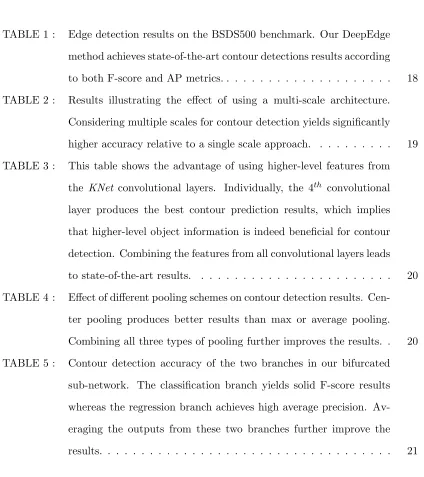
TABLE 1 : Edge detection results on the BSDS500 benchmark. Our DeepEdge
method achieves state-of-the-art contour detections results according
to both F-score and AP metrics. . . 18
TABLE 2 : Results illustrating the effect of using a multi-scale architecture.
Considering multiple scales for contour detection yields significantly
higher accuracy relative to a single scale approach. . . 19
TABLE 3 : This table shows the advantage of using higher-level features from
the KNet convolutional layers. Individually, the 4th convolutional
layer produces the best contour prediction results, which implies
that higher-level object information is indeed beneficial for contour
detection. Combining the features from all convolutional layers leads
to state-of-the-art results. . . 20
TABLE 4 : Effect of different pooling schemes on contour detection results.
Cen-ter pooling produces betCen-ter results than max or average pooling.
Combining all three types of pooling further improves the results. . 20
TABLE 5 : Contour detection accuracy of the two branches in our bifurcated
sub-network. The classification branch yields solid F-score results
whereas the regression branch achieves high average precision.
Av-eraging the outputs from these two branches further improve the
TABLE 6 : Summary of results achieved by our proposed method (HfL) and
state-of-the-art methods (SotA). We provide results on four vision
tasks: Boundary Detection (BD), Semantic Boundary Labeling (SBL),
Semantic Segmentation (SS), and Object Proposal (OP). The
eval-uation metrics include ODS F-score for BD task, max F-score (MF)
and average precision (AP) for SBL task, per image intersection over
union (PI-IOU) for SS task, and max recall (MR) for OP task. Our
method produces better results in each of these tasks according to
these metrics. . . 25
TABLE 7 : Boundary detection results on BSDS500 benchmark. Upper half of
the table illustrates the results for “consensus” ground-truth
crite-rion while the lower half of the table depicts the results for “any”
ground-truth criterion. In both cases, our method outperforms all
prior methods according to both ODS (optimal dataset scale) and
OIS (optimal image scale) metrics. We also report the run-time of
our method (‡ GPU time) in the FPS column (frames per second),
which shows that our algorithm is faster than prior approaches based
on deep learning [11, 12, 13, 1]. . . 31
TABLE 8 : Results of semantic boundary labeling on the SBD benchmark using
the Max F-score (MF) and Average Precision (AP) metrics. Our
method (HfL) outperforms Inverse Detectors [14] for all 20 categories
according to both metrics. Note that using the CRF output to label
the boundaries produces better results than using the outputs from
TABLE 9 : Semantic segmentation results on the SBD and VOC 2007 datasets.
We measure the results according to PP-IOU (per pixel) and PI-IOU
(per image) evaluation metrics. We denote the original
DeepLab-CRF system and our proposed modification as DeepLab-CRF and
DL-CRF+HfL, respectively. According to the PP-IOU metric, our
pro-posed features (DL-CRF+HfL) yield almost equivalent results as the
original DeepLab-CRF system. However, based on PI-IOU metric,
our proposed features improve the mean accuracy by 3% and 1.9%
on SBD and VOC 2007 datasets respectively. . . 37
TABLE 10 : Comparison of object proposal results. We compare the quality
of object proposals using Structured Edges [15] and HfL
bound-aries. We evaluate the performance for three different IOU values
and demonstrate that using HfL boundaries produces better results
for each evaluation metric and for each IOU value. . . 42
TABLE 11 : Boundary detection results on BSDS500 benchmark. Our proposed
method outperforms all prior algorithms according to all three
eval-uation metrics. . . 51
TABLE 12 : We compare semantic segmentation results when using a color-based
pixel affinity and our proposed boundary-based affinity. We note
that our proposed affinity improves the performance of all
globaliza-tion techniques. Note that all of the inference methods use thesame
FCN unary potentials. This suggests that for every method our
semantic boundary based affinity is more beneficial for semantic
TABLE 13 : Semantic segmentation results on the SBD dataset according to
PP-IOU (per pixel) and PI-PP-IOU (per image) evaluation metrics. We
use BNF-SB to denote the variant of our method that uses only
semantic boundary based affinities. Additionally, we use
BNF-SB-SM to indicate our method that uses boundary and softmax based
affinities. We observe that our proposed globalization method
out-performs other globalization techniques according to both metrics by
at least 0.3% and 1.3% respectively. Note that in this experiment,
all of the inference methods usethe same FCN unary potentials.
Additionally, for each method except Dense-CRF (it is challenging
to incorporate boundary based affinities into the Dense-CRF
frame-work) we use our boundary based affinities, since those lead to better
results. . . 60
TABLE 14 : Summary of recent semantic segmentation models. For each model,
we report whether it requires: (1) CRF post-processing, (2) complex
loss functions, or (3) recurrent layers. We also list the size of the
model (using the size of Caffe [16] models in MB). We note that
unlike prior methods, our RWN does not need post-processing, it
is implemented using standard layers and loss functions, and it also
has a compact model. . . 64
TABLE 15 : Semantic segmentation results on the SBD dataset according to the
per-pixel Intersection over Union evaluation metric. From the
re-sults, we observe that our proposed RWN consistently outperforms
TABLE 16 : Quantitative comparison between our RWN model and several
vari-ants of the DeepLab system that use a dense CRF or a
domain-transfer (DT) filter for post-processing. These results suggest that
our RWN acts as an effective globalization scheme, since it produces
results that are similar or even better than the results achieved by
post-processing the DeepLab outputs with a CRF or DT. . . 76
TABLE 17 : Quantitative comparison of spatial segmentation smoothness. We
extract the boundaries from the predicted segmentations and
evalu-ate them against ground truth object boundaries using max F-score
(MF) and average precision (AP) metrics. These results suggest that
RWN segmentations are spatially smoother than the DeepLab-CRF
segmentations across all baselines. . . 79
TABLE 18 : Scene labeling results on the Stanford Background and Sift-Flow
datasets measured according to the overall IOU evaluation metric.
We use a DeepLab-largeFOV network as base model, and show that
TABLE 19 : We use the ImageNet VID [17] dataset to compare our STSN to the
state-of-the-art FGFA [18] and D&T [19] methods. Note that SSN
refers to our static baseline, which is obtained by using only the
reference frame for output generation (no temporal info). Also note,
that D&T+ and STSN+ refer to D&T and STSN baselines with
temporal post-processing applied on top of the CNN outputs. Based
on these results, we first point out that unlike FGFA, our STSN does
not rely on the external optical flow data, and still yields higher mAP
(78.9 vs 78.8). Furthermore, when no temporal post-processing is
used, our STSN produces superior performance in comparison to the
D&T baseline (78.9 vs 75.8). Finally, we demonstrate that if we
use a simple Seq-NMS [20] temporal post-processing scheme on top
of our STSN predictions, we can further improve our results and
outperform all the other baselines. . . 94
TABLE 20 : Pose detection results on the PoseTrack dataset measured in mAP.
The first row reports the results of a single-frame baseline [21], which
won the ICCV17 PoseTrack challenge. In the second row, we present
the results of our method, which is based on the same exact model
as [21] but it istrainedon pairs of frames with our DiMoFs training
scheme (the testingis still done on individual frames). These results
indicate consistent performance gains for each body joint, and a
mean mAP improvement of 2.2%. . . 114
TABLE 21 : Keypoint tracking results on the PoseTrack dataset using
Multi-Object Tracking Accuracy (MOTA) metric. As our baseline, we use
the ICCV17 PoseTrack challenge winning method [21]. Our model
is trained using the same architecture as [21], but using our DiMoFs
TABLE 22 : We examine how various factors affect spatiotemporal action
local-ization performance on JHMDB. We observe that learning DiMoFs
discriminatively through detection outperforms the model with the
same architecture but that was not trained with DiMoFs scheme by
5.3% and 9.7% mAP for δ = 0, and δ = 10 respectively (compare
column 2 to 4, and 3 to 6). We also note that replacing DiMoFs
off-sets with optical flow yields 50.6% mAP, which is 3.8% worse than
using DiMoFs (column 5 vs 6). . . 118
TABLE 23 : Our results on Diving48 dataset. In the top half of the table, we show
that our system achieves 24.1% accuracy and outperforms 2D
meth-ods TSN [22] and TRN [23]. We also observe that even using the
initial cluster ID histograms as features produces solid results (i.e.
17.2% and 21.4%). Note that replacing DiMoFs with optical flow
reduces the accuracy by 2.6% (compared to our 21.4%). Our model
does not perform as well as the pre-trained R(2+1)D [24] baseline.
However, our pre-training is done on a much smaller dataset, and on
a more general pose detection task. Without Kinetics pre-training,
we outperform R(2+1)D [24] by a solid 2.7% margin. Finally, we
show that combining DiMoFs with pre-trained R(2+1)D [24]
im-proves the results, suggesting complementarity of the two methods. 119
TABLE 25 : The quantitative results for action-object detection task on our
first-person action-object RGBD dataset according to max F-score (MF)
and average precision (AP) metrics. All methods except GBVS were
trained on our dataset using a leave-one-out cross validation. The
result indicates that EgoNet has the strongest predictive power with
at least 2.9% (MF) and 5.3% (AP) gain over other methods. We also
include our human study results, which suggest that human subjects
achieve better action-object detection accuracy than the machines
across most activities from our dataset. . . 134
TABLE 26 : Quantitative results on GTEA Gaze+ dataset for an action-object
detection task. To test each model’s generalization ability on GTEA
Gaze+ dataset, we train each methodonlyon our first-person
action-object RGBD dataset. Based on the results, we observe that EgoNet
exhibits the strongest generalization power. . . 139
TABLE 27 : Quantitative results on Social Children Interaction dataset [25] for
the visual attention prediction task. The dataset contains 9
first-person videos of children performing activities such as playing cards
games, etc. We note that to test each method’s generalization ability,
none of the methods were trained on this dataset. We show that
EgoNet outperforms all the other methods on this dataset, which
indicates strong EgoNet’s generalization power. . . 141
TABLE 28 : The quantitative important object prediction results on the
first-person important object RGBD and GTEA Gaze+ datasets
accord-ing to the max F-score (MF) and average precision (AP) metrics.
Our results indicate that even without using important object labels
our VSN achieves similar or even better results than the supervised
TABLE 29 : The quantitative results for atomic basketball event detection on
our first-person basketball dataset according to max F-score (MF)
metric. These results show that our method 1) outperforms prior
first-person methods and 2) that each component plays a critical role
in our system. . . 172
TABLE 30 : The quantitative results for our basketball assessment task. We
evaluate our method on 250 labeled pairs of players, and predict,
which of the two players in a pair is better. We then compute the
accuracy as the fraction of correct predictions. We report the results
of various baselines in two settings: 1) using our predicted atomic
events, and 2) using ground truth atomic events. These results show
that 1) our model achieves best results, 2) that each of our proposed
components is important, and 3) that our system is pretty robust to
atomic event recognition errors. . . 174
TABLE 31 : We assess each method on two tasks: predicting a player’s future
motion (PFM), and capturing the goals of real players (CG). The
↑ and ↓ symbols next to a task indicate whether a higher or lower
number is better, respectively. Our method outperforms the
base-lines for both tasks, suggesting that we can generate sequences that
(1) are more similar to a true player’s motion and (2) capture the
goals of real players more accurately. We also note that removing a
goal verifier (“Ours w/o GV”) leads to a sharp decrease in
LIST OF ILLUSTRATIONS
FIGURE 1 : Egocentric images recorded using a GoPro camera attached to a
person’s head. The recorded first-person images capture almost
exactly what that person sees as he performs activities such as
cooking, or playing basketball. Such visual data allows us to infer
a person’s attention, his intentions, his skill level at a particular
activity, and even his decision making process in different situations. 3
FIGURE 2 : Contour detection accuracy on the BSDS500 dataset. Our method
attains higher average precision compared to prior methods and
state-of-the-art F-score. At low recall, DeepEdge achieves nearly
100% precision. . . 7
FIGURE 3 : Visualization of multi-scale DeepEdge network architecture. To
extract candidate contour points, we run the Canny edge
detec-tor. Then, around each candidate point, we extract patches at four
different scales and simultaneously run them through the five
con-volutional layers of theKNet[26]. We connect these convolutional
layers to two separately-trained network branches. The first branch
is trained for classification, while the second branch is trained as
a regressor. At testing time, the scalar outputs from these two
sub-networks are averaged to produce the final score. . . 8
FIGURE 4 : Visualization of the activation values at the selected convolutional
filters of theKNet (filters are resized to the original image
dimen-sions). The filters in the second layer fire on oriented edges inside
the image. The third and fourth convolutional layers produce an
outline of the shape of the object. The fifth layer fires on the
FIGURE 5 : Detailed illustration of our proposed architecture in a single-scale
setting. First, an input patch, centered around the candidate point,
goes through five convolutional layers of theKNet. To extract
high-level features, at each convolutional layer we extract a small
sub-volume of the feature map around the center point, and perform
max,average, and center pooling on this sub-volume. The pooled
values feed a bifurcated sub-network. At testing time, the scalar
outputs computed from the branches of a bifurcated sub-networks
are averaged to produce a final contour prediction. . . 11
FIGURE 6 : A few samples of ground truth data illustrating the difference
be-tween the classification (first row) and the regression (second row)
objectives. The classification branch is trained to detect contours
that are marked by at least one of the human annotators.
Con-versely, the regression branch is optimized to the contour values
that depict the fraction of human annotators agreeing on the
con-tour. . . 13
FIGURE 7 : Qualitative results produced by our method. Notice how our method
learns to distinguish between strong and weak contours. For
in-stance, in the last row of predictions, contours corresponding to
zebra stripes are assigned much lower probabilities than contours
that correspond to the actual object boundaries separating the
ze-bras from the background. . . 17
FIGURE 8 : A visualization of selected convolutional feature maps from VGG
network (resized to the input image dimension). Because VGG
was optimized for an object classification task, it produces high
FIGURE 9 : An illustration of our architecture (best viewed in color). First we
extract a set of candidate contour points. Then we upsample the
image and feed it through 16 convolutional layers pretrained for
object classification. For each candidate point, we find its
corre-spondence in each of the feature maps and perform feature
inter-polation. This yields a 5504-dimensional feature vector for each
candidate point. We feed each of these vectors to two fully
con-nected layers and store the predictions to produce a final boundary
map. . . 27
FIGURE 10 : Qualitative results on the BSDS benchmark. The first column
of images represent input images. The second column illustrates
SE [15], while the third column depicts HfL boundaries. Notice
that SE boundaries are predicted with low confidence if there is no
significant change in color between the object and the background.
Instead, because our model is defined in terms of object-level
fea-tures, it can predict object boundaries with high confidence even if
there is no significant color variation in the scene. . . 32
FIGURE 11 : We train a linear regression model and visualize its weight
magni-tudes in order to understand which features are used most heavily
in the boundary prediction (this linear regression is used only for
the visualization purposes and not for the accuracy analysis). Note
how heavily weighted features lie in the deepest layers of the
net-work, i.e., the layers that are most closely associated with object
FIGURE 12 : A visualization of the predicted semantic boundary labels. Images
in the first column are input examples. Columns two and three
show semantic HfL boundaries of different object classes. Note that
even with multiple objects appearing simultaneously, our method
outputs precise semantic boundaries. . . 36
FIGURE 13 : In this figure, the first column depicts an input image while the
second and third columns illustrate two selected eigenvectors for
that image. The eigenvectors contain soft segmentation
informa-tion. Because HfL boundaries capture object-level boundaries, the
resulting eigenvectors primarily segment regions corresponding to
the objects. . . 39
FIGURE 14 : An illustration of the more challenging semantic segmentation
ex-amples. The first column depicts the predictions achieved by
DeepLab-CRF, while the second column illustrates the results after adding
our proposed features to the CRF framework. The last column
represents ground truth segmentations. Notice how our proposed
features render the predicted semantic segments more spatially
co-herent and overall more accurate. . . 41
FIGURE 15 : Examples illustrating shortcomings of prior semantic
segmenta-tion methods: the second column shows results obtained with a
FCN [27], while the third column shows the output of a
Dense-CRF applied to FCN predictions [28, 29]. Segments produced by
FCN are blob-like and are poorly localized around object
bound-aries. Dense-CRF produces spatially disjoint object segments due
to the use of a color-based pixel affinity function that is unable to
FIGURE 16 : We employ a semantic segmentation FCN [29] for two purposes:
1) to obtain semantic segmentation unaries for our global energy;
2) to compute object boundaries. Specifically, we define semantic
boundaries as a linear combination of these feature maps (with a
sigmoid function applied on top of the sum) and learn individual
weights corresponding to each convolutional feature map. We
inte-grate this boundary information in the form of pairwise potentials
(pixel affinities) for our energy model. . . 47
FIGURE 17 : An input image and convolutional feature maps corresponding to
the largest weight magnitude values. Intuitively these are the
fea-ture maps that contribute most heavily to the task of boundary
detection. . . 49
FIGURE 18 : A figure illustrating our boundary detection results. In the second
column, we visualize the raw probability output of our boundary
detector. In the third column, we present the final boundary maps
after non-maximum suppression. While most prior methods
pre-dict the boundaries where the sharpest change in color occurs, our
method captures semantic object-level boundaries, which we
sub-sequently use to aid semantic segmentation. . . 52
FIGURE 19 : A figure illustrating semantic segmentation results. Images in columns
two and three represent FCNsoftmax and Dense-CRF predictions,
respectively. Note that all methods use the same FCN unary
poten-tials. Additionally, observe that unlike FCN and Dense-CRF, our
methods predicts segmentation that are both well localized around
FIGURE 20 : Examples illustrating shortcomings of prior semantic segmentation
methods. Segments produced by FCNs are poorly localized around
object boundaries, while Dense-CRF produce spatially-disjoint
ob-ject segments. . . 63
FIGURE 21 : The architecture of our proposed Random Walk Network (RWN)
(best viewed in color). Our RWN consists of two branches: (1)
one branch devoted to the segmentation predictions , and (2)
an-other branch predicting pixel-level affinities. These two branches
are then merged via a novel random walk layer that encourages
spa-tially smooth segmentation predictions. The entire RWN is jointly
optimized end-to-end via a standard back-propagation algorithm. 65
FIGURE 22 : A figure illustrating the segmentation results of our RWN and the
DeepLab-v2 network. Note that RWN produced segmentations are
spatially smoother and produce less false positive predictions than
the DeepLab-v2 system. . . 73
FIGURE 23 : Comparison of segmentation results produced by our RWN
ver-sus the DeepLab-v2-CRF system. It can be noticed that, despite
not using any post-processing steps, our RWN predicts fine
ob-ject details (e.g., bike wheels or plane wings) more accurately than
DeepLab-v2-CRF, which fails to capture some these object parts. 75
FIGURE 24 : Localization error around the object boundaries within a trimap.
Compared to the DeepLab system (blue), our RWN (red) achieves
lower segmentation error around object boundaries for all trimap
widths. . . 77
FIGURE 25 : A figure illustrating how the probability predictions change as we
apply more random walk steps. Note that the RWN predictions
become more refined and better localized around the object
FIGURE 26 : IOU accuracy as a function of the number of random walk steps.
From this plot we observe that the segmentation accuracy keeps
improving as we apply more random walk steps and that it reaches
its peak when the random walk process converges. . . 81
FIGURE 27 : An illustration of the common challenges associated with object
detection in video. These include video defocus, motion blur,
oc-clusions and unusual poses. The bounding boxes denote the objects
that we want to detect in these examples. . . 84
FIGURE 28 : Our spatiotemporal sampling mechanism, which we use for video
object detection. Given the task of detecting objects in a particular
video frame (i.e., a reference frame), our goal is to incorporate
in-formation from a nearby frame of the same video (i.e., a supporting
frame). First, we extract features from both frames via a backbone
convolutional network (CNN). Next, we concatenate the features
from the reference and supporting frames, and feed them through
multiple deformable convolutional layers. The last of such layers
produces offsets that are used to sample informative features from
the supporting frame. Our spatiotemporal sampling scheme allows
us to produce accurate detections even if objects in the reference
FIGURE 29 : A figure illustrating some of our ablation experiments. Left: we
plot mAP as a function of the number of supporting frames used by
our STSN. From this plot, we notice that the video object detection
accuracy improves as we use more supporting frames. Right: To
understand the contribution of each of the supporting frames, we
plot the average weight magnitudes wt,t+k(p) for different values
of k. Here, p represents a point at the center of an object. From
this plot, we observe that the largest weights are associated with
the supporting frames that are near the reference frame. However,
note that even supporting frames that are further away from the
reference frame (e.g. k = 9) contribute quite substantially to the
final object detection predictions. . . 95
FIGURE 30 : An illustration of our spatiotemporal sampling scheme (zoom-in
for a better view). The green square indicates a point in the
ref-erence frame, for which we want to compute a new convolutional
output. The red square indicates the corresponding point predicted
by our STSN in a supporting frame. The yellow arrow illustrates
the estimated object motion. Although our model is trained
dis-criminatively for object detection and not for tracking or motion
estimation, our STSN learns to sample from the supporting frame
at locations that coincide almost perfectly with the same object.
This allows our method to perform accurate object detection even
FIGURE 31 : An illustration of using our spatiotemporal sampling scheme in
action. The green square indicates a fixed object location in the
reference frame. The red square depicts a location in a supporting
frame, from which relevant features are sampled. Even without
optical flow supervision, our STSN learns to track these objects
in video. In our supplementary material, we include more of such
examples in the video format. . . 98
FIGURE 32 : A figure illustrating object detection examples where our
spatiotem-poral sampling mechanism helps STSN to correct the mistakes
made by a static SSN baseline (please zoom-in to see the class
predictions and their probabilities). These mistakes typically
oc-cur due to occlusions, blurriness, etc. STSN fixes these errors by
using relevant object level information from supporting frames. In
Column 1 we illustrate the points in the supporting frame that
STSN considers relevant when computing the output for a point
denoted by the green square in Column 2. . . 101
FIGURE 33 : We extend modern detection models (e.g., Faster R-CNN) with
the ability to learn discriminative motion features (DiMoFs) from
RGB video data. We do so by training the detector on pairs of
time-separated frames, with the objective of predicting pose in one
frame using features from the other frame. This task forces the
net-work to learn motion “offsets” relating the two frames but that are
discriminatively optimized for detection. Our learned DiMoFs can
be used on a variety of applications: salient motion localization,
human motion estimation, improved pose detection and keypoint
tracking, spatiotemporal action localization, and fine-grained
FIGURE 34 : An illustration of our Discriminative Motion Feature (DiMoFs)
training procedure. Given Frame A and Frame B, which are
sepa-rated byδsteps in time, our goal is to detect pose in Frame A using
the features from Frame B. First, we extract multi-scale features
from both frames via a backbone CNN with shared parameters.
Then, at each scale, we compute the difference between feature
tensors A and B. From these tensor differences, offsets ∆pn are
predicted for each pixel locationpn. The predicted offsets are used
to re-sample feature tensor B. As a last step, the resampled feature
tensors from each scale are fed into a multi-scale detection head,
which is used to predict the pose in Frame A. Our scheme
opti-mizes end-to-end the DiMoFs network so that the feature tensors
re-sampled from Frame B maximize the pose detection accuracy in
FIGURE 35 : A figure with our DiMoFs visualizations. In the first two columns,
we visualize a pair of video frames that are used as input by our
model. The 3rd and 4th columns depict 2 (out of 256) randomly
selected DiMoFs channels visualized as a motion field. It can be
noticed that the DiMoFs capture primarily human motion, as they
have been optimized for pose detection. Different channels appear
to capture the motion of different body parts, thus performing a
sort of motion decomposition of discriminative regions in the video.
In the 5th column, we display the magnitudes of summed DiMoFs
channels, which highlight salient human motion. Finally, the last
two columns illustrate the standard Farneback flow, and the human
motion predicted from our DiMoFs. To predict human motion we
train a linear classifier to regress the (x, y) displacement of each
joint from the offset maps. The color wheel, at the bottom right
corner encodes motion direction. . . 107
FIGURE 36 : We extend our DiMoFs architecture for spatiotemporal action
lo-calization. Given a pair of video frames–Frame A and Frame B—we
output for each person detected in Frame A, a bounding box and
an action class. Up until the RoI Align, our model operates in
the same way as for the pose detection task. Then, RoI Align is
applied on 1) the multi-scale FPN feature tensors from Frame A
(appearance), and 2) the multi-scale DiMoFs (motion). These RoI
features are then fed into separate MLPs, and the resulting
1024-dimensional features are used to predict a bounding box and an
FIGURE 37 : A high-level overview of our approach for learning fine-grained
ac-tion recogniac-tion features. Initially, we use our DiMoFs model to
ex-tract pose and DiMoFs features from a given pair of video frames.
We then accumulate these pose and DiMoFs features across the
entire Diving48 training set, and cluster them using a k-means
al-gorithm. The resulting cluster assignment IDs are then used as
pseudo ground truth labels to optimize our action recognition
fea-tures, as illustrated in Figure 36. . . 111
FIGURE 38 : Pose detection results on the PoseTrack dataset. Our model
pre-dicts pose in Frame A using features from a Frame B that is δ
time-steps away. Duringtraining, our model is optimized on frame
pairs with random time-gapsδ ∈ {−10, . . . ,10}. Here, we present
the results obtained by using different values of δ at inference
time. Asδ becomes large the motion between frames may become
substantial. Yet, the accuracy of our model drops gracefully asδ
deviates from 0. This confirms that our model estimates the human
motion between the two frames reliably. . . 113
FIGURE 39 : Our spatiotemporal action localization results on JHMDB dataset
as we vary the time-gapδseparating Frame B from Frame A during
inference. Based on these results, we observe that the performance
is lowest atδ = 0, which makes sense as there are no motion cues
to leverage. However, once δ gets larger, the accuracy increases
sharply indicating that the learned DiMoFs contain useful motion
FIGURE 40 : We predict action-objects from first-person RGBD images (best
viewed in color) where action-objects are defined as objects that
facilitate people’s conscious tactile (grabbing a food package) or
visual interactions (watching a TV). Left: a woman approaches a
shelf to pick up a food item (red). Right: The food (action-object)
is detected progressively as she approaches and reaches her hand
to pick it up. . . 123
FIGURE 41 : Our proposed EgoNet architecture (best viewed in color) takes as
input first-person RGB and DHG images, which encode 2D visual
appearance and 3D spatial cues respectively. The fully
convolu-tional RGB pathway then uses the visual appearance cues, while
the fully convolutional DHG pathway exploits 3D spatial
informa-tion to detect acinforma-tion-objects. The informainforma-tion from both
path-ways is combined via the joint pathway, which also implements the
first-person coordinate embedding, and then outputs a per-pixel
action-object probability map. . . 125
FIGURE 42 : The visualization of the fc7 activation values from the RGB and
DHG pathways. The RGB pathway has higher activations around
objects that stand out visually (e.g. a TV, a frying pan, a trash
bin), while the DHG pathway detects objects that are at a certain
distance and orientation relative to the person (e.g. a wine glass,
the gloves). . . 131
FIGURE 43 : Qualitative human study results averaged across 5 human subjects.
In many cases, third-person human subjects detect action-objects
correctly and consistently. However, some activities such as
shop-ping makes this task difficult even for a human observer since he
FIGURE 44 : An illustration of qualitative results on our dataset (the mirror
and the fry pan are the action-objects). Unlike other methods, our
EgoNet model correctly recognizes and localizes action-objects in
both instances. . . 137
FIGURE 45 : Qualitative results on GTEA Gaze+ dataset. EgoNet predicts
action-objects more accurately and with better localization
com-pared to DeepLab [29] based methods. . . 138
FIGURE 46 : Our results on Social Children Interaction Dataset. Strong EgoNet’s
generalization power allows it to predict action-objects in a novel
scenes, that contain previously unseen objects, and activities. . . . 140
FIGURE 47 : Given an unlabeled set of first-person images our goal is to find
all objects that are important to the camera wearer. Unlike most
prior methods, we do so without using ground truth importance
FIGURE 48 : We implement an interplay between the segmentation and
recog-nition agents via an alternating cross-pathway supervision scheme
inside our proposed Visual-Spatial Network (VSN). Our VSN
con-sists of the 1) visual (“what”) and 2) spatial (“where”) pathways,
which both act as recognition agents. In between these two
path-ways, the VSN uses an MCG projection scheme, which acts as a
segmentation agent. Then, given a set of unlabeled first-person
training images, we first guess “where” an important object is in the
first-person image and use an MCG projection scheme to propose
important object segmentation masks. These masks are then used
a supervisory signal to train a visual pathway such that it would
learn “what” an important object looks like. Then, in the V2S
round, the predictions from the visual pathway are passed through
the MCG projection, and transfered to the spatial pathway. The
spatial pathway then learns “where” an important object is in the
first-person image. Such an alternating cross-pathway supervision
scheme is repeated for several rounds. . . 146
FIGURE 49 : The qualitative important object predictions results. Despite not
using any importance labels during training, our VSN correctly
FIGURE 50 : A figure illustrating a qualitative important object prediction
com-parison between the visual and spatial pathways (best viewed in
color). Subfigure on the left illustrates instances where the spatial
pathway’s reliance on location features is beneficial: it detects small
and partially occluded important objects, which the visual
path-way fails to detect accurately. The Subfigure on the right shows
instances where the spatial pathway’s reliance on location features
leads to incorrect results: it falsely marks regions in the first-person
image as important objects just because they appear at a certain
location in the first-person image. In contrast, the visual pathway
correctly predicts important objects in those instances. . . 158
FIGURE 51 : Our results demonstrate that using a visual and a spatial pathway
(VSN) yields better important object detection accuracy than using
either two visual (VVN) or two spatial pathways (SSN). . . 159
FIGURE 52 : Our goal is to assess a basketball player’s performance from
un-scripted first-person basketball videos. During training, we learn
such a model from the pairs of weakly labeled first-person
bas-ketball videos. During testing, our model predicts a performance
measure customized to a particular evaluator from a given video.
Our model also discovers basketball events that contribute
FIGURE 53 : A detailed illustration of our basketball assessment prediction scheme.
Given a video segment from time interval [t, t+ 10], we first feed
it through a function fcrop, which zooms-in to the relevant parts
of a video. We then apply fevent to predict 4 atomic basketball
events from a zoomed-in video and a player’s (x, y) location on the
court. We then feed these predictions through a Gaussian mixture
functionfgm, which produces a highly non-linear visual
spatiotem-poral assessment feature. Finally, we use this feature to compute a
player’s assessment measure by multiplying it with linear weights
learned from the data, and with a predicted relevance indicator for
a given video segment. . . 170
FIGURE 54 : An illustration of of our training procedure to learn the linear
weights w that are used to assess a given basketball player’s
per-formance. As an input we take a pair of labeled first-person
bas-ketball videos with a label provided by a basbas-ketball expert
indicat-ing, which of the two players is better. Then, we compute visual
spatiotemporal basketball assessment features for all input video
segments, and use them to learn weightsw by minimizing our
for-mulated hinge loss function. . . 171
FIGURE 55 : We randomly select 4 pairs of basketball players, and visualize how
our assessment model evaluates each player over time. The red plot
denotes the better player in a pair, whereas the blue plot depicts
the worse player. The y-axis in the plot illustrates our predicted
performance measure for an event occurring at a specific time in a
FIGURE 56 : A visualization of basketball activities that we discovered by
man-ually inspecting Gaussian mixtures associated with the largest
bas-ketball assessment model weightsw. Each row in the figure depicts
a separate event, and the columns illustrate the time lapse of the
event (from left to right), We discover that the two most positive
Gaussian mixtures correspond to the events of a player making a
2 point and a 3 point shot respectively (the first two rows), while
the mixture with the most negative weight captures an event when
a player misses a 2 point shot (last row). . . 176
FIGURE 57 : A figure illustrating the events that contribute most positively (top
figure) and most negatively (bottom figure) to a player’s
perfor-mance measure according to our model. The red box illustrates
the location where our method zooms-in. Each row in the figure
depicts a separate event, and the columns illustrate the time lapse
of the event (from left to right). We note that among the detected
positive events our method recognizes events such as assists, made
layups, and made three pointers, whereas among the detected
neg-ative events, our method identifies events such as missed layups,
and missed jumpshots. . . 177
FIGURE 58 : Given a single first-person image from a one-on-one basketball
game, we aim to generate an egocentric basketball motion sequence
in the form of a 12D first-person camera configuration trajectory,
which encodes a player’s 3D location and 3D head orientation. In
this example, we visualize our generated motion sequence within a
FIGURE 59 : Our model takes a single first-person image as input and outputs
an egocentric basketball motion sequence in the form of a 12D
cam-era configuration trajectory, encoding a player’s 3D location and
3D head orientation throughout the sequence. First, we feed the
first-person image through our proposed future CNN to predict
an initial sequence of future 12D camera configurations. Then, we
use our proposed inverse synthesis procedure to synthesize a refined
camera configuration sequence that matches the configurations
pre-dicted by the future CNN, while also maximizing the output of the
goal verifier network. The goal verifier network is a fully-connected
network trained to verify that a given 12D camera configuration is
consistent with the final goals of real players. Finally, by
follow-ing the trajectory resultfollow-ing from the refined camera configuration
sequence, we obtain the complete 12D motion sequence. . . 185
FIGURE 60 : A figure illustrating the 3D locations of every camera configuration
from our dataset mapped on a 2D court (best viewed in color).
The blue points indicate the configurations from the beginning of
sequences, whereas the yellow points depict configurations from the
end of sequences. The diversity of real sequences in our dataset
FIGURE 61 : A figure illustrating some of our qualitative results. In the first
column, we depict an egocentric input image. In the second and
third columns, we visualize the activations of a Future CNN from
the res4a and res5c layers. Finally, in the last column, we present
our generated 2D motion trajectories. Based on the activations
of the Future CNN, we conclude that our CNN recognizes visual
cues in an egocentric image, which may be helpful for deciding
how to effectively navigate the court and reach the basket, or how
to get away from a defender. Furthermore, our generated motion
trajectories seem realistic, as they avoid colliding with the defender
and typically end near the basket, which reflects how most real
players would move. . . 194
FIGURE 62 : An illustration of the camera configurations generated by our
fu-ture CNN, which we visualize in a sparsely reconstructed 3D space
(best viewed in color). The red camera depicts the initial
cam-era configuration state, while the blue, magenta, green, and cyan
cameras correspond to the outputs from the 1st,2nd,3rd, and 4th
branches of our future CNN, respectively. We note that our future
CNN is able to produce a diverse set of intermediate configurations,
which allows us to generate a wide array of different sequences at
a later step in our model. . . 195
FIGURE 63 : A visual illustration of our generated basketball sequences, in the
form of first-person images retrieved using nearest neighbor search.
We observe that our generated sequence is similar to a real
se-quence, suggesting that our model could be used for applications
FIGURE 64 : A figure comparing the final images of our generated sequences in
two settings: without and with using the goal verifier network.
We retrieve these images via nearest neighbor search. Note that
the images produced with a goal verifier “focus” on the basket, just
as real players would, thus capturing the goals of real players more
Part I
CHAPTER 1 : Problem Overview
Understanding the core attributes of human behavior such as attention, intent, or skill level
is crucial for many applications. Nevertheless, directly measuring them is difficult because
these attributes require understanding what that person is thinking in a particular situation.
Now, imagine a scenario where we could “tap” into a particular person’s visual system and
see exactly what that person sees as he progresses through his day (see Figure 1). Could we
then use such visual data to answer questions such as “what is that person paying attention
to?”, “what is he doing now?”, “what will he do next?”, “how good is he at a particular
activity?”.
For instance, take a look at the first image in row one of Figure 1. This image illustrates
almost exactly what a person sees during a particular activity. Just by looking at this
image, we can immediately tell a few things about the person behind the camera. First, we
know that he is in the kitchen, and thus, he is probably cooking. Furthermore, it also seems
that his attention is currently focused on the kitchen stove, and thus we could predict that
he might approach the kitchen stove next. Finally, from some of the objects in the scene
(i.e. a steak on the cutting board), we can even guess what kind of dish he is preparing.
Similarly consider the sequence of images in row two of Figure 1. Just by looking at these
images, we can easily tell that the person is currently playing basketball. However, there
are also many other details in these images that reveal more subtle cues about this person.
For instance, from his current position on the court, we can infer that he is the point guard
in his team. Furthermore, throughout the sequence, we observe that by calling a certain
play he outmaneuvers both of the defenders, which allows him to create an open three
point shot for himself. Not only does such an action signifies that this person has a good
decision making ability, but it also reveals that he is a skilled shooter as we observe his shot
time t time t+5 time t+10
Figure 1: Egocentric images recorded using a GoPro camera attached to a person’s head. The recorded first-person images capture almost exactly what that person sees as he per-forms activities such as cooking, or playing basketball. Such visual data allows us to infer a person’s attention, his intentions, his skill level at a particular activity, and even his decision making process in different situations.
Why would knowing any of these things be useful? Consider an application of building a
personal AI assistant inside one’s home. Suppose such a system had access to the visual
data of a person cooking a meal (row one of Figure 1). With the ability to infer that
person’s attention and his intentions, such a system could automatically control gadgets
such as the kitchen stove, order missing materials when needed, and assist this person in
a number of different ways. Similarly, having access to a particular person’s visual feed
during activities such as basketball (row two of Figure 1), would allow us to build novel
systems for player’s decision making analysis and their skill assessment. This would be
highly beneficial as nowadays these tasks are still performed by humans, making it a costly
and a time consuming process.
Inspired by these ideas, we aim to build visual perception models for inferring the core
attributes of human behavior such as attention, intention, and skill. We identify two key
terms of object-level cues– a representation that would allow us to understand the observed
environment better. Second, we need models that can infer the core behavioral attributes
from the visual data. We refer to these two challenges as “learning to see”, and “seeing to
learn” respectively.
We tackle the problem of “learning to see” by developing techniques that extract
object-level information directly from raw visual data. To do so, we first propose two top-down
edge detectors: DeepEdge [1] and HFL [2], which utilize high-level object features for a
low-level boundary detection process. We show that due to the semantic nature of our
boundaries we can also use these boundaries to aid a number of high-level vision tasks
such as semantic object segmentation or object detection. In addition, we also present two
effective object segmentation methods, Boundary Neural Fields (BNF) [3] and
Convolu-tional Random Walk Networks (RWN) [4], which successfully integrate low-level affinity
cues for improved semantic object segmentation performance. Furthermore, we introduce a
novel Spatiotemporal Sampling Network (STSN) architecture, which we use for video object
detection [5], and discriminative motion feature learning [6].
Afterwards, we transition to the problem of “seeing to learn”. To tackle this problem,
we leverage first-person GoPro cameras, which allow us to study the interplay between a
person’s visual attention and his actions. First, we propose a concept of action-objects–
the objects that capture person’s conscious visual (watching a TV) or tactile (taking a
cup) interactions. We then present EgoNet [7], a joint two-stream network that holistically
integrates visual appearance (RGB) and 3D spatial layout (depth and height) cues to predict
per-pixel likelihood of action-objects using a supervised learning objective. Next, to enable
unsupervised learning of action-objects, we introduce a Visual-Spatial Network (VSN) [8]
consisting of spatial (“where”) and visual (“what”) pathways, which are optimized using
our proposed alternating cross-pathway supervision scheme.
Finally, we describe several approaches for behavior understanding in a complex basketball
first-person videos in an unscripted five-on-five basketball game [9]. Next, we propose a
model that takes as input a single first-person image capturing exactly what a player sees,
and then predicts his future motion trajectory [10].
In the subsequent chapters, we will discuss each of these systems in more detail.
Fur-thermore, we will present experiments validating the effectiveness of each method at its
Part II
CHAPTER 1 : DeepEdge: A Multi-Scale Bifurcated Deep Network
for Top-Down Contour Detection
1.1. Introduction
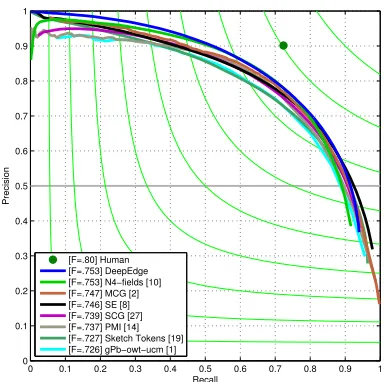
0 0.1 0.2 0.3 0.4 0.5 0.6 0.7 0.8 0.9 1 0 0.1 0.2 0.3 0.4 0.5 0.6 0.7 0.8 0.9 1 Recall Precision [F=.80] Human [F=.753] DeepEdge [F=.753] N4−fields [10] [F=.747] MCG [2] [F=.746] SE [8] [F=.739] SCG [27] [F=.737] PMI [14] [F=.727] Sketch Tokens [19] [F=.726] gPb−owt−ucm [1]
Figure 2: Contour detection accuracy on the BSDS500 dataset. Our method attains higher average precision compared to prior methods and state-of-the-art F-score. At low recall, DeepEdge achieves nearly 100% precision. Contour detection is typically considered a
low-level problem, and used to aid
higher-level tasks such as object detection [30, 31,
32, 33]. However, it can be argued that
the tasks of detecting objects and
predict-ing contours are closely related. For
stance, given the contours we can easily
in-fer which objects are present in the image.
Conversely, if we are given exact locations
of the objects we could predict contours just
as easily. A commonly established pipeline
in computer vision starts with with
low-level contour prediction and then moves up
to higher-level object detection. However,
since we claim that these two tasks are mutually related, we propose to invert this process.
Instead of using contours as low-level cues for object detection, we want to use
object-specific information as high-level cues for contour detection. Thus, in a sense our scheme
can be viewed as a top-down approach where object-level cues inform the low-level contour
detection process.
In this work, we present a unified multi-scale deep learning approach that uses higher-level
object information to predict contours. Specifically, we present a front-to-end
convolu-tional architecture where contours are learned directly from raw pixels. Our proposed deep