Recent progress in hypernuclear physics
E. Hiyama1,aNishina Center for Accelerator-Based Science, Institute for Physical and Chemical Research (RIKEN), Wako, Saitama, 351-0198, Japan
Abstract. Hypernuclear physics has become very exciting owing to new epoch-making experimental
data. The recent progress in theoretical and experimental studies of hypernuclei and discussion about the future development in this filed are done.
1 Introduction
One of the main goals in hypernuclear physics is to un-derstand the baryon interaction. The baryon-baryon interaction is fundamental and important for the study of nuclear physics. In order to understand the baryon-baryon interaction, two-body scattering ex-periment is the most useful. For this purpose, many
N N scattering experiments have been done and the total number ofN N data are more than 4,000. How-ever, due to the difficulty of performing two-body hyp-eron(Y)-nucleon(N) and hyperon(Y)-hyperon(Y) scat-tering experiments, the total number ofY Nscattering data are very limited. Namely, the number of differen-tial cross section are only about 40 and there is noY Y
scattering data. Then,Y N and Y Y potential models so far proposed have large ambiguity.
Therefore, as a substitute for the two-body limited
Y N and non-existentY Y scattering data, the system-atic investigation of light hypernuclear structure is es-sential. Strategy to extract useful information about
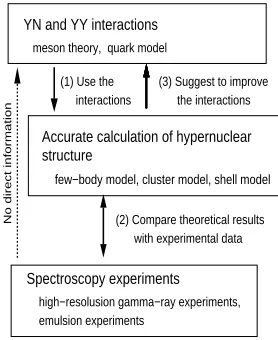
Y N and Y Y interactions from study of light hyper-nuclear structure is as follows (cf. Fig. 1):
i) Firstly, we have candidateY N andY Y interac-tions which are based on the meson
theory and the constituent quark model. ii) Secondly, we have hypernuclear spectroscopy experiments performed in order to
provide information about theY N andY Y in-teractions. However, these experiments
do not directlygive any information about the interactions.
iii) Therefore, using the interactions in i), accurate calculation of hypernuclear
struc-ture is performed. The calculated result is com-pared with the experimental data.
iv) From this comparison, suggestions to improve the interactions are proposed.
a e-mail:
Within the programs among i) to iv), the author’s role is to contribute to iii) and iv) using an accurate three- and four-body calculational method developed by the author and her collaborators (cf. the next sec-tion).
Spectroscopy experiments
emulsion experiments
Accurate calculation of hypernuclear
few−body model, cluster model, shell model
(2) Compare theoretical results with experimental data YN and YY interactions
No direct information
(1) Use the (3) Suggest to improve meson theory, quark model
interactions the interactions
structure
high−resolusion gamma−ray experiments,
Fig. 1.Strategy for extracting information aboutY Nand
Y Y interactions from the study of the structure of light hypernuclei
2
S
=
−
1
hypernuclei and
Y N
interaction
On the basis of the strategy mentioned in Sec. 1, we have obtained information about the spin, spin-orbit and tensor term of Y N interaction from the study ofS=−1 hypernuclei. As an example, the case of the study ofY N spin-orbit force is explained.
In theY N interaction, there are two kinds of LS
forces, symmetricLS force (SLS) and antisymmetric
LS (ALS) force, defined by
VSLS=L·(sΛ+sN)vSLS(r),
VALS=L·(sΛ−sN)vALS(r),
DOI:10.1051/epjconf/20100301010
where sΛ and sN are spins ofΛ and N, respectively. TheALSforce vanishes in conventional nuclei because of the Pauli principle. On the other hand, the ALS
force is produced in hypernuclei since no Pauli princi-ple works betweenΛ andN.
Historically, it is well known that the ALS force differs between meson theory and the constituent quark model [9]. For instance, the quark model of the Kyoto-Niigata group [10] predicts that the strength of the
ALS amounts to approximately 85% of that of the
SLS with the opposite sign. On the other hand, the meson based interaction of the Nijmegen group [11, 12] generates much smaller strength in theALS, some 20−40 % of that of the SLSwith the opposite sign. It is important to extract information about theseLS
forces from the study of the structure ofΛ hypernu-clei.
For the study of spin-orbit force,9
ΛBe and13ΛC are very useful. Recently, in high-resolution γ-ray exper-iments, BNL-E930 [13] and BNL-E929 [14], the spin-orbit splitting energies of9
ΛBe and13ΛC were measured. Namely, the one (E930) observedγrays from the de-cay of the 5/2+1 and the 3/2+1 states to the 1/2+1 ground state in9
ΛBe, and the other (E929) measured those from the 3/2−
1 and 1/2−1 states to the 1/2 + 1 ground state in13
ΛC.
Before the measurements, we predicted those en-ergy splittings in [15]. we took anα+α+Λthree-body model for 9
ΛBe and anα+α+α+Λ four-body cal-culations for13
ΛC. We employed two types of the Y N spin-orbit force, namely, the Nijmegen meson-theory basedY N interaction and the Kyoto-Niigata group’s quark based Y N interaction mentioned above. The predicted energy splittings of9
ΛBe and13ΛC are listed in the second and third columns of Table 1. In both nuclei, the splittings given by using the quark based
LS force is significantly smaller than those by using the meson basedLS force.
Recently, experimental data for these energy split-tings of 9
ΛBe [13] and13ΛC [14] have been reported to be 43±5 keV and 152±54±36 keV, respectively as shown in Table 1. We see that the predicted energy splitting using the quark-model based spin-orbit force can explain both data. On the other hand, the pre-dictions using the meson theory based one are much larger than the data.
The reason why meson theory based Y N inter-action proposed large spin-orbit splitting in the case of 9
ΛBe is as follows: Using the SLS force only, the splitting energy is 140−250 keV depending on the five models in the Y N interaction: it is not so small value. When theALSforce is included, theALSwith the opposite sign of the SLS reduces this splitting. But, the strength of the ALS in the case of Nijme-gen model, 20−40% of the SLS as mentioned be-fore, is not enough to reproduce the observed data. On the other hand, in the quark model, the ALS is strong enough to reproduce the data. Therefore, we suggested that there are two paths to improve the me-son based model; one is to reduce the SLS strength
and the other is to enhance the ALS strength so as to reproduce the observed spin-orbit splittings in9
ΛBe and13
ΛC.
Recently, a new Y N interaction based on meson theory was proposed by the Nijmegen group (ESC06) [16]; they proposed a reduced strength of the SLS. Using this potential, we obtained, as shown in Table 2, the energy splitting in9
ΛBe to be 98 keV in the case of theSLSonly and 39 keV with including theALS, which is in good agreement with the data.
To summarize with referring to the numbers in the parentheses in the strategy diagram of Fig. 1, (1) we used two types of the Y N spin-orbit models, the Nij-megen model and the Kyoto-Niigata model and calcu-lated the energy splittings of9
ΛBe and13ΛC. (2) We then compared our results with the experimental data. (3) We suggested improving the strength of theLS force. After that, the Nijmegen group proposed a new poten-tial version ESC06. Using this potenpoten-tial, we calculated the energy splitting, and we compared them with the experimental data. Then, the calculated results were in good agreements with the experimental data. Since 1998, we have manyγ-ray spectroscopic data [17,18]. By the combined analysis of experiments and theoret-ical calculations, we succeeding in extracting informa-tion about the spin-spin, spin-orbit and tensor terms ofΛN interaction.
3
S
=
−
2
hypernuclei and
Y Y
interaction
It is interesting to investigate the structure of the multi-strangeness system when one or more Λs are added to a S = −1 nucleus. It is conjectured that extreme limit, which includes manyΛs (and other hy-perons) in nuclear matter is the core of a neutron star. In this meaning, the sector ofS=−2 nuclei, doubleΛ
hypernuclei andΞhypernuclei, is just the entrance to the multi-strangeness world. However, we have hardly any knowledge of the Y Y interaction because there exist noY Y scattering data. Then, in order to under-stand the Y Y interaction, it is crucial to study the structure of doubleΛhypernuclei andΞ hypernuclei. The equation of state with the strangeness degree of freedom is a crucial component in understanding neu-tron stars.
Recently, the epoch-making data has been reported by the KEK-E373 experiment. Namely, the doubleΛ
hypernucleus 6
ΛΛHe was observed [19]. This observa-tion was called NAGARA event. The formaobserva-tion of 6
ΛΛHe was uniquely identified by the observation of sequential weak decays, and the precise experimental value of the 2Λ binding (separation) energy,BΛΛ = 7.25±0.19+0.18
−0.11MeV, was obtained.
Following the strategy mentioned in Sec. 1, we studied double Λ hypernuclei with A = 6−10 [20]. Firstly, (1) we employed theΛΛinteraction of Nijme-gen model D and performed anα+Λ+Λthree-body calculation for6
Table 1. Spin-orbit splitting energy in in 9
ΛBe and
13
ΛC. Calculated values are given by Hiyama et al. [15] using the meson-theory basedΛNspin-orbit force [11, 12] and the quark-model based one [10]. Experimental values are taken from [13] for9
ΛBe and from [14] for
13
ΛC.
splitting CAL(meson theory) CAL(quark model) EXP
(keV) (keV) (keV)
9
ΛBe : E(5/2
+ 1−3/2
+
1) 80−200 35−40 43±5
13
ΛC : E(3/2−1−1/21−) 390−960 150−200 150±54±36
Table 2.Calculated spin-orbit splitting energy in in9
ΛBe using an improved meson theory basedLSforce (ESC06) [16]. Contribution ofSLS is shown in comparison with that ofSLS+ALS. CAL(meson theory) is the same as in Table 1.
splitting CAL(meson theory) CAL(ESC06) EXP
(keV) SLS SLS+ALS SLS SLS+ALS (keV)
9
ΛBe :E(5/2
+ 1−3/2
+
1) 140−250 80−200 98 39 43±5
result with the experimental data of the binding en-ergy of6
ΛΛHe, (3) we suggested reducing the strength of1S
0term of theΛΛinteraction by half to reproduce the data. Again, (2) using the improved potential, we predicted energy spectra of new doubleΛhypernuclei withA= 7−10 [20], which is discussed below.
In fact, it is planned at J-PARC to produce many double Λ hypernuclei by emulsion experiment [21]. However, it will be difficult to determine spin-parities and to know whether the observed state is the ground state or an excited state. Therefore, it will be neces-sary to compare the data with any theoretical study for the identification of the state. The author’s role is to contribute to the theoretical calculation using few-body techniques.
A successful example to determine spin-parity of double Λ hypernuclei is the case of 10
ΛΛBe. There was one more event found in the E373 experiment named the ’Demachi-Yanagi’ event [22,23]. The most proba-ble interpretation of this event is the production of a bound state of10
ΛΛBe having B exp
ΛΛ = 12.33 +0.35
−0.21 MeV.
But the experiment could not determine whether this state was the ground state or any excited state. In or-der to determine this, our calculation [20] mentioned above was useful as following: We studied 10
ΛΛBe by employing an α+α+Λ+Λ four-body model. The
ΛΛ interaction is the one improved from the Nijme-gen Model D as mentioned above. The ΛΛ, αΛ and
αα interactions were chosen so as to reproduce the binding energies of all the subsystems, 6
ΛΛHe, 5ΛHe, 8Be and 9
ΛBe. As shown in Fig. 2, it is striking that our calculated value ofBΛΛ(10
ΛΛBe(2+)) is 12.28 MeV that agrees with the experimental data. Therefore, the Demachi-Yanagi event can be interpreted most proba-bly as the observation of the 2+excited state in10
ΛΛBe.
0+
1/2+
0+
B
ΛΛ
= 15.14
B
Λ
= 6.73 (exp. 6.71)
5
He
Λ +
α+
6 He ΛΛ +
α Λ α+ Λ+Λ
–6.64
8Be 9Be
Λ
10
Be
ΛΛ
0.0
–4.0 –2.0
–6.0
–8.0 (MeV)
2+
–15.05
–10.0
–12.0
–14.0
0.09
–16.0
α α+
α
α
0.00 (0.00)
+
α+
)
(0
+
0.00 2.86 cal.(exp.)
Ex
B
ΛΛ
(2
+
)
= 12.28 (exp. 12.33)
5/2+
3/2+
2.83 (3.05)
2.0
2+ 3.00
Ex
Fig. 2. Calculated energy levels of 8
Be, 9
ΛBe and
10
ΛΛBe
on the basis of the α+α,α+α+Λ, and α+α+Λ+
Λ models, respectively. The level energies are measured from the particle breakup thresholds or are given by the excitation energies Ex. The calculated 2+ state of 10ΛΛBe
explains the Demachi-Yanagi event. This figures is taken from [20]
In this way, we succeeded in interpreting the spin-parity of 10
0+
3/2–
1+ 6
He+n
Λ α+ Λ + Λ
6
He+d
ΛΛ α+n+Λ + Λ α+d+Λ+Λ
–7.25
–8.47
6
He ΛΛ7Li ΛΛ8Li
0.0
–4.0 –2.0
–6.0
–8.0 (MeV)
3+
2+
–10.0
–12.0
–14.0 –12.91
0.00 1.36 5.63
Ex 2.0
Λ
α+p+Λ + Λ
6
He+p
ΛΛ
–7.48 3/2–
ΛΛ ΛΛ7He
–16.0
α+t+Λ+Λ
6
He
ΛΛ + t
8
Li
Λ +Λ
7/2–
5/2–
3/2–
1/2–
–17.05 0.00
Ex
0.73 4.55 5.96
α+3He+Λ+Λ
6
He+
ΛΛ 3He
8
Be+Λ Λ
–16.00 3/2– 1/2– 7/2– 5/2–
Ex
0.00 0.71 4.54 5.92
α+α+Λ+Λ
6He ΛΛ +α
0+ 2+
Ex
0.00 2.86
9
Li
ΛΛ ΛΛ9Be 10ΛΛBe
–15.05
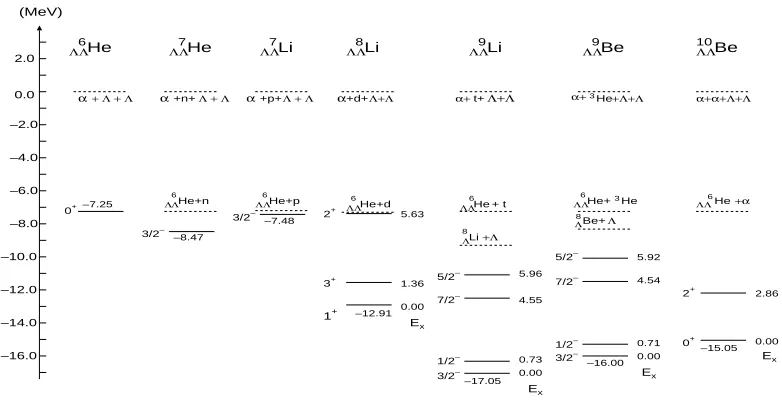
Fig. 3. Energy levels of double-Λ hypernuclei, 6
ΛΛHe,
7
ΛΛHe,
7
ΛΛLi,
8
ΛΛLi,
9
ΛΛLi,
9
ΛΛbe and
10
ΛΛBe calculated using the α+x+Λ+Λmodel withx= 0, n, p, d, t,3
He andα, respectively. This figure is taken from [20].
A= 7−9 taking the framework of theα+x+Λ+Λ
models withx=n, p, d, tand3He [20].
4 Observation of Hida event
In the KEK-E373 experiments, they have observed the two events of doubleΛhypernuclei, named as Nagara, Demachi-Yanagi [19,22,23]. Recently, since the mass of Ξ− has been modified by 0.4 MeV in the PDB,
they have re-analyzed them to beBΛΛ= 6.91±0.16 MeV for6
ΛΛHe and to beBΛΛ= 11.90±0.13 MeV for 10
ΛΛBe. Also, in the KEK-E373 experiments, they ob-served one more event, Hida event [24]. This observa-tion is for11
ΛΛBe or12ΛΛBe. The observedBΛΛfor11ΛΛBe is 20.49±1.15 MeV andBΛΛfor12ΛΛBe is 22.06±1.15 MeV [24]. Then, we have two important issues: (1) Can we reproduce the revised Deamchi-Yanagi event usingΛΛinteraction which reproduce the revised NA-GARA event? (2) Is the Hida event the observation of 11
ΛΛBe or12ΛΛBe?
In order to answer issue (1), we perform four-body calculation of ααΛΛ model for 10
ΛΛBe. The employed
ΛΛinteraction is adjusted so as to reproduce the ob-served BΛΛ = 6.91±0.16 of 6ΛΛHe. Calculated BΛΛ of 2+ state for 10
ΛΛBe is 11.83 MeV which is in good agreement with the revised data. Then, we can still in-terpret the Demachi-Yanagi event as a observation of the 2+excited state. Next, we discuss the Hida event. We assume Hida event as11
ΛΛBe and calculate theBΛΛ withααnΛΛfive-body problem. This five-body calcu-lation is numerically difficult since we have three kinds of particles such asα,Λand neutron, and we have five different kinds of interactions such asΛΛ,Λn,Λα,nα
andαα, and we have Pauli principle betweenαandα, and between α and neutron. Recently, we succeeded in performing this calculation.
In the presentα+α+n+Λ+Λfive-body model for11
ΛΛBe, it is absolutely necessary that all sub-cluster systems composed of two α’s, a neutron and twoΛ’s are described reasonably with the interactions among these units. In our previous work [20], our interactions, which include theαα, αn, αΛ, ΛnandΛΛinteractions, were determined so as to reproduce reasonably well the following observed quantities: (i) Energies of the low-lying states and scattering phase shifts in theα+n
andα+αsystems, (ii)Λ-binding energiesBΛ in5ΛHe (=α+Λ),6
ΛHe (=α+Λ+n) and9ΛBe (=α+α+Λ), (iii) double-Λ binding energiesBΛΛ in 6ΛΛHe (= α+
Λ+Λ), the Nagara event. Then, as mentioned above, the Demachi-Yanagi event for10
ΛΛBe (=α+α+Λ+
Λ) was simultaneously reproduced with no additional adjustable parameter.
In the present work, we employ the same inter-actions of Ref.[20] so that those severe constraints are also successfully met in our two-, three- and four-body subsystems. But, as for the present core nucleus 9Be (= α+α+n), which does not belong to the subsys-tems studied previously, use of the interactions that explain well the property of theααandαnsubsystems do not well reproduce the energies of the low-lying states of9Be measured from the α+α+nthreshold (the same property of the calculated result was re-ported in another microscopicα+α+ncluster-model study [25]). Therefore, we additionally introduce a phenomenologicalααnthree-body force with a Gaus-sian shape, v0e−(rα−α/r0)
2
−(Rαα−n/R0) 2
, having r0 = 3.6 fm,R0= 2.0 fm andv0=−9.7 MeV (+13.0 MeV) for the negative-parity (positive-parity) state; we thus reproduce well the observed energies of the 3/2−
1, 5/2−1, 1/2−
1 and 1/2+1 states of 9Be. The calculated BΛΛ of the ground state in 11
ΛΛBe is 18.23 MeV which is not contradict with the observed value of Hida event,
er-ror bar. For the confirmation of Hida event, we expect to have more precise data at J-PARC facility in the future.
5
Ξ
hypernuclei
For the study of ΞN interaction, it is important to study the structure ofΞhypernuclei. Our intention in this section is to investigate the possible existence ofΞ
hypernuclei and to explore the properties of the under-lyingΞN interactions. Identification ofΞ hypernuclei in coming experiments at J-PARC will contribute sig-nificantly to understanding nuclear structure and in-teractions inS=−2 systems, which can lead to an en-trance into the world of multi-strangeness. In order to encourage new experiments seekingΞ hypernuclei, it is essential to make a detailed theoretical investigation of the possible existence of bound states, despite some uncertainty in contemporaryΞN interaction models. We investigate here the binding energies and struc-ture of Ξ hypernuclei produced by (K−, K+)
reac-tions on light targets on the basis of microscopic clus-ter models. One of the primary issues is how to choose theΞN interaction. Although there are no definitive data for any Ξ hypernucleus at present, a few ex-perimental data indicate thatΞ-nucleus interactions are attractive. One example is the observed spectrum of the (K−, K+) reaction on a12C target, where the
cross sections for Ξ− production in the threshold
re-gion can be interpreted by assuming aΞ-nucleus Wood-Saxon (WS) potential with a depth of∼14 MeV [26]. Other indications of attractiveΞ-nucleus interactions are given by certain emulsion data, the events for
twin-Λhypernuclei, where the initialΞ− energies were
de-termined by the identification of all fragments after the Ξ−p-ΛΛ conversion in nuclei. The inferred Ξ−
binding energies are substantially larger than those obtained using only the Coulomb interaction [27]. When theseΞ− states are assumed to be 1pstates, the WS
potentials obtained from the binding energies are sim-ilar to the one above. These data suggest that the av-erage ΞN interaction should be attractive, which we utilize to select the appropriate interaction models. In this work we adopt two types ofΞN interactions, the Nijmegen Hard-Core model D (ND) [28] and the Extended Soft-Core model (ESC04) [29,30].
The structure of lightp-shell nuclei can be reason-ably described in terms of cluster models composed of two- or three-body subunits. Here, we model the pos-sibleΞ−hypernuclei produced by (K−, K+) reactions
on available light p-shell targets as four-body cluster structures: The possible targets 12C, 11B, 10B, 9Be and7Li naturally lead to such cluster configurations as
ααtΞ−(12
Ξ−Be),αα2nΞ
−(11
Ξ−Li),ααnΞ−(Ξ10−Li),αtnΞ
−( 9
Ξ−He) and αnnΞ−( 7
Ξ−H), respectively, by conversion of a proton into aΞ−. (In our model calculations, theαΞ−
potential is generated from a G-matrix ΞN interac-tion via a folding procedure.) In the case of lighter targets, 6Li, 4He, 3He and d, the Ξ−-hypernuclear
states are composed ofαnΞ−, pnnΞ− (tΞ−), pnΞ−
andnΞ− configurations, respectively. However, these
systems are not expected to support bound states, considering the weakly attractive nature of theΞN in-teractions suggested so far, except for Coulomb-bound (atomic) states. Then, among the aboveΞ−
hypernu-clei, 7
Ξ−H(αnnΞ
−) is expected to be the lightestΞ−
bound system. Thus, possibleΞ− hypernuclear states
to be investigated lie in the light p-shell region and may be considered to have basically a four-body clus-ter structure.
In this work, we adopt two-types ofG-matrixΞN
potentials derived from the Nijmegen hard-core model D(ND) [28] and the extended soft-core model (ESC04) [29,30]. The detailed potential parameters in these
G-matrix ΞN interaction are listed in Table II in Ref.[31]. It is should be noted here that the even-state interaction of ESC04 is more attractive than that of ND, while the odd-state interaction of ND is more at-tractive than ESC04. The calculated energies ofαΞ−
systems which is dominated by even-state spin- and isospin- independent part, are−1.36 MeV for ESC04 and −0.57 MeV for ND, respectively. And the calcu-lated energies of ααΞ− systems are −4.81 MeV for
ESC04 and −2.87 MeV for ND. In the ααΞ−
sys-tem, odd state spin-and isospin-independent term con-tributes significantly. Thus, we can say that observa-tions of αΞ− and ααΞ− systems certainly provide
information about spin-independent parts of theΞN
interactions.
α+n+n+Ξ–
0 MeV
–0.96
6He+Ξ–
αΞ–
( +n+n
–1.71
–3.06
1/2+
–0.57
–1.83
–0.19
–1.29
(i) kF (ii) kF (iii) kF
H (ESC)
5
H
Ξ
=0.9 =1.055 =1.3
)cal
7 Ξ−
α+α+n+Ξ–
0 MeV
–1.57
9Be+Ξ–
α Ξ–
(
–5.17
–8.35
2–
–2.57
–5.16
–1.04
–3.13
α +n
Li (ESC)
9
Li
Ξ )cal
(i) kF=0.9 (ii) kF=1.055 (iii) kF=1.3
1– –7.83
–4.77
–2.89
10 Ξ−
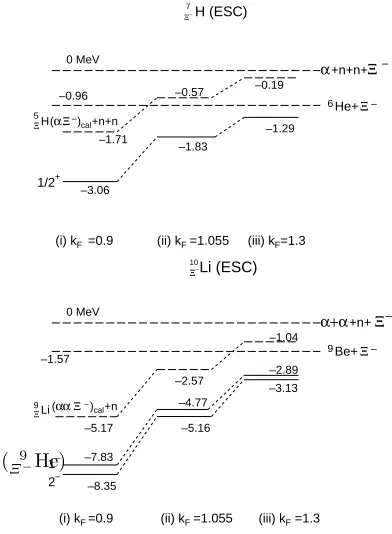
Fig. 4.Calculated energy levels of (a) 7
Ξ−H and (b)
10
Ξ−Li
In reality, however, there are no corresponding nu-clear targets to produce the above systems by the (K−, K+) reaction. As their actual substitutes, in the
following, we investigate the structures of 7
Ξ−H(αnnΞ−) and 10Ξ−Li(ααnΞ
−) having additional
neutron(s) and propose to perform the7Li(K−, K+)
and10B(K−, K+) reaction experiments with available
targets. The calculated energies in the 1/2+ ground state forΞ7−H(αnnΞ
−) and 1−and 2− state for 10
Ξ−Li using ESC are demonstrated in Fig.3 as a function of
kF.
In A=7 hypernucleus, the four-body calculation predicts the existence of nuclear bound states in ESC case at reasonablekFvalues of around 0.9 fm−1. It is
interesting to note that the addition of two neutrons to theαΞ− system gives rise to about 1.3 (2.0) MeV
more binding. The same tendency is seen in ND. This means that an experimental finding of a7
Ξ−H bound state indicates the existence of an αΞ− bound state
in which the even-state spin- and iso-spin independent part of the ΞN substantially attractive. This state-ment is almost independent on the interaction model. In A=10 hypernucleus, we have obtained the nu-clearΞ− bound states as a result of careful four-body
calculations with kF ∼ 1.0 fm−1. Furthermore, we
have similar binding energies of theJ = 2− state for
both the ESC and ND interactions. Then, to produce 10
Ξ−Li, we propose to perform the10B(K−, K+) reac-tion experiment at J-PARC in addireac-tion to that with a 12C target. We say that theααnΞ−(10
Ξ−Li) system produced by the (K−, K+) reaction on10B is suitable
to investigateαΞ− interaction, namely the spin- and
iso-spin independent terms of even and odd-stateΞN
interactions.
Acknowledgement
The numerical calculations were done on HITACHI SR11000 at KEK.
References
1. M. Kamimura, Phys. Rev. A38(1988) 621. 2. E. Hiyama, Y. Kino, M. Kamimura, Prog. Part.
Nucl. Phys.51(2003) 223.
3. S. Eidelmanet al., Phys. Lett. B592(2004) 1. 4. Y. Kino, M. Kamimura, H. Kudo, Proc. Int. Conf.
on Low Energy Antiproton Physics, Yokohama, 2003, Nucl. Instrum. Methods Phys. Res. B214
(2004) 84.
5. M. Horiet al., Phys. Rev. Lett.91(2003) 123401. 6. H. Kamadaet al., Phys. Rev. C64(2001) 044001. 7. E. Hiyama, B.F. Gibson and M. Kamimura, Phys.
Rev. C70, (2004) 031001(R).
8. E. Hiyama, M. Kamimura, A. Hosaka, H. Toki and M. Yahiro, Phys. Lett. B633(2006) 237. 9. O. Morimatsu, S. Ohta, K. Shimizu and K.
Yazaki, Nucl. Phys. A420(1984) 573.
10. Y. Fujiwara, C. Nakamoto and Y. Suzuki, Phys. Rev. C59(1999) 21.
11. M.M. Nagels, T. A. Rijken and J. J. deSwart, Phys. Rev. D12 (1975) 744;15 (1977) 2547; 20
(1979) 1633.
12. T. A. Rijken, V.G. Stoks and Y. Yamamoto, Phys. Rev. C59 (1999) 21.
13. H. Akikawa et al., Phys. Rev. Lett. 88 (2002) 82501;H. Tamuraet al., Nucl. Phys. A754(2005) 58c.
14. S. Ajimuraet al., Phys. Rev. Lett.86(2001) 4225. 15. E. Hiyama, M. Kamimura, T. Motoba, T. Yamada and Y. Yamamoto, Phys. Rev. Lett. 85 (2000) 270.
16. T. A. Rijken, private comminucation (2006). 17. O. Hashimoto and H. Tamura, Prog. Part. Nucl.
Phys.57(2006) 564.
18. H. Tamura, in Proceedings on Interanational Nu-clear Physics Conference 2007, to be published. 19. H. Takahashi et al., Phys. Rev. Lett. 87 (2002)
212502.
20. E. Hiyama, M. Kamimura, T. Motoba, T. Ya-mada and Y. Yamamoto, Phys. Rev. C66(2002) 024007.
21. K. Imai, K. Nakazawa, H. Tamuraet al., J-PARC proposal No.E07, 2006.
22. K. Ahn et al., In Hadron and Nuclei, edited by II-Tong Chen et al., AIP Conf. Proc.594(2001) 180.
23. A. Ichikawa, Ph.D. thesis, Kyoto Universitym 2001.
24. K.Nakazawaet al., in this proceedings, and to be submitted to Phys. Rev. C.
25. K. Arai, P. Descouvemont, D. Baye, and W. N. Catford, Phys. Rev. C68, (2003) 014310.
26. P. Khaustov et al., Phys. Rev. C61, (2000) 054603.
27. S. Aoki et al., Prog. Theor. Phys.89(1993), 493.; S. Aoki et al., Phys. Lett.B355(1995), 45.; Y. Ya-mamoto, Genshikaku Kenkyu 39 (1996), 23. 28. M. M. Nagels, T. A. Rijken, and J. J. deSwart,
Phys. Rev.D15(1977) 2547.
29. Th. A. Rijken and Y. Yamamoto, Phys. Rev.C73, 044008 (2006); [arXiv:nucl-th/0603042]
30. Th. A. Rijken and Y. Yamamoto, [arXiv:nucl-th/0608074]