Publisher: Asian Economic and Social Society
Topographic Information System As A Tool For Environmental Management
E.O. Oriola (Department of Geography & Environmental Management, University of Ilorin, Ilorin. Nigeria.)
Asonibare S.O (Department of Surveying and Geoinfomatics Kwara State Polytechnic Ilorin, Nigeria.)
Introduction
Land surveying is the first point of reference in all meaningful land development projects. Provision of infrastructures; planning of towns and cities; management of hazardous natural events and human actions such as erosion, flooding, earthquakes, and subsidence; coastal management; exploration and exploitation of minerals; sitting of industries; resources exploitation on the land and on the sea all are dependent on Land Surveying products.
Topography of an area describes the surface characteristics of relief features of such area as depicted by hills, valleys and plains. It can be used to study and represent, as a surface, any characteristic that has a continuously changing value other than elevation. For instance, population, magnetic data and geo-chemical data. Topographical Surveying involves the acquisition of topographic data of the features on the earth‟s surface, both man-made and natural in three-dimensions. This employs the techniques of plane surveying and other special techniques to establish both horizontal and vertical controls.
The implications of the above is that no meaningful development can be embarked upon by an individual, government and any other agencies without information about the topography of the land in the area where such development is to take place. Topographic Information System can be derived from the topographical data with
the employment of the analytical capabilities of Geographic Information System (GIS).
According to Burrough (1986), GIS is a tool for collecting, storing, retrieving at will, transforming and displaying spatial data from the real world for a particular set of purposes. In short, GIS can be used to add value to spatial data (Sharma et al 2006). This is by allowing data to be organized and viewed effectively, by integrating them with other data, by analysis and by the creation of new data that can be operated on in turn to create useful information that can help decision making. The uniqueness of GIS is in its ability to integrate data from a variety of sources. A GIS can thus be described as a form of spatial decision support system. This objective of this paper is to create topographic information system for adequate management immediate physical environment.
Topographic Information System
Digital technology was successfully introduced in the field of mapping in the late 1960‟s as means of speeding up map production. (Perera and Shanta, 2002). With the change in technology in the last two decades and the growth in the number of spatial information systems, the concept of topographic database has been introduced in several mapping-surveying organizations in the world, in order to deliver more Geo-information to the user community.
Topographic Information System As A Tool For Environmental Management
Abstract
Author (s)
E.O. Oriola
Department of Geography &
Environmental Management, University of Ilorin, Ilorin. Nigeria.
E-mail: [email protected]
Asonibare S.O.
Department of Surveying and
Geoinfomatics Kwara State Polytechnic Ilorin, Nigeria.
E-mail: [email protected]
Key words: Topography, Attribute data, Information, Decision, Planning.
Topographic Information System is very crucial in this present age in other to be able to update maps and retrieve necessary data at any given time with minimal efforts. Topographic Information System can be explained as the combination of human effort and computer-based tools for the collection, storage, analysis, manipulation and retrieval of various kinds of data relating to geographic features (man-made and natural) on the surface of the earth (Lexicon Universal Encyclopedia , 1989).
In view of this, it is necessary to create Topographic Information System for different locations because the information generated from such system can be used for various purposes in physical planning and decision-making in such locations. Some of the usefulness and advantages of this digital database for such system over the conventional maps include:-
a) Possibility of fast amendment and dynamic updating of data
b) Fast capturing of data with Total Stations or GPS c) Analysis of many important spatial problems
d) Versatility in integrating data collected from various sources
e) Flexibility output possibilities
f) Provides bases for additional information with relative ease for production of maps.
The Study Area
This study was carried out at the permanent site of the Kwara state Polytechnic, Ilorin. Ilorin is located within longitude 0829‟ 21”E latitude 0430‟ 50”N and 0829‟ 43”E latitude 0431‟ 01”N. It is the capital of Kwara State. It has been experiencing rapid urbanization since 1967 when it became the capital of Kwara State (see fig 1). The extent of its built-up area in 1967 was about 8.37km² but it has today increased by about sixty percent in the year 2000. In general, the city grows mainly along the major arteries of river Oyun and its numerous tributaries drain the city (Oyegun, 1983). The largest of the tributaries is Asa River which actively divided the city into almost two halves.
The Polytechnic is at kilometer 10 along the old Ilorin- Jebba Road. The polytechnic entrance is between Elekoyangan and Oke-ose village along the road. The Institution was carved out of the present Moro Local Government area of the state. The State Polytechnic is having boundary with Ilorin East Local Government and Moro Local Government areas (see fig 2).
Materials And Methods
For the purpose of this pilot study, the following data were collected from both primary and secondary sources: previous analogue map covering the area, previous control points at the vicinity of the project area and
coordinates of points at the vicinity of the project. Others are Coordinates of points and features on the field. Vector approach of data acquisition was used that is, x, y, coordinates of the objects of interest were acquired using Total Station in a computerized electronic instrument which has a combination of EDM and Theodolite was used for measuring distances, angle, fixing of details and determination of coordinates of points.
It is a basic rule in surveying that for a new area, reference must be made to old existing controls by way of connecting the new survey from the existing one. The Surveying rule of working from whole to part was employed. This is the basis for carrying out the perimeter traverse first before the detailing and spot heightening. Heights of instrument and target were measured and stored in the memory of the instrument after the perimeter traversing which started from the control point KWPT 02 and closed back to the point KWPT 04. All the detailing and spot heightening were done by orienting with the coordinated boundary marks/Stations. Results and Discussion
The major characteristic that differentiates GIS from other information systems is the spatial analytical capability; especially overlay operation, buffering, spatial search, topographic operation, and neighborhood and connectivity operations. GIS uses this spatial analytical capability to answer fundamental generic question of location, condition, trend, routing, pattern and modeling by the manipulation and analysis of input data. The major analyses performed in this project were overlay operations, topographic operations and spatial search.
Overlay Operation
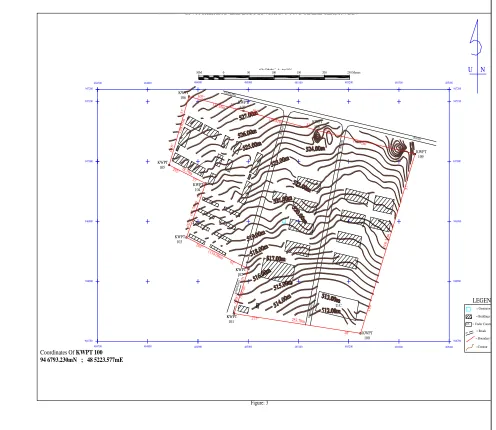
In this study the contour map was overlaid on detailed map of the study area to produce the topographic map of the area, which shows the relationship that exists between the various spatial entities in the study area. This result can be used to determine area that need access road to be built or other facilities.
Fig 1 Map of Nigeria showing Kwara State
Fig 3 Topographic Map of the Study Area
Topographic Operations
This operation was performed from digital elevations model generated using Arc View GIS 3.2a version. The earth is 3-dimensional, most GIS applications include some element of 3- dimensional analysis of which topographic operations and analysis of surface terrain becomes paramount. Slope, Aspect and other DTM generations are considered as the most common uses in application of terrain model use in GIS. The analyses were performed using Arc View GIS 3.2a version and the products generated are as follows:-
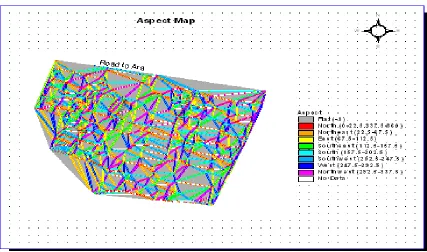
1. Hill shade map of the project site is presented in fig 5. This can be used to determine the best part of a farmland to be reserved for drying of crops after harvesting, in fact, hill shade is used to portray relief difference and terrain morphology in hilly and mountainous area. Furthermore, Aspect map of the area is very essential for the determination of intensity of sun that can be received. This information can be used for sitting of houses where they will get enough sunlight. Aspect maps can also be used to determine where different crops will perform best, the values for aspect are in degrees, 0º of true north, 90 º for east, 180 º for south and 270 º for west (fig 6).
KWPT 100 KWPT 101 KWPT 102 KWPT 103 KWPT 104 KWPT 105 KWPT 106 KWPT 107 KWPT 108 KWPT 109 277° 26' 253.70m 020° 57' 79. 97m 293° 01' (134. 08m ) 022° 57' (97. 78m ) 292°
78.79m 57' 018° 57' 120. 93m
102° 23'
111.16m 150.81m 101° 25' 198.32m 199° 57' 318. 32m
PLAN SHEWING THE TOPOGRAPHICAL MAP OF THE STUDY AREA OF
PART OF KWARA STATE POLYTECHNIC, ILORIN (PERMANENT SITE)
ALONG OLD ILORIN - JEBBA ROAD, MORO LOCAL GOVERNMENT AREA, KWARA STATE.
ORIGIN:- WGS 84 (UTM)
AREA:- 12.25 HECTARES
SCALE:- 1: 2,500 U N
EXI ST ING R OA D ROA D EXI S TIN G EXISTING ROAD
50M 0 50 100 150 200 250 Metres
484700 484800 484900 485000 485100 485200 485300 485400
484700 484800 484900 485000 485100 485200 485300 485400
946780 946880 946980 947080 947180 947200 946780 946880 946980 947080 947180 947200 U/C
CONTOUR INTERVAL:- 0.5m
= Generator House LEGEND
Coordinates Of KWPT 100 94 6793.230mN ; 48 5223.577mE
Figure: 3
= Buildings = Roads = Under Construction
U/C
102°
33'
FIG. 4.1
2. Slope map of the project site presented in fig 8 is an important map for soil erosion analysis of a given area and Triangulated irregular network (TIN) map of the project site as shown in fig 8 is basically used to connect points of equal heights. Different colours in the map depict the different ranges in the study area. It is a tessellation model
which allows recording topographic data as points in a regular or irregular grid. When a three dimensional view is necessary the grid can be converted to the crystalline shape. In addition, the point data can be used for performing the surface as a series of contour lines with all interpolation procedures needed for surface analysis.
KWPT 100 KWPT 101 KWPT 102 KWPT 103 KWPT 104 KWPT 105 KWPT 106 KWPT 107 KWPT 108 KWPT 109 277° 26' 253.70m 020 ° 57 ' 79. 97 m 293° 01' (13 4.08m ) 022 ° 57 ' (97 .78m ) 292° 57 ' 78.79m 018 ° 57 ' 120 .93 m 102° 23' 111.16m 150.81m 101° 25' 198.32m 199 ° 57 ' 318 .32 m
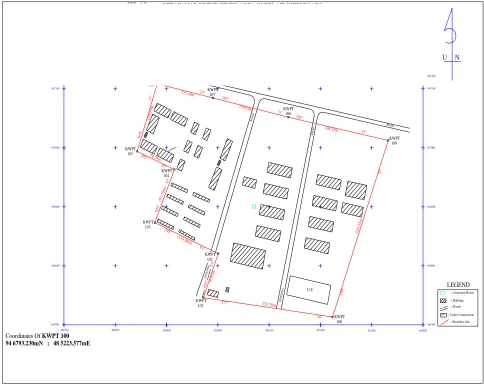
DETAIL MAP OF THE STUDY AREA OVERLAID WITH ROADS OF
PART OF KWARA STATE POLYTECHNIC, ILORIN (PERMANENT SITE)
ALONG OLD ILORIN - JEBBA ROAD, MORO LOCAL GOVERNMENT AREA, KWARA STATE.
ORIGIN:- WGS 84 (UTM)
AREA:- 12.25 HECTARES
SCALE:- 1: 2,500
U N
EX IST ING RO AD R OA D E XIS T ING EXISTING ROAD
50M 0 50 100 150 200 250 Metres
484700 484800 484900 485000 485100 485200 485300 485400
484700 484800 484900 485000 485100 485200 485300 485400
946780 946880 946980 947080 947180 947200 946780 946880 946980 947080 947180 947200
U/C LEGEND= Generator House
Coordinates Of KWPT 100 94 6793.230mN ; 48 5223.577mE
= Building = Roads = Under Construction
U/C
102°
33'
= Boundary line FIG. 4.3
Fig 4 Detail Map of the Study Area Query and presentation of analysis
The most fundamental of all tools provided by a GIS are those involved with database query and its ability to perform complex spatial analysis and modeling operations in support of environmental management planning and mapping. Queries may be Simple or Multiple.
Simple criteria analysis
Figure 5 Hill shade of the Study Area
Fig 7 Slope map of the Study Area
Fig 8 Triangulated Irregular Network (TIN) map of the Study
Syntax ((Building Use) = “Laboratory) Query on Single Criterion
Fig 9 Map of Laboratories in the Study Area
Syntax {(Building type) = “Storey} Query on Single Criterion
Fig 10 Map of Storey building in the Study Area
{(Building Use) = Lect Room} and {(Building type) = Bungalow} Fig 11 Map of Lecture Room that are bungalow
Multi criteria analysis
Multi criteria analysis refers to a situation where more than one condition is used to query a database, for example, “show all building that are bungalows and used for Staff Offices”.
Query command and syntax: {[B_Type] = “Bungalow”} and {[B_Use] = “Staff Offices‟} here the conditions requested in the query are, the TYPE and USE of the building which are BUNGALOW and LECTURE ROOM (Fig. 11).
Query on Multiple Criteria.
Queries can be designed to select all objects, point objects, line objects, and polygon objects. The result of the queries is then analyzed. Planners can be guided by the results of the queries in deciding how many structures are needed in the area. Likewise Estate Surveyor can use the analysis or queries to determine the exact available property for rent without taking the client to the site. More importantly, the construction engineers can used maps generated to determine the best route for road connection.
Application of products
The various products generate in this study can be very useful for planning purposes and decision making. The topographical map of the Polytechnic shows all the features as they exist on the ground and other available areas for future development. Some of the products that were generated include Slope, Aspect and hill shade. These are maps that are very essential for taken good decision on environmental issues.
on its orientation relative to the illumination source. This illumination source is usually chosen at an angle of 45 above the horizon in the north-west direction.
d. Useful in the visibility studies, that is, determining what is visible on a surface from a set of one or more location.
Other products generated from the query can be used for physical planning, decision making, and solution of some spatial problems of the Polytechnic. These products are all very essential for environmental management and easy analysis of our physical environment.
Conclusion
This study has been able to showcase topographic information system as a necessary tool for managing environmental issues and abate some environmental related problems. With this system, it is now possible to amend and update data in the system, quickly analyse many important spatial problems in the area, produce output that is flexible and supply data for producing interactive maps of the area.
References
Burrough, P. A. (1986) „Principles of Geographical Information System for Land Resources Assessment.‟ Oxford University Press, New York, Pp194
Lexicon University Encyclopedia (1989) Lexicon publication inc. New York N.Y (1989).
Oyegun R. O. (1983) Water Resources in Kwara State. Matanmi and sons publishing Co. Ltd. Ilorin. P7 Perera, S. and Shanta, K. O. (2002). “A Topographic Database for Geoinformation Process in the Survey Department of Sir Lanka”.Pp 1-6