Isolation Of Pure Culture Of Bacteria From Soil And StudyTheir Antimicrobial Activity
Sneha Wankhade, Sunil Hadke*, Rajesh Oswal, itin Londhe, Trushal Chorage
JSPM’s Charak College of Pharmacy and Research
Gat no.720/1&2, Pune-Nagar Road, Wagholi, Pune-412 207 India. Ph.020-27051170-75, 65101410, Fax.020-27051175
Summary
Soil contains different types of microorganisms including bacteria actinomycets, fungi, protozoa, algae, and viruses. The aim of present study was undertaken to isolate specific bacteria from soil and convert it into pure culture and to study its antibacterial activity against different types of bacteria including it into gram positive as well as gram negative. Soil contains different types of microorganisms and the Concentration of microorganisms in soil more and it is decreased by serial dilution method. Transfer the dilution on nutrient agar plate and incubate it. Different colonies are formed on the agar plate and select the one colony, and convert it into pure culture and then, Identify the isolated microorganism. The isolated bacteria was further evaluated for antibacterial activity against S.Aureus, B.Subtilis, E.Coli, P.otatum by using Streptomycin as standard drug in the zone of inhibition. The antibacterial activity is counted by zone of inhibition using cup plate method.
Keywords- Soil, Bacteria, Protozoa, algae, fungi, viruses, Streptomycin, Zone of Inhibition
Introduction2, 3, 4
Soil
and termites, vertically redistribute this humus within the mineral matter found beneath the surface of a soil. When water moves downward into the soil, it causes both mechanical and chemical translocations of material. The complete chemical removal of substances from the soil profile is known as leaching. Leached substances often end up in the groundwater zone and then travel by groundwater flow into water bodies like rivers, lakes, and oceans. Eluviations refers to the movement of fine mineral particles (like clay) or dissolved substances out of an upper layer in a soil profile. The deposition of fine mineral particles or dissolved substances in a lower soil layer is called eluviations. Important plant foods include nitrogen (helps leaves and stems grow), phosphate (helps roots and fruits develop) and potassium (stimulates overall plant health). When plants die, they return the nutrients they initially absorbed from the soil, back to the soil, and enrich the soil. In this way soil plays a very important role in the recycling of nutrients (Enviro Facts, 1999).Soil contain different types of microorganism, including Bacteria actinomycets fungi algae and viruses. Soil environment differ from one location to another and from season to season .therefore factor such as moisture PH temperature, organic and inorganic content, and oxygen content affect the microbial flora of soil sample.
Materials and Methods2
Table 1.The Materials Used in Project Work were as follows
Method for Isolation of pure culture of bacteria from soil3, 4
Various method are used to isolate and enumerate microorganism from soil, food milk and water .the serial dilution agar plate method or viable plate count methods commonly used techniques for the isolation and enumeration microorganism .when the sample containing microorganism is cultured in media then each viable microorganism will develop into colony .the number of colonies appearing on the plates are present the number of living microorganism present in sample .nutrient agar ,glycerol yeast extract agar and sabouraud agar media are used
SR O. MATERIAL USED I PRACTIL
1 Soil From Medicinal Garden 2 Nutrient Agar
3 Nutrient Broth
4 Bacterial Culture for Observing Activity of Isolated Bacteria
5 Gram’s Iodine 6 Crystal Violet 7 Saffranin 8 Ethyl Alcohol 9 Autoclave 10 Incubator
for isolation of bacteria ,actinomycets and fungi respectively the glycerol yeast extract agar and sabouraud agar are supplement with 10mg of chlortetracycline of medium to inhibit the growth of bacteria. Collect the soil sample from medicinal garden take1gmof soil sample which is free from dust, degradable matters, dust etc. add 1gm of soil sample into 10ml of sterile water to make 1:10(10-1) dilution shake the test tube or centrifuge for 5 to10min at 4000 r.p.m and after that soil get settle down at the bottom and supernatant remains at the top by using this dilution (10-1) , prepare 10-3,10-4,10-5, transfer make the dilution of different concentrations by shifting 1ml from dilution of 10-1 concentration by using sterile pipette prepare nutrient agar and nutrient broth transfer the agar into Petri plate to solidify and after solidification add 1 ml solution of dilution having concentration 10-5 incubate the Petri plate at 370c for24 to 48 hrs. And soil microorganisms are calculated by using following formula:
o. of microorganism/gm of soil = number of colonies × dilution factor
After keeping the Petri-plates for several hours single bacterial colony selected and inoculates on media, after this inoculation this mixture placed at 37oc for24to48 hrs after several hours the colonies get multiplied and form same colonies. Then harvesting of microorganisms is done for this any one colony get shifted to saline water or peptone .Then pure culture is formed and we got it for further process that is to identify the bacteria by gram staining methods.(2)
Identification of Bacteria2
Prepare a smear from bacterial pure culture suspension on clean slide allow smear to air dry and heat fix in usual manner. cover the smear by crystal violet (primary stain )keep for 1min. wash the smear with water and cover it with grams iodine(mordant) for 1 min .wash the smear with water and decolorize with 95% ethyl alcohol very carefully till the washing does not contain violet colour for normal smears 10 to 15 seconds are enough. Rinse the smear with water and counter stain with saffranin or dilute carbol fuchsin for 1 min. wash the smear with water and allow to air dry put a drop of oil on the smear and examine under oil immersion objective.
Zone of inhibition by cup plate method2, 3
A broth media may be defined as sterile liquid nutrient solution which does not have any solidifying agent. Broth culture is ideal where growth of microbes occurs. Nutrient broth is the general liquid media used for cultivation of bacteria that contain beef extract and peptone. The given bacterial samples is transfers in nutrient broth and incubate at 370c for 24to 48 hours, after incubation the sample is centrifuge by micro centrifuge apparatus, it separates the bacterial cultures and supernatant, and by using this obtained supernatant we study its acivity by zone of inhibition of cup plate method.
cork borer and then gram positive bacterial solution is pour into that holes by using pipette, during pouring make sure that the solution doesn’t get flooded. Then these Petri-plates are incubated at37oc for 24to48 hours, and then count the zone of inhibition.2, 13
Result and Discussion
Microbial population in soil
Observe the plate for number and distribution of colonies of bacteria, fungi from each dilution. Select the plates from the dilution which contain colonies in the range of 30 to 300 and count the number of microorganism by using colony counter.
180 colonies were counted in 104 dilution of soil sample then number of colonies per gram of soil would be 1.8×10⁶ microorganism/gm.
Fig o. 1.Microbial population of soil grows on utrient Agar Plate.
Gram staining:
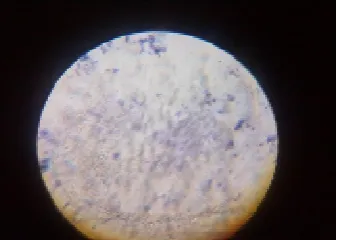
Smear prepared from the suspension of isolated bacteria which is violet coloured rod shaped bacteria that are Gram positive bacteria.
The isolated bacteria were gram positive rod shaped according to its appearance it is B.subtilis species.
Zone of inhibition by cup plate method
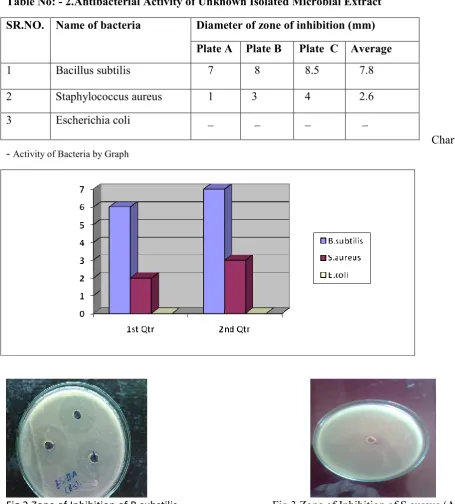
The isolated bacterial extract shows the zone of inhibition by cup plate method against the B.substilis, S.aureus bacteria. Observe all the plates for the zone of inhibition and record the diameter in the observation table. Observe the zone of inhibition around the cavity .Measure the diameter by zone reader and record in the observation table and chart.
Table o: - 2.Antibacterial Activity of Unknown Isolated Microbial Extract
Chart: - Activity of Bacteria by Graph
Fig.2.Zone of Inhibition of B.substilis Fig.3.Zone of Inhibition of S.aureus (A)
Diameter of zone of inhibition (mm) SR.O. ame of bacteria
Plate A Plate B Plate C Average
1 Bacillus subtilis 7 8 8.5 7.8
2 Staphylococcus aureus 1 3 4 2.6
Fig.4. Zone of Inhibition of S.aureus (B) Fig.5. Zone of Inhibition of S.aureus (C)
In the above Petri-Plates Zone of Inhibition is observed against S. aureus and B.substilis
Conclusion
The work undertaken to isolate and identification of specific bacteria from soil and its antimicrobial activity. The specific bacteria isolated from soil by serial dilution method by using sterile water and forming pure culture of bacteria and due to the dilution concentration of microorganisms in soil is decreased. According to gram staining The isolated bacteria was rod shaped, violet in colour and Gram positive in nature. The isolated pure culture shows the antimicrobial activity. These isolated bacteria inhibit the growth of other bacteria .The antimicrobial activity is observed by zone of inhibition by cup plate method. The isolated bacteria show the activity against the S.aureus, B.subtilis P.notatum by cup plate method. The present work concludes that the isolated bacteria show antimicrobial activity. The antimicrobial activity shows in comparison with streptomycin.
References
1. http://www.physicalgeography.net/fundamentals/10t.html
2. Kokare C R, Practical pharmaceutical Microbiology, Career Publication second edition. page
no.42-44,167-169.
3. Kokare C R, textbook of Pharmaceutical Microbiology, Nirali publication. Page no.4.1- 4.18.
4. Pelczar M J. ECS Chan, Noel R Krieg Textbook of Microbiology, Tata McGraw Hill Eduction Private
limited Page no.144-146.
5. Gaud R S, Gupta G D, Gokhale S B, Practical Biotechnology, Nirali Publication, page no. 42-43
6. Singh B D, Textbook of Biotechnology, B.S.C. Edition, Kalyani Publication, Page no. 65-66
7. Ananthanarayan R., Paniker G K. Textbook of Microbiology, universities press 8thedition Page no.15-16.
8. http://en.wikipedia.org/wiki/Gram-positive_bacteria.
9. http://en.wikipedia.org/wiki/Gram-negative_bacteria.
10. http://en.wikipedia.org/wiki/Growth_medium.
11. http://www.microrao.com/micronotes/pg/Gram%20stain.pdf.
12. http://www.ceroi.net/reports/johannesburg/csoe/html/nonjava/Soil/intro.html
13. http://www.sciencebuddies.org/science-fair-projects/project_ideas/Micro Bio_p014.shtml
14. http://www.buzzle.com/articles/different-types-of-bacteria.html