D E B A T E
Open Access
Implementation capital: merging
frameworks of implementation outcomes and
social capital to support the use of
evidence-based practices
Jennifer Watling Neal
*and Zachary P. Neal
Abstract
Background: Although there is growing recognition that the implementation of evidence-based practices is a social process, the conceptualization of social capital in implementation frameworks often conflates bonding and bridging social capital. This conflation makes it difficult to concretely operationalize social capital and limits the concept’s utility for explaining implementation outcomes.
Discussion: We propose a new framework ofimplementation capitalthat merges an existing conceptual framework of implementation outcomes with an existing operational framework of social capital. First, we review a conceptual framework of implementation outcomes, which includes the acceptability, appropriateness, adoption, feasibility, fidelity, cost, penetration, and sustainability of evidence-based practices. Second, we describe an operational framework of social capital that grounds bonding and bridging social capital in the structure of implementers’ social networks. Third, we bring these two frameworks together to create a merged framework of implementation capital that shows how specific aspects of social capital can support specific implementation outcomes. Implementation outcomes ofacceptability,appropriateness, andadoptionare linked to bonding social capital through mechanisms of trust and norm enforcement, while outcomes offeasibilityandfidelityare linked to bridging social capital through mechanisms of increased access to information and resources. Additionally, setting-level implementation outcomes ofcost,penetration, andsustainabilityare associated with small worldliness at the setting level, which simultaneously optimizes both bonding and bridging social capital in a setting.
Conclusion: The implementation capital framework is helpful because it separates two distinct forms of social capital—bonding and bridging—that are often conflated in the implementation literature, and offers concrete ways to operationalize them by examining the structure of implementers’ social networks and the networks of their settings. This framework offers specific guidance about how individual and setting networks might be shifted to support implementation outcomes.
Keywords: Implementation outcomes, Bridging social capital, Bonding social capital, Social networks, Evidence-based practice
*Correspondence:[email protected]
Department of Psychology, Michigan State University, 316 W. Physics Rd., East Lansing 48824, MI, USA
Background
The implementation of evidence-based practices (EBPs)1 is a social process that requires the people performing the implementation (i.e. implementers) to communicate with and receive social support from multiple actors includ-ing other implementers, researchers, developers, support staff, information brokers, and organizational leaders [1–5]. For example, during early stages of implementation, prospective implementers often communicate with other implementers and information brokers to explore and make decisions to adopt EBPs [6–9]. Likewise, during later stages of implementation, implementers often work closely with other implementers, program/practice devel-opers, and support staff to build support and capacity to implement EBPs [2,5,10]. Certain aspects of these social relationships facilitate the implementation of new prac-tices, reforms, and EBPs [8,11–13]. For example, imple-menters’ adoption and implementation depend on their exposure to social pressure or their access to new informa-tion through these relainforma-tionships. Therefore, frameworks often draw on the role of social relationships, and more specifically the concept of social capital, to understand the implementation of EBPs [13–16].
Despite the widespread use of social capital in imple-mentation frameworks, these frameworks often conflate bonding social capital, which focuses on norm enforce-ment and trust, with bridging social capital, which focuses on the circulation of resources like information [17–20]. For example, a guide to knowledge translation theory notes that:
Social capital refers to networks with bonding, bridging, and linking capacity to facilitate cooperative, collective, inclusive action and reduce opportunistic behavior. It represents a range of key resources that exist in social relationships, networks, links, connections, associations, customs, and norms [15], p. 32.
Similarly, the Consolidated Framework For Imple-mentation Research (CFIR) includes the concept of social capital as critical to EBP implementation in both the inner and outer settings of organizations, defining it as:
The collective networks of relationships of individuals represent the social capital of the organization. Social capital is one term used to describe the quality and the extent of those relationships and includes dimensions of shared vision and information sharing [14].
These definitions include features of both bonding social capital (e.g., customs, norms, shared vision) and bridging social capital (e.g., access to resources and infor-mation). However, they do not attempt to distinguish
between these two forms of social capital. Theories of social capital suggest that the distinction between bond-ing and bridgbond-ing social capital matters [17–20]. Bond-ing and bridgBond-ing social capital involve distinct patterns of social relationships with distinct social consequences for implementation. More specifically, in the context of implementation outcomes, the tightly knit relationships that create bonding social capital lead to norm enforce-ment and trust that may be important for impleenforce-mentation outcomes related to implementers’ perceptions of EBPs. Likewise, the brokering relationships that create bridging social capital lead to increased access to resources that may be important for implementation outcomes related to implementers’ use of EBPs. Thus, conflating bonding and bridging social capital makes it difficult to concretely operationalize social capital and limits social capital’s util-ity for explaining implementation outcomes.
To overcome these issues, this debate paper unpacks what social capital is from a structural perspective, then argues that specific forms of social capital can facilitate specific implementation outcomes. By merging a concep-tual framework of implementation outcomes [21] with an operational framework of social capital [17,19], we pro-pose a new framework we call implementation capital, which details how implementers’ social networks can sup-port or hinder the implementation of EBPs. We begin by outlining one conceptual framework of implementation outcomes [21]. Next we describe an operational frame-work of social capital that provides distinct operational-izations of bonding and bridging social capital [17–20]. Finally, we bring these two frameworks together to cre-ate a merged framework of implementation capital that highlights how particular aspects of implementers’ social networks can be leveraged to improve specific implemen-tation outcomes.
A conceptual framework of implementation outcomes
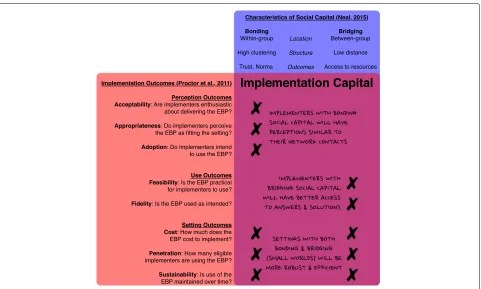
In implementation research, there has been a push to separate more proximal implementation outcomes from distal service outcomes (e.g., service effectiveness, effi-ciency) or clinical outcomes (e.g., satisfaction, wellbeing [1,21,22]). Drawing on elements from existing dissemi-nation and implementation theories including diffusion of innovations [9] and frameworks including RE-AIM [23], Proctor et al. [21] developed a conceptual framework that presents a taxonomy of eight implementation outcomes outlined in Fig.1.
Fig. 1Types of social capital and their link to implementation outcomes
are associated with its complexity (i.e., how easy it is to use?) and relative advantage (i.e., is it better than alterna-tive practices?). Appropriateness refers to whether imple-menters perceive an EBP as fitting their setting, needs, and experiences, and thus mirrors the concept of compatibil-ity (i.e., does it fit?) [9]. Proctor et al. acknowledge that there is some overlap between the concepts of acceptabil-ity and appropriateness, but maintain that it is possible for implementers to perceive an EBP as “appropriate but not acceptable, and vice versa” [21, p. 69]. Finally, adop-tion refers to whether implementers intend to use or have made an initial decision to use an EBP. This initial adoption decision is also an important part of the dis-semination and implementation process described in both diffusion of innovation theory and the RE-AIM frame-work [9, 23]. Although there is some variation, these outcomes are often of greatest significance early in the implementation process, when implementers are forming opinions about a new EBP.
Two outcomes—feasibilityandfidelity—focus on imple-menters’ use of EBPs [21]. Feasibility refers to whether an EBP is practical for implementers to use. The feasibility of an EBP is influenced by several characteristics outlined in diffusion of innovations theory including compatibil-ity (i.e., does it fit?), complexcompatibil-ity (i.e., is it easy to use?),
and trialability (i.e., can it be experimented with on a lim-ited basis; [9]). Fidelity refers to whether an EBP is used by implementers as intended. This maps onto concepts of implementer delivery described as part of the implemen-tation component of the RE-AIM framework [23] as well as Rogers’ [9] discussion of re-invention or the extent to which users of an innovation change it to fit their needs or settings. Again, although there is some variation, these outcomes are often of greatest significance during the implementation process, when implementers attempt to put a new EBP into practice.
whether the use of an EBP is maintained over time. This implementation outcome is also described as the main-tenance component of the RE-AIM framework and in Rogers’ [9] discussion of how individuals seek reinforce-ment of their decisions to adopt EBPs.
An operational framework of social capital
To better understand the relationship between social capi-tal and implementation outcomes, it is necessary to clarify what social capital is. Although the construct of social capital has grown dramatically in popularity, it is over a century old [24,25]. It has been used to describe specific patterns of relationships and the advantages one gets by having such relationships [17,18,20]. As with other forms of capital (e.g., physical capital like tools, human capital like education), we view social capital as a resource that facilitates certain behaviors. But, what kind of resource and what kinds of behaviors?
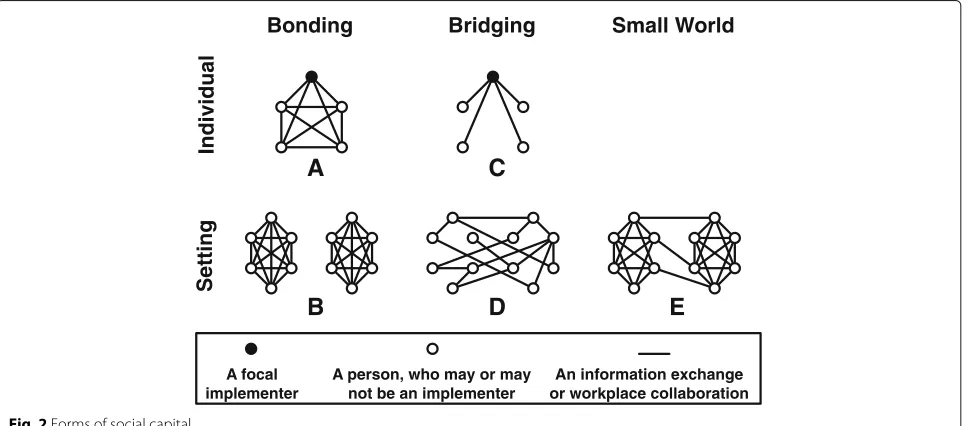
Despite significant variation in terminology, the litera-ture on social capital is clear that there are two distinct forms and that each form facilitates a distinct kind of behavior (see Fig. 1). We call one form bonding social capital, using the widely known term from Putnam [20], although it is also known as closure [26] and strong ties [18]2. An individual has bonding social capital when (or to the extent that) the individuals with whom they interact also interact with one another, which in network science terms is known as density. Figure 2a illustrates a focal implementer (the black circle) whose interactions with others (the white circles) are characterized by density, and thus who has bonding social capital. When many indi-viduals in a given setting have bonding social capital, this is reflected in the setting-level network by the presence
of dense clusters or groups, which is measured in net-work science byclustering or transitivity[19]. Figure2b illustrates a setting within which each individual (the white circles) has bonding social capital, and thus which is characterized by densely connected groups of other individuals. Whether at the individual or setting level, bonding social capital facilitates a sense of community and reinforces community norms because, as Fig. 2a and b highlight, those with bonding social capital are members of relatively tight-knit closed groups with distinct bound-aries. Bonding social capital also allows everyone to trust that others will comply with community norms because the “everyone knows everyone else” pattern of interac-tions serves as a monitoring system that deters violation of those norms [26]. At the same time, bonding social capital has some disadvantages, most notably, individuals’ lack of access to new ideas from outside the group, which can give rise to groupthink that hampers innovation and reproduces the status quo [27].
Again adopting Putnam’s [20] term,bridging social cap-ital represents a second form, which others have called brokerage [17] and weak ties [18]. An individual has bridg-ing social capital when (or to the extent that) their rela-tionships connect them to other individuals and groups that are otherwise not connected to each other, which in network science terms is known asbetweenness. Figure2c illustrates an implementer who interacts with others who do not interact with each other; this position of being between others and serving as a gatekeeper for or bro-ker of information gives this implementer bridging social capital. When many individuals in a given setting have bridging social capital, this is reflected in the setting-level network by, in network science terms,short average
Bonding Bridging
Individual
Setting
Small World
A
B
C
D
E
A focal implementer
A person, who may or may not be an implementer
An information exchange or workplace collaboration
distances between nodes[19]. Figure2d illustrates a setting within which each individual has bridging social capital, and thus is located only one or two “degrees of separa-tion” from every other individual in the setting. Whether at the individual or setting level, bridging social capital facilitates the rapid and efficient circulation of resources, including information. For example, a piece of informa-tion can move from one part of the network to another through a relatively small number of person-to-person interactions. Although bridging social capital offers indi-viduals the advantage of quick access to novel information, it does little to facilitate trust or support because individ-uals have only one-off interactions with others rather than sustained interactions in groups.
Because bonding and bridging social capital each facil-itates different beneficial behaviors, it is ideal to have some of each [17, 19]. However, at the individual level, the patterns of relationships that provide bonding and bridging social capital are opposites; more bonding social capital for an individual means less bridging. However, small world theory from network science has shown that bonding and bridging social capital are not zero-sum at the setting level, where both forms of social capital can simultaneously be high [28]. When a setting is character-ized by high levels of clustering, which provides bonding social capital, the formation of even a few of bridging relationships can dramatically reduce the average dis-tance between individuals and thus create bridging social capital [19]. Figure2e illustrates a setting where each indi-vidual enjoys bonding social capital in one of the two dense clusters, but also enjoys rapid access to information because the few bridging links between the clusters ensure each individual is only one or two interactions away from every other individual in the setting. Networks with these characteristics—clustering and short distances—are known assmall worldnetworks, which have been associ-ated with creativity [29], problem solving [30], and closing the research-practice gap [31].
A merged framework of implementation capital Merging the conceptual framework of implementation outcomes [21] with an operational framework of social capital [17–20] has the potential to highlight how imple-menters’ social networks can be leveraged to improve their implementation of EBPs. Below, we explore how bonding social capital, bridging social capital, and their setting-level combination in small world networks can shape individual perceptions, individual use, and setting-level implementation of EBPs (see Fig.1).
Individual perceptions and bonding social capital
Implementation outcomes of acceptability, appropriate-ness, and adoption focus on implementers’ perceptions of EBPs and thus can be influenced by implementers’
bonding social capital, which reinforces norms, establishes trust, and cultivates a sense of community [17, 19, 26]. When bonding social capital is high, an implementer is integrated in a dense social network of other individuals, who collectively share norms about how things should be done, and whom the implementer is likely to trust. These shared norms and trust mean that the implementer’s per-ceptions of an EBP will likely be influenced by, and come to resemble those of, others in their network. As a result, bonding social capital can be a double-edged sword for perceptual implementation outcomes. An implementer with significant bonding social capital where others in their network are enthusiastic about an EBP will also likely find the EBP acceptable and appropriate. In con-trast, if others in their network lack enthusiasm for an EBP, the implementer will likely find the EBP unacceptable and inappropriate. Diffusion of innovations theory also suggests that a prospective implementer’s adoption of an EBP depends on its adoption by others, and especially by trusted others such as those in one’s own social net-work [9]. When a prospective implementer has bonding social capital and others in their network have decided to adopt an EBP, the prospective implementer is more likely to also adopt it. However, if others in their network have not adopted an EBP, the prospective implementer is likely to also not adopt it.
Although outcomes of acceptability and appropriateness are often most relevant in the early stages of implementa-tion, they remain relevant in later stages as implementers update and reevaluate their perceptions. For example, implementers may find hard-to-use EBPs less acceptable after attempting to implement them for a while or may find that an EBP is less appropriate than initially expected after putting it into practice in a specific setting. However, bonding social capital can also be relevant for later-stage outcomes of acceptability and appropriateness. Member-ship in a dense social network—the hallmark of bonding social capital—provides an implementer with a source of support while confronting the inevitable challenges of EBP implementation. Even if others in the implementer’s network are also experiencing challenges, the mere fact that the network establishes a community struggling with implementation together can mitigate declines in accept-ability and appropriateness over time.
Individual use and bridging social capital
(e.g., other teams, departments, or roles) and those out-side the setting. Implementers with bridging social capital therefore have access a range of potentially novel (i.e., as opposed to redundant) ideas about how to address imple-mentation challenges when they arise. For example, an implementer who only interacts with colleagues on the same tight-knit team and thus has limited bridging social capital might struggle to find ways to adapt a new EBP to client needs because these colleagues are struggling with the same issues, thus limiting the EBP’s feasibility. In contrast, an implementer who occasionally interacts with others in different roles or departments within their set-ting, or with an implementer in another state, and thus has high bridging social capital has an opportunity to find ways to make a challenging EBP more feasible by “think-ing outside the box” and import“think-ing new ideas. Bridg“think-ing social capital may be particularly important when it links implementers directly or indirectly to an EBP’s develop-ment team or other experts in its impledevelop-mentation. Such bridging links mean that implementers can get quicker and more accurate answers to questions about how an EBP should be delivered, thereby boosting the fidelity with which they implement the EBP. Although bridging links do not necessarily connect an implementer with an individual or organization that has relevant informa-tion [7], they do connect an implementer with a diverse range of information, which is nonetheless associated with improved problem-solving [32,33].
Settings and small worlds
Unlike other implementation outcomes that are focused on individual implementers’ perceptions and use of EBPs, outcomes of cost, penetration, and sustainability focus on the entire setting where implementation occurs. Thus rather than focusing on individual-level forms of social capital (i.e., bonding and bridging), it is more helpful to focus on the structural phenomenon of small worlds, which represents the optimal combination of bonding and bridging social capital at the setting level [19,28]. A set-ting will be structured as a small world when participants in that setting (including both implementers and non-implementers) have bonding social capital (e.g., within department-, team-, or role-based clusters), but where a few participants have within-setting ties that bridge across these clusters. However, unlike the implementa-tion outcomes associated with bonding or bridging social capital, we expect that each setting outcome is asso-ciated with small world networks for slightly different reasons.
First, although implementation cost can include exoge-nous factors such as the actual time and financial costs of using an EBP, it can also be impacted by the complexity of the implementation setting itself [21]. Implementa-tion cost will be high in settings characterized primarily
by bonding social capital, where participants are in sets of densely connected but isolated groups (see Fig. 2b), because implementation will involve significant redun-dancies (e.g., multiple trainings must be conducted in each isolated team). Cost will also be high in settings characterized primarily by bridging, where participants lack a clear team structure or hierarchy (see Fig. 2d), because implementation efforts will be difficult to coor-dinate. In contrast, a setting structured as a small world (see Fig.2e) balances these competing pressures because the bonding social capital it provides allows coordina-tion within teams, while the bridging social capital it provides allow economies of scale in the delivery of training.
Second, penetration of an EBP’s implementation requires the penetration of two distinct phenomena: implementers’ knowledge about the EBP and imple-menters’ use of the EBP [9,34,35]. A setting structured as a small world is ideal for achieving both. Penetration of implementers’ knowledge about an EBP (i.e., dissem-ination) is facilitated by the bridging social capital of a small world network, which makes it possible for infor-mation to reach all setting participants efficiently. The bridging ties ensure that information about an EBP (e.g., its existence, its basic practices and tools) can spread throughout the entire setting via a relatively small number of intermediaries, which helps transmit the information both quickly and without distortion. Conversely, penetra-tion of implementers’ use of an EBP (i.e., implementapenetra-tion) is facilitated by the bonding social capital of a small world network. The bonding ties form clusters in the setting’s network, which can serve as communities of practice that encourage continued use by providing reinforcement and support to implementers during the implementation process.
Conclusion
Although there is growing recognition that the implemen-tation of EBPs is a social process [1–5], the conceptu-alization of social capital in implementation frameworks remains vague [14,15]. In this paper, we propose a new framework of implementation capital that merges a con-ceptual framework of implementation outcomes [21] with an operational framework of social capital [17,19]. The implementation capital framework offers several advan-tages over current discussions of social capital in the con-text of implementation science. First, it is helpful because it separates two distinct forms of social capital—bonding and bridging—that are often conflated in the implementa-tion literature, and offers concrete ways to operaimplementa-tionalize them by examining the structure of implementers’ social networks and the networks of their settings.
Second, by offering clarity around types of social capital, the implementation capital framework implies specific hypotheses regarding how social capital is associated with implementation outcomes. Accordingly, it answers a call for theory-building research that involves “treat-ing [implementation outcomes] as dependent variables, in order to identify correlates and predictors of their attain-ment” [21], p. 73. For example, while implementation outcomes of acceptability, appropriateness, and adoption may be linked to bonding social capital through mecha-nisms of trust and norm enforcement, other outcomes of feasibility and fidelity may be linked to bridging social cap-ital through mechanisms of increased access to informa-tion and resources. Addiinforma-tionally, setting-level outcomes of cost, penetration, and sustainability may be associ-ated with small world network configurations that provide an optimal combination of bonding and bridging social capital.
Finally, if these hypotheses are supported, the frame-work can offer specific guidance about how individual and setting networks might be shifted to support imple-mentation outcomes. For example, professional learning communities (PLCs)—“a group of people sharing and critically interrogating their practice in an ongoing way” [38, p. 223]—have been identified as a strategy for increas-ing implementers’ social capital and their implementation of EBPs [39–41]. The implementation capital framework suggests that PLCs might be particularly well-suited to promoting bonding social capital because they bring a consistent group together to share and discuss, and thus that PLCs are a pathway toward implementation out-comes of acceptability, appropriateness, and adoption. At the same time, others have suggested promoting EBP implementation by finding ways to link implementers to people and organizations outside their immediate set-tings (i.e., building bridging social capital) who can pro-vide advice and expertise [7,8,30,31,42]. For example, Palinkas et al. [8] describe the formation of community
development teams to build mental health providers’ information and advice networks across counties, while Bunger et al. [39] describe building clinicians’ links to training experts. If strategies like PLCs can build bonding social capital among individual implementers, and strate-gies like building new ties to outside individuals or experts can build bridging social capital among individual imple-menters, then the settings in which these implementers are embedded will have the characteristics of a small world and will facilitate setting-level outcomes of cost, penetration, and sustainability.
Although the implementation capital framework offers several advantages over existing syntheses of social capital and implementation science, it also raises several ques-tions that identify direcques-tions for future research. First, what role do factors like political pressures or resource availability, which are known to impact implementation outcomes but are not directly linked to implementers’ (or implementers’ settings’) social networks, fit in? The implementation capital framework focuses specifically on the impact of social factors, and specifically social struc-tural factors, which do not operate in a vacuum and are likely moderated by other forces. For example, if there are no resources available to implement a particular EBP, then even an optimal combination of bonding and bridg-ing social capital may have little effect on implemen-tation outcomes. Similarly, if there are strong political incentives to implement (or not implement) a particu-lar EBP, they may reinforce or mitigate the impact of implementers’ social capital. Accordingly, the implemen-tation capital framework is not a replacement for other ways of understanding implementation outcomes, but instead can be used alongside other approaches to more explicitly and concretely examining the effects of social relationships.
However, the implementation capital framework can still offer heuristic guidelines for improving implementation outcomes through social capital, for example by recom-mending activities that build communities of practice (i.e., bonding social capital) while at the same time ensuring that implementers also have some interactions with those outside their settings (i.e., bridging social capital).
Third, why do implementers (and their settings) have the networks and social capital that they do? Under-standing the origins of specific network structures is a central concern for the field of social network analysis. While common demographic characteristics like gender are important [48], some factors unique to the context of implementation may also matter. For example, an EBP can arrive in a setting via a demand-sidepullprocess in which implementers locate an EBP believed to meet their needs, or via a supply-side push process in which researchers encourage and facilitate implementers’ use of an EBP [49,50]. Although the implementation capital framework is agnos-tic about the origins of an EBP, its arrival process may nonetheless be associated with implementers’ social cap-ital. Specifically, when a researcher pushes an EBP out to a setting, this forges a bridging link between the practice setting and research world that enhances implementers’ bridging social capital. More generally, however, under-standing the forces that shape implementers’ networks and social capital is critical for using the implementation capital framework to purposefully promote networks that will improve implementation outcomes.
Endnotes
1There are many names for the things that
implemen-tation science studies the implemenimplemen-tation of: evidence-based practices (EBPs), empirically supported treatments (ESTs), innovations, and interventions. For simplicity, in this paper, we use EBPs as a general term intended to encompass all practices, treatments, innovations, and interventions that have an evidence base. Our definition is inclusive of EBPs that are implemented by single indi-viduals as well as those implemented by groups or teams of individuals in collaboration.
2We use Putnam’s [20] terms here for convenience and
because these terms have been employed in implemen-tation science [14, 15], but this choice does not imply our agreement with other nuances of his theory, which is unrelated to our central argument about implementation outcomes.
Abbreviations
CFIR: Consolidated framework for implementation research; EBP: Evidence-based practice; PLCs: Professional learning communities; RE-AIM: Reach, efficacy or effectiveness, adoption, implementation, and maintenance
Acknowledgements
The authors thank Todd Herrenkohl, Courtenay Barrett, and the Michigan Social Emotional Learning Alliance (MiSELA) for helpful feedback on earlier drafts.
Funding
This work was funded by an award from the Spencer Foundation (#201900052).
Availability of data and materials
Not applicable.
Authors’ contributions
The two authors contributed equally to the writing and conceptualization of this paper. Both authors read and approved the final manuscript.
Ethics approval and consent to participate
Not applicable.
Consent for publication
Not applicable.
Competing interests
The authors declare that they have no competing interests.
Publisher’s Note
Springer Nature remains neutral with regard to jurisdictional claims in published maps and institutional affiliations.
Received: 20 November 2018 Accepted: 24 January 2019
References
1. Fixsen D, Naoom SF, Blase KA, Friedman RM, Wallace F. Implementation research: a synthesis of the literature. Tampa: University of South Florida, Louis de la Parte Florida Mental Health Institute, the National
Implementation Research Network (FMHI Publication #231); 2005. 2. Palinkas LA, Aarons GA, Chorpita BF, Hoagwood K, Landsverk J, Weisz
JR. Cultural exchange and the implementation of evidence-based practices. Res Soc Work Pract. 2009;19:602–12.
3. Saldana L, Chamberlain P. Supporting implementation: the role of community development teams to build infrastructure. Am J Community Psychol. 2012;50:334–46.
4. Saldana L, Chamberlain P, Wang W, Brown CH. Predicting program start-up using the stages of implementation measure. Adm Policy Ment Health Ment Health Serv Res. 2012;39:419–25.
5. Wandersman A, Duffy J, Flaspohler P, Noonan R, Lubell K, Stillman L, Blachman M, Dunville R, Saul J. Bridging the gap between prevention research and practice: the interactive systems framework for dissemination and implementation. Am J Community Psychol. 2008;41: 171–81.
6. Greenhalgh T, Robert G, MacFarlane F, Bate P, Kyriakidou O. Diffusion of innovations in service organizations: systematic review and
recommendations. Millbank Q. 2004;82:581–629.
7. Neal JW, Neal ZP, Kornbluh M, Mills KJ, Lawlor JA. Brokering the research-practice gap: a typology. Am J Community Psychol. 2015;56: 422–35.
8. Palinkas LA, Holloway IW, Rice E, Fuentes D, Wu Q, Chamberlain P. Social networks and implementation of evidence-based practices in public youth-serving systems: a mixed methods study. Implement Sci. 2011;6:113.
9. Rogers EM. Diffusion of Innovations. New York: The Free Press; 1995. 10. Fixsen D, Blase KA, Van Dyke MK. Mobilizing communities for
implementing evidence-based youth violence prevention programming: A commentary. Am J Community Psychol. 2011;48:133–7.
11. Frank KA, Zhao Y, Borman K. Social capital and the diffusion of innovations within organizations: the case of computer technology in schools. Sociol Educ. 2004;77:148–71.
13. Smylie MA, Evans AE. Social capital and the problem of implementation. In: Honig MI, editor. New Directions in Educational Policy
Implementation: Confronting Complexity. Albany: State University of New York Press; 2006. p. 187–208.
14. Damschroder LJ, Aron DC, Keith RE, Kirsh SR, Alexander JA, Lowery JC. Fostering implementation of health services research findings into practice: a consolidated framework for advancing implementation science. Implement Sci. 2009;4:50.
15. Estabrooks CA, Thompson DS, Lovely JE, Hofmeyer A. A guide to knowledge translation theory. J Contin Educ Health Prof. 2006;26:25–36. 16. Nilsen P. Making sense of implementation theories, models, and
frameworks. Implement Sci. 2015;10:53.
17. Burt RS. Structural holes versus network closure as social capital. In: Lin N, Burt RS, editors. Social Capital: Theory and Research. New York: Aldine de Gruyter; 2001. p. 31–56.
18. Granovetter MS. The strength of weak ties. Am J Sociol. 1973;78:1360–80. 19. Neal ZP. Making big communities small: using network science to
understand the ecological and behavioral requirements for community social capital. Am J Community Psychol. 2015;55:369–80.
20. Putnam RD. Bowling alone: the collapse and revival of American community. New York: Simon & Schuster; 2001.
21. Proctor E, Silmere H, Raghavan R, Hovmand P, Aarons G, Bunger A, Griffey R, Hensley M. Outcomes for implementation research: conceptual distinctions, measurement challenges, and research agenda. Adm Policy Ment Health Ment Health Serv Res. 2011;38:65–76.
22. Proctor E, Landsverk J, Aarons G, Chambers D, Glisson C, Mittman B. Implementation research in mental health services: an emerging science with conceptual, methodological, and training challenges. Adm Policy Ment Health Ment Health Serv Res. 2009;36:24–34.
23. Glasgow RE, Vogt TM, Boles SM. Evaluating the public health impact of health promotion interventions: the re-aim framework. Am J Public Health. 1999;89:1322–1327.
24. Dewey J. School and Society. Chicago: University of Chicago Press; 1900. 25. Hanifan LJ. The rural school community center. Ann Am Acad Pol Soc Sci.
1916;67:130–8.
26. Coleman JS. Social capital in the creation of human capital. Am J Sociol. 1988;94:95–120.
27. Janis IL. Victims of groupthink: a psychological study of foreign-policy decisions and fiascoes. Oxford: Houghton Mifflin; 1972.
28. Watts D, Strogatz SH. Collective dynamics of ‘small world’ networks. Nature. 1998;393:440–2.
29. Uzzi B, Spiro J. Collaboration and creativity: the small world problem. Am J Sociol. 2005;111:447–504.
30. Singh J, Hansen MT, Podolny JM. The world is not small for everyone: inequity in searching for knowledge in organizations. Manag Sci. 2010;56: 1415–38.
31. Neal ZP, Neal JW, Lawlor JA, Mills KJ. Small worlds or worlds apart? Using network theory to understand the research-practice gap. Psychosoc Interv. 2015;24:177–84.
32. Hong L, Page SE. Groups of diverse problem solvers can outperform groups of high-ability problem solvers. Proc Natl Acad Sci. 2004;101: 16385–9.
33. Page SE. The difference: how the power of diversity creates better groups, firms, schools, and societies. Princeton: Princeton University Press; 2008. 34. Burt RS. The social capital of opinion leaders. Ann Am Acad Pol Soc Sci.
1999;566:37–54.
35. Neal JW, Neal ZP, Atkins MS, Henry DB, Frazier SL. Channels of change: contrasting network mechanisms in the use of interventions. Am J Community Psychol. 2011;47:277–86.
36. Woltmann EM, Whitley R, McHugo GJ, Brunette M, Torrey WC, Coots L, Lynde D, Drake RE. The role of staff turnover in the implementation of evidence-based practices in mental health care. Psychiatr Serv. 2008;59: 732–7.
37. Achard S, Salvador R, Whitcher B, Suckling J, Bullmore E. A resilient, low-frequency, small-world human brain functional network with highly connected association cortical hubs. J Neurosci. 2006;26:63–72. 38. Stoll L, Bolam R, McMahon A, Wallace M, Thomas S. Professional learning
communities: a review of the literature. J Educ Chang. 2006;7:221–58. 39. Bunger AC, Hanson RF, Doogan NJ, Powell BJ, Cao Y, Dunn J. Can
learning collaboratives support implementation by rewiring professional networks. Adm Policy Ment Health Ment Health Serv Res. 2016;43:79–92.
40. Mehta TG, Atkins MS, Neal JW, Walden AL. Supporting mental health providers: the feasibility and promise of a virtual professional learning community. Evid Based Pract Child Adolesc Ment Health. 2018;3:236–251. 41. Shernoff ES, Frazier S, Lora A, Lakind D, Atkins M, Jakobsons L, Hamre B, Bhaumik D, Katz M, Neal JW, Patel D, Smylie M. Expanding the role of school psychologists to support early career teachers: a mixed method study. Sch Psychol Rev. 2016;45:226–49.
42. Penuel WR, Briggs DC, Davidson KL, Herlihy C, Sherer D, Hill HC, Farrell C, Allen A. How school and district leaders access, perceive, and use research. AERA Open. 2017;3:1–17.
43. Burt RS. Structural Holes. Cambridge: Harvard University Press; 1992. 44. Lin N, Fu Y, Hsing R. The position generator: measurement techniques
for investigations of social capital. In: Lin N, Burt RS, editors. Social Capital: Theory and Research. New York: Aldine de Gruyter; 2001. p. 57–81. 45. Burt RS. Network items and the general social survey. Soc Netw. 1984;6:
293–339.
46. Burt RS. A note on social capital and network content. Soc Netw. 1997;19: 355–73.
47. Narayan D, Cassidy MF. A dimensional approach to measuring social capital: Development and validation of a social capital inventory. Curr Sociol. 2001;49:59–102.
48. Burt RS. The gender of social capital. Ration Soc. 1998;10:5–46. 49. Lavis J, Ross S, McLeod C, Gildiner A. Measuring the impact of health
research. J Health Serv Res. 2003;8:165–70.