R E S E A R C H
Open Access
Development of rapid guidelines: 2. A
qualitative study with WHO guideline
developers
Ivan D. Florez
1,2, Rebecca L. Morgan
1, Maicon Falavigna
3,4, Sérgio C. Kowalski
1,5, Yuan Zhang
1,
Itziar Etxeandia-Ikobaltzeta
1, Nancy Santesso
1,7, Wojtek Wiercioch
1and Holger J. Schünemann
1,6,7*Abstract
Background:Situations such as public health emergencies and outbreaks necessitate the development and publication of high-quality recommendations within a condensed timeframe. For example, WHO has produced examples of and guidance for the development of rapid guidelines (RGs). However, more information is needed to understand the experiences and perceptions of guideline developers. This is the second of a series of three articles addressing methodological issues around RGs. This study describes the perceptions and experiences of guideline developers at WHO about RGs.
Methods:We conducted interviews consisting of open- and closed-ended questions with guideline developers at WHO. Our analysis described the definition and rationale of RGs, the differences from regular guidelines with regard to timelines from topic definition until publication, barriers to identifying the evidence and the lack of a standard methodology to develop RGs.
Results:We interviewed 10 participants, the majority of whom were comfortable with the current WHO definition of RGs. Most stated that the rationale for developing RGs should be in response to new evidence about efficacy, cost-effectiveness or safety. Respondents differed with regards to the amount of time RGs should take. While the majority of participants agreed that guidelines should be based on a systematic review, this step in the process was considered the most time and resource intensive. Challenges for developing RGs included limited personnel and financial resources as well as the lack of evidence. Facilitators, in turn, that may improve RG development include additional financial and personnel resources as well as the use of virtual meetings.
Conclusions:While our study suggests a strong need and rationale for the development of RGs, standardisation of timelines and guidance on panel composition, peer-review process, conduct of meetings and sources of permissible evidence require further research.
Keywords:Guideline, Emergencies, Methodology, Rapid reviews, Guideline development, Clinical guidelines
Background
Healthcare guidelines are recommendations developed to inform decision-making among healthcare providers and consumers, as well as other stakeholders [1]. A variety of organisations, including professional and scientific
associations, academic institutions and governmental orga-nisations, develop guidelines.
High-quality guidelines are resource intense, requiring both human and economic resources. The time needed to develop practice guidelines can range from 18 to 24 months [2, 3]; however, the timeframe is dependent on several factors, including the number of questions and the scope of the guideline [4].
In 2006, a review of WHO’s approach to guideline devel-opment and use of evidence revealed shortcomings that, in turn, led to organisational changes of its guideline * Correspondence:[email protected]
1Department of Health Research Methods, Evidence and Impact and Mac
GRADE Center, McMaster University Health Sciences Centre, Room 2C16, 1280 Main Street West, Hamilton, ON L8N 4K1, Canada
6Department of Medicine, McMaster University, Health Sciences Centre,
Room 2C14, 1280 Main Street West, Hamilton, ON L8S 4K1, Canada Full list of author information is available at the end of the article
development efforts [5, 6]. This included the creation of a detailed handbook for guideline development according to best practice for guideline development and a committee overseeing the efforts for the organisation. The various editions of the handbook provide guidance in planning, developing and publishing a guideline that meets WHO standards [7]. The latest edition of the WHO Hand-book recommends that guidelines are developed over 6–24 months [4].
However, in response to specific situations (e.g. out-breaks, public health emergencies, etc.), there is an urgent need for expedited guidance to inform decision-making. The term‘rapid advice guidelines’has been used by WHO to define guidelines that must be developed in a very short period of time in response to specific urgent healthcare sce-narios [4]. When rapid advice guidelines are needed, WHO suggests that the timeframe to develop a recommenda-tion should be 1–3 months. Although this is a very short period of time, rapid guidelines (RGs) should still be developed with adequate quality standards, which is a real challenge for guideline developers. As WHO has developed and issued multiple rapid advice guidelines on clinical and public health topics, mem-bers of the organisation were contacted to share their knowledge, attitudes and beliefs regarding the RG development process [8, 9].
This article is the second in a series of three evaluating the state, perceived challenges and solutions related to RG development. Based on a systematic survey, the first article in this series described the concept and import-ance of RGs in decision-making and provided a number of examples including an assessment of their quality [10]. This article describes current perceptions and expe-riences, as well as the perceived barriers and facilitators for the development of RGs based on semi-structured interviews of guideline developers at WHO.
Methods
This qualitative descriptive study describes the percep-tions and experiences of guideline developers at WHO. This manuscript follows the recommendations provided by the Standards for Reporting Qualitative Research [11]. We used the term ‘rapid guidelines’ to refer to guidelines produced with a shortened timeframe to es-tablish recommendations.
Researchers’characteristics
Four MD- and PhD-level researchers with experience in epidemiological methods conducted the interviews and performed the main analysis (IF, RM, MF and HLS). The researchers are methodologists and clinicians with ex-perience in regular guidelines development and one of the researchers, and the senior author (HJS), has
developed a RG for WHO that was used in some of the examples provided to interviewees (avian influenza RG).
Participants and setting
We purposively sampled WHO staff who participated in rapid guidelines or whose work required rapid response. To gain a broad perspective of perceptions and experi-ences for this study, participants were selected from dif-ferent departments throughout WHO and contacted directly based on their involvement with guideline devel-opment. We also intended to include a broad range of topic areas, such as acute infectious diseases, cata-strophic events and chronic non-communicable diseases. A further selection criterion was to sample participants that have been working in the RG field. With the excep-tion of one remote video interview, we conducted all in-terviews in person at WHO Headquarters in Geneva, Switzerland, in May 2013.
Data collection tool and process
We utilised pilot-tested semi-structured interviews contain-ing both closed- and open-ended questions to understand the process and development of RGs at WHO. The inter-views had the main objective of capturing insights about the RG development process, to identify time consuming as-pects of the standard process and potential shortcuts for guideline development, and to identify potential scenarios for RG development. We explored the experts’current or previous experience with RG development and not the char-acteristics of the institution’s policies. Topics related to the RG development methods explored in the interviews were based on a previously conducted systematic review [10]. We considered the following key points/themes: the differences in timeline from topic definition until publication, the bar-riers to identify evidence, the peer-review process, and the lack of standard methodology to develop RGs. Two investi-gators developed an initial draft of interview questions (MF, HJS) and discussed it with other members of the research team to obtain consensus and finalise the questions. A pilot interview was conducted with a healthcare professional in-volved in the guidelines field. The research team approved a final set of 18 questions (Additional file1).
objectives of the study, followed by a series of closed-ended questions related to the interviewee back-ground (Additional file 1), their department in WHO, their current position and time in it, areas of interest and activity, academic background, clinical or public health background, formal education in research methods, partici-pation in previous guideline development, and whether or not they had chaired or led any guideline panels. The sec-ond part of the instrument asked participants to read the WHO definition of rapid advice guidelines and answer a series of questions (Additional file2). Finally, one example of the key steps that occurred during the development of WHO rapid advice guidelines and timelines (Additional file3) were described. If the interviewee required clarifica-tion for any quesclarifica-tion, the interviewer provided neutral but informative responses.
Participants were ensured that the data would be treated confidentially, and that the results would be pub-lished without revealing the identities of the respondents. Informed consent was obtained from all participants. The research ethics review board at McMaster University reviewed and approved the study.
Data management, analysis and synthesis
The raw data was recorded, transcribed, assessed to develop a thematic analysis, and coded into themes of similar mean-ing identified through the process of interviews and ana-lysis. We established themes for coding, classified their meanings, and synthetised the statements when saturation was reached. We defined saturation as the absence of emer-gence of new ideas, concepts or suggestions. Two investiga-tors (IF, RM) developed and independently applied the coding scheme to the qualitative data and discussed dis-agreements. We used a qualitative thematic analysis [12] to obtain main themes that summarise and describe the re-ported perceptions, opinions and thoughts of interviewees, based on the qualitative description method [13,14].
Results
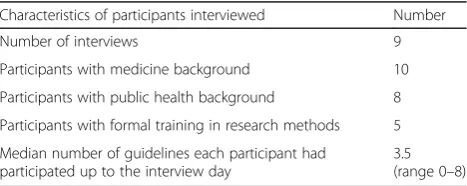
Out of 12 invited experts, 10 individuals agreed to par-ticipate (two individuals refused to parpar-ticipate because of lack of availability during the time of data collection), and we conducted 9 interviews (two participants were interviewed together). Participant characteristics are de-scribed in Table 1 demonstrating different background areas, including malaria, tuberculosis, HIV, reproductive health, diabetes, and evidence-informed policy-making. Four interviewees were native English speakers and the remainder spoke English as a second language.
Themes
WHO definition for rapid advice guidelines
The definition of WHO rapid advice guidelines
(described in Additional file2) was considered‘adequate’
or ‘reasonable’ by participants. Some participants were concerned with the statement explaining‘what is a pub-lic health emergency’. Others recommended replacing the term ‘interim‘ with ‘rapid’, and ‘guide’ or ‘guidance’ with‘guideline’because of the perception that‘guideline’ can be interpreted as a systematic process that should include all the steps.
“I would phrase it differently;‘Emergencies with an impact in public health’, to make it broader: In the sense that…in all emergencies you will have intrinsically public health complements in it. Right? But some are caused by, you know, either manmade or not, but with more focus, like in pandemics, you have a more clear public health component.”
Additional potential or hypothetical situations for performing RGs
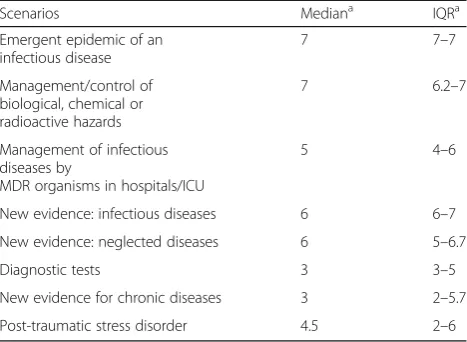
Emergence of new important evidence in terms of effect-iveness, safety or cost-effectiveness about a new or old intervention was considered the most important reason to develop RGs (Table 2). Additional potential reasons mentioned were: “Pressure from country members of the WHO”, “the need for giving an advice”, or “the need to respond to the public opinion”. In response to a series of
eight hypothetical scenarios, participants identified an emergent epidemic of an infectious disease and the man-agement or control of biological, chemical or radioactive hazards as the most important reasons for developing RGs. Less agreement existed for scenarios describing in-fectious diseases due to multidrug-resistant organisms or new evidence about an infectious disease (Table2).
Feasibility and obstacles
The most common perceived obstacle when developing RGs was the lack of personnel resources taking into account the shorter timeframe (i.e. selecting the work group and coordinator, and familiarising experts with the RGs process). Lack of evidence was perceived as an important obstacle and as a risk:
“There may not be enough evidence and if something goes wrong, then WHO may be accused of either being
Table 1Participant characteristics (n= 10)
Characteristics of participants interviewed Number
Number of interviews 9
Participants with medicine background 10
Participants with public health background 8
Participants with formal training in research methods 5
Median number of guidelines each participant had participated up to the interview day
guided by wrong evidence or having pharma industry pushing us to develop a guideline because there is only one medication available. That is the risk.”
Lack of financial resources for the development and the implementation of RGs taking into account lack of availability of interventions, such as drugs, in some countries, were additional perceived obstacles.
Timeline and the most time-consuming aspects
Four participants described that the time should depend on the topic or disease, whereas another four considered 1–3 months as an adequate period but some flexibility would be required according to the topic. However, one participant clearly stated that the best period of time is less than 1 month. Three participants recommended the development of an‘interim’recommendation during the first week if it is needed, maintaining the 1- to 3-month period.
“…what I would suggest as an alternative for this is to get a real rapid response stuff, that takes from 48 hours to 7 days…and which is extremely provisional, which has a big caution, and says:‘this what we have, we are looking to see if there is something else…’”
Four participants stated that evidence gathering and synthesis were the most time-consuming steps in the RG process.
“Talking about the guideline, the most
time-consuming process, of course is this process of evidence and gathering: the systematic review and meta/analysis, which is taking several months”
One participant each responded that external review, drafting and editing the guideline, agreement among ex-perts when there is not robust evidence, finding knowledgeable and available people in the specific topic, getting the guideline approval, and framing the right questions were the most time-consuming steps.
We specifically asked participants to read an example of the Avian Influenza RG (Additional file3) and suggest improvements to the timeline. Although the Avian Influ-enza RG was developed in 3 months, publicising the RG after almost 5 months seemed long for two of the partic-ipants. Participants suggested that the time to comple-tion may be shortened during panel composicomple-tion and question formulation (n= 3), approval period (n= 2), and the writing of the text/formulation of the recommenda-tion (n= 1). Other suggestions included (one participant each) meeting as soon as possible, a RG approval period of 48 h, involvement of the WHO Guideline Re-view Committee (GRC) in regular meetings (of note, the WHO GRC did not exist when the Influenza guide-line was developed and approval processes at WHO were less structured), and to agree on the text of the recommendation during the meetings (although that was already part of the Avian Influenza RG process). Two participants suggested that the timeline could be met depending on other criteria, e.g. it would be “ feas-ible when we have a narrow scope”. One participant
stated that anticipation of the emergencies could allow for people to connect and begin the process earlier.
Systematic reviews and evidence synthesis
Four participants agreed on the importance of maintain-ing appropriate methods in the process:“avoid shortcuts because of bias”, “not doing systematic reviews would lead to loss of data” and “rigor must be maintained”.
However, two participants recommended optimising the processes by making more efficient use of time and maintaining rigor, while others suggested avoiding some steps such as searching grey literature, restricting to the English language, or reducing the search parameters. Two participants insisted on the flexibility of the process based on the urgency of the situation, and two stated that systematic reviews should not be a routine (i.e. in cases of very urgent RGs the process and evidence should be given by experts, without systematic reviews and without methodologists).
Panel composition
Three participants stated that all stakeholders should be in-cluded in the RGs development panel. One participant noted that including all stakeholders is important“when we have limited evidence”. Two participants recommended
that panels might be smaller, while two recommended not including individuals with conflicts of interest.
Table 2Circumstances to develop a Rapid Guideline
Scenarios Mediana IQRa
Emergent epidemic of an infectious disease
7 7–7
Management/control of biological, chemical or radioactive hazards
7 6.2–7
Management of infectious diseases by
MDR organisms in hospitals/ICU
5 4–6
New evidence: infectious diseases 6 6–7
New evidence: neglected diseases 6 5–6.7
Diagnostic tests 3 3–5
New evidence for chronic diseases 3 2–5.7
Post-traumatic stress disorder 4.5 2–6
ICUIntensive-care unit,IQRInterquartile range,MDRMultidrug-resistant
a
“Conflict of interest is a huge problem; If you consult experts, it gets out of control...”
One participant explicitly stated that methodologists should not be part of the team, “because of them, the process is slower and complicated”.
“Maybe we should not involve methodologists; experts would bring the best evidence, since they know what to present and the most important evidence…”
Other participants suggested including health econ-omists and one participant suggested balancing panels for gender and geographic location. Five participants would include patients while two participants would not do so. Six participants agreed that country mem-ber representatives should be included. Of those six, three specified that it would be “important for implementation”.
“I think that if you are in an emergency situation where you really have to do rapid advice having a full representative panel is not always possible…I would try as much as possible to involve them[country member representatives], but the process with the government to choose the appropriate participants is long and you do not always get the right people”
Additional criteria to include: costs and resources, values and preferences, and external review
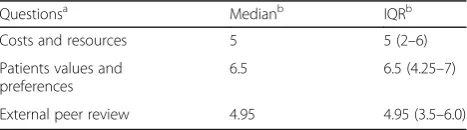
Agreement of participants with regards to the need to include information on cost, values and preferences as well as on external peer-review of RGs is shown in Table3. One participant stated that costs must be taken into account at the implementation step. Two described that information about costs “may be assessed more through expert opinion”, whereas two participants men-tioned that costs are not important in some emergen-cies. One participant was not sure whether costs should be included in RGs.
In the follow-up question, five participants expanded on their thoughts about how patient’s values and preferences should be discussed or incorporated in RGs. Two partici-pants provided suggestions on where information on pa-tient’s values and preferences can be located, namely either through the involvement of non-governmental organisa-tions, by examining the qualitative literature or conducting an ethnographic assessment. Two participants addressed the process for incorporating patient values and prefer-ences; one stated that, for this step, there are“no shortcuts
[in RGs] compared to other guidelines” and the other highlighted that they did not know how to assess patient’s values and preferences and that “…it is difficult even for standard ones”. Another participant stated that
incorporat-ing or discussincorporat-ing patient’s values and preferences was not typically time consuming. Finally, one participant stated that the inclusion of this information was“fundamental”to the context of the guideline.
Regarding external peer review, two participants stated that it could be skipped, whereas one clearly said it should not, and others state that finding good reviewers would be difficult.
“If you are doing[a rapid guideline]for something really urgent, you will probably have all the best experts in the field, sitting in your guideline group, you will have difficulties finding other to do the peer-review; perhaps this step could be skipped”
Four other participants addressed the process for con-ducting external peer review; three spoke of a less rigor-ous process than standard guidelines, with a turnaround of less than 2 days. One participant disagreed with the external review step arguing that the documents are “comprehensive enough”.
Virtual meetings
All participants supported a combination of both virtual and face-to-face meetings. They identified facilitators and barriers to both approaches. Facilitators of virtual meetings included saving resources, efficiency, and “…
people may be less intimidated to give their opinion…”.
Barriers to virtual meetings included trying to gather everybody at the same time given other commitments and different time zones. Facilitators to holding face-to-face meetings included the ability to discuss more materials and to discuss controversial topics and reaching consensus. Four participants stated that “ face--to-face meetings are important” and virtual meetings could complement them.
There were mixed suggestions for the number of face-to-face meetings (e.g. “one face-to-face meeting is important” or “face-to-face meetings important in the beginning and in the end of the process”).
Table 3Agreement level of participants to inclusion of costs, values and preferences, and external peer-review process in the development of Rapid Guidelines
Questionsa Medianb IQRb
Costs and resources 5 5 (2–6)
Patients values and preferences
6.5 6.5 (4.25–7)
External peer review 4.95 4.95 (3.5–6.0)
a
See Appendix 1, for more information about the original question
b
“I do think face-to-face[meetings]are still necessary. But probably in the beginning of the process an at the end of the process; in between, we can be more effective in doing virtual meetings”
Need for extra funding
Five participants said that the availability of more fund-ing is critical for the development of guidelines, statfund-ing that additional funds would facilitate pooling data, hiring extra staff (i.e. people working full time), or hosting meetings. However, one participant recognised that additional funding might not facilitate the process, since many collaborators provide their time in-kind for the de-velopment of RGs. Two participants highlighted that the funds were not necessarily the barrier to developing RGs, but they could allow for faster diffusion of the rec-ommendations. Creation of a specific team for develop-ment of RGs within the WHO was also recommended by one participant.
Discussion
RGs are important for organisations tasked with provid-ing prompt response and effective recommendations for emerging issues in health and disease in a variety of ferent settings. In this study, key participants from dif-ferent areas of WHO involved in the development of RGs were interviewed to identify their experiences and perceptions about the RG development process.
Strengths and weaknesses
The detailed qualitative methods, careful development of the interview process and interviews of real-life guideline developers at a high ranking international organisation by a team with a wealth of experience in guideline meth-odology represent strengths of this study. Given the lim-ited information on this topic, the coupling of our systematic review with the analysis of existing RGs [10] lends support to the importance of our findings. Qualita-tive studies can reveal important information not cap-tured in quantitative surveys. Furthermore, the lack of detailed guidance on RG development that we found in our systematic review in this series [10] indicates that these findings can facilitate the development of such guidance.
Among the limitations of this study, as in many quali-tative studies, is the selection of key participants without considering representativeness. Conclusions drawn from the interviews do not necessarily represent the points of view of other members of the organisation nor the pos-ition of the organisation. Furthermore, we only inter-viewed participants from WHO.
What are RGs? Situations requiring RGs and timing The criteria for defining which situations will require RGs were not clear for participants. Some of them stated that it was necessary to describe which situations or sce-narios could be considered a public health emergency within the WHO RG definition, and perhaps this could expedite the topic selection itself. The WHO Handbook utilised for this study suggested the development of RGs in response to a public health emergency, such as pan-demic influenza, in which WHO is required to provide rapid global leadership and guidance. However, from the perspective of some participants, RGs may be developed in other situations, such as the management of multidrug-resistant organism infectious diseases or con-trol of biological, chemical or radioactive hazards, among others. Other situations, such as diagnostic test-ing, new evidence on chronic diseases or post-traumatic disorders, were considered important by some partici-pants, but not by others.
available, when new information on an existing technol-ogy is likely to change existing guidance, or because a Member State or external entity has made an urgent re-quest for guidance. However, because of these reasons, the handbook recommends that the guideline may be developed with the same standards of other guidelines; a short timeframe could be achieved with allocation of ap-propriate resources [4].
In the same line, other authors have stated that rapid re-views can be seen as an ‘interim guidance’while a formal systematic review in a second stage is developed [16, 17]. For instance, there are situations when immediate action, within hours or a day, is required such as in radiation or toxin exposures [15]. Thus, in emergency situations, a re-sponse may be performed between 1 and 3 months, while in cases where an interim guidance is to be given (i.e. and urgent response is needed), a recommendation during the first 1 to 2 weeks may be provided [15].
Systematic reviews and evidence synthesis
We observed that some participants suggested following all steps expected in a regular guideline development process. Some participants did suggest avoiding certain steps of the process of regular guideline development but yet wanted to maintain a balance with rigor in the process. These participants suggested streamlining the evidence review and systematic review processes, redu-cing the peer-review process, and expediting the admin-istrative issues related to the approval of RGs. On the other hand, few participants recommended skipping it and supporting decisions on experts’opinion that would not describe the source of evidence for their opinion. Other participants suggested avoiding other steps but maintaining the systematic review. In this study, there was a perception that the systematic review of the evi-dence is a very time-consuming step in the RG develop-ment process. The methods for developing high-quality rapid reviews are a relatively new enterprise and can be challenging, but maintaining adherence to a minimum standard in the search, selection and synthesis of evi-dence methods, as well as maintaining standards of complete reporting, are key to avoiding the development of unreliable recommendations [18–20].
In fact, rapidly developed guidelines should not be as-sociated with lack of trustworthiness. We believe that adequate planning which is supported by existing guide-lines for guideguide-lines [4] can result in the development of a trustworthy RG, without eliminating the systematic re-view required to retain evidence-based principles. In contradiction to these principles, some participants per-ceived experts as a very reliable source of evidence, stat-ing that they can brstat-ing the best evidence. Furthermore, two participants suggested that methodologists may be a ‘barrier’ when there is a need for very rapid response.
We think this may be because methodologists are associ-ated with a long systematic process while expert opinions can be related to expedited decision-making processes. In contrast, other authors suggest that methodologists, as ex-perts of the guideline development process, are critical members in the process of any evidence-based guideline to ensure transparency [21]. Striking the right balance be-tween obtaining information and avoiding bias is challen-ging. There is no reason to believe that a rapid process solely relying on expert opinion would avoid the concerns previously identified with regular guidelines at WHO [6]. In fact, conducting rapid reviews was suggested to over-come part of this challenge. In addition, we previously described that, in addition to rapid reviews, transparent methods for evidence assessment can be used for emer-gent and uremer-gent situations [16, 17]. However, we believe that these efforts require methodological expertise. If methodologists facilitate the adherence to these principles of high rigor while recognising time constraints they would no longer be perceived as barriers, but rather as fa-cilitators of systematic and adaptable processes.
Panel composition
Finally, when participants were asked about the Influ-enza RG process, they also recommended the involve-ment of members of the WHO GRC in regular meetings during the RG process. Interestingly, this recommenda-tion arose at the time of data collecrecommenda-tion although this committee did not exist at WHO at the time of the In-fluenza RG development. Nevertheless, this idea highlighted the need for appropriate planning and in-volvement of key actors within the organisation to en-hance the process and avoid administrative delays after RGs have been drafted.
External review, values and preferences, and external review
beginning. Participants’criticism of the peer-review step was deemed as having the potential to impact the final recommendations. In fact, recommendations should preferably not change because of peer review as it would require reconvening of the panel.
Finally, consideration of costs and resources and of pa-tients’values and preferences when developing RGs was seen predominantly, but not consistently, as important. Concerns about the importance of costs on emergency situations were raised, as well as their importance when implementing the guidelines. Furthermore, there was some agreement in the inclusion of values and prefer-ences in the process, which was considered an action that can be easily implemented in the process.
RG development process and funding
All participants supported the process with mixed meet-ings (face-to-face and virtual) despite both types being associated with advantages and disadvantages. Careful planning of the process with one or two meetings might lead to efficient use of time while allowing appropriate deliberation and discussion. Increased funding was considered as a way to improve the process by most of participants. This action was also seen as a potential en-abler of human resource working allowing the simultan-eous work of teams of experts and methodologists, which would result in a more efficient process.
Conclusions
RGs are an important tool to inform decision-making in the context of health emergencies or urgencies as they can allow for evidence-based recommendations. Our study identified appropriate balance between the rigor and speed of the process as key themes. While systematic reviews are the basis of any guideline process, some participants consid-ered them to be an obstacle. This can be overcome by con-ducting rapid reviews. Peer-review processes were identified as a major issue in providing rapid guidance. While our work is based on interviews at WHO, they might be useful to other organisations dealing with emergencies or urgen-cies. Based on the findings of this and the prior article [10], and utilising the GIN-McMaster Checklist for Guideline Development, the next and final article in this series will provide guiding principles for the development of RGs [24].
Additional files
Additional file1:Interview questions. (DOCX 19 kb)
Additional file 2:WHO rapid Advice Guideline definition. (DOCX 18 kb)
Additional file 3:Avian influenza rapid advice guideline–timeline. (DOCX 20 kb)
Abbreviations
GRC:Guideline Review Committee; RGs: rapid guidelines
Acknowledgements
Dr Susan L. Norris, World Health Organization, Geneva, Switzerland, contributed to the design of this study and to its implementation.
Funding
This research was supported by McMaster University internal research funds.
Availability of data and materials
The datasets generated and/or analysed during the current study are available from the corresponding author on reasonable request.
Authors’contributions
MF and HS designed and conceived the study. MF, II, YZ, NS, SK, WW and HS developed and piloted the interview instrument. MF conducted participant interviews. IF and RM analysed the data. IF, RM, MF and HS wrote and revised the manuscript. HS provided key institutional support. All authors read and approved the final manuscript.
Competing interests
The authors declare that they have no competing interests.
Publisher’s Note
Springer Nature remains neutral with regard to jurisdictional claims in published maps and institutional affiliations.
Author details
1Department of Health Research Methods, Evidence and Impact and Mac
GRADE Center, McMaster University Health Sciences Centre, Room 2C16, 1280 Main Street West, Hamilton, ON L8N 4K1, Canada.2Department of
Pediatrics, University of Antioquia, Cra. 51D #62-29, Medellin 050001, Colombia.3Hospital Moinhos de Vento, Porto Alegre, Brazil.4National
Institute of Science and Technology for Health Technology Assessment, Universidade Federal do Rio Grande do Sul, Porto Alegre, Brazil.5Department
of Internal Medicine, Division of Rheumatology, Universidade Federal do Paraná, R. Gen. Carneiro, 181, Curitiba, PR, Brazil.6Department of Medicine,
McMaster University, Health Sciences Centre, Room 2C14, 1280 Main Street West, Hamilton, ON L8S 4K1, Canada.7Cochrane Canada Center, McMaster
University, Health Sciences Centre, Room 2C14, 1280 Main Street West, Hamilton, ON L8S 4K1, Canada.
Received: 16 August 2017 Accepted: 22 May 2018
References
1. Institute of Medicine. Clinical Practice Guidelines we Can Trust. Washington, DC: National Academies Press; 2011.
2. Scottish Intercollegiate Guidelines Network. SIGN 50: A Guideline Developers’Handbook. Edinburgh: Scottish Intercollegiate Guidelines Network; 2008.
3. National Institute for Health and Care Excellence N. The Guidelines Manual. London: NICE; 2012.
4. World Health Organization. WHO Handbook for Guideline Development. Geneva: WHO; 2014.
5. Oxman AD, Fretheim A, Schünemann HJ. Improving the use of research evidence in guideline development: introduction. Health Res Policy Syst. 2006;4(1):1.
6. Oxman AD, Lavis JN, Fretheim A. Use of evidence in WHO recommendations. Lancet. 2007;369(9576):1883–9.
7. World Health Organization. WHO handbook for guideline development. 2nd ed. Geneva: WHO; 2012.
8. World Health Organization. Rapid Advice: Antiretroviral Therapy for HIV Infection in Adults and Adolescents. Geneva: WHO; 2009.
9. World Health Organization. Rapid Advice: Treatment of Tuberculosis in Children. Geneva: WHO; 2010.
10. Kowalski SC, Morgan RL, Falavigna M, et al. Development of rapid guidelines: 1. Systematic review of current practices and methods. Health Res Policy Syst. Under review
11. O’Brien BC, Harris IB, Beckman TJ, et al. Standards for reporting qualitative research: a synthesis of recommendations. Acad Med. 2014;89(9):1245–51.
12. Braun V, Clarke V. Using thematic analysis in psychology. Qual Res Psychol. 2006;3(2):77–101.
13. Sandelowski M. What's in a name? Qualitative description revisited. Res Nurs Health. 2010;33(1):77–84.
14. Sandelowski M. Focus on research methods-Whatever happened to qualitative description? Res Nurs Health. 2000;23(4):334–40.
15. Thayer KA, Schünemann HJ. Using GRADE to respond to health questions with different levels of urgency. Environ Int. 2016;92–93:585–9. http://dx.doi. org/10.1016/j.envint.2016.03.027
16. Watt A, Cameron A, Sturm L, et al. Rapid reviews versus full systematic reviews: an inventory of current methods and practice in health technology assessment. Int J Technol Assess Health Care. 2008;24(02):133–9.
17. Hailey D, Corabian P, Harstall C, et al. The use and impact of rapid health technology assessments. Int J Technol Assess Health Care. 2000;16(02):651–6. 18. Ganann R, Ciliska D, Thomas H. Expediting systematic reviews: methods and
implications of rapid reviews. Implement Sci. 2010;5(1):56.
19. Khangura S, Konnyu K, Cushman R, et al. Evidence summaries: the evolution of a rapid review approach. Syst Rev. 2012;1(1):1–9.
20. Schünemann HJ, Moja L. Reviews: Rapid! Rapid! Rapid!…and systematic. Syst Rev. 2015;4(1):1–3.
21. Fretheim A, Schünemann H, Oxman AD. Improving the use of research evidence in guideline development: 5. Group processes. Health Res Policy Syst. 2006;4:17.
22. Brouwers MC, Kho ME, Browman GP, et al. AGREE II: advancing guideline development, reporting and evaluation in health care. Can Med Assoc J. 2010;182(18):E839–E42.
23. Centers for Disease Control and Prevention C. Guidelines and
Recommendations: A CDC Primer. Atlanta: Office of the Associate Director for Science Centers for Disease Control and Prevention; 2012.