Open Access
Research
Serial personal digital assistant data capture of health-related
quality of life: A randomized controlled trial in a prostate cancer
clinic
Andrew G Matthew
1,2, Kristen L Currie*
1, Jane Irvine
2,3, Paul Ritvo
2,4,5,
Daniel Santa Mina
1, Leah Jamnicky
1, Robert Nam
2,6and John Trachtenberg
1,2Address: 1Department of Surgical Oncology, University Health Network, Toronto, Ontario, Canada, 2Department of Surgery, University of Toronto, Toronto, Ontario, Canada, 3Department of Psychology, York University, 4700 Keele St, Toronto, Ontario M3J 1P3, Canada, 4School of Kinesiology & Health Science, York University, 4700 Keele St, Toronto, Ontario M3J 1P3, Canada, 5Division of Preventive Oncology, Cancer Care Ontario, 620 University Avenue, Toronto, Ontario, M5G 2M9, Canada and 6Divisions of Urology and Surgical Oncology, Sunnybrook Health Sciences Centre, 2075 Bayview Avenue, Toronto, Ontario, M4N 3M5, Canada
Email: Andrew G Matthew - [email protected]; Kristen L Currie* - [email protected]; Jane Irvine - [email protected]; Paul Ritvo - [email protected]; Daniel Santa Mina - [email protected]; Leah Jamnicky - [email protected];
Robert Nam - [email protected]; John Trachtenberg - [email protected] * Corresponding author
Abstract
Background: In clinical and research practice linked to prostate cancer treatment, frequent monitoring of patient health-related quality of life (HRQOL) is essential. Practical and analytic limitations of paper questionnaire data capture may be overcome with the use of self-administered personal digital assistant (PDA) data collection. The objective of this study was to assess the reliability, validity, and feasibility of using PDA in place of paper versions of the International Prostate Symptom Score (IPSS), the Patient Oriented Prostate Cancer Utility Survey (PORPUS), and the International Index of Erectile Function-5 (IIEF-5) in a prostate cancer clinic setting.
Methods: 152 participants were randomly assigned to one of three conditions: 1) paper followed by PDA survey; 2) PDA followed by paper survey; or 3) PDA followed by PDA survey. Evaluation included an assessment of data quality (internal consistency, test-retest reliability, response correlation, completeness of data), and feasibility (participation rates, time to completion, preference and difficultly/ease of using PDA).
Results: Internal consistency was similar for both PDA and paper applications. Test-retest reliability was confirmed for PDA repeated administration. Data from paper and PDA questionnaires were strongly correlated. Lower missed item rates were found in PDA administration. 82.8% of participants preferred using the PDA or had no preference. Mean difficulty/ease ratings indicated that participants found the PDA easy to use. Age did not significantly correlate with preference or difficulty.
Conclusion: The results confirm the adaptability of the IPSS, IIEF-5, and the PORPUS to PDA administration. Similarly, the findings of this study support the feasibility of using PDA technology for HRQOL serial data capture in the prostate cancer patient population.
Published: 6 July 2007
Health and Quality of Life Outcomes 2007, 5:38 doi:10.1186/1477-7525-5-38
Received: 21 December 2006 Accepted: 6 July 2007
This article is available from: http://www.hqlo.com/content/5/1/38 © 2007 Matthew et al; licensee BioMed Central Ltd.
Background
The long term survival rates and treatment side-effect pro-files of most prostate cancer patients combine to empha-size the importance of serial monitoring of health-related quality of life (HRQOL) in advancing clinical care and treatment outcome research. With the advent of prostate specific antigen (PSA) testing, prostate cancer detection rates continue to increase resulting in more and younger men having to cope with the impact of treatment on HRQOL. Specific HRQOL areas of concern for this popu-lation of men include sexual, urinary, and bowel dysfunc-tion [1,2]. These side-effects are also known to change over time and can have considerable impact on the patient's emotional, functional, and social well-being [2-4].
Frequent and systematic collection of HRQOL informa-tion in the prostate cancer patient populainforma-tion is therefore necessary for informed treatment decision-making, thor-ough patient care, and comprehensive evaluation of treat-ment outcome. In collecting this ongoing data, traditional paper questionnaires can be problematic within the clinic setting. For example, if clinical decision-making necessi-tates input from patient questionnaire data, the paper for-mat can require too much processing time to be helpful under the usual time constraints of the clinical consulta-tion [5]. Furthermore, whether the quesconsulta-tionnaire data are electronically scanned or manually entered into a clinic database for analysis, the integrity of the data is vulnerable to data entry errors [6]. These limitations to the traditional paper questionnaire data capture method may be over-come with the use of an electronic data collection system.
Electronic data capture with desktop computers (includ-ing touch-screen applications) [7,8], tablets [9], or hand-held personal digital assistants (PDA) [6,10,11] has been shown to improve data quality and allow for immediate and effective data manipulation. Electronic data collec-tion improves data quality by providing software safe-guards against entry omission and inconsistent response sets, and by completely eliminating data entry errors at the researcher's level. Moreover, because the data are captured electronically, data manipulation and analysis can be achieved faster than is possible with a paper data capture format. Indeed, results can be immediately scored, dis-played and printed, allowing the clinician to review and interpret a patient profile in the company of the patient and discuss possible treatment decisions [6,10,11].
Although there may be a relatively significant start-up cost associated with electronic data collection, costs associated with questionnaires (paper and reproduction), data entry, coding, and cleaning are either eliminated or substantially reduced [6]. Additionally, advances in technology
con-tinue to result in reduced costs associated with electronic data collection computer devices and software [10,12].
Handheld PDA devices may be particularly economical and effective for electronic data collection in high traffic clinical healthcare settings [13-16]. PDA technology meets or exceeds the hardware requirements necessary for data collection in most clinical healthcare research. Given the low individual unit cost, multiple PDA units can be deployed at a fraction of the cost of a single desktop, lap-top or tablet. The portability of the PDA offers greater flex-ibility within a clinic setting, less demand for clinic space (e.g. workstation) and, due to PDA energy efficiency, reduced dependence on battery power compared to lap-tops or tablets.
Moreover, for security purposes, PDA software allows for only a single patient's data to be collected at any one time. The data collected are protected through the use of multi-ple levels of encryption and a password access system. Once the PDA has been synchronized with the personal computer (PC), the patient self-reported data are purged from the unit. These features ensure that only the current user's data are stored on the PDA and that the data are only accessible to appropriate clinic staff. All other medi-cal data are stored in the Prostate Centre main database and are not directly accessible on either the PC or PDA. The Prostate Centre database is safeguarded through industry standard security and operational protections. Therefore, if a PDA device is lost or stolen, sensitive infor-mation will not be accessible.
These advantages notwithstanding, there are some draw-backs to PDA data collection. A potential problem with electronic data collection devices, including the PDA, is that lack of computer literacy may cause some patients to prefer paper forms to computerized versions [17]. The majority of studies, however, document patient accept-ance of and preference for using PDAs over paper forms [12,14,17,18]. Patients have also reported difficulty in seeing the questions due to the relatively small display screens in PDA [7,19]. Increasing text font size and restricting the amount of text per screen can overcome this limitation. As well, some patients may be unfamiliar with using PDA devices and may require guidance/training from clinic staff.
response correlation, completeness of data), and feasibil-ity (participation rates, time to completion, preference, and difficultly/ease of using PDA). The unique relevance of this research is its focus on 1) the responses of prostate can-cer patients to the PDA data collection system, and 2) the adaptability of the International Prostate Symptom Score (IPSS), the Patient Oriented Prostate Cancer Utility Survey (PORPUS), and the International Index of Erectile Func-tion-5 (IIEF-5) to the PDA format.
Methods
Participant selection and study design
Prostate cancer patients at the outpatient clinic of the Prostate Centre, Princess Margaret Hospital, Toronto, between April 1 and July 15, 2006 were considered for participation in the study. Eligible patients were identified by the uro-oncologists and the research team prior to attending each outpatient clinic. Potential participants were approached in the clinic upon registering at recep-tion and the particulars of the study and specific informa-tion on the requirements of participainforma-tion were described. Informed consent was obtained from all eligible patients agreeing to participate. Where possible, reasons for refus-ing to participate were recorded along with the patient's age and treatment stage (pretreatment or time since treat-ment). Inclusion criteria included prostate cancer patients (new or follow-up patients) who could read, speak and write English, and who did not have significant hearing or visual impairment. All patients meeting these criteria were invited to participate. This study received approval from the University Health Network Research Ethics Board.
One hundred and fifty-two (n = 152) participants were randomly assigned using a random number generator [20] to one of three HRQOL survey administration condi-tions: 1) paper survey followed by PDA survey; 2) PDA survey followed by paper survey; or 3) PDA survey fol-lowed by PDA survey. Each participant was asked to com-plete one survey administration at clinic check-in and one after a 30-minute wait period prior to their clinical consul-tation with the uro-oncologist. The separation in time between completing the two survey administrations allowed for the avoidance of immediate recall respond-ing, and analysis of test-retest reliability of the PDA modality (Condition 3). The alternating paper/PDA sur-vey administrations (Conditions 1, 2) was designed to allow for control of order effects. All participants were given a brief (less than 1 minute) tutorial on using the PDA. Patients were shown how to select a response by tap-ping the stylus to the PDA, and were instructed on how to enter their date of birth, hospital ID number, and how to proceed to the next screen.
Following completion of two survey administrations (Conditions 1, 2 or 3), participants were given a one-page
questionnaire examining the level of difficulty/ease using the PDA and survey format preferences. All participants were asked to rate ease/difficulty by completing a 10-point visual analogue scale (VAS) ranging from "Very Dif-ficult" (0) to "Very Easy" (10). Patients participating in conditions 1 and 2 were then asked to complete a 10-point VAS examining format preferences, ranging from paper questionnaire (0) to PDA questionnaire (10). The cut-off score used to determine ease of use and preference for PDA was 5.1. All participants were given the opportu-nity to comment on what they liked/disliked about the PDA format.
Materials
Health-related quality of life measures
All participants were asked to complete a paper and/or PDA version of the International Prostate Symptom Score (IPSS) [21], the Patient Oriented Prostate Cancer Utility Survey (PORPUS) [22], and the International Index of Erectile Function-5 (IIEF-5) [23]. The IPSS is an 8-item measure of patient urinary voiding function commonly used in prostate cancer research [24-28]. The PORPUS is a prostate cancer specific measure of HRQOL. The 10-item psychometrically validated instrument assesses ten qual-ity of life domains: energy, pain, emotional well-being, support from family/friends, communication with doc-tor, erectile function, sexual interest, urinary frequency, bladder control and bowel symptoms. The IIEF-5 is a short-form version of the International Index of Erectile Function [29], and is used in clinical settings to assess erectile dysfunction. The questions explore maintenance ability, erection confidence, maintenance frequency, erec-tion firmness and intercourse satisfacerec-tion [23]. All of the measures are reliable and valid [21,30,31].
In order to adapt the IPSS, IIEF-5, and PORPUS to the PDA device, the questions were presented one question per PDA screen. Consequently, in comparison to paper forms, participants completing the PDA version were able to see only one question at a time (Figure 1).
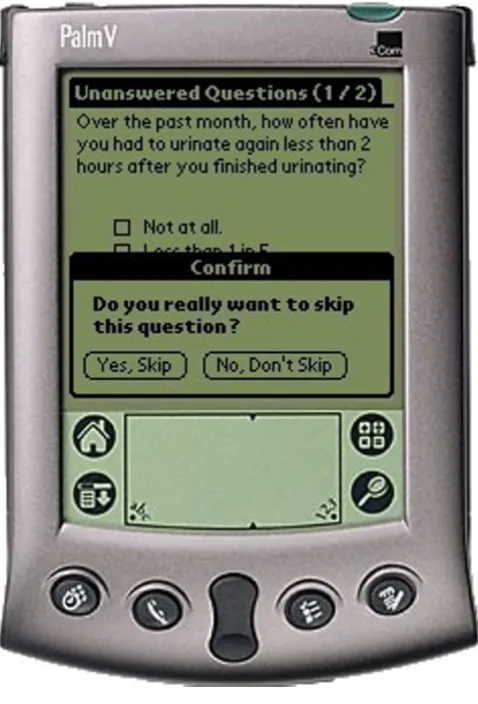
then repeated, giving participants the option to complete each of the unanswered questions or to confirm that they have chosen to skip the questions (Figure 2).
Upon completion of the survey, the participant returned the PDA to research staff for data synchronization with a PC. During the synchronization, demographics informa-tion was checked against that of known patients stored in a relational database on the PC. If no demographics match was found, the participant was asked to correct his demographics information on the PDA and resynchronize (survey responses were preserved). Otherwise, survey data from the PDA was transferred into the database on the PC, a report was generated for the patient, and the PDA was cleared of data in preparation for the next user.
PDA software was developed in C++ for the Palm Vx series of PDAs. All surveys were administered using Palm Vx PDAs. Synchronization (Palm COM Conduit) and report generation software was written in Visual Basic [32]. Microsoft Access [33] was used as a relational database to transfer data to the Statistical Package for the Social Sci-ences (SPSS) [34].
Paper HRQOL Survey
Paper surveys were marked with identification numbers and handed to participants by study investigators. Partici-pants were supplied with a pen and clipboard, and instructed to complete questionnaires in the clinic waiting room. Upon completion of the survey, participants returned the questionnaire package to study investigators. Survey data were entered by an investigator into SPSS [34].
Statistical methods
Comparisons of characteristics between non-respondents and respondents, and amongst the three experimental conditions were made using chi-square and t-tests. Demo-graphic characteristics of participants are shown in Table 1.
Data quality
Internal consistency of related questionnaire items within administration mode (PDA and Paper) was assessed by Cronbach's alpha. Test-retest reliability within the PDA capture mode and concurrent validity examining the reproducibility between the initial administration and
Side by side comparison: PDA and paper/pencil survey
Figure 1
Side by side comparison: PDA and paper/pencil survey.
6 5 4 3 2 1 0 If you were to spend the rest of your life with your urinary condition just the way it is now, how would you feel about that?
Terrible Unhappy Mostly dissatisfied Equally satisfied & dissatisfied Mostly satisfied Pleased Delighted 5 4 3 2 1 0 7. How many times did you most typically get up to urinate from the time you went to bed at night until the time you got up in the morning? 5 Times or more 4 Times 3 Times 2 Times 1 Time None 5 4 3 2 1 0 6. How often have you had to push or strain to begin urination?
5 4 3 2 1 0 5. How often have you had a weak urinary stream? 5 4 3 2 1 0 4. How often have you found it difficult to postpone urination? 5 4 3 2 1 0 3. How often have you found you stopped and started again several times when you urinated? 5 4 3 2 1 0 2. How often have you had to urinate again less than two hours after you finished urinating? 5 4 3 2 1 0 1. How often have you had a sensation of not emptying your bladder completely after you finish urinating?
Almost always More than half the time About half the time Less than
half the time Less than 1
time in 5 Not at all
6 5 4 3 2 1 0 If you were to spend the rest of your life with your urinary condition just the way it is now, how would you feel about that?
Terrible Unhappy Mostly dissatisfied Equally satisfied & dissatisfied Mostly satisfied Pleased Delighted 5 4 3 2 1 0 7. How many times did you most typically get up to urinate from the time you went to bed at night until the time you got up in the morning? 5 Times or more 4 Times 3 Times 2 Times 1 Time None 5 4 3 2 1 0 6. How often have you had to push or strain to begin urination?
5 4 3 2 1 0 5. How often have you had a weak urinary stream? 5 4 3 2 1 0 4. How often have you found it difficult to postpone urination? 5 4 3 2 1 0 3. How often have you found you stopped and started again several times when you urinated? 5 4 3 2 1 0 2. How often have you had to urinate again less than two hours after you finished urinating? 5 4 3 2 1 0 1. How often have you had a sensation of not emptying your bladder completely after you finish urinating?
Almost always More than half the time About half the time Less than
half the time Less than 1
repeat administration of the two data capture modes was assessed by the intraclass correlation coefficients (ICC) of a 2-way mixed model reliability model. The ICCs were computed on the total scores for the IPSS, IIEF-5, and for the 10 separate domains of the PORPUS. To investigate possible order effects, an independent sample t-test was used to compare conditions 1 and 2 in terms of variation in scores in the first and second administration. Com-pleteness of data was compared between modes of appli-cation on an individual item basis across the three health measures.
Feasibility
To assess feasibility of using the PDA versus paper admin-istration modes of the HRQOL questionnaires, participa-tion rates, time to compleparticipa-tion, and patient preference were recorded in administration conditions 1 and 2, and difficulty with using the PDA administration in adminis-tration conditions 1, 2, and 3. Statistical analysis was per-formed using SPSS [34].
Results
Sample characteristics
A total of 216 patients were approached to participate in the study over a 3.5 month period between April 1 and July 15, 2006. Thirty-one patients (22%) declined to par-ticipate. The reasons for refusal included: 18 patients (8%) did not want to complete any questionnaires (paper or PDA versions), 5 patients (2%) did not have their eye-glasses, 2 patients (1%) reported time constraints, 1 patient (0.5%) stated that he was uncomfortable with 'electronics', and the remaining 5 patients (2%) did not provide a reason for non-participation. A further 16 patients failed to complete the entire study protocol and were excluded from the analysis. Reasons for partial par-ticipation included time constraints and a refusal to com-plete the questionnaire for a second time. A chi-square analysis revealed these partial respondents were equally represented across experimental conditions. An addi-tional 17 (8%) participants were excluded from the study because clinic wait-times were less than 30 minutes and did not allow for second administration of the question-naires. Therefore, 152 patients were included in the anal-ysis, 70% of those initially approached about the study. No significant differences were observed between partici-pants and non-participartici-pants on age and purpose of clinic visit (elevated risk, cancer diagnosis, treatment follow-up).
As a result of random number assignment, 53 participants completed the paper survey followed by PDA survey (Condition 1), 53 participants completed the PDA survey followed by paper survey (Condition 2), and 46 partici-pants completed the PDA survey followed by another administration of the PDA survey (Condition 3). Between group analysis of participant age and purpose of clinic visit revealed no significant differences (Table 1) amongst the three conditions.
PDA skipped question confirmation screen
Figure 2
PDA skipped question confirmation screen.
Table 1: Comparison of characteristics of respondents by experimental condition
Reason for Clinic Visit Condition N (% of total) Mean Age (S.D.) Age Range
(years)
Elevated Risk (%)
Diagnosis (%) Treatment Follow-up (%)
Data quality
Internal consistency coefficients (Cronbach's alpha) across the IPSS and IIEF-5 revealed excellent internal con-sistency for both the PDA and paper applications (Table 2).
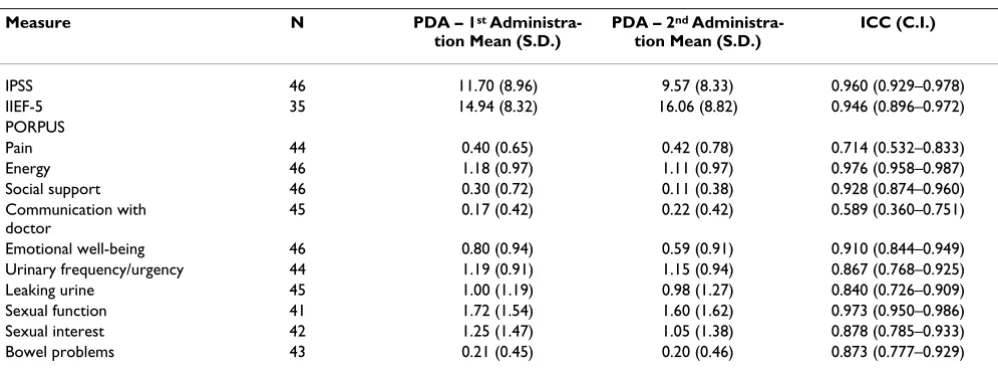
ICCs used to measure test-retest reliability in Condition 3 for repeated PDA administration of the IPSS, IIEF-5, and the PORPUS quality of life domains are shown in Table 3. The large magnitude correlation coefficients are all highly significant (p < 0.01).
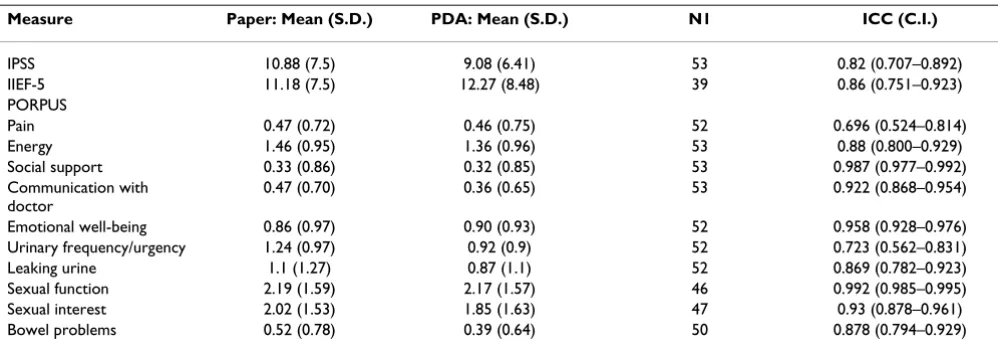
ICCs reveal that the total scores by patients completing paper and PDA questionnaires were strongly correlated (Table 4a and 4b). This provides evidence of concurrent validity across administration modalities. The correlation coefficients reported are all highly significant (P < 0.01).
An independent sample t-test was used to compare condi-tions 1 and 2 in terms of the variation in scores inputted in the first and second administration. Non-significant t-scores suggest that there was no order effect. A final aspect of data quality that was measured included a comparison of completeness of data collected via the two modes of administration. Examination of individual item comple-tion in Condicomple-tion 1 revealed that when completing the
IPSS, IIEF-5 and PORPUS in the paper format, 10%, 27.7%, and 7.5% of respondents failed to complete at least one question. In comparison, when completing the IPSS, IIEF-5, and PORPUS in the PDA format, 0%, 13.6%, and 7.5% of respondents failed to complete at least one question. Similarly, the same analysis in Condition 2 revealed that 11.3%, 17.0%, and 5.1% of the items were missed in the paper administration version of the IPSS, IIEF-5, and PORPUS, respectively. In contrast only 0%, 6.8%, and 5.7% of the items were missed on the PDA administration versions of the IPSS, IIEF-5, and PORPUS, respectively. Finally, the analysis of Condition 3 revealed exactly the same results for the first and second adminis-tration of the questionnaire using the PDA. Missed item rates for the IPSS, IIEF-5, and PORPUS were 0%, 0%, and 8.7% respectively.
Feasibility
A Pearson chi-square was used to assess possible differ-ences in level of participation (full, partial, decline) across experimental condition (1, 2, 3) for all 216 patients approached for participation in this study. No significant differences were found. As well, in comparing mode of application, participants were able to complete the survey significantly faster using the PDA. Mean times for comple-tion using the paper survey for condicomple-tions 1 and 2 were Table 2: Internal consistency coefficients by measure
Mode of Application IPSS (Cronbach's alpha range) IIEF-5 (Cronbach's alpha range)
Paper .78 to .85 .97 to .98
PDA .85 to .87 .97 to .98
Note: This analysis was not performed on the PORPUS as this scale uses 10 independent questions to measure 10 quality of life domains and is not an appropriate scale for internal consistency analysis.
Table 3: Intraclass correlation coefficients of PDA administration of questionnaires
Measure N PDA – 1st
Administra-tion Mean (S.D.)
PDA – 2nd
Administra-tion Mean (S.D.)
ICC (C.I.)
IPSS 46 11.70 (8.96) 9.57 (8.33) 0.960 (0.929–0.978)
IIEF-5 35 14.94 (8.32) 16.06 (8.82) 0.946 (0.896–0.972)
PORPUS
Pain 44 0.40 (0.65) 0.42 (0.78) 0.714 (0.532–0.833)
Energy 46 1.18 (0.97) 1.11 (0.97) 0.976 (0.958–0.987)
Social support 46 0.30 (0.72) 0.11 (0.38) 0.928 (0.874–0.960) Communication with
doctor
45 0.17 (0.42) 0.22 (0.42) 0.589 (0.360–0.751)
Emotional well-being 46 0.80 (0.94) 0.59 (0.91) 0.910 (0.844–0.949) Urinary frequency/urgency 44 1.19 (0.91) 1.15 (0.94) 0.867 (0.768–0.925) Leaking urine 45 1.00 (1.19) 0.98 (1.27) 0.840 (0.726–0.909) Sexual function 41 1.72 (1.54) 1.60 (1.62) 0.973 (0.950–0.986) Sexual interest 42 1.25 (1.47) 1.05 (1.38) 0.878 (0.785–0.933) Bowel problems 43 0.21 (0.45) 0.20 (0.46) 0.873 (0.777–0.929)
12.5 minutes, and 10.2 minutes, respectively, compared to 11.2 minutes and 8.6 minutes respectively using the PDA format.
Preference for using paper or PDA modes of application was measured using a 10-point VAS, ranging from paper preference to PDA preference. Results of the analysis revealed that 58.6% of patients preferred using the PDA format, 24.2% had no preference, and 17.2% preferred the paper format. To determine if age had an impact on preference, a Pearson correlation coefficient was com-puted between age and the mode preference scale. The correlation coefficient was weak (r = 0.16, p = 0.12) and not statistically significant. In a similar fashion, difficulty of use of the PDA administration was also measured using a 10-point VAS. The mean score was 8.6. Again, there was a weak and non-significant correlation between age and scores on the visual analogue difficulty scale (r = -0.15, p = 0.08).
All participants were provided with a brief tutorial on using the PDA. Following the tutorial, a research assistant documented the frequency and content of questions asked by participants while using the PDA. The majority of patients (76%) were able to complete PDA adminis-tered questionnaires without requiring further instruc-tion. Twenty-nine (19%) patients were able to complete the PDA administered questionnaire by presenting with 1 or 2 follow-up questions or concerns, and the remaining 7 (5%) patients presented 3 or more inquiries. Questions or concerns included difficulty recording answers on the PDA as a result of stylus-device insensitivity. Other inquir-ies included how to skip questions, and how to correct errors entering hospital ID or date of birth. Four patients required assistance with the paper questionnaire.
Discussion
Data quality
The results of this study showed that PDA administration of the IPSS, IIEF-5, and the PORPUS was psychometrically Table 4a: Concurrent validity across administration modalities – Condition 1 (Paper/PDA)
Measure Paper: Mean (S.D.) PDA: Mean (S.D.) N1 ICC (C.I.)
IPSS 10.9 (6.88) 9.8 (6.62) 52 0.901 (0.834–0.942)
IIEF-5 11.39 (8.25) 12.39 (7.73) 41 0.963 (0.931–0.980)
PORPUS
Pain 0.41 (0.77) 0.43 (0.75) 53 0.92 (0.865–0.953)
Energy 1.5 (0.91) 1.53 (0.89) 53 0.898 (0.830–0.940)
Social support 0.25 (0.69) 0.29 (0.72) 52 1 (1.00–1.00)
Communication with doctor 0.26 (0.52) 0.42 (0.949) 52 0.38 (0.122–0.590) Emotional well-being 0.73 (0.86) 0.74 (0.74) 53 0.78 (0.647–0.867) Urinary frequency/urgency 1.1 (0.75) 1.08 (0.76) 52 0.818 (0.702–0.891) Leaking urine 0.88 (0.8) 1.23 (1.07) 53 0.551 (0.332–0.714) Sexual function 2.17 (1.49) 2.06 (1.42) 51 0.924 (0.871–0.956) Sexual interest 1.53 (1.42) 1.67 (1.38) 50 0.934 (0.886–0.961) Bowel problems 0.4 (0.59) 0.34 (0.52) 53 0.933 (0.886–0.961)
*All correlations are significant at p ≤ 0.01
Table 4b: Concurrent validity across administration modalities – Condition 2 (PDA/Paper)
Measure Paper: Mean (S.D.) PDA: Mean (S.D.) N1 ICC (C.I.)
IPSS 10.88 (7.5) 9.08 (6.41) 53 0.82 (0.707–0.892)
IIEF-5 11.18 (7.5) 12.27 (8.48) 39 0.86 (0.751–0.923)
PORPUS
Pain 0.47 (0.72) 0.46 (0.75) 52 0.696 (0.524–0.814)
Energy 1.46 (0.95) 1.36 (0.96) 53 0.88 (0.800–0.929)
Social support 0.33 (0.86) 0.32 (0.85) 53 0.987 (0.977–0.992) Communication with
doctor
0.47 (0.70) 0.36 (0.65) 53 0.922 (0.868–0.954)
Emotional well-being 0.86 (0.97) 0.90 (0.93) 52 0.958 (0.928–0.976) Urinary frequency/urgency 1.24 (0.97) 0.92 (0.9) 52 0.723 (0.562–0.831) Leaking urine 1.1 (1.27) 0.87 (1.1) 52 0.869 (0.782–0.923) Sexual function 2.19 (1.59) 2.17 (1.57) 46 0.992 (0.985–0.995) Sexual interest 2.02 (1.53) 1.85 (1.63) 47 0.93 (0.878–0.961) Bowel problems 0.52 (0.78) 0.39 (0.64) 50 0.878 (0.794–0.929)
comparable to paper administration. Internal consistency analysis revealed identical coefficients (Cronbach's alphas) for the IIEF-5 under both modes of application, and slightly better coefficients for PDA administration of the IPSS compared to paper survey. The test-retest reliabil-ity coefficients should be high given that we do not expect the participant's 'state' to change over the 30-minute test-ing interval. The generally accepted test-retest reliability coefficient under these circumstances is above 0.70 [35]. Our analysis found coefficients for the IPSS, IIEF-5, and nine out of ten domains of the PORPUS exceeded the 0.70 cut-off. "Communication with Doctor" was the one domain of the PORPUS that produced only a moderate coefficient of 0.59. This moderate value is similar to the test-retest coefficient reported for the paper version of the PORPUS [30] and is therefore not a direct result of the PDA format. However, in this study, given that the partic-ipants did not have any direct contact with their physi-cians in the interval between testing, this moderate correlation is an unexpected result. The mean score for the "Communication with Doctor" question increased from the first to second administration, from 1.7 (S.D. = 0.42) to 2.2 (S.D. = 0.41) respectively, and represents a self-reported decrease in communication with doctor. It is possible that this reported decline in communication is explained by participant frustration associated with wait-ing a minimum of 30 minutes to see the physician.
In conditions 1 and 2, we made direct comparisons of data collected by the paper and PDA formats. Our ICCs should be high across administration modes given that our analysis of test-retest reliability suggests scores are sta-ble over the testing period. Once again, in conditions 1 and 2 we found strong and significant ICCs between modalities for the IPSS, IIEF-5, and the PORPUS. Excep-tions were found in our analysis of Condition 1 in which the PORPUS domains, "Communication with Doctor" and "Leaking Urine" revealed moderate ICCs of 0.38 and 0.55 respectively. It is not clear why these ICCs are only moderate and different than those found in our analysis of Condition 2 (0.92 and 0.87 respectively). Our analysis of order effects, however, revealed that the difference in mean scores for the "Communication with Doctor" and the "Leaking Urine" questions were non-significant (p = 0.44 and p = 0.13, respectively). Unfortunately, closer examination of participant responses in both conditions did not lead to a further understanding of this domain-specific deviation. The overall strong ICCs, however, sug-gest that researchers and clinicians can be confident that similar data can be collected using both modes. Our find-ings are similar to findfind-ings in previous literature where there continues to be very little evidence of mode effects in data capture [36-38].
Our findings also support previous literature reporting that PDA administration can enhance completeness of data collection. No missed items were found in the PDA mode collection of IPSS data, while 10 to 11% of the paper surveys contained missed items. The number of missed items for the PORPUS was low and virtually iden-tical under both conditions of data collection. For the IIEF-5 the number of missed items in conditions 1 and 2 was high, although the PDA mode missed-item rate was less than half that found using paper questionnaires. The overall elevated number of missed items on the IIEF-5 is likely due to the sensitive topic of the questionnaire. Our experience in the serial collection of over 3500 paper IIEF-5 questionnaires in the Prostate Centre since 200IIEF-5 (missed-item rate of 17.6%) suggests that the overall missed-item rate in this study is not unusual. It appears from the response pattern, patients with little or no erec-tile functioning complete questions 1 and/or 2 and leave the remaining 3 questions unanswered. The reason for our finding of the advantage of the PDA mode in collect-ing sensitive data is not clear, although this benefit has been reported in previous literature comparing self-administered electronic to paper sensitive data capture [39,40]. It is possible that the single-question per screen in the PDA administration along with skipped question reminders (Figure 2) encourages patients to respond to each question in order to progress to the next screen. As well, the more "private" or "concealed" nature of the PDA (i.e. it is difficult for others sitting adjacent to the partici-pant to see the PDA screen) may support participartici-pants in feeling more comfortable spending time to complete the entire questionnaire. Overall, this increased data collec-tion has a direct beneficial impact on the quality of the data collected.
Feasibility
insensitivity. It appears that these reasons for non-prefer-ence can be accommodated through brief training and adjustment in existing technology. In this regard, we can also be optimistic about successful use of PDA data collec-tion within this populacollec-tion given that the majority of par-ticipants in this study rated the PDA device as very easy to use. Given the clinical and research benefit of PDA data capture and that the device is readily acceptable to pros-tate cancer patients, there appear to be few reasons not to take advantage of this technology in prostate cancer clin-ics requiring continuous health status monitoring.
Design Issues
Selection bias
It is important to acknowledge the potential impact of selection bias in this type of research. Selection bias can occur in two ways: 1) self-selection of individuals to par-ticipate in an experimental study; and 2) selection of sam-ples that may introduce systematic bias to the generalizability of the findings. Both of these selection biases represent a challenge to the validity of this study. First, a specific concern in studying the prostate cancer population was that older patients may be less familiar or comfortable with computer technology, and therefore these patients may decline to participate.
To investigate this potential source of bias, we asked about the age of patients who declined to participate. Statistical comparison of the mean age of non-participants to partic-ipants was non-significant. As well, the age of particpartic-ipants in the trial indicates representation across a broad age-range. We were also concerned that patient distress, which may vary according to a patient's reason for his clinic visit (e.g. elevated risk, diagnosis and treatment decision-mak-ing, or treatment follow-up), could influence willingness to participate in research. Once again, comparisons of non-participants and participants regarding their reasons for attending the Prostate Centre revealed no significant differences. Second, recruitment only included patients treated by an urologist-co-investigator in a prostate clinic of a large urban hospital. This sampling method limits the degree of generalization of our results and may not reflect outcomes in other settings.
In summary, we acknowledge the common difficulty of selection bias in this type of research and we attempted to control for obvious individual patient selection bias, while recognizing the limits of generalization imposed by the sample. Comparisons between participants and non-participants however, suggest that the 152 non-participants in this study are representative of patients typically seen in our specialty prostate cancer treatment centre. Addition-ally, analysis of level of participation (full, partial, and decline) did not find a significant difference between con-ditions, suggesting that we can be confident that selection
bias by condition was controlled for by random group assignment.
Test-Retest Reliability
Test-retest reliability of the PDA version of the question-naires was evaluated in Condition 3. In determining the time interval between questionnaire administrations, two factors were considered; 1) the longest time interval pos-sible within the framework of the clinic; and 2) the poten-tial confounding nature of participant-physician contact. The majority of patients attending the clinic wait at least 30 minutes prior to seeing the physician; thus, we attempted the second questionnaire administration 30 minutes after the first administration but prior to any par-ticipant-physician contact. We would have preferred a longer interval between testing, however we feel the 30-minute separation achieves the best possible balance between the risks of immediate recall versus the potential influence of extraneous factors during the test-retest time interval.
Conclusion
The major goals of this study were two-fold: 1) to assess the reliability and validity of PDA administration of the International Prostate Symptom Score (IPSS) [21], the International Index of Erectile Function-5 (IIEF-5) [41], and the Patient Oriented Prostate Cancer Utility Survey (PORPUS) [22]; and 2) to determine the feasibility of serial data capture through patient completed PDA administered HRQOL questionnaires.
The results of this study confirm the adaptability of the IPSS, IIEF-5, and the PORPUS to PDA administration. Analyses of data quality, including internal consistency, test-retest reliability, and concurrent paper-PDA mode suggest that the psychometric properties of these ques-tionnaires are maintained under PDA application. Fur-thermore, data quality of the PDA mode was superior to the paper mode due to increased levels of data comple-tion. The findings of this study also support the feasibility of using PDA technology for data capture in the prostate cancer patient population. Assessment of study participa-tion rates, time to compleparticipa-tion, patient preferences, and difficulty of use revealed that PDA administration met or exceeded the practicability of regular paper administra-tion.
Future directions
A future research direction is the examination of the clin-ical impact of PDA produced real-time patient-physician feedback. A significant advantage to the use of PDA administered surveys is the capability to produce an immediate print-out of data provided in the survey. Research reveals that measurement of patient HRQOL can be used in clinical practice to monitor physical and psy-chological functioning, inform treatment decision-mak-ing, and improve care [42]. PDA administration makes real-time patient-physician feedback practicable even in high-traffic clinics. One recent study found that oncology patients receiving immediate feedback of HRQOL infor-mation report their physicians enquire about daily activity and emotional problems more often than without com-puterized results. Furthermore, physicians indicate that HRQOL information improves communication with patients and can assist in treatment or disease manage-ment decisions [42]. Another study indicated cancer patients experience clinically meaningful improvements in HRQOL after three sessions of using immediate feed-back print-outs [43]. Perhaps more importantly, real-time review of HRQOL information helps physicians identify patients experiencing significant reductions in quality of life, thus promoting rapid assessment of patient health and promoting intervention when necessary [44].
Competing interests
The author(s) declare that they have no competing inter-ests.
Authors' contributions
Authors' contributions to this study include: conception and design (AGM, KLC, PR, LJ, RN & JT); analysis and interpretation of data (AGM, KLC, JI & DSM); drafting of the manuscript (AGM, KLC & JI); and revising the manu-script for intellectual content (AGM, JI, PR, LJ, RN & JT). All authors read and approved the final manuscript.
References
1. Stanford JL, Feng Z, Hamilton AS, Gilliland FD, Stephenson RA, Eley JW, Albertsen PC, Harlan LC, Potosky AL: Urinary and sexual function after radical prostatectomy for clinically localized prostate cancer: The prostate cancer outcomes study. JAMA
2000, 283(3):354-360.
2. Lilleby W, Fossa SD, Waehre HR, Olsen DR: Long-term morbidity and quality of life in patients with localized prostate cancer undergoing definitive radiotherapy or radical prostatec-tomy. Int J Radiat Oncol Biol Phys 1999, 43(4):735-743.
3. Cooperberg MR, Koppie TM, Lubeck DP, Ye J, Grossfeld GD, Mehta SS, Carroll PR: How potent is potent? Evaluation of sexual function and bother in men who report potency after treat-ment for prostate cancer: Data from CaPSURE. Urology 2003,
61(1):190-196.
4. Schover LR, Fouladi RT, Warneke CL, Neese L, Klein EA, Zippe C, Kupelian PA: Defining sexual outcomes after treatment for localized prostate carcinoma. Cancer 2002, 95(8):1773-1785. 5. Couper MP, Nicholls II WL: The history and development of
computer assisted survey information collection methods.
In Computer assisted survey information collection Edited by: Couper MP,
Baker RP, Bethlehem J, Clark CZF, Martin J, Nicholls II WL, O'Reilly JM. New York , John Wiley; 1998.
6. Gravlee CC: Mobile computer-assisted personal interviewing with handheld computers: The entryware System 3.0. Field Methods 2002, 14(3):322-336.
7. Velikova G, Wright EP, Smith AB, Cull A, Gould A, Forman D, Perren T, Stead M, Brown J, Selby PJ: Automated collection of quality-of-life data: A comparison of paper and computer touch-screen questionnaires. J Clin Oncol 1999, 17(3):998-1007. 8. Athale N, Sturley A, Skoczen S, Kavanaugh A, Lenert L: A
web-com-patible instrument for measuring self-reported disease activ-ity in arthritis. J Rheumatol 2004, 31:223-228.
9. Aiello EJ, Taplin S, Reid R, Hobbs M, Seger D, Kamel H, Tufano J, Bal-lard-Barbash R: In a randomized controlled trial, patients pre-ferred electronic data collection of breast and cancer risk-factor information in a mammography setting. J Clin Epidemiol
2006, 59:77-81.
10. Giammattei FP: Implementing a total joint registry using per-sonal digital assistants. Orthop Nurs 2003, 22(4):284-288. 11. Benjamin E, Alusi G: A head and neck cancer database for the
21st century. Ann R Coll Surg Engl 2004, 86:404-406.
12. Kvien TK, Mowinckel P, Heiberg T, Dammann KL, Dale , Aaneurd GJ, Alme TN, Uhlig T: Performance of health status measures with a pen based personal digital assistant. Ann Rheum Dis 2005,
64:1480-1484.
13. McBride JS, Anderson RT, Bahnson JL: Using a hand-held compu-ter to collect data in an orthopedic outpatient clinic: A ran-domized trial of two survey methods. Med Care 1999,
37(7):647-651.
14. VanDenKerkhof EG, Goldstein DH, Blaine WC, Rimmer MJ: A Com-parison of Paper with Electronic Patient-Completed Ques-tionnaires in a Preoperative Clinic. Anesth Anal 2005,
101:1075-1080.
15. Chang CH, Cella D, Masters GA, Laliberte N, O'Brien P, Peterman A, Shervin D: Real-time clinical application of quality-of-life assessment in advanced lung cancer. Clin Lung Cancer 2002,
4(2):104-109.
16. Saleh KJ, Radosevich DM, Kassim RA, Moussa M, Dykes D, Bottolfson H, Gioe TJ, Robinson H: Comparison of commonly used ortho-paedic outcome measures using palm-top computers and paper surveys. J Orthop Res 2002, 20:1146-1151.
17. Bernhardt JM, Strecher VJ, Bishop KR, Potts P, Madison EM, Thorp J:
Handheld Computer-assisted Self-interviews: User Comfort Level and Preferences. Am J Health Behav 2001, 25(6):557-563. 18. Bushnell DM, Reilly MC, Galani C, Martin ML, Ricci JF, Patrick DL,
McBurney CR: Validation of Electronic Data Capture of the Irritable Bowel Syndrome - Quality of Life Measure, the Work Productivity and Activity Impairment Questionnaire for Irritable Bowel Syndrome and the EuroQol. Value Health
2006, 9(2):98-105.
19. Palmblad M, Tiplady B: Electronic diaries and questionnaires: Designing user interfaces that are easy for all patients to use. Qual Life Res 2004, 13:1199-1207.
20. Research Randomizer [http://www.randomizer.org]
21. Barry MJ, Fowler FJJR, O'Leary MP, Bruskewitz RC, Holtgrewe HL, Mebust WK, Cockett ATK: The American Urological Associa-tion Symptom Index for Benign Prostatic Hyperplasia. J Urol
1992, 148:1549-1557.
22. Krahn M, Ritvo P, Irvine J, Tomlinson G, Bezjak A, Trachtenberg J, Naglie G: Construction of the Patient-Oriented Prostate Util-ity Scale (PORPUS): a multiattribute health state classifica-tion system for prostate cancer. J Clin Epidemiol 2000,
53:920-930.
23. Rosen RC, Cappelleri JC, Smith MD, Lipsky J, Peña BM: Develop-ment and evaluation of an abridged, 5-item version of the International Index of Erectile Function (IIEF-5) as a diag-nostic tool for erectile dysfunction. Int J Impot Res 1999,
11:319-326.
24. Namiki S, Saito S, Ishidoya S, Tochigi T, Ioritani N, Yoshimura K, Terai A, Arai Y: Adverse Effect of Radical Prostatectomy on Noctu-ria and Voiding Frequency Symptoms. Urology 2005,
66:147-151.
Publish with BioMed Central and every scientist can read your work free of charge "BioMed Central will be the most significant development for disseminating the results of biomedical researc h in our lifetime."
Sir Paul Nurse, Cancer Research UK
Your research papers will be:
available free of charge to the entire biomedical community
peer reviewed and published immediately upon acceptance
cited in PubMed and archived on PubMed Central
yours — you keep the copyright
Submit your manuscript here:
http://www.biomedcentral.com/info/publishing_adv.asp
BioMedcentral
26. Merrick GS, Butler WM, Wallner KE, Allen Z, Galbreath RW, Lief JH:
Brachytherapy-related dysuria. BJU Int 2005, 95:597-602. 27. Masters JG, Rice ML: Improvement in urinary symptoms after
radical prostatectomy: a prospective evaluation of flow rates and symptom scores. BJU Int 2003, 91:795-797.
28. Kumar V, Toussi H, Marr C, Hough C, Javle P: The benefits of rad-ical prostatectomy beyond cancer control in symptomatic men with prostate cancer. BJU Int 2004, 93:507-509.
29. Rosen RC, Riley A, Wagner G, Osterloh IH, Kirkpatrick J, Mishra A:
The International Index of Erectile Function (IIEF): A Multi-dimensional Scale for Assessment of Erectile Dysfunction. Urology 1997, 49:822-830.
30. Ritvo P, Irvine J, Naglie G, Tomlinson G, Bezjak A, Matthew A, Tra-chtenberg J, Krahn M: Reliability and validity of the PORPUS, a combined psychometric and utility-based quality-of-life instrument for prostate cancer. J Clin Epidemiol 2005,
58:466-474.
31. Cappelleri JC, Siegel RL, Glasser DB, Osterloh IH, Rosen RC: Rela-tionship Between Patient Self-Assessment of Erectile Dys-function and the Sexual Health Inventory for Men. Clin Ther
2001, 23(10):1707-1719.
32. Visual Basic. 6th edition. Microsoft Corporation; 1998. 33. Microsoft Access. 9.0.6926 SP-3 edition. Microsoft Corporation;
2000.
34. SPSS for Windows. 12.0th edition. Chicago , SPSS Inc; 2003. 35. Streiner DL, Norman GR: Health Measurement Scales: A
Prac-tical Guide to Their Development and Use. second edition. Toronto , Oxford University Press; 1995:231.
36. Lynn P: Data collection mode effects on responses to attitudi-nal questions. J Off Stat 1998, 14(1):1-14.
37. Baker RP: New technology in survey research: Computer-assisted personal interviewing (CAPI). Soc Sci Comput Rev 1992,
10(2):145-157.
38. de Leeuw E, Nicholls II WL: Technological innovations in data collection: Acceptance, data quality and costs. Sociological Research Online 1996, 1:4.
39. Robinson R, West R: A comparison of computer and question-naire methods of history-taking in a genito-urinary clinic. Psy-chol Health 1992, 6:77-84.
40. Wright DL, Aquilino WS, Supple AJ: A Comparison of Computer-Assisted and Paper-and-Pencil Self-Administered Question-naires in a Survey on Smoking, Alcohol, and Drug Use. Public Opin Q 1998, 62(3):331-353.
41. Rosen RC, Cappelleri JC, Gendrano III N: The International Index of Erectile Function (IIEF): a state-of-the-science review. Int J Impot Res 2002, 14:226-244.
42. Velikova G, Brown JM, Smith AB, Selby PJ: Computer-based qual-ity of life questionnaires may contribute to doctor-patient interactions in oncology. Br J Cancer 2002, 86:51-59.
43. Velikova G, Booth L, Smith AB, Brown PM, Lynch P, Brown JM, Selby PJ: Measuring Quality of Life in Routine Oncology Practice Improves Communication and Patient Well-Being: A Rand-omized Controlled Trial. J Clin Oncol 2004, 22(4):714-724. 44. Boyes A, Newell S, Girgis A: Rapid assessment of psychosocial