R E S E A R C H
Open Access
Construction of an Yucatec Maya soil
classification and comparison with the WRB
framework
Francisco Bautista
1*†, J Alfred Zinck
2†Abstract
Background:Mayas living in southeast Mexico have used soils for millennia and provide thus a good example for understanding soil-culture relationships and for exploring the ways indigenous people name and classify the soils of their territory. This paper shows an attempt to organize the Maya soil knowledge into a soil classification scheme and compares the latter with the World Reference Base for Soil Resources (WRB).
Methods:Several participative soil surveys were carried out in the period 2000-2009 with the help of bilingual Maya-Spanish-speaking farmers. A multilingual soil database was built with 315 soil profile descriptions. Results:On the basis of the diagnostic soil properties and the soil nomenclature used by Maya farmers, a soil classification scheme with a hierarchic, dichotomous and open structure was constructed, organized in groups and qualifiers in a fashion similar to that of the WRB system. Maya soil properties were used at the same categorical levels as similar diagnostic properties are used in the WRB system.
Conclusions:The Maya soil classification (MSC) is a natural system based on key properties, such as relief position, rock types, size and quantity of stones, color of topsoil and subsoil, depth, water dynamics, and plant-supporting processes. The MSC addresses the soil properties of surficial and subsurficial horizons, and uses plant communities as qualifier in some cases. The MSC is more accurate than the WRB for classifying Leptosols.
Background
Ethnoecology is concerned with studying the relation-ships between humans and nature, and investigates how indigenous people perceive, know and use the land-scapes and their natural resources. This approach puts emphasis on the cultural value of the belief-knowledge-practice (kosmos-corpus-praxis or K-C-P) complex [1]. Ethnopedology, as part of ethnoecology, seeks to explore the connections, synergies and feedbacks between sym-bols, concepts and perceptions of soils and soilscapes in local societies [2-5].
Yucatec Maya have used soils over four millennia, pro-viding a good example for understanding soil-culture relationships. The soils occurring in the Maya territory have been well documented [6-14]. For instance, Pérez
[7] describes soil profiles in the southern portion of the Yucatán state, using the FAO soil classification adapted to the Mexican context [15]. This study is the first one recognizing the Maya soil reference groups (MRGs) of Ek’lu’um, Yax kom and Ak’al che’, and their local uses. Using chemical and physical topsoil properties, Pool and Hernández [8] highlight important short-distance differ-ences between the MRGs of Ho lu’um and K’an kab lu’um in the eastern part of the Yucatán state. Duch [16,17] reports a variety of Maya soil-related names from the southern Yucatán state. Working in the same region, Dunning [10] classifies the soils according to the USDA Soil Taxonomy [18], the INEGI soil classification system [15,19], and the Yucatec Maya soil nomenclature [17], but fails to analyze the differences among these soil clas-sification schemes. Estrada [20] made a detailed descrip-tion and sampling of 21 soil profiles in the Hocabá municipality, using the WRB classification [21] and the Maya nomenclature. This field information was subse-quently used by Estrada et al. [22], together with local
* Correspondence: [email protected]
†Contributed equally
1
Centro de Investigaciones en Geografía Ambiental, Universidad Nacional Autónoma de México, Antigua Carretera a Pátzcuaro No. 8701, Col. Ex-Hacienda de San José de La Huerta, C.P. 58190 Morelia, Michoacán, México
soil knowledge, to construct an indigenous soil classifica-tion and prepare a map using MRGs. Bautista et al. [12,13] studied micro-catenas in a karstic plain, highlight-ing the importance of ushighlight-ing micro-relief features and soil color as diagnostic properties. They relate these features with chemical constituents, such as organic matter and phosphorus, and mineral contents of calcite, hematite, goethite, and boehmite. Bautista et al. [23] also high-lighted the importance of soil-relief patterns in large areas within karstic plains for establishing a geopedologic map of the whole Yucatán state. In general, soil variabil-ity is controlled by relief and landforms from local and plot scales [12-14,24] to regional scales [25]. Using geos-tatistical analysis, Bautista et al. [14] showed the close correlation and complementarity of the numerical, Maya and WRB [21] classifications of 54 soil profiles from the Mérida municipality. The Maya soil, geoform and water knowledge at the Yucatán peninsula level was analyzed in an integrated way by Bautista et al. [24], implementing the K-C-P model as suggested by Barrera and Zinck [26] and Barrera and Toledo [1] to understand the Yucatec Maya ethnopedology.
The kosmos domain, which refers to the beliefs and symbolism associated with the indigenous culture, has been little studied in Yucatán [1,27]. Some studies report on the Maya experience (i.e., the praxis domain) in managing their soils [10,24,28,29]. Several studies have addressed the Maya soil corpus per se but only in small areas [12-14,17,22-24,29-33], and very few have attempted to compare the Maya soil nomenclature with the World Reference Base for Soil Resources [13,14].
The possibility of using indigenous soil knowledge for designing local soil classifications and amending interna-tional soil classifications is often questioned. Duch [17], for instance, considers that Maya soil names should be used only within the framework of the Maya soil nomenclature, while Krasilnikov and Tabor [4] sustain that folk systems are only locally valid and have rela-tively limited application compared to scientific systems. It is, however, remarkable that soil classifications were originally constructed from the farmers’ knowledge. Dokuchaiev, for instance, documented and organized the soil knowledge of the Ukrainian peasants into a clas-sification scheme [34]. Nowadays, the Maya soil nomen-clature is used by more than 1.5 million people in the Yucatán peninsula.
The objective of this work was to organize the Maya soil nomenclature and knowledge and to construct a Yucatec Maya soil classification by comparison with the framework of the World Reference Base for Soil Resources.
Methods
The relief in the Yucatán State, southeast Mexico, has developed from Miocene-Pliocene and Holocene
limestones and includes, as main regional units, a coastal plain, a karstic plain, inland basins with hills (extended karst), and hillands crossed by valleys (tec-tono-karst) [35]. Our study was carried out mainly in the lowlands of the coastal and karstic plains.
The coastal plain is a strip of land very slightly inclined towards the sea that extends along the western and northern coast at less than 10 m above sea level. The climate is semiarid [36] and the vegetation cover is shrub, savannah and mangrove [37].
The karstic plain lies 10-60 m above sea level and its topography varies from horizontal to undulating. Two main geoforms, namely mounds and depressions, sys-tematically recur throughout the landscape [12]. Mounds are lapiaz fields with large bedrock outcrops, intensively carved by minor solution channels, which dominate the depressions by a few meters elevation (2-10 m). Depressions are sinkholes (dolines) formed by solutional enlargement of joints and subsequent settling of the surface and/or by subsidence resulting from roof collapse of small caverns. In general, shallow black soils occur on mounds and deep red soils in depressions. Cli-mate is subhumid warm with summer rains [36]. The most common vegetation cover is dry forest [37].
The inland territory of the peninsula has also been formed by karstification and includes basins with iso-lated hills and larger hilly relief units crossed by valleys. Hills reach elevations of about 220 m above sea level, while basins and valleys are flat, closed depressions at 120-150 m above sea level [25].
Forty-five open interviews were conducted between 2000 and 2009. In 2009, field trips with bilingual Maya-Spanish-speaking peasants took place. Some of these peasants were agricultural technicians from the Agroe-cology School“U Yits Ka’an”of Mani, Yucatán, who are knowledgeable with the main soils of the Yucatán state [13,25,29].
Structured interviews were not done because peasants do not feel comfortable when formal questionnaires are used. As a consequence, we missed the opportunity to perform statistical data analysis but responses gained in quality.
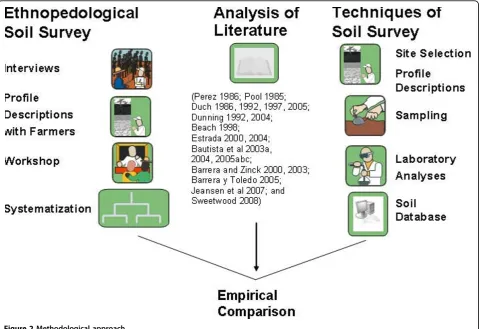
Soils were described and sampled at representative sites for laboratory analysis, and classified using the WRB [21]. A multilingual soil database was built with 315 soil profile descriptions, using the database struc-ture developed by De la Rosa et al. [38] (Figure 1). By means of interviews, participative field transects and workshops, local farmers were asked to name and show the soil types, describe their properties, and explain the characteristics used to recognize them in the territory of their community (Figure 2).
allowed accommodating the levels of soil perception shown by Maya farmers. It is also the international soil classification system most commonly used by Mexican soil scientists together with the national INEGI system. The WRB states comprising only two tiers of categorical information, but the practical operation of the frame-work implies four consecutive classification steps [21]. The system starts providing a set of ten classes based on soil properties, forming factors and processes, which serve as entries to the classification key. The following level, the most important of the system, includes 32 reference soil groups (RSGs) that are clustered into the ten entry classes aforementioned. Subsequently, soil classification is refined using a two-tier system of prefix (primary) qualifiers and suffix (secondary) qualifiers. Thus practically, a four-step procedure is used to clas-sify a given soil in the WRB. We have implemented a similar categorical approach to construct the Maya soil classification scheme. The criteria used to define the entries to the classification key and the Maya soil refer-ence groups (MRGs) are similar to those used in the
WRB framework, namely in our case: (1) organic carbon content; (2) presence of features in the soil profiles that reflect strong anthropic influence; (3) physical restric-tions to root growth; (4) water influence and drainage limitations; and (5) weak profile development (sandy soils). Additional criteria were extracted from the Maya soil nomenclature and implemented to subdivide the MRGs at lower levels. For instance, Maya people make a distinction between rock outcrops and stones as coarse fragments that hinder root development. Simi-larly, in Maya knowledge, the color contrast between A and B horizons is relevant to separate MRGs, probably as a reflection of differences in soil fertility or drainage. This distinction has important implications for planting strategies.
Results
Diagnostic soil properties
Maya peasants identify soil reference groups based on relief position, soil color, stoniness, rockiness, gravel content, depth, texture, structure and drainage, which
are all soil properties of universal use in indigenous soil classifications [3]. Plant community and area size are also used as differentiating criteria in some particular sites. The MSC gives more weight to topsoil than sub-soil properties. Many of these properties are also diag-nostic attributes in scientific soil classifications, such as the WRB system and the USDA Soil Taxonomy [39].
The position of the soils on the terrain is a primary diagnostic feature [40]. Maya soil groups and soil units vary according to soil position on the landscape [13,23]. A major distinction takes place between soils on mounds (Ho-lu’um) and soils in depressions (Kankabal), the two main geoforms in the Yucatán karstic landscape. Also the word ka’anal lu’um designates soils on high sites [17]. While terrain position is used by Maya pea-sants for management purposes, it is considered mainly as a pedogenic factor in the WRB classification.
Color is usually taken as an accessory, co-variant soil property, as it reflects chemical and mineralogical prop-erties that are not directly observable in field conditions, such as organic matter, iron and manganese contents, among others [41,42]. In the Yucatec Maya perception, color is a highly differentiating attribute used to distin-guish soils at the higher levels of the soil classification.
From the soils in the northern part of Yucatán, Bautista et al. [12,13] report a clear difference between the black soils on mounds and the red soils in depressions, the first ones being rich in organic matter, calcium and phosphorus, the second ones with high contents of Si, Al and Fe oxides, together with the presence of hematite and boehmite. Maya farmers use also color to distin-guish key soil horizons. The concept of K’an kab, for example, means“yellow underneath”that refers to a yel-low Bt horizon underlying a usually red epipedon in Luvisols.
Stoniness is a relevant property influencing soil pro-ductivity and soil management [43]. In karstic areas, the amount of coarse fragments in the soil reflects the intensity and stage of rock dissolution. High tempera-ture and abundant rainfall accelerate the weathering of calcareous rocks, generating deep clayey soils, with neu-tral reaction and well developed structure [44,45]. Stoni-ness is an important differentiating property in the Yucatec Maya soil perception and classification. Special words are used to refer to stoniness (mulu’uch) and stone mounds (mu’ul). Particular MRGs (e.g., Ch’och’ol) allow distinguishing stony soils from others, which are strongly correlated with the Hyperskeletic Leptosols in
the WRB classification [14]. The consideration given to stoniness in the MSC could help improve the WRB clas-sification with the introduction of qualifiers to recognize the presence of calcareous coarse fragments in the Lep-tosols, such as Ch’ich’ic for gravelly soils and Ch’och’olic for stony soils.
Rockiness can take different forms that are reflected in two MRGs: (1) Chaltún soils on smooth laminar bed-rocks with surface dissolution channels, and (2) Tzek’el soils on large, rugged promontories with cracks (karst mounds). In both cases, soils are poorly developed and very shallow, except along joints and fractures where limestone dissolution proceeds. Chaltún lu’um soils are extensive in the north of Yucatán under semiarid cli-mate, with a thorny shrub cover and a variety of herbac-eous plants that grow only during the short rainy season. To place these soils in the WRB system, Tzek’ e-lic and Chaltunic are proposed as qualifiers of the Leptosols.
Depth is used as an indicator of effective soil volume. The MSC is more precise than the WRB classification, establishing a clear difference between Hay lu’um and Chaltún soils within the Lithic Leptosols. In Mayan lan-guage, different words are used to indicate soil depth, such as Hach taan lu’um for very deep soils; Taan lu’um and Taan taan lu’um for deep soils; Ma’taan lu’um for shallow soils; and Hach ma’taan taan lu’um for very shallow soils [17]. On the basis of depth criteria, the K’an kab lu’um soil class can be divided into three sub-groups, resulting in a shallow (25-50 cm) K’an kab lu’um, a moderately deep (50-100 cm) K’an kab lu’um, and a deep (>100 cm) K’an kab lu’um. Recent modifica-tions of the WRB [21] have led to eliminating depth limits as a diagnostic criterion, arguing that the latter are artificial and not genetic soil subdivisions. This is questionable in the case of the tropical karst in the Yucatán peninsula, where there are shallow soils that show degrees of development similar to those of deep soils [12,23,45]. We strongly support maintaining or re-introducing depth qualifiers, i.e., lithic in Leptosols, and epileptic and endoleptic in Kastanozems, as practical classes for farming purposes but also for morphological characterization.
Soil heterogeneity is relevant to farming. In the north-ern part of the Yucatán peninsula, soil distribution pat-terns are very complex, with frequent spatial variations at short distance. For example, Bautista et al. [14] identi-fied six MRGs, corresponding to four types of Leptosol and one type of Kastanozem, on a surface area no larger than 1350 m2. This might be the reason why farmers integrate soil, land and soilscape in one comprehensive concept. By contrast, the southern part of the Yucatán state is more homogeneous. In the Pucc region, for instance, K’an kab lu’um, Chac lu’um, Ek’ lu’um and
Yaax kom, that are among the best soils of the penin-sula, occupy in general large areas. Only Ak’al che’soils occur as small patches in swampy lowlands [28].
Yucatec Maya farmers use also the type and density of individual plants and plant communities as soil indica-tors. For instance, Ak’al che’are associated with hydro-phytes, Chaltún lu’um with seasonal herbs, K’an kab lu’um and Chac lu’um with plants adapted to hydropho-bic soil materials, and Tzek’el lu’um and Box lu’um with tree communities.
All this soil knowledge is integrated by farmers when it comes to crop selection and farming practices. Each soil class or soil unit is used according to its suitability for selected varieties of maize and other crops [46,47]. Engineering properties of soils were also taken into account when building pyramids [48].
Soil nomenclature
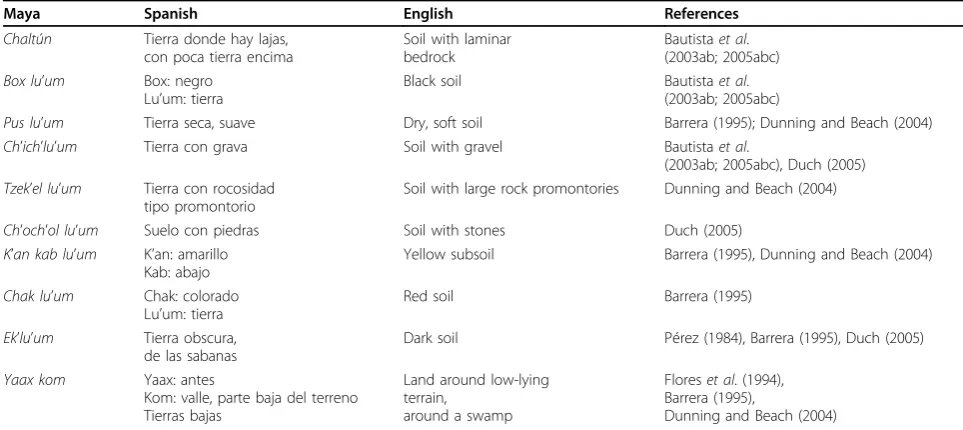
The phonetic writing of the oral terms used by Maya peasants can lead to confusions. For example, the com-posite expression of Yaax kom lu’um means literally
“the soil around a poorly drained area”, while Yaax hom lu’um (with hom instead of kom) would mean “green soil”. The apostrophes following consonants in Yucatec Maya words are used by linguists to indicate glottal stops. Thus, Ch’och’ol is preferable to Chochol, which in plain pronunciation has no meaning in Mayan lan-guage (Table 1).
To distinguish among MRGs, Maya farmers give high weight to topsoil properties, in the same fashion as other indigenous people do in different agro-ecological zones [5]. However, in deep soils with contrasting mor-phology, they also take into consideration subsoil prop-erties that influence soil management and/or crop adaptability. This is the case of the K’an kab lu’um soils that have red topsoil and yellow subsoil.
Soils enriched in organic matter from decomposition of human and animal wastes in earlier settlements, together with other rests of human activities such as ceramic shards and kitchen middens, are clearly distin-guished from other kinds of soil and named Kakabb lu’um (Anthrosols). Similar soils have been described by Dunning and Beach [31], and Duch [17].
Incipient soils, poorly developed because of the pre-vailing environmental conditions, are frequent in the Yucatán peninsula. Shallow soils and soils with little fine earth material are segregated on the basis of vegetation cover density, water dynamics, and the degree of disso-lution of the calcareous substratum. Tzek’el lu’um and Chaltún lu’um are rocky soils; Ch’och’ol lu’um and Box lu’um are stony soils; and Ch’ich’ lu’um are gravelly soils.
as such by the local farmers. Many national soil classifi-cations (e.g., the French, German, Polish, and Russian) have specific groups to account for the occurrence of calcareous fragments in soils. The WRB classification, in contrast, does not fully recognize the essential role of calcareous rocks, stones and gravels in soils and excludes them from the Leptosols [39,49].
Tzek’el lu’um, Yaax kom and Ak’al che’ are compre-hensive concepts, referring simultaneously or alterna-tively to soils, soilscapes, lands, sites, ecosystems, or plant communities. For instance, Tzek’el lu’um desig-nates the unproductive land and soilscape of Lithic Lep-tosols on mounds and in depressions. Yaax kom is a site name referring to the low-lying land that surrounds a swampy area. Ak’al che’is rather an ecosystemic con-cept, corresponding to a swamp with indicator trees such asDalbergia sp.,Haematoxylon campechianumL., Bucida buceras, and Annona glabra (Table 1). Akal means flooded area and ché means tree or vegetation. Thus, the combination of both particles in Ak’al che’ refers to marshlands with soil seasonally flooded and covered with trees [9]. The term expresses the interac-tion between relief, hydrology and plant communities. The soils can be grey Gleysols or light brown Stagno-sols. Ak’al che’is a good example to illustrate the indi-genous land concept proposed by Ortiz et al. [50], where land is a specific terrestrial area that includes all attributes of the biosphere, directly observed in the top-soil or inferred from the presence of indicator plants or animals.
Maya peasants use soil names and other terms as modifiers to designate particular soils that share charac-teristics of several groups. Also Maya soil names can
refer to soilscapes. For example, K’an kab Tzek’el is sometimes used for patches of shallow stony soils within a K’an kabal area. Pus ek’lu’um can be used for shallow transitional soils around a swath of deeper Ek’ lu’um. Mulu’uch Tzek’el is sometimes used to reflect the essen-tially soil-less conditions found on some rocky mounds.
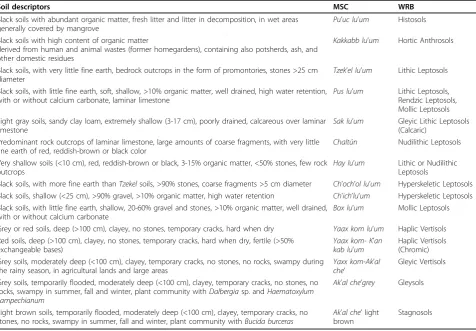
Maya use additional terms, not included in the classi-fication scheme of Table 2, to refer to special soil or land conditions that significantly restrict their use potential. For example, Buy lu’um stands for poor soils, Sohol lu’um for dry and sterile soils, K’oha’an lu’um for degraded soils, and Ch’ech lu’um for compact soils [17,51].
Proposed classification scheme
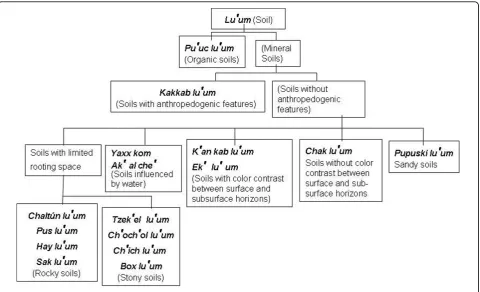
On the basis of the diagnostic soil properties and soil nomenclature used by Yucatec Maya farmers, we have constructed a folk soil classification scheme with a hier-archic, dichotomous and open structure based on the WRB framework. Maya soil properties were used at the same categorical levels as similar diagnostic properties are used in the WRB system (Figure 3).
The first division is between organic and mineral soils to separate the Pu’uc lu’um soils (Histosols), which occur in areas of the karstic plain neighboring the coastal plain. The second division considers the pre-sence of anthropedogenic features to separate Kakkab lu’um soils that are found in all regional relief units. Kakkab lu’um are homegarden soils (Hortic Anthrosols) that are enriched in organic matter derived from human and animal wastes but may also contain potsherds, cera-mic shards, ash, and other domestic residues. Their location allows tracing former human settlements. Table 1 Yucatec Maya soil names
Maya Spanish English References
Chaltún Tierra donde hay lajas, con poca tierra encima
Soil with laminar bedrock
Bautistaet al. (2003ab; 2005abc) Box lu’um Box: negro
Lu’um: tierra
Black soil Bautistaet al. (2003ab; 2005abc)
Pus lu’um Tierra seca, suave Dry, soft soil Barrera (1995); Dunning and Beach (2004) Ch’ich’lu’um Tierra con grava Soil with gravel Bautistaet al.
(2003ab; 2005abc), Duch (2005) Tzek’el lu’um Tierra con rocosidad
tipo promontorio
Soil with large rock promontories Dunning and Beach (2004)
Ch’och’ol lu’um Suelo con piedras Soil with stones Duch (2005) K’an kab lu’um K’an: amarillo
Kab: abajo
Yellow subsoil Barrera (1995), Dunning and Beach (2004)
Chak lu’um Chak: colorado Lu’um: tierra
Red soil Barrera (1995)
Ek’lu’um Tierra obscura, de las sabanas
Dark soil Pérez (1984), Barrera (1995), Duch (2005)
Yaax kom Yaax: antes
Kom: valle, parte baja del terreno Tierras bajas
Land around low-lying terrain,
around a swamp
Floreset al. (1994), Barrera (1995),
All other mineral soils that do not show conspicuous anthropedogenic features are grouped in five classes on the basis of rockiness/stoniness, water influence and drainage conditions, color contrast between topsoil and subsoil, and the occurrence of sandy texture.
(1) Soils with limited rooting space because of rocki-ness and/or stonirocki-ness at shallow depth. These soils are separated on the basis of the same criteria as those used in the WRB. Rock fragments can be boulders as in Tze-k’el lu’um or laminar limestone slabs as in Sak lu’um, Pus lu’um, Chaltún and Hay lu’um. Tzek’el lu’um (Lithic Leptosols) occur mainly on mounds and hillslopes in all regional relief units, while Sak lu’um (Gleyic Lithic Lep-tosols) are common in the coastal plain (place of dis-charge of the groundwater). Pus lu’um are found in small areas, usually of less than one hectare, in all regio-nal relief units. The Pus lu’um concept covers a variety of soils including Lithic Leptosols, Mollic Leptosols and Rendzic Leptosols, reflecting variability in soil depth, calcium carbonate and organic matter. Chaltún and Hay lu’um occur principally in the karstic plain, near the coastal plain, but occasionally also in other relief units. The stony soils called Ch’och’ol and Ch’ich’ lu’um are distributed in small areas of less than one hectare. Box
lu’um are commonly shallow, well drained, black soils with little fine earth, 20-60% stoniness, >10% organic matter, and with or without calcium carbonate.
(2) Soils influenced by water and poor drainage condi-tions. These soils also are separated on the basis of the same criteria as those used in the WRB. Yaax kom and Ak’al che’ are frequent in the south of the Yucatán peninsula. Yaax kom cover large areas in inland plains, while Ak’al che’are found in depressions between hills.
The central concept of Ak’al che’corresponds to soils temporarily flooded. These can be Gleysols as in Cam-peche or Stagnosols as it occurs sometimes in the southern Yucatán state. The difference between gleyic and stagnic properties is reflected in the vegetation cover. In the WRB system, Stagnosols were first consid-ered “false Gleysols”mainly because of the lack of infor-mation for full characterization, but they have been recently separated from Gleysols as an individual group. Similarly, in the Maya soil classification, primary and secondary qualifiers are added to the central concept of the soil group. Thus, Ak’al che’soils can be either grey Gleysols or light brown Stagnosols.
(3) Soils with color contrast between surface and sub-surface horizons. This soil class was built using the Table 2 Soil descriptors of Maya reference groups and correspondence with WRB soil groups
Soil descriptors MSC WRB
Black soils with abundant organic matter, fresh litter and litter in decomposition, in wet areas generally covered by mangrove
Pu’uc lu’um Histosols
Black soils with high content of organic matter
derived from human and animal wastes (former homegardens), containing also potsherds, ash, and other domestic residues
Kakkabb lu’um Hortic Anthrosols
Black soils, with very little fine earth, bedrock outcrops in the form of promontories, stones >25 cm diameter
Tzek’el lu’um Lithic Leptosols
Black soils, with little fine earth, soft, shallow, >10% organic matter, well drained, high water retention, with or without calcium carbonate, laminar limestone
Pus lu’um Lithic Leptosols, Rendzic Leptosols, Mollic Leptosols Light gray soils, sandy clay loam, extremely shallow (3-17 cm), poorly drained, calcareous over laminar
limestone
Sak lu’um Gleyic Lithic Leptosols (Calcaric)
Predominant rock outcrops of laminar limestone, large amounts of coarse fragments, with very little fine earth of red, reddish-brown or black color
Chaltún Nudilithic Leptosols
Very shallow soils (<10 cm), red, reddish-brown or black, 3-15% organic matter, <50% stones, few rock outcrops
Hay lu’um Lithic or Nudilithic Leptosols
Black soils, with more fine earth thanTzekelsoils, >90% stones, coarse fragments >5 cm diameter Ch’och’ol lu’um Hyperskeletic Leptosols Black soils, shallow (<25 cm), >90% gravel, >10% organic matter, high water retention Ch’ich’lu’um Hyperskeletic Leptosols Black soils, with little fine earth, shallow, 20-60% gravel and stones, >10% organic matter, well drained,
with or without calcium carbonate
Box lu’um Mollic Leptosols
Grey or red soils, deep (>100 cm), clayey, no stones, temporary cracks, hard when dry Yaax kom lu’um Haplic Vertisols Red soils, deep (>100 cm), clayey, no stones, temporary cracks, hard when dry, fertile (>50%
exchangeable bases)
Yaax kom- K’an kab lu’um
Haplic Vertisols (Chromic) Grey soils, moderately deep (<100 cm), clayey, temporary cracks, no stones, no rocks, swampy during
the rainy season, in agricultural lands and large areas
Yaxx kom-Ak’al che’
Gleyic Vertisols
Grey soils, temporarily flooded, moderately deep (<100 cm), clayey, temporary cracks, no stones, no rocks, swampy in summer, fall and winter, plant community withDalbergiasp. andHaematoxylum campechianum
Ak’al che’grey Gleysols
Light brown soils, temporarily flooded, moderately deep (<100 cm), clayey, temporary cracks, no stones, no rocks, swampy in summer, fall and winter, plant community withBucida burceras
Ak’al che’light brown
Maya perception of color contrast in well-developed and deep soils such as Luvisols and Phaeozems. K’an kab lu’um are widespread in the south of the penisula and occupy also small areas in the north. Deep Phaeozoms called Ek’ lu’um occur in karstic depressions in the south.
(4) Soils without color contrast between surface and subsurface horizons. The absence of strong color con-trast in less-developed mineral soils lacking B horizons is used by Maya to build a separate soil class. Chack lu’um are widespread in the karstic plains of the south and occur also in small areas in the north.
(5) Sandy soils. Pupuski lu’um are white sandy soils located in the coastal plain, with or without gleyic and/ or salic properties. They can be distinguished from other grey or white soils occurring in the area (e.g., Sak lu’um) because they lack a lithic qualifier. Pupuski lu’um include Arenosols as well as Gleysols and Solonchaks. Thus the central concept of Pupuski lu’um can be speci-fied using primary qualifiers for depth, gleyic properties, and salinity.
Discussion
The relatively simple structure of the WRB helped us accommodate the levels of soil perception shown by Maya farmers. The criteria used in the WRB to distin-guish entries to the classification key and reference soil
groups were useful to construct the upper levels of the MSC scheme. The lower MSC levels are mainly based on the formalization of features used by the Maya for more detailed soil distinction.
The Maya soil classification can be used for improving the WRB and other soil classification systems, in parti-cular in karstic landscapes. For instance, the Maya soil classification can provide qualifiers for Leptosols to cope with soil and landscape features that strongly influence land management and use, such as soil depth (e.g., extremely shallow soils), types of bedrock (e.g., promon-tory bedrock, laminar bedrock), surface and subsurface stoniness with ranges of size and quantity, and soil color. Stoniness and gravel content are relevant proper-ties to build hierarchy in the Maya soil classification (e. g., Ch’och’ol and Ch’ich’lu’um). Rockiness can take dif-ferent forms that are reflected in two MRGs: Chaltún soils have smooth laminar bedrocks with surface disso-lution channels, while in Tzek’el soils bedrocks are large, rugged promontories with cracks. The WRB clas-sification does not include this feature as a diagnostic property.
The Maya soil classification and the WRB classifica-tion are complementary. The MSC shares categories and classes with the WRB framework. This is an advan-tage for the scheme being understood by technicians and local scientists and being incorporated in specialized
curricula at regional universities. It is recommended that both systems be used at a maximum level of detail, as together they provide valuable information on soil prop-erties, distribution, formation, and use potential in the study area. The MSC is addressed especially to exten-sion agents and other experts involved in rural develop-ment as a means for communicating with Maya farmers in terms of soil management, farming practices and crop selection.
The soil properties used to build the MSC agree with similar soil properties used in indigenous soil classifica-tions in other parts of the world [3,5,11]. As indigenous soil classification schemes are mental constructs, result-ing from the way the soil scientist interprets farmers’ soil perceptions, variations might appear among the schemes proposed by different authors to organize the Yucatec Maya soil knowledge [11].
The meaning of some Maya soil names may vary throughout the Yucatán peninsula. Such is the case of the Ak’al che’, for instance. These soils can be Gleysols as in Campeche or Stagnosols as in some places of the southern Yucatán state. The difference between gleyic
and stagnic properties is taken care of in the Maya soil classification by adding primary and secondary qualifiers to the central concept of the soil group. In general, interregional variations such as in the above example are more common than intraregional variations. How-ever, it can be assumed that the Maya soil classification applies to a large part of the peninsula of Yucatán (ca 152,000 km2) for two main reasons. One is the spatial repetition of four geomorphic systems all over the area: coastal, karstic, tectono-karstic, and fluvio-paludal, each one showing specific soil-relief patterns [12,14,25]. Our study documents the soils found in these four geo-morphic environments and describes their variability over an area of nearly 39,000 km2 (Figure 4). This can be considered a representative sample of the peninsula. The second reason is linguistic homogeneity as 1.5 mil-lion people speak the Yucatec Mayan language in the Yucatán peninsula [51,52]. Obviously, additional studies are needed to improve the MSC and test its applicability in a variety of settings throughout Yucatán.
Soil heterogeneity at parcel level is well recognized by Maya peasants who select the type of milpa according
to soil quality and variability. For instance, in the center of the Yucatán state, several types of milpa are used including slash-and-burn milpa and sugar cane milpa, but intensive milpa is practiced only on K’an kab lu’um and Chak lu’um soils, using manure, manual tillage, and cover crops with herbaceous legumes. In Tzek’el, Ch’ich’ lu’um and Ch’och’ol lu’um, the planting distance is 1 × 1 m, using a local maize variety along with beans and squash. Whereas in Chacklu’um and K’an kab lu’um, the planting distance is 0.6 × 0.6 m with an improved vari-ety of maize together with sweet potato and cassava [29]. This local soil variability should be reflected in soil maps using the MSC as a reference system.
Conclusions
The conclusions about the Yucatec Maya soil knowledge that can be derived from this study are as follows: (a) the identification of soils in the Yucatec Maya classifica-tion may be made using a key similar to that used in the WRB; (b) the MSC is a natural system based on key properties, such as rock types, size and quantity of stones, color of topsoil and subsoil, depth, relief posi-tion, water dynamics, and plant-supporting processes; (c) the MSC addresses the soil properties of surficial and subsurficial horizons that have morphological, genetic and practical importance; (d) the soil properties used in the MSC can help generate primary and second-ary qualifiers for the WRB (e.g., Chaltunic, Ch’och’olic, Ch’ich’ilic). However, much effort is still needed to go deeper into the Maya soil knowledge. In particular, a better understanding of the diagnostic properties used and their relationships with soil forming factors is necessary, before a complete classification system can be established, especially at the lower categorical levels.
Acknowledgements
This research was supported by CONACYT and the Yucatán State government (Projects 0308P-B9506; R31624-B; YUC-2003-C02-054). We thank the collaboration provided by Bernardo Xiu, Pedro Canché, Raúl Casanova, Anastacia Dzul, E. Pérez, Miguel Uicab, Fredy Tzek, and the peasants of Hocabá, Yucatán. We acknowledge the valuable comments provided by three anonymous reviewers that helped improve an earlier version of this manuscript.
Author details
1Centro de Investigaciones en Geografía Ambiental, Universidad Nacional
Autónoma de México, Antigua Carretera a Pátzcuaro No. 8701, Col. Ex-Hacienda de San José de La Huerta, C.P. 58190 Morelia, Michoacán, México.
2
International Institute for Geo-Information Science and Earth Observation, PO Box 6, 7500 AA Enschede, the Netherlands.
Authors’contributions
FB carried out the soil surveys, peasant interviews and the building of the first version of the Maya soil classification. JAZ improved the Maya soil classification and reviewed previous versions of the paper. FB and JAZ wrote the final version of the paper.
Competing interests
The authors declare that they have no competing interests.
Received: 4 August 2009
Accepted: 13 February 2010 Published: 13 February 2010
References
1. Barrera N, Toledo V:Ethnoecology of the Yucatec Maya: symbolism, knowledge and management of soil resources.J Lat Am Geogr2005, 4(Suppl 1):9-41.
2. Ortiz C, Pájaro D, Ordaz V:Manual para la cartografía de clases de tierras campesinas.Serie Cuadernos de Edafología 15. Centro de Edafología, Colegio de PostgraduadosMontecillo, Estado de México, México 1990.
3. Barrera N, Zinck JA:Ethnopedology: a worldwide view on the soil knowledge of local people.Geoderma2003,111:171-195.
4. Krasilnikov P, Tabor J:Perspectives of utilitarian ethnopedology.Geoderma 2003,111:197-215.
5. Barrera N, Zinck JA, Ranst EV:Symbolism, knowledge and management of soil and land resources in indigenous communities: Ethnopedology at global, regional and local scales.Catena2006,65:118-137.
6. Cowgill UM:Soil fertility and the ancient Maya.Trans Connecticut Acad Arts Sci1961,42:1-56.
7. Pérez J:Caracterización y utilización de la clasificación maya de suelo en el municipio de Oxcutzcab Yucatán.Thesis of agronomistUACh. Chapingo, México 1984.
8. Pool L, Hernández E:Los contenidos de materia orgánica de suelos en áreas bajo el sistema agrícola de roza, tumba y quema: importancia del muestreo.Terra1987,5(Suppl 1):81-92.
9. Duch J:La conformación territorial del estado de Yucatán. Los componentes del medio físicoCentro Regional de la Península de Yucatán (CRUPY), Universidad Autónoma de Chapingo Edo de México, México 1988. 10. Dunning N:Lords of the hills: ancient maya settlement in the Puuc
region, Yucatán, México.Monographs in World Archaeology No. 15WI, USA. Prehistoric Press, Madison 1992.
11. Barrera N:Symbolism, knowledge and management of soil and land resources in indigenous communities: ethnopedology at global, regional and local scales.PhD thesisITC Dissertation 173. International Institute for Geoinformation Science and Earth Observation, Enschede, The Netherlands 2003.
12. Bautista F, Jiménez-Osornio J, Navarro-Alberto J, Manu A, Lozano R: Microrelieve y color del suelo como propiedades de diagnóstico en Leptosoles cársticos.Terra2003,21:1-11.
13. Bautista F, Estrada H, Jiménez J, González J:Relación entre relieve y suelos en zonas cársticas.Terra Lat Am2004,22(Suppl 3):243-254.
14. Bautista F, Diáz-Garrido S, Castillo-González M, Zinck JA:Soil heterogeneity of the soil cover in the Yucatán karst: comparison of Mayan, WRB and numerical classifications.Eurasian Soil Sci2005,38(Suppl 1):81-88. 15. DETENAL:Modificaciones al sistema de unidades FAO-UNESCO 1968. .
México DF1972.
16. Duch J:Los suelos, la agricultura y vegetación en Yucatán.La milpa en Yucatán: un sistema de producción agrícola tradicional. Tomo 1México: Colegio de Postgraduados, ChapingoHernández E, Bello E, Levy S 1995. 17. Duch J:La nomenclatura maya de los suelos: una aproximación a su
diversidad y significado en el sur del estado de Yucatán.Caracterización y manejo de suelos en la Península de YucatánMéxico DF: UACAM-UADY-INEBautista F, Palacio G 2005, 73-86.
18. Soil Survey Staff:Soil Taxonomy: A Basic System of Soil Classification for Making and Interpreting Soil Surveys, USDA.Handbook436United States Government Printing Office, Washington DC, 2 1999, 696.
19. INEGI:Mapa edafológico 1:250000 .Mérida F16-10 INEGI México1984. 20. Estrada H:Caracterización y cartografía del recurso suelo del municipio
de Hocabá, Yucatán.Msc ThesisFMVZ-UADY. Mérida, Yucatán, México 2000, 128.
21. IUSS Working Group WRB (2006):World Reference Base for Soil Resources. World Soil Resources Reports no 103, UN Food and Agriculture
Organization, Rome, 2 2006, 128.
22. Estrada H, Bautista F, Jiménez J, González J:Relationships between mayan land classification and WRB in Yucatan, Mexico [abstract].Book of Abstracts International Conference and Field Workshop Soil classification 2004: 3-8 August 2004Petrozavodsk, Karelia, RusiaKrasilnikov P 2004, 120. 23. Bautista F, Batllori-Sampedro E, Ortiz-Pérez MA, Palacio-Aponte G,
de Ciencias y Centro de Investigación Científica de YucatánColunga P, Larque A 2003, 21-35.
24. Bautista F, Palacio G, Ortiz M, Batllori E, Castillo M:El origen y el manejo maya de las geoformas, suelos y aguas en la Península de Yucatán. Caracterización y manejo de suelos en la Península de Yucatán: Implicaciones agropecuarias, forestales y ambientalesMéxico DF: UACAM-UADY-INEBautista F, Palacio G 2005, 21-32.
25. Bautista F, Aguilar Y, Rivas H, Páez R:Los suelos del estado de Yucatán. Comunicaciones del Seminario: Importancia del binomio suelo-materia orgánica en el desarrollo sostenible: 3-4 december 2007; Mérida Yucatán Agencia Española de Cooperación Internacional y el Centro de Edafología y Biología Aplicada del Segura de Murcia, EspañaMartínez M, Cabañas D 2007, 11-42.
26. Barrera N, Zinck JA:Ethnopedology in a worldwide perspective. An annotated bibliographyEnschede The Netherlands: ITC Publication 77 2000. 27. Hirose J:La Salud de la TIERRA: el Orden Natural en el Ceremonial y las
Prácticas de Sanación de un Médico Tradicional Maya.Msc thesis in Human EcologyCinvestav, Yucatán, México 2002.
28. Dunning N, Beach T:Fruit of the luum: lowland maya soil knowledge and agricultural practices.Mono y conejo2004,2:3-15.
29. Bautista F, Garcia J, Mizrahi A:Diagnóstico campesino de la situación agrícola en Hocabá, Yucatán.Terra Lat Am2005,23(Suppl 4):571-580. 30. Aguilera N:Los recursos naturales del sureste y su aprovechamiento:
suelos.Rev Esc Nac de Agricultura Chapingo1963,3(Suppl 11-12):1-54. 31. Beach T:Soil constraints in northwest Yucatan, Mexico: pedoarchaeology
and Maya subsistence at Chunchucmil.Geoarchaeology1998,13:759-791. 32. Jensen Ch, Moriarty MD, Johnson KD, Terry RE, Emery KF, Nelson SD:Soil
resources of the Motul de San José Maya: correlating Soil Taxonomy and modern Itzá Maya soil classification within a classic Maya archaeological zone.Geoarchaeology2007,22:337-357.
33. Sweetwood R:The maya footprint: soil resources of Chunchucmil, Yucatán, México.Msc thesisFaculty of Brigham Young University 2008. 34. Krasilnikov P, Arnold R, Ibáñez J-J:Introduction to Classifications With an
Emphasis on Soil Taxonomies.A Handbook of Soil Terminology, Correlation and ClassificationEarhScan, LondonKrasilnikov P, Ibáñez JJ, Arnold R, Shoba S 2009, 7-15.
35. Ihl T, Frausto O, Rojas J, Giese S, Goldacker S, Bautista F, Bocco G: Identification of geodisasters in the state of Yucatan, Mexico.N Jb Geol Paläont2007,246(Suppl 3):299-311.
36. Orellana Lanza R, Balam M, Bañuelos I, García E, González-Iturbe JA, Herrera F, Orellana R, Vidal J:Evaluación climática.Atlas de procesos territoriales de YucatánUniversidad Autónoma de Yucatán, Fac. ArquitecturaGarcía A, Córdoba J 1999, 163-182.
37. Flores S, Espejel I:Tipos de vegetación de la Península de Yucatán. Etnoflora yucatanenseUniversidad Autónoma de Yucatán. Mérida, Yucatán, México 1994,3.
38. De la Rosa D, Mayol F, Moreno F, Cabrera F, Díaz-Pereira E, Antoine J:A multilingual soil profile database (SDBM Plus) as an essential part of land resources information systems.Environ Modell Softw2002, 17:721-730.
39. Krasilnikov P, Ibáñez JJ, Arnold R, Shoba S, Eds:A Handbook of Soil Terminology, Correlation and ClassificationEarthScan, London 2009. 40. Hall GF, Olson CG:Predicting variability of soils from landscape models.
Spatial Variabilities of Soils and LandformsSSSA Special Publication, Number 28. Soil Science Society of America, Madison, Wisconsin, USAMausbach ML, Wilding LP 1991.
41. Torrent J, Schwertman U, Fechter H, Alférez F:Quantitative relationships between soil color and hematite content.Soil Sci1983,136:354-358. 42. Torrent J, Cabedo A:Sources of iron oxides in reddish brown soil profiles
from calcarenites in southern Spain.Geoderma1986,37:57-66. 43. Magier J, Rabina I:Rock fragments and soil depth as factors in land
evaluation of terra rossa.Special Public Soil Sci Soc Am1984,13:13-30. 44. Blum WE:Soil classification and forms of energy involved in pedogenesis
[abstract].Book of Abstracts International Conference and Field Workshop Soil classification 2004: 3-8 August 2004Petrozavodsk, Karelia, RusiaKrasilnikov P 2004, 4-5.
45. Gama-Castro J, Palacios-Mayorga S, Solleiro-Rebodello E, Sedov S: Rendzinas: a group of soil that requires a new review [abstract].Book of Abstracts International Conference and Field Workshop Soil classification 2004: 3-8 August 2004Petrozavodsk, Karelia, RusiaKrasilnikov P 2004, 19.
46. Terán S, Rasmussen Ch:La milpa de los mayas.Ministerio de Relaciones Exteriores del Gobierno de Dinamarca. Yucatán, México 1994. 47. Flores S, Bautista F:Inventario de plantas forrajeras utilizadas por los
mayas en los paisajes geomorfológicos de la península de Yucatán. Caracterización y manejo de suelos en la Península de YucatánMéxico D.F. UACAM-UADY-INEBautista F, Palacio G 2005.
48. García-Solís C, Quintana P, Bautista F:La identificación de materiales arcillosos y pétreos utilizados en la manufactura del friso modelado en estuco de la SUBII-C1 de Calakmul, a través del análisis de difracción de rayos X.La ciencia de materiales y su impacto en la arqueologíaAcademia Mexicana de Materiales, Innovación Editorial Lagares. México DFMendoza D, Arenas J, Rodríguez V, Ruvalcaba J 2006,2:237-252.
49. Goryachkin SV:Soil minorities - How should we classify them in WRB and other classification systems? [abstract].Book of Abstracts International Conference and Field Workshop Soil classification 2004: 3-8 August 2004 Petrozavodsk, Karelia, RusiaKrasilnikov P 2004, 22-23.
50. Ortiz C, Gutiérrez-Castorena C, Licona-Vargas A, Sánchez-Guzman P: Contemporary influence of indigenous soil (land) classification in México.Eurasian Soil Sci2005,38(Suppl 1):89-94.
51. INEGI:Censo de población y viviendaAguascalientes, México 2005. 52. Barrera A:Diccionario Maya: maya-español, español-mayaMéxico: Porrúa
1995.
doi:10.1186/1746-4269-6-7
Cite this article as:Bautista and Zinck:Construction of an Yucatec Maya soil classification and comparison with the WRB framework.Journal of Ethnobiology and Ethnomedicine20106:7.
Submit your next manuscript to BioMed Central and take full advantage of:
• Convenient online submission
• Thorough peer review
• No space constraints or color figure charges
• Immediate publication on acceptance
• Inclusion in PubMed, CAS, Scopus and Google Scholar
• Research which is freely available for redistribution