R E S E A R C H
Open Access
Advice-seeking during implementation: a
network study of clinicians participating in
a learning collaborative
Alicia C. Bunger
1*, Nathan Doogan
2, Rochelle F. Hanson
3and Sarah A. Birken
4Abstract
Background:Successful implementation depends on the transfer of knowledge and expertise among clinicians,
which can occur when professionals seek advice from one another. This study examines advice-seeking patterns among mental health clinicians participating in learning collaboratives (a multi-component implementation and quality improvement strategy) to implement trauma-focused cognitive behavioral therapy (TF-CBT). We apply transactive memory system theory, which explains how professionals access and retrieve knowledge, to examine factors associated with the evolution of advice-seeking relationships during implementation. Our aim is to unpack learning collaboratives’mechanisms by investigating how and why advice-seeking networks change, which may help us understand how implementation strategies can best target networks.
Methods:Using social network analysis and a pretest-post-test design, we examined patterns in general and treatment-specific advice-seeking among 146 participants (including five clinical experts) from 27 agencies participating in a regional scale-up of TF-CBT. Surveys were administered person at the first and last of three in-person learning sessions (10 months apart) that comprise a core component of learning collaboratives. Participants nominated up to five individuals from whom they seek general and treatment-specific advice. Exponential random graph models (ERGMs) tested the likelihood of maintaining or forming advice-seeking relationships based on indicators of expertise quality, accessibility, need, and prior advice-seeking relationships.
Results:Participants formed or maintained advice-seeking relationships with those who possess perceived expertise (e.g., learning collaborative faculty experts, supervisors, and those with greater field experience than themselves). Participants also tended to seek advice from those within the same organization and with similar disciplinary training, highlighting the importance of expertise accessibility. Prior relationships and network structural features were associated with advice-seeking, indicating that participants built on existing social ties. Advice-seeking did not vary based on participants’role or experience.
Conclusions:Given the importance of accessible clinical expertise and ongoing supervision for delivering treatment with fidelity, learning collaboratives may support implementation by promoting clinicians’awareness of and access to others’expertise, especially those with substantial expertise to share (e.g., faculty experts and supervisors). Future controlled studies are needed to verify the effectiveness of learning collaboratives for building networks that connect clinicians and experts and for improving implementation.
Keywords:Learning collaborative, Advice-seeking, Social network analysis, Mental health services
* Correspondence:[email protected]
1College of Social Work, The Ohio State University, 1947 College Road,
Columbus, OH 43210, USA
Full list of author information is available at the end of the article
Background
Implementing evidence-based treatments (EBTs) in health and human service organizations is a complex and knowledge-intensive process requiring clinicians to develop new skills, knowledge, and expertise. The social interactions among clinicians, their supervisors, and other sources of clinical knowledge can serve as conduits for transferring technical information and expertise needed to learn and use an EBT with proficiency [1]. This transfer occurs when professionals seek and share advice with one another. Advice-seeking in this context is a deliberate ac-tion where a clinician asks another for expertise around a work-related task, including generaladvice about serving their clients, and specific advice for using an EBT. Advice-seeking relationships directly shape clinicians’EBT use [2] and can be a more powerful influence over work behaviors than other types of social relationships (e.g., friendship) [3].
As professional values, work expectations, and clinical treatments change, clinicians may need new or different types of expertise and thus alter whom they approach [4]. For example, clinicians may build a new relationship and ask advice from a colleague who has demonstrated proficiency in a new EBT; they might ask their trusted mentor or supervisor for advice more frequently than in the past; or they may stop asking advice from a col-league who does not use the new EBT. Advice-seeking patterns (and changes in them) during implementation and other quality improvement initiatives have been documented in studies conducted in public health and healthcare settings. More specifically, these studies sug-gest that clinicians’ advice-seeking patterns may evolve over time as they learn to implement a new EBP or en-gage in other quality improvement initiatives [5–7].
However, clinicians may not know who has expertise in the new EBT or have access to them, constraining advice-seeking, and the flow of needed expertise. Large-group interventions that foster interaction and knowledge sharing among professionals have the potential to facilitate advice and expertise sharing needed for implementation. For instance, the Institute for Healthcare Improvement’s Breakthrough Series Learning Collaborative Model has grown in popularity as a multi-organizational, multi-component implementation, and quality improvement strategy [8,9]. Learning collabo-ratives have a potential to promote implementation of EBTs in healthcare organizations and systems by fostering shared learning among clinicians and with key content ex-perts. Little is known about how these large-scale imple-mentation initiatives influence clinicians’ advice-seeking patterns and access to expertise. Emerging evidence sug-gests that clinicians’ advice-seeking and communication patterns change over the duration of learning collabora-tives [10, 11] and other large-group quality improvement
initiatives [5], as clinicians form new, and even dissolve, pre-existing relationships. But how do these relationships change and do they facilitate access to needed expertise for implementation? The underlying processes that ac-count for these changes and their implications for clini-cians’access to expert clinical advice and implementation are unclear.
To address this gap, this study examined change in professional advice-seeking patterns and factors that underlie the formation and maintenance of these ties among mental health clinicians participating in learn-ing collaboratives to implement trauma-focused cogni-tive therapy (TF-CBT), an EBT for treating children with trauma-related mental health and behavioral problems [12, 13]. Understanding how clinicians seek and access expert advice over time has a potential to unpack potential mechanisms that underlie the evolu-tion of advice-seeking networks and inform whether refinements are needed for learning collaboratives and other networked strategies (that may leverage or modify social networks to promote implementation).
Facilitating knowledge and expertise sharing for implementation––learning collaboratives
Originally developed by the Institute for Healthcare Improvement to guide quality improvement initiatives in healthcare systems, the learning collaborative has been widely used within behavioral health-care to im-prove care processes (e.g., improving family engage-ment or reducing wait times), as well as to promote the implementation of evidence-based practices [14,
15]. Learning collaboratives emphasize shared learning by bringing multidisciplinary teams together from sev-eral organizations or units over 8–12 months under the guidance of faculty experts. Although the specific components may vary, the typical structure of a learning collaborative involves teams that participate in in-person training, or learning sessions, where fac-ulty experts lead didactic sessions, group discussion, and skill building activities; interspersed action pe-riods at home agency where teams implement the new practice using plan-do-study-act cycles; as well as conference calls, coaching, site visits, and regular monitoring of performance data to support skill ac-quisition and implementation over the duration of the learning collaborative.
interventions. For instance, Yousefi-Nooraei and colleagues found that over a 22 month organizational initiative to pro-mote evidence-informed decision making within public health departments, professionals’networks changed - those engaged in the intervention strengthened ties with one an-other, producing clusters of engaged professionals [7]. In addition, earlier descriptive findings published from the present study also suggested that the advice-seeking network among mental health clinicians became more centralized around key faculty experts, as clinicians increased their ties to learning collaborative leaders over time [10]. Also internal communication among organizational team members strengthened [11]. Thus, learning collaboratives and other large-group inter-ventions have potential to alter advice-seeking and other social networks - however, exactly how and why participants form new advice-seeking ties, and the im-plications for implementation remain unclear.
What drives professional advice-seeking?
To understand what drives changes in advice-seeking relationships among learning collaborative participants, this study draws on transactive memory systems theory [22]. Transactive memory systems theory is based on the notion that a group is more knowledgeable than an individual and explains how knowledge sharing net-works form, evolve, and influence group performance [23,24]. According to transaction memory systems the-ory, specialized knowledge, expertise, and skills are dis-tributed across individuals within groups; to make the most of complementary capacities within a group, members must have a shared and accurate sense of “who knows what” and the ability to access expertise [25]. Thus, free flowing information within the network is a function of an individual’s ability to recognize and identify others with expertise, the decision to seek and retrieve that expertise, adjusting perceptions of “who knows what”, and deciding whether and with whom that newly acquired information should be shared [26]. Within a knowledge network, ties between individuals facilitate awareness of others’ expertise and the flow of information. Therefore, the advice seeker, the advice source, and their relationships matter. These ties can form naturally over time, but can also be stimulated by large-group inter-ventions, which are deliberate organizational or system development interventions that engage whole teams, orga-nizations, or systems in dialog, learning, and change [19]. A variety of models are commonly used in public and private management and include participatory methods for work re-design and EBT implementation (e.g. Search Conferences, World Cafes, large-group training) [27–29].
We posit that learning collaboratives are one such large-group intervention that can alter advice-seeking net-works. Consistent with transactive memory systems theory,
our working hypothesis is that learning collaboratives, and other types of group trainings, stimulate formation of knowledge and advice-seeking networks by offering oppor-tunities for intensive interactions [30]. During their interac-tions, clinicians’ become more aware of others’ expertise (the knowledge recognition process described in transactive memory systems theory). In addition, in person, phone, and web meetings with other clinicians and the local experts fa-cilitate regular access to these individuals, and encourage clinicians to seek and retrieve new advice and expertise. As a result of heightened awareness of other’s expertise, and opportunities to interact, clinicians are able to locate and access assistance when they need advice. Therefore, we ex-pect that general and TF-CBT-specific advice-seeking dur-ing a learndur-ing collaborative evolves in predictable ways: professionals seek advice and expertise from others when they are aware of and can easily access their colleagues’ ex-pertise [22, 31]. Thus, advice-seeking is likely to be deter-mined by characteristics of the advice source (the perceived quality of their expertise and their accessibility), the advice-seeker (their need for expertise), and their relation-ship (whether there are existing relationrelation-ships) [32].
Characteristics of the advice source Expertise quality
First, professionals are likely to seek advice from col-leagues who are known, perceived as competent, and whom they believe can offer high quality, appropriate expertise in a given situation [32]. In fact, perceived quality of the advice sources is one of the most salient motivators for advice-seeking [32, 33]. Accordingly, pro-fessionals with senior positions, extensive experience, and specialized training or credentials in a particular EBT are often sought after for advice and assistance [34,
35]. Title and role labels provide clear signals around key expertise sources in work settings [36]. For example, within learning collaboratives, there are faculty experts leading the learning and coaching sessions, and other participants are supervisors or senior leaders denoting some authority, experience, and expertise. Thus, participants may be more likely to maintain existing relationships or form new ad-vice ties with individuals perceived as experts (e.g. faculty expert, senior leader, supervisor).
be especially helpful to others who have questions or concerns about how to use a new treatment with a par-ticular client population. Consequently, participants might maintain relationships or form new ones with in-dividuals who are perceived as experts. Thus, we hypothesize that the likelihood of maintaining or form-ing advice-seekform-ing relationships will be positively associ-ated with the perceived quality of an advice source’s expertise (as indicated by their role, field experience, and prior training in TF-CBT) (H1).
Accessibility and proximity
For expertise quality to drive advice-seeking within and across organizations, clinicians must have enough in-formation about their colleagues’ knowledge and skills to inform their advice-seeking decisions. However, es-pecially in busy community mental health settings, cli-nicians rarely have time to systematically inventory “who knows what” about a treatment and its interven-tion, or wait for advice that might not be offered, use-ful, or without social costs. In fact, clinicians are unlikely to ask for assistance from those who are per-ceived as distant, unapproachable, or unable to respond [32]. Consequently, and similar to other choices made with incomplete information, clinicians may satisfice by choosing an advice source who is known, in close prox-imity, and accessible [31,37,38]. In fact, accessibility is one of the most consistent and important determinants of advice-seeking [31, 39, 40]. Learning collaboratives bring clinicians into closer proximity to expertise dur-ing learndur-ing sessions, structured coachdur-ing calls, group work among implementation teams, conference calls with other teams, and site-visits with faculty experts. Thus, learning collaboratives might facilitate access to local expertise and, therefore, promote advice-seeking among participants who work at the same organization or participate in the same learning collaborative cohort. In a similar vein, colleagues are likely to rely on advice from others in close social proximity (e.g. being trained in the same discipline), or who are socially accessible [31]. Participants may find it easier to ask for help or information from a colleague with comparable training because they share common professional values, norms, language, and practice skills [37]. In other words, be-longing to similar groups, and sharing a common group identification can reduce cognitive barriers associated with asking for help [33]. As a result, over the duration of a learning collaborative, participants might seek advice on treatment from a colleague in the same discipline. Thus, we hypothesize that the likelihood of forming or maintain-ing advice-seekmaintain-ing relationships is positively associated with shared physical or social proximity (similar disciplin-ary training) of the advice-seeker and source (H2).
Needs of the advice seeker
In addition to characteristics of the advice source, advice-seeking depends on the needs of the individual who is looking for help. Professionals seek advice when it is needed and valued; when individuals encounter a problem that they do not have the knowledge or com-fort to solve [38]. Thus, professionals who are newer to the field, or have a little training or experience in a par-ticular EBT, may seek advice more often than those who are more experienced [31, 32]. Also, professionals in front-line positions in the organizations may have greater advice needs than supervisors or senior leaders because they are directly responsible for delivering a new EBT. Even experienced clinicians may consult others often for technical information or feedback until they feel comfortable using the new treatment. As a result, front-line clinicians may have more robust ad-vice networks than their supervisors or agency leaders who may not be directly using the new treatment. Thus, changes in advice-seeking over the duration of a learning collaborative may vary based on an individuals’ role in the organization. Thus, we hypothesize that front-line workers (clinicians) will be more likely to form or maintain advice-seeking relationships than su-pervisors or senior leaders (H3).
The role of existing relationships and network structure
In professional contexts, individuals might connect their colleagues to a trusted mentor for additional ad-vice. Having common third-party colleagues can facili-tate advice sharing and knowledge transfer [33, 42]. For example, a clinician who provides advice to a colleague might also connect her colleague to one of her mentors. Thus, two participants who share advice, also share a mutual third party mentor. This tendency toward triadic pathways of advice-seeking (“a friend of a friend is a friend”) is called transitivity and creates tighter clusters among participants. As participants in the learning col-laborative learn and locate expertise, they may become increasingly connected through these third-party ties. Based on this evidence, we hypothesize that participants will be more likely to form and maintain advice-seeking ties with colleagues with whom they have existing rela-tionships either directly (by building multiplex relation-ships or in reciprocity) or through a mutual third party (transitivity) (H4).
Methods
Study context and design
This study was conducted in the context of a regional initiative to implement TF-CBT, within a large county in the Midwest (USA). Funded through a county-based sales tax levy, a university-based mental health agency was contracted to design and lead the learning collab-orative. Five therapists from the university-based mental health agency served as faculty experts––TF-CBT treat-ment developers previously trained all five therapists, and three completed the “Train the Trainer” program.
The learning collaborative model was based on the National Center for Child Traumatic Stress (NCCTS) Learning Collaborative which integrates the core IHI Breakthrough Series Collaborative components with clinical training and coaching [9, 17]. Participation in the learning collaborative was open to the 44 agencies funded through the county sales tax levy. Participating agencies selected implementation teams comprised of three to ten staff members including a senior adminis-trative leader, a clinical supervisor, and front-line clini-cians. Of those invited, 32 agencies volunteered to participate and selected 206 staff to attend. To accom-modate the demand (given the availability of funding, time, space, and faculty), four learning collaboratives were conducted (with about 30 participants in each), be-ginning in April 2011 and ending in September 2012.
The learning collaborative model used in this study has been previously specified [10]. Briefly, this model offered several opportunities for clinicians to interact with other clinicians and faculty experts. Active learning sessions and cross-site conference calls (where there was discussion of shared experiences/strategies, small group breakouts to allow more face-to-face time within each cohort, and be-havioral rehearsal activities) were intended to promote participants’awareness of and access to their external col-leagues’ expertise. Collective trouble-shooting and refine-ment during Plan-Do-Study-Act cycles (small iterative tests of change) were intended to promote clinicians’ ac-cess and use of their internal colleagues’expertise. Finally, coaching calls and on-site visits were intended to build awareness of and access to faculty experts’knowledge and skills.
To examine changes in social ties, the external re-search team designed a pre/post-test assessment and ad-ministered it during the in-person learning sessions.
Participants and data collection
Across the four LC cohorts, 145 individuals from 32 agencies completed the LCs (70% completion). Of these individuals, 126 (86.9%) voluntarily responded to two surveys administered in person by research staff during the first learning session (time 1) and again approxi-mately 10 months later during the last learning session (time 2) of each learning collaborative.
Measures
Advice-seeking (dependent variables)
Two types of advice-seeking relationships were mea-sured using an ego-network approach [45]. At both time points, participants were asked to nominate up to five individuals to whom they turned to in the past 6 months for (1) general advice about youth with a trauma history and (2) specific advice about TF-CBT. We refer to the nominator as ego and the nominees as alters. For each
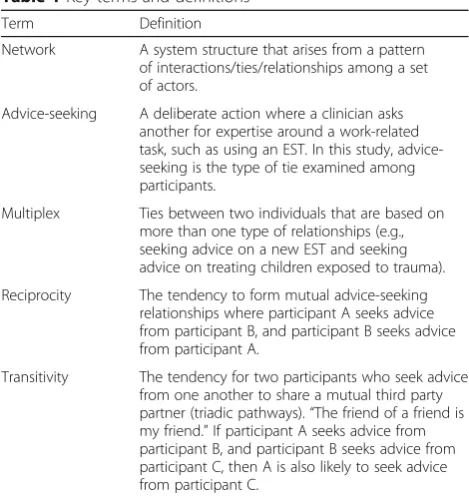
Table 1Key terms and definitions
Term Definition
Network A system structure that arises from a pattern of interactions/ties/relationships among a set of actors.
Advice-seeking A deliberate action where a clinician asks another for expertise around a work-related task, such as using an EST. In this study, advice-seeking is the type of tie examined among participants.
Multiplex Ties between two individuals that are based on more than one type of relationships (e.g., seeking advice on a new EST and seeking advice on treating children exposed to trauma).
Reciprocity The tendency to form mutual advice-seeking relationships where participant A seeks advice from participant B, and participant B seeks advice from participant A.
alter nominated, participants reported the name and organizational affiliation. This process identified 422 in-dividuals. Because this study focused on development of advice-seeking relationships among learning collabora-tive participants, our analysis is restricted to the ties among the 126 participants and five faculty experts (131 total).
Professional characteristics
We measured professional characteristics including org anization, disciplinary training (e.g., social work, coun-seling, psychology), and role on the implementation team (senior leader, supervisor, or clinician). General experience in the field and experience working at the current agency were measured with two categorical sur-vey items, where responses included from 0 to 6 months, 6–11 months, 1–3 years, 3–5 years, and more than 5 years. In addition, because some participants may have come to the learning collaborative with some knowledge of TF-CBT, respondents were asked to indicate whether they received prior training on TF-CBT (binary, where 1 = yes).
Analysis
In preparation for analysis, networks were visualized and several general descriptive network metrics were calcu-lated for each advice-seeking network at both time points (see Additional file1). Exponential random graph models (ERGMs) were used to test hypotheses about formation and maintenance of the general and specific advice-seeking ties at the end of the learning collabora-tive by conditioning on the ties present at the first obser-vation [46]. This lagged ERGM approach has been used in other network studies with only two measured time points [47]. ERGMs are models of the probability of, in our case, advice-seeking ties among a set of nodes. From a practical standpoint, model fitting and interpretation with ERGMs proceeds similarly to an analysis using lo-gistic regression. Both are multivariable approaches. Two major differences are that ERGMs (1) allow the re-searcher to control for the dependencies in relational data that may otherwise cause issues for estimation or inference and (2) offer numerous possibilities to test hy-potheses about the mechanisms likely to underlie the formation or evolution of a network that has been mea-sured at a particular moment in time. The ERGMs we fit included terms that allowed the model to adjust the odds of the presence of ties depending on (1) the pres-ence of other ties in the network (e.g., those that are re-ciprocal or transitive), (2) characteristics of the advice seeker, source, or (3) some function of the characteristics of both (e.g., employment at the same agency). Since the primary interest was in describing how the network changed from the beginning to the end of the learning
collaborative, we modeled the time 2 network as a func-tion of terms like those described aboveanda term that adjusted the odds that a tie existed at time 1 (i.e., a dyadic covariate). We refer to these model terms as lag terms. Terms included the following:
Indicators of expertise quality (H1)
Five terms reflected advice quality, including whether the potential advice source was a senior leader, super-visor, faculty expert, had prior TF-CBT training, and whether the potential advice source had more experi-ence in the field than the advice-seeker (participant).
Indicators of advice accessibility (H2)
Three terms reflect advice accessibility relative to the advice-seeker (H2), including whether the advice-seeker and their potential advice source were from the same organization, in the same learning collaborative cohort, and trained in the same discipline.
Characteristics of the advice-seeker (participant) (H3)
Three terms reflected the advice-seeker’s potential need for advice, including their role (where clinician served as the referent), prior training in TF-CBT, and experience in the field.
Existing relationships (H4)
These terms included the presence of general and spe-cific advice-seeking ties at time 1 (two lag terms) and reciprocity (the dependence between the presence of a tie from an individual A to another B and the presence of a tie from B to A). We also included two terms to ac-count for transitivity (if participant A seeks advice from participant B, and participant B seeks advice from par-ticipant C, parpar-ticipants A and C are also likely to have a tie). Geometrically weighted edgewise shared partners (GWESP) term accounts for the number of partners that a participant and advice source share. Theoretically, each additional shared tie does not increase the probability of a tie between A and B equally, this term contributes positively to the probability of a tie between two actors based on increasing shared partners, but does so in a de-creasing way. We also included a 3-cycle term, which ac-counts for shared partners but only for cyclic relationships where A seeks advice from B, B seeks ad-vice from C, and C seeks adad-vice from A. These cycles are often indicators of egalitarian (non-hierarchical) knowledge sharing patterns.
and BIC), were calculated for each model. The models were built in a step-wise fashion of increasing complex-ity. (Our results and relative fit statistics are detailed in Additional file 2). We report the most complete model (model 4) that includes all of our terms.
Results
Participant characteristics
Participant characteristics are displayed in Table 2. Two-thirds (67%) of participants provided direct clinical services, 22% were supervisors, and 10% were senior leaders. All participants held a master’s degree or higher in social work (54%), counseling (17%), psychology
(12%), or other discipline (16%). A majority practiced in children and family service settings for more than 5 years (65%), although 44% worked in their current position for less than 1 year.
Factors associated with the formation/maintenance of advice-seeking ties
Final results of the full ERGM models are displayed in Table3. Interpretation of the coefficients were, as always in multivariable models, taken to be conditional on all other model terms, including the lagged terms (repre-senting time 1 ties). Thus, where the model implies high-tie probabilities, advice-seeking ties were likely to have been maintained from time 1 or newly created at time 2. Similarly, where the model implies low-tie prob-abilities, advice-seeking ties that were not present at time 1 were likely to be maintained in their null state at time 2 or removed if they were present at time 1.
H1: expertise quality
Hypothesis 1 was partially supported. During the learn-ing collaborative, advice-seeklearn-ing ties were more likely to be formed or maintained with a faculty expert or super-visor. Participants tended to form or maintain general and specific advice-seeking relationships with learning collaborative faculty experts (b= 4.19,SE= .31,p< .05;b = 4.24,SE= 3.05,p< .05, respectively) and with others in supervisory roles (b= .822, SE= .23,p< .05;b= 1.09,SE = .22, p< .05, respectively). Participants were likely to form and maintain specific advice about TF-CBT from individuals with more field experience (b= .64, SE = .21, p< .05), but not general advice. Having prior TF-CBT training or the role of the senior leader was not associated with forming or maintaining either type of advice-seeking tie.
H2: accessibility and proximity
Hypothesis 2 was supported. Being located within the same organization was associated with the formation or maintenance of general (b= 2.82, SE= .25, p< .05) and TF-CBT-specific advice-seeking (b= 2.68, SE= .27, p< .05). Similar disciplinary training was associated with formation or maintenance of general (b= .33, SE = .17, p< .05) and specific advice-seeking (b= .37, SE = .19, p< .05), although being in the same learning collaborative cohort was not significant.
H3: needs of advice-seeker
Hypothesis 3 was not supported. None of the indicators of the advice seekers’ need for expertise were associated with formation/maintenance of either advice-seeking tie.
Table 2Participant characteristics (n= 126)
Number Percent
Role
Senior leader 13 10.32
Supervisor 28 22.22
Clinician 85 67.46
Education
Bachelor’s degree 2 1.59
Master’s degree 116 92.06
Doctoral degree or equivalent 8 6.35
Discipline
Social work 68 53.97
Counseling 22 17.46
Psychology 15 11.9
Other (education, medicine, addictions) 21 16.67
Experience in the field
0–6 months 1 0.79
6–11 months 6 4.76
1–3 years 18 14.29
3–5 years 19 15.08
more than 5 years 82 65.08
Experience in current job
0–6 months 27 21.43
6–11 months 28 22.22
1–3 years 22 17.46
3–5 years 17 13.49
more than 5 years 32 25.4
Learning collaborative cohort
1 41 32.54
2 22 17.46
3 39 30.95
4 24 19.05
Prior TF-CBT training
H4: role of existing relationships and network structure
Hypothesis 4 was supported. The presence of a general advice-seeking tie at time 2 was significantly related to the presence of the same general advice-seeking tie at time 1 (b= 2.0, SE = .24, p< .05) and to the corresponding TF-CBT-specific advice-seeking tie at time 1 (b= 1.38, SE = .34, p< .05). Likewise, the presence of a specific advice-seeking tie at time 2 was significantly related to the presence of the same specific advice-seeking tie at time 1 (b= 1.52, SE = .26,p< .05) and the general advice-seeking tie at time 1 (b= .82, SE = .21, p< .05). Reciprocity was positively and significantly associated with the formation/ maintenance of general (b= 2.1, SE = .35,p< .05) and spe-cific advice-seeking ties (b= 1.2, SE = .42,p< .05) indicat-ing that both forms of advice-seekindicat-ing tend to be reciprocated. Transitivity was positively associated with the formation/maintenance of TF-CBT-specific advice-seeking (b= 1.0, SE = .12,p< .05); these results indicate that individ-uals seek advice from those who provide advice to their other advice sources (e.g., the mentor of my mentor be-comes my mentor as well). Transitivity was not associated
with general advice-seeking. Also, the effect of three cycles, an additional triadic dependence term, was negative and significant in both the general (b=−.99, SE = .28, p< .05) and specific advice-seeking models (b=−.88, SE = .27, p < .05), suggesting a hierarchical pattern of advice-seeking.
Discussion
As clinicians adopt and implement EBTs, their knowledge and skill needs might change, necessitating new relation-ships with colleagues who have relevant general and treatment-specific expertise. Drawing on transactive mem-ory systems themem-ory, strategies should help clinicians de-velop a shared and accurate sense of who is an expert in a particular EBT and promote access to them [25]. Our re-sults suggest that learning collaboratives may do just this. Mental health clinicians participating in a learning collab-orative to implement TF-CBT formed or maintained advice-seeking relationships with those with treatment ex-pertise (especially faculty experts and supervisors) and who were easily accessible (e.g., located in the same agency). However, clinicians’ pre-existing social relationships
Table 3ERGM results––factors associated with formation and maintenance of advice-seeking ties
Characteristic Feature of General advice-seeking Specific advice-seeking
est se est se
Expertise quality(H1)
Senior lead Advice source 0.321 (0.301) 0.187 (0.370)
Supervisor Advice source 0.822* (0.226) 1.092* (0.223)
Faculty expert Advice source 4.185* (0.305) 4.242* (0.305)
Prior training Advice source 0.146 (0.210) 0.170 (0.193)
Alter higher experience Dyad 0.245 (0.234) 0.644* (0.208)
Accessibility(H2)
Same agency Dyad 2.818* (0.249) 2.683* (0.273)
Same cohort Dyad 0.265 (0.194) 0.256 (0.215)
Same field Dyad 0.329* (0.166) 0.372* (0.187)
Expertise need(H3)
Senior leader Advice seeker −0.381 (0.306) −0.288 (0.306)
Supervisor Advice seeker −0.072 (0.233) 0.075 (0.226)
Prior training Advice seeker −0.293 (0.174) −0.200 (0.181)
Experience Advice seeker 0.116 (0.098) 0.053 (0.106)
Existing relationships(H4)
General ties lag Dyad 1.996* (0.244) 1.515* (0.259)
Specific ties lag Dyad 0.817* (0.213) 1.379* (0.340)
Reciprocity Dyad 2.083* (0.353) 1.213* (0.420)
Transitivity Triad 0.624 (0.636) 0.991* (0.119)
gwesp.alpha Triad 2.164* (0.149) 0.847* (0.115)
3-cycles Triad −0.988* (0.274) −0.876* (0.266)
Edges (density) −7.078* (0.497) −6.887* (0.520)
determined with whom they built or maintained advice-seeking ties, which, in some situations, could con-strain clinicians’ access to high-quality expertise. These findings have implications for learning collaborative model refinements.
High-quality expertise
Our findings that expertise quality and accessibility drove the formation of advice-seeking relationships are consistent with other studies rooted in transactive memory systems theory [22, 31, 32]. Consistent with our first hypothesis, clinicians formed and maintained general and TF-CBT-specific advice-seeking relation-ships with those who were faculty experts, supervisors, or who had more field experience than they did. These clinical leaders had expertise and experience to diffuse through clinicians’ advice networks. Faculty experts were trained TF-CBT clinicians; they introduced the treatment, led the learning sessions, and provided hands-on coaching and consultation––strategies associ-ated with implementation effectiveness [48]. Given how clinicians formed and sought advice from expert faculty over the duration of the learning collaboratives, faculty members likely had more clinicians seeking their advice over time. In this study, five faculty experts were avail-able to the 126 completers. While it is unclear whether five faculty members offered sufficient capacity for meeting participants’advice needs, the number of fac-ulty experts available to clinicians over the duration of the learning collaborative may be an important consid-eration for future learning collaborative or implementa-tion initiatives.
Within organizational teams, senior leaders were less sought-after advice sources perhaps because these indi-viduals are responsible for administration and manage-ment and may not serve in clinical capacities. However, clinicians formed and maintained advice-seeking rela-tionships with their supervisors. Supervisors are critical to implementation. As middle managers, they diffuse in-formation, synthesize inin-formation, mediate between strategy and day-to-day activities, and sell implementa-tion [49, 50]. By sharing general and specific advice, su-pervisors may have engaged in each of these activities. They might diffuse information by answering questions about TF-CBT, synthesize information by helping clini-cians apply TF-CBT with their clients, mediate between organizational goals and clinicians’ TF-CBT use by translating the key TF-CBT components into concrete tasks, and promote implementation by encouraging cli-nicians’TF-CBT use. With this in mind, learning collab-oratives might emphasize supports for supervisors to help them engage in these activities in a way that is likely to promote desired outcomes.
The importance of accessibility and existing relationships
Consistent with our second hypothesis, clinicians tended to seek advice from their colleagues in the same agency or with similar disciplinary training. However, being in the same learning collaborative cohort did not seem to influence clinicians’ advice-seeking patterns, although the cohort structure was intended to improve access to others’ knowledge and expertise. Other studies have demonstrated that social and physical accessibility are important considerations in diffusing knowledge and expertise [32], as clinicians are likely to turn to col-leagues who they are close to physically (e.g., down the hallway) [22, 51] and believe will provide reliable and understandable information [52]. Clinicians might have prioritized advice from colleagues from the same agency or disciplinary background over other participants in the same learning collaborative cohort. Related to these findings, and consistent with our fourth hypothesis, cli-nicians formed and maintained advice-seeking ties with colleagues with whom they were already directly or in-directly connected. Clinicians asked for TF-CBT advice from colleagues who previously offered general clinical advice and vice versa. Likewise, clinicians reciprocated advice-seeking and connected their colleagues to their own advice sources (transitivity). These findings indicate that clinicians build on existing networks when forming new relationships and are consistent with other studies demonstrating that network evolution is driven by strong endogenous effects [53,54].
agencies which could be counterproductive if they end up strengthening ties with individuals who do not have strong skills or knowledge in the EST.
Participants seek advice in similar ways
Contrary to our expectations, clinicians, supervisors, and senior leaders sought advice in comparable ways. This sug-gests that participants, regardless of their role in their organization, need and rely on advice when implementing a new EBT. Also, despite having some prior knowledge of the EBT (and potentially valuable advice to share), those with prior TF-CBT training were not more likely to be tapped as advice sources, or need less advice than those without prior training. It may be that clinicians preferred advice from fac-ulty experts and supervisors over their peers with prior ex-posure to TF-CBT. Together, these findings suggest that future learning collaboratives should involve multiple organizational stakeholders, regardless of their prior train-ing, and help connect them to available expertise.
Limitations and future directions
The findings should be interpreted in light of limitations that have implications for research on networks, learning collaboratives, and implementation. First, this study was conducted in one geographic region with a strong col-laborative history [54]. Given the importance of existing relationships to network evolution, generalizability might be limited to similar service delivery systems. Second, we measured social networks based on self-report of two advice-seeking ties (general and TF-CBT specific) and did not capture implementation-related advice. Our measures also did not capture friendship ties, which in-fluence clinicians’attitudes toward an EBT, but are more stable than advice ties (and less likely to change in re-sponse to learning collaboratives) [4]. Third, the size of our learning collaborative cohorts (about 30 partici-pants) is both larger and smaller [55, 56] than cohorts reported in other learning collaborative studies. Large groups may experience more growth in social networks than small groups [11, 57]. However, we do not antici-pate that the mechanisms guiding advice-seeking (which we focus on in this study) vary based on cohort size, al-though this should be confirmed in a future study. Fourth, without a comparison or control group, we can-not determine whether the change in advice-seeking was driven by the learning collaborative, the need to learn TF-CBT, or other random factors. Future controlled studies are needed to verify the effectiveness of learning collaboratives on advice network evolution, implementa-tion outcomes, and clinical outcomes. A three-wave de-sign could allow for a quasi-experiment where the first period (T1–T2; pre-collaborative) could serve as a base-line picture of network evolution, and the second (T2– T3; during and post collaborative) could be used to
examine how the network evolution process changed with the learning collaborative. Such an experiment would be ideally modeled using stochastic actor-based models for network dynamics [58].
Conclusions
Learning collaboratives and other quality improvement col-laborative models have a potential to support implementa-tion by altering the social networks that diffuse expertise, knowledge, and skill for using an EBT, but the change mechanisms were unknown [59, 60]. In this study, partici-pants formed and maintained advice-seeking relationships with faculty experts and supervisors, who were experienced and well positioned to support implementation. Viewed through the lens of transactive memory systems, our results suggest that learning collaboratives might activate clini-cians’awareness and ability to recognize expertise and re-trieve it from accessible sources. This model and other large-group implementation interventions could be stream-lined to emphasize network building among clinicians and those with the most relevant, appropriate, and high-quality expertise.
Additional files
Additional file 1:Description of advice-seeking networks over time (PDF 1793 kb)
Additional file 2:ERGM model-building details (DOCX 37 kb)
Abbreviations
EBT:Evidence-based treatment; ERGM: Exponential random graph model; GWESP: Geometrically weighted edgewise shared partners; NCCTS: The National Center for Child Traumatic Stress; TF-CBT: Trauma-Focused Cognitive Behavioral Therapy
Acknowledgements
We wish to acknowledge Dr. Jerry Dunn and the clinicians who led and participated in the learning collaboratives––we appreciate your commitment and partnership. Also, we wish to thank Dr. Thomas Valente for his consultation on network data management, Dr. Doug Luke for his consultation on the analytic approach, and Dr. Yiwen Cao for her assistance with data entry and management.
Funding
Data collection was supported by a post-doctoral traineeship at the Univer-sity of North Carolina-Chapel Hill funded by the National Institute of Mental Health (T32 MH019117). The preparation of this article was supported in part by the Implementation Research Institute (IRI) at Washington University in St. Louis through an award from the National Institute of Mental Health (R25 MH080916-01A2) and the Department of Veterans Affairs, Health Services Re-search & Development Service, Quality Enhancement ReRe-search Initiative (QUERI) (AB and RH). SB’s work on this paper was supported by the National Center for Advancing Translational Sciences, National Institutes of Health, through grant no. KL2TR001109. The content is solely the responsibility of the authors and does not necessarily represent the official views of the NIH.
Availability of data and materials
Authors’contributions
All authors read and approved the final manuscript.
Ethics approval and consent to participate
This research study was reviewed and approved by the Institutional Review Boards at UNC (2011–2012) and OSU (2012–2018). Informed consent was obtained from all participants.
Consent for publication Not applicable.
Competing interests
The authors declare that they have no competing interests.
Publisher’s Note
Springer Nature remains neutral with regard to jurisdictional claims in published maps and institutional affiliations.
Author details
1College of Social Work, The Ohio State University, 1947 College Road,
Columbus, OH 43210, USA.2The Ohio Colleges of Medicine Government Resource Center , The Ohio State University, 1070 Carmack Road, Columbus, OH 43210, USA.3National Crime Victims Research and Training Center, Department of Psychiatry and Behavioral Sciences, Medical University of South Carolina, 100 Doughty Street, Charleston, SC 29425, USA.4Department of Health Policy and Management, Gillings School of Global Public Health, University of North Carolina at Chapel Hill, 1105C McGavran-Greenberg Hall, Campus Box 7411, Chapel Hill, NC 27599, USA.
Received: 26 March 2018 Accepted: 23 July 2018
References
1. Valente TW. Social networks and health: models, methods, and applications. New York: Oxford University Press; 2010.
2. Burkhardt ME, Brass DJ. Changing patterns or patterns of change: the effects of a change in technology on social network structure and power. Adm. Sci. Q. 1990;35:104.
3. Zagenczyk TJ, Murrell AJ. It is better to receive than to give: advice network effects on job and work-unit attachment. J Bus Psychol. 2009;24:139–52. 4. Gibbons DE. Friendship and advice networks in the context of changing
professional values. Adm Sci Q. 2004;49:238–62.
5. Rangachari P, Madaio M, Rethemeyer RK, Wagner P, Hall L, Roy S, et al. The evolution of knowledge exchanges enabling successful practice change in two intensive care units. Health Care Manag Rev. 2015;40:65–78. 6. Rangachari P, Madaio M, Rethemeyer RK, Wagner P, Hall L, Roy S, et al. Role
of communication content and frequency in enabling evidence-based practices. Qual. Manag. Health Care. 2014;23:43–58.
7. Yousefi-Nooraie R, Dobbins M, Marin A, Hanneman R, Lohfeld L. The evolution of social networks through the implementation of evidence-informed decision-making interventions: a longitudinal analysis of three public health units in Canada. Implement Sci. 2015;10:166.
8. Kilo CM. A framework for collaborative improvement: lessons from the Institute for Healthcare Improvement’s Breakthrough Series. Qual Manag Health Care. 1998;8:1–13.
9. Institute for Healthcare Improvement. The Breakthrough Series: IHI's Collaborative Model for Achieving Breakthrough Improvement. IHI Innovation Series white paper. Boston: Institute for Healthcare Improvement; 2003.
10. Bunger AC, Hanson RF, Doogan NJ, Powell BJ, Cao Y, Dunn J. Can learning collaboratives support implementation by rewiring professional networks? Adm Policy Ment Heal. 2016;43:79–92.
11. Bunger, AC, Lengnick-Hall, R. Do learning collaboratives strengthen communication? A comparison of organizational team communication networks over time. Health Care Manage Rev. 2018;43:50-60.
12. Cohen JA, Mannarino AP, Deblinger E. Treating trauma and traumatic grief in children and adolescents. New York: Guilford Press; 2006.
13. Cary CE, McMillen JC. The data behind the dissemination: a systematic review of trauma-focused cognitive behavioral therapy for use with children and youth. Child Youth Serv Rev. 2012;34:748–57.
14. Nadeem E, Olin SS, Hill LC, Hoagwood KE, Horwitz SM. A literature review of learning collaboratives in mental health care: used but untested. Psychiatr. Serv. 2014;65:1088–99.
15. Nadeem E, Olin SS, Hill LC, Hoagwood KE, Horwitz SM. Understanding the components of quality improvement collaboratives: a systematic literature review. Milbank Q. 2013;91:354–94.
16. Carter P, Ozieranski P, McNicol S, Power M, Dixon-Woods M. How collaborative are quality improvement collaboratives: a qualitative study in stroke care. Implement Sci. 2014;9:32.
17. Ebert L, Amaya-Jackson L, Markiewicz JM, Kisiel C, Fairbank JA. Use of the breakthrough series collaborative to support broad and sustained use of evidence-based trauma treatment for children in community practice settings. Adm. Policy Ment. Heal. 2012;39:187–99.
18. Nembhard IM. Learning and improving in quality improvement collaboratives: which collaborative features do participants value most? Health Serv Res. 2009;44:359–78.
19. Garcia SK. Developing social network propositions to explain large-group intervention theory and practice. Adv Dev Hum Resour. 2007;9:341–58. 20. Tenkasi RV, Chesmore MC. Social networks and planned organizational
change: the impact of strong network ties on effective change implementation and use. J Appl Behav Sci. 2003;39:281–300. 21. Clarke N. Transorganization development for network building. J Appl
Behav Sci. 2005;41:30–46.
22. Borgatti SP, Cross R. A relational view of information seeking and learning in social networks. Manage Sci. 2003;49:432–45.
23. Monge PR, Contractor NS. Theories of communication networks. New York: Oxford University Press; 2003.
24. Peltokorpi V. Transactive memory systems. Rev Gen Psychol. 2008;12:378–94. 25. Brandon DP, Hollingshead AB. Transactive memory systems in
organizations: matching tasks, expertise, and people. Organ Sci. 2004;15:633–44.
26. Palazzolo ET, Serb DA, She Y, Su C, Contractor NS. Coevolution of communication and knowledge networks in transactive memory systems: using computational models for theoretical development. Commun Theory. 2006;16:223–50.
27. Bunker BB, Alban BT. Introduction to the special issue on large group interventions. J Appl Behav Sci. 2005;41:9–14.
28. Bryson JM, Anderson SR. Applying large-group interaction methods in the planning and implementation of major change efforts. Public Adm. Rev. 2000;60:143–62.
29. Nisar MA, Maroulis, S. Foundations of relating: theory and evidence on the formation of street-level bureaucrats' workplace networks. Public Adm Rev. 2017;77:829-39.
30. Ren Y, Argote L. Transactive memory systems 1985–2010: an integrative framework of key dimensions, antecedents, and consequences. Acad Manag Ann. 2011;5:189–229.
31. Yuan YC, Carboni I, Ehrlich K. The impact of awareness and accessibility on expertise retrieval: a multilevel network perspective. J Am Soc Inf Sci Technol. 2010;61:700–14.
32. Hertzum M. Expertise seeking: a review. Inf Process Manag. 2014;50:775–95. 33. Kang M, Kim YG. A multilevel view on interpersonal knowledge transfer. J
Am Soc Inf Sci Technol. 2010;61:483–94.
34. Yousefi-Nooraie R, Dobbins M, Marin A. Social and organizational factors affecting implementation of evidence-informed practice in a public health department in Ontario: a network modelling approach. Implement Sci. 2014;9:29.
35. Hofmann DA, Lei Z, Grant AM. Seeking help in the shadow of doubt: the sensemaking processes underlying how nurses decide whom to ask for advice. J Appl Psychol. 2009;94:1261–74.
36. Bunderson JS. Recognizing and utilizing expertise in work groups: a status characteristics perspective. Adm. Sci. Q. 2003;48:557.
37. Mascia D, Di Vincenzo F, Iacopino V, Fantini MP, Cicchetti A. Unfolding similarity in interphysician networks: the impact of institutional and professional homophily. BMC Health Serv Res. 2015;15:92.
38. Nebus J. Building collegial information networks: a theory of advice network generation. Acad Manag Rev. 2006;31:615–37.
39. Culnan MJ. The dimensions of perceived accessibility to information: implications for the delivery of information systems and services. J. Am. Soc. Inf. Sci. 1985;36:302–8.
41. Shearer JC, Dion M, Lavis JN. Exchanging and using research evidence in health policy networks: a statistical network analysis. Implement Sci. 2014;9:126.
42. Siciliano MD. Advice networks in public organizations: the role of structure, internal competition, and individual attributes. Public Adm Rev. 2015;75: 548–59.
43. Siciliano MD, Moolenaar NM, Daly AJ, Liou YH. A cognitive perspective on policy implementation: reform beliefs, sensemaking, and social networks. Public Adm Rev. 2017;77:889–901.
44. Agneessens F, Wittek R. Where do intra-organizational advice relations come from? The role of informal status and social capital in social exchange. Soc. Networks. 2012;34:333–45.
45. Wasserman S, Faust K. Social network analysis: methods and applications. New York: Cambridge University Press; 1994.
46. Robins G, Pattison P, Kalish Y, Lusher D. An introduction to exponential random graph (p*) models for social networks. Soc Networks. 2007;29:173–91. 47. Dhand A, Luke DA, Carothers BJ, Evanoff BA. Academic cross-pollination:
the role of disciplinary affiliation in research collaboration. PLoS One. 2016;11:1–13.
48. Gustafson DH, Quanbeck AR, Robinson JM, Ford JH, Pulvermacher A, French MT, et al. Which elements of improvement collaboratives are most effective? A cluster-randomized trial. Addiction. 2013;108:1145–57. 49. Birken SA, Lee S-YD, Weiner BJ, Chin MH, Schaefer CT. Improving the
effectiveness of health care innovation implementation: middle managers as change agents. Med. Care Res. Rev. 2013;70:29–45.
50. Birken SA, DiMartino LD, Kirk MA, Lee S-YD, McClelland M, Albert NM. Elaborating on theory with middle managers’experience implementing healthcare innovations in practice. Implement Sci. 2015;11:2. 51. Cao Y, Bunger AC, Hoffman J, Robertson HA. Change Communication
Strategies in Public Child Welfare Organizations: Engaging the Front Line. Hum Serv Organ Manag Leadersh Gov. 2016;40:37-50.
52. Agarwal NK, Xu YC, Poo DCC. A context-based investigation into source use by information seekers. J. Am. Soc. Inf. Sci. Technol. 2011;62:1087–104. 53. Gulati R, Gargiulo M. Where do interorganizational networks come from?
Am J Sociol. 1999;104:1439–93.
54. Bunger AC, Doogan NJ, Cao Y. Building service delivery networks: partnership evolution among children’s behavioral health agencies in response to new funding. J Soc Social Work Res. 2014;5:513–38. 55. Saunders BE, Hanson RF. Innovative methods for implementing
evidence-supported interventions for mental health treatment of child and adolescent victims of violence. In: Reece R, Hanson RF, Sargent J, editors. Treat. Child Abus. Common Gr. Ment. Heal. Medical, Leg. Pract. 2nd ed. Baltimore: Johns Hopkins University Press; 2014. p. 392.
56. Lang JM, Franks RP, Epstein C, Stover C, Oliver JA. Statewide dissemination of an evidence-based practice using Breakthrough Series Collaboratives. Child Youth Serv Rev. 2015;55:201–9.
57. Anderson BS, Butts C, Carley K. The interaction of size and density with graph-level indices. Soc Networks. 1999;21:239–67.
58. Snijders TAB, van de Bunt GG, Steglich CEG. Introduction to stochastic actor-based models for network dynamics. Soc Networks. 2010;32:44–60. 59. Schouten LM, Grol RP, Hulscher ME. Factors influencing success in
quality-improvement collaboratives: development and psychometric testing of an instrument. Implement. Sci. 2010;5:84.