R E S E A R C H
Open Access
Differences in preferences for rural job postings
between nursing students and practicing nurses:
evidence from a discrete choice experiment in
Lao People
’
s Democratic Republic
Peter C Rockers
1*, Wanda Jaskiewicz
2, Margaret E Kruk
3, Outavong Phathammavong
4, Phouthone Vangkonevilay
5,
Chanthakhath Paphassarang
5, Inpong Thong Phachanh
5, Laura Wurts
2and Kate Tulenko
2Abstract
Background:A discrete choice experiment was conducted to investigate preferences for job characteristics among nursing students and practicing nurses to determine how these groups vary in their respective preferences and to understand whether differing policies may be appropriate for each group.
Methods:Participating students and workers were administered a discrete choice experiment that elicited preferences for attributes of potential job postings. Job attributes included salary, duration of service until promotion to permanent staff, duration of service until qualified for further study and scholarship, housing provision, transportation provision, and performance-based financial rewards. Mixed logit models were fit to the data to estimate stated preferences and willingness to pay for attributes. Finally, an interaction model was fit to formally investigate differences in preferences between nursing students and practicing nurses.
Results:Data were collected from 256 nursing students and 249 practicing nurses. For both groups, choice of job posting was strongly influenced by salary and direct promotion to permanent staff. As compared to nursing students, practicing nurses had significantly lower preference for housing allowance and housing provision as well as lower preference for provision of transportation for work and personal use.
Conclusions:In the Lao People’s Democratic Republic, nursing students and practicing nurses demonstrated important differences in their respective preferences for rural job posting attributes. This finding suggests that it may be important to differentiate between recruitment and retention policies when addressing human resources for health challenges in developing countries, such as Laos.
Keywords:Nursing, Human resources for health, Attraction, Retention, Discrete choice experiment, Laos People’s Democratic Republic
Background
Lao People’s Democratic Republic (commonly referred to as Laos) is a lower-middle-income country located in Southeast Asia. Population health indicators in Laos have steadily improved over the past 15 years. Indeed, life expectancy increased from 51 years to 65 years bet-ween 1995 and 2008 and during that same time, infant
mortality was more than halved from 102 to 42 deaths per 1,000 live births [1]. However, inequities in access to health care services between urban and rural popula-tions threaten to undermine these achievements. The Laos Ministry of Health (MOH) is struggling to provide adequate access to primary health care services for rural populations that comprise more than three-quarters of the country’s total population. The MOH has identified a shortage of health workers at primary and secondary health facilities in rural areas as a priority area for health system reform efforts [2].
* Correspondence:[email protected] 1
Department of Global Health and Population, Harvard School of Public Health, 677 Huntington Ave, Boston, MA 02115, USA
Full list of author information is available at the end of the article
According to recent estimates, there are fewer than 5,000 nurses in Laos serving a population of more than six million, or less than one nurse per 1,000 population [1]. Further, as in many countries, a disproportionate number of nurses in Laos live and work in urban cen-ters, leaving rural populations with limited access to skilled clinicians [3]. A recent study of the nurse work-force situation in Laos found that staffing shortages in the country do not stem from emigration [4]. The base salary for nurses in Laos in 2012 was 630,000 Lao Kip per month (around US$78.50). As of 2012, there were limited programs in place to incentivize nurses to live and work in rural areas. For example, there were no bo-nuses provided to nurses for working in rural areas, though such bonuses were under consideration by the MOH [5]. Further, at that time there were no condi-tional scholarship programs in the country that required nurses to fulfill a commitment to work in rural areas after receiving financial support for training.
The World Health Organization (WHO), the World Bank, USAID’s CapacityPlusproject, and other partners have recently drafted a road map to guide governments in developing countries, such as Laos, in selecting and employing analytic tools to inform policy-making to ef-fectively address human resources for health (HRH) challenges [6]. The draft road map identifies three im-portant aspects of the problem of health worker staffing in underserved areas as critical for HRH policy: 1) un-derstanding the health needs of the population and how the current health workforce is addressing or not ad-dressing those needs; 2) understanding the health labor market; and 3) understanding the needs and expecta-tions of health workers. Only after a thorough analysis of each of these aspects of the problem at the local-level can effective policy be formulated to address HRH challenges.
The discrete choice experiment (DCE) is one tool that policymakers can use to understand the needs and ex-pectations of health workers. DCE is an analytic method that allows for the quantification of survey respondents’ preferences for various attributes of a good or service. DCEs that investigate health workers’preferences for job posting attributes, including salary levels, health facility quality and future opportunities for advanced education and career promotion, have become increasingly com-mon in the literature [7-13]. To support the method’s use in policy formulation, the World Bank, along with WHO and CapacityPlus, has developed a practitioner’s guide for conducting DCEs for HRH policy [14].
WHO has argued that governments should pursue both recruitment and retention policies to address health sec-tor human resource constraints [15]. Recruitment policies primarily target students in the final year of health wor-ker training programs, while retention programs target
currently practicing health workers. Making decisions on investments in recruitment and retention strategies re-quires an understanding of the health labor market, for example, the available supply of graduating students in health worker training programs and the rates of turnover among current health sector employees. Determining the content of the incentive packages for recruitment and re-tention can be assisted by data from DCEs.
At present, there is little evidence to suggest how re-cruitment and retention policies for HRH should differ, if at all. Recently, several DCE studies have been pub-lished that focus alternatively on students in health worker training programs [3,4,8,9] or practicing health workers [5-7]. One DCE study, conducted by the World Bank in Vietnam and published in 2010, has compared preferences for job posting attributes among practicing physicians and medical students in their final year of training [16]. Further, a recent study in India employed qualitative methods to investigate differences in prefe-rences for rural job postings among students and prac-ticing health workers in doctor and nurse cadres [17]. However, further evidence is needed before firm conclu-sions can be drawn on this issue.
As an initial step toward identifying policies to ad-dress human resource constraints at rural health faci-lities, the Laos MOH solicited the assistance of WHO and CapacityPlus in determining preferences for rural job postings among students and health workers in the country. A DCE was conducted to investigate prefer-ences for job characteristics among nursing students and practicing nurses. In this article we present a direct com-parison of preferences for job postings among nursing students and practicing nurses in Laos. We aim to de-termine how students and health workers vary in their respective preferences to understand whether differing recruitment and retention policies may be appropriate.
Methods
Sampling
Three of 17 provinces in Laos were selected for inclu-sion in the study. One province each was selected from the northern (Luang Prabang), central (Savannakhet), and southern (Champasak) regions of the country. These particular provinces were selected for two reasons: 1) they were predominantly rural; and 2) they each included train-ing program sites for health worker cadres of interest to the study. Within each selected province, nursing students and practicing nurses were recruited for the study ac-cording to specific methodologies.
Nursing students
nurse training programs at their respective provincial colleges. All students in their third and final year of the nurse training program in the three sampled provinces were invited to participate in this study.
Practicing nurses
Nurses practicing in Laos work at various levels of the health system, including the provincial hospital, district hospitals, and local health centers. Within each sampled province, all nurses at the provincial hospital were re-cruited for inclusion in the study. Further, four districts were selected from each province, and all nurses at the district hospitals and health centers within these districts were recruited for inclusion in the study. Provinces in Laos are comprised of five to ten districts.
Instrument and survey fielding
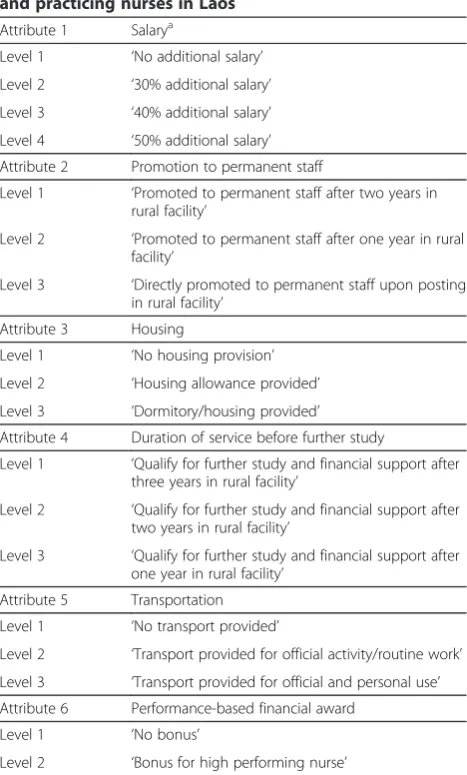
Nursing students and practicing nurses completed iden-tical DCE surveys that elicited preferences for attributes of nursing job postings in Laos. Selection of DCE attri-butes and levels was informed by three activities: 1) a re-view of the published literature on strategies to attract and retain health workers, 2) discussions with members of the Laos MOH, and 3) a focus group discussion with nursing students in Laos. For additional information on DCE instrument design see the Technical Appendix (Additional file 1). Six attributes were deemed suffi-ciently important to warrant inclusion in the final DCE instrument: salary, duration of service until promotion to permanent staff, duration of service until qualified for further study and scholarship, housing provision, trans-portation provision, and performance-based financial re-wards (Table 1). DCE scenario alternatives were paired using an experimental design to optimize D-efficiency using Sawtooth Software’s Choice-Based Conjoint pac-kage (Sawtooth Software Inc. 2007). Five versions of the survey were generated and used in the study.
All participants were randomized to receive one of the five versions of the DCE instrument. For each version, respondents were presented with 12 choice tasks. Choice tasks were comprised of two job scenarios, each with a unique combination of levels for the six job attributes described above. For each choice task, respondents were asked,‘Which of these two job postings do you prefer?’ The job postings described in the DCE scenarios were not labeled as being in rural or urban settings. Rather, as part of an introductory script presented prior to survey administration, respondents were told to consider all DCE job scenarios to be located in rural areas. No addi-tional information on the definition of ‘rural’ was pro-vided, so that respondents were free to interpret the term in their own way. There is some evidence that sug-gests that labels distract respondents from job attributes and thus may diminish the reliability of estimates of
attribute preferences [18]. We were interested in investi-gating preferences for attributes of job postings within a rural setting. For additional information on DCE experi-mental design, see the Technical Appendix (Additional file 1). A survey questionnaire administered along with the DCE included questions about demographics, educa-tion experience, and prior work experience. Prior to the start of data collection, the DCE instrument was piloted with a small group of students to make certain that the presentation was conceptually clear.
Paper-based surveys were administered to student respondents in groups ranging from 50 to more than 150 respondents in classrooms, and to practicing health worker respondents in groups ranging from 10 to 20 at health facilities of employment during work hours. Re-spondents completed the survey questionnaire and DCE survey at their own pace. On average, respondents took approximately 20 to 30 minutes to complete the survey. Table 1 DCE attributes and levels for nursing students and practicing nurses in Laos
Attribute 1 Salarya
Level 1 ‘No additional salary’
Level 2 ‘30% additional salary’
Level 3 ‘40% additional salary’
Level 4 ‘50% additional salary’
Attribute 2 Promotion to permanent staff
Level 1 ‘Promoted to permanent staff after two years in rural facility’
Level 2 ‘Promoted to permanent staff after one year in rural facility’
Level 3 ‘Directly promoted to permanent staff upon posting in rural facility’
Attribute 3 Housing
Level 1 ‘No housing provision’
Level 2 ‘Housing allowance provided’
Level 3 ‘Dormitory/housing provided’
Attribute 4 Duration of service before further study
Level 1 ‘Qualify for further study and financial support after three years in rural facility’
Level 2 ‘Qualify for further study and financial support after two years in rural facility’
Level 3 ‘Qualify for further study and financial support after one year in rural facility’
Attribute 5 Transportation
Level 1 ‘No transport provided’
Level 2 ‘Transport provided for official activity/routine work’
Level 3 ‘Transport provided for official and personal use’
Attribute 6 Performance-based financial award
Level 1 ‘No bonus’
Level 2 ‘Bonus for high performing nurse’
a
At the completion of each survey group, the administra-tive team, comprised of members of the MOH, WHO, and CapacityPlus, entered the collected responses into project computers and aggregated the data into a central protected database.
The survey was fielded to inform health system re-forms in Laos. All survey respondents provided written consent prior to participation. The Lao People’s Demo-cratic Republic MoH subsequently shared data with the authors for analysis and publication. Clearance to ana-lyze the de-identified administrative data and publish re-sults was obtained by the institutional review board at Harvard University.
Statistical analysis
Descriptive statistics were calculated for demographic and work experience variables. A separate main effects mixed logit model was fit to DCE data collected from each of the respondent groups - nursing students and practicing nurses - to estimate preferences for job attri-butes. In both models, all attribute variables were speci-fied as having a random component except for salary, which was specified as fixed. Further, all attribute vari-ables were coded as dummy varivari-ables except for salary, which was specified as continuous in both models. Mixed logit is not the only method that can be used to analyze DCE data, and there are ongoing debates in the literature regarding which modeling techniques are most efficient and appropriate [19]. Recent research suggests that traditional OLS modeling methods may be an ef-ficient means to estimate individual-level choice prefer-ences [20]. Mixed logit methods are frequently used for DCE modeling within the healthcare field [21,22]. How-ever, recently generalized multinomial logit (GMNL) methods have been adopted in other fields that use the DCE method, including transportation economics [23]. The GMNL method separates heterogeneity in respon-dent preferences from heterogeneity in the scale of estimates produced by mixed logit models [24,25]. For comparison with estimates from mixed logit models, we also estimated the main results with GMNL models.
Willingness to pay (WTP) estimates were calculated by dividing attribute coefficients by the salary coefficient for both models. WTP confidence intervals were esti-mated using the delta method [26]. Finally, a formal stat-istical analysis of the differences in preferences for job posting attributes between nursing students and prac-ticing nurses was conducted by fitting a mixed logit inter-action model. The interinter-action model was fit to a DCE dataset that combined students’and practicing nurses’ re-sponses, and included a dummy variable that indicated that the respondent was a practicing nurse interacted with each of the DCE attributes. Interaction terms were speci-fied as being fixed. A test for lexicographic preferences
was conducted to identify respondents potentially be-having irrationally. For additional information on the statistical model specifications and the results of vali-dity tests, see the Technical Appendix (Additional file 1). All mixed logit models were fit using Stata’s mixlogit command (StataCorp 2007), and were specified with 500 Halton draws.
Results
Of 408 nursing students eligible for inclusion in the study, data were collected from 256 (62.7%). Of 383 practicing nurses eligible for inclusion in the study, data were collected from 249 (65.0%). Non-responses were due to eligible participants not reporting to survey loca-tions. No data were collected from non-respondents.
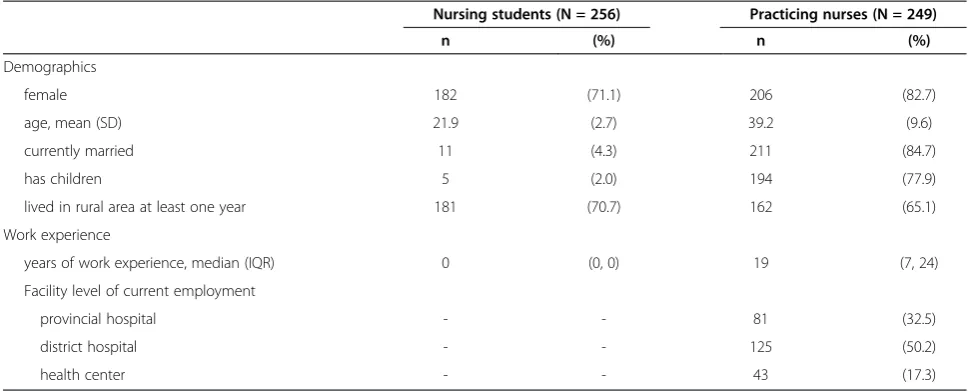
Nursing students and practicing nurses were predo-minantly female (Table 2). The mean age of nursing students was 21.9 years (SD 2.7) and the mean age of practicing nurses was 39.2 years (SD 9.6). Most prac-ticing nurses were married and had children while most nursing students were neither married nor had children. A majority of both nursing students (70.7%) and prac-ticing nurses (65.1%) had lived in a rural area for at least one year at a previous time in their lives. Finally, as expected, practicing nurses had substantially more work experience than did nursing students. The median prac-ticing nurse had worked 19 years at the time of the study while the median nursing students had not worked at all.
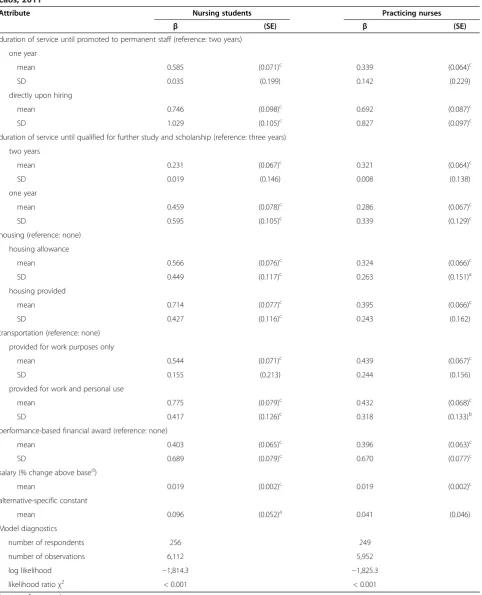
deviations, a measure of preference heterogeneity in the respondent population, produced by the GMNL models are consistently smaller.
Table 5 presents a formal analysis of differences in preferences for job attributes between nursing students and practicing nurses. The results of the interaction model confirm that, compared to nursing students, prac-ticing nurses had a significantly lower preference for housing allowance and provision as well as transporta-tion provision for personal use. In additransporta-tion, practicing nurses had a significantly lower preference for promo-tion to permanent staff after one year of work as com-pared to two years than did nursing students. As with the main effect model estimates, interaction estimates from GMNL models were not substantively different from mixed logit estimates, though the standard errors produced by the GMNL models were consistently larger (see Additional file 2).
Discussion
We investigated similarities and differences in preferen-ces for rural job postings among nursing students and practicing nurses in Laos. This information can help the Laos MOH better understand which strategies to pursue to address HRH challenges in rural areas in the country. Nursing students and practicing nurses had similar pre-ferences for several job posting attributes. Both groups were willing to give up more than 35% of their monthly salary in exchange for being promoted to permanent staff directly upon hiring. Similarly, both groups of re-spondents were willing to give up around 21 to 23% of their monthly salary in exchange for the institution of a performance-based financial reward for high perfor-ming nurses.
Despite these similarities, there were important diffe-rences in prefediffe-rences for job posting attributes between nursing students and practicing nurses in Laos. Prac-ticing nurses placed significantly lower value on housing provision as compared to nursing students. In a recent DCE that looked at practicing nurses’ preferences for job attributes in Kenya, South Africa and Thailand, Blaauw et al. found that respondents’ preference for housing attributes were consistently lower than were preference for other attributes such as training oppor-tunities and salary increases [4]. Further, as compared to nursing students, practicing nurses placed signifi-cantly lower value on transportation provision for work and personal use.
There are several plausible mechanisms that could ex-plain why we observe differences in preferences for job posting attributes. First, practicing nurses in this study were on average 39 years old and the median nurse had been in the workforce 19 years, and thus likely had sub-stantial experience in obtaining housing and arranging transportation. On the other hand, lack of housing and transportation might be much more daunting to a nurs-ing student contemplatnurs-ing a rural job, resultnurs-ing in higher utilities for these incentives among students. In addition to differences in job experience, younger nursing stu-dents and older practicing nurses are in different stages in their lives, such that what they consider to be most important may be very different. Indeed, very few of the nursing students had families, while a large majority of practicing nurses were married and had children. Finally, not all nursing students choose to pursue a career in the nursing profession upon completion of their studies. Similarly, some nurses leave the nursing profession early in their career. Therefore, the practicing nurses included Table 2 Descriptive statistics for students in the final year of nursing training programs and practicing nurses in Laos, 2011
Nursing students (N = 256) Practicing nurses (N = 249)
n (%) n (%)
Demographics
female 182 (71.1) 206 (82.7)
age, mean (SD) 21.9 (2.7) 39.2 (9.6)
currently married 11 (4.3) 211 (84.7)
has children 5 (2.0) 194 (77.9)
lived in rural area at least one year 181 (70.7) 162 (65.1)
Work experience
years of work experience, median (IQR) 0 (0, 0) 19 (7, 24)
Facility level of current employment
provincial hospital - - 81 (32.5)
district hospital - - 125 (50.2)
Table 3 Comparison of results from mixed logit models of DCE data from nursing students and practicing nurses in Laos, 2011
Attribute Nursing students Practicing nurses
β (SE) β (SE)
duration of service until promoted to permanent staff (reference: two years)
one year
mean 0.585 (0.071)c 0.339 (0.064)c
SD 0.035 (0.199) 0.142 (0.229)
directly upon hiring
mean 0.746 (0.098)c 0.692 (0.087)c
SD 1.029 (0.105)c 0.827 (0.097)c
duration of service until qualified for further study and scholarship (reference: three years)
two years
mean 0.231 (0.067)c 0.321 (0.064)c
SD 0.019 (0.146) 0.008 (0.138)
one year
mean 0.459 (0.078)c 0.286 (0.067)c
SD 0.595 (0.105)c 0.339 (0.129)c
housing (reference: none)
housing allowance
mean 0.566 (0.076)c 0.324 (0.066)c
SD 0.449 (0.117)c 0.263 (0.151)a
housing provided
mean 0.714 (0.077)c 0.395 (0.066)c
SD 0.427 (0.116)c 0.243 (0.162)
transportation (reference: none)
provided for work purposes only
mean 0.544 (0.071)c 0.439 (0.067)c
SD 0.155 (0.213) 0.244 (0.156)
provided for work and personal use
mean 0.775 (0.079)c 0.432 (0.068)c
SD 0.417 (0.126)c 0.318 (0.133)b
performance-based financial award (reference: none)
mean 0.403 (0.065)c 0.396 (0.063)c
SD 0.689 (0.079)c 0.670 (0.077)c
salary (% change above based)
mean 0.019 (0.002)c 0.019 (0.002)c
alternative-specific constant
mean 0.096 (0.052)a 0.041 (0.046)
Model diagnostics
number of respondents 256 249
number of observations 6,112 5,952
log likelihood −1,814.3 −1,825.3
likelihood ratioχ2 < 0.001 < 0.001
aP
< 0.10,bP
< 0.05,cP
< 0.01.
d
in this study may constitute a self-selected sample with unmeasured characteristics that influence both the pro-bability of remaining a practicing nurse and preferences for job posting attributes.
With the data we have collected for this study, we un-fortunately have limited ability to differentiate the poten-tial effects of these proposed mechanisms. We find that, among practicing nurses, age was not significantly asso-ciated with preferences for job attributes (see Additional file 3). This may validate the self-selection explanation. There is, however, evidence from the labor economics literature that work experiences do indeed influence pre-ferences for future job opportunities as well as actual se-lection of jobs [27,28]. The literature suggests that one
reason preferences differ is because experienced workers have more information upon which to base decisions [29]. However, related research on health workers in low-income settings is limited. Future investigations should aim to understand how age, experience, and states of life might influence preferences and job decisions.
The findings we present in this study suggest that it may be important to differentiate recruitment and reten-tion policies when addressing HRH challenges in deve-loping countries, such as Laos. There is support for this finding in the literature. Raoet al. found, in a qualitative study conducted in India, that students in training to be-come doctors and nurses had different preferences for rural job postings as compared to practicing doctors and nurses [13]. Further, in an analysis comparing preferen-ces for job postings among medical students and prac-ticing physicians in Vietnam, Vujicic et al. found both similarities and differences in preferences for job attri-butes between student and professional groups [12]. The authors concluded that governments should tailor HRH attraction and retention strategies to doctors at different stages of their careers. We do not, however, present data in this paper that may indicate whether recruitment or Table 4 Willingness to pay for job attributes among
nursing students and practicing nurses in Laos, 2011
Attribute Nursing
students
Practicing nurses
% base salarya % base salary
duration of service until promoted to permanent staff (reference: two years)
one year 30.174 18.078
(22.730, 37.619) (11.302, 24.854)
directly upon hiring 38.503 36.958
(27.515, 49.492) (26.995, 46.921)
duration of service until qualified for further study and scholarship (reference: three years)
two years 11.899 17.140
(5.033, 18.764) (10.273, 24.008)
one year 23.698 15.275
(15.181, 32.215) (8.081, 22.468)
housing (reference: none)
housing allowance 29.224 17.320
(20.328, 38.121) (9.792, 24.847)
housing provided 36.841 21.097
(27.592, 46.091) (13.554, 28.641)
transportation (reference: none)
provided for work purposes only
28.071 23.451
(20.366, 35.776) (16.087, 30.814)
provided for work and personal use
39.992 23.071
(30.803, 49.182) (15.490, 30.652)
performance-based financial award
20.767 21.113
(13.569, 27.966) (13.984, 28.243)
number of respondents 256 249
number of observations 6,112 5,942
a
Base salary for nurses in Laos at the time of survey administration: 630,000 LAK per month (1 USD = 8,025 LAK). Numbers in parentheses are 95% confidence intervals.
Table 5 Interaction model demonstrating differences in preferences for job posting attributes between nursing students and practicing nurses in Laos, 2011
Interaction β (SE)
Practicing nurse X
duration of service until promoted to permanent staff (reference: two years)
one year −0.193 (0.092)b
directly upon hiring −0.007 (0.125)
duration of service until qualified for further study and scholarship (reference: three years)
two years 0.087 (0.090)
one year −0.165 (0.100)a
housing (reference: none)
housing allowance −0.191 (0.096)b
housing provided −0.254 (0.095)c
transportation (reference: none)
provided for work purposes only −0.075 (0.094) provided for work and personal use −0.285 (0.099)c performance-based financial award (reference: none) 0.029 (0.088)
salary (% change above base) 0.001 (0.002)
Model diagnostics
number of respondents 505
number of observations 12,064
log likelihood −3,644.3
likelihood ratioχ2 < 0.001
a
retention policies should be prioritized at this time by the government of Laos. In order to make a strong argu-ment for specific policies, it would be necessary to col-lect and analyze information related to the health needs of the population and the health worker labor market in the country.
This analysis had important limitations. First, we did not collect the data necessary to fully delineate the planatory power of two plausible mechanisms - work ex-perience and self-selection - on observed differences in preferences for job attributes between nursing students and practicing nurses. Second, we did not collect infor-mation from non-respondents and thus were unable to assess whether selection bias may have resulted from dif-ferential participation. However, because surveys were administered to students during class hours and to prac-ticing nurses during work hours, we may conclude that the primary reason for non-response was unavailability due to class and work responsibilities. Further, we would not expect such a selection mechanism to significantly bias the observed results. Third, the DCE presented to nursing students and practicing nurses in Laos was un-labeled. That is, DCE scenarios were not identified as being in urban or rural settings. As such, we can’t com-ment on the effect of rural job location on respondents’ job preferences. Fourth, the hypothetical nature of the DCE methods employed in this study may raise validity concerns. Respondents may not have fully understood the survey directions and may not have accurately stated their preferences. Similarly, respondents may have made choices based on what they felt interviewers wanted them to choose, biasing results. Perhaps most impor-tantly, it is unlikely that the preference data that we present comprises the full range of factors that deter-mine nurses’job-related decision making in Laos. Recent research suggests that, among workers across various ec-onomic sectors, factors related to job satisfaction do not explain a substantial proportion of job turnover [30]. Future research should focus on validating DCE results from analyses of health worker data with information on revealed preferences, that is, observations of actual health worker job choice behavior. However, it is diffi-cult to disaggregate job attributes to permit the analysis of their separate influence in real-life scenarios.
Conclusions
The Laos MOH is seeking to address HRH challenges to meet the health needs of the country’s rural populations. The challenges faced in Laos are not only local, they are global. Developing and developed countries throughout the world are struggling with similar challenges. Further, while emigration is not currently a primary contributor to staffing shortage in Laos, it is a substantial concern in other countries, underscoring the cross-border nature of
the issue. International solutions to the challenges of health worker staffing are required [31]. This study de-monstrates the potential value that the DCE method can provide to HRH policymakers. In Laos, conducting a thorough analysis of the local labor market -including production rates and attrition - would help to determine whether recruitment or retention policies (or what mix-ture of the two) may be most effective in filling vacant nurse postings in underserved areas. The DCE informa-tion presented here may be used in conjuncinforma-tion with labor market data to inform the development of specific policy interventions.
Additional files
Additional file 1:Technical Appendix.
Additional file 2:Estimates from generalized multinomial logit (GMNL) models.
Additional file 3:Effect of age on preferences among practicing nurses.
Abbreviations
DCE:Discrete choice experiment; HRH: Human resources for health; MOH: Ministry of Health; USAID: United States Agency for International Development; WHO: World Health Organization; WTP: Willingness to pay.
Competing interests
The authors declare that they have no competing interests.
Author’contributions
PCR contributed to the design of the study and led the analysis and writing. WJ conceived the study and assisted with data collection and writing. MEK assisted with study design and writing. OP, PV, CP, and ITP assisted with study design, data collection and writing. LW assisted with the data collection and writing and KT assisted with study design, analysis and writing. All authors read and approved the final manuscript.
Acknowledgments
This project was funded by the United States Agency for International Development and the World Health Organization. The funder had no role in study design, analysis or writing.
Author details
1Department of Global Health and Population, Harvard School of Public Health, 677 Huntington Ave, Boston, MA 02115, USA.2CapacityPlus, IntraHealth International Inc., Washington, DC, USA.3Department of Health Policy and Management, Mailman School of Public Health, Columbia University, New York, NY, USA.4World Health Organization, Vientiane, Lao People’s Democratic Republic.5Lao People’s Democratic Republic Ministry of Health, Vientiane, Lao People’s Democratic Republic.
Received: 29 November 2012 Accepted: 7 May 2013 Published: 24 May 2013
References
1. WHO Global Health Observatory.http://www.who.int/gho/en/. 2. Ministry of Health Lao People's Democratic Republic:Health personnel
development strategy by 2020; 2010.
3. Dodd R, Hill PS, Shuey D, Antunes AF:Paris on the Mekong: using the aid effectiveness agenda to support human resources for health in the Lao People's Democratic Republic.Hum Resour Health2009,7:16.
5. World Health Organization:Improving rural retention of health workers in Lao People's Democratic Republic.Technical workshop meeting report; 2011. 6. World Health Organization:Tools for implementing rural retention strategies. Towards a‘how to’guide for‘Discrete Choice Experiments; 2011. Available at: http://www.who.int/hrh/resources/DCE_report.pdf [Accessed 16 August 2011]. 7. Rockers PC, Jaskiewicz W, Wurts L, Kruk ME, Mgomella GS, Ntalazi F, Tulenko
K:Preferences for working in rural clinics among trainee health professionals in Uganda: a discrete choice experiment.BMC Health Serv Res2012,12:212.
8. Blaauw D, Erasmus E, Pagaiya N, Tangcharoensathein V, Mullei K, Mudhune S, Goodman C, English M, Lagarde M:Policy interventions that attract nurses to rural areas: a multicountry discrete choice experiment.
Bull World Health Organ2010,88:350–356.
9. Vujicic M, Alfano M, Ryan M, Sanford Wesseh C, Brown-Annan J:Policy options to attract nurses to rural Liberia: evidence from a discrete choice experiment. Nutrition and Population Discussion Paper.World Bank: Health; November 2010.
10. Penn-Kekana L, Blaauw D, KS T, DM JC:Nursing staff dynamics and implications for maternal health provision in public health facilities in the context of HIV/AIDS, Centre for Health Policy (South Africa) & Frontiers in Reproductive Health (South Africa). 1–45. Population Council 2005:1–45. 11. Mangham LJ, Hanson K:Employment preferences of public sector nurses
in Malawi: results from a discrete choice experiment.Trop Med Int Health 2008,13:1433–1441.
12. Kruk ME, Johnson JC, Gyakobo M, Agyei-Baffour P, Asabir K, Kotha SR, Kwansah J, Nakua E, Snow RC, Dzodzomenyo M:Rural practice preferences among medical students in Ghana: a discrete choice experiment.
Bull World Health Organ2010,88:333–341.
13. Kolstad JR:How to make rural jobs more attractive to health workers. Findings from a discrete choice experiment in Tanzania.Health Econ 2010,20:196–211.
14. Ryan M, Kolstad J, Rockers P, Dolea C:How to conduct a discrete choice experiment for health workforce recruitment and retention in remote and rural areas: a user guide with case studies.World Health Organization & CapacityPlus: World Bank; 2012.
15. World Health Organization:Increasing access to health workers in remote and rural areas through improved retention.Geneva: WHO; 2010. Available from: http://www.who.int/hrh/retention/guidelines/en/index.html. [Access 16 August 2011].
16. Vujicic M, Alfano M, Shengelia B, Witter S:Attracting doctors and medical students to rural Vietnam: insights from a discrete choice experiment. Nutrition and Population Discussion Paper.World Bank: Health; December 2010. 17. Rao K, Ramani S, Murthy S, Hazarika I, Khandpur N, Chokshi M, Khanna S,
Vujicic M, Berman P, Ryan M:Health worker attitudes toward rural service in India: results from qualitative research. Nutrition and Population Discussion Paper.World Bank: Health; 2010.
18. de Bekker-Grob EW, Hol L, Donkers B, van Dam L, Habbema JD, van Leerdam ME, Kuipers EJ, Essink-Bot ML, Steyerberg EW:Labeled versus unlabeled discrete choice experiments in health economics: an application to colorectal cancer screening.Value Health2010,13:315–323. 19. Lancsar E, Louviere J:Conducting discrete choice experiments to inform
healthcare decision making: a user's guide.Pharmaco Economics2008,
26:661–677.
20. Frischknecht B, Eckert C, Louviere J:Simple ways to estimate choice models for single consumers. Working Paper Series, Number 11–006.Sydney: Centre for the Study of Choice, University of Technology; 2011.
21. Hole AR:Modeling heterogeneity in patients' preferences for the attributes of a general practitioner appointment.J Health Econ2008,
27:1078–1094.
22. Kjaer T, Gyrd-Hansen D:Preference heterogeneity and choice of cardiac rehabilitation program: results from a discrete choice experiment.Health Policy2008,85:124–132.
23. Greene W, Hensher D:Does scale heterogeneity across individuals matter? An empirical assessment of alternative logit models.
Transportation2010,37:413–428.
24. Fiebig DG, Keane MP, Louviere J, Wasi N:The generalized multinomial logit model: accounting for scale and coefficient heterogeneity.
Marketing Sci2010,29:393–421.
25. Louviere J, Street D, Carson R, Ainslie A, Deshazo JR, Cameron T, Hensher D, Kohn R, Marley T:Dissecting the random component of utility.Mark Lett 2002,13:177–193.
26. Hole AR:A comparison of approaches to estimating confidence intervals for willingness to pay measures.Health Econ2007,16:827–840. 27. Johnson WR:A theory of job shopping.Quarterly J Econ1978,92:261–278. 28. Miller RA:Job matching and occupational choice.J Political Economy1984,
92:1086–1120.
29. Caldwell DF, O’Reilly CA:The impact of information on job choices and turnover.Academy of Manage J1985,28:934–943.
30. Levy-Garboua L, Montmarquette C, Simonnet V:Job satisfaction and quits.
Labour Econ2007,14:251–268.
31. Frenk J, Chen L, Bhutta ZA, Cohen J, Crisp N, Evans T, Fineberg H, Garcia P, Ke Y, Kelley P,et al:Health professionals for a new century: transforming education to strengthen health systems in an interdependent world.
Lancet2010,376:1923–1958.
doi:10.1186/1478-4491-11-22
Cite this article as:Rockerset al.:Differences in preferences for rural job
postings between nursing students and practicing nurses: evidence from a discrete choice experiment in Lao People’s Democratic Republic. Human Resources for Health201311:22.
Submit your next manuscript to BioMed Central and take full advantage of:
• Convenient online submission
• Thorough peer review
• No space constraints or color figure charges
• Immediate publication on acceptance
• Inclusion in PubMed, CAS, Scopus and Google Scholar
• Research which is freely available for redistribution