R E S E A R C H
Open Access
Advancing the application of systems thinking in
health: realist evaluation of the Leadership
Development Programme for district manager
decision-making in Ghana
Aku Kwamie
1,2*, Han van Dijk
2and Irene Akua Agyepong
1Abstract
Background:Although there is widespread agreement that strong district manager decision-making improves health systems, understanding about how the design and implementation of capacity-strengthening interventions work is limited. The Ghana Health Service has adopted the Leadership Development Programme (LDP) as one intervention to support the development of management and leadership within district teams. This paper seeks to address how and why the LDP‘works’when it is introduced into a district health system in Ghana, and whether or not it supports systems thinking in district teams.
Methods:We undertook a realist evaluation to investigate the outcomes, contexts, and mechanisms of the intervention. Building on two working hypotheses developed from our earlier work, we developed an explanatory case study of one rural district in the Greater Accra Region of Ghana. Data collection included participant observation, document review, and semi-structured interviews with district managers prior to, during, and after the intervention. Working backwards from an in-depth analysis of the context and observed short- and medium-term outcomes, we drew a causal loop diagram to explain interactions between contexts, outcomes, and mechanisms.
Results:The LDP was a valuable experience for district managers and teams were able to attain short-term outcomes because the novel approach supported teamwork, initiative-building, and improved prioritisation. However, the LDP was not institutionalised in district teams and did not lead to increased systems thinking. This was related to the context of high uncertainty within the district, and hierarchical authority of the system, which triggered the LDP’s underlying goal of organisational control.
Conclusions:Consideration of organisational context is important when trying to sustain complex interventions, as it seems to influence the gap between short- and medium-term outcomes. More explicit focus on systems thinking principles that enable district managers to better cope with their contexts may strengthen the institutionalisation of the LDP in the future.
Keywords:Continuous quality improvements, District health systems, Realist evaluation, Systems thinking
* Correspondence:[email protected] 1
University of Ghana, School of Public Health, P.O. Box LG 13, Accra, Ghana
2Wageningen University, Anthropology and Sociology of Development, P.O.
Box 8130, Hollandseweg 1 6700, EW, The Netherlands
Background
To date, the majority of management and leadership initia-tives in low- and middle-income countries (LMICs) have focused on skills acquisition [1], with less attention paid to the complexity of the contexts and the health system ar-rangements which support or hinder such initiatives. In this paper we explore, using realist evaluation methodology, the outcomes, contexts, and mechanisms of a management and leadership initiative introduced into the district health system in the Greater Accra Region of Ghana, and whether or not such an intervention supports systems thinking in district managers. Firstly, we present an extensive back-ground of the decision-making context at district-level. We then delve into several concepts, including systems thinking and continuous quality improvements, before discussing our analytical framework, case study design, results, and conclusions.
District manager decision-making and systems thinking In district health systems in LMICs, district managers link the national and regional levels–where policies are
formulated – to the facility and community levels –
where services are delivered. District managers are re-sponsible for providing management and leadership to supervise staff, balance resources, coordinate pro-grammes, and network with local officials and commu-nity members, all in a specific time and place. Thus, the manner in which district managers make decisions is important. It has been argued that limited management and leadership capacities at district level contribute to bottlenecks in achieving health outcomes [2-5].
Questions pertaining to management and leadership are some of the most complex in health systems analyses, not least because developing management and leadership requires nurturing myriad individual and organisational capacities [6]. Consequently, interventions that aim to strengthen management and leadership are also complex, and engage with both individual and organisational processes. District managers find themselves navigating
complex environments in which district health systems dis-play features of complex adaptive systems, such as self-organisation, path-dependence, emergence, and feedback loops. District health systems evolve over time as a result of multiple interactions between individuals and the system’s structure [7,8]. As an approach to navigating this complex-ity, systems thinking aims to identify the interrelations be-tween a system’s various components [9]. Defined by de Savigny and Adam, “systems thinking is an approach to problem-solving that views‘problems’as part of a wider, dy-namic system”[10]. The authors further identify a cluster of problem-solving skills relevant for systems thinking that distinguishes it from ‘usual thinking’ paradigms (Table 1). Due to their vantage point at the helm of district health sys-tems, systems thinking can usefully support district man-ager decision-making.
Continuous quality improvements
Continuous quality improvement (CQI) is both a man-agement philosophy and approach. Adopted in Ameri-can healthcare institutions in the 1980s, the concept spread to LMICs during the 1990s. CQI offers a system-atic way of supporting change in management processes towards improving the organisational culture of quality [12]. CQI is based on the assumption that problems within organisations are not rooted clinically or adminis-tratively, but are rather systemic and arise out of struc-tural inabilities to perform as intended [13]. McLaughlin and Kaluzny identify nine elements necessary to classify an approach as CQI (Table 2). Systems thinking is em-bedded within this constellation, and can be seen as the glue that binds CQI elements together (the authors refer to this as‘systems-view’).
To date, the impact of CQI in sub-Saharan Africa has been mixed. Case studies from three countries have dem-onstrated several factors that contribute to reduced CQI sustainability and effectiveness [14]. These are: i) introdu-cing quality management as a vertical programme; ii) lacking systemic perspectives and identifying problems in
Table 1 Systems thinking skills
From‘usual thinking’approaches… …to systems thinking
Focused on particular events (Static thinking) Problems framed in terms of a patterns of behaviour over time (Dynamic thinking)
Focused on particular details (Tree-by-tree thinking) Focused on understanding the context of relationships (Forest thinking)
Focused on factors that influence/correlate with results (Factors thinking)
Focused on causality and understanding how behaviour is generated (Operational thinking)
System-generated behaviours are driven by external forces (Systems
-as-effect thinking)
System-generated behaviours are driven by internal actors who interact with system itself (Systems-as-cause thinking)
Causality is viewed as uni-directional, without interdependence or in-teractions between causes (Straight-line thinking)
Causality is viewed as ongoing with feedback effects, including interdependence and interactions between causes (Loop thinking)
their own sub-systems; iii) oversimplifying decision-making through the use of toolbox techniques; and iv) the conun-drum of organisational culture and quality management: does organisational culture change to modify practise, or does organisational culture change by modifying practise? Furthermore, CQI is always implemented within an organi-sation’s own context – its history, cultural norms, and values. This latter point contributes to understanding the
‘inherent duality’ of CQI, namely that its principles are based on two distinct, paradoxical goals: although CQI pro-motes organisational control, uniformity, and standardisa-tion, it also gives rise to organisational creativity, learning, and cultural change. This means that CQI practise (and the mechanisms behind it) will vary depending on whether its underlying goal is organisational control or organisational learning. Related to this, CQI’s underlying goal will be driven, either implicitly or explicitly, by the culture and structure of the organisation itself. Sitkin et al. [15], suggest that the most likely goal is informed by the degree of isational uncertainty: when uncertainty is high, the organ-isation is predisposed to learning because control, in a sense, is out of reach. On the other hand, when contextual uncertainty is low, the organisation is predisposed to con-trol because the problem is well understood and can be dealt with mechanistically. CQI has been proposed as a po-tential solution to improving service delivery in Ghana [16].
Implementing the Leadership Development Programme in the Greater Accra Region
In Ghana, district managers are staff of the Ghana Health Service (GHS)a. The context of district manager decision-making is such that resource decisions (human, material, and financial) are constrained. This is partly due to the hier-archical structure of the GHS in which decision-making re-mains highly centralised, and resources scarce [17,18]. District managers have more discretion around program-ming decisions. Formalised management training is limited, and most managers learn their management roles on the job. Additionally, managers face serious time con-straints due to concurrent scheduling of vertical and donor programme activities.
The LDP has been intermittently implemented in Ghana since 2008. Developed by Management Sciences for Health [19], the LDP has been implemented in several countries including Egypt [20], Kenya [21,22], and Mozambique [23]; the Greater Accra Region first introduced the LDP in 2010. In 2011, the LDP was proposed as an approach to address limited responsiveness, lacking leadership, and mismatched resources indicated as bottlenecks to improving maternal and newborn (MNH) service delivery [24]b. The LDP is de-signed for teams to apply‘leading and managing’practices to service delivery problems (referred to as ‘challenges’in the LDP–Table 3). This is realised through teamwork, de-fining root causes, action planning, monitoring, and evalu-ation, and repeating the cycle. Its programme theory puts forth that, when deployed in tandem, leading and managing practices improve work climate, management systems, and capacity to respond to change, and ultimately result in bet-ter services and health outcomes. However, the programme theory is based on LDP content alone and does not account for differential impacts in various contexts.
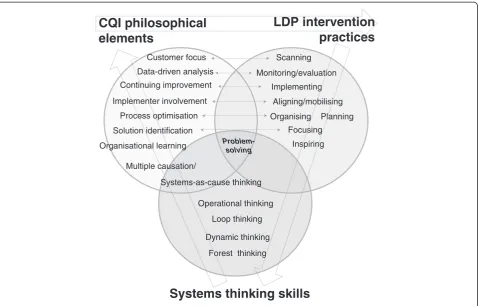
A review of the LDP suggests that it draws upon CQI principles in its approach. The LDP acknowledges the com-plex environment of managerial decision-making, and states that sustaining advances in health outcomes only occurs when leading and managing practices are absorbed into rou-tine practise (i.e., their institutionalisation). However, the LDP is not explicit about this theoretical basis in CQI, nor does it claim systems thinking as a prime objective. We rec-ognise that CQI philosophy–and implicitly, systems think-ing –is embedded within the LDP practise and tools, and we were therefore interested in understanding the degree to which the LDP can stimulate systems thinking in district teams. Though the language differs, the concepts of systems thinking, CQI, and the LDP overlap in their approach to shifting problem-solving towards a more systemic orienta-tion for improved decision-making: if systems thinking is the capacity to see interrelationships between components of a system, CQI is the process of managing these interrela-tionships, and the LDP is a practical intervention to imple-ment these principles. This overlap is illustrated in Figure 1.
Table 2 Elements of continuous quality improvements
Element Description
Systems-view Emphasis on analysis of the whole system providing a service, or influencing an outcome
Customer focus Emphasis on both customer (patient, provider, payer) satisfaction and health outcomes as performance measures
Data-driven analysis
Emphasis on gathering and use of objective data on system operations and system performance
Implementer involvement
Emphasis on involving the owners of all components of the system in seeking a common understanding of its delivery process
Multiple causation Emphasis on identifying the multiple root causes of a set of system phenomena
Solution identification
Emphasis on seeking a set of solutions that enhance overall system performance though simultaneous improvements in a number of normally independent functions
Process optimisation
Emphasis on optimising a delivery process to meet customer needs regardless of existing precedents, and on implementing the system changes regardless of existing territories and fiefdoms
Continuing improvement
Emphasis on continuing the systems analysis, even when a satisfactory solution to the presenting problem is obtained
Organisational learning
Emphasis on organisational learning so that the capacity of the organisation to generate process improvement and foster personal growth is enhanced
The objectives of our study, therefore, are to understand: a) the mechanisms by which a complex intervention intro-duced into a complex context brings about its observed outcomes (i.e., how and why does the LDP‘work’when it is introduced into a district health system in Ghana); and b) whether or not the LDP increases systems thinking in dis-trict managers in this context.
Methods
Study setting
The LDP was introduced in a rural district, Dangme Westc. The study took place from November 2011 to August 2013. An initial period of participant observation prior to the onset of the intervention lasted from November 2011
to January 2012. The LDP intervention was implemented from February to August 2012, and a follow-up period of participant observation extended until August 2013.
District managers were defined as: i) members of the district health management team (DHMT); ii) members of the district hospital management team; and iii) mem-bers of the three sub-district health teams. These man-agers were selected because they represent top-level management for decision-making within the district.
Description of the LDP intervention in Dangme West The LDP was introduced to district teams (district health administration, district hospital, and three sub-district management teams) by a facilitation team con-sisting of three members of the regional health adminis-tration, and one external consultant specialised in the LDP. The curriculum, teaching materials, and learning strategies were based on the LDP Handbook [19]. The LDP consists of a six-month cycle of root challenge identification, action planning, and monitoring and evaluation. For each training workshop, district teams consisted of 4 to 7 members per team, depending on the size of the facility. These were managers (core manage-ment including medical superintendents, district direc-tors of health services, deputy direcdirec-tors of nursing services, physician assistants, and hospital administra-tors), and staff (accountants, public nursing officers, and midwives). Two-day, face-to-face workshops were held in the capital city Accra three times bi-monthly. These involved modules on LDP practices, developing a shared team vision, diagnosing challenge root causes, develop-ing action plans, settdevelop-ing priorities, mobilisdevelop-ing stake-holders to commit resources, monitoring and evaluation, understanding roles in teamwork, and building trust. Workshops were interspersed with monthly coaching visits, with the facilitation team attending teams and their wider staff in their facilities to ensure organisation-wide diffusion of LDP teachings. For their LDP results, each team identified one MNH-related challenge they wished to address (Table 4). Every team attained their planned results except for one sub-district team; at the time, the health facility did not have a resident midwife and thus faced difficulties in improving its skilled deliv-ery coverage.
Study design: realist evaluation
We used a case study design as most appropriate for organ-isational studies in which‘how’or‘why’questions are being asked. Criticisms of case study designs include their weak external validity [25]. Seeking to address this criticism through cumulative validation, realist evaluation is an ap-proach capable of addressing complex investigation and probing causal linkages between contexts, actors, and the changes observed. Realist evaluation attempts to move
Table 3 LDP leading and managing practices
Leading practices
Scanning Identifying client priorities and needs
Seeing opportunities, trends, constraints and risks
(Organisational outcome:valid,current knowledge of context)
Focusing Developing shared goals
(Organisational outcome:articulated mission,vision,
strategies and priorities)
Aligning/ mobilising
Building congruence between values, mission, structures and daily actions
Supporting teamwork
(Organisational outcome:external and internal stakeholders have ownership over organisational goals and support resource mobilisation towards these goals)
Inspiring Building trust and acknowledging team members
Modelling creativity and learning
(Organisational outcome:climate of continuous learning with committed staff)
Managing practices
Planning Identifying goals, annual plans and performance objectives
(Organisational outcome:defined results and matching resources)
Organising Ensuring accountability and authority structures
Aligning staff capacities with planned activities
(Organisational outcome:functional structures and processes for operations)
Implementing Integrating workflows and systems
Balancing competing demands
(Organisational outcome:effective,efficient and responsive actions)
Monitoring and evaluation
Reflecting on progress against action plans
Improving work processes and procedures
(Organisational outcome:continuous up-to-date data for decision-making)
beyond asking‘did the intervention work?’towards under-standing‘how did the intervention work, for whom, and in which contexts’ [26-29]? The case study begins with the formulation of the middle range theory (MRT), based on existing theory and past actor experience. The MRT, struc-tured as a‘context + mechanism→outcome’ (CMO) con-figuration, is validated with actors, and against the literature. The validated MRT then becomes the working hypothesis to be‘tested’in the case. It is subject to revision based on accumulated new evidence.
Analytical framework: our middle range theory
Context of district manager decision-making (C)
The first part of developing our MRT included an in-depth exploration of the decision-making context for district managers in Ghana. Based on our pre-LDP ob-servation period, we found that district managers have
narrow decision-space due to the highly-centralised au-thority within the GHS. National-level control over re-sources leads to resource uncertainty at district level. Through formal and informal communication channels, district managers engender trust and employ it as a cop-ing mechanism to counter organisational uncertainty and manage the risk of not fulfilling their managerial mandates of oversight, coordination, and networking in the face of resource scarcity. Trust and respect for regional- and national-level authorities further legiti-mises the system’s hierarchy, thereby reinforcing it [un-published observations]. This decision-making ‘loop’ is the context into which the LDP was introduced.
Outcomes of the LDP–short- and medium-term (O)
Furthermore, we worked backwards from the observed short-term outcomes of the LDP (i.e., LDP results) and
Systems thinking skills
CQI philosophical
elements
LDP intervention
practices
Loop thinking
Dynamic thinking
Forest thinking Operational thinking Systems-as-cause thinking
Problem-solving
Implementer involvement Customer focus
Continuing improvement
Solution identification Process optimisation
Data-driven analysis
Organisational learning
Scanning
Focusing Aligning/mobilising
Inspiring Planning Organising
Implementing Monitoring/evaluation
Multiple causation/
Figure 1Overlap in problem-solving approach between systems thinking,CQI, and the LDP.
Table 4 LDP results (short-term outcomes) February to August 2012
Team LDP challenge LDP results(short-term outcome)
District Health Administration Increase skilled delivery from 37% to 40% Increased skilled delivery to 51%
District Hospital Reduce still birth from (n=) 30 to 20 Reduced still birth to (n=) 11
Sub-district 1 Increase skilled delivery from 15% to 18% Increased skilled delivery to 19%
Sub-district 2 Increase skilled delivery from 1.7% to 5% Increased skilled delivery to 2.6%
medium-term outcomes, which were interpreted as the re-sidual organisational changes (i.e., LDP institutionalisation). These included new organisational roles and relationships as a result of the LDP, extensiveness (i.e., how widely dis-seminated across the organisation) and intensiveness (i.e., how deeply integrated into routine practise) of the LDP, and any organisational routines displaced by the LDP [30].
Mechanisms of the LDP (M)
Through our MRT, we attempt to uncover the mecha-nisms of the LDP. Our beginning assumption was that if systems thinking took place as a result of LDP practices, this would support LDP institutionalisation. In a feed-back mechanism, institutionalisation of the LDP would further increase systems thinking. We hypothesised our MRT as follows:
The LDP brings about its short-term outcomes by en-couraging district managers to seek alternative sources of financial and material resources. If successful, the in-creased ability to look within and across the district for resources: i) supports relationship building with district stakeholders, which improves the number and quality of district relationships; ii) expands managerial understand-ing of the linkages and interactions in the district health system, which deepens systems thinking in managers, and supports LDP institutionalisation; and iii) reduces resource uncertainty, which lessens managerial risk, and thus the need to draw upon trust and respect as coping mechanisms. Reduced resource uncertainty increases district manager decision-space. Reduced uncertainty triggers the LDP’s underlying focus on organisational control.
Rival MRT
We also propose a rival MRT where the LDP brings about its short-term outcomes by reinforcing hierarch-ical authority, because it is introduced in a top-down manner. As such, resource uncertainty remains high, and district manager decision-space narrow. Thus, dis-trict managers continue to rely on trust and respect as coping mechanisms to deal with resource uncertainty. The context of high uncertainty triggers the LDP’s underlying focus on organisational creativity. This focus on creativity stimulates systems thinking, which supports LDP institutionalisation.
Data collection
Document review
For data on the LDP implementation, we reviewed weekly district management team meeting minutes and monthly regional management team meetings for the duration of the study period, as well as all training workshop materials, team presentations and action plans, and reports from pre-vious LDP cycles in other regions. For overall context, we
further reviewed national, regional and district policies, and protocols (Additional file 1: Table S1).
Participant observation
For the duration of the study period, the first author partici-pated in weekly district health management meetings, monthly regional health management team meetings, semi-annual district planning and district review meetings, all LDP training workshops and coaching visits, teams’ LDP activities, DHMT supervisory visits to sub-districts, and day-to-day operations of the district. Until October 2012, the third author participated in monthly regional health management team meetings. Continuous discussion with management and staff was the method of sense-making used. As part of their routine management meetings, valid-ation workshops took place at the end of the initial and follow-up observation periods to feedback findings to dis-trict teams and integrate their views into the analysis.
Semi-structured interviews
We conducted a total of 23 interviews with members of the DHMT (8), district hospital management (4), and sub-district management (7); 4 managers were lost to staff transfers (2 from the DHMT and 2 at the sub-district level). At the regional level, we interviewed 3 out of 4 members of the LDP facilitation team, and one development partner supporting the LDP; 17 respondents were women and 6 were men; 3 respondents were in their current posting less than 1 year, 13 between 1–3 years, and 7 between 3–5 years. More than half the respondents (12) had no prior formalised management training.
Interview guides were developed to investigate team perceptions of quality, actual LDP implementation (in-cluding challenges and functioning), influence of concur-rent district initiatives, organisational sustainment of LDP practices, and changes in relationships and re-sources. Interviews took place 8 months after the end of the LDP.
Data analysis
Ethical considerations
This study was part of a larger study to identify effective ways of improving MNH service delivery, for which eth-ical approval was awarded by the Ghana Health Service Ethical Review Committee. Teams were made aware of the observation periods. Respondents participated volun-tarily, and were able to withdraw at any time. Informed consent was obtained from all respondents, and re-spondent anonymity was maintained during all parts of the study using coding.
Results
LDP as it was implemented
The LDP was mainly implemented as designed. During implementation, the LDP was frequently discussed as part of management team meetings, and was often men-tioned at the monthly regional health management team meetings.
The LDP training approach was more team-based, less didactic, and more intensive than most district work-shops. Modules focused more on the deployment of LDP tools and proceeding through LDP processes, and less on facilitating teams to reflect on their own organ-isational practices or thinking systemically through them. This was indicated in the first LDP workshop, where facilitators identified the programme goals as be-ing: i) to learn how to lead and manage to enable others to face challenges and achieve results; ii) to apply tools to analyse challenges to achieve results; iii) to know how to produce measurable results; and iv) as managers, to learn how to build a positive work climate. The em-phasis was more on the LDP’s ‘managing’ rather than
‘leading’practices.
A review of teams’ LDP action plans and presentations showed that teams broadly undertook two categories of activities: i) community sensitisation and customer care training for frontline staff, or ii) lobbying local organisations for material resources. From the customer care training workshops we found clear patterns of hierarchy being reinforced. Customer care workshops were facilitated by non-LDP regional staff and were regarded as‘customer care as corporate responsibility, to redeem the corporate image’. In part, this stemmed from some high-profile media cases about staff error. Emphasis was placed on rules and regula-tions of the GHS, proper comportment of staff in forms of address towards their seniors, and dress codes. Very little related to client-provider relationships and there was min-imal opportunity for staff to reflect on their experiences with clients. Furthermore, in performing their root cause analyses, teams were not trained to investigate the interrela-tionships between different causes, but rather to deal with single root causes separately. Taking the example of poor staff attitude, teams worked through their root cause ana-lysis in the following manner:
“staff attitude is poor,because staff lack courtesy and good customer care;this is because they have inadequate knowledge about good customer care;
which is because they have not been trained on good customer care;therefore the solution is to provide customer care training.”
An example of gaps between LDP practise in the con-text of its implementation and LDP practise in routine work was observed 2 weeks prior to the final LDP work-shop. In one sub-district, having been called to assist in a conflict between staff and management, DHMT mem-bers resolved the situation by stating:
“Any time your leader tells you something,she has a plan. Only one person can lead,others follow faithfully. Yours is to do what you are told. The rest,
she will manage”.
Once ended, there was little evidence of teams’efforts to support LDP institutionalisation. None of the five teams en-gaged in another LDP cycle, no new staff were oriented in the LDP, no funds were set aside for LDP activities, and meeting minutes and staff conversations no longer reflected mention of the LDP. The lack of team efforts towards LDP institutionalisation was influenced to some extent by time constraints of routine district work: at the time the LDP ended (August–September), district teams were focused on completing year-end activities and reporting, and preparing for a new planning cycle. LDP institutionalisation was fur-ther compromised by changes of leadership at regional, district, and sub-district levels, which witnessed the ap-pointment of new directors at each level. Critically, the splitting of the district into two separate districts in October 2012 required new administrative structures in the new trict, and a restructuring of relationships across both dis-tricts. It does not appear that teams used their LDP practices to support these transitions. Several months after the end of the LDP, the majority of team members could not list the LDP practices. The LDP did not appear to support the development of systems thinking in district managers.
Participant perceptions of the LDP
“These big,big,top,top,top,people were here. It’s not
the normal people like we that they[the staff]are used to. So that one alone will give them some
inspiration…”(DHMT member)
Since the teams had little formalised management training, the novelty of the LDP disposed them to being receptive to capacity support. The exposure to manage-ment practices enabled teams to attain their LDP results, and they noted that the imposition of deadlines created a sense of urgency and increased the need to attain re-sults, compared to their routine targets. The LDP also helped managers build initiative. Managers
acknowl-edged that some problems were ‘beyond’ them, and
therefore, initiative-taking was encouraged, but only on a‘small-scale’:
“You are supposed to make do with what you have. Because sometimes when we have challenges we think that‘oh as for this one,we are waiting for region to come and do it,or we are waiting for national to come and do it’.LDP says you shouldn’t think so big,but something within…you should just try to think around yourself”. (DHMT member)
Managers learned to better prioritise and felt more able to manage concurrent programmes, and thus viewed themselves as working more efficiently. Support-ing teamwork through inspiration and acknowledgment was also important. One manager stated that prior to the LDP she used to ignore her staff if they incorrectly performed a task. Managers did note that the LDP had no influence on the relationship between district and re-gional levels, nor did it alter the dynamics around resources:
“It hasn’t changed our resources. If I am saying the truth,I don’t think we have the resources to work
with”. (Sub-district head)
One issue reported consistently by district managers was the LDP’s resource intensiveness. Convening stake-holders and running training workshops all require add-itional funds, which was perceived as burdensome, since teams had severe resource constraints and had not bud-geted for the LDP in advance. Lobbying for funds from the District Assembly was difficult as the annual plan-ning cycle had already passed. Furthermore, the time re-quired to meet for LDP activities, convening the wider team, and preparing plans was viewed as onerous in the face of concurrent programmes and other health system constraints. One manager highlighted the difficulty that under-staffing created in trying to gather staff for train-ing without disrupttrain-ing service delivery:
“The challenges that we had in implementing the LDP were trying to get staff themselves to come around to listen to us. It’s terrible,the beginning it was very hard to get the unit heads to come around. The reason was that due to lack of staff. The unit heads must be there to monitor,and there is no staff to bring to come and listen to us.”(Hospital management)
Managers widely perceived the lack of LDP
institutio-nalisation as related to the LDP being a ‘regional
project’:
“You can also see that at the regional level it has ended. So if the regional level it has ended can the district continue?Since then there has never been any coach from region to come and see what we have done,
where we have reached and what the challenges are. So you can imagine,we at the sub-district can we also do it?So me,it is not about the district not doing it or it’s not implementing it,I only see it as a project…at
the[LDP workshops]we were told it is not a project,
it is a running thing. But it has ended as if it is a project and the project has come to an end.”(DHMT member)
Proposing causal linkages (C + M→O)
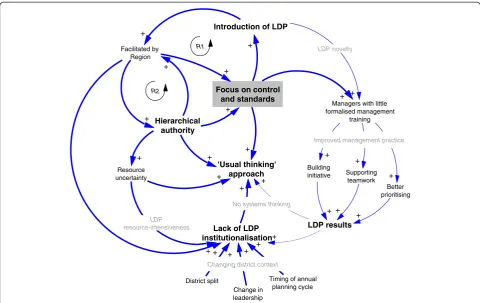
We illustrate the relationships between our contexts, mechanisms, and outcomes in a CLDd (Figure 2). This schema represents causation between variables, with di-rections of influence depicted by arrows. Influence in the same direction is represented by positive arrows. Feedback loops can reinforce (R) or self-regulate the pathway [32].
Our CLD shows the pathway of the LDP’s short-term outcomes (right-side of the figure, thin arrows) and medium-term outcomes (left-side of the figure, thick ar-rows). On the short-term, the novelty of the LDP for man-agers with limited formalised management training (C) stimulated the value and utility of bundled management practices taught by the LDP (M) for teams to achieve their LDP results (O). This causal pathway is linear, and does not significantly deviate from the predicted programme theory of the LDP. On medium-term outcomes, the introduction and facilitation of the LDP in a top-down manner (i.e., from the region) (C) promoted hierarchical authority and trig-gered the LDP’s focus on controls and standardisation (M). Multiple, reinforcing feedback mechanisms (R1 and R2) neither supported LDP institutionalisation, nor systems thinking among district teams (O).
Discussion
Hawe et al. [30] suggest that the most important dimen-sion of complexity is frequently not the complex inter-vention itself, but rather the context into which it is introduced. We found that in trying to produce change in a complex adaptive system, the LDP in this case could not be sufficiently institutionalised. In essence, the sys-tem ‘rejected’ it and returned to its prior equilibrium. The context of system hierarchy, as demonstrated by the deployment of regional staff to train the districts, high-lights the cascading approach to systems change from the top. This may not always be appropriate, and further underscores the need to think systemically when intro-ducing any intervention. We note that, in this case, the LDP appeared to engage systems thinking in its tools ra-ther than through its practices, and incorporated its CQI elements in its organisational outcomes rather than its processes. This suggests a focus on organisational con-trol, rather than creativity, of both the LDP and the or-ganisational context into which it was introduced. Being tool-driven, the LDP does not itself provide processes for developing a learning organisation, and we noted no evidence of new mental models created in district teams
–what Sterman [33] distinguishes as‘single-loop’versus
‘double-loop’learning. Our study raises questions about the nature of management and leadership capacity
strengthening. We recognise that short-term capacity strengthening interventions may not necessarily support such reorientations. As such, it is critical for donor part-ners and national governments to reconsider the types of idealised interventions often put in place, and how contexts can modulate expected outcomes over time. This suggests support for longer term, more reflective, and potentially unpredictable capacity strengthening ap-proaches. This notion is further supported by a recent study from Rwanda that found no statistical association between training and adherence to recommended MNH practise [34]. Our findings uphold earlier work by Blaise and Kegels [35], who describe the rigidity and lack of re-sponsiveness in command-and-control structures ob-served in several African health systems as contributors to quality of care challenges in service delivery.
At the outset we hypothesised that, in reinforcing sys-tem hierarchy, the LDP’s underlying goal of organisa-tional creativity would prevail due to the context of high uncertainty. Paradoxically, the LDP’s underlying goal of organisational control was more pronounced. We attri-bute this to the degree of centralised decision-making in the system: the strength of ‘command-and-control’ over-rides other mechanisms that enable learning, creativity, and adaptability. This mismatch in contextual uncer-tainty and organisational culture may very well account 'Usual thinking'
approach
Lack of LDP institutionalisation
Focus on control and standards Facilitated by
Region
Hierarchical authority
Resource uncertainty
LDP results
Managers with little formalised management
training
Building
initiative Supporting teamwork
Better prioritising
District split +
+
+
+ +
+ + +
+
Change in leadership
Timing of annual planning cycle +
+ +
Changing district context
+ Improved management practice
+ +
+ R2
+ +
LDP resource-intensiveness
+
Introduction of LDP +
+
+ +
R1
+ LDP novelty
+ +
No systems thinking
for the lack of effective management at district level. With this in mind, we refine our MRT as follows:
The LDP brings about its short-term outcomes through its experience of novelty, building initiative, supporting bet-ter prioritisation, and building teamwork. The LDP rein-forces hierarchical authority due to being introduced in a top-down manner. As such, resource uncertainty remains high and, as a consequence, district manager decision-space remains narrow. Thus, district managers continue to rely on trust and respect as coping mechanisms to deal with resource uncertainty and their managerial risk. The context of high uncertainty, coupled with reinforced hier-archical authority, triggers the LDP’s underlying focus on organisational control. Systems thinking is not stimulated, and LDP institutionalisation does not occur.
In thinking about how the LDP might have been im-plemented differently, we consider five ways in which the causal pathway could have been altered: i) had the LDP facilitators been peers instead of superiors (for ex-ample, training teams could have consisted of district managers whose districts had previously undertaken the LDP rather than being regional officers), this may have weakened hierarchical authority, thereby reducing the top-down nature of its introduction; ii) had districts volunteered to receive the LDP instead of being ran-domly selected, they may have expected it and better prepared their resources; iii) had ongoing mentorship and coaching been built into the process through sys-tematic follow-up, this may have supported the view of greater district ownership; iv) had the timeframe of the LDP intervention been lengthened to include two or three cycles, this may have had longer-lasting effects and become routine practise; and v) had organisational cre-ativity and learning been an explicit goal, with reflective processes as a major part of the intervention, this may have provided greater opportunity for more systems thinking to develop in district managers. We recom-mend that the LDP could be strengthened by a more
explicit integration of CQI philosophy and principles into its existing tools, and greater attention paid to context to support its institutionalisation. We are aware of existing CQI-based interventions in the Ghanaian health system with similar ‘Plan-Do-Study-Act’ cycles, indicating that the lack of institutionalisation of one programme does not prevent the implementation of other similar interventions.
Our findings clearly demonstrate that a lack of consid-eration of the context into which such interventions are introduced can minimise their effectiveness. More im-portantly, our work highlights the fact that context also informs the kind of management and leadership that emerges at district level. Not uniquely a Ghanaian chal-lenge, decision processes are often rooted in a desire for control and prediction, such that managers who cannot deliver are perceived as ineffective and are soon replaced [36]. These issues exceed the scope of our study, but do underscore the fact that improvements in management and leadership do not reside in the capacities of man-agers alone, but demand keen attention to the organisa-tional contexts in which managers are embedded.
A limitation of our study is that it reports on only one context for LDP implementation. This is a first level analysis; moving forward we expect to conduct a wider exploration of other districts in the Greater Accra Re-gion and further refine our MRT.
Conclusions
may strengthen the institutionalisation of the LDP in the future.
Endnotes a
The Ghana Health Service (GHS) is the semi-autonomous agency of the Ministry of Health respon-sible for public health service delivery. Since its creation in 1996, the GHS has been administratively
decentra-lised along national, regional, and district lines.
National-level GHS is responsible for policy direction. Regional health directorates provide technical and ad-ministrative oversight to district health directorates re-sponsible for coordinating service provision at district and sub-district level.
b
This was as part of a larger study to improve service de-livery for MNH. One key aspect of the study sought to sup-port managerial decision-making as part of the overall organisational change needed to improve MNH quality in the Greater Accra Region. The larger study envisioned de-signing and implementing a CQI programme to address this. However, given the existence of the LDP already in the health system, and its overlap in approaches and philosophy with CQI, the LDP was instead identified as the CQI-based intervention to be evaluated.
c
Dangme West was subsequently divided into two
sep-arate districts: Shai-Osudoku District and
Ningo-Prampram District; this paper reports its findings against the district structure at the time of the study.
d
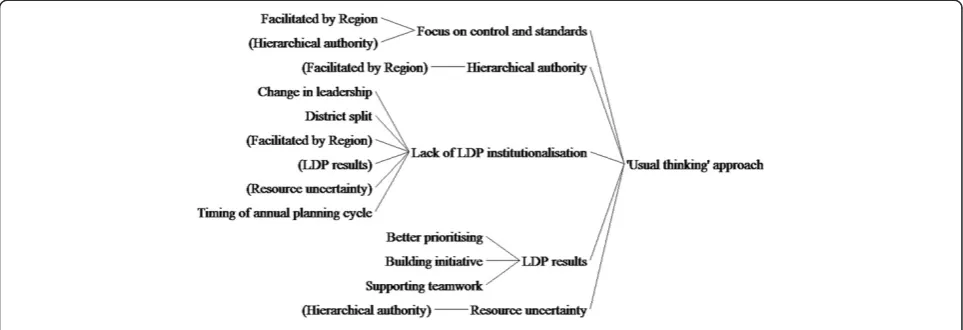
We drew Figures 2 and 3 using Vensim simulation software : www.vensim.com.
Additional file
Additional file 1: Table S1.Policy documents and reports reviewed.
Abbreviations
CQI:Continuous quality improvements; CLD: Causal loop diagram; CMO: Context-mechanism-outcome configuration; DHMT: District health management team; GHS: Ghana Health Service; LDP: Leadership Development Programme; LMIC: Low- and middle-income country; MNH: Maternal and newborn health; MRT: Middle range theory.
Competing interests
The authors declare that they have no competing interests.
Authors’contributions
Conceived and designed study: AK, IAA, HvD. Developed instruments and collected data: AK, IAA. Analysed data: AK, IAA, HvD. Wrote and reviewed manuscript: AK, IAA, HvD. All authors read and approved the final manuscript.
Acknowledgements
This paper is part of the Thematic Series entitled:“Advancing the application of systems thinking in health”. The Series was coordinated by the Alliance for Health Policy and Systems Research, World Health Organization. The publication of the Series and the associated capacity building and dissemination activities were carried out with the aid of a grant from the International Development Research Centre, Ottawa, Canada. This study was supported with funding from the Greater Accra Regional Health Directorate of the Ghana Health Service through its Government of Ghana budget, and
the Netherlands Organisation for Scientific Research/Science for Global Development (NWO/WOTRO), Grant Number W07.45.102.00. We gratefully acknowledge the Ghana Health Service regional and district health teams for their participation and generosity in this study; our colleagues from the University of Ghana School of Public Health for their support; and colleagues who supported the development of this paper with their helpful comments: Taghreed Adam (Alliance for Health Policy and Systems Research), Bruno Marchal (Institute of Tropical Medicine, Antwerp), Peter Hill (University of Queensland), Uta Lehmann (University of the Western Cape), and Lucy Gilson (University of Cape Town); Jonathan Arku, who provided excellent transcription services; and Nextgenediting Global Initiative (www. nextgenediting.com) for editorial assistance.
Received: 16 December 2013 Accepted: 28 April 2014 Published: 16 June 2014
References
1. Curry L, Taylor L, Chen P, Bradley E:Experiences of leadership in health care in sub-Saharan Africa.Hum Resour Health2012,10(1):33.
2. WHO:Strengthening management in low-income countries: lessons from Uganda.InMaking Health Systems Work: Working Paper No. 11.Geneva: World Health Organisation; 2007.
3. WHO:Towards better leadership and management in health: report on an international consultation on strengthening leadership and management in low-incomes countries, 29 January–1 February 2007, Accra, Ghana.InMaking Health Systems Work: Working Paper No. 10. Geneva: World Health Organisation; 2007.
4. WHO:Managing the health Millennium Development Goals–the challenge of management strengthening, lessons from three countries. InMaking Health Systems Work: Working Paper No. 8.Geneva: World Health Organisation; 2007.
5. WHO:Who Are Health Managers?InCase Studies from Three African Countries.Geneva: World Health Organisation; 2009.
6. Frenk J:The Global Health System: strengthening national health systems as the next step for global progress.PLoS Med2010, 7(1):e1000089.
7. Begun J, Zimerman B, Dooley K:Health care organisations as complex adaptive systems.InAdvances in Health Care Organisation Theory.Edited by Wyttenbach M. San Francisco: Jossey-Bass; 2003:253–288.
8. Holland J:Studying complex adaptive systems.J Systems Sci Complexity 2006,19(1):1–8.
9. Foster-Fishman P, Nowell B, Yang H:Putting the system back into systems change: a framework for understanding and changing organizational and community systems.Am J Community Psychol2007,39(3):197–215. 10. De Savigny D, Adam T:Systems Thinking for Health Systems Strengthening.
Geneva: Alliance for Health Policy and Systems Research; 2009.
11. Richmond B:The‘thinking’in systems thinking: seven essential skills.Waltham, MA: Pegasus; 2000.
12. Spencer BA:Models of organization and total quality management: a comparison and critical evaluation.Acad Manag Rev1994,19(3):446–471. 13. McLaughlin C, Kaluzny A:Continuous Quality Improvement in Health Care:
Theory, Implementation and Applications.Gaithersberg, MA: Aspen Publishers Inc.; 1994.
14. Blaise P, Kegels G:Quality Management in Health Care Systems in Africa. InOne Concept, Many Faces, Contrasted Results.Lisbon: Quality in Higher Education, Health Care, Local Government 5th‘Toulon-Verona’Conference ISEG: An Analysis of Three Case Studies from Africa; 2002.
15. Sitkin SB, Sutcliffe KM, Schroeder RG:Distinguishing control from learning in total quality management: a contingency perspective.Acad Manag Rev 1994,19(3):537–564.
16. Agyepong IA, Sollecito WA, Adjei S, Veney JE:Continuous quality improvement in public health in Ghana: CQI as a model for primary health care management and delivery.Quality Manag Healthcare2001, 9(4):1–10.
17. Asante A, Zwi A, Ho M:Getting by on credit: how district health managers in Ghana cope with the untimely release of funds.BMC Health Serv Res2006,6(1):105.
19. Mansour J, Vriesendorp S, Ellis A:Managers Who Lead.Management Sciences for Health: A Handbook for Improving Health Services; 2005 [https://www.msh.org/resources/managers-who-lead-a-handbook-for-improving-health-services]
20. Mansour M, Mansour J, Swesy A:Scaling up proven public health interventions through a locally owned and sustained leadership development programme in rural Upper Egypt.Human Res Health2010, 8(1):1.
21. Kenya Leadership Development Programme:A Programmatic Assessment Linking Changes in Management and Leadership with Service Delivery Outcomes in the Context of Human Resource Constraints.InLMS Monitoring, Evaluation and Communications Team. Leadership.Management Sciences for Health: Management and Sustainability Programme; 2011. http://projects.msh.org/projects/lms/NewsRoom/upload/LMS-Kenya-LDP-Programmatic-Assessment_FINAL_1-27.pdf.
22. Seims LR, Alegre J, Murei L, Bragar J, Thatte N, Kibunga P, Cheburet S: Strengthening management and leadership practices to increase health-service delivery in Kenya: an evidence-based approach.Human Res Health2012,10(1):25.
23. Perry C:Empowering primary care workers to improve health services: results from Mozambique's leadership and management development program.Human Res Health2008,6(1):14.
24. Ghana Ministry of Health, Government of Ghana:United Nations Country Team in the Republic of Ghana.Maternal Health: MDG Acceleration Framework and Country Action Plan; 2011 [http://www.undp.org/content/ dam/undp/library/MDG/MDG%20Acceleration%20Framework/MAF% 20Reports/RBA/MAF%20Ghana_MDG5_Low_Web%20%282%29.pdf] 25. Yin RK:Case Study Research: Design and Methods.3rd edition. London: Sage
Publications; 2003.
26. Pawson R, Tilley N:Realistic Evaluation.London: Sage Publications; 1997. 27. Marchal B, Kegels G:Focusing on the software of managing health
workers: what can we learn from high commitment management practices?Int J Health Plann Mgmt2008,23(4):299–311.
28. Marchal B, Dedzo M, Kegels G:A realist evaluation of the management of a well- performing regional hospital in Ghana.BMC Health Serv Res2010, 10(1):24.
29. Prashanth NS, Marchal B, Hoeree T, Devadasan N, Macq J, Kegels G, Criel B: How does capacity building of health managers work?A realist evaluation study protocol. BMJ Open2012,2:e000882.
30. Hawe P, Shiell A, Riley T:Theorising interventions as events in systems. Am J Community Psychol2009,43(3–4):267–276.
31. Pawson R, Manzano-Santaella A:A realist diagnostic workshop. Evaluation2012,18(2):176–191.
32. Rwashana AS, Williams DW, Neema S:System dynamics approach to immunization healthcare issues in developing countries: a case study of Uganda.Health Informatics J2009,15(2):95–107.
33. Sterman JD:Learning from evidence in a complex world.Am J Public Health2006,96(3):505–514.
34. Sipsma H, Curry L, Kakoma J-B, Linnander E, Bradley E:Identifying charac-teristics associated with performing recommended practices in maternal and newborn care among health facilities in Rwanda: a cross-sectional study.Human Res Health2012,10(1):13.
35. Blaise P, Kegels G:A realistic approach to the evaluation of the quality management in health care organisational models.Inter J Health Plann Manag2004,19:337–364.
36. Chapman J:System Failure: Why Governments Must Learn to Think Differently. 2nd edition. London: Demos; 2004.
doi:10.1186/1478-4505-12-29
Cite this article as:Kwamieet al.:Advancing the application of systems
thinking in health: realist evaluation of the Leadership Development Programme for district manager decision-making in Ghana.Health Research Policy and Systems201412:29.
Submit your next manuscript to BioMed Central and take full advantage of:
• Convenient online submission
• Thorough peer review
• No space constraints or color figure charges
• Immediate publication on acceptance
• Inclusion in PubMed, CAS, Scopus and Google Scholar
• Research which is freely available for redistribution