SURVEY ON E-BUSINESS MODELS
M.S.SALEEM BASHA
Department of Computer Science, Pondicherry University, R.V Nagar, Kalapet, Puducherry, India
P.DHAVACHELVAN
Department of Computer Science, Pondicherry University, R.V Nagar, Kalapet, Puducherry, India
Abstract :
In the turbulence of internet and business, company can only survey with the periodical reinventing their e-business models, because e-business model of a firm can only capture the snap shot of the current value chain. This snap shot cannot survive longer with their competitors. Companies must decide how and when to implement e-business model. The choice should be based on an overall assessment that includes an evaluation of costs and benefits and well-defined goals that are dependent on whether the decision was based on business or strategic criteria. In this paper we surveyed the e-business model of various authors. Dell, Cisco and Bata are the three revolutionary new business models of business to business e-commerce models that have come out for the successful business. However, these models are not appropriate for every organization. In addition to these new paradigms for individual firms, other changes in business-to-business e-commerce are occurring that are revolutionizing the traditional paradigms.
Keywords: Keyword1; keyword2; keyword3.
1. Introduction
2. E-Business Model
The e-business models can help companies implement their e-business strategies and additionally allow them to assess, measure, change and sometimes even play around with and simulate their business.[6].
For the following reasons e-Business models are widely considered
• The process of modeling social systems, such as an e-business model which helps to identify and understanding the relevant elements in a specific domain and the relationship between them [7][24].
• The use of formalized e-business models helps managers easily communicate and share their understanding of an e-business among other stakeholders [8].
•
Mapping and using e-business models as a foundation for discussion facilitates change. Business model designers can easily modify certain elements of an existing e-business model [9].•
A formalized e-business model can help identifying the relevant measures to follow in an e-business, similarly to the Balanced Scorecard Approach [10].•
e-Business models can help managers simulate e-businesses and learn about them. This is a way of doing risk free experiments, without endangering an organization [11].So what really is a business model anyway? As explained by Petrovic, Kittl and Teksten [9], a business model is not a description of a complex social system itself with all its actors, relations and processes. Instead it describes the logic of a “business system” for creating value, which lies behind the actual processes. Therefore the business model is a conceptual and architectural implementation of a business strategy and foundation for the implementation of business processes
Alexander Osterwalder[6] explains his e-business model ontology is founded on four main pillars as illustrated in figure 1. (1) The products and services a firm offers, representing a substantial value to the customer, and for which he is willing to pay. (2) The infrastructure and the network of partners that are necessary in order to create value and to maintain a good customer relationship. (3) The relationship capital the firm creates and maintains with the customer, in order to satisfy him and to generate sustainable revenues. And last, but not least, (4) The financial aspects, which are transversal and can be found throughout the three former components, such as cost and revenue structures.
2.1 Product innovation
In e-business model framework, Product invocation is the step that defines the product of the company that needs to offer its customer and sub product in the production line. Product invocation needs a through analysis of the targeted customer segments have to be undertaken in order to find out the relevance and the components of an effective value recognition by the customer. To deliver this value proposition, the firm has to possess a certain set of in-house and/or outsourced capabilities.
2.2 Customer relationship
The heart of any successful business model is to consider the customer relationship and all time support for the customer. Many models are often concentrates on products, value chain creation and exchange patterns between the actors of the business, but forgets the significance of the customer relationship. Now a days customer
Resources for
Customer Relationship Product Innovation Infrastructure Management
Information
Feel and Serve
Trust & Royalty
Target Customer
Value Proposition
Capabilities
Resource / Asset
Activity / Process
Partner / Network Value for
Revenue Value Added + Costs
Price Profit
relationship is the one of the key concept to emphasis the business goals and this notion has also evolved product and marketing to represent customer relation which enhances the iteration between the firm and the customer[3]. It is believed that the customer relation increases the profitable business opportunities. The customer relation includes all customer information and the knowledge of the company. It gives a wide understanding of the customers need and the expectation of the products, in this concern the feedback and the grievance plays a major role to improve the customer relation.
These insights can be used throughout marketing and sales, and especially for customer relationship management (CRM). Hamel et al. calls this the positive feedback effect. A firm with a large number of customers and a way of getting the feedback and grievances from the customer rapidly, can helps the firm to improver the quality, product and service faster than the competitors. Fulfillment and support refer to the way the firm “goes to market” and how it actually “reaches” customers [12]. A firm should understand the channel strategy that the r-business has a greater impact to complement rather than cannibalize its business [13]. For example, think that advertising, promotion, publicity, public relations and a lot of other aspects of corporate communications are becoming archaic concepts [3]. Branding shifts towards relationship dynamics [12] where emotional, as well as transactional elements in the interaction between firm and client, form the image of a company. It’s the firm’s ability to engage customers, suppliers, and other partners in mutually beneficial value exchanges that determines its relationship capital [3] and brand.
2.3 Infrastructure management
Infrastructure management is the critical issue and complex activities. The better synchronization of infrastructure in the product chain delivers the product sooner than the competitors, this intern helps to create and deliver the value proposition. The infrastructure component describes the value system configuration that is necessary to deliver the value proposition [14]. In order to create value, a firm needs resources [15][16]. Gant et al [17] distinguishes tangible, intangible, and human assets. Tangible resources include plants, equipment and cash reserves. Intangible resources include patents, copyrights, reputation, brands and trade secrets. Human resources are the people a firm needs in order to create value with tangible and intangible resources. To define the value creation process in a business model, the extension of the value chain framework [18] as defined by Stabell and Ffeldstad [19]. In e-business literature there are several terms arising for these new forms of strategic networks in the value creation process, such as b-webs [3] and value networks [20].
2.4 Financial aspects
An E-business model is introduced for the increase the revenue and value chain in a short span. Financial aspects include the cost of the products, cost of the infrastructure and the values. A firm revenue model includes the cost of the advertisement, commissions, transaction, fees, taxes, registration, shares, salary, research and development. These all revenues are gather fractionally(over head) by simply selling a products. The revenue model of a firm gives the long run of the business. The magnitude of the overhead must be less as possible. 'Higher overhead lesser product sell' in other words the magnitude of the overhead can be reduced by selling more products.
3. Classifying E-Business Models
Most authors suggest two dimensions in order to rate the business models: functional integration and degree of innovation [4], economic control (both hierarchical and self-organizing) and value integration [21], type of relationships and degree of externality [22], power of sellers and buyers [23]. Based on their classification, they propose to keep a limited number of basic types of business models: from 5 for Tapscott [21] to about 30 for Rappa [59]. This diversity shows the inadequacy of a unique classification scheme. Therefore, unlike the hierarchical “decomposition and specialization” structure adopted by the Process Handbook [25], Alexander Osterwalder [6] proposes to use a multicategory approach and to accept that a business model could be positioned with regard to several dimensions, in a web of many classification schemes. The business models of PriceLine could be considered for example as an “Agora” in the Tapscott’s[21] classification, high (self-organizing) on the control axe, low on the value integration; as an “e-auction” in the Timmers’s classification [4], medium on the functional integration and medium (to high) on the degree of innovation; as a “Reverse auction e-market” in the Pigneur’s classification [23], equilibrated power between buyers and sellers.
partially, and (c) necessary design knowledge is distributed among many design participants. In its simplest form, this critiquing system could be similar to an opportunity/threat method such as presented by Frick et al. [27] or Bodart et al [58] with their assessment questions to the business model designers during the design process.
4. Related Research
Most of the authors have defined the business model partially for example [28], fails to discuss the customer component of a business model. [14] demonstrated the value creation process in a network of partners, but do not describe any of the other necessary components for a complete model from a business point of view. Hamel [12] however, has quite a complete approach to business models.
Revenue/product aspects Rappa [59] describes the business model as, how a company makes money by
specifying where it is positioned in the value chain. His taxonomy consists of nine generic forms of e-business models, which classify companies among the nature of their value proposition or their mode of generating revenues. Tapscott, Ticoll and Lowy [21] provides an other typology of business models that they call b-webs. They identify five generic b-webs, which are called Agoras, Aggregations, Value chains, Alliances and Distribution Networks. These five models are classified according to their degree of value integration and their degree of control of the value creation process.
Business actor and network aspects: Timmers [4] is one of the best known classification scheme and definition of electronic business models. According to him, a business model is the architecture for the product, service and information flows, a description of the various business actors and of their roles, as well as a description of the potential benefits of these actors and finally a description of the sources of revenue. In addition he acknowledges the necessity of providing a marketing strategy, in order to accomplish a business mission. Timmers classifies the eleven generic e-business models he outlines, according to their degree of innovation and their functional integration. A quite rigorous business model framework - which is very different from the classification approaches mentioned previously - is the one provided by Gordijn and Akkermans [14]. Their methodology is based on a generic value-oriented ontology specifying what’s in an e-business model. This approach allows the representation and understanding of value flows between the several actors of an e-business model. The main elements are value-oriented and actor-oriented. Another framework for business models that is value-centered and takes in account the creation of value through several actors is given by Afuah and Tucci [28]. In this methodology one can find a list of business model components, from scope over pricing and revenue source to connected activities and capabilities. But it is less clear how the value is delivered to the customer; i.e. classical marketing problems such as channel design or conflict are not in the center of this approach. A highly network-centered framework is given by Amit and Zott [29]. They describe a business model as the architectural configuration of the components of transactions designed to exploit business opportunities. Their framework depicts the ways in which transactions are enabled by a network of firms, suppliers, complementors and customers.
Marketing specific aspects A very interesting business model methodology has been developed by Hamel [12]. For him a business model is simply a business concept that has been put into practice. He identifies four main business model components that range from core strategy, strategic resources over value network to customer interface. These components are related to each other and are decomposed into different sub-elements. The main contribution of this methodology is a view of the overall picture of a firm. The business model framework by Petrovic, Kittl and Teksten [9] suggest that a business model can be divided into seven sub-models, which are the Value Model, the Resource Model, the Production Model, the Customer Relations Model, the Revenue Model, the Capital Model and the Market Model. These sub-models and their interrelation shall describe the logic of a business system for creating value that lies behind the actual processes. Weill and Vitale [30] give a systematic and practical analysis of eight so called atomic e-business models. Every one of these models is analyzed according to its strategic objectives and value proposition, its sources of revenue, its critical success factors and its core competencies. In addition the authors also outline the different model’s channels, customer segments and IT-Infrastructure. Firms can combine atomic e-business models to create an ebusiness initiative. A very interesting and rich framework is described by Rayport and Jaworski [31]. They divide an e-business model in four main pillars, which are the value cluster, the marketspace offering, the resource system and the financial model.
• The scope of an organisation’s activities and the match between these activities, the organisation's resource capability, and the environment in which the organisation operates.
• Reallocation of resources in an organisation and changes to values, expectations and goals to reflect the attitudes and beliefs of the dominant coalition.
• The direction in which an organisation will move in the long term, and the implications of change throughout the organisation.
In this respect, [33] distinguish:
• A corporate level where strategy is concerned with the types of business that engage the company.
• A business-unit level where strategy is concerned with competition in a particular market.
• A functional level where strategy is concerned with how the different functional components of an enterprise, such as marketing and manufacturing, are aligned.
Most IS strategies are aligning the IS function to the other enterprise functions and to business and corporate strategy. Strategic management can be thought of as being comprised of four main elements: strategic analysis, strategic choice, strategy implementation, which is concerned with planning how the chosen strategy can be put into effect and strategy evaluation through feedback, determining whether the strategy is working and adopting steps to make it work.
Single Organisational Oriented Strategic Management Research: Porter [34] is one of the most important strategy theorists, with a strong influence on IS planning. His view emphasises that market structure, the number of competitors and the degree of rivalry between them are the principal influences on company behaviour. He argues that a firm's profitability is determined by the characteristics of its industry environment and the firm’s position within it, so these factors should also determine its strategy. Basic concepts such as generic (competitive) strategies, competitive forces, value system and value chain should have an important place in IS planning (for example [18][35][36]. In Porter’s view, IT is an important “weapon” for influencing the competitive forces within an industry.
Porter can be criticised by stating that in an era of rapid technological change and resultant unpredictability, sustainable competitive advantage is no longer rooted in positioning, but depends more on organizational resources and skills. This resource-based view on strategy has been popularised in the core competence approach of Prahalad and Hamel [37]. In their view, sustainable competitive advantage is based on distinctive capabilities, which cannot easily be replicated by competitors. However the application of this approach has been made problematic by the absence of sharp criteria for distinguishing core capabilities. Theorists suggest at least three primary sources for core capabilities: market structure which limits entry; company history, which requires by its nature extended time to replicate and tacitness in relationships (routines and behaviour of “uncertain imitability”). Elements of this resource-based approach are applied in the field of IS planning and can be found for example in knowledge management research [38]. Scenario planning is a further elaboration of the resource-based view and is proposed especially for uncertain environments with intense competition [39][40]. Especially in unpredictable situations, scenario planning can help managers in mapping out a wide range of possible futures by forcing them to think “outside the box”. The basic idea in scenario construction is to identify existing trends and key uncertainties and combine them into future worlds that are internally consistent and within the realm of the possible. The purpose of scenarios is not to cover all eventualities but to make managers aware of existing and future strategic behaviour and their underlying assumptions. Scenario planning is not primarily focused on a plan but on broadening the often myopic and short-term mindset of managers.
Single Organisational Oriented Strategic IS Planning (SISP) Research: Many theorists have advanced alternative prescriptive views on SISP planning. Based on [41][42] and [43]. Arjen Wassenaar et al. defines SISP as the process of identifying the scope of the IS function (portfolio of information systems), its required organisational IS resource capabilities, IT infrastructure and the IS organisation that will assist an organisation in realising its business strategy. SISP aims to relate -on a single organisational, functional level- the IS strategy to the strategies of other organisational functions and to the overall business and corporate strategy. The SISP process based on the alignment concept of Parker and Benson [36] and Henderson and Venkatraman [44] is supported by methods and techniques mainly derived from strategic management. Earl [42] developed an integrated multiple methodology SISP approach and distinguished different planning approaches for different planning situations.
determination of the impact of IOS on internal organisational activity, and information systems and technology planning. Hackbarth and Kettinger [46] developed a breakout methodology for transforming (single) organisations into E-businesses, using wellknown strategic management concepts and techniques in four stages: initiation, diagnosis of company and assessment, strategic choice, and transition. This approach recognises that a single company has to compete in an interorganisational environment, but has still a strong single organisational focus as it aims primarily at improving the company’s competitive position.
Interorganisational Oriented Information and Communication Platform (ICP) Research: The idea underlying ICP research is that (electronic) markets are the best way to allocate and exchange resources given two basic assumptions: perfect and symmetric information exchange and equality of market power among individual agents (full competition). This ICP platform, enabled by interactive IT capabilities, creates excellent opportunities for the fulfilment of the basic assumptions (market transparency). This - mainly prescriptive- oriented research is widespread and can be found in “electronic market research” [47] [57]and the “reference market model research” of the “St. Gallen school” [48]. On the one hand, “electronic market research” considers a market and intermediaries as a (horizontal) co-ordination mechanism connecting buyers and sellers and creating value by making trading more efficient. On the other hand, the “reference market model research” is based on a generic model appropriate for redesigning new electronic markets (as an intermediary between buyers and sellers) that distinguishes phases in market transactions and design layers. This reference market model is a generic co-operation platform between enterprises, and can be implemented for specific situations such as the co-operation between small and medium sized enterprises and in so-called vertical electronic marketplaces. Both research approaches are based on the hypothesis, arising from transaction economics [49], that highly specific assets are most likely traded through a hierarchy and simple, nonspecific assets through a market system.
Interorganisational Oriented virtual Organisation (VO) Research: There has been an extensive debate about the essence of virtual organisations [50]. Based on Campbell (1997) Arjen Wassenaar distinguished two types of VO's: the more stable one, existing of a stable network with a permanent character and a core partner who sets out the rules for co-operation and the decentralised, continuously adapting VO consisting of a network with a temporary nature, equality of partners and shared leadership. Virtual organising is considered as IT-enabled, continuous adaptation of networks consisting of temporary organisational units in order to improve their responsiveness to fast changing customer needs. VO is based on incremental planning and implementing of new structures at the group, intra-organisational and interorganisational level for realising co-operative advantages (Sieber, 1996). To summarise virtual organising research: Jarvenpaa and Shaw [51] study VO’s as virtual teams with trust as a key design parameter and Gebauer [52] and Wigand et al. [53] study VO’s on the level of internal and external coordination structures considering transaction governance structures as a key design parameter, both based on realising co-operative advantages by evolutionary and natural development of interorganisational networks.
Interorganisational Oriented Dynamic Electronic Business Modelling (EBM) Research: Arjen Wassenaar considers a business model as an overall architecture reflecting the core business of an interorganisational network specified in terms of strategic themes (based in the strategic positioning of this network) and their underlying interorganisational value and IOS activities. While virtual organising has as a starting point the existing network structure, EBM can be characterised by the redesign of existing processes, reconfiguration of process owners (network actors) and appropriate structures at the different network levels. Basically, Arjen Wassenaar distinguish three categories of business networks:
• Supplier-driven supply chain networks (supported by vertical IOS)
• Supplier-driven industry networks (supported by horizontal IOS) and
• Customer-value driven business network (supported by diagonal IOS).
5. Renowned E-Business Model
5.1 The Dell E-Business Model
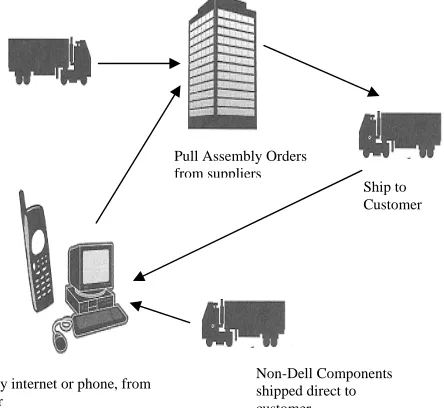
One of the business models for business-to-business operations that has been enabled by information technology is the Dell business model. As shown in Figure 2, in this model, orders for computers are placed with Dell by telephone or through the Internet. Through a process called just-in-time (or lean) manufacturing, waste is reduced and productivity improved by only having the required inventory on hand when it is actually needed for manufacturing. This reduces both lead times and set up times for building a computer. Under the just-in-time philosophy, Dell only orders the parts for a computer when it has a firm (and in the case of non-corporate orders, prepaid) order. As a result, Dell operates with little in-process and no finished goods inventory: Products are shipped as soon as they are manufactured. This approach also enables Dell to forego having brick and mortar store fronts with inventory that must be kept on the books or that might become obsolete, thereby significantly reducing overhead. In addition, items that are not built by Dell are shipped directly to the customer by the manufacturer. These features help Dell to reduce the costs of production and sales. Far from being inflexible, however, this process also allows Dell to custom design systems for its customer within certain parameters as well as to offer a range of items rather than a single system.
5.2 The Cisco E- Business Model
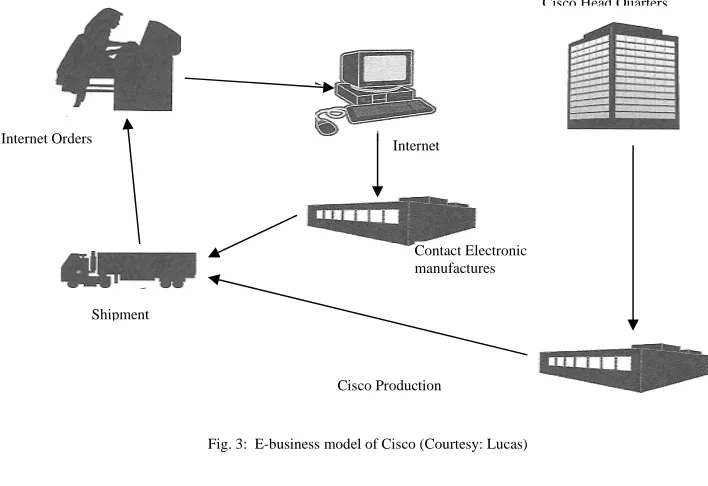
Another lean business-to-business model that has been enabled by information technology is the Cisco model illustrated in figure 3. This successful network communications manufacturer receives approximately 90 percent of its orders over the Internet. The orders are routed to contract electronics manufacturers who build the products to Cisco’s specifications. Not only are the majority of Cisco’s orders received over the web, but 70 to 80 percent of their customer service requests are also dealt with online.
5.3 The Bata E-Business Model
Bata is one of the leading footwear manufactures in India. Bata has a worldwide reach, with operations across 5 continents managed by 4 regional meaningful business units (MBUs). Each unit benefits from synergies specific to their environment, such as product development, sourcing or marketing support. Each MBU is entrepreneurial in nature, and can quickly adapt to changes in the market place and seize potential growth opportunities. The below figure 4 illustrates the e-business model of Bata. In this successful model there are no distributors or agents. The product is directly delivered to the retailers. By doing this the commission for the distributors and agents are reduced and a fraction of the commissions are utilized for the development of the firm and to the retailers.
Fig. 2: E-business model of Dell (Courtesy: Lucas) Orders by internet or phone, from
customer
Pull Assembly Orders from suppliers
Ship to Customer
6. Conclusion
Business models play an important role in expressing the business needs in concrete ways, controlling the business operation work flow, handling run-time exception, managing the business object, consisting of the business logic with respect to the context, etc. As a result, this business models serves as the driving factor for business systems, which form an essential part of the business processes containing the set of business rules and business functions bound with policies and standards. As directions of future research, in addition to the study of business models an exception handling mechanism can be modeled for Business Logic as discussed above.
Reference
[1] Maître. B and Aladjidi. G, “Les Business Models De La Nouvelles Economies”, Paris: Dunod, 1999. [2] Kalakota. R, “E-Business : Roadmap for Success”, Addison-Wesley, Information Technology Series, 1999
[3] Tapscott. D, Ticoll. D and Lowy. A, “Digital Capital - Harnessing the Power of Business Webs”, Harvard Business School Press, 2000 [4] Timmers. P, “Business Models for Electronic Markets” Journal on Electronic Markets, vol. 8 (2), pp 3-8, 1998.
[5] Martinez. P, “Models made ‘e’: What Business are You in?”, Centers for IBM E-Business Innovation, 2000
[6] Alexander Osterwalder, “An E-business Model Ontology for Modeling E-Business”, 15th Bled Electronic Commerce Conference, e-Reality: Constructing the e-Economy Bled, vol. 44, pp 5-23, 2002
[7] Morecroft. J.D, “Executive Knowledge, Models, and Learning”, Productivity Press, Portland. [8] Fensel. D, “Ontologies: Silver Bullet for Knowledge Management and Electronic Commerce – 2nd
Edition”, Springer-Verlag New York, 2003
[9] Peterovic. O, Kittl. C and Teksten R.D, “Developing Business Models for E-Business”, International Conference on Electronic Commerce, 2001.
[10] Norton. D and Kaplan. R, “The Balanced Scorecard: Measures that Drive Performance”, Harvard Business Review, 70 (1), 1992 [11] Sternman. J.D, “Business Dynamics: Systems Thinking and Modeling for a Complex World”, Boston: McGraw-Hill, 2000. [12] Hamel. G, “Leading the Revolution”, Harvard Business Press, 2000
[13] Porter. M, “Strategy and the Internet”, Harvard Business Review 79 (3), pp 62-78, 2001.
Cisco Head Quarters
Internet Orders Internet
Contact Electronic manufactures
Cisco Production Shipment
Suppliers
BATA
Internet Orders
Retailer Fig. 3: E-business model of Cisco (Courtesy: Lucas)
[14] Gordijn, Akkermans and van Vliet “What's in an Electronic Business Model? - Knowledge Engineering and Knowledge Management - Methods, Models, and Tools” 12th
international Conference, EKAW, Springer Vol. 1937, pp 257-273, 2000 [15] Tarondeau. J. C, “Approches et Formes de la Flexibilité, Revue Française de Gestion”, pp 66-71, 1999. [16] Wernefelt, “A Resource-Based View of the Firm”, Strategic Management Journal, vol. 5, pp 171-181, 1984 [17] Grant. R.M, “Contemporary Strategy Analysis”, Malden MA: Blackwell, 1995
[18] Porter. M and Millar. V, “How Information Gives You Competitive Advantage” Harvard Business Review vol. 63(4), pp 149-160, 1985.
[19] Stabell. C.B and Fjeldstad O.D, “Configuring Value for Competitive Advantage: on Chains, Shops, and Networks”, Strategic Management Journal, vol. 19, pp 413-437, 1998.
[20] Nalebuff. B and Brandenburger. A, Co-opetition, Doubleday, 1996
[21] Tapscott. D, Ticoll. D and Lowy. A, “The Rise of the Business Web”, Business 2.0, pp 198-208, 1999.
[22] Amami, M., J. Thévenot. “L’Internet Marchand: Caractérisation et Positionnements Stratégiques”, Systèmes d’Information et Management vol. 5, pp 5-40, 2000
[23] Pigneur. Y, “A Framework for Defining E-business Models”, LNCS, Springer, Vol. 2425/2002, pp 489-497, 2002
[24] Ushold. M and King. M, “Towards a Methodology for Building Ontologies”, Workshop on Basic Ontological Issues in Knowledge Sharing, IJCAI-95, 1995.
[25] Malone. T.W, Crowston. K, Lee. J, Pentland. B, Dellarocas. C, Wyner. G, Quimby. J, Osborn. C, Bernstein. A, Herman. G, Klein. M, and O’Donnell. E, “Tools for Inventing Organizations: Toward a Handbook of Organizational Processes”, Management Science, vol. 45 (3), pp 425-443, 1999
[26] Fischer. G, Lemke. A.C, Mastaglio. T and Morch. A, “The Role of Critiquing in Cooperative Problem Solving”, ACM Transaction on Information Systems vol 9(2), pp 123-151, 1991
[27] Frick. V, Gill. B, Lill. A and Murphy. K, “E-Business: Opportunities, Threats and Paper Tigers”. Gartner Group Strategic Analysis Report, R-09-8265, 1999
[28] Afuah, A., C. Tuccci, “Internet Business Models and Strategies”, McGraw Hill, 2000
[29] Zott. C, Amit. R and Donlevy. J, “Strategies for Value Creation in Ecommerce: Best practice in Europe”, European Management Journal, vol. 18 pp 463-475, 2000
[30] Weill. P and Vitale. M.R, “Place to Space: Migrating to eBusiness Models”, Harvard Business School Press, 2001. [31] Rayport. J.F, and Jaworski. B.J, “e-Commerce”, New York: McGraw-Hill/Irwin, 2001
[32] Glueck. W.F and Jauch. L.R, “Business Policy and Strategic Management”, McGraw-Hill Inc., 1984. [33] Johnson. G and Scholes. K, “Exploring Corporate Strategy - 2nd
edition”, Prentice Hall, UK, 1988
[34] Porter. M.E, “Competitive Strategy: Techniques for Analysing Industries and Competitors”, The Free Press, New York, 1980 [35] Wiseman. C, “Strategy and Computers”, Dow Jones Irwin, 1985
[36] Parker. M.M. and Benson. R.J, “Information Economics: Linking Business Performance to Information Technology”, Englewood Cliffs, N.J. Prentice Hall International, 1988.
[37] Prahalad. C.K and Hamel. G, “The Core Competence of the Corporation”, Harvard Business Review, 1990 [38] Zack. M.H, “Developing a Knowledge Strategy”, California Management Review, Vol. 41(3) pp 125-145, 1999. [39] Geus. A. de, “Planning as Learning In: Harvard Business Review”, Vol 66, pp. 70-74, 1988
[40] Schoemaker. P.J.H, “Scenario Planning – a Tool for Strategic Thinking”, Sloan Management review, Winter vol. 36(2), pp 25-40, 1995.
[41] Lederer. A.L and Sethi. V, “The Implementation of Strategic Information Systems Methodology”, MIS Quarterly, 1988 [42] Earl, M.J., Management Strategy for Information Technology, Prentice Hall, New York, 1989
[43] Sambamurthy. V, Zmud. R.W and Byrd. T.A, “The Comprehensiveness of IT Planning Processes a Contingency Approach”, Journal of Information Technology Management, vol. 5 (1), pp 1-10, 1994.
[44] Henderson. J.C and Venkatraman. N, “Strategic Alignment: Leveraging Information Technology for Transforming Organizations”, IBM Systems Journal, Vol. 32, nr. 1, 1993
[45] Finnegan. P, Galliers. R, and Powell. P.H, “Guidelines for effective information systems planning in interorganisational environments” 7th European Conference on Information Systems, Copenhagen, vol 1, pp 171-181, 1999
[46] Hackbarth. G and Kettinger. W.J, “Building an E-Business Strategy”, Information Systems Management, vol. 17, pp 78-93, 2000 [47] Bakos, J.Y., “Electronic marketplaces”, MIS Quarterly, pp. 295-310, September 1991.
[48] Schmid. B and Lindemann. M, “Elements of a Reference Model for Electronic Markets”, 38th
HICCS Conference, 1998
[49] Williamson. O.E, “The Economics of Organizations: The Transactions Cost Approach”, American Journal of Sociology vol 87(3), pp 548-577, 1981
[50] Wassenaar. D.A, “Understanding and Designing virtual Organisation Forms”, VoNet Newsletter, Vol. 3(1), Berne, 1999
[51] Jarvenpaa. S.L and Shaw. T.R., “Global Virtual teams: Integrating models of trust, In (Sieber and Griese): Organizational Virtualness”, VoNet-Workshop, pp. 53-61, April 27-28, 1998
[52] Gebauer. J, “Virtual Organizations from an Economic Perspective”, 4th
European Conference on Information Systems, Portugal, Part A, pp. 91-103, 1996
[53] Wigand. R, Picot. A, and Reichwald. R, “Information, Organization and Management: Expanding Markets and Corporate Boundaries”, John Wiley & Sons Ltd., Chichester, 1997
[54] Mowshowitz. A, “Virtual Organisation”, Communication of ACM vol. 40 (9), pp. 30-37, 1997
[55] Christiaanse. E and Kumar. K, “From Static Supply Chain to Dynamic Supply Webs: Principles for Radical Redesign in the Age of Information”, ACM, 20th
International Conference on Information Systems, pp 307-323, 1999
[56] Hagel III. J and Singer. M, “Networth, Shaping Markets When Customers Make the Rules”, Harvard Business School Press, Boston, 1999.
[57] Malone. T.W, Yates. J and Benjamin. R.I “Electronic Markets and Electronic Hierarchies”, Communication of ACM vol. 30(6), pp. 484-497, 1997
[58] Bodart. F “Guide Méthodologique D’implantation De L’E-Business Dans les PME”, Namur Belgium: Agence wallonne Des Telecommunications, 2000
![Fig. 1: E-business Model Ontology[6]](https://thumb-us.123doks.com/thumbv2/123dok_us/9650495.1492885/2.612.95.517.376.546/fig-e-business-model-ontology.webp)