Complex Multi-state System Reliability
Modeling and Assessment
Li Yong1, Liu Anxin1,Zhang Xiaonan1
1.Engineering Institute of Engineering Corps. PLA Univ. of Sci. & Tech., Nanjing 210007, P.R . China Corresponding Author: [email protected]
Abstract
This paper considers a problem of multi-state system reliability modeling and assessment. By using the advantages of uncertainty reasoning and figurative expression of Bayesian network, a new method of modeling and assessment of multi-state system reliability based on BN is proposed to determine the nodes of BN and the multiple states of components of system, and to give the probability of each state and then utilizing conditional probability distributing(CPD)to describe the relationship among the component states, so as to express the states of correlated nodes and build a BN model of multi-state system. The model can clearly express the multiple states of system and component and the state probability, and also call directly calculate the system reliability on the basis of multiple state probabilities of component, thereby carrying out qualitative analysis and quantitative assessment of multi-state system reliability. By means of an example of multi-state radar system, we give the detailed multi-state system reliability analysis process based on BN. This paper not only proves the effectiveness of assessment of multi-state system reliability based on BN, but contributes to good help of complex system reliability, safety analysis.
Keywords: System reliability Multi-state Bayesian networks Modeling Assessment
1.
INTRODUCTIONTraditionally, system reliability has been analyzed from a binary perspective assuming the system and its components can be in either of two states: completely functioning or failed. However, many systems that provide basic services, such as telecommunications, gas and oil production, transportation and electric power distribution, operate at various levels of performance as opposed to the binary perspective. These types of systems may provide a service or function at degraded component performance levels. Therefore, it is essential to model and analyze them accordingly. For these systems, multi-state system reliability methods have been proposed as a more appropriate modeling and computational approach.
An important issue is how to model practical system in the multi-state context through careful analysis and definition. Many binary reliability models [1] have been extended to multi-state reliability models, such as the series-parallel system models [2,3], the k-out-of-n system models [4], the weighted k-out-of-n system model [5], the network system models [6], etc. There might be more than one way to extend a binary reliability model to the multi-state context. For example, in Barlow and Wu’s definition of multi-state series-parallel system [2], the state of a parallel subsystem is equal to the state of the best component. However, in Levitin’s definition of multi-state series-parallel systems, the capacity of a parallel subsystem is equal to the sum of the capacities of its constituent components. Under traditional definition of multi-state k-out-of-n: G system [7, 8], the system is in state j or above when at least k components are in state j or above.
In recent years, Bayesian network (BN) has found applications in, e.g., software reliability, fault finding systems and maintenance modeling. One important feature that makes BN appealing is the possibility of combining different sources of information to provide a global safety assessment. Bouissou et al. [5] report on the experience of a hierarchical construction of a BN to combine different sources of evidence in the reliability analysis of complex software systems. On a similar line, Fenton et al. [6] showed that the robustness and well-founded underlying theory of BN can provide significant advantages. Wooff et al. [8] designed software tests using BN, and concluded that BN are well suited for these problems.
identification, monitoring, maintenance, and prediction. However, as far as the complex multi- state system reliability modeling and assessment, there is no systematic study and conclusion.
In this paper, by using the advantages of uncertainty reasoning and figurative expression of Bayesian network, a new method of modeling and assessment of multi-state system reliability based on BN is proposed to determine the nodes of BN and the multiple states of elements of system, and to give the probability of each state and then utilizing conditional probability distributing (CPD)to describe the relationship among the element states, so as to express the states of correlated nodes and build a BN model of multi-state system. The model can clearly express the multiple states of system and elements and the state probability, and also call directly calculate the system reliability on the basis of multiple state probabilities of elements, thereby carrying out qualitative analysis and quantitative assessment of multi-state system reliability. Analysis of practical examples proves the effectiveness of assessment of multi-state system reliability by using BN method.
2. Bayesian Network theory
BN is probabilistic networks based on graph theory. Each node represents a variable and the arcs indicate direct probabilistic relations between the connected nodes. Variables are defined over several states. The BN allow taking into account time by defining different nodes to represent the variables at different time slices.
BN is directed acyclic graphs used to represent uncertain knowledge in Artificial Intelligence [8]. A BN is defined as a couple: G ((N,A),P), where (N,A) represents the graph; N is a set of nodes; A is a set of arcs; P represents the set of probability distributions that are associated to each node. When a node is not a root node, i.e. when it has some parent nodes, the distribution is a conditional probability distribution that quantifies the probabilistic dependency between that node and its parents.
In accordance with the definition of BN conditional probability:
( / ) ( / )
( ) P B A P A B
P B
(1)
In the formula, P (B) is the prior probability, P (A / B) for the posterior probability.
Supposed A is a variable, there are n states
a a
1,
2,
, ,
a
i
,
a
n, according to the total probability formula:( ) ( / i) ( i)
P B
P B Aa P Aa (2)the posterior probability P (A / B) can be calculated.
With the conditional independence, BN can carry out two-way reasoning, not only forward reasoning, derived from the prior probability to posterior probability, which is from reasons to results, but also derived from the posterior probability to prior probability with the formula, which is from results to reasons.
3. Multi-state system reliability model based on BN
Multi-state reliability BN model is described by three different systems in the following. If the component has open circuit and short circuit, two failure modes, such systems also have two kinds of failure modes. In the same situation, the component has open circuit, short circuit and normal state, three states, the system composed of such components has the same three states.
In this paper we use this kind of three states as the example to study the multi-state reliability BN model.
(1) Parallel system of two three-state components
The parallel system reliability block diagram is shown in figure1a.A open circuit component will not cause the system failure, and a short circuit component will cause the system failure. Figure 1b, 2c are system reliability block diagram in the two failure modes.
Fig. 1b open circuit failure mode
Fig. 1c short circuit failure mode
Fig. 1 Parallel system of two three-state components
According to literature [11]:
0 01 02, s 1 (1 s1(1 s2))
Q q q Q q q (3)
In the type, Q0 is open circuit system failure probability, Qs is short circuit system failure probability, q0i is open circuit failure probability of component i; qsi is short circuit failure probability of component i; Rs is the working probability of component. Then the working probability of the system is that:
0 1 2 01 02
1 (1 )(1 )
s s s s
R Q Q q q q q (4)
If applying the method, when the component number increasing, not only the minimal path sets and the minimal cut sets is difficult to be got, but no doubt the above formula will become more complex computation. Comparing the above method, we use BN reliability model to solve the problem in the following. It is shown in Figure 2. We use 0, l, 2 to represent system and component open circuit, short circuit state and normal state respectively. P is system or component state probability; node a, b represent two state component;X is the system state.
Fig. 2 BN reliability model of parallel system
,
( ) ( , , )
( ) [ ( / ) ( )]
( ) ( )
a b
a b
P X p a b X
P a P X b P b P a P b
(5)P(a)=1 or P(b)=1, P(X)=1 P(a)=0 and P(b)=0, P(X)=0
P(a)
1 P(b)=2 or P(a)=2 P(b)
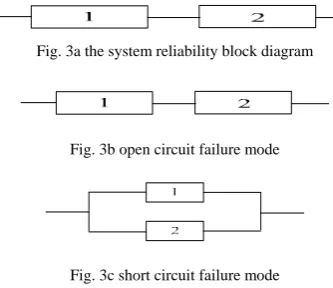
1, P(X)=2 (2)Series system of two three-state componentsThe series system reliability block diagram is shown in figure 3a.A open circuit component will cause the system failure, and a short circuit component will not cause the system failure. Figure 3b, 4c are system reliability block diagram in the two failure modes.
Fig. 3a the system reliability block diagram
Fig. 3b open circuit failure mode
Fig. 3c short circuit failure mode
Fig. 3 Series system of two three-state components
According to literature [11]:
0 1 (1 01(1 02)), s s1 s2
0 01 02 1 2
1 (1 )(1 )
s s s s
R Q Q q q q q (7)
In the same way, we use BN reliability model to solve the problem in the following. It is shown in Figure 4. We use the CPD to analyze the node X.
Fig. 4 BN reliability model of series system
,
( ) ( , , ) ( ) [ ( / ) ( )]
( ) ( )
a b a b
P X p a b X P a P X b P b
P a P b
(8)P(a)=0 or P(b)=0, P(X)=0 P(a)=1 and P(b)=1, P(X)=1
P(a)
0 P(b)=2 or P(a)=2 P(b)
0, P(X)=2From figure 2,4 showing, for the same number of multi-state components of the series system and parallel system, the reliability model based on BN is consistent in form, and only the CPD is different, so the multi-state system can be expressed by adjusting the CPD.
(3) k-out-of-n system of three-states components
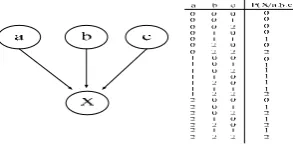
K-out-of-n system can work if at least k components are working. In figure 3, two-out-of-three of three-state component BN model is established. We use 0, l, 2 to represent system and component three-state probability respectively. Nodes a, b, c represent the three basic event; node X represents system.
Fig. 5 BN reliability model of two-out-of-three system
The main establishment steps of multi-state system reliability model based on BN network is as following:
(1) Determine the BN network node. The network root node represents basic events, the leaf node represents the system.
(2) Determine the multiple states of discrete systems and components
(3) Give the state probability of each component, which is usually given by actual test data.
(4) Describe various components state relationship with the CPD; express the associated node state; establish of the BN model of system reliability.
Through the above three systems, we can know that multi-state system reliability model based on BN network has better visual image, and the state is expressed more clearly. Although as the number of system components increasing, CPD expression is more complex, but because CPD of BN network is simple, regular, and suitable for programming.
4. Complex multi-state system reliability analysis
Supposed
X
1,...,
X
6 having all three kinds of states: 0 (failed), 1 (reduction success) and 2 (success);2
,...,
11X
X
having only two kinds of states: 0 (failed) and 1 (success). In the following, we establish the multi-state fault tree and BN of this system separately. Through analysis, we can see that the method of BN has more analytical modeling than the traditional multi-state fault tree analysis methods.(1) Analysis
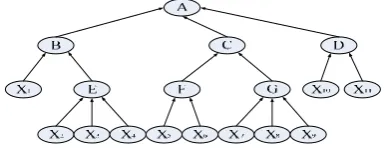
Figure 7 shows the corresponding radar system multi-state fault tree, which gives the state space of middle events and top event.
Fig. 6 a radar system
Fig. 7 multi-state system fault tree
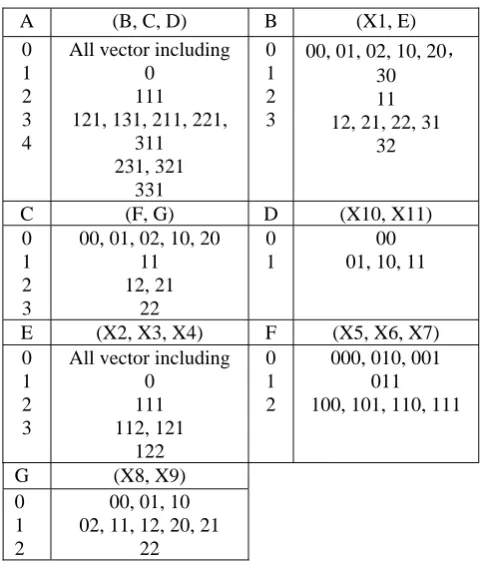
The multi-state logic operator of middle events and top event is as follows:
Table 1 Logic operator
A (B, C, D) B (X1, E)
0 1 2 3 4
All vector including 0
111 121, 131, 211, 221,
311 231, 321
331
0 1 2 3
00, 01, 02, 10, 20,
30 11 12, 21, 22, 31
32
C (F, G) D (X10, X11)
0 1 2 3
00, 01, 02, 10, 20 11 12, 21
22
0 1
00 01, 10, 11
E (X2, X3, X4) F (X5, X6, X7) 0
1 2 3
All vector including 0
111 112, 121
122
0 1 2
000, 010, 001 011 100, 101, 110, 111
G (X8, X9)
0 1 2
00, 01, 10 02, 11, 12, 20, 21
22
All operator are translated into CPD. The CPD E, A are as follows:
P(E=0/X2=0)=1 P(E=0/X3=0)=1
P(A=0/C=0)=1 P(A=0/D=0)=1 P(A=1/B=1, C=1, D=1)=1 P(A=3/B=2, C=3, D=1)=1 P(A=3/B=3, C=2, D=1)=1 P(A=4/B=3, C=3, D=1)=1 P(A=0/else)=1
Figure 8 shows the BN reliability model of this radar system. Table 2 gives the conditional probability of each root node.
Fig. 8 radar system BN reliability model
Table 2 root node conditional probability
X1 X3 X4 X5 X6
0 0.008 0.034 0.001 0.008 0.002
1 0.042 0.058 0.033 0.09 0.04
2 0.95 0.908 0.966 0.902 0.958
X2 X7 X8 X9 X10 X11 0 0.02 0.001 0.0015 0.001 0.02 0.021 1 0.97 0.998 0.9985 0.998 0.97 0.979
(2) Result
1) Top event probability
In the traditional multi-state fault tree analysis, top event probability need to calculate the system minimal cut sets and minimal path sets. Based on BN, we can calculate each node probability directly, avoiding non-payment computing. In this radar system, the top event A probability formula and procedure is as following:
11
10, 11 , ,
1 3 4 5 6
2 7 8 9 10 11
( ) ( , , , )
, , {0,1, 2,3}, , , , , , , , {0,1, 2} , , , , , {0,1}, 0,1, 2, 3, 4
B C D X
P A i P B C D X X A i B C E D F G X X X X X X X X X X X i
(9)
Table 3 A probability in each state
A 0 1 2 3 4
probabilit 0.0675169 2x10⁻⁸
0.0167952 0.215148 0.70054
Bayes Net Toolbox (BNT) has the corresponding procedure to solve the problem to simplified the computing.
2) The importance
In the traditional multi-state fault tree analysis, the importance of components Ei need to get all the quality implication set, and then calculate the importance index Ei. However based on BN, the importance of components Ei can be directly calculated by the conditional probability components. Here we take the RAW ( Risk Achievement Worth) as an example, and other type of importance can be calculated according to their definition.
0
(
\
)
1
( , )
1
(
)
i M i l j i
P TE
l E
j
R i j
M
P TE
l
(10)Figure 9 shows the various component RAW importance in state 4. We can be seen from Figure 9, components X6,X7 has the greatest importance, while X8 has the smallest importance. So we can improve the system reliability based on the importance analysis.
0 0.1 0.2 0.3 0.4 0.5 0.6 0.7 0.8 0.9 1
X1 X2 X3 X4 X5 X6 X7 X8 X9 X10 X11
Fig. 9 RAW importance in state 4
3) Posterior probability
In addition, BN can get more rich information, such as the posterior probability. Supposed system failure, in order to diagnosing the fault and improving the system reliability, we need to compute all nodes posterior probability, while BN gives the fix computing and procedure, which need not compute all node combination, and get the best result.
Supposed system fault at the moment T, compute the posterior probability of component X5.
1 2 11
1 2 11 ,
5 5
( 1, , 1)
( 1, 1)
( / )
( ) ( )
X X X
P A X X X P A X
P X A
P A P A
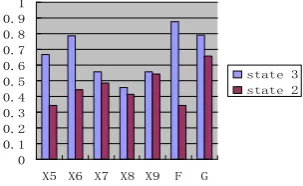
Figure 10 shows probability distribution of each node changing when subsystem C transferring from state 3 into state 2. Obviously we can get the information that it is probably that the state changing of component X5 and X6 lead to the subsystem C changing. Therefore if monitoring subsystem C changing from the intact state 3 to state 2, it should firstly investigate X5 and X6 in order to improve the system reliability.
0 0.1 0.2 0.3 0.4 0.5 0.6 0.7 0.8 0.9 1
X5 X6 X7 X8 X9 F G
state 3 state 2
Fig. 10 each node probability distribution changing
5. Conclusion
(1) According to the BN's two-way uncertainty logical reasoning ability and parallel computing characteristics, we study two state and multi-state system reliability modeling and assessment based on BN.
(2) Multi-state system reliability modeling based on BN has the features of the good structure and hierarchy, and the expression of CPD makes multi-state relationship between components and systems more simple and intuitive. Such as the same series and parallel systems with the same components, because BN form is the same, we can reflect the different system just by adjusting the CPD.
(3) During computing the model's reliability, we do not find the system minimal cut sets or minimal path sets, so as to simplify the calculation and greatly enhance the computing accuracy and efficiency. The calculated results of the examples of show the effectiveness and advantage of multi-state system reliability modeling and evaluation based on BN.
distributions and prior distributions are obtained according to multi-state logic operators. Analysis is performed on BN to obtain the probability of top event, importance measures of components and posterior probability and the corresponding formula and procedure is given. Through analysis, we can see that the method of BN has more analytical modeling than the traditional multi-state fault tree analysis methods. This paper not only proves the effectiveness of assessment of multi-state system reliability based on BN, but contributes to good help of complex system reliability, safety analysis.
References
[1] M. Modarres, M. Kaminskiy and V. Krivtsov. Reliability Engineering and Risk Analysis: A Practical Guide, New York: Marcel Dekker, 1999.
[2] R.E. Barlow and A.S. Wu. Coherent systems with multistate components. Mathematics of Operation Research, 3(4): 275-281,1978. [3] G. Levitin. Universal Generating Function in Reliability Analysis and Optimization. Springer-Verlag, 2005.
[4] J. Huang, M.J. Zuo and Y. H. Wu. Generalized multi-state k-out-of-n: G systems. IEEE Transactions on Reliability, 49(1): 105-111, 2000.
[5] W. LI, M.J. Zuo. Reliability evaluation of multi-state weighted k-out-of-n systems. Reliability Engineering and System Safety, 2006. [6] A. Lisnianski and G. Levitin. Multi-state System Reliability: Assessment, Optimization and Application. World Scientific, Singapore,
2003.
[7] E. EI-Neweihi, F. Proschan and J. Sethuraman. Multi-state coherent system. Journal of Applied Probability, 15: 675-688, 1978. [8] R.A. Boedigheimer and K.C. Kapur. Customer-driven reliability models for multistate coherent systems. IEEE Transaction on
Reliability, 43(1): 46-50, 1994.
[9] QIAN Wenxue, YIN Xiaowei, XIE LIyang. Diseretized Modeling Proeess of Reliability 0f Multi-state Mechanical Systems[J]. Journal of Northeastern Unversity,29; 2008.1609-1613
[10] Makis V. Multivariate Bayesian control chart. Operations Research 2008; 56(2):487--496.