ISSN: 2231-5381 http://www.ijettjournal.org
Page 116Analysis of ECG Data Compression Techniques
* V.S.R Kumari 1 Sridhar Abburi 2
1 Professor & HOD, Dept. of ECE, Sri Mittapalli College of Engineering, Guntur, A.P, India. 2 PG Student (M. Tech), , Dept. of ECE, Sri Mittapalli College of Engineering, Guntur, A.P, India.
Abstract: ECG (electrocardiogram) is a test that measures the electrical activity of the heart.
The heart is a muscular organ that beats in rhythm to pump the blood through the body. Large amount of signal data needs to be stored and transmitted. So, it is necessary to compress the ECG signal data in an efficient way. In the past decades, many ECG compression methods have been proposed and these methods can be roughly classified into three categories: direct methods, parameter extraction methods and transform methods. In this paper a comparative study of Fast Fourier Transform (FFT), Discrete Cosine Transform (DCT), Discrete sine Transform (DST) and Discrete Cosine Transform-II (DCT-II). Records selected from MIT-BIH arrhythmia database are tested. For performance evaluation Compression Ratio (CR), Percent Root Mean Square differences (PRD) are used.
Keywords: Fast Fourier Transform (FFT), Discrete Cosine Transform (DCT) and Discrete sine
Transform (DST), ECG data compression, ECG, Percentage Mean Square Difference (PRD), Compression Ratio (CR).
1.
IntroductionElectrocardiographic signals may be recorded on a long timescale (i.e., several days) for the purpose of identifying intermittently occurring disturbances in the heart rhythm. As a result, the produced ECG recording amounts to huge data sizes that quickly fill up available storage space. Transmission of signals across public telephone networks is another application in which large amounts of data are involved. For both situations, data compression is an essential operation and, consequently, represents yet another objective of ECG signal processing. Signal processing has contributed significantly to a new understanding of the ECG and its dynamic properties as expressed by
changes in rhythm and beat morphology. For example, techniques have been developed that characterize oscillations related to the cardiovascular system and reflected by subtle variations in heart rate.
ISSN: 2231-5381 http://www.ijettjournal.org
Page 117the heart. Due to low cost and non-invasion, ECG signal has been extended for heart disease diagnosis and ambulatory monitoring. For storage and transmission of large signal data, it is necessary to compress the ECG signal data.
Data compression has its application in many fields and so as in the field of medical science. ECG is an important parameter that measures patient’s health and reports abnormalities if any. This paper has done a survey of various kinds of ECG data compression techniques. Recently, numerous research and techniques have been developed for compression of the signal. These techniques are essential to a variety of application ranging from diagnostic to ambulatory ECG’s. Thus, the need for effective ECG compression techniques is of great importance.
Many existing compression algorithms
have shown some success in
electrocardiogram compression; however, algorithms that produce better compression ratios and less loss of data in the reconstructed signal are needed. This proposed paper discusses various techniques proposed earlier in literature for compression of an ECG signal and provide comparative study of these techniques.
This paper is organized as follows: ECG compression using FFT, DCT and DST are presented in section III. Performance evaluation parameters are explained in section IV. In section IV,
simulation experiments conducted to test performance are also presented. Finally a conclusion is given in section V
2.
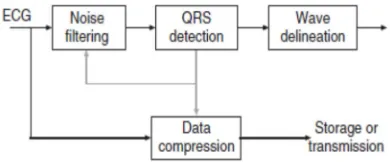
ECG Signal ProcessingThe block diagram in Figure 1 presents this set of signal processing algorithms. Although these algorithms are frequently implemented to operate in sequential order, information on the occurrence time of a heartbeat, as produced by the QRS detector, is sometimes incorporated into the other algorithms to improve performance. The complexity of each algorithm varies from application to application so that, for example, noise filtering performed in ambulatory monitoring is much more sophisticated than that required in resting ECG analysis.
ISSN: 2231-5381 http://www.ijettjournal.org
Page 118heartbeat and the onset and end of each wave.
Figure 1 Algorithms for basic ECG signal processing.
The algorithm for real-time ECG signal compression and reconstruction is summarized in Figure 2. As shown in this figure, it is composed of five compressing procedures and four reconstruction procedures. For compression, the first procedure is to obtain backward differences after 1/2 down-sampling of the ECG signal. The second procedure is to detect the peak of the differenced signal and classify it from the current peak to the previous peak and store the result. The third procedure is to obtain the DCT of the stored data. The fourth procedure is to filter the transformed data obtained in the previous procedure using a window filter, and the final procedure is to apply the Huffman coding algorithm.
The data transmitted to a server or a base station from e-health devices are the data block coming out of the last compression procedure. The channel number can be added to the protocol header if e-health devices need to transmit multiple bio-signals.
Figure 2 also shows the
reconstruction procedure, which is the reverse order of the compression procedure. The first reconstruction procedure applies the inverse Huffman
coding algorithm to the compressed and transmitted data. The second procedure obtains the inverse discrete cosine transform. The third interpolates the recovered time signal during the previous procedure using Spline interpolation, and the final procedure is to reconstruct the original signal after calculating the inverse difference[2].
Figure 2 Block diagram of compression and decompression procedures
ECG, which is an analog signal, is usually sampled at 200 Hz to 1 kHz depending on the purpose of applications. Usually, the sampled data are represented as a 2-byte data. In the proposed data compression algorithm, the acquired ECG signal is first down-sampled by 1/2 and represented as 1-byte data after calculating the backward difference, decreasing its data size by 75% . The signed 1-byte data can be represented from –128 to +127 in decimal.
ISSN: 2231-5381 http://www.ijettjournal.org
Page 119ECG Data Compression is required to reduce the disk space required to store the data, as ECG is a continuous data taken for a very long interval of time. Also by compressing redundant data from the signal can be removed which actually takes considerably large area in memory. The need of signal transmission over telephone lines or antenna for remote analysis makes the compression and data reconstruction of the signal an important issue in signal processing. ECG is a graphic display of the electrical activity of the heart. Due to low cost and non-invasion, ECG signal has been extended for heart disease diagnosis and ambulatory monitoring. For storage and transmission of large signal data, it is necessary to compress the ECG signal data.
Data compression has its application in many fields and so as in the field of medical science. ECG is an important parameter that measures patient’s health and reports abnormalities if any. This paper has done a survey of various kinds of ECG data compression techniques. Recently, numerous research and techniques have been developed for compression of the signal. These techniques are essential to a variety of application ranging from diagnostic to ambulatory ECG’s. Thus, the need for effective ECG compression techniques is of great importance.
Many existing compression algorithms
have shown some success in
electrocardiogram compression; however,
algorithms that produce better compression ratios and less loss of data in the reconstructed signal are needed. This proposed paper discusses various techniques proposed earlier in literature for compression of an ECG signal and provide comparative study of these techniques.
ECG Compression Methods
In this paper we use FFT, DCT, and DCT-II and DST transformations for ECG data compression.
Fast Fourier Transform (FFT)
By using Fourier transform we can obtain the frequency – amplitude of a represented signal.
( ) =
( )
For k = 0, 1, 2, 3, 4, 5……….N-1
X (K) is the FFT of a signal x (n).
The FFT compression algorithm
Separate the ECG components into three components x, y, z.
Find the frequency and time between two samples.
Find the FFT of ECG signal and check for FFT coefficients (before compression) =0, increment the counter A if it is between +25 to-25 and assign to Index=0.
Check for FFT coefficients (after compression) =0, increment the Counter B.
Calculate inverse FFT and plot decompression, error.
ISSN: 2231-5381 http://www.ijettjournal.org
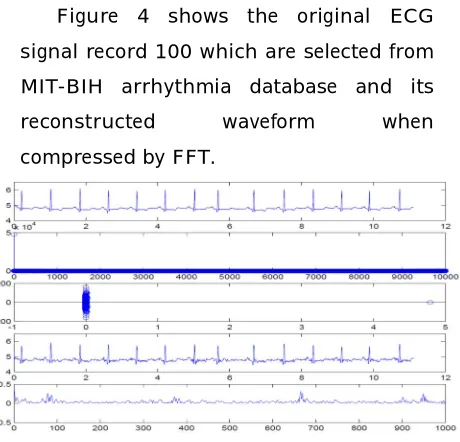
Page 120Figure 4 shows the original ECG signal record 100 which are selected from MIT-BIH arrhythmia database and its
reconstructed waveform when
compressed by FFT.
Figure 4 FFT compression of MIT-BIH record 100
Limitation of FFT is it fails to provide the information regarding the exact location of frequency component in time
Discrete Cosine Transform (DCT):
In DCT compression signal
information can restore in a restrict number of DCT coefficients. The DCT of a discrete signal f (u), u=0, 1. , N-1 is defined as:
( ) =
( )
( ) cos(
(2 + 1)
2 )
Where
u = 0, 1, 2…N-1.
w (u) = √1/N, for u= 0
= √2/N, for u ≠ 0
DCT Compression Algorithm
Separate the ECG components into three components x, y, z.
Find the frequency and time between two samples.
Find the DCT of ECG signal and check for DCT coefficients (before compression) =0, increment the counter A if it is between +0.22 to -0.22 and assign to Index=0.
Check for DCT coefficients (after compression) =0,
Increment the Counter B.
Calculate inverse DCT and plot decompression, error.
Calculate the compression ratio CR and PRD.
Fig.5 shows the original ECG signal record 100 which are selected from MIT-BIH arrhythmia database and its
reconstructed waveform when
compressed by DCT.
Figure 5 DCT compression of MIT-BIH record 100
Limitation of DCT:
Distortion is more in reconstructed signal.
Discrete sine Transform (DST):
ISSN: 2231-5381 http://www.ijettjournal.org
Page 121with odd symmetry (since the Fourier transform of a real and odd function is imaginary and odd), where in some variants the input and/or output data are shifted by half a sample. Like any Fourier-related transform, discrete sine transforms (DSTs) express a function or a signal in terms of a sum of sinusoids with different frequencies and amplitudes.
Like the discrete Fourier transforms (DFT), a DST operates on a function at a finite number of discrete data points. The obvious distinction between a DST and a DFT is that the former uses only sine functions, while the latter uses both cosines and sines (in the form of complex exponentials). However, this visible difference is merely a consequence of a deeper distinction: a DST implies different boundary conditions than the DFT or other related transforms.
( ) =
{
+ 1
( + 1)( + 1)
The DST compression algorithm
Separate the ECG components into three components x, y, z.
Find the frequency and time between two samples.
Find the DST of ECG signal and check for DST
Coefficients (before compression) =0, increment the counter A if it is between +15 to-15 and assign to Index=0.
Check for DST coefficients (after compression) = 0, increment the Counter B.
Calculate inverse DST and plot decompression, error.
Calculate the compression ratio CR and PRD.
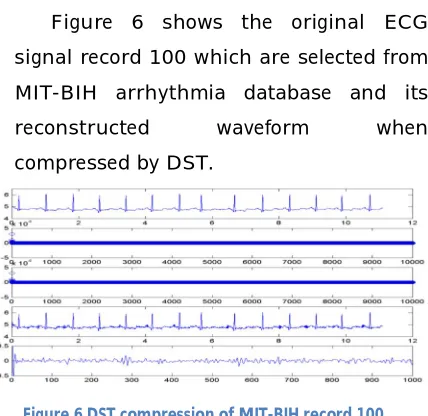
Figure 6 shows the original ECG signal record 100 which are selected from MIT-BIH arrhythmia database and its
reconstructed waveform when
compressed by DST.
Figure 6 DST compression of MIT-BIH record 100
Discrete Cosine Transform-II (DCT-II)
The most common variant of discrete cosine transform is the type-II DCT. The DCT-II is typically defined as a real,
orthogonal (unitary), linear
transformation by the following equation
For N inputs xn and N outputs
ISSN: 2231-5381 http://www.ijettjournal.org
Page 122 DCT-II compression algorithm Partition of data sequence x in Nb consecutive blocks bi, i =0, 1, ¼.., Nb-1, each one with Lb samples.
DCT computation for each block.
Quantization of the DCT coefficients.
Lossless encoding of the quantized DCT coefficients.
Figure 7 shows the original ECG signal record 100 which are selected from MIT-BIH arrhythmia database and its reconstructed waveform when compressed by DCT-II.
Figure 7 DCT-II compression of MIT-BIH record 100
3.
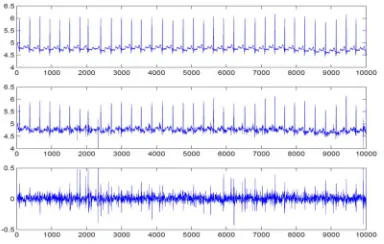
ResultsOne of the most unique characteristic of ECG is its periodicity, which is maintained after DCT and enables the use of a high compression rate during Huffman coding. A typical ECG signal has three important features, the P-wave, the QRS complex, and the T-wave. In addition, the R-peak position appears well after the difference of the ECG signal and can be used as a reference point to extract a periodic ECG, as shown in Figure 8(a) and (b).
Performance Evaluation
The effectiveness of an ECG compression technique is described in
terms of: Percentage Mean Square Difference (PRD), Compression Ratio (CR).
1. Compression Ratio (CR):
CR is the ratio of the original data to compressed data without taking into account factors such as bandwidth, sampling frequency, precision of the original data, word- length of compression parameters, reconstruction error threshold, database size, lead selection, and noise level. It is given by:
CR = Bit rate of original file / Bit rate of reconstructed file ……… (1) That is, Higher the CR, smaller the size of
the compressed file.
2. Percentage Mean Square Difference
(PRD):
Percentage Mean Square Difference (PRD) is a measure of error loss. This measure evaluates the distortion between the original and the reconstructed signal. PRD calculation is as follows:
PRD = √Σ (Xi – Xi1)2 / Σ Xi2 …………. (2) Where Xi is the original file and Xi1 is its reconstructed version.
ISSN: 2231-5381 http://www.ijettjournal.org
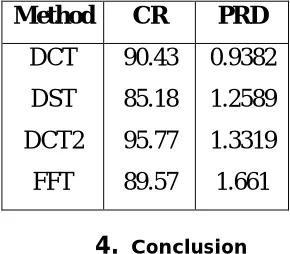
Page 123while achieving high CR. As the PRD indicates reconstruction fidelity; the increase in its value is actually undesirable. Although DCT-II provides maximum CR, but distortion is more. So a compromise is made between CR and PRD.
Figure 8 Peak-detecting procedure (record no. 111). (a) R-peak detecting of Original ECG signal. (b) Peak detection of differenced ECG. (c) Classification of peak interval using difference data.
Table 1Comparision of resultant compression techniques
4.
ConclusionAmong the four techniques presented, DST provides lowest CR and distortion is also high. DCT improves CR and lowers PRD. Next is FFT which gives CR 89.5767 with PRD as 1.661. But DCT-II provides an improvement in terms of CR of 95.77 but PRD increases up to 1.3319. Thus an improvement of a discrete cosine transform (DCT)-based method for electrocardiogram (ECG) compression is presented as DCT-II in terms of amount of
compression. The appropriate use of a block based DCT-II associated to a uniform scalar dead zone quantizes and arithmetic coding show very good results, confirming that the proposed strategy exhibits competitive performances compared with the most popular compressors used for ECG compression.
Acknowledgements
The authors would like to thank the anonymous reviewers for their comments which were very helpful in improving the quality and presentation of this paper.
References:
1. W. C. Mueller, “Arrhythmia detection program for an ambulatory ECG monitor,” Biomed. Sci. Instrum., vol. 14, pp. 81–85, 1978.
2. SangJoon Lee et.al, “A Real-Time ECG Data Compression and Transmission Algorithm for an e-Health Device”, IEEE Transactions on Biomedical Engineering, VOL. 58, NO. 9, September 2011
3. J. R. Cox, F. M. Nolle, H. A. Fozzard, and G. C. Oliver, “AZTEC, apreprocessing program for real-time ECG rhythm analysis,” IEEE Trans. Biomed. Eng., vol. BME-15, no. 2, pp. 128–129, Apr. 1968.
4. B. Furht and A. Perez, “An adaptive real-time ECG compression algorithm with variable threshold,” IEEE Trans. Biomed. Eng., vol. 35, no. 6, pp. 489–494, Jun. 1988.
Method
CR
PRD
DCT
DST
DCT2
FFT
90.43
85.18
95.77
89.57
0.9382
1.2589
1.3319
ISSN: 2231-5381 http://www.ijettjournal.org
Page 1245. J. P. Abenstein, “Algorithms for real-time ambulatory ECG monitoring,” Biomed. Sci. Instrument., vol. 14, pp. 73–79, 1978. 6. R. C. Barr, S. M. Blanchard, and D. A.
Dipersio, “SAPA-2 is the Fan,” IEEE Trans. Biomed. Eng., vol. BME-32, no. 5, p. 337, May 1985.
7. B. R. S. Reddy and I. S. N.Murthy, “ECG
data compression using Fourier
descriptors,” IEEE Trans. Biomed. Eng., vol.BME-33, no. 4, pp. 428–434, Apr. 1986. 8. M. E.Womble, J. S. Halliday, S.K. Mitter,M.C. Lancaster, and J. H. Triebwasser, “Data compression for storing and transmitting ECGs/VCGs,” Proc. IEEE, vol. 65, no. 5, pp. 702–706, May 1977.
Authors Profile:
V.S.R KUMARI is working as a
Professor & Head of the department of Electronics & Communication Engineering in Sri Mittapalli College of Engineering, Guntur, A.P, India. She has over 18 years of teaching experience and she is carrying out her research under Andhra University, Vishakhapatnam, AP, India.
Sridhar Abburi is Pursuing his