Hough, Christine Victoria (2010) Every child matters: a small scale enquiry into policy and practice. Doctoral thesis, University of Cumbria (awarded by Lancaster University).
Downloaded from: http://insight.cumbria.ac.uk/id/eprint/3736/
Usage of any items from the University of Cumbria’s institutional repository ‘Insight’ must conform to the following fair usage guidelines.
Any item and its associated metadata held in the University of Cumbria’s institutional repository Insight (unless stated otherwise on the metadata record) may be copied, displayed or performed, and stored in line with the JISC fair dealing guidelines (available here) for educational and notforprofit activities
provided that
• the authors, title and full bibliographic details of the item are cited clearly when any part of the work is referred to verbally or in the written form
• a hyperlink/URL to the original Insight record of that item is included in any citations of the work • the content is not changed in any way
• all files required for usage of the item are kept together with the main item file. You may not
• sell any part of an item
• refer to any part of an item without citation
• amend any item or contextualise it in a way that will impugn the creator’s reputation • remove or alter the copyright statement on an item.
The full policy can be found here.
Every child matters:
a small scale enquiry into policy and practice
Christine Victoria Hough
A thesis submitted in partial fulfilment of the requirements
of the degree of Doctor of Philosophy in Education Policy
University of Cumbria (awarding body: Lancaster University)
1 Table of Contents
ABSTRACT ... 9
PART ONE. ... 11
Chapter 1. ... 11
1. Introduction ... 11
Box 1: Every Child Matters. ... 12
Box 2: A President’s wish for the children of America. ... 13
The research aim and questions. ... 15
1.1. Addressing the research questions: progression through the thesis. ... 16
1.1.1. Chapter 2. ... 16
1.1.2. Chapter 3. ... 17
1.1.3. Chapter 4. ... 18
1.1.4. Chapter 5. ... 19
1.1.5. Chapter 6. ... 20
1.1.6. Chapter 7. ... 22
1.1.7. Chapter 8. ... 27
1.2. Values and beliefs. ... 29
1.2.1. “Reading the data”. ... 32
1.3. Rationale for the research. ... 33
1.3.1. My proposal and how it developed. ... 35
1.3.2. Who is this research for? ... 35
1.3.3. Inspiration and motivation. ... 36
1.4. New Legislation ... 39
1.5. The Introduction of the Every Child/Youth Matters programmes for change. .... 40
1.5.1. The aims of Every Child Matters. ... 42
Example 1. ... 43
Example 2. ... 43
Example 3 ... 43
1.6. Writing for different audiences. ... 45
1.7. Where is the Every Child Matters agenda making a difference? ... 46
1.8. The context for research into Every Child Matters. ... 47
1.8.1. A comparison of terms. ... 49
Diagram 1.1: Overarching areas for analysis, Every Child Matters. ... 49
SUMMARY ... 51
CHAPTER 2... 53
2. LITERATURE REVIEW. ... 53
2.1. The starting point. ... 53
2.1.1. Literature sources. ... 53
Diagram 2.1, Overview of literature reviewed. ... 55
2.1.2. Conceptual literature (1). ... 56
2.1.3. Conceptual literature (2). ... 58
Example 2.1. ... 60
Example 2.3. ... 62
Example 2.2. ... 62
2
2.1.4. Research literature. ... 66
Example 2.5. Findings from research, Robinson et al. 2005. ... 68
Table 2.1 definitions of multi agency working. ... 71
Diagram 2.2, Key Issues for Research – (after Wilkin et al. 2005) ... 74
Summary. ... 75
Chapter 3. ... 76
3. Methodology. ... 76
3.1 Research design. ... 76
Foreword. ... 76
Why two research studies? ... 77
Diagram 3.1, Simple research model. ... 80
3.2 Validity and Reliability. ... 81
3.2.1 Triangulation. ... 81
3.2.2 Validity and bias. ... 83
3.2.3 Purpose. ... 83
3.2.4 Methods ... 84
3.2.5 Research questions. ... 87
Table 3.1. Core questions for Research Study 1. ... 89
3.2.6 Conceptual framework. ... 90
Diagram 3.2: conceptual framework (1 (Fullan, 2004.) ... 92
3.3 Ethical issues – the guiding principles. ... 94
3.4 Details and difficulties of research design. ... 94
Diagrams 3.3a and 3.3b. Modes of research participation and outcomes: comparison between general model and PhD research. (After Truman, 2001). .. 100
3.5 RESEARCH STUDY 1. ... 102
3.5.1 The sample of interviewees. ... 103
Table 3.2: Table of samples of respondents in interviews, Research Study 1... 105
3.5.2. The nature of the interviews. ... 107
3.6. Method of Analysis. ... 108
3.7. Grounded Theory – what is it? ... 110
3.8. Programme systems. ... 113
3.9. An appraisal of Grounded Theory. ... 114
3.10. Constant comparative method of qualitative analysis (Glaser and Strauss, from p.101). ... 120
Diagram 3.4. Coding: Constructing and Abstracting Categories from research data. ... 123
Diagram 3.5. Coding for Categories: layout for recording data by hand. ... 125
Diagram 3.6a, dimensionalising the category of Structure/Planning for ECM/YM ... 127
Diagram 3.6 b, dimensionalising the category of Training. ... 128
Diagram 3.7, integrating the categories. ... 133
3.11. Reflections on applying grounded theory tools for analysis. ... 136
3.12. Understanding the process of induction. ... 137
Diagram 3.8: The Ashridge Diamond – A Mission Model for strategy. ... 141
Diagram 3.9: The application of Grounded Theory research processes, based on the Ashridge Mission Model for Strategy. ... 142
3
CHAPTER 4. ... 144
4. Analysis of Findings from Research Study (1) ... 144
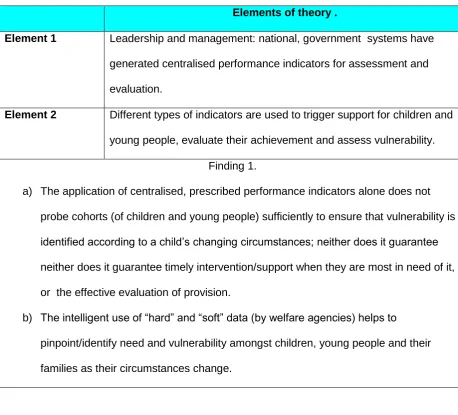
4.1. Finding 1 ... 144
4.1.1. Discussion of Finding 1: supported by the research data. ... 145
Table 4.1. Elements of theory (Glaser and Strauss, 2007) emerging from analysis of data from Research Study (1): Finding 1. ... 145
Research Study (1|): Findings 1. ... 145
Vulnerability: “knowing” it or prescribing it? ... 147
Measuring performance – what counts? ... 151
4.1.2. Discussion of Finding 1: supported by the literature. ... 156
National Indicators: their limitations in performance management. ... 156
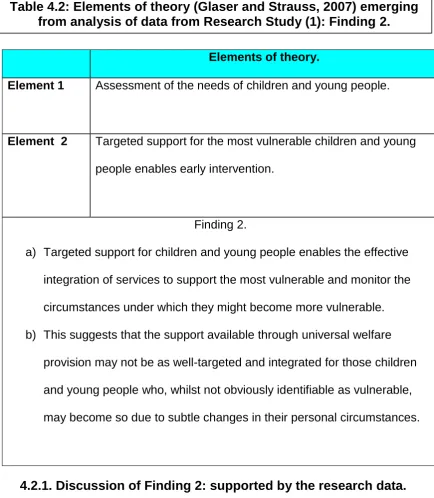
4.2. Findings 2. ... 160
4.2.1. Discussion of Finding 2: supported by the research data. ... 160
Table 4.2: Elements of theory (Glaser and Strauss, 2007) emerging from analysis of data from Research Study (1): Finding 2. ... 160
Does integration mean inclusion? ... 161
How targeted support makes a difference. ... 163
What builds effective targeted support? ... 165
4.2.2. Discussion Finding 2: supported by the literature. ... 168
Needs-driven provision of welfare services. ... 168
The limitations of conceptualising people’s needs. ... 170
Diagram 4.1: Disadvantages experienced by families, which reflect the cross-cutting nature of social exclusion (constituting multi deprivation). ... 171
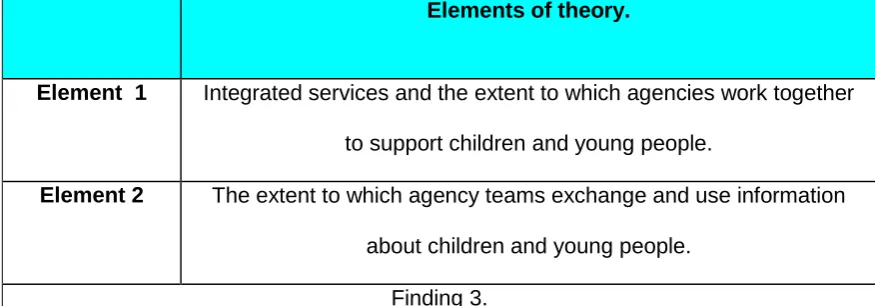
4.3. Findings 3. ... 174
Table 4.3: Elements of theory (Glaser and Strauss, 2007) emerging from analysis of data from Research Study (1): Finding 3. ... 174
. ... 174
4.3.1. Discussion of Finding 3: supported by the research data. ... 175
Assessment of need, targeted support and integrating the services. ... 177
Sharing information. ... 179
The structure of teams... 181
The size of teams. ... 182
4.3.2. Findings supported by the literature. ... 183
Integrated services and targeted support: how are they linked? ... 183
What is multi-agency working practice? ... 185
Summary. ... 188
Linkages between the Findings. ... 188
Defining “vulnerability” or being “at risk”. ... 189
The complexity and dilemmas of multi agency working and difficulties in achieving good working practice. ... 189
The challenges facing children’s services. ... 190
PART TWO ... 193
Chapter 5. ... 193
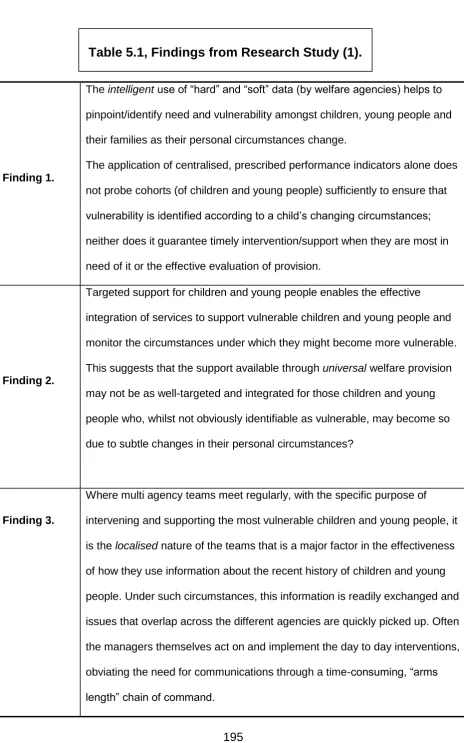
5. Developing the Conceptual Framework for Research Study (2). ... 193
Introduction. ... 193
Table 5.1, Findings from Research Study (1). ... 195
4
5.1.1 Indicators of vulnerability (recap from Chapter 4). ... 197
Box 5.1: Disadvantages experienced by families that reflect the cross-cutting nature of social exclusion (constituting multi deprivation). ... 198
Box 5.2. Profile of Andy. ... 199
5.1.2 Identifying vulnerability. ... 201
5.2 Socio-economic background. ... 205
Table 5.2. The changing role of mothers in the family. ... 207
Box 5.3. Interview, School Improvement Officer Local authority G. ... 211
5.3 Literature and Conceptual Framework. ... 212
Diagram 5.1. Literature Review Part 2. ... 214
Diagram 5.2. Conceptual Framework (2). ... 220
5.4 A different discourse for analysis. ... 225
Old-style social democracy – the language. ... 226
5.5 Background to the language of New Labour. ... 228
5.5.1 A critical view of public/social policy. ... 230
5.5.2 The influences that have shaped the language of New Labour. ... 234
5.5.3 What is the rationale for social policy-making? ... 237
5.5.4 Comparing the data. ... 240
Table 5.3. Measures of Child Welfare ... 241
Table 5.4. Percentage of children living in relative poverty, 2005. (Layard and Dunn 2009, p.131). ... 242
5.5.5 Comparing the language. ... 243
Table 5.5. A Comparison of language used across government and EU documentation... 245
5.5.6 Rhetoric and Reality. ... 250
5.6 The government’s approach to policy-making. ... 254
5.6.1 Complexity. ... 254
5.6.2 Unintended consequences. ... 256
5.6.3 A conceptualisation of need. ... 260
5.7 Afterword... 262
Diagram 5.3. The Cycle of Deprivation ... 264
Conclusions. ... 265
Chapter 6. ... 266
6. (Research Study 2). Context and rationale: an emerging new theoretical framework. ... 266
6.1. Overview of Research Part 1. ... 266
6.2. Research part 2: Theoretical frameworks. ... 269
Diagram 6.1: profile of a Social Worker. ... 269
Box 6.1: Young people’s perspective of social services (research data). ... 271
6.3. A critical approach to theory. ... 273
6.3.1. Which theoretical framework(s)? ... 276
Structure. ... 276
Research question/focus. ... 277
6.4. Research design - Research Study 2. ... 278
6.4.1. Context. ... 278
6.4.2. Methodology. ... 279
5
Diagram 6.2: Phenomenology as a method of inquiry – development over time.
... 285
6.6. Links between vulnerability and conditions for learning. ... 286
Table 6.1: Mann’s conditions of learning compared with factors of vulnerability (taken from Vulnerability Index, Appendix Table A1.1) ... 288
Diagram 6.3. The emerging theoretical and analytical framework: stages of thinking. ... 290
Diagram 6.4: Development of the second research question ... 292
6.7. The direction of Research Study 2. ... 293
6.7.1. The complexity surrounding vulnerability and multi deprivation. ... 293
Diagram 6.5: Disadvantages experienced by families that reflect the cross-cutting nature of social exclusion (constituting multi deprivation). ... 297
Diagram 6.6. Factors that constitute vulnerability. (from Local Authority G, 2007). ... 298
6.7.2. Before and beyond deprivation and disadvantage. ... 299
6.8. Research Study 2. Implementing the research design. ... 300
6.8.1. Limitations and difficulties. ... 300
6.8.2. Serendipity. ... 302
6.8.3. Interview respondents for the second research study. ... 302
Table 6.2: Interview respondents for Research Study 2. ... 304
6.9. Method of data analysis. ... 306
Box 6.6: Model for Analysis (Research Study 2). ... 309
Diagram 6.7, Interrelated theoretical issues that underpin analysis for Research Study 2. ... 313
6.10. Atlas ti and its suitability for this research study. ... 314
6.10.1. The advantages. ... 314
6.10.2. The disadvantages ... 316
Chapter 7. ... 319
7. Analysis and Interpretation of data from Research Study (2). ... 319
Introduction. ... 319
7.1. Key aspects of design for Research Study (2). ... 319
Plan. ... 319
Structure. ... 322
Table 7.1: Axioms of Naturalistic Research (Guba and Lincoln) ... 323
Strategy. ... 325
7.2. Paring down the initial findings. ... 327
Table 7.2: Key issues arising from data analysis (first draft). ... 329
Table 7.3 (a): process of paring down key issues from the data analysis (Category of data: Original). ... 330
Table 7.3 (b): process of paring down key issues from the data analysis (Category of data: Conflict). ... 331
Table 7.4: Findings/Issues for Research Study (2) pared down from the data analysis (final). ... 333
7.3. Findings from the research data, Research Study (2). ... 334
6
Findings supported by the literature. ... 336
The limitations of the evidence/output based approach. ... 336
Holistic versus linear approach to support - the differences in outcomes. ... 338
The cycle of deprivation. ... 343
Foreword to conclusions. ... 346
Conclusions. ... 347
Finding 2: “The importance of the role of the Voluntary sector in supporting young offenders and their families”. ... 350
Findings supported by the research data. ... 351
The ways in which the Voluntary sector supports families and prisoners. ... 351
Communication between prisons and families: Family Links. ... 351
Rhetoric and reality: safeguarding in prison. ... 353
“Getting through the ordeal” of prison: the key role of Voluntary Sector. ... 354
Conflicts between institutional support and the more holistic, welfare support provided by the voluntary sector. ... 355
Findings supported by the literature. ... 358
Devolving central state responsibility to local partnerships. ... 358
Unmet needs in the prison service. ... 359
Inconsistent funding for the Voluntary and Community Sector (VCS). ... 361
Conclusions. ... 362
Finding 3: “Maslow revisited : skills for the “older young people’s” workforce and models of good practice. ... 364
Findings supported by the research data. ... 364
No advocate. ... 364
Findings supported by the literature. ... 368
The hierarchy of need according to Maslow. ... 368
Identifying the different levels of need of children, young people and “older young people”. ... 369
Diagram 7.2: Maslow’s hierarchy of needs (after Ventegodt et al. 2003). ... 369
Table 7.5: Darren and Ben, a needs analysis using Maslow. ... 376
Two models of good practice. ... 378
(1) “Serendipity”: the Scafell Project. ... 378
Assertive Outreach Workers. ... 378
(2) The local support agency, LSA. ... 381
The heart of good practice. ... 384
Table 7.6. Supporting vulnerable young adults: the key elements of good practice. ... 384
Conclusions. ... 387
Finding 4: “Addressing welfare problems that are the outcomes of a ‘patriarchal society’”. ... 389
Findings supported by the research data. ... 389
How agencies can undermine the aims of Every Child/Youth Matters. ... 389
A 21st Century patriarchal society? ... 393
Table 7.7: Patriarchy and the five ECM outcomes. ... 394
Findings supported by the literature. ... 397
7
Social policies: their incompatibility with professional identity and the ethos of the
voluntary sector. ... 400
The “delegitimation” of advocacy. ... 401
Letting go of the characteristics of control and predictability. ... 403
“A bad day or parliamentary democracy”. ... 405
Conclusions. ... 408
8. Chapter 8. Reflections on criticality, analytical concepts and the findings from the second research study. ... 410
8.1. Findings from the second research study. ... 410
8.2. Resume of findings from the second research study. ... 414
8.3. Impact on and implications for practice. ... 416
Excerpt 1: overlap with the welfare agencies. ... 419
Excerpt 2: overlap with the welfare agencies. ... 419
8.4. Related, recent research and possibilities for further/continuing studies. 420 8.4.1. The Demos research project. ... 420
Excerpt 3: forming relationships. ... 422
8.5. Further research. ... 422
Conclusions. ... 424
Example 8.1. ... 424
Example 8.2. ... 425
Example 8.3. ... 425
Appendix. ... 427
Example A1. Ethical Framework for PhD research studies ... 427
Guidelines for planning, conducting and reporting research. ... 430
Table A1.1. Examples, original questions for research study 1. ... 433
Table A 1.2. VULNERABILITY INDEX. Local authority G, 2007. ... 434
8
This PhD thesis is dedicated to the
research participants:
the young people and families whose
lives are such a struggle because of
their vulnerable circumstances;
voluntary organisations who work on
their behalf, tirelessly and non-
judgementally.
Acknowledgements are given to:
Professor Hilary Cooper, my
supervisor, for her generous support
and encouragement.
The police and welfare professionals
working within the Scafell Project in
Cumbria.
Partners of Prisoners (POPS).
The staff and young people at
9
ABSTRACT
1. This research study examines aspects of the effectiveness of the Every
Child/Youth Matters (ECM/YM) programme with regard to its
implementation in 2006. Part 1 of the study explores the practical
implications of ECM/YM for professional practice across the different
welfare agencies, through a series of loosely structured interviews with
managers, case workers and young offenders (aged up to 16 years).
From an analysis of the data, using grounded theory approaches, three
key findings were inducted. These findings suggested the following:
I.A lack of consistency in the quality of targeted support provided by
integrated services for the most vulnerable children and young people
and their families;
II.A lack of fine tuning in:
a) the identification of vulnerability across different cohorts of
children and young people, according to their changing
circumstances;
b) the ways in which information (about vulnerable children and
young people) is shared and used across the different welfare
agencies.
2. Reflection on these findings led to a further review of the literature that
focuses on critiques of social policy. The analyses of research data within
this domain suggest the limitations of social policy making that conforms
10
individualised, local need. This suggests further that it is the policies
themselves that account for the perceived lack of fine tuning identified in
the above findings in part one of this research thesis. Therefore it was important, next, to capture data which drew on respondents’ personal
perceptions of welfare provision, which might endorse, or otherwise,
those aspects in which part 1 of the study suggested that the ECM/YM
agenda is failing, in some localities, to meet the needs of the most
vulnerable children, young people and their families.
3. In part two of this study, further research was conducted through a series
of extended conversations with: male offenders (aged between 16 and 24
years); parents/partners of prisoners; managers from voluntary/not for
profit organisations and senior multi-agency professionals. The data were
analysed using a phenomenological approach. Overall, the findings
suggest that a purely mechanistic, evidenced-based approach to
providing welfare support for vulnerable children, young people and their
families can result in negative outcomes when compared with a more
11
PART ONE.
Chapter 1.
1. Introduction
“Inequality and exclusion in society is a phenomenon as old as societies
themselves. Efforts towards addressing these problems have manifested in a
range of ideologies and practices, from Marxist communism to social democracy
to the 'third way' of recent years”. (Social Inclusion and Regeneration, 2003).
The above provides me with an apposite starting point for the introduction to this
PhD research thesis. The underlying factors that brought about the policy
changes and initiatives that constitute the Every Child/Youth Matters (referred to
hereafter as ECM/YM) programmes for change stem from the inequalities that
exist in our society. There is nothing new in this process, nor in the practice of
governments moving to bring about sweeping changes to dispel inequality or
exclusion. However, the way in which governments go about implementing such
changes is what is of interest to this thesis. Through the findings of two
qualitative research studies and conducting reviews of the literature I have been
able to explore some of the outcomes of the ECM programme for change, from
the viewpoints of different welfare professionals and of young people and
families who were experiencing different degrees of vulnerability and
deprivation.
12
“Overall, this country is still one where life chances are unequal. This damages not only those children born into disadvantage, but our society as a whole. We all stand to share the benefits of an economy and society with less educational failure, higher skills, less crime, and better health. We all share a duty to do everything we can to ensure every child has the chance to fulfil their potential.
Our aim is to ensure that every child has the chance to fulfil their potential by reducing levels of educational failure, ill health, substance misuse, teenage pregnancy, abuse and neglect, crime and anti-social behaviour among children and young people”.
(Chief Secretary to the Treasury, Every Child Matters Green Paper, 2003c).
13
It is no coincidence that there are certain similarities between the two quotations
in the above Boxes 1 and 2, nor that there is an air of wistfulness in the writing
of each.
The UK government - at the instigation of Prime Minister Tony Blair - introduced
the Every Child Matters/Youth Matters (ECM/YM) agendas in the wake of the
brutal death of Victoria Climbié at the hands of her carers. This resulted in the Laming Inquiry in 2003, the purpose of which was to “find out why this once
happy, smiling, enthusiastic little girl – brought to this country by a relative for ‘a
better life’ – ended her days the victim of almost unimaginable
cruelty….Victoria’s great-aunt and her boyfriend were convicted of her murder”
“I want all our children to go to schools worthy of their potential – schools that challenge them, inspire them and instil in them a sense of wonder about the world around them. I want them to have the chance to go to college – even if their parents aren’t rich. And I want them to get good jobs: jobs that pay well and give them benefits like health care, jobs that let them spend time with their own kids and retire with dignity.
These are the things I want for you – to grow up in a world with no limits on your dreams and no achievements beyond your reach....And I want every child to have the same chances to learn and dream and grow and thrive....”
Barack Obama, President elect, January 2009 on the eve of his Presidential inauguration. (Doyle, 2009)
14
(Great Britain. HMG 2003b.) Box 1 contains a statement from the Every Child
Matters Green Paper (Great Britain. Chief Secretary to the Treasury, 2003c p.
11) that has a direct resonance with the aspirations of President Obama as
expressed in a letter to his daughters on the eve of his inauguration as
President of the United States in 2009, (Box 2).Through the aims of the Every
Child Matters initiative, the government was stating its intention to prevent the tragic circumstances that led to Victoria’s death from occurring again, with the
intention of improving the educational, developmental and life outcomes for all
children, but particularly those who could be identified as being at a similar level
of risk to Victoria.
The above aspirations of President and Prime Minister have similarities with the
aims of the No Child Left Behind (NCLB) Act as stated by the US Department of Education in 2002: “our commitment to you, and to all Americans is to see every
child in America – regardless of ethnicity, income, or background – achieve high
standards” (Francis and Skelton, 2005, p. 42). Just as the ECM policies aim to
improve on past failures in the UK’s systems of care and provision for children
and young people, so Mr Obama’s aspirations can be seen as a declaration to
improve on the educational outcomes for future generations of American
children and young people. Both Prime Minister and future President are striking
a note of optimism through their words, which are tinged with an earnest
expectation that things in the future will be an improvement on what has gone
before.
In the US, the NCLB programme earned extensive criticism from education
professionals who saw it as an outcomes-based approach to education. This
15
instruction of children in schools because of the danger that American states
might lower their achievement goals and encourage their teachers to "teach to
the test." (This in turn has an uncanny resonance with criticism of our own SATS
tests in the UK). Both Prime Minister and President are stating the tenets of
what they are espousing for their respective countries; their words are also
tinged with the earnest expectation that things in the future will be an
improvement on what has gone before .
The research aim and questions.
At the very beginning of this research project I set out to explore the government
legislation underpinning the overall ECM programmes. I wanted to discover the extent to which the government’s espoused aims, (as expressed through ECM
legislation), were actually engaged with, in practice, by the front line welfare
agencies of education, social services, health and youth justice. To this end, I
decided the main research question, or focus, of my research would be:
“To explore the impact of the Every Child Matters/Youth
Matters programme on professional practice across the different welfare agencies”.
In the first research study I undertook, I looked at how welfare
practitioners from the different agencies (education, health, social
services and youth justice) were interpreting the ECM/YM legislation in
relation to their own professional practice. From the analysis of these
data I inducted four key findings, behind which lay further issues to
explore. These issues stemmed from the social policies that were the
16
From these I identified a second research focus, or question, that I
wanted to explore, which was:
“A critical appraisal of the social policies that underpin the
Every Child Matters/Youth Matters programme”.
My analysis of the data from this second research study was conducted
within a framework that I structured closely around the literature of
critical social policy, which enabled me to explore the origins and
complexities of the government’s social policies that relate to the aims of
the ECM agenda.
1.1. Addressing the research questions: progression
through the thesis.
1.1.1. Chapter 2.
In this chapter I outline the literature I reviewed for the first research study and
discuss it in terms of two distinct categories: conceptual and research literature.
An example of conceptual literature, which I found of particular interest to my
research, is the oral (and written) evidence of the DfES Select Committee
Meetings (Great Britain. DfES (2005b; Great Britain. House of Commons
(2006c). This was valuable because the information contained in the minutes
often reflects (at times) an astute criticality on the parts of the chair and committee. When questioning government advisers and “experts”, MP’s bring
significant pressure to bear through their probing of assumptions and their
relentless quest for clarity in responses to the questions they ask. The
17
the wider context of Every Child/Youth Matters, which suggested further
concepts and issues for my conceptual framework. From the literature I identify
two key issues for research, school improvement and integrated services.
1.1.2. Chapter 3.
In this chapter I discuss my rationale for conducting two research studies and
the overall methodology of the research. The findings from the first research
study directed me towards a further literature review, which required me to a
more analytical and critical approach towards the underpinning factors that gave
rise to the ECM/YM programme for change. The outcome of this analysis was a
shift in the emphasis of my research focus towards social policy. In this third
chapter I illustrate the conceptual framework for the first research study, which
draws directly on the sources of my literature review. I discuss the necessary
ethical guidance for the research and consider some of the ethical issues that
may arise in the process of interviewing respondents. For both research studies,
the respondents were selected by the contacts I that I had nurtured personally,
within different local authorities, and who were themselves welfare
professionals. I had to rely on their selection of participants, the rationale for
which was no more prescribed than that it represented a convenient, or
available, sample of respondents. Because I was wholly dependent on my
network of contacts for arranging the interviews, inevitably I was not able to
include the full range of respondent categories, such as teachers. Similarly, the
number and nature of interviews were determined by who was available and
their case load at the time rather than by what and who I would have interviewed
18
1.1.3. Chapter 4.
Analysis and interpretation of the data, research study 1.
My chosen method of data analysis for the first research study was grounded
theory, from which I applied a selection of analytic tools. Through this
methodology, the coding and analysis of the data provided me with findings or hypotheses, rather than theory, which enabled me to tap into “the fullest extent
[of] the in vivo patterns of integration in the data itself” (Glaser and Strauss,
2007, page 109).
The first finding I inducted from the data analysis contrasted the
centralised performance indicators that are generated by government
systems, for the assessment and evaluation of welfare need, with an
altogether different, more effective set of indicators, created locally, to
trigger support for children and young people and assess their
vulnerability.
The second finding highlighted the high quality of targeted support in
place to support the most vulnerable children and young people in one of
the local authorities that participated in the research interviews. The data
suggests that universal welfare provision may not be as well-structured
for children and young people who are not obviously vulnerable (but who
may become so).
The third finding suggests that where multi agency teams meet regularly,
it is the localised nature of the teams that is a major factor in the
effectiveness of how they use information to support children and young
19
When considered collectively, the findings begin to open up some of the
enormous complexities that exist in the process of identifying vulnerability and
the many external and internal factors that affect the degree to which welfare
agencies are able to realise the aims of the ECM/YM programme. This
prompted me to think about the ways in which the research respondents
themselves might have perceived the quality of the welfare support they
received, at times when they were most at risk. How would they view the
differing practice and provision across the welfare agencies?
1.1.4. Chapter 5.
In this chapter I discuss the development of the rationale and research design
for the second part of this thesis, which is centred on the second research study.
I examine the findings from the first study within the context of the second
literature review, which contributes to my second conceptual framework. This
framework draws on political, critical social policy and social contexts. I discuss a “different discourse for analysis” and explore the influences that contribute to
the language of New Labour and the neo-liberal approach to government, embraced by Margaret Thatcher’s conservative government towards the end of
the 1970’s, and continued by New Labour when they came to power in 1997. I
appraise critically the Labour Party’s approach to (social) policy making and
argue the shortcomings of this approach in realising the far-reaching aims of the
ECM/YM programme. This is because the inherent difficulties presented by the
unhappy outcomes of extreme vulnerability and multi-deprivation cannot be
20
this evidence based approach to policy-making and evaluation of outcomes
does not do justice to the complexity and multi-faceted nature of the welfare
needs of individuals and groups. Finally, I acknowledge that if my second
research study were to make any realistic contribution to examining the aims,
shortcomings and successes of ECM/YM programmes, I needed to move closer
to understanding the effects of deprivation and vulnerability on young people
and the impact of these on their lives and outlooks. I needed to capture
evidence that would reflect the realities of their lives and perhaps indicate a direction in which social policy could progress towards “addressing the root
causes of disadvantage” (Broadhurst et al. 2007, p.11).
1.1.5. Chapter 6.
My reading and analysis of the second literature review helped to develop and
move my thinking towards a more critical appraisal of the influences that define the government’s approach to social policy making. The first study is concerned
with the practical implications of the policies that underpin the ECM/YM
programme. The second study explores the context and underlying influences that shaped the government’s approach to (social) policy making. Therefore, I
needed to develop a new rationale, which could be explained within a different
theoretical framework.
The aims of the second study were; a) to identify the ways in which social and
educational policies are meeting the needs of the most vulnerable and multi
deprived children, young people and families and b) to establish the extent to
which the aims of the ECM/YM programme are achieved. These aims gave rise
21
social/welfare policies that underpin the aims of the ECM/YM programme. Are
these policies fit for purpose?”
For this study, I interviewed a group of respondents whose personal
circumstances constituted a particular set of welfare needs. This group
comprised the parents and partners of prisoners and young male offenders
aged between 17 and 24 years of age. I also interviewed two senior
multi-agency welfare professionals and a young man of 18 years of age, who had
been in care for thirteen years. I wanted to capture data that would reflect the respondents’ own perceptions of the way things appeared to themin their
conscious, everyday lives about issues such as vulnerability, support,
deprivation and achievement. Therefore, I would require a framework for
analysis and inquiry that would give this knowledge validity and theoretical
meaning.
I decided the most suitable framework was to be found in phenomenology, or the discipline of “philosophical investigation” (Stewart and Mickunas, p.3). This
approach enabled me, the researcher, to interpret people’s individual
understanding (of “things” or phenomena) and provided me with an appropriate
context within which to argue and construct the outcomes from the data
analysis.
I structured a four stage model for the data analysis that allowed for the nature
of the data (the respondents’ personal interpretations and narratives) to be
upheld and enabled me, the researcher, to “make sense of the participants
trying to make sense of their world” (Smith, 2006, p. 51). This methodology
22
any bias from my own perceptions. I formalised my research analysis in order to
give it a direction that would allow for links between emerging issues and the
second conceptual framework. I selected three interrelated theoretical issues to underpin my analysis, which reflected my own “specific research interests”
(Ribbens and Edwards 2008 p. 125):
The identification of any models of support through which respondents
received welfare agency provision;
The impact of this support when they most needed it (social exclusion);
Issues from the data that connected with the key areas of policy outlined
in the conceptual framework (the critical social policy, political and social
research contexts).
1.1.6. Chapter 7.
Analysis and interpretation of the data, research study 2.
At the start of this chapter I outline key aspects of the design of the second
research study (the plan, the structure and the strategy) and discuss how this (and the first research study) can be located within the alternative “paradigm of
naturalistic inquiry” (Guba and Lincoln 1985, p. 37). I illustrate the process I
adopted for paring down the initial twelve key issues from the data analysis, to a
final four, which formed the basis of my findings for this study.
Finding 1: “Problems in matching social policies to the complex needs of
vulnerable people”.
The research data shows that despite the early diagnosis of learning needs of a
23
the child will achieve well at school or enjoy positive life opportunities. I discuss
this finding with regard to two research respondents, both of whom had been in
care as children, but whose eventual life opportunities were in opposition to one
another. One, Simon, had attained outstanding educational success and the
other, Chris, was unemployed, with no qualifications and a long history of
offending.
Learning support for Chris had been characterised by a linear, evidence-based
approach in which the agencies of school, health and social services had not
worked to ensure that support for Chris was structured to meet all his needs.
Simon, by contrast, had benefited from a holistic approach to his welfare
support, evidenced by stability throughout his foster placement and consistent
input from the agencies of school, social services and Connexions.
The literature argues that evidence-based social policy grounded in quantitative and statistical data, “conceals as much as it reveals” (Chapman 2004, p.11)
because such policies only measure the intended outcomes. The complexities
surrounding welfare need give rise to many unintended outcomes, which cannot
be measured.
Finding 2. “The importance of the role of the Voluntary sector in
supporting young offenders and their families”.
The research data from this study reveals that the mothers and partners of
offenders (young men aged 16 - 18 years) perceived very clear differences in
the approaches adopted towards supporting their families, by the prison
services and the voluntary organisation, POPS (Partners of Prisoners. They considered the approach of the prison staff to be one that focused on “box
24
the workers from POPS fulfilled a role far more sensitive and empathetic. I used
the literature to interpret these experiences: the mothers and partners viewed the prison staff as adhering to their prescribed, centralised role, or the ‘actuarial
techniques’ of the job. These ‘techniques’ included tasks such as “classification,
risk assessment and resource management” (Clarke et al. 2000, p.178). By
contrast, the staff from the voluntary organisation POPS were perceived to deal with the “transformative” issues to relating to the families’ welfare, such as
“individual need, diagnosis and rehabilitation” (ibid. P. 178). These differences in
the nature of welfare support provided by the prison service and the voluntary
organisation are discussed at length in the literature, which debates the marked “managerialistic” approach to welfare reform by successive governments over
the last twenty years (Clark et al. 2000). This and the current (at the time of writing, 2009) Labour party’s preoccupation with devolving central state
responsibility to local partnerships, can be seen as giving rise to a situation that
is problematic for welfare provision. The data from this research study reflects
the current political climate, wherein social policy generally is urging voluntary
organisations to fulfil an increasingly important role. The important role in this
example concerns the rehabilitation and support of offenders and their families,
which POPS is expected to fulfil without the assistance of any significant or
consistent stream of funding.
Finding 3. “Maslow revisited : skills for the ‘older young people’s’
workforce and models of good practice”.
Where the care of vulnerable “older young people” is ineffective, it can have a
25
realising their potential and self actualisation, outlined by Maslow in his hierarch
of need (Ventegodt et al. 2003, p. 1051). Existing government policy prescribes
six core areas of skills and knowledge for the workforce that cares for children
and young people, in the document Common Core of Skills and Knowledge (CCSK) for the Children’s Workforce (Great Britain. DfES, 2005c). However, the
CCSK has been recommended for those who work with children and young people, not the “older young people”, or vulnerable young adults (such as the
respondents for this study). For this older range of young adults, a core of skills, values and capacities that go beyond simply “knowing” and “understanding”
would be required, which acknowledges the need for a ‘higher order’ level of
skills and values. These could include: being able to consult and advise young
adults on developing their higher levels of need, such as personal goals and
longer term aspirations and their sense of worth (located in the higher levels of Maslow’s hierarchy). Two models of good practice were identified from
interviews with young offenders who had been, or were in the care of two
organizations: one, an organisation in the voluntary sector (Cumbria Personal
Development Associates, CPDA) and one in the public sector, comprising police
probationary professionals working on a rehabilitation project (the Scafell
Project) for imprisoned offenders. Working practice in each organization had in
common a set of key elements that were effective in supporting, nurturing and
advocating for young, vulnerable adults in their higher levels of need. Several of these elements of good practice correspond to the “higher order” level of skills,
which are discussed above as being appropriate for people with working
26
Finding 4: “Addressing welfare problems that are the outcomes of a
‘patriarchal society’”.
The research data give evidence of schools whose ethos and values (no doubt
unwittingly), conspired to foster an environment where a minority of vulnerable
young people had become offenders. These were the sons of mothers I
interviewed through POPS). The mothers attributed this to the existence of a “patriarchal society”, which fosters a poor role model for young people. I have
not used the data analysis to imply that the schools in question were deliberately
setting up the young people for failure, but rather that the prevailing systems
and values were perhaps akin to a more traditional, patriarchal style of
leadership and management associated with a past age, when corporal
punishment and enforced discipline were the norm. Where this was the case, this perceived “patriarchal attitude” actually presented a barrier to securing the
successful outcomes of the ECM programme for and on behalf of the particular
young people whose mothers I interviewed.
Across the wider welfare agency domain, the research data show how other respondents’ perceive government documentation, describing the tone and
nature as “dictatorial” and “authoritarian”, which implies a prescriptive,
centralised form of control, similar to the patriarchal attitude perceived by the
respondents in the POPS interviews.
“An increasing separation between policy and delivery has acted as a barrier to
involving, in policy-making, those people who are responsible for delivering on the front line....”. The literature is critical of the lack of joined-up government at
both policy and management level and of the “fragmenting effects of
27
and examine the issues that characterise the differences between the aims and
philosophies of the voluntary and Community Sector and those of government
policies. This has contributed to the conflict that has been described thus:
“tension between the economic and social goals [of Labour]....” and the fact that
“....collaboration between providers around client needs in social care is not
compatible with....output based performance indicators” (Clarke et al p.55). The
research evidence from the second finding identifies two aspects of social policy
in which this type of conflict/incompatibility are apparent.
1.1.7. Chapter 8.
Reflections on criticality and analytical concepts.
At the beginning of this chapter I provide a resume of my findings from the
second research study, discuss the wider context for the research findings and
briefly consider what, on reflection, I might have done differently, particularly
with regard to the criticality and analytical concepts that comprised my
framework for analysis.
I found the literature in the field of “managerialisation” a rich source of aspects
and concepts that were particularly relevant to the discussions that had arisen
from the findings from my first research study. These new ideas helped me to
articulate a further range of analytic concepts, many of which appeared to be
relevant to the new direction of my research. The concepts I chose to include in
my second theoretical and conceptual framework include:
The significance of the role of the voluntary sector in providing welfare
28
Maslow’s hierarchy of need. Despite the ubiquity with which Maslow’s
hierarchy appears to arise in theory and debate (particularly in the field of
management and motivation) I selected it as analytic tool for this research study because Maslow’s conceptual framework closely matches the
language in which the young offender respondents chose to describe
their experiences.
Of the many areas and concepts I engaged with from the literature, others that I
might have chosen to instead/as well as include: The breakdown of the family.
Hindrances to young fathers sharing the care of children.
Barriers to multi agency working.
Process of (Ofsted) inspections.
I chose not to incorporate these aspects into my research because whilst they
represented, in themselves, very interesting areas for debate and analysis, they
were not relevant to the discourse I needed, in which to debate the research
perspectives of both research studies.
I go on to discuss the findings from the both research studies with regard to their
implications for practice. The findings from the first indicate where and how
practice across the welfare agencies might be more finely tuned, in order to
reflect better the aims and objectives of the Every Child Matters/Youth Matters
programme. The findings from the second study provided the evidence of the
need to do this.
I conclude with a reflection on areas for future research; the data and findings
that arise from both research studies suggest a number of areas. For example:
29
the impact of these circumstances on their children and partners; a research
study to follow up and extend my own understanding of the role played by the
voluntary/third sector across the broader spectrum of welfare provision, looking
at how the sector contributes to supporting the different welfare agencies, not
just those connected with the criminal justice sector.
1.2. Values and beliefs.
My own values and beliefs relate closely to the content of and rationale for these
two main research questions and have also shaped my approach to the overall
research design, data collection and analysis. I have always been committed to
inclusion, both socially and educationally. I also have deep concerns for those
children, young people and families who are marginalised in society; those who
are vulnerable and those who suffer from a combination of factors that constitute
multi-deprivation (see in more detail, Chapter 6). These concerns are not
confined to those who are at the extremes of poverty or deprivation, but include
those groups and individuals whose personal circumstances may conspire to
render them vulnerable due to less tangible factors such as personal anxieties,
self doubt and the unfortunate and unforeseen events that can lead young
people to offend. My belief is that the many different sets of social policies put in
place by governments over the years, including those related to ECM, have
done very little to realise social and educational inclusion.
These values and beliefs played a significant part in my decision to focus on the
ECM programme for this research project and gave me the opportunity to
explore further my understanding of the nature and origins of social policies and
30
the life chances of children and young people who endure the circumstances of
vulnerability and deprivation.
My design for both research studies reflects these values and beliefs, with
regard to:
the nature and type of research respondents;
the ways in which I gathered data;
the methods of data analysis
The focus of this research is closely bound to aspects of people’s lives that are
complex and may often be closely linked to circumstances that incorporate
social, economic and health related difficulties. Therefore for each research
study I favoured loosely structured interviews that were conducted on a one to
one basis or in small groups, to encourage people to speak freely about aspects
that might be too personal or painful to share through, say, a questionnaire or a
focus group (see further detail in Section 3.5.2.). I created sets of very
open-ended questions that I believed would provide the best conditions for me to guide the direction of discussions according to any changes in respondents’
emotional responses, should the need arise. In the light of this, I decided that
the data I collected from this chosen area of research would be most effectively
interpreted through qualitative analysis, a methodology that would be sensitive to (and permit a voice for) respondent’s individual interpretations of their
experiences of welfare provision and the ECM agenda. I applied grounded
theory to the analysis of the first research study, because this would allow for
scrutiny of the data and the nuances and underlying meanings that would reveal the “real” issues faced by professionals and vulnerable young people. I also felt
31
disprove any formally stated theory (about ECM, welfare provision or other
related aspect) but rather to deduct key findings from the data analysis.
Similarly, I chose to apply a phenomenological approach to the analysis of the
data from the second research study. I decided this analytic process would be an effective tool with which to discern “people’s different perspectives and points
of view about vulnerability, multi deprivation as they see them affecting their own lives” (see Section 6.5), thereby getting to the heart of respondents’ individual
perceptions of their experiences. This would give me an authentic account of their own “worlds” and thereby reveal aspects in which EM policies fell short,
which, through other forms of analysis, I would not have been able to access.
The overall findings from my analysis of these two research studies suggest that the government’s approach to policy making is essentially grounded in an
approach that depends on measurable outcomes. The findings indicate that for
welfare agency professionals, one of the outcomes of this approach to policy
making is that managers and practitioners can come to view the implementation
of the ECM programmes as purely the delivery ofrequired, prescribed
outcomes, in which obtaining the necessary outcomes become a means in itself.
The danger of this is that the processes and systems of complying with
government legislation can begin to obscure, or eclipse, the underlying purpose
and aims of the ECM policies, such as inclusion, early intervention to support
32
1.2.1.
“Reading the data”.
In the same way that my own values and beliefs shaped my approach to the overall research design of this thesis, they also influenced my “readings” of the
data when I conducted my analyses. This is apparent in the data analysis for the
first research study, from which the three findings relate to: identifying
vulnerability amongst children and families; the nature of targeted support, and
the factors that contribute to successful multi-agency team support for looked
after children. Each of these findings has, as its focus, vulnerable children and
families and the means by which they are assessed/identified for support. My
interpretation of the data therefore reflects the values and beliefs that I hold with
regard to vulnerable young people and families, the extent of their social and
educational inclusion and my concerns about the ways in which support for
them has not necessarily been improved through the ECM/YM policies.
Similarly, I chose an approach to the second research study that reflected the
distinct and personal perceptions of the research respondents, (vulnerable
young men, the families and partners of prisoners and senior multi agency
professionals). My interpretations of the data analysis for the second study retained a focus on the circumstances of the “clients” rather than the policy
makers, although the overall theoretical framework for this study was located in
the literature and research framework of social policy. Reading research data is
never value free and so it is conceivable that another researcher, with values
and beliefs different to mine, might have read the data and interpreted the “voices” quite differently. In Chapter 3, Section 3.1, I discuss the fact that the
data I intended capture for this research would be in the form of value
33
view. Punch (1998, p. 47) discusses this in terms of the “fact to value” gap, ie
the fact that there is no logical way to get from statements of facts to statements of value (or vice versa). I have addressed this “gap” through the different
frameworks I structured for this research (outlined above) Another researcher
(with different values, beliefs and experiences to mine, could have chosen a
research different route that would have yielded different interpretations and
different sets of findings.
1.3. Rationale for the research.
The first research study was designed to ground the outcomes in the “language
of the research” (Glaser and Strauss, 2007, p. 107) and the findings were
inducted from the most significant issues that emerged from the data. The data
were captured from interviews with professionals across the different agencies
and with a number of vulnerable young men who were in the care of youth
offending agencies. In the second study, my purpose was to capture the
narratives of a group of vulnerable and deprived people and record their
perceptions of and responses to the reality of their lives and their experiences of
the different support agencies.
The progress of this research reflects a “journey” through many different and
challenging areas that relate to the outcomes of the ECM/YM policies and
practices.
These include :
the analysis of a range of day to day – and often bleak - realities and
34
analyses of research respondents’ “real life” perceptions, explanations
and responses to the implementation of the changes espoused in the
ECM programme;
an engagement with the underlying processes and factors that influence
the government’s approach to policy making and how these have
contributed to the content and aims of the ECM programmes for change -
are these policies fit for purpose?
the development of two different conceptual frameworks that give
theoretical cohesion to the research methodology and design of each of
the research studies.
Whilst my intention all along has been to ground my research in the day to day
experiences of professional practitioners who administer the welfare services
and the people who are the recipients of their work, this thesis also argues for
the validity of the contexts selected to underpin the methodological frameworks
of the overall project. The context for the first Research Study is focused on
individual accounts of practice and the outcomes of practice across the welfare
agencies. The context for the second study derives from the analytical discourse
to the extent that the data is analysed with close attention to two aspects: the nature of the respondents’ own particular worlds, which derives from
their own, particular sets of personal circumstances (ontological); the knowledge and perceptions that each respondent have, which are
35
1.3.1. My proposal and how it developed.
For my first Research Study, I analysed data that I collected in order to explore
the impact of the ECM programme on professional practice across the agencies
of education, health, social services and youth justice. My main purposes were
to address the impact of the ECM agenda on the bridging (or not) of the
achievement and life opportunity gap that exists between children and young
people from different socio-economic backgrounds, which supports the main
aims of the ECM policies. The findings from the first study directed me towards a
new focus for a second Research Study, for which I developed my thinking
towards a more critical appraisal of the influences that contribute to the
government’s approach to social policy making. The focus of the first study was
concerned with the practical implications of the policies that underpinned the
ECM programme (ie the impact of ECM on professional practice). The focus of the second study had shifted to one “where analysis is targeted towards
providing answers about the contexts for social policies and programmes and the effectiveness of their delivery and impact” (Ritchie and Lewis, p.201,1994). It
also considered the context and underlying influences that shape the government’s approach to (social) policy making.
1.3.2. Who is this research for?
I hope that my research will benefit all those who have made the study possible
through their generous contribution to interviews, providing documentation and
being supportive of the project in many other, practical ways. I hope that the
outcomes of my research will also be of some benefit to three distinct groups of
36
1. those who work, or who are training to work, with children and young
people;
2. the children, young people and parents/carers who will be the customers, or recipients (sometimes referred to as “service users”) of the services of
the care agencies;
3. the “authorities”; those experts and politicians who are (and have been)
responsible for administering and evaluating the many initiatives that
underpin the framework of Every Child Matters and Youth Matters (ECM and YM) and who therefore inform the government’s approach to
policy-making.
1.3.3. Inspiration and motivation.
My motivation for engaging in research into the implications of ECM has its
origins in two features of my own life that are rooted in my experiences as an educational professional who has worked both as a “front line provider” (or
teacher and school manager) and as an Ofsted inspector, concerned with the “quality control” aspects of educational provision.
From 2002 onwards, my role as an inspector of secondary schools gave me the
opportunity to work in a different capacity, one in which I advised and guided
teachers, whilst drawing on my own professional experiences in teaching and
working with children, young people and their families. At the same time I began
to write and lead training courses for teachers and I worked as a consultant with
school leaders and middle managers. Throughout this career journey I
continued to teach, in some of the most challenging schools locally, on a
37
professional challenges of my career, however the experience raised sharply my
awareness of the ways in which socio-economic factors can influence, negatively, pupils’ (and their families’) attitudes towards education. In the
schools where I was teaching it was apparent that over time, a climate of low
aspiration amongst the young people and their families had evolved as a result
of the combination of poorly paid (often minimum wage) work and dismal long
term employment prospects. This had a negative impact on the ways in which
pupils viewed their own achievements and, as a consequence, created barriers
to their learning. In the longer term, these circumstances conspired to have a negative impact on pupils’ overall life chance.
These experiences, gleaned from both sides of the educational “fence” (front
line teaching and my advisory/developmental work as an inspector and
consultant), instigated in me a deep interest in the causes that bring about
change, to people and organisations, and the wider dimensions of social change
and their impact on individuals. Within the two or three years after leaving full
time teaching, I had acquired a whole new range of professional experiences
across a much wider educational spectrum. When I came to read of the
proposed changes to the Ofsted inspection framework and the new agenda of
Every Child Matters, I responded to them from each of my different professional
standpoints. As I read of the reasoning behind the sweeping changes being
recommended, I could see what a huge undertaking they represented to those people working at the “chalk face” in teaching. I contributed to the initial ECM
discussion document; I engaged in discussions about the new framework with
fellow inspectors, teachers and managers across the agencies concerned
38
existing pressures faced by teachers in schools and across the different welfare
agencies and wondered at the scale of this new task facing welfare
professionals. Who would implement the changes? How would those working in
schools, health centres, youth justice and social services be inducted into the new regime? And exactly what were the reasons behind the government’s
decisions to introduce this new agenda of “Every Child/Youth Matters”? Initially, I
found answers to some of these questions within the documents produced by
the government at the time, such as the Every Child Matters Summary
document, (Great Britain 2003a). I read of the importance the government
attached to addressing the reduced life and educational chances of children and
young people living in impoverished circumstances; and to the need to do
something about bridging the conspicuous gap in achievement between
different children and young people from different socio-economic classes. As a
practitioner I could see the implications of these two objectives. As a research
student I saw an opportunity to find out just how much the proposed changes
were actually benefiting the life chances of children and young people and to
analyse the impact of the ECM agenda on professional practice across the
agencies. Having worked in different roles connected with children and young
people, I intend to ground my writing and research for this thesis in the field of
the professionals, children, parents/carers and young people who are the direct
recipients of the ECM agenda. My findings will be drawn from the evidence they
provide me with - and not from what the legislation tells us should be happening.
This is the standpoint, or position I have chosen to take in relation to this
research project and it is informed by the developments in my own career over
39
educational “fence”; as a front line teacher/practitioner and as a former Ofsted
inspector and consultant.
I will conclude this section by making clear my position in undertaking this
research in relation to others, to circumstances and to my own point of view. As
a teacher of vulnerable students I was concerned about how teachers and
professionals in other welfare agencies would respond to the scale of the tasks set through the government’s ECM programmes and policies. As an Ofsted
inspector I wanted to know more about the reasons behind the legislation. And
as a researcher I wanted to explore the impact of the ECM agenda on
professional practice, and also to explore in which ways it was impacting on the
lives of the most vulnerable young people, irrespective of what the legislation
told us should be happening.
1.4. New Legislation
In 2004, I read of the government’s new vision for children’s services and the
proposed legislation for big changes in the way children’s services were to work
together (Great Britain. Her Majesty’s Treasury 2003c). New inspection
arrangements were under discussion in Parliament, resulting in the New
Relationship with Schools document (Great Britain. DfES 2004b), which had as
its focus the Every Child Matters agenda. Inspections would in future take account of the contribution schools made to “pupil well-being” (ibid. p. 7), a
phrase that was to take on an immense catalogue of meaning over the coming
months.
40
Services. The implementation was to be planned and based on A Five Year
Strategy for Children and Learners, (Great Britain. DfES, 2006b; A Ten Year
Strategy for Childcare (Great Britain. HM Treasury 2004d) and A Common Core of Skills and Knowledge for the Children’s Workforce (Great Britain. Her
Majesty’s Government, 2005c).
The legislation underpinning education and other care agencies was to change dramatically. Schools were still not informed about the criteria for Ofsted’s
judgements from the most recent “new” framework. With yet another set of
changes due, how on earth would teachers and managers ever catch up?
Looking beyond schools, how would the managers and workers in the other areas of care, welfare and justice catch up with – or even understand and learn
to work with - these sweeping changes?
1.5. The Introduction of the Every Child/Youth Matters
programmes for change.
The agenda for Every Child/Youth Matters (ECM) is one of inclusion. It is
dedicated to eliminating the omissions, blockages, limitations and impediments
that result in the reduced (sometimes tragically so) life opportunities suffered by
children and young people from the lowest end of the socio-economic
spectrum.”At the lowest end” refers to those children, young people and families
whose circumstances exclude them from achieving their best and from having
equality of life opportunity, employment and the chance to be happy, healthy,
41
Initially ECM was born in response to the tragic outcome of Victoria Climbié’s
short lif