Identifying Common Activities in the Graphical User
Interface Development Process and their integration into
the Software-System Development Life Cycle
Laura C. Rodriguez-Martinez1, Hector A. Duran-Limon2, Ricardo Mendoza-González3, and Jaime Muñoz4,
1 Institute of Technology of Aguascalientes, Av. Adolfo López Mateos 1801 Ote., Bona Gens, CP 20256, Aguascalientes, Ags., Mexico
2 CUCEA, University of Guadalajara, Periférico Norte 799, Zapopan, Jalisco, Mexico
3 Postgraduate Studies Universidad Politecnica de Aguascalientes,
Calle Paseo San Gerardo 207, San Gerardo, CP 20342, Aguascalientes, Ags., Mexico [email protected]
4 Autonomous University of Aguascalientes, Av. Universidad 940, Ciudad Universitaria, CP 20131, Aguascalientes, Ags., Mexico
Abstract. We identify a suite of activities in the development process of Graphical User Interfaces (GUI) and include them as part of an approach to a generic model for the GUI Development Process (GDP). This work contributes with: (1) the identification of common activities of previous GDPs, (2) the definition of an approach to a generic GDP limited to its phases and activities, and (3) the integration of such a generic GDP with any software-system development life cycle (SDLC), illustrated with the Spiral SDLC. We show this work is useful by a) highlighting the advantages of our proposal over other methodologies for GDP in Human-Computer Interaction (HCI), b) showing one example of the integration of the GDP into a SDLC, and c) showing the usefulness of our approach in a case example.
Keywords: System Development Life-Cycle, Software Engineering, Graphical User Interface Development Process, Human-Computer Interaction.
1.
Introduction
SDLC process. Where usability practitioner is the person who applies the knowledge of HCI to design usability GUIs.
The study of a SDLC implies a process perspective, then, if we analyse the GUI design in a process perspective, we can include such a GDP as a natural part of a SDLC [8]. In HCI there are several proposals to develop Graphical User Interfaces (GUIs), in this sense, it is clear that all of them agree on the importance of having a methodology (defined process, methods and techniques) to develop GUIs [9], [1], [11], [18], but also, all of them –in a general way– lack of a process that ensures a systemic way to work. These GDPs are explained by means of the definition of one or several of the following large characteristics: general characteristic 1 (GC1), general characteristic 2 (GC2) and general characteristic 3 (GC3). GC1 [2], [7] is defined as phases without details and it highlights the way to iterate. GC2 [6], [9] is either a suite of process deliverables or a model of deliverables. Lastly, GC3 [22] is a suite of methods and techniques that can be applied through the same process. On the other hand, for a well-defined process in SE there is a metamodel that defines the process model of the software development in which it is indicated that a process has a number of phases, activities, deliverable artifacts, roles, and tools (methods, techniques and technology).
Therefore we have that: (1) current proposals about GUI development do not define the GDP in an explicit way, and neither indicate how the GDP can be included in a SDLC [18], [2], [15]; (2) methodologies approaches in SE do not detail the development process of GUIs [9], [1], [6]. Also, such an integration requires at minimum the experience of GUI development coming from HCI and the methodological experience of SE.
Since 1985, several authors have recognised the “need to view human-computer interface management as an integral part of the software process” [11][1][9][25][8]. Therefore, it has been recognized that the development of interfaces should not be carried out in isolation from the development of the rest of the application system, as if the interface were an “add-on” part of a system. Based on this argument, Hartson & Hix proposes in [11] a methodology for interactive system development that is called “star” life cycle, which highlights the interface development process as an integral part of a system development process. However, such a proposal can only be used as a process for GUI development since this methodology represents the implementation of the software system as a “black box”. In a similar way, in SE, Boehm includes in his “Spiral model” of software development [24], user involvement, prototyping, and iterative design strategies that Lewis and Gould suggest in [7]. Similarly, User Centered Design (UCD) emerged from HCI. UCD is software design methodology for developers and designers, that essentially focuses on reaching applications that meet user needs [10], [14] . Regarding this last issue, there are several contributions that addressed their efforts to join UCD to SDLC e.g. [25], [8], [3]. Nevertheless, these proposals of UCE are not specified enough slightly attending important software development details from SE.
can apply the HCI process either at the first or in the final stage. This approach is called a dichotomy of User Interface first (UIF) versus User Interface later (UIL) [25]. However, such all above efforts only consider specific SDLCs with a specific integrated GDP. Further more, such efforts still present the implementation of the software system as a “black box” (i.e. they do not indicate how the activities of the GDP can be intercalated with the activities of a SDLC process).
In this paper, we present an approach to a generic well-defined GDP. Our contribution focuses on defining phases and activities of such a GDP, and on specifying what and when the activities of the GDP need to be executed in a SDLC. The GDP’s deliverable artifacts, roles and associated tools are not defined, and are regarded as future work. The main contributions of this paper involve: (1) a process perspective approach to a generic GDP that explicitly defines its phases and activities; (2) our GDP enables its integration into an arbitrary SDLC; and (3) our GDP explicitly defines how the activities of the GDP are intercalated with the activities of an SDLC (as opposed to the approaches in which a GDP is represented as a “black-box” when integrating it with a SDLC or a SDLC is represented as a “black-box” and then integrated into a GDP).
This paper is structured as follows. Section 2 presents an analysis of the strengths and weaknesses of previous GDPs. In Section 3, we introduce our proposal involving an improved GDP and elaborate on how it can be integrated into a SDLC. A case example is described in Section 4 to show how our proposed GDP can be used independently of any SDLC. Our approach is evaluated in Section 5. Finally, some concluding remarks are given in Section 6.
2.
An Analysis of Strengths and Weaknesses of Previous GDPs
We carried out a literature review involving the period 1985 to 2009 because in those years the research efforts tended to develop proposals with a higher specification level for GDPs. From 2009 onwards, research proposals were more focused on illustrative "black-boxes" fashion models omitting a number of details and descriptions [6]. Although such models serve as a visual tool, we believe it is essential to describe the activities and interaction of a GDP in the SDLC.
2.1. Brief description of previous GDPs
We have reviewed ten selected GDPs. Such selected GDPs are named -as H1..H10- and described from a process point of view, as follows:
H2. “Designing for Designers: Analysis of Design Practice en the Real World” Rosson, Maass, & Kellogg, 1987 [22]. It focus on tool development for its use by GUI designers. It proposes an iterative process, and a combination of two perspectives: process and tools. The author considers that the use of adequate tools can provide a great impact over the quality of the designed interactive system. The proposal documents the results of qualitative interviews to GUI designers about their experiences given support to ideas like “an iterative approach in the general process of design and user” between others. However, there was not reported a consensus on: the GUI design process. H2 proposes the following stages: (1) design phase, (2) an implementation phase, and (3) one short evaluation phase. Such phases are not properly described.
H3. “Human-Computer Interface Development: Concepts and Systems for its Management” Hartson & Hix, 1989 [11]. It proposes the utilization of prototyping, principles of usability, and a star life cycle for human-computer interface development with the following activities: (1) Implementation, (2) Task analysis/functional analysis, (3) Prototyping, Conceptual design/formal, (4) Design Representation, (5) Requirements Specification, and (6) Evaluation. Star lifecycle does not propose a specific order to conduct its activities. The unique restriction is that, after each activity execution among the activities 1 to 5 must be performed the activity 6. It does not describe the activities proposed.
H4. “The Usability Engineering Life Cycle” Nielsen, 1992 [18]. It proposes the Usability Engineering (UE) [18]. Author considers that the process of UE can be easily incorporated into an iterative-incremental development process, as ordered steps. His proposal of UE process has the following phases: (1) Predesign, (2) Design, and (3) Postdesign. H4 describes such three large phases and also considers the following critical aspects: user evaluation, prototyping and iterative design.
H5. “Iterative Methodology and Designer Training in Human-Computer Interface Design” Bailey, 1993 [2]. It inserts two particular results of GUI design process: (1) use of methods and tools, and (2) training and knowledge of the self-designers. This proposal also considers an iterative design process, the use of prototyping, and usability guidelines. This proposal does not properly describe the implicit and supported phases of Design, Prototyping and Evaluation.
H6. “Usability Engineering Turns 10” Butler, 1996 [4]. It considers the UE basic-cycle (analysis-design-construction-evaluation) and the iterative prototyping. The iterative cycle ends when the evaluation reaches satisfactory results. This proposal describe the four phases proposed.
H7. “Design Methodology and Design Practice” Lowgren & Stolterman, 1999) [15]. It emphasises the importance of using methods for GUI design. Several explicit recommendations are reported for its proposed phases: Detailed Design, Implementation, and Evaluation; and in an implicit way the phase of Design Contextualization, in which the designer contextualizes the need of the users, the organization environment and the functional analysis. This is a short study and the author does not explain with details these phases.
proposes the stages: (1) analysis (task analysis/functional analysis, requirements specification), (2) design (conceptual design/formal design), (3) prototyping, (4) interface construction (implementation), and (5) evaluation. It does not properly provide a description neither an order to the stages proposed.
H9. “Diseño de Sistemas Interactivos Centrados en el Usuario” Granollers, Lorés, & Cañas, 2005 [9]. It proposes the use of UCD proposing the stages and their descriptions: (1) Needs Analysis, (2) User and Task Analysis, (3) Functional Analysis, (4) Requirements Analysis, (5) Design, (6) Prototype, (7) Implementation, (8) Evaluation.
H10. “A Survey on HCI in the Software Development Life Cycle: from Practitioner’s Perspective” Abd Majit, Md Noor, Wan Adnan & Mansor, 2009 [1]. It emphasises the use of guidelines and principles in a normal SDLC. This approach is called Human-centered system Development Life Cycle (HCSDCL) and proposes the use of the common phases of a SDLC: (1) planning, (2) analysis, (3) design and (4) implementation; and aggregate into them, tasks of HCI. Its main limitation is that does not provide detailed relations among such SDLC activities and the HCI guidelines and principles, and it does not provide descriptions of phases or tasks.
2.2. Normalization of GDP’s Activities
We used, in a general way, a conceptual research method [16] to perform an analysis of previous methods. As the basis of this analysis we took the normalized table defined in [2] where the ten GDPs are reviewed from the HCI literature. We analysed such GDP’s in order to find their weaknesses and their strengths. We defined a weakness of a GDP from the methodological point of view as a process that is not well-defined when such a process does not include one or more of the following aspects: all phases and activities, a complete description of phases and activities as well as the specification of how the process iterates. Strengths were defined as the phases and activities that are included in most of the reviewed approaches. We have limited the scope of our analysis to cover weaknesses regarding only the definition of phases and activities.
Table 1. Normalised activities of GDPs (Quoted from [21], p. 22)
The authors in [21] normalised the activities based on both the Macro-Phases (Definition, Development and Evolution), and the Phases (Requirements, Design, Construction and Operation) [20]. Such comparison framework [20] has its base on thirteen relevant traditional and contemporary SDLC models, and it is useful to map the variant structure of activities, phases and/or stages of each GDP without loss of a coherent order [21].
2.3. Strengths of the Ten Selected GDPs regarding the Point of View PV1
The performed analysis revealed similar phases/activities –that we consider as activities in Table 1– among the GDPs, which we identified as “strengths” of the GDPs, as said earlier. We believe that such phases/activities can be used to define a generic GDP. Then to propose the activities of our GDP we generalised the previous normalized activities (that are shown in the column 3 of the Table 2), from phases/activities of the columns 2 to 12 of the ten GDPs.
Table 2. Normalised and generalised activities of GDPs (modified from [21], p. 22)
H1, H2, and H10 was also included to make it a complete process. Table 3 shows the resulting selection of phases, which are the following: Planning, Analysis, Predesign, Design, Construction, and Evolution (the name of the latter phase is changed from “Evaluation” to “Evolution”). Others approaches apart from the ten proposals include details of some phases such as “Analysis of Needs”, “Requirements Analysis” and “User Analysis”; e.g. GDP H9 includes details of phase “Analysis”. We considered that these details could be represented by the activities in the phases of a generic GDP.
2.4. Strengths of the Ten Selected GDPs regarding the Point of View PV2
We found that GDPs are defined in different ways. However, most GDP are not described as well-defined processes. We carried out an analysis about a characterization of the GDPs’ definition.
Oktaba [19] states that a software process is defined in terms of phases, activities, deliverable artifacts, roles and agents. In this paper, the scope of the analysis is limited to the core definition of a process, which includes phases, activities, their descriptions, and the iterative mode of the process. Based on this limited scope, in order to identify the weakness and strengths of the ten GDPs we defined and used four characteristics that we identified in the ten GDPs:
PV2-1. Definition of Phases/Activities. These characteristics ensure that the process has defined at least a list of phases and/or activities.
PV2-2. Integration into a SDLC. This characteristic refers to the capability of enabling the integration of the GDP into a SDLC. We consider this characteristic is a strength since H3 (since 1989), H4 and H7 do not conceive the possibility of separating a GDP from a SDLC. Even the newest approaches (e.g. H8, H9, and H10) consider the integration of a GDP into a SDLC.
PV2-3. Detailed Description of Phases/Activities. This characteristic indicates that the process has a description of phases and/or activities, given that a detailed description of them is provided as an explicative text. In the case of phases, the description is still considered as detailed if the activities that define the phase are defined.
PV2-4. Define the iterative process. This characteristic explicitly defines how the process iterates.
Following, we can identify specific strengths and weaknesses involving characteristic
normalised activities of the ten GDPs). Some of the reviewed GDPs are based on a suite of methods and techniques that can be applied through the process. However, we did not include this characteristic in our characteristic list because such a characteristic is not directly related to the phases/activities.
In the case of characteristic PV2-2, we identified the strengths and weakness regarding the integration of GDP into a SDLC. H1 to H7 do not propose an integrated process, specifically H1, H2, H5, H6 do not consider such an integration. H3 and H7 consider the possibility of non-separation. H4 is not integrated, but Nielsen [18] suggests that his proposal (i.e. H4) is easy to integrate with a SDLC in an intuitive way. On the other hand, H8, H9, H10 propose integrated processes.
A summary of the strengths and weakness of the ten GDPs involving a comparison with the GDP we propose in this work is presented in Section 5 (Figure 7).
3.
A New GUI Development Process
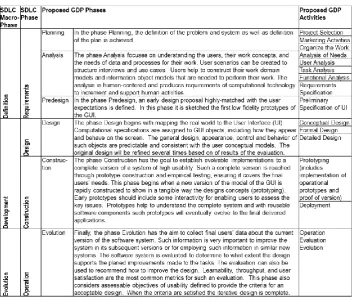
Based on the analysis presented above we present an improved generic GDP. Our GDP provides phases and activities for each phase (see Table 3) and can represent a “natural evolution” from the analysed GDPs. Table 3 matches the proposed phases and activities of the GDP with the general macro-phases and phases of the SDLC.
The organization of Table 3 is the following, column 1 includes three macro-phases of SDLC (Definition, Development and Evolution), which are equivalent to the three phases of Nielsen’s GDP [18] (see H4 in Table 1). Column 2 shows the following phases: Requirements, Design, Construction and Operation. Columns 3 and 5 of the Table 3 correspond to the phases and the activities of the GDP respectively. Finally, column 4 have the descriptions of each proposed phase of our GDP.
Table 3. Phases‘ descriptions and activities for the generic development process of the GUI –our GDP- matched with the macro-phases and phases of the SDLC
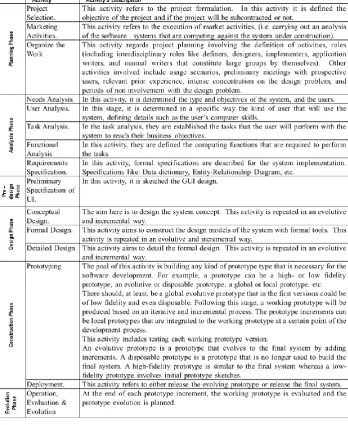
Table 4. Phases and activities of the proposed GDP
3.1. Integration of the Generic GDP into a SDLC
development process (although their order is not defined and it is possible to have some of the activities duplicated).
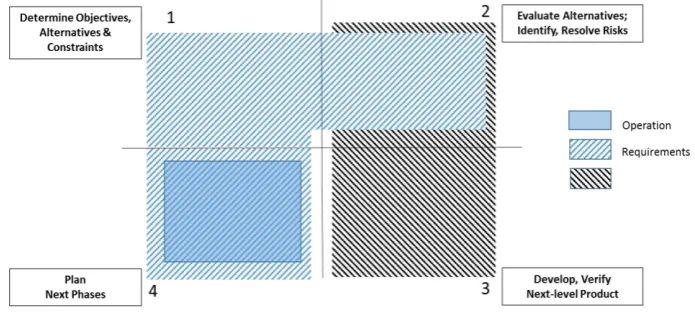
As an example we integrate the Spiral model [24] with the generic GDP by using the graphical definition of the Spiral model that presents four quadrants and several spiral loops containing the process activities. In order to simplify the location of phases/activities of the GDP over the Spiral, we first match the general SDLC (that is in column 2 of Table 3) over the quadrants of the Spiral, as shown in Figure 1.
Fig. 1. General SDLC’s phases matched with the Spiral process’s quadrants
Such a match indicates in which quadrant of the Spiral model will be included the corresponding phases/activities of the GDP. Then over the quadrants we locate the generic phases of GDP according to Table 3, then:
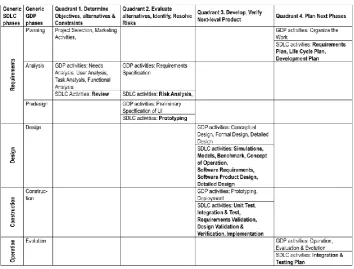
For the SDLC phase “Requirements” we have the generic GDP phases (1) “Planning”, (2) “Analysis” and (3) “Predesign”, which we allocate in the order (1), (2), (3) over the quadrants 1, 2, 3.
For the SDLC phase “Design” and “Construction” we have the generic GDP phases (1) “Design” and (2) “Construction”, which we allocate in the order (1), (2) over the quadrants 2, 3. This order is because in Spiral the activity “prototyping” is considered as part of design, but in GDP “prototyping” is part of construction.
For the SDLC phase “Operation” we have the generic GDP phase (1) “Evolution”, which we allocate over the quadrant 4.
Fig. 2. Allocation of phases of the generic GDP in the Spiral Process
Table 5. Allocation of phases and activities of the GDP over the quadrants
of Planning and Analysis of the GDP. Then the activities that the quadrant need to include are: for Planning, “Project Selection”, “Marketing Activities” and “Organise the Work”; and for Analysis, “Analysis of Needs”, “User Analysis”, “Task Analysis”, “Functional Analysis” and “Requirements Specification”.
4.
Case Example
In this section we show how our model can be used independently of any SDLC by employing an illustrative example of the execution of the generic GDP. For this particular case, our generic GDP is focused on the process. That is, our model does not suggest when the guides and principles of HCI should be used, rather, the HCI indicates that the guides must to be used accordingly to the deliverable artifact to be constructed [23]. Following this, we apply a few set of guidelines to the use of the generic GDP.
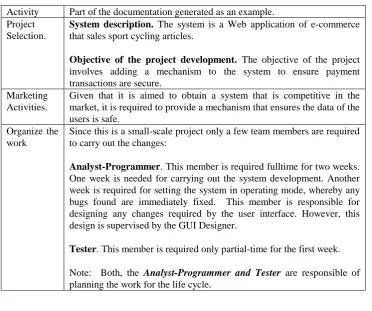
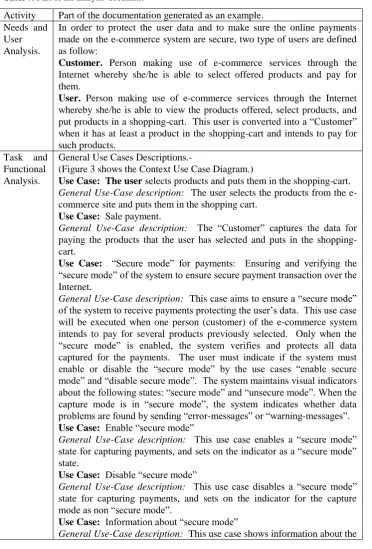
First, to illustrate the execution of the activities of the Planning and Analysis phases of the generic GDP, we present parts of the documents of the Planning and Analysis phases in Table 6 and Table 7, respectively.
Table 6. Part of the planning-document
Activity Part of the documentation generated as an example. Project
Selection.
System description. The system is a Web application of e-commerce that sales sport cycling articles.
Objective of the project development. The objective of the project involves adding a mechanism to the system to ensure payment transactions are secure.
Marketing Activities.
Given that it is aimed to obtain a system that is competitive in the market, it is required to provide a mechanism that ensures the data of the users is safe.
Organize the work
Since this is a small-scale project only a few team members are required to carry out the changes:
Analyst-Programmer. This member is required fulltime for two weeks. One week is needed for carrying out the system development. Another week is required for setting the system in operating mode, whereby any bugs found are immediately fixed. This member is responsible for designing any changes required by the user interface. However, this design is supervised by the GUI Designer.
Tester. This member is required only partial-time for the first week.
Table 7. Part of the analysis-document
Activity Part of the documentation generated as an example. Needs and
User Analysis.
In order to protect the user data and to make sure the online payments made on the e-commerce system are secure, two type of users are defined as follow:
Customer. Person making use of e-commerce services through the Internet whereby she/he is able to select offered products and pay for them.
User. Person making use of e-commerce services through the Internet whereby she/he is able to view the products offered, select products, and put products in a shopping-cart. This user is converted into a “Customer” when it has at least a product in the shopping-cart and intends to pay for such products.
Task and Functional Analysis.
General Use Cases Descriptions.-
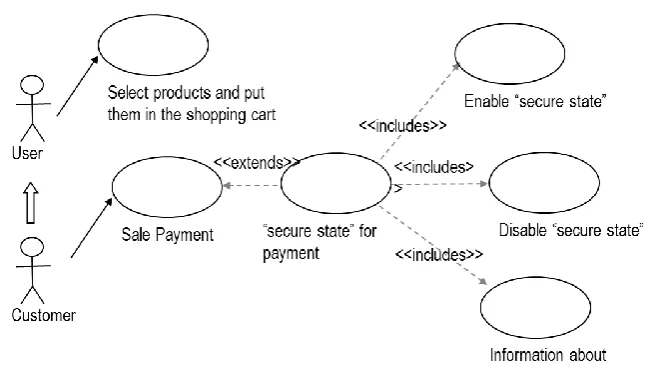
(Figure 3 shows the Context Use Case Diagram.)
Use Case: The user selects products and puts them in the shopping-cart. General UsCase description: The user selects the products from the e-commerce site and puts them in the shopping cart.
Use Case: Sale payment.
General Use-Case description: The “Customer” captures the data for paying the products that the user has selected and puts in the shopping-cart.
Use Case: “Secure mode” for payments: Ensuring and verifying the “secure mode” of the system to ensure secure payment transaction over the Internet.
General Use-Case description: This case aims to ensure a “secure mode” of the system to receive payments protecting the user’s data. This use case will be executed when one person (customer) of the e-commerce system intends to pay for several products previously selected. Only when the “secure mode” is enabled, the system verifies and protects all data captured for the payments. The user must indicate if the system must enable or disable the “secure mode” by the use cases “enable secure mode” and “disable secure mode”. The system maintains visual indicators about the following states: “secure mode” and “unsecure mode”. When the capture mode is in “secure mode”, the system indicates whether data problems are found by sending “error-messages” or “warning-messages”. Use Case: Enable “secure mode”
General Use-Case description: This use case enables a “secure mode” state for capturing payments, and sets on the indicator as a “secure mode” state.
Use Case: Disable “secure mode”
General Use-Case description: This use case disables a “secure mode” state for capturing payments, and sets on the indicator for the capture mode as non “secure mode”.
Use Case: Information about “secure mode”
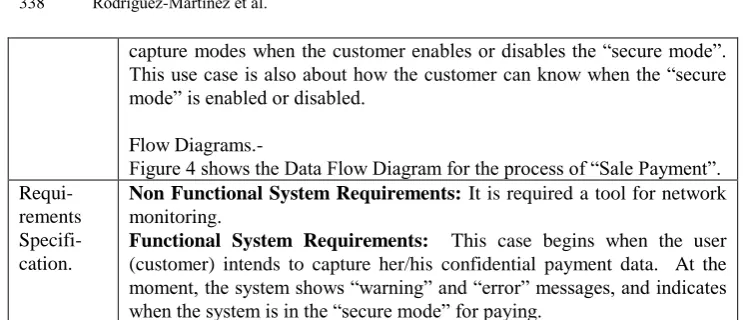
capture modes when the customer enables or disables the “secure mode”. This use case is also about how the customer can know when the “secure mode” is enabled or disabled.
Flow Diagrams.-
Figure 4 shows the Data Flow Diagram for the process of “Sale Payment”.
Requi-rements Specifi-cation.
Non Functional System Requirements: It is required a tool for network monitoring.
Functional System Requirements: This case begins when the user (customer) intends to capture her/his confidential payment data. At the moment, the system shows “warning” and “error” messages, and indicates when the system is in the “secure mode” for paying.
Now we exemplify the phases of Predesign and Design in Table 8 and Table 9 respectively. As follows.
Table 8. Part of the predesign-document
Activity Part of the documentation generated as an example.
Prelimi-nary Specifica- tion of UI
It is important to mention that for this example we considered the design criteria for secure software interaction proposed by [12], which were applied through the GDP specifically during the Predesign Phase. The use of these criteria is merely illustrative and could be replaced by any other design specification. Particularly, we chosen these criteria because they joint the basics for usable secure software development and the traditional Nielsen’s usability requirements: Visibility of system status, Aesthetic and minimalist design, Satisfaction, Convey feature, Learnability, Trust [12], [18], which contribute in achieving good designs. In this way good designs are those that fulfill the specifications that determines the shape and strengths for a product or service. These aspects are referred into Conceptual Design, which - in terms of software- normally consider elements such as User Interfaces Design, navigation, Security, among others [17], [5].
Table 9. Part of the design-document
Activity Part of the documentation generated as an example. Conceptual
Design.
From applying some need findings techniques; such as observation and interview [23], [26]; we could obtain feedback that may complement very well to results from Predesign phase. This information was then distilled throughout an interaction sketch/ paper prototype (see Figure 5).
Formal Design.
Specification for screen (that evolves to Figure 6A):
Problem: How can the security features of the web service be clearly stated to the users?
Solution: The users will be alerted about the protection of the system by using an image of traffic lights and showing the message “The Security Module is ACTIVE”. A green colour in the screen frame and the green light turned-on in the traffic lights are used to indicate the users that the system is protected. The text “The Secure Transaction is ACTIVE” is always visible. In the same way, a message is presented in a dialogue box that also includes the option to disable the security module or to continue using it giving the user more control over the system.
Specification for a second screen (that evolves to Figure 6B):
Problem: How to present a clear visibility of the system status?
Solution: (it is not included for the sake of brevity) Detailed
Design
The digital mock up produced through the “Formal Design” activity, complemented with additional feedback from users would provide a reliable starting point for a more detailed design which could be materialized using a semi-functional digital mock up closer to the final construction version (see Figure 6A y 6B).
Fig. 4. Data Flow Diagram for the “Sale Payment” process
Finally, Table 10 shows an example of the execution of the activities for the Construction and Evolution phases.
Table 10. Part of the construction-document
Activity Part of the documentation generated as an example.
Construction. From the specifications provided by the design phase, we constructed the user interface for the specific system incorporating all the elements in a prototype.
As part of the “Construction” stage the prototype (that is by space is not presented here), generated and approved by the development team, is transformed into a functional Interface, which is then launched as an evolving prototype and eventually the final system.
Fig. 5. System Design and Interaction Sketch
5.
Evaluation
From a methodological point of view, it is necessary to describe the process of how we can develop software products avoiding “assumptions” as much as possible in order to succeed in the development of a software product independently of the developers' expertise. As in other areas of science, software engineering knowledge grows incrementally; that is, frequently, new proposals represent evolutions of past contributions. On this basis, we analysed the strengths and weaknesses of ten process-oriented Graphic User Interface Development Process (GDP) models. This study allowed us to identify some gaps. The general GDP we have proposed addresses some of these gaps.
The literature review revealed several opportunities for improvement, hence, we have merged some virtues of the best GDPs analysed together with additional features obtained from our experience in developing and designing systems as well as analysing development processes; resulting in a new, basic but more robust GDP. Our main contributions include the following:
Identification of GDPs activities: The definition/description of GDP activities is essential in order to obtain a complete and understandable explanation of a development process, and must be consistent with the stages to create a graphic user interface.
Integration of the GDP into the SDLC: It is common to talk about GDPs and SDLCs in a separate way, since Human Computer Interaction (HCI) commonly studies the characteristics and behaviors of GDPs, and Software Engineering (SE) deals with the study of SDLCs. We believe as some other authors do [21], [22] that the Software System development process should not be separated from the development process of its own GUI.
We evaluated the different GDPs reviewed, including ours, with Fully met, Partially met or Not met, depending on whether the GDPs met each one of the four characteristics (PV2-1, PV2-2, PV2-3, PV2-4) defined in Section 2. We performed the evaluation in an independent way of the SDLC that could be considered for a possible the integration. Figure 7 shows the evaluation represented as four bars (one bar for each analysed characteristic) for each GDP: the horizontal axis represents each GDP (i.e. H1..H10 and our proposed GDP) and the vertical axis represents the three levels of meeting a characteristic (i.e. Fully met, Partially met, Not met).
Fig. 7. Analysis of the ten GDPs for detecting weakness
Table 11. GDPs‘ coverage of objective O1 (well-defined process) and objective O2 (integrated into SDLC)
particular SDLC, our GDP is more generic as it defines the integration process with any SDLC.
Our proposed GDP is the first effort to fully achieve objectives O1 and O2. The case example presents a feasible use of this generic GDP by employing tools and terms previously defined in Software Engineering (SE), (e.g. the “use case” of UML, or the term “Non Functional System Requirements” [24]) or techniques, methods and usability guidelines previously defined in HCI (e.g. the use of “sketching” [9], or the application of “security design criteria” [12]).
5.1. Our Proposed GDP vs the ten reviewed GDPs
Before anything we remark that the activities of our proposed GDP are taken of the previous H1..10. Bearing in mind, we argue in favor of our proposal as a natural evolution, not as replacement of the previous GDPs.
Our proposed GDP has the following advantages over the analysed GDPs. Firstly, other related and emergent solutions (such as [6]) are presented as a set of deliverables or product models of the process instead of a process itself. In contrast, our proposal is focused on defining the phases and activities of the GUI development process as part of a well-defined process. Secondly, despite the proposal of Nielsen (H4) includes processes, Nielsen’s work defines the activities only as elements to be covered in the process and no distinction is provided between methods and processes. Also, from the point of view of a well-defined process, it is necessary the specific identification of activities. Finally, regarding characteristic 2 (integration into a SDLC) of Figure 7, we can see that the proposals H8, H9 and H10 explicitly indicate the integration of a GDP into a specific Software-System Development Life Cycle (SDLC), i.e. the waterfall model [24]. The proposal H8 provides a way to integrate a GDP with a specific SDLC. H9 presents the integration as a black box, and H10 integrates both processes, GDP and SDLC as a single process, but not in an explicit way for its execution. In contrast, in our proposal, the integration is not obtained in an ad hoc manner, rather, the integration can be systematically achieved into any SDLC.
Considering the case example, we provide below an analysis that compares our GDP with other GDPs.
The planning phase of our GDP is exemplified in Table 6 that has several planning activities that should be an overview of the system and its objectives, an overview about the marketing possibilities for the system and how the work can be organized to develop the system, including roles and their great responsibilities.
Following, we compare the planning phase of H8, H9 and H10 with our GDP:
H8 and H9 do not considerate the planning proposed in the activities exemplified in Table 6, they go directly to the systems requirements that for our GDP begins with the analysis phase.
H10 considers the planning phase as a single large activity called Project Selection and Planningthat includes only the activities of Project Selection and Project Planning. This last activity is equivalent to the Work organization activity of our GDP.
Following, we compare the analysis phase of H8, H9 and H10 with our GDP:
Although H8, H9 and H10 have an equivalent final activity –Requirements Specification– for the analysis phase, only H10 have five activities in the analysis phase which are equivalent to the activities defined by our GDP (i.e. Analysis of Needs, User Analysis, Task Analysis, Functional Analysis, Requirements Specification) in such a phase. H8 has only two activities (Task Analysis and Requirements Specification).
Our proposal has four activities in the predesign and design phases: preliminary specification of UI (that helps to a better understand of the requirements), conceptual design, formal design and detailed design. Four activities that promotes different levels of design and gives a small process to follow. In contrast, F8 defines only two types of design. H9 and H10 define only a large activity for design phase.
The activity of prototyping is common in the proposals H8, H9 since it is the base of a good GUI design. They consider the prototype, only for evaluation, i.e. not for implementation. But, H10 does not consider prototyping.
Finally, we are proposing the way to achieve integration. We claim that others GPDs can use our way to integrate with an SDLC. The activities of others GDPs are normalized in Table 1, therefore, we can match them with the macro-phases and phases of SDLC and integrate all of them with any SDLC. However, even when we use this way for integration, most of the GDPs are not enough for a good integration because they are not sufficiently detailed. For example we can easily integrate H10 with our integration approach, but this is not the case of H4, which is not sufficiently detailed.
5.2. Limitations
It is important to highlight that this GDP is proposed from the point of view of a methodological processes, without proposing HCI principles and guidelines of design. However, we claim that the principles and guidelines defined by the HCI community can be used with the proposed generic GDP. Then this work presents the basis for obtaining a well-defined GDP. The GDP presented is limited to the definition of a minimum process that includes the phases, activities, their descriptions, and the iterative mode of the process. To achieve a complete and well-defined GDP from a methodological view point, it is necessary to define the deliverable artifacts, roles and the applicable tools (methods, techniques, and technology) that include a plausible integration of principles and guidelines of design and analysis of the process-oriented GDPs with respect to their deliverable artifacts, roles and tools.
6.
Conclusion
In order to apply the HCI experience in a development process it is commonly necessary to be an expert in both knowledge areas, HCI and SDLC. To address this issue, research in the HCI field has proposed approaches that intend to include the SDLC in their methodological proposals. However, some of these proposals only present the models (of artifacts) to be constructed in each phase of the SDLC and do not define the activities implied to construct the HCI models [6]. On the other hand, in the SE field the activity of screen design is generally defined as a single activity and regarded as a black box in the system design. In this paper, we have proposed a generic GDP that enables the integration of such GDP in an arbitrary SDLC. Our work has three main contributions: (1) identifying the activities that can be generic for a GDP; (2) defining a generic GDP including the experience of several methodological approaches in HCI; and (3) an approach towards the integration of GDP and SLDC.
As a future work, we will look into defining a complete well-defined process model for GUI development, which involves complementing the GDP with the definition of the products or models of products of each activity, the roles for the process and the a suit of suggested tools to use for the process execution.
References
1. Abd Majid, R., Md Noor, N. L., Wan Adnan, W. A., and Mansor, S.: A Survey on HCI in the Software Development Life Cycle: from Practitioner’s Perspective. ACM, 978-1-60558-710-3/09/11, 1–4. (2009)
2. Bailey, G.: Iterative Methodology and Designer Training in Human-Computer Interface Design. ACM INTERCHI’93, 198-205. (1993)
3. Blomkvist, S.: User-Centered Design and Agile Development of IT Systems. IT Licentiate theses, Department of Information Technology, Uppsala University (2006).
4. Butler, A.: Usability Engineering Turns 10. ACM Interactions, 59-75. (1996)
5. Chemuturi, M.: Master Software quality assurance: Best practices, tools and techniques for software developers, J. Ross Publishing. (2010)
6. Giraldo, W.J., Molina, A.I., Collazos, C.A., Ortega, M., and Redondo, M.A.: A Model Based Approach for GUI Development in Groupware Systems. In: Briggs, R.O., Antunes, P., de Vreede, G., and Read, A.S. (ed.): Groupware: Design, Implementation, and Use. 14th International Workshop, CRIWG 2008, Omaha, NE, USA, September 14-18. (2008), Revised Selected Papers, Lecture Notes in Computer Science Volume 5411, Springer, 324-339. (2008)
7. Gould, J., Lewis, C.: Designing for Usability: Key Principles and What Designers Think. Communications of the ACM, Vol. 28 No. 3, 300-311. (1985)
8. Göransson, B., Gulliksen, J., and Boivie, I.: The Usability Design Process – Integrating User-centered Systems Design in the Software Development Process. John Wiley & Sons, Ltd., Software Process Improvement and Practice, 111–131. (2003)
9. Granollers, T., Lorés, J. & Perdrix, F.: Usability Engineering Process Model. Integration with Software Engineering. In Proceedings of HCI International 2003, Crete, Greece, June 22-27-2003, Lawrence Erlbaum Associates, New Jersey, USA, 1-6. (2003)
11. Hartson, H. R., and Hix, D.: Human-Computer Interface Development: Concepts and Systems for its Management. ACM Computing Surveys, Vol. 21 No. 1, 5-92. (1989) 12. Johnston, J., Eloff., J., and Labuschagne L.: Security and Human Computer Interfaces.
Computers & Security, 675-684. (2008)
13. Losada, B., Urretavizcaya, M., and Fernández-Castro, I.: The InterMod Methodology: An Interface Engineering Process Linked with Software Engineering Stages. In: Macías, J.A., Granollers Saltiveri, A., and Latorre, P.M. (ed.): New Trends on Human-Computer Interaction. Research, Development, New Tools and Methods, Springer-Verlag London Limited, 53-63. (2009)
14. Lowdermilk, T.: User Centered Design, O'Reilly Media. (2013)
15. Lowgren, J., and Stolterman, E.: Design Methodology and Design Practice. ACM Interactions, 13-20. (1999)
16. Mora, M.: The Conceptual Research Approach. Universidad Autónoma de Aguascalientes, (2005).
17. Muñoz, J., Mendoza, R., Vargas Martin, M., Vanderdonckt, J., Álvarez, F., and González Calleros, J.: A method to design information security feedback Using patterns and HCI-security criteria. In Proceedings of the 7th International Conference on Computer-Aided Design of User Interfaces CADUI, Lecture Notes in Computer Science, Springer, Albacete, Spain, (2008)
18. Nielsen, J.: The Usability Engineering Life Cycle. IEEE, 11-22. (1992)
19. Oktaba, H., and Ibargüengoitia, G.: Software Process Modeled with Objects: Static View. Computación y Sistemas. Vol. 1 No. 4 CIC-IPN ISSN 1405-5546, 228-238. (1998)
20. Rodríguez L. C., Mora M., and Alvarez F. J.: Process Models of SDLCs: Comparison and Evolution. In: Mahbubur Rahman S., Nessa Syed S. (Eds.), Research con Modern Systems Analysis and Design Technologies and Applications. IGI-Global, pp. 76-89. (2008)
21. Rodríguez-Martínez, L. C., Mora, M., Muñoz, J., and Mendoza, R.: A Descriptive-Comparative Study of Activities of GUI Development Processes and their Evolution. In Proceedings of CONISOFT, 17-24. (2012)
22. Rosson, M., Maass, S., and Kellog, W.: Designing for Designers: Analysis of Design Practice in the Real World. ACM CHI+GI 87, 137-142. (1987)
23. Shneiderman, B., and Plaisant, C.: Designing the User Interface: Strategies for effective Human-Computer Interaction, Addison Wesley. (2010)
24. Sommerville, I.: Software Engineering, Addison-Wesley. (2005)
25. Wallach, D., and Scholz, S.C.: User-Centered Design: Why and How to Put Users First in Software Development, Springer-Verlag Berlin Heidelberg., Software for People, Management for Professionals, 11-38. (2012)
26. Dix, A.: Human Computer Interaction, 3rd Edition, Prentice Hall. (2004)
Laura C. Rodriguez-Martinez is a full Professor at the Systems and Computing Department, Instituto Tecnologico de Aguasaclientes, Mexico. She holds a PhD in Computer Science at Universidad Autonoma de Aguascalientes, Mexico in 2009. Her research interests include Software Systems Development Processes, Service-Oriented Software Engineering and Graphical-User Interfaces Development Processes.
Dr. Ricardo Mendoza-González is a researcher professor at Universidad Politecnica de Aguascalientes and the Instituto Tecnologico de Aguascalientes. He holds a PhD in Computer Science and particularly addresses his research works to Human-Computer Interaction and UX topics. He has over forty scientific publications in Journals, book-chapters, and conference proceedings.
Dr. Jaime Muñoz Arteaga is a research professor at Universidad Autonoma de Aguascalientes, Mexico. He got his PhD in Computer Science at Université Toulouse III, in France. His research topics are in Human-Computer Interaction, E-learning and Web Engineering. The Dr. Muñoz has published two books about Software Engineering, one book about Human-Computer Interaction and two books about Learning Object Technology.
![Table 1. Normalised activities of GDPs (Quoted from [21], p. 22)](https://thumb-us.123doks.com/thumbv2/123dok_us/1171955.1619792/6.595.119.475.154.494/table-normalised-activities-gdps-quoted-p.webp)
![Table 2. Normalised and generalised activities of GDPs (modified from [21], p. 22)](https://thumb-us.123doks.com/thumbv2/123dok_us/1171955.1619792/7.595.122.475.266.634/table-normalised-generalised-activities-gdps-modified-p.webp)