Effect of Continuous Contour Trenches on Nutrient
Status of the Micro-Catchment
R. M. WaNkhadE*, R. S. PaTodE, M. B. NagdEvE,
v. v. gaBhaNE and C. B. PaNdE
AICRP for Dryland Agriculture, Dr. Panjabrao Deshmukh Krishi Vidyapeeth, Akola.
abstract
The adoption of in-situ soil and water conservation techniques are the need of the day all over the country. Taking into consideration this logic, the experiment on practical implementation of the conservation measures along with impact assessment was undertaken at AICRP for Dryland Agriculture Dr. PDKV, Akola. In which impact assessment of continuous contour trenches (CCTs) on hydrological, agronomic, soil nutrient status has been made. In this paper the results related to soil nutrient losses are presented. The small catchment was divided into two parts one is treated with CCTs and other is without CCTs. From the recorded data and nutrient status analysis, it was observed that in CCT treated (T1) micro-catchment Nitrogen, Phosphorous and Potassium was more by 25 %, 15.31% and 9.96% respectively over untreated (T2) micro-catchment. The micro-nutrients viz. Zinc, Ferrous, Magnesium and Copper in CCT treated micro-catchment was observed more by 15.56 %, 7.70%, 23.07% and 37.54% respectively over untreated (T2) micro-catchment. The pH and EC was also observed to be more in CCT treated (T1) micro-catchment as compared to untreated (T2) micro-catchment. These results conclude that in CCT treated micro-catchment the losses of nutrients had been reduced which ultimately useful for plant growth. Thus continuous contour trenches are useful for conservation of soil nutrients.
article history
Received: 19 July 2017 Accepted: 21 October 2017
keywords:
CCT,
Micro-catchment, Nutrients, Treated.
CoNTaCT R.M. Wankhade [email protected] AICRP for Dryland Agriculture, Dr. Panjabrao Deshmukh Krishi Vidyapeeth, Akola.
© 2017 The Author(s). Published by Enviro Research Publishers
This is an Open Access article licensed under a Creative Commons Attribution-NonCommercial-ShareAlike 4.0 International License (https://creativecommons.org/licenses/by-nc-sa/4.0/ ), which permits unrestricted NonCommercial use, distribution, and reproduction in any medium, provided the original work is properly cited.
To Link to this Article: http://dx.doi.org/10.12944/CARJ.5.3.07
Current agriculture Research Journal
www.agriculturejournal.org
Introduction
Agricultural drought is common in Dryland agriculture. Soils of shallow depth, low fertility, and poor water holding capacity and the resultant soil moisture stress during crop growth are some of the major
backbone of the watershed programmes. As a part of better land management, several land treatments such as contour farming tied ridging, broad bed furrows are being suggested for erosion control and rain water conservation. The utility of such measures in terms of soil water availability to crops will depend on a number of factors. Additional retention of water in the soil profile will depend on the antecedent soil moisture condition, amount of rainfall infiltration and seepage / percolation losses besides the water holding capacity of the soil7. The utility of such
practices will also depend on the frequency of runoff events as well as the quantum of runoff, which we are trying to control through such practices17.
Plant nutrition is the study of the chemical element and compound necessary for plant growth, plant metabolism and their external supply. In its absence the plant is unable to complete a normal life cycle or that the element is part of some essential plant constituent or metabolite. The soil supplies nitrogen, phosphorus, potassium, calcium, magnesium, and sulphur are called macronutrients and iron, manganese, boron, molybdenum, copper, zinc, chlorine, and cobalt, are called micronutrients18.
Prevention of losses of these nutrients is possible by continuous contour trenches. In order to know the actual benefits and quantification of soil moisture regimes, soil nutrient losses, groundwater recharge and water balance of the treated catchment over the untreated catchment, the present study have been undertaken with the objective of estimation of nutrient losses through treated and untreated micro- catchment.
Study area
The field experiment was conducted at All India Co-ordinated Research Project for Dryland Agriculture, Dr. Panjabrao Deshmukh Krishi Vidyapeeth, Akola during 2014-1517,19. The site is situated at the latitude
of 200 43’ North and Longitude of 770 02’ East. The
altitude of this place is 307.41m above MSL. The climate of the place is semi-arid and characterized by hot dry summer and cool winter12. Area of
experimental plot was 1 hectare and it is divided into two parts (50x100 m2) each. The micro catchments
A and C are treated (T1) with continuous contour trenches (CCTs) and B and D are untreated (T2). The micro-catchment A and B are having Custard apple
(Annona squamosa) plantation and micro-catchment C and D are having Atemoya (Annona cherimola) plantation. There are four observation wells viz., well A, well B, well C and well D prepared in each micro-catchment A, B, C and D respectively. Eight moisture tubes viz., M1, M2, M3, M4, M5, M6, M7 and M820 are also installed in these micro-catchments;
Two moisture tubes in each micro-catchment i.e. M1 and M2 in A, M3 and M4 in C, M5 and M6 in B and M7 and M8 in D. Green gram has been taken as an inter crop in the perennial plantation in both the micro-catchment. The details of treatments in the micro-catchments are given below.
Materials and Methodology
available Nitrogen, Phosphorus, Potassium
Available Nitrogen is calculated by alkaline potassium permanganate method13. Available Phosphorus14 is
calculated by NaHCO3–(0.5) pH 8.5 Colorimetric16.
Available Potassium is calculated by Neutral normal ammonium acetate using Flame photometer15.
Micro Nutrients
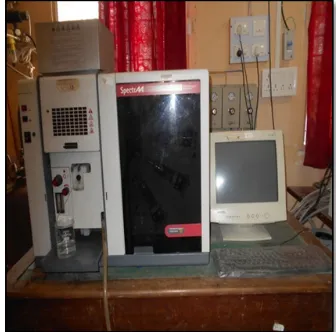
DTPA extractable micronutrients (Zn, Fe, Mn and Cu) are calculated6. The Atomic Absorption
Spectrophotometer used for this purpose was shown in Fig.1
ph of Soil
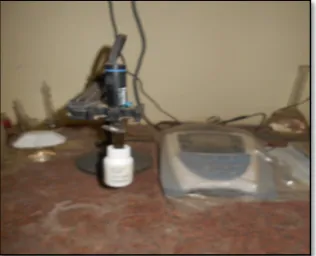
pH of soil is calculated by using glass electrode pH meter (Fig. 2)3.
Nitrogen, Phosphorus, Potassium and Micro nutrient were calculated in treated (T1) and untreated (T2) micro-catchment. For nutrient analysis soil samples was collected from the field. Four samples from treated (T1) micro-catchment with CCTs and four samples from untreated (T2) micro-catchment.
CCT-C-H-1= First sample of soil in C section of micro-catchment which is treated (T1) by continuous
Fig. 2: glass electrode ph meter
Fig. 3: Electric conductivity meter
Table 1: Nutrient Status in Custard apple Plantation for Cct Treated and Untreated Micro-Catchment.
Micro-Catchment Nutrient Status in Custard apple Plantation
MICRoNUTRIENT
N P k Zn Fe Mn Cu
(kgha-1) (kgha-1) (kgha-1) (mgkg-1) (mgkg-1) (mgkg-1) (mgkg-1) ph EC
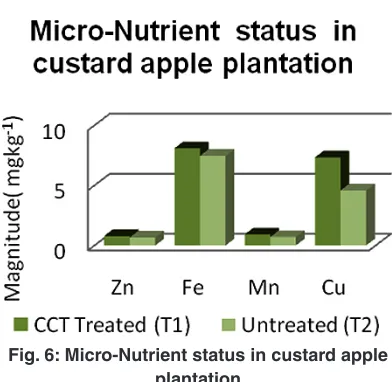
Treated 175.6 17.03 308 0.77 8.08 0.91 7.32 8.25 0.01
(T1)
Untreated 131.7 14.42 277.3 0.65 7.45 0.7 4.57 7.94 0.13
(T2)
Fig. 4: Layout of Experimental area EC of Soil
EC of soil is calculated by using electric conductivity meter (Fig.3)3.
contour trenches and have Atemoya plantation. CCT-C-H-2=second sample of soil in C section of micro-catchment which is treated (T1) by continuous contour trenches and have Atemoya plantation CCT-A-S-3=Third sample of soil in A section of micro-catchment which is treated (T1) by continuous contour trenches and have Custard apple plantation. CCT-A-S-4=Fourth sample of soil in A section of micro-catchment which is treated (T1) by continuous contour trenches and have Custard apple plantation. NCCT-B-S-5=Fifth sample of soil in B section of micro-catchment which is not treated (T1) by continuous contour trenches and have Custard apple plantation. NCCT-B-S-6=Sixth sample of soil in B section of micro-catchment which is not treated (T1) by continuous contour trenches and have Custard apple plantation. NCCT-D-H-7=Seventh sample of soil in D section of micro-catchment which is not
treated (T1) by continuous contour trenches and have Atemoya plantation.
Results and discussion
The soil analysis was done to know the nutrient status of the soils in CCT treated as well as untreated catchment in custard apple and atemoya plantation. The results are presented in Table 1 and 2 for
Table 2: Nutrient status in atemoya plantation for CCT treated and untreated micro-catchment.
Micro- Nutrient status in atemoya plantation catchment
MICRoNUTRIENT
N P k Zn Fe Mn Cu
(kgha-1) (kgha-1) (kgha-1) (mgkg-1) (mgkg-1) (mgkg-1) (mgkg-1) ph EC
Treated 181.88 16.47 297.58 0.79 7.67 0.91 6.6 8.2 0.12
(T1)
Untreated 144.25 14.62 288.56 0.62 7.64 0.64 5.85 8.02 0.25
(T2)
the soils in custard apple and atemoya plantation respectively. From these tables it is observed that the nutrient/ micronutrient status of CCT treated soils is more as compared to untreated soils for both the plantations.
Fig. 5: Nutrient status in custard apple plantation
Nutrient Losses Through Custard apple Plantation
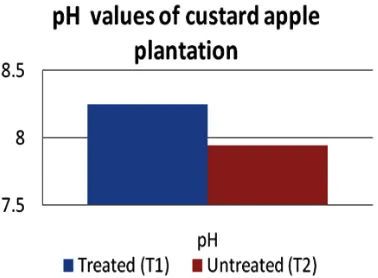
The nutrient and micronutrient status of the soils in custard apple plantation are depicted in Fig. 5 and Fig. 6 respectively. The pH and EC comparison is depicted in Figures 7 and 8 respectively.
From Fig.5, it was observed that the nutrient status of treated (T1) micro-catchment in respect of Nitrogen, Phosphorous and Potassium was more compared to untreated (T2) micro-catchment. In treated (T1) micro-catchment Nitrogen, Phosphorous and Potassium was more by 25 %, 15.31% and 9.96% respectively over untreated (T2) micro-catchment.
Fig. 7: ph values of custard apple plantation
Fig. 8: EC values of custard apple plantation
Fig. 9: Nutrient status in atemoya plantation
Fig. 10: Micro-nutrient status in atemoya plantation
Fig. 11: ph values of atemoya plantation
Fig. 12: EC values of atemoya plantation
Nutrient Losses Through atemoya Plantation
The nutrient and micronutrient status of the soils in atemoya plantation are depicted in Fig. 9 and Fig. 10 respectively. The pH and EC comparison is depicted in Figures 11 and 12 respectively.
From Fig. 9 it is observed that the nutrient status of treated (T1) micro-catchment in respect of Nitrogen,
Phosphorous and Potassium was more compared to untreated micro-catchment. In treated (T1) catchment
Nitrogen, Phosphorous and Potassium was more by 20.68 %, 11.24% and 3.02% respectively over untreated (T2) micro-catchment
From Fig.10 it was observed that the micro-nutrient status of treated (T1) and untreated (T2) micro-catchment in respect of Zinc, Ferrous, Magnecium and Copper was more in treated (T1) micro-catchment as compared to untreated (T2) micro-catchment. In treated (T1) micro-catchment Zinc, Ferrous, Magnecium and Copper was more by 21.23 %, 0.64%, 29.67% and 11.35% respectively over untreated (T2) micro-catchment.
From Fig.11 and 12 it is observed that the pH and EC observed more in treated (T1) micro-catchment as compared to untreated (T2) micro-catchment.
Conclusion
1. For custard apple plantation, in treated (T1) micro-catchment Nitrogen, Phosphorous
and Potassium content is observed more by 25 %, 15.31% and 9.96% respectively over untreated (T2) micro-catchment. For atemoya plantation in treated (T1) micro-catchment Nitrogen, Phosphorous and Potassium content is observed more by 20.68 %, 11.24% and 3.02% respectively over untreated (T2) micro-catchment.
2. For custard apple plantation, in treated (T1) micro-catchment Zinc, Ferrous, Magnesium and Copper is observed more by 15.56 %, 7.70%, 23.07% and 37.54% respectively over untreated (T2) micro-catchment. For Atemoya plantation in treated (T1) micro-catchment Zinc, Ferrous, Magnesium and Copper is observed more by 21.23, 0.64%, 29.67% and 11.35% respectively over untreated (T2) micro-catchment. From these results it is concluded that the CCTs are found effective in preventing nutrient and micro-nutrient losses.
acknowledgements
References
1. Bertol I.E.L., Mello, J. Guadagnin, A. Zaparolli, M.R. Carrafa, Nutrient Losses by Water Erosion, J. Scientia Agricola, 60(3):581-586 (2003).
2. Gabhane V.V. and S.M. Taley, Effect of contour cultivation on soil fertility, runoff, soil and nutrient losses and moisture use efficiency of soyabean on Inceptisol under semi-arid Agro-ecosystem, ICON-ARM. pp. 165 (2004). 3. Jackson, M.L., Soil Chemical Analysis.
Prentice Hall of India Pvt. Ltd., New Delhi, 498 (1973).
4. Katkar, R.N, S.T. Wankhede, A.B. Turkhede and S. P. Lambe, Effect of integrated nutrient management in cotton grown on shallow soil on growth seed yield and physio-chemical properties, PKV Res.J. 29(1):210-214 (2005).
5. Lima W.D.P, Overland Flow and Soil and Nutrient Losses from Eucalyptus Plantations, IPEF International, Piracicaba, (1):35-44 (1990).
6. Lindsay W.L. and W.A. Norvell, Development of a DTPA soil test for Zinc, iron manganese and copper, Soil Sci. Soc. America J. 42: 421-428 (1978).
7. Padmanbhan, M.V, P.K. Mishra and S. Sharma, Soil and water conservation research in rainfed areas, in dryland agriculture Research in India-State of art of Research in India (Eds. Somani L.L, Vittal K.P.R and Venkateswarlu B.) Scientific publishers, Jodhpur, 1992). 8. Patil, S.L., Sheelavantar, M.N. and Shashidhar,
K.C, Growth and yield of winter sorghum (Sorghum bicolor (L.) Moench) as influenced by rainwater conservation practices, organic materials and nitrogen application in Vertisols of Semi Arid Tropical India, Indian J. Soil cons.
39(1): 50-58 (2011).
9. Pilbeam C.J, Tripathi B. P, Sherchan D. P,
Gregory P.J and Gaunt J., Nitrogen balances for households in the Mid-Hills of Nepal, Agric. Eco. Syst. Environ. 79: 61–72 (2000). 10. Sahrawat K.L, S.P. Wani, P. Pathak, T.J.
Rego, Review: Managing natural resources of watersheds in the semi-arid tropics for improved soil and water quality: A review. Agric Water Manage. (97):375-381 (2010). 11. Soil Survey Staff, Key to soil taxonomy, 6th
Edn. Soil Conservation Service, U. S. Dept. Agric., Washington D.C (1994).
12. Surendran, U., V. Ramesh, M.Jayakumar, S. Marimuthu, and G. Sridevi., Improved sugarcane productivity with tillage and trash management practices in semi arid tropical agro ecosystem in India, Volume 158, May, Pages 10-21 (2016).
13. Subbaiah, B.V. and Asija, G.L., A rapid procedure for the estimation of available nitrogen in soil. Curr. Sci., 1956, 25: 259. 14. K. N. Singh, B. Prasad and S. K. Sinha, Effect
of integrated nutrient management on a Typic Haplaquant on yield and nutrient availability in a rice-wheat cropping system, Australian Journal of Agricultural Research 52(8) 855 - 858 (2001).
15. Knudsen, D., Peterson, G. A. and Pratt, P. F., Lithium, sodium, potassium. In Methods of soil analysis, part 2, ed. A. L. Page. Madison, Wisc., ASA-SSSA,(1982).
16. Watanabe F.S. and S.R. Olsen, Test of ascorbic acid methods, For determining phosphorus in water and sodium bicarbonates extracts of soils. Proc.Soil. Sci. Soc. Am. 677-678 (1965).
17. www.crida.in.