by
Christopher Robert Sutton
A thesis
submitted in partial fulfillment
of the requirements for the degree of
Master of Science in Computer Science
Boise State University
of the thesis submitted by
Christopher Robert Sutton
Thesis Title: Performance, Scalability, and Robustness in Distributed File Tree Copy
Date of Final Oral Examination: 19th June 2018
The following individuals read and discussed the thesis submitted by student Christo-pher Robert Sutton, and they evaluated the presentation and response to questions during the final oral examination. They found that the student passed the final oral examination.
Amit Jain, Ph.D. Chair, Supervisory Committee
Tim Andersen, Ph.D. Member, Supervisory Committee
Steven Cutchin, Ph.D. Member, Supervisory Committee
I would like to express my gratitude to my advisor, Amit Jain, for his incredible
patience and for all the help and support he has given throughout this project.
I would like to thank Ben Peterson for all the help he has given, setting up
experiments on the GeneSIS cluster and addressing all the technical issues that arose.
I would also like to thank Eric Whiting and Peter Cebull for their help and
support getting access to the High Performance Computing cluster at Idaho National
Laboratories, and getting started running our experiments there.
This research made use of the resources of the High Performance Computing
Center at Idaho National Laboratory, which is supported by the Office of Nuclear
Energy of the U.S. Department of Energy and the Nuclear Science User Facilities
under Contract No. DE-AC07-05ID14517.
As storage needs continually increase, and network file systems become more
common, the need arises for tools that efficiently copy to and from these types of file
systems. Traditional copy tools like the Linux cp utility were originally created for traditional storage systems, where storage is managed by a single host machine. cp
uses a single-threaded approach to copying files. Using a multi-threaded approach
would likely not provide an advantage in this system since the disk accesses are the
bottleneck for this type of operation. In a distributed file system the disk accesses
are spread across multiple hosts, and many accesses can be served simultaneously.
Volumes in a distributed file system still look like a single storage device to the
operating system of a client machine, so traditional tools like cp can still be used,
but they cannot take advantage of the performance increase offered by a distributed,
multi-node approach. While some research has been done in this area and some tools
have been created there are still shortcomings in the area, particularly when it comes
to scalability and robustness to process failure. The research presented here attempts
to adress these shortcomings.
The software created in this project was tested in a variety of enviornments and
compared to other tools that have attempted to make improvements in these areas.
In the area of scalability, this software performed well from a small cluster to large
high-performance-computing cluster. In comparisons to other tools, the performance
was comparable to or better than the other tools measured.
The unique contribution of this project is in the area of robustness, which other
minimum number of processes that can fail without losing progress or requiring a
restart of the copy job. This means process death can be tolerated, or resources can
be diverted after the start of the copy job. This is especially helpful in very large,
long-running jobs. Many clusters are made with low-cost, consumer-grade hardware
which is susceptible to failure. A study entitled “Failure Trends in a Large Disk Drive
Population” [2], published in the proceedings of the USENIX FAST’07 conference,
looked at the failure rate of disk drives across Google’s various services. It found that
a large number of drives fail within a few years. Drive failure rate was somewhat high
within the first few months, weeding out the lower quality drives, but at the two and
three year mark as many as eight percent of drives failed per year. This high rate
shows the importance of software like this that can tolerate these types of failures.
ABSTRACT . . . v
LIST OF TABLES . . . x
LIST OF FIGURES . . . xi
1 Introduction . . . 1
1.1 Rationale . . . 1
1.2 Problem Statement . . . 2
2 Literature Review . . . 4
2.1 Introduction . . . 4
2.2 Kevin Nuss - PCT . . . 4
2.3 Los Alamos National Laboratory - MPI-FTW . . . 5
2.4 LaFon, Moody, and Bringhurst - DCP . . . 5
2.5 Bisson, Patel, and Pasupathy . . . 6
2.6 Kolano and Ciotti - MCP . . . 6
3 Methods . . . 8
3.1 Introduction . . . 8
3.2 Traversal . . . 9
3.3 Producer . . . 13
3.4 Consumer . . . 14
4.1 Introduction . . . 16
4.2 Experimental Setup . . . 16
4.2.1 Linux VM . . . 16
4.2.2 BSU GeneSIS Cluster . . . 17
4.2.3 INL Falcon Cluster . . . 18
4.2.4 Amazon AWS . . . 19
4.3 Data Sets . . . 20
4.4 Timing Measurements . . . 21
4.4.1 BSU GeneSIS Cluster - Copy, Zero Backups . . . 21
4.4.2 INL Falcon Cluster . . . 22
4.4.3 Amazon AWS . . . 23
4.4.4 AWS Cluster - Tree Traversal, Varying Backups . . . 23
4.5 Comparison to Existing Tools . . . 24
4.5.1 dcp - Setup . . . 25
4.5.2 mcp - Setup . . . 25
4.5.3 Results . . . 26
5 Conclusions . . . 29
5.1 What have we done so far? . . . 29
5.2 Future directions . . . 30
REFERENCES . . . 33
A Idaho National Laboratories - Falcon Cluster . . . 34
B Boise State University - GeneSIS Cluster . . . 37
4.1 AWS VM Instances . . . 19
4.2 Many Small Files . . . 20
4.3 Fewer Large Files . . . 21
4.4 AWS Files . . . 21
4.5 BSU GeneSIS Cluster Results - Many Small Files . . . 22
4.6 BSU GeneSIS Cluster Results - Linux ’cp’ command - Many Small Files 22 4.7 BSU GeneSIS Cluster Results - Fewer Large Files . . . 22
4.8 INL Falcon Cluster Results - Many Small Files . . . 23
4.9 INL Falcon Cluster Results - Fewer Large Files . . . 23
4.10 AWS VM Cluster Results . . . 23
4.11 AWS Cluster Results - Tree Traversal, Varying Backups . . . 24
4.12 AWS VM Tool Comparison - “AWS Files” Set (Table 4.4) . . . 27
1.1 Structure of a Parallel Filesystem [10] . . . 2
3.1 PCT parts - 4 producers, 4 consumers . . . 9
4.1 DCP parts - 4 MPI processes . . . 26
4.2 MCP parts - 4 MPI processes . . . 27
4.3 Tool Comparison - AWS Cluster with Lustre . . . 28
CHAPTER 1
INTRODUCTION
1.1
Rationale
While storage size and availability has increased, the tools for manipulating that
storage have lagged behind. Parallel file systems increase the capability to store large
amounts of data and to access it at high speed. Current tools are not able to take full
advantage of these capabilities. A Linux machine connected to a parallel file system
may use the standard ‘cp’ tool to copy a large directory. In this case a single-threaded
process will walk the file tree and copy each of the files, one by one. This makes sense
for a traditional file system on a single disk; multiple threads or multiple concurrent
copy requests could not increase the speed since it is bound by the speed of the disk.
But with a parallel file system, especially one with many nodes servicing metadata
and IO requests, this type of parallelism can dramatically increase the speed of the
operation. See Figure 1.1 for an example of a parallel filesystem.
Some progress has been made in this area, see Literature Review (Chapter 2).
This project seeks to develop a tool that provides expanded capabilities in this area
Figure 1.1: Structure of a Parallel Filesystem [10]
1.2
Problem Statement
These are the three principal areas of improvement:
Performance - The tool should utilize the characteristics of a parallel file system
to improve upon the performance of earlier tools. It should use multiple threads and
multiple machines to take advantage of the parallelism offered by this kind of file
system.
Scalability - The tool should be able to run on a smaller network with only a few
low power machines, all the way up to a large high performance cluster with many
high power machines. It should effectively take advantage of the increased capabilities
in the larger, higher powered clusters.
Robustness - Even with improvements in the areas of performance and scalability
it still may take hours or even days to completely copy a very large set of files,
lot of time. This tool should gracefully handle most failures, such as the death of
one of the processes, without losing progress and without the need to restart the
job. The robustness should be tunable, the user should be able to decide what
level of protection is needed weighed against the performance impact of maintaining
CHAPTER 2
LITERATURE REVIEW
2.1
Introduction
Some work has been done by other groups, working to address the limitations of
current copy tools and take advantage of the opportunities presented by parallel
filesystems. This includes the work that this project built on (Section 2.2) as well
as work by groups from other universities and laboratories. Some of this work is
summarized below.
2.2
Kevin Nuss - PCT
In 2013 Kevin Nuss, a graduate student at Boise State University (BSU), created a
Message Passing Interface (MPI) based tool called parallel copy tool (pct) [4]. This tool divides up the job of copying files among multiple nodes, each with multiple
worker threads. The process of walking the directory tree and dividing the files into
jobs is performed by a single node with multiple threads. This multithreaded
ap-proach was found to speed up the directory traversal over a single-threaded program,
but it was still found to be the bottleneck in the process of copying a directory that has
algorithm to perform this tree walk was identified. The work presented in this thesis
builds on Nuss’s pcttool.
2.3
Los Alamos National Laboratory - MPI-FTW
A tool called MPI File Tree Walker (MPI-FTW) was developed at Los Alamos National Laboratory (LANL), and was open sourced in 2007. MPI-FTW performs a file tree walk with multiple nodes communicating via MPI. It uses a centralized algorithm;
the first two process ranks are reserved for management and collection. A single
management process tracks the directories yet to be traversed, tracks the available
worker processes, and load balances the jobs between them. The worker threads
perform the directory traversal and perform a user-specified command on each file.
The program collects and reports statistics on the files found. Although this tool
makes use of multiple nodes to perform the traversal, its centralized approach to job
management limits its scalability. The robustness of this algorithm is limited by the
single management process; a loss of this node means failure of the copy job.
Some details about this can be found at the referenced url [5]. The link at LANL
has since become unavailable, and has said for months that it is currently undergoing
maintenance.
2.4
LaFon, Moody, and Bringhurst - DCP
A team from New Mexico State University (NMSU) and LANL described an approach
that overcomes the limitation of a single-node tree traversal, and the limitations of a
centralized distributed approach. With this tool, all nodes participate in the file tree
in this implementation seems to be robustness, of which no mention was found in
the paper. If any node is lost, the jobs queued on that node are also lost. Since
no centralized management process is tracking jobs for the threads, the other nodes
cannot determine what jobs were dropped by the node when it went down. This
would require any node failure to trigger a second scan to fill in the holes. In a file
system in which files change frequently, this increases the window in which a file may
change.
This research was published in Supercomputing Conference 2012.
This software is now part of the mpifileutilssuite [8].
2.5
Bisson, Patel, and Pasupathy
In tackling the problem of creating a fast file tree crawler, Bisson, Patel, and
Pasu-pathy described a multi-threaded approach to the file tree traversal [6]. In addition
to discussing optimizations for CPU and memory utilization, they compared the
performance of a multithreaded file tree crawler to a single threaded approach. They
found a significant speedup, but this implementation is still limited by the same
factors as the traversal algorithm used by pct; it is unable to take advantage of the speedup offered by a multi-node, distributed approach.
2.6
Kolano and Ciotti - MCP
Another open source tool in this area comes from the NASA Advanced
uses parallel copying to achieve speedup over the standard tool. This parallelism
is implemented in both a single node multithreaded approach, and a multi-node
distributed approach. Although the actual file copies are performed in parallel this
tool has the same potential bottleneck as pct; the manager node is the only node that runs a traversal thread and stat thread. This management design limits the
scalability and robustness of this tool. As demonstrated by the experiments of Kevin
Nuss with pct, this approach is best suited for a file tree structure that contains a few large files in a small number of subdirectories. With many small files in many
subdirectories, this single manager node becomes the bottleneck and the algorithm
CHAPTER 3
METHODS
3.1
Introduction
This project started by building on the work done by Kevin Nuss with his pct
program. The pcttool is an MPI based program. It uses a single process to perform the directory tree traversal and builds up a list of all the files that need to be copied
as well as their size. It then batches these together into jobs based on the number and
size of files, and sends these jobs to the consumer processes. The consumer processes
then perform the actual copies.
To increase the performance and scalability of this program we needed to move
away from the single producer model. In the new implementation the directory
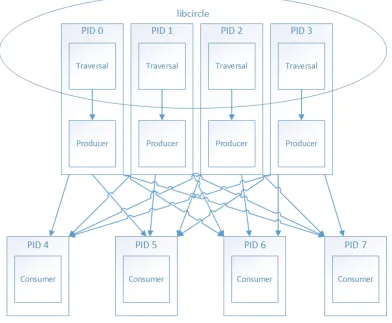
traversal is performed in parallel, and all of those traversal processes then act as
producers. So now instead of a single producer, many consumer model we have a many
producer, many consumer model. This allows better utilization of the capabilities of
a network filesystem.
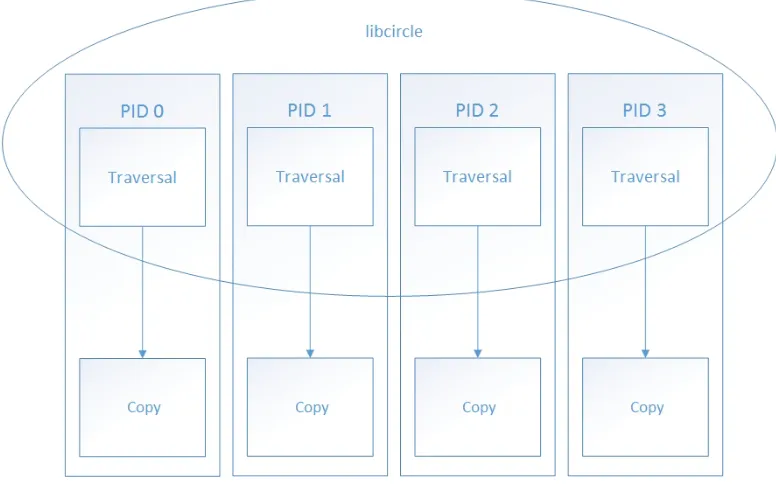
Each phase of this must be decentralized in order to be able to handle the failure
of an arbitrary process, and to be scalable. The following sections describe how this
was accomplished for each of the phases of pct. See Figure 3.1, showing the parts of
Figure 3.1: PCT parts - 4 producers, 4 consumers
3.2
Traversal
The traversal phase was modified to use thelibcirclelibrary. This is an open-source library that can be obtained through GitHub [9].
The libcircle library provides an API for scalable operations. Each process maintains its queue of work items and is able to exchange work items with random
processes without a central coordinator. To keep the processes balanced, libcircle
makes work requests to random nodes when work is needed. If the node requested
the job to be performed. This makeslibcirclevery versatile, since the interpretation of the items is left to the user-defined functions. It can introduce some inefficiency
however since the work item is a fixed-sized array of characters that must be large
enough to contain any potential item descriptor.
In the pct implementation, the function to produce the initial work item takes the parameters passed in by the user and enqueues a string describing the source
and destination directories. The function to process a work item walks a single level
within its directory. It adds the files to its producer queue to be combined with other
files into a copy job. Each of the subdirectories are added to the libcircle work queue to be processed independently.
create_work
for item in directory if item is directory
enqueue to libcircle queue else if item is file
enqueue to local producer queue
Although thelibcircleprovides much of the decentralization necessary for fault tolerance it does not handle the failure of a process. This project modified the
libcircle code to be able to handle this. It was modified to use intercommuni-cators, and to tolerate a failure to communicate with a process. The idea to use
intercommunicators to facilitate fault tolerance came from the “Fault Tolerance in
MPI Programs” paper by William Gropp and Ewing Lusk [1].
Using standard communicators in MPI does not allow for the failure of a process.
By instead using an array of intercommunicators, a process still has a means to
a version of MPI that supports returning an error to the program when a send or
receive error is encountered. When an error is returned on a send or receive, the
program notes that that rank is no longer available, and continues communicating
with remaining ranks via their respective intercommunicators.
When processes fail in their random work requests they pick a new random node
to request work from. Barrier operations are now handled by a two-pass token ring.
This token includes a mask of the nodes that are currently alive. All processes must
agree that they are done and agree on the mask of alive nodes before the operation
can complete. The first pass begins when processes reach the barrier. The process
that starts this operation sets an identifier for the barrier it has reached, and the
mask of ranks it believes are still alive. The token is then passed to the next rank. If
that process finds that it disagrees on the nodes that are still alive, it will change the
mask to a matching subset of nodes between its mask and the mask it received in the
token. It will also set its current barrier number; since the barriers in this program are
sequential it will set the barrier to a lower number if it has not yet reached the latest
barrier. This indicates to the other processes that it is not yet time to move on. The
token continues around until a sender receives a token identical to the one it started
around the loop. At this point the token is modified to indicate to all processes that
it is time to move on from the barrier, and the token is sent once more around the
loop.
token barrier
receive token with token_mask and token_barrier_number and token_originator
if token_barrier_number == end barrier number done with this barrier
increment my_barrier_number
send token with updated barrier number to next process continue
if my_barrier_number < token_barrier_number set token_barrier_number to my_barrier_number
if my_mask != token_mask
set my_mask to (my_mask & received_mask) set token_mask to my_mask
send token to next process continue
The token ring is also used to implement a heartbeat to remove nodes from the
mask when they stop responding. This heartbeat token works just like the barrier
token, but its operation is a bit more simple. It just provides updates to all alive
processes on which ranks are still available.
Within the API’s user-defined function for consuming work, in this case the
function to walk a particular directory, we added the capability to send backup copies
to a specified number of backup nodes. This is how robustness to process failure is
enforced in this phase. Each node has a queue of the jobs it owns, as well as queues
of jobs for which it is the first backup, second backup, etc. The number of backups
is determined by the user when the program is launched, based on the number of
process failures the job should tolerate. If, for example, the number of backups is
two then process 0 will send a copy of the work items it creates to the first backup
queue on process 1, and the second backup queue on process 2. If process 0 fails then
process 1 will add the work items from its first back queue to its owner queue. If
queue (previously owned by process 1) and its second backup queue (previously owned
by process 0). In this example each process is sending to the next two processes in
numerical order, looping back to process 0 at the end. Because of this model a run
where two backups are used may actually tolerate far more than two process failures.
It can tolerate at most the failure of two adjacent processes before data is lost.
replicate directory to backups for i in 1 to backup_count
set backup_process to (my_rank + i) % number_processes send to queue i on process backup_process
Once a directory has been traversed and its files have been added to the producer
queue, and its subdirectories added and replicated, then the directory work item
can be released along with its backup copies. This means the queue of work items
and their backups consist of only the lowest unexamined level of each branch of the
directory tree.
When a traversal process randomly splits its queue to pass work to the another
process, we must take steps to retain reduncancy. Jobs are first copied to the new
backups, then the new owner, then removed from the old backups. This ensures that
if a process fails while splitting its queue, the job will still be picked up by a backup.
When all the traversal processes have run out of work items the file tree has been
walked in its entirety, and all the file descriptors have been added to the queue for
the copy job producer.
3.3
Producer
The producer phase also implements this same type of redundancy. This phase is
can be forgotten in the traversal process, one or more backup copies of the file’s
description is added to backup queues in other proccesses. Then if one of the producer
processes fails its backup will add the list of files into its owner queue. The producer
phase leverages the code from the pct project to batch files into jobs based on the number of files and their size. The producer sends these copy jobs to the consumer
processes. The producer does not remove the files from its list until the consumer
acknowledges that the corresponding copy job has completed successfully.
create copy job
combine files into a job with a ticket number send job to ready consumer
release copy job
receive completion acknowledgement with ticket number from consumer look up job in local queue
for file in job
release file in backup queues of remote processes release file in local queue
3.4
Consumer
Since the producer maintains its list of files, protected by the specified level of
redun-dancy, until the copy job is completed there is no need for another level of replication
in the consumers. If a consumer process dies while a producer has outstanding jobs to
that process, then the producer will simply assign those files to a new consumer. For
this reason, regardless of the level of redundancy specified at the start of the job any
number of consumer processes may be lost until there is only one remaining without
Again the token ring is used to maintain a heartbeat and keep track of a mask
of the nodes that are still communicating. The token ring is also used for barrier
CHAPTER 4
EXPERIMENTAL SETUP AND RESULTS
4.1
Introduction
This software was tested in a number of different enviornments, for correctness as well
as to look at the scalability and portability. This ranged from a VM running on a
standard PC, to a small cluster at BSU, to a large high performance computing cluster
at INL. Tests were also performed in a cloud-computing environment through Amazon
AWS. See the sections below for details on the setup in each of these enviroments as
well as the results.
4.2
Experimental Setup
4.2.1 Linux VM
This environment was used for development testing. All MPI processes run on the
same machine. This environment was useful for initial development and for testing of
process failure and recovery. Since this is a Linux VM running on a standard desktop
PC, with one hard drive and no parallel filesystem, this setup was not used for testing
the performance and scalability of this implementation.
Linux VM details:
CPUs - 1 Memory - 2 GB
4.2.2 BSU GeneSIS Cluster
The GeneSIS cluster at BSU has the Lustre parallel filesystem. This environment
was used to test the correctness of this product in a real-world cluster.
See Appendix B for more information about this cluster.
Debug code was added to pct to test recovery from process failure in this en-vironment. The program reads a configuration file when it starts up. Each line in
the file specifies a process number, a specific point in the code, and a count. Once
that process has executed that code the specified number of times it will trigger
an abnormal termination. This forces the surviving processes to go through their
recovery mechanisms and process the backup work items for that process.
This code uses a simple mechanism to accomplish this. Calls to the function
code point count are sprinkled throughout the code. Each place that calls this function calls it with a unique identifier. If the configuration file had an error set up
for this process and point, and the count is reached, it triggers a seg fault.
void code_point_count(int point) {
int *x = 0; int y;
code_point_counters[point].cur_count++;
if (code_point_counters[point].cur_count == code_point_counters[point].limit) { // Segfault
printf("*** Injected error ***\n"); y = *x;
} }
lost.
• Producer - Panic a producer with a number of items in its queue. Make sure the backup picks up this work and sends it to the consumers.
• Consumer - Panic a consumer when it has an outstanding job from a producer. Ensure the producer reassigns the job to another consumer.
In addition to this programmatic method of testing, this was also tested by
randomly killing process via the command line while the program was running.
The GeneSIS cluster was also one of the environments used to test the performance
of pct. Results are recorded below.
4.2.3 INL Falcon Cluster
The Falcon cluster at INL was used to test the scalability of this product. This is a
much larger cluster, allowing for experiments with 16 and 32 MPI processes, with each
process on its own node. Processes were spread out one per node to reduce contention
for network interfaces. Nodes were not reserved exclusively for this experiment, jobs
from other users were allowed to run on other CPUs on the same node. This, along
with contention for the network filesystem, created some variability in the amount of
time taken to complete each job.
4.2.4 Amazon AWS
The pct tool was also tested in a cloud computing environment. Amazon AWS provides a template to launch a cluster of VMs using the Lustre parallel filesystem [3].
A user fills out the template, choosing the VM type for each of the components
required to set up the Lustre filesystem, as well as the clients that will have access to
that system. Once setup completes, each of the clients has the Lustre filesystem
mounted. After installing MPICH and other necessary packages the cluster has
everything necessary to test pct.
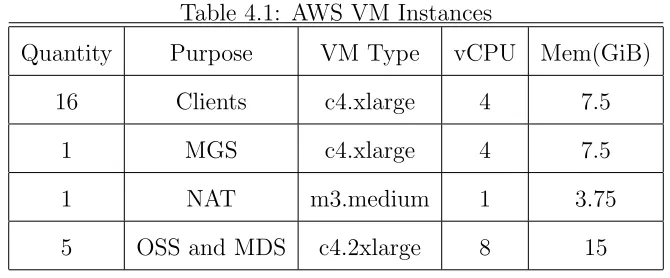
The following table shows the VM types that were used in this experiment.
See Table 4.1. A full description of the types can be found through AWS, a brief
description including number of virtual CPUs and memory size has been included
here.
Table 4.1: AWS VM Instances
Quantity Purpose VM Type vCPU Mem(GiB)
16 Clients c4.xlarge 4 7.5
1 MGS c4.xlarge 4 7.5
1 NAT m3.medium 1 3.75
5 OSS and MDS c4.2xlarge 8 15
This setup was also used to measure performance against the Linux ‘cp’ command
This was tested on the GeneSIS cluster at BSU and the Falcon cluster at INL with
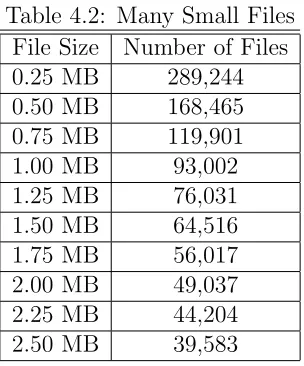
two different data sets. The first set is the “Many Small Files” set. This set is a
directory tree with 17,596 total directories. It contains 1,000,000 files totaling 904.1
GB. The files sizes range from 0.25 MB to 2.50 MB. See Table 4.2. The second set
is the “Fewer Large Files” set. This set is a directory tree with 185 directories. It
contains 2,460 files totaling 989 GB. The file sizes range from 1 MB to 3480 MB. See
Table 4.3. In both cases the distribution used to determine the file sizes is a “zipf”
distribution. The files are uniformly distributed across the directories in the tree.
Files were filled with random data generated by /dev/urandom
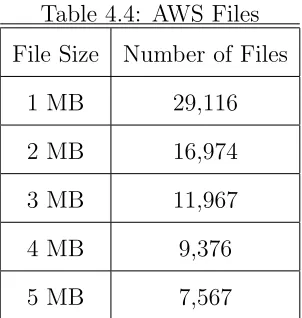
The data set used on the AWS cluster was a randomly generated directory tree
of 1,469 directories. It contained 75,000 files, rangining from 1 MB to 5 MB. A zipf
distribution was used to determine the file sizes. The files were uniformly distributed
across the directories. Files were filled with random data generated by/dev/urandom. See Table 4.4.
Table 4.2: Many Small Files File Size Number of Files
0.25 MB 289,244
0.50 MB 168,465
0.75 MB 119,901
1.00 MB 93,002
1.25 MB 76,031
1.50 MB 64,516
1.75 MB 56,017
2.00 MB 49,037
2.25 MB 44,204
Table 4.3: Fewer Large Files File Size Number of Files
1 MB to 1023 MB 2,097
1024 MB to 2047 MB 205
2048 MB to 3071 MB 122
3072 MB to 3480 MB 36
Table 4.4: AWS Files
File Size Number of Files
1 MB 29,116
2 MB 16,974
3 MB 11,967
4 MB 9,376
5 MB 7,567
4.4
Timing Measurements
4.4.1 BSU GeneSIS Cluster - Copy, Zero Backups
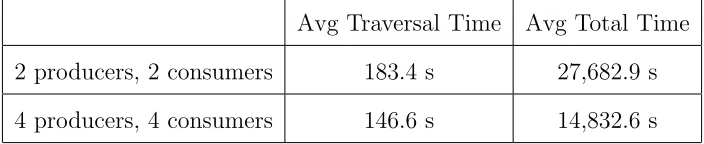
The tests on the GeneSIS cluster at BSU used the “Many Small Files” (see Tables 4.5
and 4.6) and “Fewer Large Files” (see Table 4.7) sets described above. The results of
these tests are shown below. Measurements were taken for the amount of time taken
to traverse the directory tree and discover the files to be copied, and the total time
Avg Traversal Time Avg Total Time
2 producers, 2 consumers 183.4 s 27,682.9 s
4 producers, 4 consumers 146.6 s 14,832.6 s
Table 4.6: BSU GeneSIS Cluster Results - Linux ’cp’ command - Many Small Files
Avg Total Time
46,202.687 s
Table 4.7: BSU GeneSIS Cluster Results - Fewer Large Files
Avg Traversal Time Avg Total Time
2 producers, 2 consumers 1.3 s 6,728.5 s
4 producers, 4 consumers 1.8 s 7,943.0 s
4.4.2 INL Falcon Cluster
Tests on the Falcon cluster at INL used the same “Many Small Files” and “Fewer
Large Files” sets as the tests on the GeneSIS cluster at BSU. Only the data in the
files was different, since the data set was rebuilt on this cluster and files are filled
from/dev/urandom. The results of these tests are shown below. Measurements were taken for the amount of time taken to traverse the directory tree and discover the
files to be copied, and the total time taken for both traversal and copying the files.
Table 4.8: INL Falcon Cluster Results - Many Small Files
Avg Traversal Time Avg Total Time
8 producers, 8 consumers 125.7 s 19,474.0 s
16 producers, 16 consumers 150.3 s 10,918.7 s
Table 4.9: INL Falcon Cluster Results - Fewer Large Files
Avg Traversal Time Avg Total Time
8 producers, 8 consumers 14.2 s 1,478.7 s
16 producers, 16 consumers 16.2 s 885.7 s
4.4.3 Amazon AWS
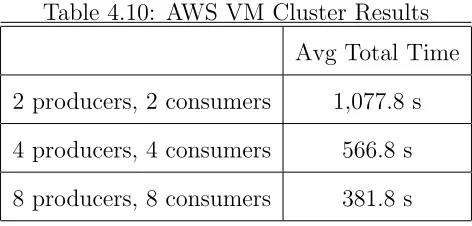
The tests on the AWS VM cluster used the “AWS Files” set detailed above. The
results of these tests are shown below, see Table 4.10.
Table 4.10: AWS VM Cluster Results
Avg Total Time
2 producers, 2 consumers 1,077.8 s
4 producers, 4 consumers 566.8 s
8 producers, 8 consumers 381.8 s
4.4.4 AWS Cluster - Tree Traversal, Varying Backups
Tests were performed to measure the impact of the redundancy features that were
added topct. This involved creating a very large directory tree and performing only the traversal portion of the copy. Multiple tests were performed, varying the number
Table 4.11: AWS Cluster Results - Tree Traversal, Varying Backups
Avg Traversal Time
4 producers, 0 backups 144.2 s
4 producers, 1 backups 154.7 s
4 producers, 2 backups 159.1 s
8 producers, 0 backups 76.4 s
8 producers, 1 backups 80.1 s
8 producers, 2 backups 82.7 s
8 producers, 3 backups 84.4 s
Even on this very large directory tree, replicating work to multiple backups did
not have a large impact on the time needed to perform the directory traversal. The
time jump from zero to one backups is a bit larger than the jump from one to two.
This is because with zero backups there is no replication; with one there is replication
to the single backup as well as re-replication to the new owner and the new backups
when the libcircle queue is randomly split to share work. Moving from one to two
adds just one more backup into the steps needed for one backup.
4.5
Comparison to Existing Tools
tools used the same VM setup and the same file tree setup as the pct experiment detailed above.
cp was tested with the standard parameters to provide a baseline to compare the
performance of pct, dcp, and mcp.
The results of tests withpct,dcp, andmcpare shown each using 4, 8, and 16 MPI processes.
4.5.1 dcp - Setup
dcp is part of the mpifileutils suite developed by LANL [8]. Like pct, dcp uses
libcircle as part of its implementation. See Figure 4.1 for the dcp design. In addition to the requirements formcp, the following packages were installed to compile
dcp: automake, libtool, gcc-c++, libarchive-devel, git, openssl-devel. There are also additional packages required from github: libcircle [9], lwgrp [11], and dtcmp [12].
This left compilation errors for some of the utilities in mpifileutils but was sufficient
to compile dcp.
4.5.2 mcp - Setup
mcp is part of the mutil suite developed by NASA [7]. See Figure 4.2 for the mcp
design. This comparison was done with mutil-1.76.1. This is a patch for coreutils-7.6.
In addition to coreutils and the mutil patch, the following packages were required to
compile and use this software: kernel-headers, gcc, gperf, mpich-devel. The configure
file was modified to work with mpich. Experimentation showed that with the default
parameters, including –mpi, the program never exits. Instrumentation was added to
track down the problem. MPI process 0 never exits because it is waiting for a flag
Figure 4.1: DCP parts - 4 MPI processes
–print-stats flag is used. For this reason –print-stats was included on the command
line in the tests using mcp.
4.5.3 Results
pct, dcp, and mcp all showed a significant improvement over the standard cp. pct
showed significant improvement with an increasing number of processes. dcp was faster than pct with 4 and 8 processes, although pct outperformed dcp at 16 pro-cesses. It is worth noting that dcpis using all MPI processes for the actual copying, whereas pct is using only half with the given parameters. mcp was comparable to
dcpat 4 MPI processes, but showed no significant improvement increasing to 8 or 16 processes. Bothpctand dcpoutperformedmcpwith the higher numbers of processes.
Figure 4.2: MCP parts - 4 MPI processes
Table 4.12: AWS VM Tool Comparison - “AWS Files” Set (Table 4.4)
Tool MPI Procs Params Avg Total Time
cp NA default 1938.1 s
pct 4 2 prod, 2 cons 1077.8 s
pct 8 4 prod, 4 cons 566.8 s
pct 16 8 prod, 8 cons 381.8 s
dcp 4 default 608.6 s
dcp 8 default 403.1 s
dcp 16 default 393.6 s
mcp 4 –mpi –print-stats 627.1 s
mcp 8 –mpi –print-stats 604.7 s
2 4 6 8 10 12 14 16 18 20 22 24 26 400
600 800 1,000 1,200 1,400 1,600 1,800 2,000
MPI Processes
Seconds
pct dcp mcp
CHAPTER 5
CONCLUSIONS
5.1
What have we done so far?
The goal of this project was to create a solution to the problem of copying files in
a network filesystem, building on the work of Kevin Nuss. The software tool should
meet the three criteria stated earlier: Performance, Scalability, and Robustness.
The experiments detailed here have shown that this software is able to perform well
in and scale to a variety of environments, from a single VM instance, to a large high
performance computing cluster, to a VM cluster in a cloud computing environment.
For a sufficiently large file tree, speedups were realized increasing to very large sets
of processes working on the tree. This showed very large improvements over the
standard Linux cp command.
pct performance was comparable to the tools it was compared against, mcp and
dcp. At lower numbers of MPI processes these tools outperformed pct, though as noted above much of this can be explained by the fact that pct uses only half of its processes to do the actual copying. With increasing numbers of MPI processes pct
actually outperformed both of these tools on the randomly generated file tree with
which they were tested.
By adding options to tolerate process failure, this software becomes even more
this project, and is not addressed in other of the other software that was studied.
5.2
Future directions
There are some opportunities for enhancements and improvements in this project.
In the current implementation the traversal phase runs to completion before the
producer/consumer phase begins. This means the source and destination descriptions
for the entire file tree are queued up all at once. If the file tree is sufficiently large
compared to the memory available for thepctprocesses, this could lead to issues with running out of memory. This issue is compounded when using a higher number of
backups, since the memory required to queue up all these items is directly proportional
to the number of backups (i.e. adding one backup doubles the amount of memory
needed for this queue). One way to alleviate this memory pressure would be to
allow the file copying to begin while the traversal is still ongoing. As files finish
copying, the record of source and destination description is released, along with the
backup copies. A configurable memory cap could be implemented, where the traversal
processes would be throttled from adding new items to the producer queue until the
producer/consumer processes have completed enough work to make room for the new
items. This could potentially affect the speed of the copy, especially if that cap is set
at a low number, but it would add greater flexibility to allow this software to work
in a larger set of environments.
Another area of opportunity is in the libcircle library itself. The libcircle
fixed size means that all work items use the same amount of memory regardless of
the actual string length needed to describe the source and destination paths. Files
with small path descriptor lengths have a lot of unused space that is wasted. The
maximum length must be set long enough to include the maximum path length for
both the source and the destination paths, or pct will fail to copy files of a large enough path length. Significant modification would be required to introduce variable
buffer sizes in the libcircle work items, as well as modification on the pct side. This modification could potentially make the software more flexible. As with the
improvements described above, this would also increase the set of environments where
this software could be effective.
Currently the MPI processes that perform the traversal are the same processes
that act as producers in the copy phase of pct. This introduces a couple of limitations. The test results showed that as the number of processes performing the traversal gets
sufficiently large, it actually takes more time to traverse the tree than it would with a
smaller number of proceeses. This is because the overhead of communication between
the processes, and exchanging jobs between processes in libcircle, becomes large compared to the time needed to actually walk the tree. The traversal and producer
processes could be decoupled. This would allow more fine tuning, since a different
number of processes could be specified for performing the traversal and for the number
of processes acting as producers. This would require some additional work, but would
also open the door to another area of improvement. Currently the process that
traverses a directory keeps all files discovered in the first level of that directory in
its queue, while queueing subdirectories to be walked by any process. Although the
traversal phase allows directory walk jobs to be swapped between processes to more
fairly evenly. But it is possible to construct a file tree that in the worst case would
highly skew the file list to one process. The producer processes could be enhanced to
balance their load. It is questionable how much benefit this would provide in overall
speed, since the consumers doing the actual copy are the bottleneck at this phase and
REFERENCES
[1] Gropp and Lusk.Fault Tolerance in MPI Programs, Jul. 2016,http://www.mcs. anl.gov/publication/fault-tolerance-mpi-programs
[2] Pinheiro, Weber, Barroso. Failure Trends in a Large Disk Drive Population, 2007, https://www.usenix.org/legacy/events/fast07/tech/full_papers/ pinheiro/pinheiro_old.pdf
[3] Bhakti, Micah. Intel Cloud Edition for Lustre - Self Support Feb. 2018, https://wiki.hpdd.intel.com/display/PUB/Intel+Cloud+Edition: for:Lustre*+-+Self+Support
[4] Knuss, Kevin.Parallel Copy Tools for Distributed File SystemsMar. 2013,http: //scholarworks.boisestate.edu/cs_gradproj/4/
[5] Grider and Torrez. MPI File Tree Walk Apr. 2007, https://www.osti.gov/ scitech/biblio/12311011-mpi-file-tree-walk
[6] Bisson, Patel and Pasupathy. Fast File System Crawler https://atg.netapp. com/wp-content/uploads/2012/12/FS_crawler_Bisson.pdf
[7] Kolano and Ciotti. Multi-Threaded Multi-Node Utilities (Mutil) https:// pkolano.github.io/projects/mutil.html
[8] Bringhurt, et al. Mpifileutils https://github.com/hpc/mpifileutils
[9] Bringhurst and LaFon.Libcircle https://github.com/hpc/libcircle
[10] Wu, Tony and Hopkins, Tycen “Parallel file system architecture: compute nodes look up file information via metadata services, then perform I/O tasks against object storage” Parallel File Systems for HPS Storage on Azure Ed Price, Microsoft, 2017,https://blogs.msdn.microsoft.com/azurecat/2017/ 03/17/parallel-file-systems-for-hpc-storage-on-azure/
[11] Unknown Lwgrp, Lawrence Livermore National Laboratory, https://github. com/hpc/lwgrp
IDAHO NATIONAL LABORATORIES - FALCON
CLUSTER
These details of the Falcon cluster at Idaho National Laboratories were provided by
Peter Cebull.
Storage: Our high-speed scratch storage resides on a Panasas ActiveStor 14
system, using a PanFS parallel file system. Each compute node on the Falcon compute
cluster runs a Panasas DirectFlow client to optimize file I/O between the compute
nodes and the storage server. There is 230 TB of scratch storage.
Falcon is an SGI ICE-X distributed memory system with 34,992 cores, 121 TB of
memory and a LINPACK rating of 1,087.58 TFlops. Falcon came online in November
2014 and ranked 97th on the TOP500 list. After a series of upgrades to the current
34,992 cores, it is currently #143 on the TOP500.
Specifications:
• Overview
– 34992-core SGI ICE X distributed memory cluster
– 121 TB total memory
– FDR InfiniBand Network (56 Gbit/s), Single-Plane Enhanced Hypercube
Topology
– SUSE Linux Enterprise Server 11 Service Pack 4 operating system
– LINPACK: 1087.58 TFlops
∗ Broadwell chipset ∗ 18 cores per CPU ∗ 2.10 GHz
– 128GB of RAM
The details on the GeneSIS cluster at Boise State University were provided by Ben
Peterson.
The GeneSIS storage cluster which is a 21 node Beowulf style cluster dedicated
to bioinformatics research is:
• Connected via both dual channel bonded GigE and low latency infiniband SDR.
• Eight dedicated processing nodes, Intel i7 Quadcore processors, 12 GB system memory.
• Eight dedicated storage nodes supporting a parallel distributed storage system with Intel i7 Quadcore processors, 12 GB system memory each node, total 78
Amazon AWS provides a template to launch a cluster of VMs using the Lustre parallel
filesystem [3]. This template does most of the work creating the cluster. It sets up all
the Lustre filesystem components, creates the worker VMs of the user-specified type,
then mounts the file system on the worker VMs. After that, it is up to the user to
install software and all the necessary packages.
pct requires installing kernel-headers, gcc, gperf, and mpich-devel packages. It also requires git in order to retrieve the code from github.
Setting up the cluster to be able to run the mpi program requires setting up ssh
keys along with an ssh config file to be able to log into each node without a password.
It also requires adding the all nodes to the /etc/hosts files.
One of the sources of frustation trying to set this up is the default firewall settings.
Adding VMs to the same security group made no difference in allowing them to
communicate via MPI. The firewall has all relevant ports locked down. The easiest
Some tools were created to aid in testing pct
• rand dir - This tool is used to created a randomly generated directory. A configuration file is used to specify the maximum depth of the directory tree
and the maximum number of children per directory. It also specifies a number
of files to create, their size range, and the distribution to use when determining
the size. Distributions currently supported are normal and zipf. Seeds are used
to be able to create the same tree on multiple systems. Files are filled with
random data from the /dev/urandom device.
• dist dir - This tool provides some distributed operations to aid in testing. These operation include distributed checksum between two trees, and distributed
![Figure 1.1: Structure of a Parallel Filesystem [10]](https://thumb-us.123doks.com/thumbv2/123dok_us/1147478.1616396/13.612.162.487.101.328/figure-structure-of-a-parallel-filesystem.webp)