Multiple-Access Channels
!Antonio Fern´andez Anta1,
Miguel A. Mosteiro2,3, and Jorge Ram´on Mu˜noz3
1 Institute IMDEA Networks, Madrid, Spain
2 Department of Computer Science, Rutgers University, Piscataway, NJ, USA
3 LADyR, GSyC, Universidad Rey Juan Carlos, M´ostoles, Spain
Abstract. A frequent problem in settings where a unique resource must be shared among users is how to resolve the contention that arises when all of them must use it, but the resource allows only for one user each time. The application of efficient solutions for this problem spans a myr-iad of settings such as radio communication networks or databases. For the case where the number of users is unknown, recent work has yielded fruitful results for local area networks and radio networks, although ei-ther a (possibly loose) upper bound on the number of users needs to be known [7], or the solution is suboptimal [2], or it is only implicit [11] or embedded [6] in other problems, with bounds proved only asymptot-ically. In this paper, under the assumption that collision detection or information on the number of contenders is not available, we present a novel protocol for contention resolution in radio networks, and we recre-ate a protocol previously used for other problems [11, 6], tailoring the constants for our needs. In contrast with previous work, both protocols are proved to be optimal up to a small constant factor and with high probability for big enough number of contenders. Additionally, the pro-tocols are evaluated and contrasted with the previous work by extensive simulations. The evaluation shows that the complexity bounds obtained by the analysis are rather tight, and that both protocols proposed have small and predictable complexity for many system sizes (unlike previous proposals).
1
Introduction
The topic of this work is the resolution of contention in settings where an un-known number of users must access a single shared resource, but multiple si-multaneous accesses are not feasible. The scope of interest in this problem is
!A brief announcement of this work has been presented at PODC 2011. This work
is supported in part by the Comunidad de Madrid grant S2009TIC-1692, Span-ish MICINN grant TIN2008–06735-C02-01, and National Science Foundation grant CCF-0937829.
D. Peleg (Ed.): DISC 2011, LNCS 6950, pp. 225–236, 2011. c
wide, ranging from radio and local area networks to databases and transactional memory. (See [2] and the references therein.)
A common theme in protocols used for this problem is the adaptive adjust-ment of some user variable that reflects its eagerness in trying to access the shared resource. Examples of such variable are the probability of transmitting a message in a radio network or the frequency of packet transmission in a local area network. When such adjustment reduces (resp. increases) the contention, the technique is calledback-off (resp. back-on). Combination of both methods are calledback-on/back-off. Protocols used may be further characterized by the rate of adjustment. E.g., exponential back-off, polynomial back-on, etc. In par-ticular, exponential back-off is widely used and it has proven to be efficient in practical applications where statistical arrival of contenders is expected. Nev-ertheless, worst case arrival patterns, such as bursty or batched arrivals, are frequent [18, 12].
A technique calledLoglog-iterated Back-off was shown to be within a sublogarithmic factor from optimal with high probability in [2]. 1 The pro-tocol was presented in the context of packet contention resolution in local area networks for batched arrivals. Later on, also for batched arrivals, we presented a back-on/back-off protocol in [7], instantiated in the k-selection problem in
Radio Networks (defined in Section 2). The latter protocol, named here Log-Fails Adaptive, is asymptotically optimal for any significant probability of error, but additionally requires that some upper bound (possibly loose) on the number of contenders is known. In the present paper, we remove such require-ment. In particular, we present and analyze a protocol that we callOne-Fail Adaptive for k-selection in Radio Networks. We also recreate and analyze
another protocol fork-selection, called hereExp Back-on/Back-off , which was previously embedded in protocols for other problems and analyzed only asymptotically [11, 6]. Our analysis shows thatOne-Fail Adaptive andExp Back-on/Back-off, both of independent interest, resolve contention among an unknown and unbounded2 number of contenders with high probability in optimal time up to constants. Additionally, by means of simulations, we evalu-ate and contrast the average performance of all four protocols. The simulations show that the complexity bounds obtained in the analysis (with high probability) for these protocols are rather tight for the input sizes considered. Additionally, they show that they are faster that Loglog-iterated Back-off and more predictable for all network sizes thanLog-Fails Adaptive.
Roadmap: The rest of the paper is organized as follows. In the following section the problem, model, related work and results are detailed. In Section 3, we introduceOne-Fail Adaptiveand its analysis. Exp Back-on/Back-offis detailed and analyzed in Section 4. The results of the empirical contrast of all
1 Fork contenders, we definewith high probability to mean with probability at least
1−1/kcfor some constantc >0.
2 We use the term unbounded to reflect that not even an upper bound on the number
four protocols is given in Section 5 and we finish with concluding remarks and open problems in Section 6.
2
Preliminaries
A well-studied example of unique-resource contention is the problem of broad-casting information in a multiple-access channel. A multiple-access channel is a synchronous system that allows a message to be delivered to many recipients at the same time using a channel of communication but, due to the shared na-ture of the channel, the simultaneous introduction of messages from multiple sources produce a conflict that precludes any message from being delivered to any recipient. The particular model of multiple-access channel we consider here is the Radio Network, a model of communication network where the channel is contended (even if radio communication is not actually used [4]). We first precise our model of Radio Network as follows.
The Model: We consider a Radio Network comprised ofnstations callednodes.
Each node is assumed to be potentially reachable from any other node in one communication step, hence, the network is characterized assingle-hop or one-hopindistinctively. Before running the protocol, nodes have no information, not even the number of nodesnor their own label. Time is supposed to be slotted
incommunication steps. Assuming that the computation time-cost is negligible in comparison with the communication time-cost, time efficiency is studied in terms of communication steps only. The piece of information assigned to a node in order to deliver it to other nodes is called a message. The assignment of a message is due to an external agent and such an event is called a message arrival. Communication among nodes is carried out by means of radio broadcast on a shared channel. If exactly one node transmits at a communication step, such a transmission is calledsuccessfulornon-colliding, we say that the message was delivered, and all other nodes receive such a message. If more than one message is transmitted at the same time, a collision occurs, the messages are garbled, and nodes only receiveinterference noise. If no message is transmitted in a communication step, nodes receive only background noise. In this work, nodes can not distinguish between interference noise and background noise, thus, the channel is called without collision detection. Each node is in one of two states,active if it holds a message to deliver, or idle otherwise. As in [2, 16, 11], we assume that a node becomes idle upon delivering its message, for instance when an explicit acknowledgement is received (like in the IEEE 802.11 Medium Access Control protocol [1]). For settings where the channel does not provide such functionality, such as Sensor Networks, a hierarchical infrastructure may be predefined to achieve it [6], or a leader can be elected as the node responsible for acknowledging successful transmissions [22].
channel of communication, each of them at least once. As in [2, 16, 11], in this paper we study k-selection when all messages arrive simultaneously, or in a
batch. Under this assumption thek-selection problem is calledstatic. Adynamic
counterpart where messages arrive at different times was also studied [16].
The Problem: Given a Radio Network where k network nodes are activated
by a message that arrives simultaneously to all of them, the static k-selection
problem is solved when each node has delivered its message.
Related Work: A number of fruitful results for contention resolution have been obtained assuming availability of collision detection. Martel presented in [19] a randomized adaptive protocol fork-Selection that works inO(k+ logn) time in
expectation3. As argued by Kowalski in [16], this protocol can be improved to
O(k+ log logn) in expectation using Willard’s expected O(log logn) selection
protocol of [23]. In the same paper, Willard shows that, for any given protocol, there exists a choice of k ≤ n such that selection takes Ω(log logn) expected
time for the class of fair selection protocols (i.e., protocols where all nodes use the same probability of transmission to transmit in any given time slot). For the case in which n is not known, in the same paper a O(log logk) expected
time selection protocol is described, again, making use of collision detection. If collision detection is not available, using the techniques of Kushilevitz and Mansour in [17], it can be shown that, for any given protocol, there exists a choice ofk≤nsuch thatΩ(logn) is a lower bound in the expected time to get
even the first message delivered.
Regarding deterministic solutions, thek-Selection problem was shown to be
in O(klog(n/k)) already in the 70’s by giving adaptive protocols that make
use of collision detection [3, 13, 20]. In all these results the algorithmic tech-nique, known astree algorithms, relies on modeling the protocol as a complete binary tree where the messages are placed at the leaves. Later, Greenberg and Winograd [10] showed a lower bound for that class of protocols ofΩ(klogkn). Regarding oblivious algorithms, Koml`os and Greenberg [15] showed the exis-tence of O(klog(n/k)) solutions even without collision detection but requiring
knowledge ofk andn. More recently, Clementi, Monti, and Silvestri [5] showed
a lower bound ofΩ(klog(n/k)), which also holds for adaptive algorithms if
colli-sion detection is not available. In [16], Kowalski presented the construction of an oblivious deterministic protocol that, using the explicit selectors of Indyk [14], gives aO(kpolylogn) upper bound without collision detection.
In [9], Ger`eb-Graus and Tsantilas presented an algorithm that solves the problem of realizing arbitraryh-relations in ann-node network, with probability
at least 1−1/nc, c > 0, in Θ(h+ lognlog logn) steps. In an h-relation, each processor is the source as well as the destination of at mosthmessages. Making h=kthis protocol can be used to solve statick-selection. However, it requires
that nodes knowh.
Extending previous work on tree algorithms, Greenberg and Leiserson [11] presented randomized routing strategies in fat-trees for bounded number of
3 Througout this paper, log means log
messages. Underlying their algorithm lies a sawtooth technique used to “guess” the appropriate value for some critical parameter (load factor), that can be used to “guess” the number of contenders in statick-selection. Furthermore, modulo
choosing the appropriate constants, Exp Back-on/Back-off uses the same sawtooth technique. Their algorithm usesnand it is analyzed only
asymptoti-cally.
Monotonic back-off strategies for contention resolution of batched arrivals of
k packets on simple multiple access channels, a problem that can be seen as
statick-selection, have been analyzed in [2]. In that paper, it is shown that r
-exponential back-off, a monotonic technique used widely that has proven to be efficient for many practical applications is inΘ(kloglogrk) for batched arrivals.
The best strategy shown is the so-calledloglog-iterated back-off with a makespan inΘ(klog logk/log log logk) with probability at least 1−1/kc, c >0, which does not use any knowledge ofkorn. In the same paper, the sawtooth technique used
in [11] is informally described in a paragraph while pointing out that it yields linear time for contention resolution thanks to non-monotonicity, but no analysis is provided.
Later on, Farach-Colton and Mosteiro presented an optimal protocol for Gos-siping in Radio Networks in [6]. The sawtooth technique embedded in [11] is used in that paper as a subroutine to resolve contention in linear time as in Exp Back-on/Back-off. However, the algorithm makes use of nto achieve
the desired probability of success and the analysis is only asymptotical.
A randomized adaptive protocol for static k-selection in a one-hop Radio
Network without collision detection was presented in [7]. The protocol is shown to solve the problem in (e+ 1 +ξ)k+O(log2(1/ε)) steps with probability at
least 1−2ε, whereξ >0 is an arbitrarily small constant and 0< ε≤1/(n+ 1).
Modulo a constant factor, the protocol is optimal ifε∈Ω(2−√n). However, the algorithm makes use of the value ofε, which must be upper bounded as above
in order to guarantee the running time. Therefore, knowledge ofnis required.
Our Results: In this paper, we present a novel randomized protocol for static
k-selection in a one-hop Radio Network, and we recreate a previously used
tech-nique suiting the constants for our purpose and without making use ofn. Both
protocols work without collision detection and do not require information about the number of contenders. As mentioned, these protocols are calledOne-Fail Adaptiveand Exp Back-on/Back-off. It is proved thatOne-Fail Adap-tivesolves statick-selection within 2(δ+ 1)k+O(log2k) steps, with probability
at least 1−2/(1 +k), for e< δ≤!5j=1(5/6)j. On the other hand,Exp Back-on/Back-offis shown to solve statick-selection within 4(1 + 1/δ)ksteps with
probability at least 1−1/kc for some constant c > 0, 0 < δ < 1/e, and big enoughk. Given thatk is a lower bound for this problem, both protocols are
optimal (modulo a small constant factor) for big enough number of contenders. Observe that the bounds and the probabilities obtained are given as functions of the parameterk, as done in [2], since this is the input parameter of our version
Both protocols presented are of interest because, although protocolExp Back-on/Back-offis simpler,One-Fail Adaptiveachieves a better multiplicative factor, although the constant in the sublinear additive factor may be big for small values ofk.
Additionally, results of the evaluation by simulation of the average behavior ofOne-Fail AdaptiveandExp Back-on/Back-offand a comparison with Log-Fails Adaptiveand Loglog-iterated Back-offare presented. Both algorithmsOne-Fail AdaptiveandExp Back-on/Back-offrun faster than Loglog-iterated Back-offon average, even for small values ofk. Although
Loglog-iterated Back-offhas higher asymptotic complexity, one may have expected that it may run fast for small networks. On the other hand, the knowl-edge on a bound of k assumed by Log-Fails Adaptive seems to provide an edge with respect to One-Fail Adaptive and Exp Back-on/Back-off for large values of k. However,Log-Fails Adaptive has a much worse behavior than the proposed protocols for small to moderate network sizes (k≤105). In any case, for all values ofk simulated, One-Fail Adaptive and Exp Back-on/Back-offhave a very stable and efficient behavior.
3
One-Fail Adaptive
As inLog-Fails Adaptive [7],One-Fail Adaptiveis composed by two in-terleaved randomized algorithms, each intended to handle the communication for different levels of contention. One of the algorithms, which we call AT, is intended for delivering messages while the number of nodes contending for the channel is above some logarithmic threshold (to be defined later). The other algorithm, calledBT, has the purpose of handling message delivery after that number is below that threshold. Nonetheless, a node may transmit using the BT (resp. AT) algorithm even if the number of messages left to deliver is above (resp. below) that threshold.
Both algorithms, AT and BT, are based on transmission trials with certain probability and what distinguishes them is just the specific probability value used. It is precisely the particular values of probability used in each algorithm what differentiates One-Fail Adaptive from Log-Fails Adaptive. For the BT algorithm, the probability of transmission is inversely logarithmic on the number of messages already transmitted, while in Log-Fails Adaptive that probability was fixed. For the AT algorithm the probability of transmission is the inverse of an estimation on the number of messages left to deliver. In One-Fail Adaptivethis estimation is updated continuously, whereas in Log-Fails Adaptiveit was updated after some steps without communication. These changes yield a protocol still linear, but now it is not necessary to known.
Fur-ther details can be seen in Algorithm 1.
Algorithm 1.One-Fail Adaptive. Pseudocode for nodex.δis a constant such thate < δ≤!5
j=1(5/6)
j.
uponmessagearrival do
1 "
κ←δ+ 1 // Density estimator
2
σ←0 // Messages-received counter
3
starttasks 1,2 and 3 4
Task1
5
foreachcommunication-step= 1,2, . . . do
6
if communication-step≡0 (mod 2)then // BT-step
7
transmit %x,message&with prob 1/(1 + log(σ+ 1)) 8
else // AT-step
9
transmit %x,message&with probability 1/"κ
10
"
κ←"κ+ 1 11
Task2
12
uponreception from other node do
13
σ←σ+ 1 14
if communication-step≡0 (mod 2)then // BT-step
15
"
κ←max{κ"−δ, δ+ 1} 16
else // AT-step
17
"
κ←max{κ"−δ−1, δ+ 1} 18
Task3
19
uponmessagedeliverystop
20
handling the communication after that threshold is crossed. For the latter, we use standard probability computations to show our time upper bound. For the AT algorithm, we use concentration bounds to show that the messages are delivered with large enough probability, while the density estimator "κ does not exceed
the actual number of messages left. This second proof is more involved since it requires some preliminary lemmas. We establish here the main theorem, which is direct consequence of the lemmata described that can be found in [8].
Theorem 1. For anye < δ≤!5j=1(5/6)j and for any one-hop Radio Network under the model detailed in Section 1, One-Fail Adaptive solves static k
-selection within 2(δ+ 1)k+O(log2k) communication steps, with probability at
least1−2/(1 +k).
4
Exp Back-on/Back-off
The algorithm presented in this section is based in contention windows. That is, each node repeatedly chooses uniformly one time slot within an interval, or window, of time slots to transmit its message. Regarding the size of such window, our protocol follows a back-on/back-off strategy. Namely, the window is increased in an outer loop and decreased in an inner loop, as detailed in Algorithm 2.
The intuition for the algorithm is as follows. Letmbe the number of messages
Algorithm 2.Window size adjustment inExp Back-on/Back-off. 0 < δ <
1/e is a constant.
fori={1,2, . . .}do
1
w←2i
2
whilew≥1do
3
Choose uniformly a step within the nextwsteps 4
w←w·(1−δ) 5
the algorithm as a random process where m balls (modelling the messages)
are dropped uniformly in w bins (modelling time slots). We will show that, if m≤w, for large enoughm, with high probability, at least a constant fraction
of the balls fall alone in a bin. Now, we can repeat the process removing this constant fraction of balls and bins until all balls have fallen alone. Since nodes do not know m, the outer loop increasing the size of the window is necessary.
The analysis follows.
Lemma 1. Fork≥m≥(2e/(1−eδ)2)(1+(β+1/2) lnk),0< δ <1/e,m
≤w,
andβ >0, ifm balls are dropped inwbins uniformly at random, the probability
that the number of bins with exactly one ball is less thanδm is at most1/kβ.
Proof. Since a bigger number of bins can only reduce the number of bins with more than one ball, if the claim holds forw=mit also holds forw > m. Thus,
it is enough to prove the first case. The probability for a given ball to fall alone in a given bin is (1/m)(1−1/m)m−1
≥ 1/(em). Let Xi be a random variable that indicates if there is exactly one ball in bini. Then,P r(Xi = 1)≥1/e. To handle the dependencies that arise in balls and bins problems, we approximate the joint distribution of the number of balls in all bins by assuming the load in each bin is an independent Poisson random variable with mean 1. Let X be a
random variable that indicates the total number of bins with exactly one ball. Then,µ=E[X] =m/e. Using Chernoff-Hoeffding bounds [21],P r(X ≤δm)≤ exp#−m(1−eδ)2/(2e)$, because 0< δ <1/e.
As shown in [21], any event that takes place with probabilitypin the Poisson
case takes place with probability at most pe√m in the exact case. Then, we
want to show that exp%−m(1−eδ)2/(2e)&e√m
≤k−β, which is true form ≥ 2e
(1−eδ)2
%1 +%1 2+β
&ln
k&. &'
Theorem 2. For any constant 0< δ <1/e,Exp Back-on/Back-offsolves statick-selection within4(1 + 1/δ)k steps with probability at least 1−1/kc, for some constantc >0 and big enoughk.
Proof. Consider an execution of the algorithm onk nodes. Let a round be the
Consider the first round when k ≤w < 2k. Assume no message was
trans-mitted successfully before. (Any messages transtrans-mitted could only reduce the running time.) By Lemma 1, we know that, for 0< δ <1/e andβ >0, at least δkmessages are transmitted in this round with probability at least 1−1/kβ, as long ask≥τ, whereτ!(2e/(1−eδ)2)(1 + (β+ 1/2) lnk).
Conditioned on this event, for someδ1 ≥δ fraction of messages transmitted in the first round, using the same lemma we know that in the following round at leastδ(1−δ1)k messages are transmitted with probability at least 1−1/kβ, as long as (1−δ1)k≥τ. This argument can be repeated for each subsequent round
until the number of messages left to be transmitted is less thanτ. Furthermore,
given that the size of the window is monotonically reduced within a phase until
w= 1, even if the fraction of messages transmitted in each round is justδ, the
overall probability of reducing the number of messages left fromk to τ within
this phase is at least (1−1/kβ)log1/(1−δ)(2k).
Consider now the first round of the following phase, i.e. when 2k≤w <4k.
Assume that at mostτ nodes still hold a message to be transmitted. Using the
union bound, the probability that two or more ofmnodes choose a given step
in a window of sizewis at most%m2&/w2. Applying again the union bound, the probability that in any step two or more nodes choose to transmit is at most %m
2 &
/w≤%τ 2 &
/(2k) =τ(τ+ 1)/(4k).
Therefore, using conditional probability, in order to complete the proof, it is enough to show that
'
1−τ(τ+ 1) 4k
( ' 1− 1
kβ
(log1/(1−δ)(2k)
≥1−k1c, for some constantc >0
exp'− τ(τ+ 1) 4k−τ(τ+ 1)−
log1/(1−δ)(2k) kβ−1
(
≥exp
'
−k1c
(
τ(τ+ 1)
4k−τ(τ+ 1) +
log1/(1−δ)(2k)
kβ−1 ≤ 1
kc. (1)
Given that δis a constant and fixing β > 0 as a constant, Inequality 1 is true
for some constant c < min{1, β}, for big enough k. Telescoping the number
of steps up to the first round when w = 4k, the running time is less than
4k+ 2k!∞i=0!∞j=0(1−δ)j/2i= 4(1 + 1/δ)k.
& '
5
Evaluation
In order to evaluate the expected behavior of the algorithmsOne-Fail Adap-tiveand Exp Back-on/Back-off, and compare it with the previously pro-posed algorithmsLoglog-iterated Back-offandLog-Fails Adaptive, we have simulated the four algorithms. The simulations measure the number of steps that the algorithms take until the statick-selection problem has been solved, i.e.,
each of thek activated nodes of the Radio Network has delivered its message,
for different values ofk. Several of the algorithms have parameters that can be
10 100 1000 10000 100000 1e+06 1e+07 1e+08 1e+09
10 100 1000 10000 100000 1e+06 1e+07
Steps
Nodes
Log-Fails Adaptive (2) Log-Fails Adaptive (10) One-Fail Adaptive Exp Back-on/Back-off Loglog-Iterated Backoff
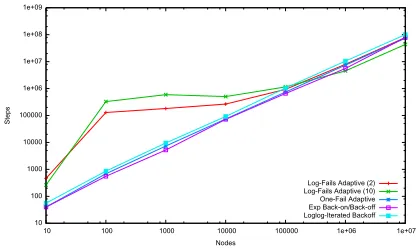
Fig. 1.Number of steps to solve statick-selection, per number of nodesk
Table 1.Ratio steps/nodes as a function of the number of nodesk
k 10 102 103 104 105 106 107 Analysis
Log-Fails Adaptiveξt= 1/2 46.4 1292.4 181.9 26.6 9.4 8.0 7.8 7.8
Log-Fails Adaptiveξt= 1/10 26.3 3289.2 593.8 50.3 11.5 4.5 4.4 4.4
One-Fail Adaptive 4.0 6.9 7.4 7.4 7.4 7.4 7.4 7.4 Exp Back-on/Back-off 4.0 5.5 5.2 7.2 6.6 5.6 7.9 14.9 Loglog-iterated Back-off 5.6 8.6 9.6 9.2 10.5 10.5 10.1Θ#log log loglog logkk$
the same algorithm (except the parameterεof Log-Fails Adaptivethat has to depend onk). ForExp Back-on/Back-offthe parameter is chosen to be
δ = 0.366. For One-Fail Adaptive the parameter is chosen to be δ = 2.72.
ForLog-Fails Adaptive, the parameters (see their meaning in [7]) are chosen to be ξδ =ξβ = 0.1 and ε≈1/(k+ 1), while two values of ξt have been used,
ξt = 1/2 and ξt = 1/10. Finally, Loglog-iterated Back-off is simulated with parameterr= 2 (see [2]).
Figure 1 presents the average number of steps taken by the simulation of the algorithms. The plot shows the the average of 10 runs for each algorithm as a function ofk. In this figure it can be observed thatLog-Fails Adaptivetakes significantly larger number of steps than the other algorithms for moderately small values of k (up to 105). Beyond k = 105 all algorithms seem to have a similar behavior.
A higher level of detail can be obtained by observing Table 1, which presents the ratio obtained by dividing the number of steps (plotted in Figure 1) by the value of k, for each k and each algorithm. In this table, the bad behavior of
Log-Fails Adaptive for moderate values of k can be observed, with values
of the ratio well above those for largek. It seems like the value of ξt used has an impact in this ratio, so that the smaller valueξt= 1/10 causes larger ratio values. Surprisingly, for large values ofk(k≥106), the ratios observed are almost exactly the constant factors ofkobtained from the analysis [7]. (Recall that all
are averages.) This may indicate that the analysis with high probability is very tight and that the termO(log2(1/ε)) that appears in the complexity expression
is mainly relevant for moderate values of k. The ratio obtained for largek by
Log-Fails Adaptivewith ξt = 1/10 is the smallest we have obtained in the set of simulations.Loglog-iterated Back-off, on its hand, seems to have a constant ratio of around 10. In reality this ratio is not constant but, since it is sublogarithmic, this fact can not be observed for the (relatively small) values of
ksimulated.
Regarding the ratios obtained for the algorithms proposed in this paper, they seem to show that the constants obtained in the analyses (with high probabil-ity) are very accurate. Starting at moderately large values ofk(103and up) the ratio forOne-Fail Adaptivebecomes very stable and equal to the value of 7.4
obtained in the analysis. The ratios for theExp Back-on/Back-off simula-tions, on their hand, move between 4 and 8, while the analysis for the value of
δused yields a constant factor of 14.9. Hence, the ratios are off by only a small
constant factor. To appreciate these values it is worth to note that the smallest ratio expected by any algorithm in which nodes use the same probability at any step ise, so these values are only a small factor away from this optimum ratio.
In summary, the algorithms proposed here have small and stable ratios for all values ofkconsidered.
6
Conclusions and Open Problems
In this work, we have shown optimal randomized protocols (up to constants) for statick-selection in Radio Networks that do not require any knowledge on the
number of contenders. Future work includes the study of the dynamic version of the problem when messages arrive at different times under the same model, either assuming statistical or adversarial arrivals. The stability of monotonic strategies (exponential back-off) has been studied in [2]. In light of the improvements obtained for batched arrivals, the application of non-monotonic strategies to the dynamic problem is promising.
References
1. Balador, A., Movaghar, A., Jabbehdari, S.: History based contention window con-trol in ieee 802.11 mac protocol in error prone channel. Journal of Computer Sci-ence 6, 205–209 (2010)
2. Bender, M.A., Farach-Colton, M., He, S., Kuszmaul, B.C., Leiserson, C.E.: Ad-versarial contention resolution for simple channels. In: 17th Ann. ACM Symp. on Parallel Algorithms and Architectures, pp. 325–332 (2005)
3. Capetanakis, J.: Tree algorithms for packet broadcast channels. IEEE Trans. Inf. Theory IT-25(5), 505–515 (1979)
5. Clementi, A., Monti, A., Silvestri, R.: Selective families, superimposed codes, and broadcasting on unknown radio networks. In: Proc. of the 12th Ann. ACM-SIAM Symp. on Discrete Algorithms, pp. 709–718 (2001)
6. Farach-Colton, M., Mosteiro, M.A.: Sensor network gossiping or how to break the broadcast lower bound. In: Tokuyama, T. (ed.) ISAAC 2007. LNCS, vol. 4835, pp. 232–243. Springer, Heidelberg (2007)
7. Fern´andez Anta, A., Mosteiro, M.A.: Contention resolution in multiple-access chan-nels: k-selection in radio networks. Discrete Mathematics, Algorithms and Appli-cations 2(4), 445–456 (2010)
8. Fern´andez Anta, A., Mosteiro, M.A., Mu˜noz, J.R.: Unbounded Contention Reso-lution in Multiple-Access Channels. arXiv:1107.0234v1 [cs.DC] (July 2011) 9. Ger`eb-Graus, M., Tsantilas, T.: Efficient optical communication in parallel
com-puters. In: 4th Ann. ACM Symp. on Parallel Algorithms and Architectures, pp. 41–48 (1992)
10. Greenberg, A., Winograd, S.: A lower bound on the time needed in the worst case to resolve conflicts deterministically in multiple access channels. Journal of the ACM 32, 589–596 (1985)
11. Greenberg, R.I., Leiserson, C.E.: Randomized routing on fat-trees. Advances in Computing Research 5, 345–374 (1989)
12. Gusella, R.: A measurement study of diskless workstation traffic on an ethernet. IEEE Transactions on Communications 38(9), 1557–1568 (1990)
13. Hayes, J.F.: An adaptive technique for local distribution. IEEE Trans. Comm. COM-26, 1178–1186 (1978)
14. Indyk, P.: Explicit constructions of selectors and related combinatorial structures, with applications. In: Proc. of the 13th Ann. ACM-SIAM Symp. on Discrete Al-gorithms, pp. 697–704 (2002)
15. Koml`os, J., Greenberg, A.: An asymptotically nonadaptive algorithm for conflict resolution in multiple-access channels. IEEE Trans. Inf. Theory 31, 303–306 (1985) 16. Kowalski, D.R.: On selection problem in radio networks. In: Proc. 24th Ann. ACM
Symp. on Principles of Distributed Computing, pp. 158–166 (2005)
17. Kushilevitz, E., Mansour, Y.: An Ω(Dlog(N/D)) lower bound for broadcast in radio networks. SIAM Journal on Computing 27(3), 702–712 (1998)
18. Leland, W.E., Taqqu, M.S., Willinger, W., Wilson, D.V.: On the self-similar nature of ethernet traffic (extended version). IEEE/ACM Transactions on Networking 2, 1–15 (1994)
19. Martel, C.U.: Maximum finding on a multiple access broadcast network. Inf. Pro-cess. Lett. 52, 7–13 (1994)
20. Mikhailov, V., Tsybakov, B.S.: Free synchronous packet access in a broadcast chan-nel with feedback. Problemy Peredachi Inform 14(4), 32–59 (1978)
21. Mitzenmacher, M., Upfal, E.: Probability and Computing: Randomized Algorithms and Probabilistic Analysis. Cambridge University Press, Cambridge (2005) 22. Nakano, K., Olariu, S.: A survey on leader election protocols for radio networks. In:
Proc. of the 6th Intl. Symp. on Parallel Architectures, Algorithms and Networks (2002)