Geschke Center
Doctoral Dissertations Theses, Dissertations, Capstones and Projects
2017
Exploring Self-Regulated Learning (SRL) and
Listening Strategy Instruction in A Chinese L2
Classroom
Yue Li
University of San Francisco, [email protected]
Follow this and additional works at:https://repository.usfca.edu/diss
Part of theAdult and Continuing Education Commons, and theLanguage and Literacy Education Commons
This Dissertation is brought to you for free and open access by the Theses, Dissertations, Capstones and Projects at USF Scholarship: a digital repository @ Gleeson Library | Geschke Center. It has been accepted for inclusion in Doctoral Dissertations by an authorized administrator of USF Scholarship: a digital repository @ Gleeson Library | Geschke Center. For more information, please [email protected].
Recommended Citation
Li, Yue, "Exploring Self-Regulated Learning (SRL) and Listening Strategy Instruction in A Chinese L2 Classroom" (2017).Doctoral Dissertations. 343.
EXPLORING SELF-REGULATED LEARNING (SRL) AND
LISTENING STRATEGY INSTRUCTION IN A CHINESE L2 CLASSROOM
A Dissertation Presented to
The Faculty of the School of Education
International and Multicultural Education Department Second Language Acquisition Emphasis
In Partial Fulfillment
of the Requirements for the Degree Doctor of Education
By Yue Li San Francisco
ii
THE UNIVERSITY OF SAN FRANCISCO Dissertation Abstract
Exploring Self-Regulated Learning (SRL) and Listening Strategy Instruction in A Chinese L2 Classroom
This interpretive case study explored the effectiveness of listening strategy instruction that promoted self-regulated learning and gained insights into students’ and
instructors’ perceptions of strategy-integrated listening instruction among second
semester learners of Chinese as a second language at a military college in Northern
California. Most of previous studies investigated listening strategy use and the
relationship between listening strategy use and listening achievement. Few studies
investigated the effectiveness of listening strategy instruction. Thus, this study addressed
the gaps in research by examining the effectiveness of integrating listening strategies into
regular curriculum and explored students’ and instructors’ perceptions of listening
strategy instruction among learners of Chinese as a second language.
An interpretive case study research design was employed to achieve the goal of this study. The participants included one instructor and six students who studied at an intensive Chinese basic course. Three sources of data were collected from 25 classroom observations, a focus group session with the student participants , and a face-to-face interview with the instructor. All data were transcribed, coded, and analyzed to answer the research questions.
iii
listening strategy instruction helped learners raise awareness of strategy use, increase
confidence, improve listening abilities, and foster learner autonomy and
self-regulation. The findings further indicated that implementing strategy-integrated listening
instruction could improve teaching quality, but might face possible challenges from
teachers. Finally, the findings suggested that teacher training on integrating listening
strategies into regular curriculum should be provided.
This study has implications for language teachers, foreign language learners, and
language course developers, who are involved in the field of foreign language teaching
and learning. More research on self-regulated learning and listening strategy instruction
among learners of Chinese as a second/foreign language would further expand the
understanding of listening strategy instruction in the field and better assist language
iv
This dissertation, written under the direction of the candidate’s dissertation committee
and approved by the members of the committee, has been presented to and accepted by
the Faculty of the School of Education in partial fulfillment of the requirements for the
degree of Doctor of Education. The content and research methodologies presented in this
work represent the work of the candidate alone.
Yue Li April 25, 2017
Candidate Date
Dissertation Committee
Dr. Brad Washington April 25, 2017
Chairperson
Dr. Sedique Popal April 25, 2017
v
DEDICATION
This dissertation is dedicated to my loving parents Pangen Li and Jufang Zuo, to
vi
ACKNOWLEDGEMENT
My dream of pursuing a doctoral degree would never come true without the
guidance and support from my dissertation committee, my friends, and my family. A
thousand words cannot express my gratitude for these great individuals who assisted me
through this dissertation journey.
I would like to express my deepest appreciation to my committee chair Dr. Brad
Washington, for his excellent guidance, caring, patience, and continually conveying
confidence in my study. Without his professional guidance and persistent assistance, this
dissertation would not have been possible.
I am indebted to my committee members, Dr. Sedique Popal and Dr. Matthew
Mitchell, who patiently read and corrected my writing, and provided insightful guidance
and valuable feedback for me to shape this dissertation to satisfaction. Without their
meticulous expertise, profound knowledge, and priceless suggestions, this dissertation
would not be completed.
I am also grateful to have Dr. Susan Katz as my adviser at the start of my
dissertation journey, who provided clear direction and useful feedback for my dissertation
proposal, which inspired me to move forward to the completion of this dissertation
journey. Thank you, Dr. Katz.
I would also like to extend my thanks to my colleagues and friends Marilyn
Chakwin and Yan Wang, and my classmate Yu-Han Lin, who were willing to share my
enjoyment and hardship during my doctoral studies and provided me with valuable
vii
My acknowledgement further goes to my research participants who were willing
to participate in this study and share their learning experience. Without their generosity of
contributing time and sharing, this dissertation would not happen.
My final special thanks go to my family: my loving parents, my beloved husband,
my precious son, my elder sister, and my younger brother. Their unconditional love,
tireless patience, and endless encouragement accompanied me throughout this
viii
TABLE OF CONTENTS
ABSTRACT ... ii
SIGNATURE PAGE ... iv
DEDICATION ...v
ACKNOWLEDGEMENT ... vi
TABLE OF CONTENTS ... viii
LIST OF TABLES ... xi
CHAPTER I: THE RESEARCH PROBLEM ...1
Statement of the Problem ...1
Background and Need for the Study ...4
Purpose Statement ...11
Research Questions ...11
Theoretical Framework ...12
Social Cognitive Theory of Self-Regulation ...13
Zimmerman’s Model of Self-Regulated Learning ...14
Delimitations and Limitations ...16
Significance of the Study ...17
Definitions of Terms ...18
CHAPTER II: REVIEW OF THE LITERATURE ...21
Introduction ...21
Listening Processes ...22
Bottom-Up Processing ...23
Top-Down Processing ...24
Self-Regulated Learning and Listening Strategies ...25
Self-Regulated Learning ...26
Listening Strategies ...29
Identification of Listening Strategies ...34
Classroom Observations ...35
Individual Interviews and Focus Groups ...35
Reflective Diaries and Journals ...38
Think-Aloud Protocols...39
Listening Strategy Instruction ...40
Metacognitive Listening Instruction ...41
Explicit and Strategy-Integrated Instruction ...43
Perceptions of Strategy Instruction ...45
Students’ Perceptions of Strategy Instruction ...46
ix
Summary ...49
CHAPTER III: METHODOLOGY ...51
Introduction ...51
Restatement of Purpose of the Study ...51
Research Questions ...52
Research Design ...52
Research Setting ...55
Participants ...56
Instrumentation ...57
Protection of Human Subjects ...59
Data Collection ...60
Data Analysis ...65
Background of the Researcher ...68
CHAPTER IV: FINDINGS ...70
Introduction ...70
Student Participants’ Background Information ...70
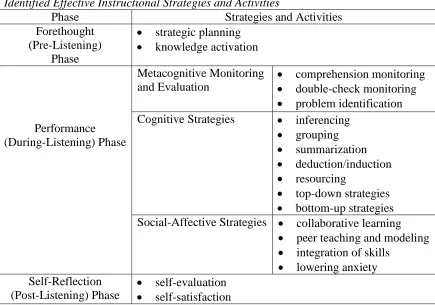
Identifying Effective Strategies and Activities and Coding Process ...73
Research Question One ...76
Effective Pre-Listening Strategies and Activities ...77
Effective During-Listening Strategies and Activities ...86
Effective Post-Listening Strategies and Activities ...99
Research Question Two ...102
Usefulness of the Strategy Instruction ...103
Improvement of Listening Skills ...103
Awareness of Using Listening Strategies ...106
Increases of Self-Confidence in Listening ...107
Research Question Three ...109
More Systematically Using Listening Strategies ...109
Fostering Autonomous and Self-Regulated Listeners ...110
Improving Teaching Quality ...112
Challenges of Implementing Strategy-Integrated Instruction ...113
Summary of the Findings ...114
CHAPTER V: DISCUSSION, IMPLICATIONS, RECOMMENDATIONS, AND CONCLUSION ...117
Overview ...117
Summary of the Study ...117
Summary of the Findings ...120
Discussion ...121
Changing the Way of Teaching Listening ...122
Integrating Effective Listening Strategies ...127
Increasing Leaners’ Confidence and Self-Efficacy ...131
x
Challenges and Implementation ...135
Implications for the Findings of the Study ...136
Implications for Teachers ...137
Implications for Students ...139
Implications for Curriculum Developers ...140
Recommendations for Future Study ...142
Conclusion ...144
REFERENCES ...146
APPENDICES ...160
APPENDIX A: IRB Approval Letter from the University of San Francisco ...161
APPENDIX B: IRB Approval Letter from the DLIFLC ...162
APPENDIX C: Informed Consent Form ...163
APPENDIX D: Listening Instruction Course Content ...165
APPENDIX E: List of Listening Strategies and Instruction Sequence ...167
APPENDIX F: Rubric for Identifying Effective Strategies and Activities ...169
APPENDIX G: Interview Questions ...171
APPENDIX H: Transcription of Focus Group Interview ...172
xi
LIST OF TABLES
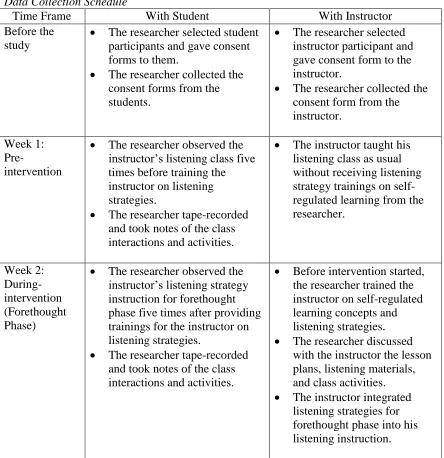
Table 1 Data Collection Schedule...60
Table 2 Demographic Information of the Six Students Participants ...71
CHAPTER I
THE RESEARCH PROBLEM
Statement of the Problem
Listening strategy instruction does not receive much attention in second language
teaching and research, and learners are seldom taught how to approach listening or how
to manage their listening when attending to aural texts (Field, 1998; Goh, 2008;
Mareschal, 2007). Although they are exposed to more listening activities in classrooms
and work on improving their listening, learners are still left to develop their listening
abilities on their own with little direct support from the teacher and many of them do not
really know where to start other than to “practice harder” on their own (Vandergrift &
Goh, 2012). Particularly, in a Chinese as a second language field, listening strategy
instruction is not emphasized and research on listening strategy instruction in a Chinese
as a second language classroom appears to be limited (Jiang & Cohen, 2012).
Listening activities in many language classrooms tend to focus on the outcome of
listening and many of the listening activities do little more than test how well the learners
listen (Goh, 2008). As Mendelsohn (2006) points out, teachers still would rather test
listening than teach it, without allocating adequate consideration to the processes which
are involved. Listening instruction has become the practice of answering listening
comprehension questions followed by the provision of the correct answers and finishing
with an explanation of the meaning of the transcripts. This form of repeated drill-based
practice may inhibit students from being active listeners, reducing their interest and
motivation to learn how to listen in foreign language context. As a result, listening
comprehension has been regarded as one of the most difficult skills for most students to
Because learners are often put in situations where they have to show how much
they have understood or what they have not understood, they feel anxious about listening.
Additionally, learners’ stress and anxiety level increases even further when they have to
understand the aural texts and have to respond in an appropriate way at the same time
(Vandergrift & Goh, 2012). In addition to anxiety, the real challenge for listeners is that
they do not know how to listen when they encounter listening input. For example,
learners often miss the first part of an aural text once the audio or video begins because
they are seldom taught how to listen (Goh, 2000).
Another issue in listening instruction is the lack of guidance on how learners can
self-direct and evaluate their efforts to improve their listening. Many learners desire to
improve their listening by actively participating in class activities and doing homework in
the hope that these will help them become “good” listeners. However, classroom
activities and homework merely require learners to demonstrate the outcome of their
listening. Thus, these efforts are not sufficiently monitored or supported. As a result,
learners may not know how to take advantage of these opportunities to improve their
listening proficiency.
In light of the problems that learners have encountered, listening strategies could
help language learners cope with their own learning process and enhance their
proficiency levels (Liu, 2008; Latifi, Tavakoli, & Dabaghi, 2014; Rahimi & Katal, 2012).
In the past few decades, strategy instruction for listening has been increasingly
emphasized by listening experts (Goh, 2000, Mareschal, 2007; Vandergrift, 2004). The
research focus has gradually shifted from investigating patterns and strategies used by
process-oriented approach to teaching listening skills in order to guide the students to
develop their listening strategies and learn how to listen actively (Richards, 2005). Thus,
self-regulated learning has attracted formidable attention in the field of language teaching
and its significance has been recognized (Pintrich, 2000; Zimmerman, 2002).
Self-regulated learning is an active, constructive process whereby learners set
goals for their learning, and then monitor, regulate and control their cognition, motivation
and behavior, guided and constrained by their goals and contextual features of the
environment (Pintrich, 2000). Self-regulated learners systematically use metacognitive,
motivational, and behavioral strategies and proactively participate in their own learning
process (Zimmerman, 1986, 2008). This concept not only looks into cognitive aspects of
learning, but also considers the social-affective dimensions of language learning such as
motivation and efficacy (Oxford, 2011). Therefore, the present study used
self-regulated learning as the theoretical framework to demonstrate effective learning
strategies in listening instruction among the learners of Chinese as a second language.
Past research showed that self-regulated learning is crucial for students’ academic
achievement (Latifi, Tavakoli, & Dabaghi, 2014; Maftoon & Tasnimi, 2014; Zimmerman,
1990; Zimmerman & Schunk, 2001). However, few studies investigated the effectiveness
of integrating self-regulated learning strategies into listening instruction among second
semester learners of Chinese as a second language at college level and examined
students’ and instructors’ perceptions of listening strategy instructions. Thus, this study
aimed to fill the gap in the literature by employing an interpretive case study research
design to identify effective instructional strategies and activities in listening instruction
instructors’ perceptions of the strategy-integrated listening instruction in order to better
assist language learners to enhance their listening skills in Chinese as a second language.
Background and Need for the Study
Foreign language demand
Due to China’s tremendous economic growth and emergence as a social and
political leader in the region, the U.S. government, business leaders, educators and
foreign language experts have recognized the urgency of equipping American students
with the abilities to demonstrate functional foreign language proficiency for global
competiveness and communications (Hsin, Wang & Huang, 2014). According to the
2002 Digest of Education Statistics report, less than 8% of United States undergraduates
took foreign language courses, and only 44% of American high school students were
enrolled in foreign language classes. Of those students, less than 1% of American high
school students combined studied Arabic, Chinese, Farsi, Japanese, Korean, Russian or
Urdu (Department of Education, 2006).
In 2010, only 18% of Americans reported speaking a language other than English, whereas 53% of Europeans could converse in a second language (Skorton & Altschuler,
2012). In China, more than 200 million children were studying English, whereas in the
U.S., only about 24,000 of approximately 54 million elementary and secondary school
children were studying Chinese (Department of Education, 2006). As former U.S. Secretary of Education Arne Duncan (2010) declared, “Americans need to read, speak
and understand other languages in order to prosper economically and improve relations
Acknowledging the nation’s foreign language deficit (Skorton & Altschuler, 2012)
and world languages as a key component of global competency, the Council on Foreign
Relations states, “the lack of language skills and civic and global awareness among
American citizens increasingly jeopardizes their ability to interact with local and global
peers or participate meaningfully in business, diplomatic and military situations” (Kehl,
Pike, Schneider, & Vander Ark, 2013). Although the U.S. is regarded as an economic,
military and cultural superpower, lacking of foreign language proficiency would make
Americans become narrowly confined within their own borders without understanding
the rest of the world around them which is essential to their continued leadership role in
the world community (Committee for Economic Development, 2006).
To address the paucity of Americans fluent in foreign languages and meet the
demand for foreign language to make the nation globally competitive, the Department of
Education and its partners have collaborated to focus resources toward educating students,
teachers and government workers in critical need foreign languages, such as Arabic,
Chinese, Japanese, and Korean, and increased budget to $57 million for this initiative in
2007 (Department of Education, 2006). The Department of Education proposed $24
million to create incentives to teach and study critical need languages in K-12 by
refocusing the Foreign Language Assistance Program (FLAP) grants (Department of
Education, 2006). With all these efforts, the foreign language course enrollment of
Kindergarten to 12th grade (K-12) students in the year 2007-2008 reached 8.9 million
individuals, about 18.5% of all students (Skorton & Altschuler, 2012).
In order to advance national security and global competitiveness, the Department
the defense abilities to meet the need for language skills and international knowledge in
confronting current and future national security challenges. The initiative called for
significantly improving the Department’s capabilities in regional area expertise and in
critical languages, recognizing that national security challenges in theMiddle East, Asia,
and elsewhere would likely continue. Language training for military linguists was
conducted under the auspices of the Defense Foreign Language Program. The Secretary
of the Army was the executive agent for the program that assigned the responsibility for
language training for military linguists to the Defense Language Institute (National
Security and International Affairs Division, 1994).
As a critical need language, Chinese language has seen dramatic increase of its
course enrollment in the past decades. In 1990, student enrollment in U.S. public high
school Chinese Mandarin courses was only 6,738. In 2004, the College Board conducted
a national survey, and 2,400 schools expressed interest in offering the Chinese Advanced
Placement Course and Examination. In 2006, Advanced Placement Course and
Examination in Chinese Language and Culture began to be offered nationally to high
schools by the College Board (Hsin, Wang & Huang, 2014). As of 2013, Chinese has
become the second most common language spoken by English language learners in the
United States (English Language Learner Information Center, 2015). With China’s
extraordinary economic growth and active diplomacy in East Asia, Chinese power and
influence will continue in the future (Ikenberry, 2008) and the demand for Chinese
Listening difficulties and individual differences
Chinese as a Category IV language is challenging for English-speaking learners.
The Department of State divides foreign languages into four categories, each representing
the difficulty a native English speaker faces when learning the foreign language.
Category I languages, such as Spanish and French, are considered the easiest languages
to learn, whereas Category IV languages, such as Arabic, Chinese, Japanese and Korean,
are the hardest to learn (National Security and International Affairs Division, 1994).
Chinese, different from Indo-European languages, does require special consideration in
teaching (Hsin, Wang & Huang, 2014).
According to Goh (2000), all language learners face difficulties when listening to
the target language. Many second and foreign language students perceive listening
comprehension more challenging than reading comprehension (Graham, 2006) as there is
less opportunity to go back over previous input in real time (Rahimiral, 2014). Thus,
listening comprehension is a complex ongoing process which involves the interaction of
various factors (Chen, 2013). Goh (2000) states that listening difficulties may be
influenced by speech rate, lexis, phonological features, and background knowledge, and
may also include issues from text structure and syntax to personal factors such as
insufficient exposure to the target language as well as a lack of interest and motivation.
Acknowledging these factors, Brown (1995) argues that listening difficulties are also
related to the levels of cognitive demands made by the content of the texts.
In the field of Chinese as a second language, English-speaking learners of
Chinese face more challenges in listening comprehension. As a nonalphabetic system,
orthography, and morphology (Shen & Xu, 2015). Particularly, in Mandarin Chinese, a
word can have different meanings depending on tonal contrasts signaled by modulations
in pitch during articulation (Malins & Joanisse, 2010). The Mandarin Chinese tone
system has five tonal values: high-level (Tone 1), rising (Tone 2), low-falling-rising
(Tone 3), high-falling (Tone 4), and mid-flat (neutral, Tone 5). A change in tone alters
the meaning of the syllable. For example, the syllable ma can have four different
meanings according to its tones represented as the following: mā (mother), má (hemp),
mǎ (horse), and mà (scold). Because of the complexity of the tonal system of Chinese,
many English-speaking learners’ listening difficulties are caused by their inability to
discriminate the tones.
For adult learners, listening is considered most difficult compared to other
language skills (Vandergrift & Goh, 2012). The unique phonetic system and complicated
Chinese characters have adult learners of Chinese frequently encounter difficulties in
class. Some researchers have sought to individual differences in second language learning
in order to identify attributes to successful language learning (Dörnyei, 2005; Dörnyei &
Skehan, 2003; Ehrman, 1996; Ehrman & Leaver, 2003; Ricahrds, 2005, Skehan, 1991).
Adult learners over the age of 18 have passed the “critical point” for language acquisition.
A classic notion is that the critical point for second language acquisition occurs around
puberty, beyond which people seem to be relatively incapable of acquiring a second
language (Brown, 2007).
In addition, adult learners differ in foreign language aptitude, educational
background, foreign language learning experience, learning styles, and L2 motivation,
for target language. According to Field (1999), lack of prior knowledge may result in
deficiency in language processing such as knowledge-driven top-down processing in
listening comprehension. Furthermore, Vandergrift’s (2006) study shows that learners’
L1 listening comprehension ability and L2 proficiency contribute significantly to their L2
listening comprehension ability. Thus, students’ previous education and knowledge base
plays a considerably role for their success in second language learning.
Most importantly, adult learners may have different levels of motivation for
learning their target language. If they are not intrinsically motivated to learn a particular
target language, their learning difficulties will eventually loom and they will struggle to
master that language. According to Dörnyei and Skehan (2003), foreign language
aptitude and motivation have generated the most consistent predictors of second language
learning success. In this respect, motivation is a big factor related to learning difficulties
for language learners.
Given the aforementioned complexity of Chinese language and learners’
individual differences, students learning Chinese as a second language need guidance that
leads to successful language learning. Particularly, students who do not have any foreign
language learning experience and have never received learning strategy training need to
be taught how to learn a foreign language. Therefore, language instructors should
incorporate learning strategies into their daily instruction to help students overcome their
learning difficulties. In this regard, the problem is what and how strategies are used
(Graham, Santos, & Vanderplank, 2008).In light of the learning context at the researched
school, this study intended to investigate effective learning strategies and activities that
Need for the study
The findings of previous studies on learning strategy demonstrated that teaching
students listening strategies could help them foster awareness of strategy use and enable
them to employ appropriate strategies to solve listening problems. These endeavors
exerted significant impact on students’ strategy use and greatly enhanced their listening
performance. However, these studies mainly investigated the listening strategies used by
proficient learners versus less proficient learners, and the relationship between listening
strategy use and listening achievement. Although an increasing number of studies have
been exploring the effects of strategy instruction for listening (Chen, 2013; Graham, 2006;
Graham & Macaro, 2008; Rahimirad, 2014; Rahimirad & Shams, 2014; Siegel, 2013;
Vandergrift & Tafaghodtari,2010), only a small number of studies have focused on
students’ perceptions of learning strategy instruction (Chen, 2013; Siegel, 2013).
In addition, past research investigated the listening strategies mainly for the
students of English as a second/foreign language. Only a limited number of listening
strategy research was related to learning Chinese as a second language (Jiang & Cohen,
2012). These studies merely examined listening strategy use and the relationship between
strategy use and academic achievement in Chinese as a second language (Bai, 2007; Di,
2007; Zhang, 2007; Zhou, 2004). Few studies explored whether strategy instruction could
influence beginning- and intermediate-level Chinese L2 learners’ listening strategy use
(Yuan, 2005).
Moreover, as the number of students learning Chinese has been steadily growing
around the globe, listening problems have been continuously emerging among learners of
language is practical and indispensable. With these perspectives in line, this study was
needed in the hope for helping learners of Chinese as a second language enhance their
listening abilities and become self-regulated learners.
Purpose Statement
The purpose of this study was to identify effective listening instructional strategies and activities that promoted self-regulated learning among adult learners of Chinese and to explore students’ and instructors’ perceptions of the effectiveness of strategy-integrated listening instruction. First, this study provided interventional listening instruction integrated with self-regulated learning strategies among learners of Chinese as a second language. Then it identified the effective strategies and activities that promoted self-regulated learning among adult learners of Chinese to assist their listening
comprehension. Finally, it gained insights into the perceptions from both the adult learners of Chinese and the Chinese instructor on the strategy-integrated listening instruction, and the challenges for students and teachers to implement this strategy-integrated instruction in listening comprehension class.
Research Questions
To address the aforementioned issues, this study posed the following three
research questions:
1. What are the effective instructional strategies and activities that promote
self-regulated learning in strategy-integrated listening instruction in Chinese as a
second language?
2. What are the students’ perceptions of the strategy-integrated listening
3. What are the instructor’s perceptions of the strategy-integrated listening
instruction in a Chinese as a second language classroom?
Theoretical Frameworks/Conceptual Rationale
This study employed social cognitive theory (Bandura, 1986) and Zimmerman’s
(2000) three-phase cyclical model of self-regulated learning as the theoretical framework.
Social cognitive theory was chosen for this study because it emphasized social influence
on learners’ development of self-regulation such as the efforts of teacher modeling and
instruction on students’ strategy use (Schunk, 1989; Zimmerman, 1989). Social cognitive
theory views human functioning as a series of reciprocal interactions between behavioral,
environmental, and personal variables (Schunk & Zimmerman, 1997), which provides the
theoretical foundation for Zimmerman’s self-regulated learning model. Zimmerman’s
model of self-regulated learning includes three cyclical processes: forethought phase,
performance phase and self-reflection phase, which depict the interactions of cognitive,
metacognitive, and motivational processes during efforts to learn (Zimmerman, 2013).
Thus, social cognitive theory could provide an appropriate framework to guide this study
to examine the effective instructional strategies and activities promoting self-regulated
learning in listening instruction of Chinese as a second language.
In this study, the strategy-integrated listening instructions followed the three
phases in Zimmerman’s model of self-regulated learning and involved listening strategies
and activities in a Chinese L2 classroom. The listening instruction sequence included
pre-listening, during-pre-listening, and post-listening phases, which corresponded with
Zimmerman’s (2000) forethought, performance, and self-reflection phases. The
framework were detailed in the research design section in Chapter III.
Social cognitive theory of self-regulation
Social cognitive theory postulates that self-regulated learning involves reciprocal
causation among personal, environmental, and behavioral influence processes as depicted
in Figure 1. According to social cognitive theorists, self-regulated learning is not
determined merely by personal processes and these processes are influenced by
environmental and behavioral events in a reciprocal way (Zimmerman, 1989). For
example, students’ performance in class is not only determined by their personal
perceptions of efficacy, but also affected by environmental stimuli such as
encouragement from teachers and by enactive outcomes such as obtaining a correct
answer to previous problems.
Figure 1. A triadic analysis of self-regulated functioning. (taken from Zimmerman, 2013, p. 137)
Behavioral forms of self-regulation refer to self-observing one’s performance and
adapting it strategically such as observation learning, which can occur through modeling
(Schunk & Zimmerman, 1997). Environmental form of self-regulation involves
monitoring the effects of varying environmental conditions and controlling those
form of self-regulation refers to observing and adapting specific feelings and thoughts
such as overcoming anxiety. Bandura (1986) cautions that the reciprocity among the
three forms of self-regulation does not function in an absolute state but rather varies in
degree, depending on the social and physical context. This approach of learning also
depends on a variety of personal influences that can change with teaching or development
such as one’s level of knowledge and metacognitive skills (Zimmerman, 1989).
Zimmerman’s model of self-regulated learning
Zimmerman (2000) postulated a cyclical model of self-regulated learning based
on social cognitive theory. According to this model, a student’s learning processes and
accompanying motivational beliefs fall into three self-regulatory phases: forethought,
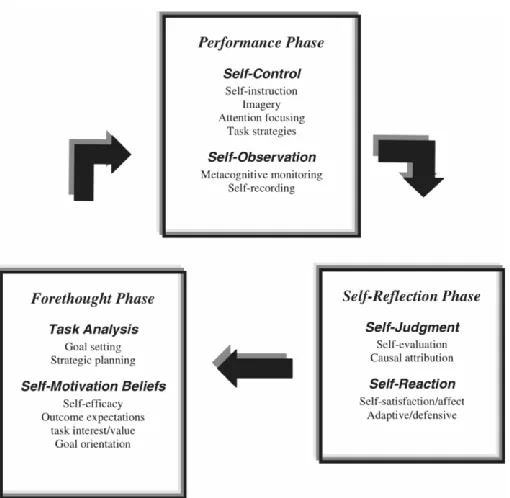
performance, and self-reflection (see Figure 2). Forethought phase processes are used in
preparation for efforts to learn to enhance learning. Performance phase processes are
employed during efforts to learn for facilitating self-control and self-monitoring of one’s
performance. Self-reflection phase processes occur after efforts to learn for optimizing
one’s reaction to his or her outcomes. These reflections, in turn, influence forethought
processes and beliefs regarding subsequent efforts to learn, thereby completing a
self-regulatory cycle.
According to Zimmerman (2013), the cyclical properties of this model are
designed to explain the results of repeated efforts to learn, such as when learning a new
language. Proactive learners employ high-quality forethought and performance phase
processes, whereas reactive learners rely on post-performance self-reflection to learn,
such as by discovery learning. “Although all learners attempt to self-regulate their
are expected to display a superior cyclical pattern of processes than reactive
self-regulators” (p. 143).
Figure 2. The Zimmerman’s three-phase cyclical model of self-regulated learning (taken from Zimmerman, 2002, p. 67).
Forethought phase includes task analysis processes and self-motivation beliefs.
Task analysis refers to a learner’s efforts to break learning into key components.
Proactive learners can set specific, proximal, and challenging goals for themselves.
Effective task analysis also enables proactive students to plan more effective strategies to
aid cognition, control affect, and direct motoric execution. By contrast, reactive learners
set vague, distal, or unchallenging goals for themselves, and preclude themselves from
planning a detailed strategy which compels them to rely on vague methods of learning.
Moreover, proactive learners are motivated by higher self-efficacy beliefs, outcome
expectancies, mastery learning goals, and/or task interest/valuing whereas reactive
learners display inferior forms of motivation and are less self-motivated to analyze tasks,
Performance phase involves self-control and self-observation. Self-control refers
to the use of specific techniques to direct learning such as self-instruction, imagery,
attention focusing, task strategies, environmental structuring, and help seeking. Proactive
learners systematically employ self-observation to guide their efforts to learn such as
metacognitive monitoring and self-recording whereas reactive learners find it difficult to
self-observe a particular process because they lack specific forethought phase goals or
plans to focus their attention.
Self-reflection phase details self-judgments and self-reactions. Self-judgments
include self-evaluations of causality regarding one’s outcomes. Proactive learners tend to
self-evaluate based on their mastery of the goals set in the forethought phase whereas
reactive learners lack specific forethought goals and often fail to self-evaluate.
Self-reaction involves self-satisfaction and adaptive inferences. Self-satisfaction Self-reaction
refers to perceptions of satisfaction or dissatisfaction regarding one’s performance.
Adaptive or defensive inferences refer to conclusions about whether one needs to alter his
or her approach during subsequent efforts to learn. Proactive learners make adaptive
inferences for errors by modifying strategies whereas reactive learners resort to defensive
inferences to protect themselves from future dissatisfaction such as helplessness, and
cognitive disengagement.
Delimitations and Limitations
The delimitations of this study were related to the selection of the research site
and participants of the study. First, a military college located in northern California was
chosen as the research site due to sampling convenience. Second, the scope of the study
64-week intensive Chinese basic course and one Chinese instructor who provided listening
instructions to the student participants. Additionally, this study only selected the student
participants who were at second semester of Chinese basic course in order to determine
the effectiveness of instructional strategies and activities that promoted self-regulated
learning in Chinese L2 listening comprehension class.
The limitations of this study were pertinent to the generalizability of the findings
due to the complexity of the military school in which the student participants differed in
age, gender, educational background, language aptitude, and motivation levels. First, the
participants varied in age from 19 to 30. Older learners might be more self-regulated than
younger ones in the learning process. Second, the participants included three male
students and three females. Male students might employ different learning strategies and
hold different beliefs towards language learning from female students. Third, the
participants’ varied educational background might lead to different perceptions of
listening strategy instruction in terms of students’ previous learning experiences. Lastly,
the participants’ aptitude and motivation could also allow the participants to perceive the
listening strategy instruction differently. Thus, with the aforementioned limitations, the
findings of the study might not be generalizable to other Chinese language programs in
different context.
Significance of the Study
This study added to the growing body of research investigating the effectiveness
of integrated strategy instruction in listening comprehension of Chinese as a second
language. The significance of this study is threefold. First, most of past research focused
academic achievement among the ESL learners. Few studies investigated the
effectiveness of listening instruction and identified effective listening strategies,
especially in the context of learning Chinese as a second/foreign language. Thus, this
study addressed the gap which attached significance to the study by identifying effective
listening strategies and activities that promoted self-regulated learning among adult
learners of Chinese.
Second, previous studies have shifted the focus on metacognitive approach to
enhancing learners’ listening abilities. However, few studies have explored the
effectiveness of listening strategy instruction promoting self-regulated learning concepts.
The present study not only took into account metacognitive strategies, but also integrated
motivational strategies in listening instruction in Chinese L2 classroom aiming at
boosting learners’ confidence and self-efficacy in their learning process.
Third, this study explored both students’ and instructors’ perceptions of listening
strategy instruction promoting self-regulated learning. In this regard, this study went
beyond previous studies that rarely gained insights into the effectiveness of listening
strategy instruction from students and instructors. Thus, the findings of this study could
be of great significance for both foreign language learners and instructors.
Definitions of Terms
Aptitude– Carroll (1981) defines aptitude as a notion that “in approaching a
particular learning task or program, the individual may be thought of as possessing some
current state of capability of learning this task – if the individual is motivated and has the
opportunity of doing so” (p. 84). According to Krashen (1981), there are three major
and inductive ability.
Category IV language – classified by Department of Defense based on the
difficulty of the language, which includes Modern Standard Arabic, Iraqi Arabic,
Chinese, Japanese, Korean, Levantine Arabic and Pashto (Defense Language Institute
Foreign Language Center General Catalog, 17 August 2011).
Defense Language Aptitude Battery (DLAB) – a test used by the United States
Department of Defense to test an individual’s potential for learning a foreign language
and thus determining who may pursue training as a military linguist (Defense Language
Institute Foreign Language Center General Catalog, 17 August 2011).
Defense Language Proficiency Test (DLPT)– a battery of foreign language tests
produced by the Defense Language Institute and used by the United States Department of
Defense (DoD) to assess the general language proficiency of native
English speakers in a specific foreign language, in the skills of reading and listening.
Intensive Language Program – a program where the language is acquired with
time concentration in which instructional time is significantly extended every day and is
condensed over a period of time(Xu, Padilla and Silva, 2014).
L1– one’s first language or first language teaching and learning.
L2– one’s second language or foreign language teaching and learning.
Language Learning Strategies– specific actions taken by the learner to
make learning easier, faster, more enjoyable, more self-directed, more effective, and
more transferable to new situations (Oxford, 1990).
Learning Strategies –techniques which students use to comprehend, store, and
Metacognition –listener awareness of the cognitive process involved
in comprehension and the capacity to monitor, regulate, and direct the process (Goh,
2008).
Motivation – the dynamically changing cumulative arousal in a person that
initiates, directs, coordinates, amplifies, terminates, and evaluates the cognitive and
motor process whereby initial wishes and desires are selected, prioritized, operationalized
and (successfully or unsuccessfully) acted out (Dörnyei & Ottó, 1998).
Scaffolding– support in performing a task provided by teachers or more
proficient peers (Vandergrift & Goh, 2012).
Self-Efficacy – perceptions about one’s capabilities to organize and implement
actions necessary to attain designated performance of skill for specific tasks (Bandura,
1986).
Self-Regulation – an active, constructive process whereby learners set goals for
their learning and then attempt to monitor, regulate, and control their cognition,
motivation, and behavior, guided and constrained by their goals and the contextual
features in the environment (Pintrich, 2000).
Self-Regulated Learning Strategies – actions and processes directed at acquisition
of information or skills that involve agency, purpose, and instrumentality perceptions by
learners (Zimmerman, 1989, 1990).
Social Cognition– social influence on learners’ development of self-regulation
such as the effects of teacher modeling and instruction on learners’ goal setting and self-
CHAPTER II
REVIEW OF THE LITERATURE
Introduction
A recent trend has shifted the focus of listening development from listening
outcome to listening process. Special attention has been paid to strategies that have
proven effective for language learners in their efforts to master the language (Jiang &
Cohen, 2012). However, knowledge about listening comprehension strategies is still
cursory because most language learning strategy researchers have placed emphasis on
reading, writing, and speaking (Vandergrift, 1996; Vandergrift & Goh, 2012; White
2008).
Previous studies have explored various learning strategies that seek to support and
maximize listening comprehension in second language classes (Goh, 2000, 2002, 2008;
Goh & Taib, 2006; Graham, 2006; Thompson & Rubin, 1996; Vandergrift, 1996, 1997;
Vandergrift & Goh, 2012). However, much research has focused on the listening
strategies that students report to use and the differences in strategy use between proficient
listeners and less-proficient listeners. Few studies have purposefully examined the
effectiveness of the listening strategies during the listening instruction and students’
perceptions of the listening strategy instruction (Siegel, 2013). Thus, this study intended
to identify effective instructional strategies and activities in listening for promoting
self-regulated learning among the adult learners of Chinese as a second language, and to
investigate the instructors’ and the students’ perceptions of the identified instructional
strategies with regard to their effectiveness in engaging students in self-regulated learning.
instruction in second language listening and consisted of five sections. The first section
addressed listening processes which included bottom-up processing and top-down
processing. The second section introduced self-regulated learning concepts and listening
strategies focusing on cognitive, metacognitive and social-affective strategies. The third
section reviewed the identification of listening strategies. The fourth section illustrated a
variety of listening strategy instructions focusing on cognitive, metacognitive and
motivational strategy instructions. The fifth section discussed students’ and instructors’
perceptions of listening strategy instructions.
Listening Process
Vandergrift (2010) states that listening comprehension involves two fundamental
cognitive processes: bottom-up and top-down processes. Learners use bottom-up
processes when they construct meaning from the incoming sound stream by gradually
combining increasingly larger units of meaning from the phoneme-level up to
discourse-level features to build comprehension of an utterance or a text. Learners use top-down
processes when they use context, prior knowledge and listener expectations to build a
conceptual framework in which to grasp the individual units of meaning retained from
bottom-up processing to eventually arrive at a reasonable interpretation of the message.
In other words, bottom-up processing is data-driven, working from small unit to large
chunk of text whereas top-down processing is schemata-driven, working from overall
message and text structure (Field, 1999; Moskovsky, Jiang, Libert, & Fagan, 2015).
Although these two processes occur simultaneously, the degree to which learners use one
of the processes more than the other will depend on the task or purpose for listening.
processes, listening comprehension is also constrained by affective factors such as
anxiety which further limits how much information short-term memory can process at
one time. Other factors such as background knowledge of the topic of the text,
proficiency level in the target language, age, metacognitive knowledge about listening,
strategy use, native language listening ability, working memory capacity, sound
discrimination ability, and listening task also affect listening comprehension.
Bottom-up processing
According to Vandergrift (2011), the bottom-up dimension of listening involves
decoding of linguistic inputs such as lexical segmentation and word recognition skills.
Field (1999) portrays the features of bottom-up processing as the assembly processes
from phonemes into syllables, syllables into words, words into clauses, and clauses into
sentences. For bottom-up level processing, listeners use lower-level, linguistic
information from the text, such as word recognition and sentence parsing, which provides
raw data to build meaning (Yeldham & Gruba, 2014). Additionally, listeners use
linguistic knowledge to emphasize grammatical or syntactic structures in order to
interpret the meaning of individual words and then synthesize chunks of words. Thus,
lexical segmentation and word recognition are important aspects of bottom-up processing.
Goh (2008) also states that learners’ comprehension is often affected by poor
lexical segmentation and word recognition skills. Some scholars have called for a greater
emphasis to be given to bottom-up processing approach to teaching listening (Field, 2003;
Hulstijin, 2003). Hulstijin points out that the more learners are able to process the text
without effort at the lower levels of word recognition and lexical parsing, the more
meaning and content. Some researchers even surmise that bottom-up processing is more
important than top-down processing in listening performance (Moskovsky, Jiang, Libert,
& Fagan, 2015; Tsui & Fullilove, 1998). A study by Sağlam (2014) assessing 73 learners
of English as a Foreign Language (EFL) at three proficiency levels shows that vocabulary
knowledge is the strongest predictor of listening comprehension. The study suggests that
lexical development with lower level students should be emphasized and explicit
vocabulary teaching must be integrated into existing curriculum.
While bottom-up processing approach is clearly needed and students should be
aware of the role that vocabulary plays in listening comprehension, the concern is raised
that learning may become decontextualized and listening instruction may involve more
drill practices such as sound discrimination (Goh, 2008). Goh suggests employing
top-down processing such as post-listening perception activity in metacognitive instruction
to revisit the text focusing on the features of words in context.
Top-down processing
Vandergrift (2011) defines top-down processing as the application of the listener
knowledge resources to the decoding process. Listeners apply prior knowledge as well as
metacognitive knowledge about the listening process to the comprehension. Top-down
processing enables listeners to draw conclusions based on contextual cues such as
familiar topics, predictable content, and/or cultural background. Top-down processing
consists of specific knowledge of content concerning real-life situations, procedures, and
participants. Using real-life tasks and giving listeners an idea of the type of information
to expect and what to do with it in advance may improve their listening comprehension.
associations between interrelated segments of a new text. Thus, background knowledge
and familiar topics are dominant features of top-down processing.
Although these two processes occur simultaneously, the issue of whether there is
more bottom-up or top-down processing to comprehend input among listeners of
different proficient levels has aroused different views (O’Malley et al., 1989; Tsui &
Fullilove, 1998). Vandergrift (2007) suggests that integration of and the balance between
both bottom-up and top-down strategies result in successful listening comprehension. The
degree to which learners use one of the processes more than the other will depend on the
text, task, speaker, listener and input processing factors (Chen, 2013).
The above review illustrates the complexity of top-down and bottom-up
processing in listening comprehension processes. Although previous studies have focused
on bottom-up and top-down processing strategies in different languages and listening
texts, little research has specifically tapped bottom-up and top-down processing listening
strategies used by intermediate-proficiency level Chinese as a Foreign Language listeners.
This study took into account the cognitive processes of top-down and bottom-up
processing as looking into the listening strategies and activities that promoted
self-regulated learning through effective strategy-integrated listening instruction.
Self-Regulated Learning and Listening Strategies
Research on language learning strategy has shifted focus on self-regulated
learning by which learners plan, monitor, and regulate their own learning (Zimmerman,
2008). However, learners are rarely given choices to practice self-regulation in academic
settings (Zimmerman, 2002). Thus, investigating language learning strategies that help
Maftoon & Tasnimi, 2014). Researchers have suggested that further research in language
study can be enriched through self-regulated learning (Dörnyei, 2005; Ping, 2012).
According to Zimmerman (1990), self-regulated learners are distinguished by
their systematic use of metacognitive, motivational and behavioral strategies. Previous
research showed the strong relationship between self-regulated learning strategies and
academic performance (Zimmerman, 1989, 1990, 2002; Inan, 2013). A study by Lin and
Gan (2014) indicated that listeners’ metacognitive awareness was closely linked to their
self-regulated learning. Another study by Serri, Boroujeni and Hesabi (2012) suggested
that there was a significant relationship between motivation level and listening strategies.
However, more research was needed to investigate the impacts of self-regulated learning
on listening in second language teaching and learning.
Self-regulated learning
Self-regulated learning approach emerged in the mid-1980s questing how students
can control their own learning processes. According to Zimmerman (2002),
regulation is not a mental ability or an academic performance skill; rather it is the
self-directive process through which learners transform their mental abilities into academic
skills. Thus, self-regulated learning is an active, constructive process whereby learners set
goals for the learning and then attempt to monitor, regulate, and control their cognition,
motivation, and behavior in the service of those goals (Winne, 2001; Winne & Hadwin,
1998; Zimmerman & Schunk, 2001). This study employed Zimmerman’s model of
self-regulated learning (Zimmerman, 2002) as the theoretical framework as explained in
Chapter 1 to examine the effective listening strategies and activities in Chinese as a
Based on social cognitive theory (Bandura, 1986), self-regulated learning not only
details personal processes, but also involves environmental and behavioral impacts in
reciprocal ways. Zimmerman (2000) delineates these reciprocal relationships with three
cyclical regulatory processes: forethought phase, performance phase, and
self-reflection phase. Zimmerman’s model expands Bandura’s perspective to better
encompass individuals’ actions before and after task engagement and reflects the
dynamic interplay of personal, behavioral, and social/environmental factors (Schunk &
Mullen, 2013).
The forethought phase refers to processes and beliefs that occur before actual
performance and include self-regulatory activities that set the stage for action, such as
identifying goals, deciding which strategies to use, establishing favorable
social/environmental conditions, and feeling self-efficious for learning. The performance
phase refers to processes that occur during behavioral implementation, which include task
engagement activities that affect attention and action. Learners implement task strategies
and monitor their performance outcomes. The self-reflection phase refers to processes
that occur after each learning effort, which involve self-evaluating and self-reaction.
Learners may persist if they believe their strategies are working, but modify their
strategies or seek assistance if they deem learning progress in adequate. Thus,
self-reflection return learners to the forethought phase to form a loop in the cycle and the
components in each phase interact each other and have effects on self-regulated learning
(Zimmerman, 2002, 2013).
Although the concept of self-regulated learning is more focused on the process
learning process. Instead, learning happens when learners are connected to social forms
such as modeling, scaffolding, guidance, and feedback from peers, coaches, and teachers
(Zimmerman & Schunk, 2001). Social cognitive theorists believe that environmental
factors such as the nature of the task and setting are also influential on students’
perceptions of self-efficacy achievement and motivation (Bandura, 1986).
Lau (2011) found that all students significantly improved their intrinsic
motivation, increased their use of self-regulated strategies and comprehension strategies,
and obtained better reading performance after using self-regulated learning strategies.
Inan (2013) further investigated the relationship between self-regulated learning
strategies of the students in an English Language Teaching Program in a university
setting and their academic performance. The study revealed that the successful learners
had very high interest about the field and high intrinsic motivation level. On the other
hand, low achievers had poor interest level about the filed, frequently gave up in difficult
situations or failure, and had poor time management.
Unlike social cognitive perspective, the situational perspective of self-regulated
learning asserts that learning takes place in constantly changing contexts and should go
beyond the static individual level (Järvenoja, Järvelä & Malmberg, 2015). This situational
self-regulated learning is aligned with constructivist perspective that learning is situated
in social and historical contexts that shape the content and processes of thinking (Paris,
Byrnes & Paris, 2001). Rose (2012) calls for exploring new models of strategic learning
that incorporate both self-regulation and strategy use applied to various language learning
Listening strategies
Listening strategies are broadly categorized as cognitive, metacognitive, and
social-affective strategies based on their functions and the type of mental, social, and
affective processes involved (Goh, 1998; O’Malley, Chamot & Küpper, 1989;
Vandergrift, 1997). Previous studies on listening strategies have shown that effective
second and foreign language learners use a variety of appropriate metacognitive,
cognitive, and social-affective strategies for both receptive and productive tasks, while
less-effective students not only use strategies less frequently, but have a small repertoire
of strategies and often do not choose appropriate strategies for the task (Chamot &
Küpper, 1989, Goh, 2000; Vandergrift, 1997, 2006). O’Malley and Chamot (1990) also
find metacognitive, cognitive, and social-affective strategies very useful for integrating
strategies into instruction.
Although consensus is reached that metacognitive, cognitive, and social-affective
strategies assist learners in enhancing their listening comprehension, the classification of
the strategies has prompted criticism from Dörnyei (2005) that these strategies are related
to language use rather than learning. Additionally, Dörnyei (2005) claims that the
social-affective strategies are not related to the cognitive theories. Instead, Dörnyei proposes a
new strategic learning model based on the concepts of self-regulation in the framework of
motivational control strategies (Dörnyei, 2001). The Dörnyei model includes five
strategies: commitment control, metacognitive control, satiation control, emotion control,
and environmental control strategies. This approach targets the core learner difference
that distinguishes self-regulated learners from their peers who do not engage in strategic
out with the bathwater, in that it throws out a problematic taxonomy and replaces it with
another problematic one.
Listening strategy research on Chinese as a second language appears to be
limited (Jiang & Cohen, 2012). Previous studies included listening strategy use by
learners (Bai, 2007; Di, 2007; Zhang, 2007) and the relationship between listening
strategy use and listening achievement (Zhang, 2007; Zhou, 2004). However, few studies
explored whether strategy instruction could influence beginning- and intermediate-level
Chinese L2 learners’ listening strategy use (Yuan, 2005). Nevertheless, the past studies
investigated the metacognitive, cognitive, and social-affective strategy use in Chinese L2
listening. In support of these insights, the subsequent sections discussed the cognitive,
metacognitive and social-affective strategies that facilitated self-regulated and effective
learning in listening comprehension.
Cognitive listening strategies
According to Goh and Hu (2014), cognitive listening strategies are used to
manipulate listening input directly in order to arrive at meanings of words and
interpretations of a message. O’Malley and Chamot (1990) perceive cognitive strategies
as strategies that “reflect mental manipulation of tasks”, such as practicing and analyzing,
which enable leaners to understand and produce new language by many different ways.
Goh (2000) suggests a number of cognitive listening strategies such as inferring
unfamiliar words using contexts, predicting general contents before listening using
contexts and prior knowledge, using prior knowledge to elaborate, taking notes, relating
limited interpretation to a wider social/linguistic context, relating one part of a text to
visualizing things being described, and reconstructing meaning using words heard.
Zhang (2007) investigated the relationship between listening strategy use and
listening achievement among 69 Japanese learners of Chinese from four Chinese
universities. The findings revealed that the learners used more cognitive strategies than
social-affective and metacognitive strategies. However, high achievers on the listening
test reported using more metacognitive strategies such as monitoring, evaluation,
prediction, and questioning strategies, whereas low achievers reported using more
strategies for dealing with new vocabulary.
Metacognitive listening strategies
Metacognition refers to thinking about, and planning and control of, one’s own
thinking (Girash, 2014). Metacognitive listening strategies are the actions that leaners use
consciously during listening wherein learners are involved in planning, monitoring, and
evaluating their own learning (Goh, 2000). Anderson (2008) divides metacognition into
five intersecting components: preparing and planning for learning, selecting and using
strategies, monitoring learning, orchestrating strategies, and evaluating learning.
Goh (2000) provides a number of metacognitive listening strategies such as
setting a goal for listening, monitoring comprehension by using contexts and prior
knowledge, evaluating comprehension by using contexts, prior knowledge and external
resources, assessing the problems, and predicting the subsequent parts. Similarly,
Vandergrift and Goh (2012) suggest some of metacognitive activities used in classrooms
like planning for language tasks, directing attention and focus, monitoring and adjusting
strategy use, applying background knowledge, and setting expectations.
strategies. Vandergrift (2010) states that skilled learners are able to use their
metacognitive knowledge to initiate appropriate cognitive strategies, contextual cues and
other relevant information available to them to inference on what was not understood. On
the other hand, students who do not employ metacognitive strategies essentially have no
direction or opportunity to plan their learning, monitor their progress, or review their
accomplishments and future learning directions (O’Malley & Chamot, 1990).
Furthermore, Zimmerman (2002) claims that students’ deficiencies in learning are
attributed to a lack of metacognitive awareness of personal limitations and an inability to
compensate. Thus, the increased metacognitive awareness about their learning processes
could cause learners to take more active part in overcoming some of their listening
difficulties (Goh, 2000).
Social-affective listening strategies
Griffiths (2008) defines socio-affective strategies as activities in which learners
interact with other people in order to help their comprehension and encourage themselves
to continue listening. Social-affective strategies in listening comprehension include
asking for clarification and repetition, paraphrasing what speakers say to check
understanding, motivating oneself to listen, learning to relax to lower anxiety before and
during listening, and providing oneself with opportunities for listening (Goh, 2000).
Zhou (2004) examined the relationship between Chinese L2 learners’ general
listening strategy use and listening achievement and found that the learners reported
using social-affective strategies most frequently, followed by metacognitive and
cognitive strategies. However, Serri, Boroujeni and Hesabi’s (2012) study indicated that
revealed that learners might be shy or fear to ask their questions from their classmates or
teachers due to learners’ individual differences, thereby affecting their motivation level.
According to Zimmerman (1989, 2008), motivation is an essential variable in
self-regulated learning. Cheng and Dörnyei (2007) also assert that motivation is one of
the key factors of determining the success in second/foreign language learning and the
strategy use. Students only employ learning strategies if they are motivated to do so (Da
Silva Marini & Boruchovitch, 2014). According to Deci and Ryan (2008, 2012), intrinsically motivated students become involved and remain in the task for their own
pleasure, the challenge, the curiosity, and the interest that the activity awakens in them,
while extrinsically motivated students fulfill the tasks to obtain external rewards and/or to
demonstrate their competences and capacities to other people. Typically, motivation for
students to learn second languages is influenced by both intrinsic motivation and extrinsic
motivation (Kuo, 2010).
Furthermore, learning strategies are particularly linked to students’ self-efficacy
leading to expectations of successful learning (Zimmerman & Pons, 1986). According to
social cognitive theory (Bandura, 1986), self-efficacy and self-regulation are key
processes that affect students’ learning and achievement (Schunk & Zimmerman, 2007).
Students with high self-efficacy demonstrate better quality learning strategies and more
self-monitoring of their learning outcome than students with low self-efficacy
(Zimmerman, 1989). Self-efficacious learners feel confident about solving a problem
because they have developed an approach to problem solving that has worked in the past
and they attribute their success mainly to their own efforts and strategies. Students with