USF Scholarship: a digital repository @ Gleeson Library |
Geschke Center
Doctoral Dissertations Theses, Dissertations, Capstones and Projects
5-2018
An Investigation of the Developmental Growth of
Preschool Children with Disabilities Being Served
in Inclusive Settings in Comparison with
Noninclusive Settings in California
Elizabeth Nicole SchroederUniversity of San Francisco, [email protected]
Follow this and additional works at:https://repository.usfca.edu/diss
Part of theEarly Childhood Education Commons, and theSpecial Education and Teaching Commons
This Dissertation is brought to you for free and open access by the Theses, Dissertations, Capstones and Projects at USF Scholarship: a digital repository @ Gleeson Library | Geschke Center. It has been accepted for inclusion in Doctoral Dissertations by an authorized administrator of USF Scholarship: a digital repository @ Gleeson Library | Geschke Center. For more information, please [email protected].
Recommended Citation
Schroeder, Elizabeth Nicole, "An Investigation of the Developmental Growth of Preschool Children with Disabilities Being Served in Inclusive Settings in Comparison with Noninclusive Settings in California" (2018).Doctoral Dissertations. 430.
The University of San Francisco
AN INVESTIGATION OF THE DEVELOPMENTAL GROWTH OF PRESCHOOL CHILDREN WITH DISABILITIES BEING SERVED IN INCLUSIVE
SETTINGS IN COMPARISON WITH NONINCLUSIVE SETTINGS IN CALIFORNIA
A Dissertation Presented to
The Faculty of the School of Education Department of Learning & Instruction
In Partial Fulfillment
of the Requirements for the Degree Doctor of Education
by
Elizabeth Schroeder San Francisco
iii
THE UNIVERSITY OF SAN FRANCISCO
Dissertation Abstract
An Investigation of the Developmental Growth of Preschool Children with Disabilities Being Served in Inclusive Settings in Comparison with Noninclusive Settings in
California
The purpose of this study was to perform a secondary data analysis to investigate
the relationship between preschool setting and the developmental growth of all children
receiving state-funded preschool special-education services in California in inclusive
settings compared with all children receiving state-funded preschool special-education
services in California in noninclusive settings.
To accomplish this purpose, a secondary data analysis of a longitudinal data set
was conducted using the Desired Results Developmental Profile (DRDP, 2015) to
measure progress across eight domains of child development over a 2-year time span and
four assessment time points. This study used individual growth modeling to analyze
developmental growth; more specifically, this study used hierarchical linear modeling
(HLM). The study included all children receiving preschool special-education services in
California (N = 78,999), in both inclusive and noninclusive settings and investigated
differences between groups based on preschool setting.
The response variables for the study included eight domains scores that are
combined into three Office of Special Education Programs (OSEP) outcome measures.
Statistically significant differences were found between the developmental-growth
trajectories of preschool children receiving special-education services in inclusive
iv
inclusive settings have a higher developmental-growth trajectory over time across all
three OSEP outcome measures. In addition, statistically significant differences were
found between the developmental-growth trajectories of preschool children receiving
special-education services in inclusive setting versus noninclusive for seven of the eight
domains on the DRDP (2015). The only domain that was statistically significant was the
English Language Development domain. For preschool children diagnosed as having
other health impairments, there is a statistically significant difference in
developmental-growth trajectories between the two groups based on setting for the OSEP 1 and OSEP 3
scores.
Overall, these results indicate that children served in inclusive settings have a
slightly higher developmental-growth trajectory than children served in noninclusive
settings. Future studies may be conducted to build upon the HLM models that were used
in the analyses as well as include additional information about severity of disability and
v
This dissertation, written under the direction of the candidate’s dissertation committee
and approved by the members of the committee, has been presented to and accepted by
the Faculty of the School of Education in partial fulfillment of the requirements for the
degree of Doctor of Education. The content and research methodologies presented in this
work represent the work of the candidate alone.
Elizabeth N Schroeder 5/1/2018 Candidate Date
Dissertation Committee
Dr. Robert Burns 5/1/2018 Chairperson Date
Dr. Patricia Busk 5/1/2018 Date
vi
ACKNOWLEDGEMENTS
I absolutely could not have gotten through the last five years or completed my dissertation without the support, guidance, and encouragement of so many important people.
To my esteemed Dissertation Committee that has guided me throughout this process. My chairperson, Dr. Robert Burns, for sharing your analytical expertise and helping me navigate some incredibly complex procedures. Thank you for encouraging me to tackle this project! Dr. Busk, for challenging me to work at a higher standard and always present my best work. I am inspired by your passion for research. Dr. Maniates, for your thoughtful feedback that really helped shape my final narrative.
To my Desired Results Access Project family – especially Dr. Steve Lohrer, Patricia Salcedo, David Sul, Cecilia Harris, Melanie Green, and Sarah Hughes – for encouraging me to pursue this crazy degree in the first place and supporting me with encouraging words and your time and talents. I am so lucky to be able to continue this adventure with all of you.
To my amazing USF, L&I compatriots that have become my friends through all of this – Melisa Kaye, Kim Kalkbrenner, Diana Neebe, Laleh Talebpour, and Jason Davis. Melisa, I don’t know what I would have done without our Monday check-ins – they kept me going when, at times, I was at a full stop.
To my amazing parents, who instilled me with the ambition and drive to never stop achieving my dreams. You never doubted my ability to balance it all. Dad, thank you for the pep talks, Jane-sitting, and advice. Mom, thank you for showing me that a woman can balance it all, just as you did when I was growing up. Both of you, along with your spouses, Larry and Brad, have made me feel so empowered and supported these last five years.
To my loving family and friends, for your unwavering support in so many ways – I feel so blessed to be surrounded by all of you. Justin and Jill Pickard, Anne and Jim Schroeder, Margaret Delmore, Todd and Pamela Stevens, Meredith Leask, and Dawn Koetz.
To my daughter, Jane Elizabeth, for whom I have been in school most of your life. I hope that you are inspired to achieve your loftiest dreams by being a part of helping me to achieve mine. Thank you for your patience when I couldn’t always cuddle at night or join you at birthday parties and for your unabashed excitement about my graduation cap and gown!
vii
TABLE OF CONTENTS
Page
DISSERTATION ABSTRACT ... iii
SIGNATURE PAGE ...v
ACKNOWLEDGEMENTS ... vi
TABLE OF CONTENTS ... vii
LIST OF FIGURES ...x
LIST OF TABLES ... xii
CHAPTER I. INTRODUCTION ...1
Statement of the Problem ...1
Purpose of the Study ...6
Educational Significance of the Study ...6
Theoretical Framework ...8
Background and Need for the Research ...11
History of Early-Childhood Special Education in the United States ...11
Special Education Implementation in the United States ...17
Preschool Inclusion ...19
Preschool Setting ...26
California’s Preschool Accountability System ...28
Research Questions ...30
Definition of Terms ...31
Summary ...36
II. REVIEW OF THE LITERATURE ...38
Research on Preschool Inclusion ...38
Research Investigating Preschool Inclusion and Developmental Growth ...40
Educational Accountability ...59
Accountability for Children with Disabilities ...60
California’s Preschool Accountability System ...60
viii
TABLE OF CONTENTS CONTINUED
CHAPTER Page
III. METHODOLOGY ...63
Research Design...63
Data Sources and Instrumentation ...65
Background Variables ...65
Explanatory Variable ...66
Response Variables ...68
Procedures ...70
Study Population ...71
Data Analysis Models ...75
Data Analyses by Research Question ...76
Research Question #1 Overall Growth and Trajectory ...77
Research Question #2: Developmental Growth by Preschool Setting ...79
Research Question #3: Developmental Growth by Preschool Setting and Disability Category ...80
Pilot Study Analysis ...81
Summary ...82
IV. RESULTS ...83
Results for Research Question 1 ...83
Covariance Matrix Selection...84
Missing Data ...87
Selection of the Time Variable ...88
Growth-Trajectory Determination ...89
Results for Research Question 2 ...100
OSEP 1: Social Relationships ...101
OSEP 2: Knowledge and Skills ...104
OSEP 3: Actions to Meet Needs ...106
Developmental Growth by Domains of the DRDP (2015) ...110
Results for Research Question 3 ...111
Speech and Language Impairment ...113
Autism ...116
Intellectual Disability ...117
Other Health Impairment ...119
Hard of Hearing ...122
Specific Learning Disability ...124
Orthopedic Impairment ...126
Multiple Disabilities...128
ix
CHAPTER Page
V. SUMMARY, LIMITATIONS, DISCUSSION, AND IMPLICATIONS 132
Summary of the Study ...132
Summary of Findings ...137
Limitations ...138
Discussion of Findings ...140
Measuring Developmental Progress of Preschool Children with Disabilities over Time ...141
Relationship Between Preschool Setting and Developmental Progress ...143
Relationship Between Preschool Setting and Developmental Progress by Domain ...146
Relationship Between Preschool Setting and Developmental Progress for Specific Disability Groups ...149
Conclusions ...150
Implications for Research ...151
Implications for Practice ...152
Implications for Policy ...153
Summary ...154
REFERENCES ...157
APPENDIXES ...163
APPENDIX A: Disability Categories ...164
APPENDIX B: Federal Preschool Settings ...169
x
LIST OF FIGURES
Figure Page
1. Box Plot of OSEP Scores by Age Category ...86
2. Line Graph of Means of OSEP 1 Scores by Age Category ...90
3. Line Graph of Means of OSEP 2 Scores by Age Category ...91
4. Line Graph of Means of OSEP 3 Scores by Age Category ...91
5. Individual Growth Trajectory Plots of OSEP 1 Scores for 25 Randomly Selected Students for Four Assessments ...92
6. Individual Growth Trajectory Plots of OSEP 2 Scores for 25 Randomly Selected Students for Four Assessments ...92
7. Individual Growth Trajectory Plots of OSEP 3 Scores for 25 Randomly Selected Students for Four Assessments ...93
8. Individual Linear Growth Trajectories of OSEP 1 Scores for 25 Randomly Selected Students for Four Assessments ...93
9. Individual Linear Growth Trajectories of OSEP 2 Scores for 25 Randomly Selected Students for Four Assessments ...94
10. Individual Linear Growth Trajectories of OSEP 3 Scores for 25 Randomly Selected Students for Four Assessments ...94
11. Line Graphs for OSEP 1 Scores Differentiated by Setting ...103
12. Growth Trajectory Lines for OSEP 1 Scores by Setting ...104
13. Line Graphs for OSEP 2 Scores Differentiated by Setting ...106
14. Growth Trajectory Lines for OSEP 2 Scores by Setting ...106
15. Line Graphs for OSEP 3 Scores Differentiated by Setting ...108
16. Growth Trajectory Lines for OSEP 3 Scores by Setting ...109
xi
LIST OF FIGURES CONTINUED
Figure Page
18. Line Graphs for OSEP Scores for Children with Autism Differentiated by Setting ...117
19. Line Graphs for OSEP Scores for Children with an Intellectual Disability Differentiated by Setting ...119
20. Line Graphs for OSEP Scores for Children with Other Health Impairments Differentiated by Setting ...121
21. Line Graphs for OSEP Scores for Children Who Are Hard of Hearing
Differentiated by Setting ...124
22. Line Graphs for OSEP Scores for Children with a Specific Learning Disability Differentiated by Setting ...126
23. Line Graphs for OSEP Scores for Children an Orthopedic Impairment
Differentiated by Setting ...128
24. Line Graphs for OSEP Scores for Children with Multiple Disabilities
xii
LIST OF TABLES
Table Page
1. Disability Categories ...25
2. Disability Category Totals for California as Indicated on the DRDP (2015) Assessment Records for Fall 2015 ...26
3. Federal Preschool Settings ...27
4. Domains of the DRDP (2015) ...29
5. Summary of Studies Comparing Inclusive and Noninclusive Settings ...44
6. Hierarchical Multiple Regression Analyses Predicting Language Development at Posttest ...47
7. Hierarchical Multiple Regression Analyses Predicting Social Competence at Posttest ...47
8. Developmental Ability at Posttest According to Degree of Disability ...48
9. Analysis of Inclusive vs. Self-Contained Group Comparability for Matching Variables ...50
10.Mean Rate of Growth per Month by Setting as Measured by the Brigance Developmental Inventory...51
11.Effects of Developmental Delay in Months and Educational Setting (Inclusive or Self-Contained) on the Rate of Progress of 15 Matched Pairs of Preschool Children ...51
12.Mean Raw Pre- and Post-Assessment Scores for Uniform Performance Assessment System Scales and z-score Changes for Each Experimental Group ...54
13.Mean Raw Pre- and Post-Assessment Scores for Teacher-Completed Vineland Adaptive Behavior Scale and z-score Changes for Each Experimental Group ...54
xiii
LIST OF TABLES CONTINUED
Table Page
15.Mean Raw Pre- and Post-Assessment Percentage of Play Codes During Free
Play Sessions and z-Score Changes for Each Experimental Group ...55
16.Repeated Measures ANOVAs on McCarthy Scales and PLAI ...57
17.Effect Sizes for Gains from Pre- to Post-test for Three Classroom Compositions ...58
18.List of Demographic Variables from CASEMIS Student Data Table A ...66
19.Explanatory Variables ...67
20.DRDP (2015) Measurement Models ...70
21.Frequency and Percentage of Demographic Information by Preschool Setting ...73
22.Number of Assessment Records per Child ...74
23.Means and Standard Deviations of DRDP Scores by Age Category and Preschool Setting ...74
24.Comparing Models, Number of Parameters, and AIC Index by OSEP Outcome ...85
25.Means and Standard Deviations of DRDP Scores by Age Category ...86
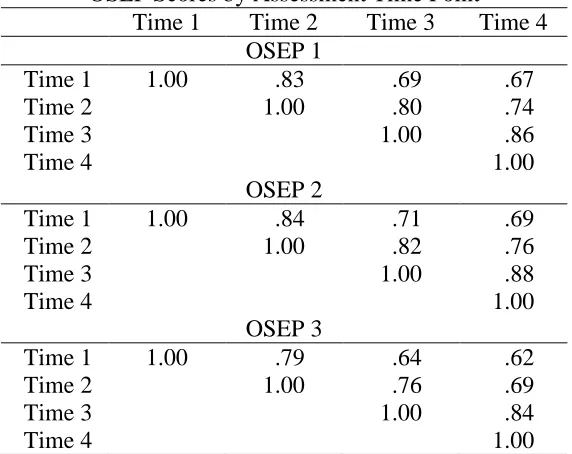
26.Pearson Product-Moment Correlation Coefficients for OSEP Scores by Assessment Time Point ...87
27.Estimates of Fixed Effects for the Linear and Curvilinear Models by OSEP Outcome ...95
28.Fixed and Random Effects for The Basic Growth Model for OSEP 1 ...95
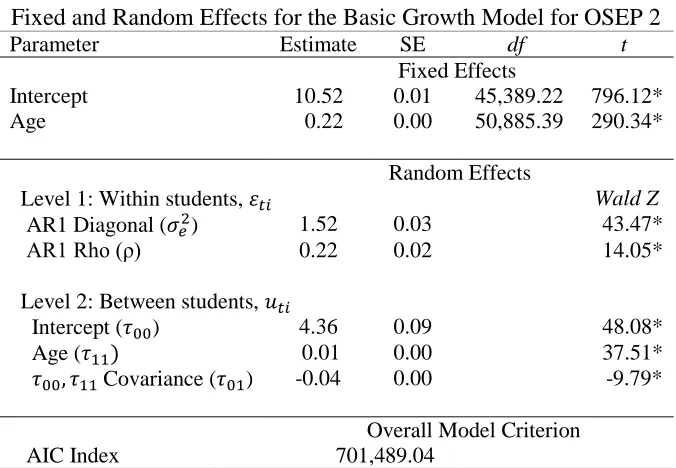
29.Fixed and Random Effects for The Basic Growth Model for OSEP 2 ...97
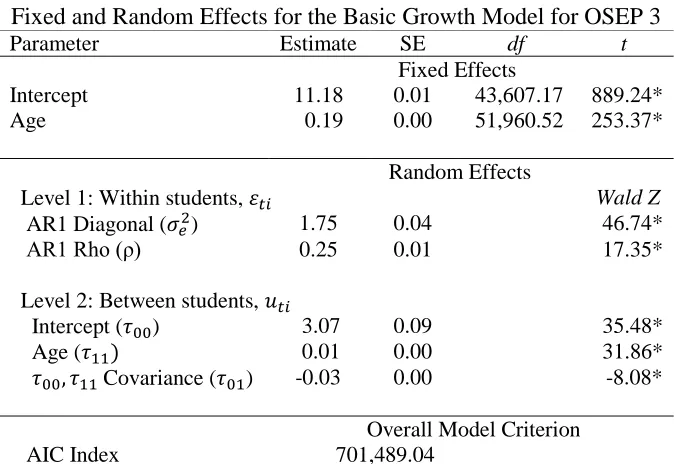
30.Fixed and Random Effects for The Basic Growth Model for OSEP 3 ...98
xiv
LIST OF TABLES CONTINUED
Table Page
32.HLM Results of the Growth Models for OSEP 2: Knowledge and Skills...105
33.HLM Results of the Growth Models for OSEP 3: Actions to Meet Needs ...107
34.Summary of HLM Results by OSEP Outcome...109
35.Comparing Results of the Growth Models for Each Domain of the DRDP
(2015) ...110
36.Comparing Results of OSEP Scores by Disability Category...113
37.Summary of HLM Results by OSEP Outcome for Children with Speech and
Language Impairments...114
38.Summary of HLM Results by OSEP Outcome for Children with Autism ....116
39.Summary of HLM Results by OSEP Outcome for Children with an
Intellectual Disability ...118
40.Summary of HLM Results by OSEP Outcome for Children with Other
Health Impairments ...120
41.Comparing Results of the Growth Models for Each Domain of the DRDP
(2015) for Children with Other Health Impairments ...122
42.Summary of HLM Results by OSEP Outcome for Children who are Hard
of Hearing ...123
43.Summary of HLM Results by OSEP Outcome for Children with a Specific
Learning Disability ...125
44.Summary of HLM Results by OSEP Outcome for Children with an
Orthopedic Impairment ...127
45.Summary of HLM Results by OSEP Outcome for Children with Multiple
CHAPTER I
STATEMENT OF THE PROBLEM
Early childhood is the most critical time in a child’s development as it is the
foundation for their lifelong educational developmental trajectory. The first 5 years of
learning are a time of rapid acquisition of knowledge and skills and critical to how the
child continues to develop as they grow (Nwokah & Sutterby, 2014). The environment
within which the development of young children occurs across emotional, social,
cognitive, and physical domains and directly effects them as adults and throughout their
lives. In the 1920s, the National Association for Nursery Education (NANE) was
founded, marking the beginning of the professionalization of early care and education for
infants, toddlers, and preschoolers. The field experienced rapid growth during World War
II as more and more women worked outside the home and, therefore, needed care for
their young children. Continuing throughout the 20th century, this trend has carried over
into the 21st century as most women now choose to work outside the home (McLean,
Sandall, & Smith, 2016).
Decades of research have shown that investing in high-quality early childhood
development, which lays the foundation for a successful adulthood, benefits the society at
large (Buysse & Bailey, 1993; Odom & Diamond, 1998; Rafferty, Piscitelli, & Boettcher,
2003). Furthermore, scientific research has shown that participating in stable, responsive,
and nurturing relationships and rich learning experiences leads to lifelong benefits for
learning, behavior, and both physical and mental health. Conversely, negative
young child can lead to weakened brain development and physical delays (Shonkoff &
Richmond, 2009).
Numerous initiatives and policies have been developed and implemented to
support the field of early-childhood education since the 1920s. Most notably, the National
Association for the Education of Young Children (NAEYC), formerly known as NANE,
continues to promote high-quality early learning for all young children, from birth
through age 8, by connecting early-childhood practice, policy, and research. Although
financial and policy support for early-childhood education services increased in the 20th
century, prior to the mid-1900s there was little to no specific attention given to the
provision of early care and education of young children with disabilities. The evolution of
the field of childhood special education is linked closely to the field of
early-childhood education. Both fields are focused on providing high-quality education and
improved social-emotional development of young children.
The field of early-childhood special education has emerged as being of primary
importance for young children with disabilities but did not receive formal support until
the 1960s with the inception of the first Head Start programs. The landmark legislation
that provided the foundation for subsequent policies and practices around the education
of individuals with disabilities was the Education for All Handicapped Children Act
(EHA) of 1975. In 2004, EHA was reauthorized and renamed the Individuals with
Disabilities Education Act (IDEA, PL 108-446). IDEA ensures that more than 6.5 million
infants, toddlers, children, and youths with special needs receive appropriate early
intervention, special education, and related services (Center for Parent Information &
children in inclusive settings with typically developing children (Barton & Smith, 2015).
More specifically, IDEA mandated that school districts must ensure that children with
disabilities, ages 3 to 21, are educated with children without disabilities to the maximum
extent appropriate (Division of Early Childhood (DEC)/NAEYC, 2009). Therefore,
young children with disabilities should be educated in inclusive settings to the greatest
extent possible.
Several decades of research have shown that high-quality and inclusive
early-education and intervention services for young children with disabilities can “(a)
ameliorate, and in some cases, prevent developmental problems; (b) result in fewer
children being retained in later grades; (c) reduce educational costs to school programs;
and (d) improve the quality of parent, child, and family relationships” (Salisbury, 1991, p.
146). In addition, research investigating the effect of inclusion on typically developing
children indicates that high-quality early-care and education services in inclusive settings
are beneficial for all children (Barton & Smith, 2015).
Inclusion can be defined broadly as an educational setting or classroom where
children with and without disabilities learn together (Barton & Smith, 2015). Inclusion
extends well beyond the classroom and can refer to participation in all daily activities and
routines. Preschool inclusion is different than inclusion in primary and secondary schools
(Odom, 2002). First, curriculum is different in preschool settings. The focus is on
developing new skills and knowledge, rather than on learning outcomes based on
academic standards. Second, because all children in preschool are new learners, the
“developmental gap” between children with and without disabilities generally is smaller
the measurement tool being proposed for use in this study, authentic or observational
assessments are used more commonly to measure the development of preschoolers.
In their review of relevant research on preschool inclusion, Odom and Wolery
(2003) summarized the literature on preschool inclusion. Their review included several
key findings, one of which was that positive outcomes are reported for children with
disabilities and typically developing children in inclusive settings. Furthermore, Odom
and Wolery (2003) noted that other reviews of the literature have concluded that on
standardized developmental measures, young children with disabilities perform equally
well in inclusive and noninclusive settings.
Buysse and Bailey (1993) completed a comprehensive and exhaustive review of
comparative studies regarding preschool inclusion. Their review was the most complete
review of this field in research up to that point in time. The review included 22 studies,
and of those studies, seven reported findings with regard to developmental outcomes. The
results of the studies reviewed by Buysse and Bailey (1993) indicated that the mean level
of children’s performance over time, as measured by the standardized measures used in
the studies, did not vary by type of setting, either inclusive or noninclusive. The studies
included in this review had several limitations: in particular, the equivalency at the onset
of the comparison groups was neither investigated nor mitigated.
Since 1993, several new studies have investigated the relationships between
preschool setting and developmental outcomes of children with and without disabilities.
The seven studies selected for comprehensive review in the present literature review in
chapter II were determined to have reported findings with regard to developmental
review of studies prior to 1993, highlight several gaps in the present body of research
investigating developmental outcomes and preschool setting. Prior research studies in this
area have been conducted using limited samples in size, geography, and ethnic and
socioeconomic diversity. In addition, most of those studies were conducted across only
one or two points in time, and the measurement tools used were limited in domains of
development measured.
Even though research provides supporting evidence about the positive outcomes
related to preschool inclusion, the current literature has three major limitations. First, the
studies specifically investigating the relationship of developmental progress to preschool
setting have been conducted on a small scale; these studies have primarily been
single-case studies or comparisons of small groups of children to other small groups. Few
studies have been conducted on a large scale; the largest of the study samples has been
223 participants. Second, these studies have been limited in the dependent variables
measured. Many studies include one or two developmental domains, such as language
development and social-emotional measures, but no study included an investigation
across all domains of early-childhood development. Finally, the relevant research is
limited in studying this relationship between preschool setting and developmental
progress over time. Many of the studies have reviewed this phenomena for a single point
in time or within one year, but few have studied progress over multiple time points and
children ages 3 through 5 years.
The present study addressed all three limitations. The study is large scale, focused
on a complete set of developmental outcomes, and included four data points over 2 years.
preschool-aged children with disabilities by researching a large-scale longitudinal data
set. The results of the study provide additional evidence about the effect of inclusion on
the development of young children with disabilities.
Purpose of the Study
The purpose of this study was to perform a secondary data analysis to investigate
the relationship between preschool setting and the developmental growth of all children
receiving state-funded preschool special-education services in California in inclusive
settings compared with all children receiving state-funded preschool special-education
services in California in noninclusive settings.
To accomplish this purpose, a secondary data analysis of a longitudinal data set
was conducted using the Desired Results Developmental Profile (DRDP, 2015) to
measure progress across eight domains of child development over a 2-year time span and
four assessment time points. This study used individual growth modeling to analyze
developmental growth; more specifically, this study used hierarchical linear modeling.
The study included all children receiving preschool special-education services in
California, in both inclusive and noninclusive settings, and investigated differences
between groups based on preschool setting.
Educational Significance of the Study
This study is important for three main reasons. First, it adds to the body of
research investigating the effect that inclusive settings have on children’s learning by
increasing the size or magnitude of the sample. Previous research comparing the
development of children by preschool setting has been conducted almost exclusively on
Carpenter, 2000). No previous studies have been conducted using a large scale (n > 250
children) data set, but the sample for the present study is drawn from the entire
population of children being served by preschool special-education providers in
California. In addition, the population of preschool-age children with disabilities in
California comprises a diverse sample of children across several demographic variables
including race, ethnicity, and disability category.
Second, the study extends the previous research by investigating developmental
growth over multiple points in time. Previous studies regarding the effect of preschool
inclusion generally have focused on a single data point, and few of them have included an
analysis of developmental growth over more than one point in time. Prior research
indicates that inclusive settings are connected to improved academic outcomes and
success later in life. A longitudinal study provides more information about how students
with disabilities progress over time when included with their typically developing peers.
Finally, this study investigated how the progress of children across multiple
developmental domains is related directly to the setting in which the children are served.
Prior research has shown that if children with special needs are served in inclusive
settings, they are more likely to progress across all domains of development, including
social-emotional, language, and cognitive measures. Studies investigating the effect of
preschool inclusion have linked positive outcomes with increased social interactions and
improved behavioral outcomes. A few studies have even investigated more than one
dependent variable at once (Buysse, Goldman, & Skinner, 2002; Diamond & Carpenter,
2000; Hundert, Mahoney, Mundy, & Vernon, 1998). None of these studies, however,
development. This study presents statistically significant results about the developmental
progress of young children with disabilities across eight different domains.
Beyond the extension of previous research, the present study contributes to the field
of early-childhood special education by providing a definitive answer to the question of
whether or not inclusion makes a difference for preschool-aged children with disabilities.
Enormous amounts of time and resources are devoted to providing inclusive services for
preschool children with a disability alongside their typically developing peers. The results
of this study could be used to support future legislation that may lead to additional
funding and support for providing inclusive opportunities for all children.
Theoretical Framework
A variety of formal theories and theoretical frameworks have influenced
early-childhood special education (McLean et. al., 2016). In the United States, most of these
theories have been situated in “psychology, applied behavior analysis, and developmental
science, although sociology, systems theory, and neuroscience also influence practice”
(Odom & Wolery, 2003, p. 165). Practitioners also have informal theories of practice that
come from their work in the field with children and families (Odom, 2016). Of all the
theories that have influenced the field of early-childhood special education, the theory
that primarily underpins the present study investigating the effect of inclusive settings on
children with disabilities is Urie Bronfenbrenner’s (2005) ecological systems theory. This
section provides an overview of Bronfenbrenner’s theory and how it serves as a
foundation for the present study.
Systems theory is often summed up with the adage that “a system is more than the
system exert a strong influence on that system (Odom, 2016). Although several of the
theoretical frameworks that are connected to practices in early-childhood special
education are grounded in systems theory—including the ecological systems theory,
family systems theory, and implementation science—the ecological systems theory is the
most relevant conceptual model for the present study.
Bronfenbrenner’s ecological systems theory has been one of the most influential
theories on the field of early-childhood special education (Odom, 2016). In Making
Human Beings Human, Bronfenbrenner’s (2005) definition of the theory proposed that a
child is influenced directly by the system he or she inhabits, such as family, friends, and
teachers:
Definition 1: The ecology of human development is the scientific study of the progressive, mutual accommodation, through the life course, between an active, growing human being and the changing properties of the immediate settings in which the developing person lives, as this process is affected by the relations between these settings, and by the larger contexts in which the settings are embedded. (p. 107)
The interactions a child has with other individuals directly effects how he or she
develops. Because a child is a part of many different systems, such as school and home,
the interaction between these systems also has a direct effect on how this child develops.
With respect to early-childhood special education, the chain of interlinking systems can
be considered as the school district, the school, the provider or teacher, and the family.
All of these systems are linked and, therefore, have a direct effect on one another and
ultimately on the education and development of the child.
In Making Human Beings Human, Bronfenbrenner (2005) discussed the research
models that apply to studying development within context, the most common and
social class, family size, ethnicity, and race. More recently, as Bronfenbrenner (2005)
noted, new demography variables have emerged such as home care versus day care,
private versus public schools, and marital status of parents. The primary limitation to this
model is that the researcher investigates the social address or attribute but fails to explore
the effect the environment might have on development. For example, with respect to
home care versus day care, the researcher studies the effect of increased social
interactions in a day-care setting, rather than focusing on the unique attributes of the
environment, such as greater access to outside space in a home setting.
A more complex research design model is the person-context model. With this
type of study, characteristics of both the person and their environment are taken into
account (Bronfenbrenner, 2005). These study designs enable the researcher to establish
“ecological niches” that are defined by an intersection between two or more
characteristics that can then be related to the outcome measure. This model has similar
limitations to the social address model in that it does not take into account all possible
factors that influence a child’s development. But from Bronfenbrenner’s (2005)
ecological perspective, it possesses a structural feature that makes it useful to studying
development in context by taking into account both personal and environmental factors.
The present study investigated child development as a product of both the
environment represented by the educational setting (inclusive vs. noninclusive) and the
specific social address for each child (disability category). In building the theoretical
framework for this study, the goal was to understand more deeply the relationship
between the environment, the disability, and the developmental outcomes. Ultimately,
the process associated with the above environment and social characteristics. Meaningful
results and a deeper understanding of the relationship between preschool setting and
development growth, however, may be learned from the results of this study.
Background and Need
In this section, a history of early-childhood special education is presented, as well
as background information about special education in the United States. A discussion of
the disability categories and preschool settings is provided, because these two
demographic variables are the primary independent variables of interest in this study.
And finally, an overview of the California accountability system provides the detail
needed to understand the context in which the DRDP is used in the State of California.
History of Early-Childhood Special Education in the United States
Several comprehensive articles on the history of early-childhood special
education in the United States have been published. In 1991, Hebbeler, Smith, and Black
published a comprehensive review of the evolution of federal educational policy in early
childhood. That review stands as a comprehensive account of the history of services for
young children with special needs. More recently, in 2016, McLean, Sandall, and Smith
published an article in the Handbook of Early Childhood Special Education on the
history of early-childhood special education. Their article provides a detailed account of
the evolution of these services and the policies influencing this field. Rather than attempt
to improve upon these exhaustive reviews, this section highlights the most important
policies and events that have had an effect on the field of early-childhood special
The field of early-childhood special education, which began to take shape in the
mid-1900s, is still relatively new (McLean et al., 2016). It was not until the 1920s that the
newly founded National Association of Nursery School Educators began to lay the
groundwork for a more comprehensive system of education for young children and
early-childhood educators. During World War II, many women had to join the workforce, so
there was a greater need for childcare (Darragh, 2010). As women continued to play a
major role in the workforce throughout the 1950s and ‘60s, the field of early-childhood
education gradually expanded.
Although early-childhood education expanded during the mid-20th century, the
education of young children with disabilities continued to receive little attention
(Peterson, 1987). During the mid-1900s, almost all public schools denied admission to
children with disabilities, and their families were turned away (McLean et al., 2016).
Because families struggled to find educational programs for their children, a role for
parents as advocates began to emerge. The Council for Exceptional Children was
founded in 1922 by early-childhood special-education professionals to connect people
interested in “special children” and establish professional teaching standards (Kode,
2002). This organization helped to increase the research, public policy, and access to
public schools for families of a child with a disability. Because of these early efforts, the
latter part of the 20th century witnessed an explosion of development in the field of
early-childhood special education. (McLean et al., 2016)
Federal and State Policy (1968–1986)
Several key federal and state policies have advanced the field of early-childhood
families. The evolution of federal policy in early-childhood special education has focused
on multiple objectives and employed a variety of strategies in moving the nation closer to
a more comprehensive system of services for young children with special needs. These
initiatives were developed for a variety of reasons, including to stimulate interest and
engagement in early-childhood special education, to share information across the field, to
improve services to young children, to improve professional development for providers,
and to help support state-level efforts to build an infrastructure (Hebbeler et al., 1991).
In the summer of 1965, Head Start began as an 8-week summer program to
prepare young children for kindergarten. As it became clear that an 8-week program was
not sufficient, the program began to expand. Head Start has grown over the years into a
year-round preschool program for 3-, 4- and 5-year-olds. In 1972, legislation passed that
required that children with disabilities make up at least 10% of Head Start enrollments.
Head Start became the first major public early-childhood program providing inclusive
services to children with disabilities (McLean et al., 2016).
The early years—1960s and ‘70s—of early-childhood special education were
focused on engaging local programs and building a knowledge base of best practices for
the field. The 1965 amendments to the Elementary and Secondary Education Act
provided grants to schools to expand and improve special-education programs. This
federal legislation (PL 89-313) was important in supporting local efforts and moving the
United States toward universally available early-childhood services for all children,
including children with special needs.
In 1968, PL 90-538 created the Handicapped Children’s Early Education Program
Disabilities. HCEEP was the first federal special-education program targeted solely at the
needs of young children with disabilities (Hebbeler et al., 1991). The main goal of this
legislation was to discover new and improved approaches to working in the field of
early-childhood special education (McLean et al., 2016). HCEEP funds were used as support
for model programs to identify more formally best practices in the field of early
childhood special education. By the mid-1970s, every state had at least one HCEEP
project site. In 1970, the Congress passed PL 91-230, which provided grants to states for
the education of handicapped children from preschool through secondary school. By
1975, more than 20,000 young children with disabilities and their families were being
served directly or through collaboration.
By the mid-1970s, even with all the legislation in support of serving children with
disabilities, an estimated one million school-aged children with special needs were still
not receiving an education (Weintraub & Abeson, 1974). In 1975, the Congress passed
PL 94-142, a landmark federal policy titled the Education for All Handicapped Children
Act (EHA). That legislation, however, was limited with regard to the education of
infants, toddlers, and preschoolers. Only if the state offered public education to young
children did this law apply. PL 94-142 did include the Preschool Incentive Grant
Program, which provided additional funding to states to expand special-education
services for preschool-age children, although less than half of the states chose to
participate in the first year of that grant program (Hebbeler et al., 1991).
In 1976, states were encouraged to improve early-childhood services through the
development of the State Implementation Grants (SIGs) program (McLean et al., 2016).
activities such as needs assessments, the development of planning groups, research in the
field of early childhood education, and the dissemination of these findings (Reaves &
Burns, 1982). Initially only 16 states received the two-year SIG funding; by 1984,
however, 43 states and territories had received SIG awards. State leaders indicated that
the SIG awards enabled them to build capacity for planning and creating structures to
help ensure statewide provision of services to young children with disabilities (Hebbeler
et al., 1991).
In 1977, the Bureau for the Education of the Handicapped established Early
Childhood Research Institutes to address the need for long-term research into how
children were developing across different service settings. The institutes conducted
research across eight primary focus areas, including home- versus center-based
instructional programs, inclusive or typical classroom services, instructional practices,
and assessment practices.
As a result of the research findings, by 1986 the Congress established a new
program, as part of HCEEP (PL 98-199), that provided federal money to states for
planning, developing, and implementing statewide services for young children with
disabilities (McLean et al., 2016). This new legislation moved states and the whole
country closer to a universal system for early-childhood education. Incentives were
provided to states to create comprehensive policies and programs for early-childhood
special education and about half of the states developed public policies for providing
services for young children with disabilities.
In 1986, closely following PL 98-199, landmark legislation was passed that
legislation, referred to as the EHA Amendments of 1986, created Part B, Section 619 for
preschool-aged children with disabilities and Part H (now known as Part C) for infants
and toddlers with disabilities (McLean et al., 2016). The EHA Amendments required
states to lower the age of free-and-appropriate public education (FAPE) from 6 years of
age to 3 years of age under Part B services. This legislation also established voluntary
early-intervention services for children with disabilities or at risk for disabilities from
birth through age 2 under Part H.
In reviewing the long evolution and development of public policy in this field, it
becomes clear that the federal government supported the states in their focus on
implementing and supporting early-childhood special-education services.
Current Federal and State Policy (1986–Present)
In the 10 years after PL 99-457 was passed, states focused on developing policies
to implement the new early-intervention and preschool requirements. By 1988, all states
had applied for funding and were required to ensure that services were available to all
eligible infants, toddlers, and preschoolers within 5 years. No major federal legislation
regarding early intervention was passed in the years following PL 99-457: with one
exception. Early Head Start was established in 1995 to provide services to children from
birth to 3 years of age. Just as in 1972, the legislation mandated that children with
disabilities make up at least 10% of Early Head Start enrollments.
In 1990, the Education of the Handicapped Act (EHA) was reauthorized and
renamed the Individuals with Disabilities Education Act (IDEA). The Americans with
Disabilities (ADA) also was passed in 1990, marking a major milestone for individuals
the increasing social value that people with disabilities are “people first” and that policy
should reflect these values with the use of “people-first” language (McLean et al., 2016).
A number of amendments to IDEA have provided additional detail to some of the
early childhood provisions of the law. The most recent amendments were passed in
December 2004 (Individuals with Disabilities Education Act, 2004), with the final
regulations being published in August 2006 for Part B and in September 2011 for Part C,
infants and toddlers (U.S. Department of Education, 2006, 2011). Federal funding for
IDEA and Head Start has increased over the years, but federal funding is not sufficient to
serve all young children who are eligible to receive services.
The amount of change that has occurred in legislation and services to young
children with disabilities is remarkable. A review of the history of federal policy for early
childhood ultimately reveals, however, that notwithstanding more than 20 years of
progress, universally available early-childhood services for children with disabilities has
not been achieved. Although research and advocacy for early-childhood education has
continued since the 1990’s, federal policy continues to evolve and provide additional
support for the field with the ultimate goal that universally available early-childhood
services are achieved.
Special-Education Implementation in the United States
The need for special-education services is supported by the sheer magnitude of
the number of children with a diagnosed disability. Over 700,000 children from birth
through age 21 are receiving special-education services in the United States. Under Part
B of IDEA, the Secretary of Education provides funds to assist states in providing a free
need of special-education and related services. To be eligible for funding under the
Preschool Grants for Children with Disabilities program and the Grants to States program
for children ages 3 through 5, a state must make free-appropriate public education
available to all children with disabilities, ages 3 through 5, residing in the state.
According to the 38th Annual Report to Congress on the Implementation of the
Individuals with Disabilities Education Act, 2016 (U.S. Department of Education, 2016),
Part B has four primary purposes:
● to ensure that all children with disabilities have free appropriate public education
available to them and receive special-education and related services designed to
meet their individual needs,
● to ensure that the rights of children with disabilities and their parents are
protected,
● to assist states and localities in providing for the education of all children with
disabilities, and
● to assess and ensure the effectiveness of efforts to educate children with
disabilities.
As of the fall of 2014, there were 736,170 children (ages 3 through 5) being
served under Part B in the 50 states, the District of Columbia, and the Bureau of Indian
Education schools (U.S. Department of Education, 2016), representing 6.1% of the entire
population of all 3-, 4-, and 5-year-olds. In California, 78,598 preschool-aged children
were served in the 2014–15 academic year (California Department of Education, 2017).
This total represents 5.1% (U.S. Census Bureau, 2010) of all 3-, 4-, and 5-year-olds in the
In a report published in 2000 by the Center for Special Education Finance for the
U.S. Department of Education, it was reported that during the 1999–2000 school year, the
50 states and the District of Columbia spent approximately $50 billion on
special-education services (Chambers, Parrish, & Harr, 2004). The report noted that this total
special-education cost translates to $8,080 spent per special-education student. Of the $50
billion of special-education funding, 9% of total spending is allocated to preschool
programs. Preschool programs operated within public schools represent 8% of the total
budget ($4.1 billion), whereas those outside public schools represent one percent ($263
million).
Because so many children are receiving preschool special-education services in
the United States, there exists a great need for continued research in the field of
early-childhood special education. Early-early-childhood-program administrators, teachers, and
providers need relevant research about the most appropriate practices by which to serve
children with disabilities. The proposed study aimed to provide findings across preschool
settings and disability categories that relate to developmental outcomes and that
potentially can be applied to program and classroom practices across
early-childhood-education programs.
Preschool Inclusion
The inclusion of preschool-aged children with disabilities in classrooms with their
typically developing peers is a relatively recent phenomenon. The concept has been
written about since the early 1970s, but it has emerged as a legitimate alternative for
children with disabilities and their families only since the 1990s (Odom, 2000). For more
children with disabilities in settings with their typically developing peers results in
positive outcomes for all children (Barton & Smith, 2015).The Individuals with
Disabilities Education Act (IDEA) of 2004 required that school districts must ensure that
children with disabilities, ages 3 to 21, are educated with children without disabilities to
the maximum extent appropriate.
Definition of Early-Childhood Inclusion
“Early Childhood Inclusion,” the position statement jointly released in 2009 by
the Division of Early Childhood and the National Association for the Education of Young
Children, provides a formal definition of early-childhood inclusion:
Early childhood inclusion embodies the values, policies, and practices that support the right of every infant and young child and his or her family, regardless of ability, to participate in a broad range of activities and contexts as full members of families, communities, and society. The desired results of inclusive experiences for children with and without disabilities and their families include a sense of belonging and membership, positive social relationships and friendships, and development and learning to reach their full potential. The defining features of inclusion that can be used to identify high quality early childhood programs and services are access, participation, and supports. (DEC/NAEYC, 2009, p. 2)
Three defining features of inclusion are listed in the final sentence of the DEC/NAEYC
definition: access, participation, and support. The position statement provides additional
detail about what each of these terms means.
Access refers to providing a wide range of appropriate and contextually relevant
learning opportunities, activities, and settings for every child by enhancing physical
accessibility through modifying and removing physical barriers to learning and offering
many different learning opportunities. The primary goal is that all children have access to
typical daily routines, activities, settings, and general-education curricula (Barton &
Participation means that adults promote belonging, participation, and engagement
of all children with and without disabilities in inclusive settings in a variety of ways.
Adults use a variety of instructional practices and techniques, including adaptations and
accommodations to promote active participation and a sense of belonging for all children.
Supports refers to the system level of supports that must be in place to reinforce
the efforts of service providers and agencies providing inclusive services for preschool
children with disabilities. Supports might include professional-development opportunities
for program administrators, service providers, and families. This element also requires
that formal policies be in place to support high-quality preschool inclusion.
The Joint Position Statement of DEC and NAEYC has served as the primary
guide for the provision of early-childhood inclusive opportunities to young children in the
United States since its release in 2009. Professionals have used this statement as a guide
on best practices, as well as an impetus for the development of curriculum, classroom
supports, and professional development opportunities for educators serving children with
special needs.
Components of Inclusion
Research since the 1980s regarding inclusive-service delivery for preschool
children with disabilities has identified key components of effective inclusion practices
(Barton & Smith, 2015; Gupta, Henninger, & Vinh, 2014; Richardson-Gibbs & Klein,
2014). Barton and Smith (2015) developed the Preschool Inclusion Toolbox, which
includes an Inclusion Self Checklist that early childhood programs can use to assess their
level of implementation across a list of seven desired components: (a) intentional,
specialized, individualized supports; (c) family involvement; (d) inclusive,
interdisciplinary services and collaborative teaming; (e) a focus on critical sociological
outcomes; (f) effective, ongoing professional development; and (g) ongoing program
evaluation.
In order for inclusion to be effective for all children, early-childhood programs
must have the supports in place to provide services to children with disabilities, while
also working with all students included in their class. The development of resources such
as the Preschool Inclusion Toolbox (Barton & Smith, 2015), First Steps to Preschool
Inclusion (Gupta et al, 2014), and Making Preschool Inclusion Work (Richardson-Gibbs
& Klein, 2014) continue to be of primary importance to support the field in providing
quality early-childhood inclusive opportunities.
Barriers to Inclusion
Even though federal policies and resources support the inclusion of preschool
children with disabilities in classrooms with their typically developing peers, several
barriers to inclusion persist. First, funding for IDEA Part B has not been increased, which
means that funding for preschool special education is insufficient to meet the needs of the
growing population of young children being diagnosed with a disability. The resulting
shortage of trained professionals available to provide inclusive educational services has
resulted in a lack of high-quality preschool classrooms where children can be served
inclusively (Richardson-Gibbs & Klein, 2014). A fundamental difference exists between
the core knowledge and skills of professionals in early-childhood special education and
those in early-childhood education: Early-childhood special-education professionals must
training only in general early-childhood education curricula. And finally, regardless of
the best intentions of administrators and educational leaders, there is a lack of
understanding in the field about how to make inclusion work (Gupta et al., 2014).
Benefits of Inclusion
Although there are many barriers to providing inclusive preschool services to
young children, there are many benefits to providing high-quality inclusive opportunities
to 3-, 4-, and 5-year-old children with disabilities. In addition, there is no evidence that
preschool inclusion has a negative effect on any child, with or without a disability, being
served in an inclusive classroom (Richardson-Gibbs & Klein, 2014). The following
review of research in chapter II on preschool inclusion provides details about the many
benefits resulting from including children with disabilities with their typically developing
peers.
Disability Categories
Thirteen official disability categories are used for the federal reporting of children
with disabilities. California uses these same disability categories for state-level reporting
on child data, with two exceptions. First, California does not use the
“developmental-delay” category. IDEA allows states flexibility in the use of the developmental-delay
category; the use of the category is optional. Only children ages 3 through 9 may be
reported in the developmental-delay disability category, and then only in states with the
diagnostic instruments and procedures to measure delays in physical, cognitive,
communication, social or emotional, or adaptive development. States must have defined
and established eligibility criteria for developmental delay in order to report children in
category of “hearing impairments” into two categories: “hard of hearing” and “deafness.”
A list of all disability categories used in California and a brief description of each
category are included in Table 1.
In 2014, according to the U.S. Department of Education, the most prevalent
disability category of preschool-age children served in Part B nationwide was speech and
language impairment (43.7%). The next most common category was developmental delay
(37.0%), followed by autism (8.9%). All other disability categories accounted for 10.5%
of all 3-, 4-, and 5-year-olds served under IDEA, Part B (U.S. Department of Education,
2016).
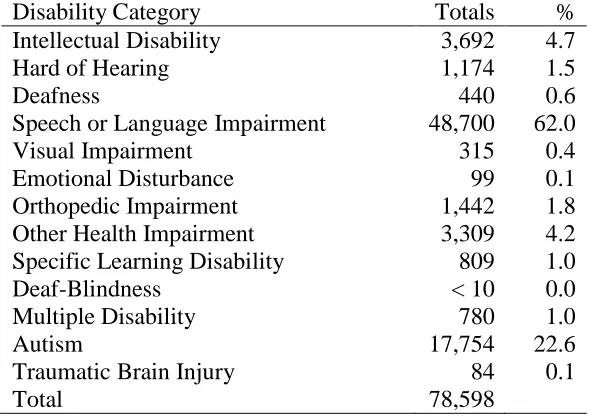
As reported on the DataQuest website, California’s percentages by disability
category are similar to the national totals (California Department of Education, 2017).
The most common disability category in California is speech and language impairment
(62%), followed by autism (22%). All other disability categories accounted for 16% of all
preschool children served in California with a diagnosed disability.
Included in Table 2 are all totals by disability category from the California
Department of Education’s DataQuest website for data reported in the December 2015
reporting cycle. For the purpose of the proposed study, only disability categories with cell
Table 1 Disability Categories
Disability Category Definition
Intellectual Disability Significantly impaired intellectual and adaptive functioning
Hard of Hearing Partial or total inability to hear
Deafness Little to no hearing
Speech or Language Impairment
Difficulty in articulation of words
Visual Impairment Decreased ability to see, to a degree that causes problems not
fixable by usual means, such as glasses
Emotional Disturbance Poor social or academic adjustment that cannot be otherwise
explained by a physical-health impairment
Orthopedic Impairment Injuries or pain in the human musculoskeletal system
Other Health Impairment Having limited strength, vitality, or alertness, including a
heightened alertness to environmental stimuli, which result in limited alertness
Established Medical Disability
A disabling medical condition or congenital syndrome that is determined to require special education and services
Specific Learning Disability
Difficulty learning in a typical manner, usually caused by an unknown factor or factors
Deaf-Blindness Little or no useful sight, and little or no useful hearing
Multiple Disability Multiple impairments
Autism Neurodevelopmental disorder characterized by impaired social
interaction, verbal and nonverbal communication, and restricted and repetitive behavior
Traumatic Brain Injury An injury to the brain caused by an external physical force,
resulting in total or partial functional disability, psychosocial impairment, or both
Table 2
Disability Category Totals for California as Indicated on the DRDP Assessment Records for Fall 2015
Disability Category Totals %
Intellectual Disability 3,692 4.7
Hard of Hearing 1,174 1.5
Deafness 440 0.6
Speech or Language Impairment 48,700 62.0
Visual Impairment 315 0.4
Emotional Disturbance 99 0.1
Orthopedic Impairment 1,442 1.8
Other Health Impairment 3,309 4.2
Specific Learning Disability 809 1.0
Deaf-Blindness < 10 0.0
Multiple Disability 780 1.0
Autism 17,754 22.6
Traumatic Brain Injury 84 0.1
Total 78,598
Preschool Setting
Because the foundation for current early-childhood inclusion practices began to
emerge as early as the mid-1980s and thus have evolved and developed over the past 3
decades, young children with disabilities have been served in a variety of settings with
varied levels of inclusion with their typically developing peers. The U.S. Department of
Education currently has nine categories of educational environment in which children
ages 3 through 5 may be served under IDEA, Part B. California uses the same nine
categories for state reporting. The nine categories and brief descriptions of the settings
are included in Table 3.
In 2014, 65.8% of preschool children with a disability in the United States were
served in a regular early-childhood program for some amount of their time in school. In
services in the regular early-childhood program. Children served in a separate class
setting accounted for 23% of the total population (U.S. Department of Education, 2016).
Table 3
Federal Preschool Settings
Federal Program Setting Description (California Department of Education, 2016)
Regular Early-Childhood Program at Least 10 hrs. per week and Majority
A program setting that includes at least 50 to 69% nondisabled children for at least 10 hrs. per wk AND a majority of special-education services provided in this setting.
Regular Early-Childhood Program at Least 10 hrs. per week Majority Elsewhere
A program setting that includes at least 50 to 69% nondisabled children for at least 10 hrs. per wk AND a majority of special-education services NOT provided in this setting.
Regular Early-Childhood Program Less than 10 hrs. per week Majority
A program setting that includes at least 50 to 69% nondisabled children for less than 10 hrs. per wk AND a majority of special-education services provided in this setting.
Regular Early-Childhood Program Less than 10 hrs. per week Majority Elsewhere
A program setting that includes at least 50 to 69% nondisabled children for less than 10 hrs. per wk AND a majority of special-education services NOT provided in this setting.
Separate Class In this setting the student attends a special-education program
in a class with less than 50% nondisabled children.
Separate School A placement setting where children receive all
special-education programs in public or private day schools designed specifically for children with disabilities.
Residential Facility Where children receive all special-education and related
services in publicly or privately operated residential schools or residential medical facilities on an inpatient basis.
Home The setting where children receive all special-education and
related services in the principal residence of the child's family or caregivers.
Service Provider Location
The setting where children receive all special-education and related services in the service provider location or other location not in any other category.
In California, during the 2015–16 academic year, 53.6% of preschool-age
children received special-education services in a regular early-childhood program for
some amount of time. Of those children, 33.5% received the majority of their
special-education and related services in their regular early-childhood program. A total of 32% of
children were served in a separate class.
California’s Preschool Accountability System
In order to comply with accountability required by federal law, the Special
Education Division (SED) of the California Department of Education (CDE), in
collaboration with the Early Education Services Division (EESD), developed the Desired
Results Developmental Profile (DRDP) assessment (Desired Results Access Project,
2015). This instrument was implemented across all SED and EESD programs in the fall
of 2015. The DRDP assessment enables California to report progress toward the three
child outcomes required by the federal Office of Special Education Programs (OSEP) for
both infants and preschool-age children with disabilities served by the CDE.
The DRDP, a developmental continuum along which children’s knowledge and
skills are measured from birth through 5 years of age, is composed of developmental
domains representing important areas of learning and development for young children.
The DRDP instrument is designed to guide program staff in observing and documenting
children’s developmental status and progress for the purpose of program improvement.
The DRDP is based on recommended practices for naturalistic observation of young
children by familiar adults as they participate in activities and routines in familiar
environments. The preschool view of the DRDP includes 43 measures across six
children who are English learners. As indicated above, these domain ratings are used to
address the three OSEP outcomes for federal reporting. A brief description of each
domain under each OSEP grouping is included in Table 4.
Table 4
Domains of the DRDP (2015)
Domain Description
OSEP 1
Approaches to Learning and Self-Regulation (ATL-REG)
The ATL skills include attention maintenance, engagement and persistence, and curiosity and initiative. The REG skills include self-comforting, self-control of feelings and behavior, imitation, and shared use of space and materials.
Social and Emotional Development (SED)
The SED domain assesses children’s developing abilities to understand and interact with others and to form positive relationships with nurturing adults and their peers.
OSEP 2
Language and Literacy Development (LLD)
The LLD domain assesses the progress of all children in developing foundational language (LANG) and literacy (LIT) skills. These skills can be demonstrated in any language and in any mode of communication.
Note: For the purpose of the study analyses, LLD was always split into LANG and LIT.
Cognition, Including Math and Science (COG)
The COG domain is made up of the Math (MATH) and Science (SCI) subdomains and focuses on observation, exploration of people and objects, and investigation of objects and concepts. Note: For the purpose of the study analyses, only the MATH measures were included.
OSEP 3
Physical Development and Health (PD-HLTH)
The PD-HLTH domain assesses motor development and the development of routines related to personal care, safety, and nutrition.
English Language Development (ELD)
The ELD domain assesses the progress of children who are dual-language learners in learning to communicate in English.
Using the DRDP, assessment information is collected twice a year—fall and
spring—for all children in California receiving preschool services from the California