Available online on 15.05.2019 at http://jddtonline.info
Journal of Drug Delivery and Therapeutics
Open Access to Pharmaceutical and Medical Research
© 2011-18, publisher and licensee JDDT, This is an Open Access article which permits unrestricted non-commercial use, provided the original work is properly cited
Open Access
Review Article
Analytical Method Development and Validation: A Review
Doltade Mayuri
1*
and Saudagar Ravindranath
21 Department of Pharmaceutical Quality Assurance, R.G. Sapkal College of Pharmacy, Anjaneri, Nashik-422213, Maharashtra, India
2 Department of Pharmaceutical Chemistry, R.G. Sapkal College of Pharmacy, Anjaneri, Nashik-422213, Maharashtra, India
ABSTRACT
Analytical method development and validation are the continuous and inter-dependent task associated with the research and development, quality control and quality assurance departments. The main purpose of the analytical method development and validation is to prove that proposed analytical method is accurate, specific, precise and robust in the pharmaceutical industry for analysis of a drug moiety. Analytical methodology development has become the essential activity of study. Recent development in analytical methods has been resulted from the advancement of analytical instruments. Analytical techniques are developed and validated for active pharmaceutical ingredients (API), excipients, drug products, degradation products and related substances, residual solvents, etc. Method validation is outlined as the method of proving that an analytical technique is appropriate for the meant use and this is often a very important requirement for analytical purpose. Result from methodology validation is used to decide the quality, reliability and consistency of analytical data. Validation parameters are explained in term of accuracy, precision, linearity, specificity, limit of detection (LOD), limit of quantification (LOQ), ruggedness, robustness and system suitability. This review offers concepts concerning varied strategies to check the stability of drug and varied validation parameters as per varied regulative authorities. The review focused on the concept, criteria, steps, strategy and importance of analytical method development and validation.
Keywords: Analytical Method Development, Method Validation, Strategy, Steps, Need, ICH guidelines.
Article Info:Received 13 March 2019; Review Completed 16 April 2019; Accepted 27 April 2019; Available online 15 May 2019 Cite this article as:
Doltade M, Saudagar R,Analytical Method Development and Validation: A Review, Journal of Drug Delivery and Therapeutics. 2019; 9(3):563-570 http://dx.doi.org/10.22270/jddt.v9i3.2774
*Address for Correspondence:
Mayuri Doltade, Department of Pharmaceutical Quality Assurance, R.G. Sapkal College of Pharmacy, Anjaneri, Nashik-422213, Maharashtra, India.
INTRODUCTION
Analytical chemistry deals with method of determining the chemical composition of sample. It is primarily concerned about determining the qualitative and quantitative composition of material. A qualitative method yields information about the identity of atomic or molecular species or functional group in the sample. A quantitative method in contrast provides numerical information as to the relative amount of one or more of these components. It is a scientific discipline used to study the chemical composition, structure and behaviour of matter. The term chemical analysis may be defined as the application of a process or series of process to identify or quantify a substance, the component of a solution or mixture or the structure of chemical compounds. It is involved in all the stages from drug discovery, development, action, safety, formulation, use, quality control, packaging, storage, marketing etc. Any drug or dosage form for human use must have excellent quality and purity, free from impurities. This dosage form directly affects the human life and behaviour so their analysis is important which is carried out using analytical methods. Analytical method
development is the heart of analytical chemistry. It involves development and validation of new analytical method for the purpose of testing samples. Sample testing is done by using UV, IR, HPLC, HPTLC, GC-MS, and LC-MS etc. Analytical chemistry has since long, occupied an important in the development of science and technology. It is very broad and embraces a wide range of natural, chemical and instrumental
technique and procedure.1
Analytical approach and Validation are important parameter consider in the discovery, improvement, and manufacturing of pharmaceutical products. The main objective of an analytical is to get consistent, realistic, and correct information. Validation plays a significant role in achieving this goal. Outcome from method validation may be used to choose the standard, reliability, and consistency of analytical results, that is associated with integral part of any sensible
analytical practice.2
additionally needed by most regulatory authorities and quality standards that impact laboratories. Pharmaceutical products developed with more than one drug, generally said as combination products, are meant to satisfy antecedent unmet patients, and would like analytical method development and validation by combining the therapeutic
effects of two or more drugs (API) in one product.3 The
official test methods that result from these processes are employed by quality control laboratories to make sure the identity, purity, potency, and performance of drug pharmaceutical products. Identification and quantification of impurities could be a crucial task in pharmaceutical method development for quality and safety. Related elements are the impurities in pharmaceutical product that are unwanted chemicals that stick with the active pharmaceutical ingredients (APIs), or develop throughout stability testing, or develop throughout formulation or upon aging of each API and formulated arthropod genus to medicines. The presence of those unwanted chemicals even in tiny amounts might
influence the efficacy and safety of the pharmaceutical products. Varied analytical methodologies are utilized for the determination of related components in pharmaceuticals. New analytical method development has great need in
quality evaluation of new drugs or molecules.4
ANALYTICAL METHOD DEVELOPMENT
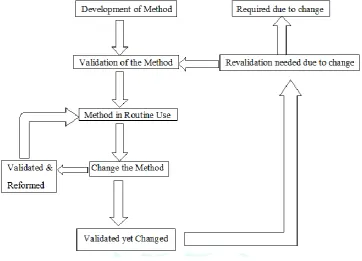
When there are no definitive methods or techniques are present, new methods are being invented for the evaluation of new or novel pharmaceutical product. To investigate the presence of either pharmacopoeial or non-pharmacopoeial product novel techniques are developed to reduce the value besides time for higher precision and strength. These methods are optimized and validated through primary runs. Different alternative ways are planned into practice to exchange the exist procedure within the comparative laboratory information with all accessible advantages and
disadvantages.2
Figure 1: Life cycle of analytical method(2)
Necessity of method development
Drug evaluation exhibits the identity characterization and resolution of the drugs in combination like dosage forms and organic fluids. At some point of producing technique and development of drug the principal purpose of analytical strategies is to generate data regarding efficiency (which may be directly connected with the need of a identification dose), impurity (related to safety of the medication), bioavailability, stability (which shows the degradation product), and effect of manufacturing parameters to verify that the production is steady.
Analyst before the development of new technologies, do not forget below mention criteria:
1. Is this technique possesses the needful sensitivity?
2. Is this method sufficiently selective for direct use
without interference by means of the opposite element within the sample?
3. Is the accuracy and precision doable with this
technique?
4. Are the reagents and equipment required on this
method available or obtained at a reasonable price?
5. Is the time requires to perform this technique
applicable?5
Basic Criteria for New Analytical Method Development
a) The drug or drug combination may not be official in any
pharmacopoeias.
b) A proper analytical procedure for the drug may not be
available in the literature due to patent regulations.
c) Analytical methods may not be available for the drug in
the form of a formulation due to the interference caused by the formulation excipients.
d) Analytical methods for the quantitation of the drug in
biological fluids may not be available.
e) Analytical methods for a drug in combination with
other drugs may not be available.
f) The existing analytical procedures may require
involve cumbersome extraction and separation
procedures and these might not be reliable.3,4
STEPS INVOLVED IN ANALYTICAL METHOD
DEVELOPMENT
Various steps are involved in the development of an analytical method are as follows:
1. Purpose of Analytical Method Development:
In the pharmaceutical industries, analytical method development gives very important information on the potency of a drug, the drug’s bioavailability, the drug’s stability and also its effects. In the very first step, the purpose of conducting any analytical method development is
established.6
2. Highlighting of Steps:
In the second step of Analytical Method Development, the steps involved in the development are recorded in a
laboratory book or online database.6
3. Analyte standard characterization:
In this step, both the biological and chemical properties
(such as solubility, optical isomerism, etc.) in addition to the physical properties of the analyte are collected.
After that, the standard analyte is equal to 100% purity
is obtained and stored according to its specific requirements (refrigerator, desiccators and freezer).
When multiple components are to be analysed in the
sample matrix, the number of components is noted, data is assembled and the availability of standards for each one is determined.
Only those techniques (spectroscopic, MS, GC, HPLC
etc.) that are compatible with sample stability are
considered.(2)
4. Requirement of the Method:
Requirement for the method development of the analysis are done and recorded. All the materials, reagents and instruments are procured that are required for the analysis of the sample. The required LOD, LOQ, Specificity, linearity, range, accuracy and precision are defined.
5. Review of Literature and existing Methodology:
Literature survey and prior methods: All the data of literature related to the drug are reviewed for its physical and chemical properties, manufacturing, solubility and applicable analytical ways with reference to relevant books, journals, United States pharmacopeia/national formulary (USP/NF), association of official agricultural chemists (AOAC) and American society for testing and materials (ASTM) publications. Chemical abstracts service (CAS) automated computerized literature searches are convenient.
6. Choosing an Analytical Method:
By using the information obtained from the literature during the literature review, a specific methodology is modified to cater for accurate output and also because methods change with the requirements of the analyte. If there is no previous method in the literature being reviewed regarding the analyte, the procedure goes on uninterrupted.
7. Instrumental setup and initial studies:
Required instruments for the analytical methodology development are set up within the laboratory. Installation qualification, operational qualification and performance
qualification of instrumentation using laboratory standard operating procedures (SOP’s) are verified. They are usually universal and standardized for ease of use in any laboratory set up.
8. Optimization of Method:
During optimization one parameter is modified at a time and set of conditions are isolated, rather than using a trial and error approach. Optimization of an analytical method is done in reference to a systematic and procedural plan while
making sure to critically follow all the documented steps.4
9. Documentation of analytical figures of merit:
Documentation of the analytical figures of benefit set upon is completed. These analytical figures of merit include limit of quantitation (LOQ), limit of detection (LOD), linearity, time per analysis, cost, sample preparation etc.
10. Evaluation of method development with actual
samples:
The specimen solution needs to prompt specific, complete recognition of the peak interest of the medication other than all different matrix part.
11. Estimation of percent recovery of real samples and
demonstration of quantitative sample analysis: Percentage recovery of spiked, actual standard medication into a sample grid which includes no analyte is evaluated. Optimization to reproducibility of recuperation from test to test must have appeared. It is not always essential to get 100% restoration so far as the outcome are reproducible to
perceive with high degree of assurance.2,4
Need of analytical method development and validation: The need of the analytical method development and validation emerged because of international competition, maintaining the quality of product in high business and moral reasons. Various International regulative Agencies have set the standard and fixed the protocol to match the reference for granting approval, authentication and registration. Some of the famous organizations governing the quality standards are:
1) United States Food and Drug Administration (US FDA).
2) Current Good Manufacturing Practice (cGMP)
regulations.
3) Good Laboratory Practice (GLP) regulations.
4) The Pharmaceutical Inspection Cooperation Scheme’s
(PIC/S).
5) Pharmaceutical Inspection Cooperation Scheme
(PIC/S).
6) The International Conference for Harmonization (ICH).
7) Quality Manual ISO/IEC 17025 issued by International
Organization for Standardization.
8) World Health Organization (WHO).7
When some changes are created in the validated nonstandard methods, the influence of such changes must be documented and a new validation method should be carried out. If standard methods are available for a particular sample take a look at, the most recent edition should be used.
Validation includes specification of requirements,
determining the method characteristics, a check that the requirements can be fulfilled by using the method, a
To know the effect of changes in methodology parameters on an analytical procedures, adopt a systematic approach for method robustness study (design of experiments with method parameters) followed by an initial risk assessment and multivariate experiments. Such approaches permit us to understand the parameters effect on method performance. Evaluations of a method performance include analysis of samples obtained from in-process manufacturing stages to the finished product. The information obtained during these studies on the sources of method variation can help to assess
the method performance.8
VALIDATION
Validation is an idea that has developed in the U. S. in 1978. The idea of validation has extended during that time to grasp an extensive variety of activities from analytical approaches utilized for the quality control of medication to computerized systems for clinical trials, marking or process control, validation is established on, however not endorsed by regulatory specifications and is best seen as a critical and necessary part of current good manufacturing practice
(cGMP).9
The phrase validation basically implies for evaluation of validity or activity of demonstrating viability. It is accepted that during the course of a typical drug product development program, a defined analytical method will undergo many modifications because composition changes, lower strength may be added or proportion of coating material might modification on the formulation. Because of the changes the analytical method may be modified and if modified it should be verified so it requires different levels of validation. Validation should in this way be considered in the accompanying circumstances:
Completely new procedure.
Latest equipment.
Procedure and equipment which have been adjusted to
suit altered needs and,
Procedure where the finished result test is a poor and
undependable marker of product Quality.(10)
Important stages in validation
The action identifying with validation studies can be categorized mainly into three stages:
Stage 1 This stage includes pre-validation qualification stage which covers all exercises identifying with product studies and improvement, formulation pilot batch testing, scale-up research, exchange of innovation to business scale groups, setting up stability conditions, and managing of in-process, finished pharmaceutical formulations, qualification of
equipment, master documents, and process limit.10
Stage 2 This step involves process validation phase. It is intended to check that every installed limit of the vital process parameter is substantial and that satisfactory
products can be created even below the worst situations.10
Stage 3 This stage is also called as the validation maintenance stage, it requires constant review of all procedure related archives, including validation of the review reports, to guarantee that there have been no modifications, departure, failures, and alteration to the production procedure and that all standard operating procedures (SOPs), involving change control procedures, had been observed. At this phase, the approval team involving people representing all essential departments also guarantees that there have been no modifications/deviations
that ought to have brought about requalification and
revalidation.10
Types of Validation:
Validation is classified in following types:
A. Equipment Validation.
Installation Qualification.
Operational Qualification.
Performance Qualification.
B. Process Validation.
Prospective Validation.
Concurrent Validation.
Retrospective Validation.
C. Analytical Method Validation.
D. Cleaning Validation.(2)
ANALYTICAL METHOD VALIDATION
Method validation is that the method of proving that an analytical methodology is suitable for its meant purpose. For pharmaceutical methods, guidelines from the United States
Pharmacopeia (USP), International Conference on
Harmonisation (ICH), and the Food and Drug Administration (FDA) provide a framework for performing such validations. In general, methods for regulatory submission must include studies on specificity, linearity, accuracy, precision, range,
detection limit, quantitation limit, and robustness.11
The need of validation of the analytical methodology development and validation emerged because of international competition, maintaining the standard of products in high commercial and market valve and ethical reasons. Various International regulative Agencies have set the quality and fixed the protocol to match the reference for
granting approval, authentication and registration.7
It is essential to use well-characterized and absolutely valid analytical strategies to yield reliable results in the laboratories whereas analysing the registration batch and accelerated stability testing samples. It is additionally necessary to emphasise that every analytical technique has its own characteristics, which will vary from analyte to analyte. In these instances, specific validation criteria might have to be developed for every analyte. Moreover, the appropriateness of the technique might also be influenced by the ultimate objective of the study. When sample analysis for a given study is conducted at over one web site and commercial batch for peoples consumption, it's necessary to validate the analytical method(s) as per ICH guidelines and to provide proper validation information for different sites and different parameter and to establish inter and intra
laboratory reliability.12
Analytical methods need to be validated or revalidated:
Before their introduction into routine use.
When the conditions changes for which the method has
been validated (e.g., an instrument with different characteristics or samples with a different matrix) and
When the method is changed, and the change is outside
Types of the Analytical method to be validated:
The four most typical kinds of analytical methods are directed to be validated
a) Identification tests.
b) Quantitative tests for impurities content.
c) Limit tests for the control of impurities.
d) Quantitative tests of the active moiety in samples of a
drug substance.(13,14)
Strategy for the Validation of Methods
The validity of a particular methodology ought to be demonstrated in laboratory experiments exploitation samples or standards that are the same as unknown samples analysed routinely. The preparation and execution should follow a validation protocol, preferably written in a step-by-step instruction format. This planned procedure assumes that the instrument has been chosen, and the method has been developed It meets criteria like ease of use; ability to be automatic and to be controlled by computer systems; prices per analysis; sample throughput; turnaround time; and
environmental, health, and safety requirements.15
Steps in Method Validation
1) Prepare a validation protocol or operating procedure
for the validation.
2) Define the application, scope, and purpose of the
method.
3) Define the performance parameters and acceptance
criteria.
4) Define validation experiments.
5) Verify relevant performance characteristics of
equipment.
6) Qualify materials, e.g. standards and reagents.
7) Perform revalidation experiments.
8) Adjust method parameters or acceptance criteria if
necessary.
9) Perform full internal and external validation
experiments.
10) Define SOPs for executing the method in routine.
11) Define criteria for re-validation.
12) Define types and frequency of system suitability tests
and Analytical Quality Control Checks (AQC) for routine.
13) Document validation experiment and results in the
validation.16
ANALYTICAL METHOD VALIDATION PARAMETERS
The validation parameters as per ICH guidelines are described below:
1) Accuracy:
The accuracy of an analytical procedure expresses the closeness of agreement between the value which is accepted either as a conventional true value or an accepted reference value and the value found. This is sometimes termed trueness. Accuracy studies for drug substance and drug product are suggested to be performed at the 80%, 100% and 120 % levels of label claim as expressed within the Guideline for Submitting Samples and Analytical information
for Methods Validation. For the drug product, this is performed frequently by the addition of known amounts of drug by weight or volume (dissolved in diluents) to the placebo formulation working in the linear range of detection of the analyte. This would be a true recovery for liquid formulations. For formulations such as tablet, suppository, transdermal patch, this could mean evaluating potential interaction of the active drug with the excipients in the diluents. From a practical standpoint, it is difficult to manufacture a single unit with known amount of active drug to evaluate recovery.
This check evaluates the specificity of the method within the presence of the excipients beneath the chromatographical conditions used for the analysis of the drug product. It will obtain recovery issues that might be encountered throughout the sample preparation and also the chromatographical procedures. However, it does not count the result of the manufacturing method. At every suggested level studied, replicate samples are evaluated. The % RSD of the replicates will provide the analysis variation or how precise the test method is. The mean of the replicates, expressed as percent label claim, indicates how accurate the
test method is.17
2) Precision:
The precision of an analytical procedure expresses the closeness of agreement (degree of scatter) between a series of measurements obtained from multiple sampling of the same homogeneous sample under the prescribed conditions. Precision is also thought of at 3 levels: repeatability, intermediate precision and reproducibility. Precision should be investigated using homogeneous, authentic samples. However, if it's impossible to get a homogeneous sample it should be investigated using artificially ready samples or a sample solution. The precision of an analytical procedure is usually expressed as the variance, standard deviation or coefficient of variation of a series of measurements.
a) Repeatability: Repeatability expresses the precision under the same operating conditions over a short interval of time. Repeatability is also termed intra-assay precision.
b) Intermediate Precision: Intermediate precision
expresses within-laboratories variations: different days, different analysts, different equipment, etc.
c) Reproducibility: Reproducibility expresses the
precision between laboratories (collaborative studies,
usually applied to standardization of methodology).17
3) Specificity:
Specificity is the capability to assess unequivocally the analyte in the presence of components which may be expected to be present. Typically these may include impurities, degradants, matrix, etc. The analyte should have no interference from other extraneous components and be well resolved from them. A representative HPLC chromatogram or profile ought to be generated and submitted to point out that the extraneous peaks either by addition of best-known compounds or samples from stress testing are baseline resolved from the parent analyte. Specificity is measured by resolution, plate count and tailing factor.17
4) Limit of detection (LOD):
ratio, standard deviation of the response and the slope. Detection limit signal to noise approach can only be applied to analytical procedures which exhibit baseline noise. Comparing measured signals from samples with known concentrations of analyte with those of blank samples and establishing the minimum concentration at which the analyte can be reliably detected. A signal-to noise ratio between 3 or 2:1 is generally considered acceptable for estimating the detection limit. The detection limit (DL) may be expressed as: DL=3.3 σ/ S
where, σ is the standard deviation of the response, S is the slope of the calibration curve.
The slope S might be determined from the calibration curve of the analyte. The estimate of σ may be carried out in a variety of ways, based on the standard deviation of the blank
and the calibration curve.14
5) Limit of Quantification (LOQ):
The Quantitation limit of an individual analytical procedure is that the lowest quantity of analyte in a sample which might be quantitatively determined with appropriate preciseness and accuracy. The quantitation limit may be a parameter of quantitative assays for low levels of compounds in sample matrices, and is employed significantly for the determination of impurities and/or degradation product. It can be determined visually, by signal to noise ratio, standard deviation of the response and the slope. Quantitation limit signal to noise approach can only be applied to analytical procedures which exhibit baseline noise. Comparing measured signals from samples with known concentrations of analyte with those of blank samples and establishing the minimum concentration at which the analyte can be reliably detected. A signal-to-noise ratio between 10 or 10:1 is generally considered acceptable for estimating the quantitation limit. The quantitation limit (QL) may be expressed as: QL=10 σ/ S
where, σ is the standard deviation of the response, S is the slope of the calibration curve.
The slope S may be estimated from the calibration curve of the analyte. The estimate of σ may be carried out in a variety of ways, based on the standard deviation of the blank and the calibration curve. The LOQ level is usually confirmed by injecting standards which have an acceptable percent
relative standard deviations (% RSD) not more than 10 %.14
Some usual techniques, methods for the assessment of LOD and LOQ are as follows:
Visual inspection,
Signal to noise ratio,
Standard deviation of the blank, and
Regression line at low concentrations.18
6) Linearity:
The linearity of an analytical procedure is its ability within a given range to obtain test results which are directly proportional to the concentration or the amount of analyte in the sample. Linearity must be evaluated by visual inspection of a plot of signals as a function of analyte concentration or content. If there is a linear relationship, test results must be evaluated by using applicable statistical methods, for example, by calculations of a regression line by using the method of least squares. Sometimes, to determine linearity between sample concentrations and assays, the test data might need to be subjected to a mathematical transformation
before the regression analysis. Data from the regression line might be useful to gives the mathematical estimates of the degree of linearity. The correlation coefficient, y-intercept, slope of the regression line and residual sum of squares must be submitted. A plot of the data must be included. In addition, analysis of the deviations of the real data points from the regression line might also be useful for evaluation of linearity. Some analytical methods, such as immunoassays, do not perform linearity after any transformation. In such cases, the analytical responses must be described by an appropriate function of the concentration (amount) of an analyte in a sample. For the determination of linearity, a minimum of 5 concentrations are recommended. Other
approaches should be justified3
7) Range:
The range of an analytical procedure is define as the interval between the upper and lower concentration or amounts of analyte in the sample for which it has been demonstrated that the analytical procedures has a suitable level of, accuracy, precision and linearity. The give specific range is normally obtain from linearity studies and depends on the intended use of the procedure. It is determined by confirming that the analytical methos provide an acceptable degree of linearity, accuracy and precision when apply to sample containing amounts of analyte within or at the extremes of the specified range of the analytical procedures.
For Assay - 80 to 120% of test concentration.
Content uniformity - 70 to 130% of test concentration.
Dissolution - Q-20% to 120%
Impurities - reporting level – 120% of impurity
specification limit
Assay & Impurities - Reporting level to 120% of assay
specific.
Linearity is limited to 150% of shelf life specification of impurities
Test concentration can be used to determine
impurities.
To determine drug substance (assay) the test
concentration must be diluted
The range is 0 – ~ 150% of impurity specification.(3)
8) Robustness:
The robustness of an analytical methods is a measure of its ability to remain unaffected by small, but deliberate change in method parameters and provides an indication of to remain normal during usage. Robustness tests examine the impact of operational parameters on the analysis results. The robustness parameter should be considered during the development phase. Robustness shows the reliability of an analytical procedure with respect to deliberate variations in method parameters. One of the use of the evaluation of robustness is that the series of system suitability parameters is established to ensure that the validity of the analytical
procedure is maintained whenever used.17
9) System Suitability Test:
System suitability test parameter is an integral part of chromatographic methods. System suitability tests are used to check that the resolution and reproducibility of the system are proper for the analysis to be performed.
unknowns. Parameters like tailing factors, plate count, resolution and reproducibility (%RSD retention time and area of repetitive injection) are determined and compared against the standard set for the method.
Documentation of system suitability can be accomplished by using software specifically designed for the task to provide a review of the separation and to summarize the data regarding reproducibility. The software are also used to
troubleshoot the method.19, 20
10)Ruggedness (As per USP):
Ruggedness is the degree or measure of reproducibility of test results obtained from analysing the same sample under variety of normal test conditions such as different analysts, instruments, days, reagents and columns i.e. lack of influence
of environmental variables on the method.19
IMPORTANCE AND ADVANTAGES OF ANALYTICAL
METHOD VALIDATION
The importance of analytical method validation emerged because of international competition, maintaining the quality of products in high commercial & market value and moral reasons. Various international regulative agencies set the quality standards and fixed the protocol to match the reference for granting approval, authentication and registration. The analytical method validation is required
because of the following reasons, 21
1) Before its initial use in routine testing and when
analytical method is transferred to other laboratory.
2) When the method parameters of pharmacopeial method
was changed.
3) It is necessary and important to employ
well-characterized and fully validated analytical methods to yield reliable results in the laboratories. During analysing the registration batch and accelerated stability testing of samples.
4) It is also important that each analytical technique has its
own characteristics, which may vary from analyte to analyte.
5) For assuring the quality of the product.
6) For achieving the acceptance criteria of the products by
the international regulatory agencies.
7) A regulatory requirement for registration of any
pharmaceutical products.
8) Reduction of quality cost, rejection, minimal batch
failures, improved efficiently, productivity and improved analyst awareness of analysis.
9) Regulatory requirement for registration of any
pharmaceutical products in the regulatory market. The advantage of method validation is that it builds a confidence, not only for the manufacturers but also to the users. Although the validation exercise might seem expensive and time intense, it results inexpensive, eliminates frustrating repetitions and results in higher time
management within the finish.21,22
DOCUMENTATION
The validity of associate degree analytical technique ought to be established and verified by laboratory studies and documentation of successful completion of such studies should be provided in the validation report. Specific SOPs (standard operating procedure) and good record keeping are
an essential and important part of a validated analytical method.
a) Summary information,
b) Method development, degradation study data and
establishment of Relative Retention Factor, Relative
Retention Time and LOQ etc.23
Summary information:
Summary information include details of certificate of analysis of reference standard and/or working standard, validation protocols and summary reports, including analytical method development report.
Summary table with a list contains validity period of
the certificate of analysis reference standard and/or working standard, protocol number should be allotted for each and every method and the summary report of the all the validation must be arranged in an appropriate way.
An operational description of the analytical method.
A forced degradation stability studies and supporting
data.
A description of experiments conducted and if any
error occurs during a validation, the incident report, original and repeated data detail should be covered.
Documentation of intra and inter-assay precision and
accuracy data.
Documentation should be annotated with
chromatograms or mass spectrograms, if applicable.
Any deviations from SOPs, protocols, or (Good
Laboratory Practice) GLPs (if applicable), and justifications for deviations and the incident report to
be captured.23
REFERENCES
1. Kenkel J., Analytical Chemistry for Technicians, Third Edition,
2009, Published By CRC Publication, 2-4.
2. Sharma S, Goyal S, Chauhan K, A Review on Analytical method
development and Validation, International Journal of Applied Pharmaceutics, 2018; 10(6):8-15.
3. Patil R, Deshmukh T, Patil V, Khandelwal K, Review on
Analytical method Development and Validation, Research and Reviews: Journal of Pharmaceutical Analysis, 2014; 3(3):1-10.
4. Ravisankar P, Gowthami S, Devlala Rao G, A Review on
analytical method development, Indian Journal of Research in Pharmacy and Biotechnology, 2014; 2(3): 1183-1195.
5. Patel A, Dwivedi N, Kaurav N, Bashani S, Patel S, Sharma HS,
Chemical analysis of pharmaceuticals: a review, Journal of Medical and Pharmaceutical Innovation, 2016; 3(18):4-7.
6. Lal B, Kapor D, Jaimini M, A review on analytical method
validation, and its regulatory perspective, Journal of Drug Delivery and Therapeutics, 2019; 9(2):501-506.
7. Chauhan A, Mittu B, Chauhan P, Analytical method
development and validation: A Concise Review, Journal of Analytical and Bioanalytical Techniques, 2015; 6(1): 233.
8. Bansal KS, Layloff T, Bush ED, Hamilton M, Hankinson EA,
Qualification of Analytical Instruments for Use in the Pharmaceutical Industry: a Scientific Approach, American Association of Pharmaceutical Scientists, 2004; 5:1-8.
9. Geeta G, Kumar VB, Gana Raja M, Analytical method validation:
An Updated Review, International Journal of Advances in Pharmacy, Biology and Chemistry, 2012; 5(4):64-71.
10. Jatto E, Okhamafe AO, An overview of pharmaceutical
validation and process controls in drug development, Tropical Journal of Pharmaceutical Research, 2002; 1:115-22.
11. Patil ST, Aherrao RA, Pawar SP, A short review on method
12. Daksh S, Goyal A, Chakshu KP, Validation of analytical methods: strategies and significance, IJRDPL, 2015; 4(3):1489-1497.
13. Ravichandran V, Shalini S, Sundaram KM, Rajak H, Validation
of analytical methods: Strategies and Importance, International Journal of Pharmacy and Pharmaceutical Sciences, 2010; 2(3):18-22.
14. Srivastava RK, Kumar SS, An update review: Analytical method
validation, European Journal of Pharmaceutical and Medical Research, 2017; 4(9):774-784.
15. CITAC/EURACHEM, Working Group, International Guide to
Quality in Analytical Chemistry: An aid to Accreditation; 2002.
16. Vessman J, Selectivity or Specificity? Validation of analytical
methods from the perspective of an analytical chemist in the pharmaceutical industry, Journal of Pharmaceutical and Biomedical Analysis, 1996; 14:867-869.
17. ICH Q2 (R1), Validation of Analytical Procedures: Text and
Methodology. International Conference on Harmonization, IFPMA, Geneva, 2005.
18. Shrivatsav A, Gupta VB, Methods for the determination of limit
of detection and limit of quantification of the analytical methods, Chronicles of Young scientists, 2011; 2:21.
19. General Chapter, Validation of compendial methods, United
States Pharmacopeia, 26th Revision, National Formulary, 21st Edition, Rockville, MD, The United States Pharmacopeial Convention, Inc, 2440; 2003.2444-2450.
20. Michel E. Swartz and Ira S Krull; Analytical method
development and validation; Special Indian edition; Marcel Dekker, Inc.73-74.
21. Pranshu T, Singh RP, Vikash J, Lakshmayya, Validation: A
critical parameter for quality control of pharmaceuticals, Journal of Drug Delivery and Therapeutics, 2012; 2(3):34-40.
22. Jenke DR. Chromatographic method validation: a review of
current practices and procedures, II guidelines for primary validation parameters, Journal of Liquid Chromatography and Related Technology, 1996; 19(5):737-57.