California State University, San Bernardino California State University, San Bernardino
CSUSB ScholarWorks
CSUSB ScholarWorks
Theses Digitization Project John M. Pfau Library
1998
A study in geometric construction
A study in geometric construction
Nichola Sue McClain
Follow this and additional works at: https://scholarworks.lib.csusb.edu/etd-project
Part of the Mathematics Commons
Recommended Citation Recommended Citation
McClain, Nichola Sue, "A study in geometric construction" (1998). Theses Digitization Project. 1811.
https://scholarworks.lib.csusb.edu/etd-project/1811
A Project
Presented to the
;,,^Eaculty of
- California. State University^
San Bernardino
In Partial Fulfillment
ofthe Requirements for the Degree
Master of Arts .^ dn
Mathematics
• 'by /,
A STUDY IN GEOMETRIC CONSTRUCTION
A Project Presented to the
Faculty of
California State University,
San Bernardino
by
Nichola Sue McClain
June 1998
Robert Stein, Committee Chair
Terry Hallett, Committee Member
Peter Williams, Chair Department of Mathematics
Date
Terry Hallett,
Graduate Coordinator
ABSTRACT
This project is a survey ofgeometric construction and some ofits connections to
modern day mathematics. It is divided into three sections. The first includes diagrams of
basic constructions and some informal proofs. The second section discusses historical
construction problems, some solutions and a look at their effect on mathematics.
Specifically, it describes the problems oftrisecting an angle, doubling a cube, squaring a
circle, constructing regular n-gons and Apollonius' problem. The final section details the
ACKNOWLEDGEMENTS
A special thank you to my committee, Dr. Robert Stein, Dr. Terry Hallett and Dr.
John Sarli for their time and advice during the course ofthis project. Also,to my
husband, Steve, son, Steven, and daughter, Danielle for their encouragement and support.
TABLE OF CONTENTS
ABSTRACT : .. iii
ACKNOmEDGEMElSrTS :. . . . . . . .
LIST OF FIGURES . . . . . . . . . . : . . . . ^ vii
INTRODUCTION . . . .
f;.
.' !
■
.
' i :.
BASIC CONSTRUCTIONS
Preview . . . ,/.v. . . . .■ ..
-S-Copying a Segment . . . ; . . . . . . . . . 7
Bisecting a Segment . . . . . , . . . . . ; . , . 8
Copying an Angle . . . . . . . . 12
Bisecting an Angle . 14
Constructing Perpendiculars . . 17
Further Constructions and Theorems . . . 20
Constructing Parallel Lines . . . . . . . . . . . . . . . . . . . . . . . 27
Varying the Construction Tools . . . 31
HISTORICAL PROBLEMS
Constructing Regular N-gons . . . 40
Trisecting an Arbitrary Angle . . . 47
Solution Overview 59
More on Apollonius'Problem 62
INVERSIONS
Inversions in a Circle . 65
Constructions Using Inverse Points 70
Inversions and Apollonius' Problem . . . 74
CLOSING REMARKS 83
I BIBLIOGRAPHY 84
LIST OF FIGURES
Figure 1. Triangle construction; a + b >c . . . . . . . . . 23
Figure 2. Triangle construction; a + b < c . . . \ . . . . , . . . . . 24
Figure 3. Triangle construction; a + b = c . . . 24
Figure 4. Intersection ofdisks. . . . . . . . . . 31
Figures. Intersection ofdisks; parallel lines . . . . . . .
. .
il.
Figure 6. Hexagon . . . . . ; . . . 40Figure 7. Constructing 2n-gons . . . . . . . . . . . 41
Figure 8. Mean proportionals . . . . . . . . . . 51
Figure 9. Lune . . . ; . . . . , . . . . 52
Figure 10. Triangle inscribed in a semi-circle ; . . . . . , 53
Figure 11 Apollonius' Problem given a line and 2 points parallel . . . 58
Figure 12 Apollonius' Problem given 3 non-intersecting circles . . . 62
Figure 13 Distance between centers . . . . . 63
Figure 14 Inverse point . . . 67
Figure 15 Apollonius'Problem given 3 circles intersecting at a point . . 74
INTRODUCTION
An understanding ofgeometric construction is an important first step in the study
ofclassical geometry. Geometric constructions link theoretical geometry with physical
reality. The literal meaning ofthe word "geometry" is "earth measure" which indicates the
origins ofthe subject.
Little is known about the development ofgeometry before the time ofEuchd,
whose Elements is the oldest major Greek work on mathematics that has survived intact.
Perhaps it was because Euclid was so thorough in incorporating all mathematical
knowledge ofhis time that previous writings were reduced to matters ofhistorical interest
and so were not preserved.
Records indicate that the Greeks traced the birth ofgeometry to Egypt. Egyptian
geometry consisted ofmethods for solving practical problems such as measurement and
surveying for tax purposes. Egyptians records,in particular the Rhind Papyrus, contain
calculations ofspecific areas and volumes that hint at a more general knowledge.
Egyptians apparently showed little interest in establishing records proving the accuracy of
their methods. The area ofaxiomatic proofwas pioneered by the Greeks, who are
therefore credited with developing the science ofgeometry. In presenting this science,
Euclid drew fi"om the works ofThales(who is said to have brought Egyptian geometry to
Greece),Pythagoras,Eudoxus, Theaetetus and many others. According to Proclus
Euclid,"brought to incontrovertible demonstration the things which were only loosely
Euclid's work was the basis for the study ofgeometry for some 2000 years, but in
recent years the study ofgeometry in the United States has tended toward the ways ofthe
Egyptians. In my experience,today's geometry students are often taught processes and
formulas and then asked to imitate without any real depth to their understanding ofthe
physical concepts or their logical relationships.
This study, with its hands-on approach to geometric constructions, would provide
practical experience and develop intuition about such concepts. It is divided into three
parts. The first section includes a brieflook at some ofEuclid's postulates and common
notions and how they are used to construct geometric figures and illustrate proofs ofsome
theorems. Some sample constructions are presented which use instruments other than the
traditional straight-edge and compass as the tools ofconstruction. The second section
discusses historical construction problems, some solutions and a look at their effect on
mathematics. The third section is about inversions and constructions that can be done
with them. Exercises and investigations which can be used to illustrate and extend the
BASIC CONSTRUCTIONS Preview
In any type ofconstruction it is important to establish what tools are available and
appropriate to the task required. In this study the appropriate tools,for the most part, are
those favored by the Greeks, a straight-edge and compass. In a sense, a length ofstring
would suffice as both. Stretched tight between two given points, it determines the line
through those points; pulled tight with one end held fixed, the free end determines a circle.
The classical tools, a straight-edge for drawing lines and a compass for drawing circles are
theoretically perfect,though in practice they are used to make drawings that illustrate the
theory. Note that all measures will be taken with the compass; ruler markings will be
ignored. With these tools established, we can now begin to consider geometric
constructions. Although alternative constructions are discussed, the niain discussion will
he in reference to a straight-edge and compass.
It is helpful to rephrase Euclid's postulates and common notions in ways that are
easier for today's users. Heath's translation ofthe first postulate is,"to draw a straight
line from any point to any point." In modern terms this becomes: Between any two
points a line can be drawn.In construction terms, given two points, a straight-edge can
be used to construct the segment they determine. Postulate two states,"to produce a
finite straight line continuously in a straight line." This means: Any line segment can be
extended in either direction indefinitely. In construction terms, any segment can be
extended with a straight-edge to include any portion ofthe line that contains it. Postulate
becomes: A circle of any radius can be drawn around any point as center. That is,
using a compass and a given point a circle ofany desired radius can be constructed. With
these three postulates we can construct points as the intersection oftwo lines, oftwo
circles or a line and a circle. In practice it is common to draw only the required portion,
or arc, ofa circle.
The fourth and fifth postulates are less straight forward in terms ofconstruction.
Postulate four states that all right angles are equal. This requires no translation into
workable vocabulary, but its implications must be clarified. In the Elements Euclid does
not clearly distinguish between equality and congruence. When showing congruence of
figures he writes in terms ofthe equality ofthe measures ofthe figures. The fourth
postulate can be interpreted to say that all right angles(being equal in measure) must also
be congruent,that is any right angle, ifpicked up and relocated properly, will coincide
with any other right angle. Common notion number four comes closer to the idea of
congruence in its statement,"things that coincide with one another are equal to one
another." The interpretation here is that iftwo figures can be matched by a change in
location then the corresponding measures ofthe figures must also be equal. Taken
together these two ideas allow mathematicians to differentiate between equality of
measures and common properties offigures.
some lines may not meet. Unique to this postulate is its indefinite character. That is, it
supposes something that is neither experimentally verifiable nor immediately obvious.
Additionally, the statement is given in the hypothesis-conclusion form ofa theorem. For
these reasons the fifth postulate has generated much study. It has been determined that
the fifth postulate is independent ofthe others, and therefore alternate or non-Euclidean
systems ofgeometry have been developed. Constructions and proofs requiring the use of
the fifth postulate will be considered separately.
We now turn to Euclid's common notions and their apphcation to construction.
The first states,"Things which are equal to the same thing are equal to each other." This
idea, the transitive property, can be used to show when two geometric figures are similar,
congruent or equal in measure,for the transitive property applies to any equivalence
relation. For example,ifit can be shown that the lengths oftwo segments are both equal
to a common compass setting, then their measures must be equal to each other. Euclid's
next two common notions can be considered together. "Ifequals are added to or
subtracted from equal things, then the results remain equal." For line segments, this
means that ifcongruent line segments are each lengthened or shortened by equal lengths,
the resulting segments will still be congruent. The fourth notion we have considered
previously, and the fifth,"The whole is greater than the part," allows us to order things in
relation to their sizes. With all ofthese ideas in place we turn now to constructions.
In the Elements constructions are an integral part ofthe proofs. The constructions
illustrate the ideas being proved and must themselves have been previously proven. In
ofthe Elements. The basic constructions are: copying a line segment(Book I,
proposition 2), copying an angle(Book I, proposition 23), bisecting a line segment(Book
I, proposition 9)bisecting an angle(Book I, proposition 10)and constructing
perpendiculars(Book I, propositions 11 and 12). Though the reader is encouraged to
justify them,these will be used without proofand constructed using the following
conventions. Arcs represent the necessaiy parts ofa circle. An arc is determined by its
center and radius and will be represented by an ordered pair. The first element ofthe pair
is the center, while the second element is the radius. For example,(A,p)is the circle
centered at point A with a radius oflength p. When the radius is the length ofa given
Copying a Segment
Given: An arbitrary line segmentAB
Construct: A new segment congruent to the given segment.
1. Begin by choosing a point, label it A'
*A
2. Set the compass opening to the length of AB . This step, in other
3. With A' as center draw circle(A', AB)
4. Draw line /through A'
I W eT
The line intersects the circle at B', and the new segment A'B' is the same length as AB so
the two segments are congruent.
Bisecting A Segment
Given: Line segmentAB .
2. Draw arc(B,AB)
The arcs will intersect at two points; call them C and D. Using postulate 1, construct the
segmentCD . Segments AB and CD bisect each other - their point ofintersection is the
midpoint ofeach segment. Notice that the lines also form right angles, so the bisection
also results in perpendicularity. Additionally, each point on the perpendicular bisectorCD
Exercises
Now that you can duplicate and bisect isegments, you should be able to construct segments
ofa variety oflengths. Try some ofthese.
1) a + b 2) a + b - c 3) 2b
4) 2b +4c-a
5) Vi a + ^/4 c
Investigations
Experiment on your own. Keep a record ofthe different lengths you construct.
Notice the constructions are described in terms ofarithmetic operations. Are any
constructions equivalent to divisionf Describe them.
What fractions can you construct?
We now consider angles. According to Euclid, a plane angle is the inclination to
one another oftwo lines in a plane which meet one another and do not lie in a straight line.
The measure ofan angle is expressed in degrees, and in basic work it is common to
assume that angle measures are positive and less than or equal to 180° unless explicitly
stated otherwise. Copying An Angle
Given: ZA
Construct: A new angle congruent to ZA.
1. Draw arc(A,r)that intersects both sides of Z A. Label the intersection points
2. Using a segment with length greater than r, label one endpoint A'. Draw arc
(A', r)intersecting the segment at a point C.
Measure, with the compass,the distance between B and C. Use this length to locate B'.
4. Draw arc(C,BC)that intersects the previously constructed arc. The point of
intersection is B'.
5. Construct the segment from A'through B'. Angle B'A'C is congruent to
ZBAC.
A
Bisecting An Angle
Griven; ZA
Construct: Angle bisector AD
1. Draw arc(A,r)so that it intersects both sides ofZA. Label the points of
2. Draw arc(B, AB).
3. Draw arc(C,AB). Arcs(B, AB)and(C, AB)intersect at A and also at
another point, called D.
4. Construct the ray from A through D. The ray divides ZA into two
smaller angles Z BAD and ZCAD which are equal in measure.
Exercises
Given angles with measures a, b and c below, construct new angles with;
1) measure a + b
2) measure 2a
3) measure 14a+c
4) measureb-c
>
Investigations
Experiment to See what angles
■andC. . ■.. ■ ■■;■
Do the ideas of addition, subtraction, multiplication and division that were considered for
Constructing Perpendiculars
In some constructions it will be important to locate perpendiculars at points other
than the midpoint. There are two cases. One is to construct a perpendicular from a point
not on the line to which the perpendicular is needed, while the second is to construct a
perpendicular through a given point on the line to which the perpendicular is needed. The
steps for each ofthese constructions are as follows.
Perpendicular From A Point Not On The Line
Given: A line /and a point G not on /.
Construct: A line perpendicular to /through G.
1. Select a point A on line I, draw arc(G,AG). Label second point of
intersection B.
2. Draw circles(A, AG)and(B, AG). The circles intersect at point G and some
other point H. GH is the required perpendicular.
Z
Perpendicular To A Line Through A Point On The Line
Given: A line I and a point C on the line
Construct: A line perpendicular to Ithrough C.
1. Draw a circle ofany radius centered at C. Label the points ofintersection of
2. Now construct the perpendicular bisector ofline segment AB as described
earlier.
B
Further Constructions and Theorems
We next consider some further constructions and the geometric theorems to which
they relate;
ConstructA Triangle With Sides OfGiven Lengths
Given: Lengths a, b and c.
Construct: AABC with sides oflength a, b and c.
1. Begin on a line I. Choose an arbitrary point B,on I. Draw arc(B,a)and label
its intersection with / as C.
2. Draw arc(B,c)and arc(C, b). Label either point ofintersection ofthe two
arcs as A. Triangle ABC is the desired triangle.
\A
B
Exercises
1. Repeat this construction starting with length b or c - note that the triangles are
congruent regardless ofwhich length you start with.
2. Given Z A,b and c, construct a triangle with sides b and c and the included
angle, ZA.
3. Given ZA,ZB and c, construct a triangle where c is the length ofthe side
between the given angles.
Investigation
These three constructions demonstrate the Triangle Congruence postulates known as
Side-Side-Side, Side-Angle-Side and Angle-Side-Angle. We say that these combinations
"determine" a triangle since the constructed figures are determined up to congruence.
There are three combinations left: Angle-Angle-Angle, Angle-Angle-Side and
Side-Side-Angle. Using the angles and lengths given decide which,ifany, ofthe remaining three
determine a unique triangle.
Informal Construction ProofOfThe Triangle Inequality Theorem
We now reconsider the construction ofa triangle from three given lengths. A little
experimentation shows that there are restrictions on the lengths that will result in a
triangle. Specifically, ifthe circles(B,c)and(C,b)from the previous demonstration of
triangle construction fail to intersect, the third point ofthe triangle cannot be constructed,
since the sum ofthe lengths ofany two sides ofa triangle must be greater than the third.
The proofofthis Triangle Inequality Theorem can be sketched as follows. The vertices
ofa triangle are three points not all on the same line. Using the endpoints ofa segment of
length c as two ofour three points, we need to locate a third which cannot be on the
segment. Ifsegments a + b > c we have two circles whose points ofintersection will not
fall on the line and can be used as the third vertex(Figure 1).
/ \
/ S
a /
^\b
/ \
/ ^
/ ^ \
c
Fig. 1 Triangle construction a + b > c
Ifa + b < c the arcs have no points ofintersection, therefore no triangle(Figure 2).
C
Fig. 2 Triangle construction,a + b < c
Finally, ifa + b -c, the arcs have one point ofintersection which is on our original
segment so, again, no triangle.
■ ■ -a
, , e
Fig. 3 Triangle construction a + b = c
The sum ofthe lengths ofany two sides ofa triangle isgreater than the length of
Properties ofIsosceles andEquilateral Triangles
In triangle construction, triangles with certain properties are given specific names.
An isosceles triangle has two sides ofequal length, while an equilateral triangle has all
sides ofequal length. Here we briefiy examine special properties ofisosceles and
equilateral triangles. An equilateral triangle can be described as"isosceles three ways"
indicating that all properties ofisosceles triangles will apply to equilateral triangles as well.
Investigation
Using a given segment AC as the base construct an isosceles triangle ABC with AB==BC.
Next, construct the median from B to AC. Let D be the point where the median
intersects AC.
Since the base has been bisected, AD^DC. Since AABC is isosceles, AB=BC. Using the
reflexive property for the median,BD=BD. By the Side-Side-Side congruence postulate,
our original isosceles triangle has been cut into two congruent triangles AABD and
ACBD.
Since corresponding parts ofcongruent triangles are congruent ZBAD = ZBCD. This
conclusion can be stated as the Base Angles Theorem:
The base angles ofan isosceles triangle are congruent.
Exercises
Use the Base Angles Theorem and the Triangle Congruence postulates from the
investigation on page 22to that show 1 and 2 also hold.
1. The angle bisector ofthe vertex angle ofan isosceles triangle is also a
median and an altitude ofthe triangle.
2. The three angles ofan equilateral triangle are congruent;
3. Construct four congruent triangles. On one triangle construct all ofits angle
bisectors. On another triangle construct all the perpendicular bisectors ofits
sides. On the third construct all medians, the segments from each vertex to
the midpoint ofits opposite side. On the fourth triangle construct all the
altitudes, the segments from each vertex perpendicular to its opposite side.
In each ofthese constructions you will find that the three constructed segments are
concurrent - that is they intersect at a single point. This property can be proved from the
properties oftriangles. The angle bisectors meet at a point called the incenter, the
altitudes meet at a point called the orthocenter,the perpendicular bisectors meet at a point
circle(I, r). The circumcenter, C,is the center ofthe circumscribed circle ofthe triangle.
The circumradius is the distance, R,from C to any vertex ofthe triangle. With the
circumcenter and circumradius the circle(C,R)can be constructed.
Constructing Parallel Lines
Now we turn to the issue ofparallel lines. This constructions depends on Euclid's
proposition 28 ofBook I: Iftwo lines cut by a transversal form equal corresponding
angles, the lines are parallel. This proposition implies the existence ofparallel lines but
says nothing about uniqueness. Parallel lines can be constructed as follows.
Construction OfA Line Through A Given PointAndParallel To A Given Line
^ ^ -4—►
Given: AB and point D not on AB
Construct: DE parallel to AB
*D
<6
B
1. . Label the point ofintersection
C
B
2. Duplicate ZDCB using point D as the vertex ofthe angle located as shown
A
In the construction, D C is a transversal, congruent angles were constructed,
■ < > % >
thereforeDE is parallel to AB . Using parallels consider what is often called the Triangle
Begin with an arbitrary triangle, call it AABC.
Construct D E parallel to AB through point C. For simplicity label the angles ofthe
triangle ZDCAas4and ZECB as 5;as illustrated. SinceZ4,Z3 and Z5 form
a straight line mZ4+mZ3+mZ5- 180°. Using the parallel relationship ofalternate
interior angles we know that m Z4= m Zl and m Z5 = mZ 2.
Thus m Z1 + m Z2+ m Z3= 180°. As an exercise it was proved that the angles ofan
equilateral tiiangle are all congruent. Combining this with the Triangle Sum Theorem the
measure ofeach angle is seen to be 60°. We now have two additional theorems.
The sum ofthe anglespfany triangle is 180°.
Themeasure ofany angle ofan equilateral triangle is 60°
The Triangle Sum Theorem is one of many theorems and geometric concepts
based on the idea that parallel lines exist and are unique. Given that the parallel postulate
is independent ofthe others and may be replaced by dtemate postulates, it is possible for
the sum ofthe angles ofa triangle may be more than 180°. dyer time many new
geometries, referred to as non-Euclidian, have been developed. Much ofEuclid's work
still holds in these new geometries, but new,important and contrasting ideas have also
Varying The Constructions Tools
The constructions discussed so far use the compass and straight-edge, tools which
have been standard since Euclid. However these are not the only tools which have been
used or which lead to interesting constructions. Additionaltools such mechanical linkages
have been used to construct curves such as conic sections and cycloids which cannot be
constructed by compass and straight-edge alone. At the other extreme, constructions with
minimal tools, such as compass or straight-edge alone have been explored and have
yielded some interesting results. Here is a sampler ofinteresting constructions with
alternate instruments.
Construction With A Disk
In using a disk as a construction tool, imagine it as a tool for drawing circles ofa
fixed size. Just as a straight-edge is used to draw a line through two given points, a disk is
used to draw a circle ofgiven size through two given points. The size ofthe circle limits
construction to points which are no further apart than the diameter ofthe circle. For
points less than a diameter apart there are two circles that can be constructed (Fig. 4).
Fig. 4 Intersection of disks
Using a disk and a located point A,on a circle determined by the disk, is it possible to
locate another point opposite A,call it B,so that AB is a diameter ofthe circle?
The construction uses this theorem;
Iftwo equal circles with centers Oi and O2 intersect at the points A and Q, the
lines O^A and QO^ are parallel.
Figure 5 illustrates the theorem. Also note that a given disk allows construction ofcircles
but does not explicitly give the centers ofsuch circles. Additionally, all circles constructed
have the same radius and are named by their centers.
Fig. 5 Intersections of disks; parallel lines
Given: Point A and a moveable disk ofradius r
1. Construct a circle Gi through A.
2. Construct circle O2 passing through A, Let Q be the second point
ofintersection ofOi and O2.
3. Repeat,constructing circle O3 passing through Q and some point R on O2.
I*
4. Now construct circle O4 through R intersecting circle O3 at S and Oi at T.
5. Construct the second circle O5 through points S and T.
0/,
since
Constructions With A Compass Only
Compass only constructions immediately pose the problem ofproducing straight
lines. Clearly they cannot be constructed, but we can imagine or visuaUze them, since two
points determine a line. Some constructions, such as dividing a circle into six congruent
arcs, are commonly done with compass Only. It was only in the 1790's that Lorenzo
Mascheroni showed that all constructions could be done by compass alone with the
understanding that a line is "constructed" by constructing two points that lie on it. It was
later discovered that a Danish mathematician Georg Mohr had developed similar
constructions in the 1670's. These constructions are often referred to as Mascheroni or
Mohr-Mascheroni constructions. An example ofa Mohr-Mascheroni construction
follows.
Constructing A Midpoint
Given: Points A and B
Construct: Construct point E so that AE = 2AB
1. Draw(B, AB)
2. Draw arc(A, AB)intersecting(B,AB)at G.
3. Draw arc(C, AB)intersecting(B, AB)at D(as well as at A).
Constructions With Straight-edge Only
A study ofthese constructions was published in 1833 by Swiss mathematician
Jacob Steiner based on previous work by French mathematicians, in particular Jean-Victor
Poncelet. According to Steiner, all constructions that are possible with a straight-edge
and compass are also possible with straight-edge alone ifwe are given one fixed circle and
its center.
Constructing A Parallel Through A Point Not On A Line
Given; AB and, fi"om the fixed circle, midpoint M,along with some point P not on AB.
Construct: A line through P parallel to AB .
.P
M
1. DrawAP .
2. Choose a point R on AP so that P is between A and R. Draw BP andRM,
call their point;ofintersection N.
M
3. Draw RB and AN with Q their point ofintersection. DrawPQ
It appears that PQ //AB,but this must be proved. The key theorem here is that ifa line
cuts two sides ofa triangle in the same proportion, then it is parallel to the third side. The
^
^ B
Since diagonals NK and AB bisect each other, quadrilateral ANBK is a parallelogram
_ ]>Q RN _ _ RP RISF
and BK//AQ with = ——. Similarly, AK//BPwith = ——. Usingthe
QB NK
^
PA NK
RQ RP -H- _
transitive property ——=;-— andPQ//AB.
/ ^ ^ QB PA
SuggestedProjects
Using sides, angles, altitudes, medians, angle bisectors, circumradius and inradius
investigate which sets ofthree independent measures determine a triangle.
Given a compass with a fixed opening and a straight-edge, what constructions
(basic and beyond)can you Complete?
Investigate additional compass-only or straight-edge Oiily constructions.
Investigate constructions on a sphere. How inight they be carried out. \\%at kind
oftools are needed?
fflSTORICAL PROBLEMS
This section reviews some construction problems which have been historically
important. Work on all ofthese problems led to major new insights.
Constructing Regular N-gons
The first problem deals with regular polygons. A regular polygon is a closed,
plane figure with sides ofequal length and angles ofequal measure. The simplest regular
polygons,the equilateral triangle and square, are easily constructed by methods previously
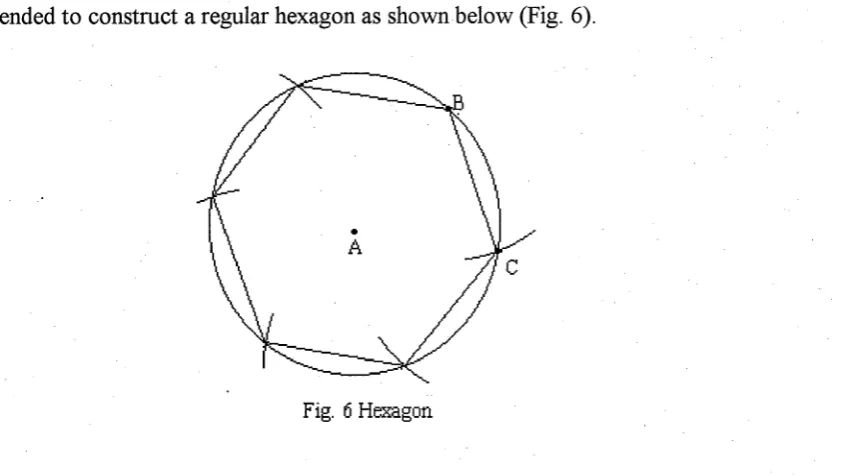
discussed, as is the regular hexagon. Can we construct a regular polygon with any number
ofsides? The method in Section I used to locate a midpoint using compass only can be
extended to construct a regular hexagon as shown below (Fig. 6).
Fig. 6 Hesjagon
Construction Of 2n-gon From An N-gon
Given an n-gon, it is possible to construct a 2n-gon. Using the hexagon as an
example, a 12-gon is completed by constructing equilateral AABC. Bisect BC and
therefore its arc to find six additional vertices ofthe regular dodecagon(Figure 7).
Fig. 7 Constructing 2n-gons
Clearly, this procedure could be applied to any regular polygon. Ifa regular n-gon
can be constructed, this is a way to construct a regular 2n-gon. Iterating the prodecure
gives a construction for a regular 2''n-gon, where k is an arbitrary positive integer. In
view ofthe this consideration, the key question becomes construction ofregular n-gons
for odd n. Euclid himselfgave a construction for regular a pentagon, based on both the
Golden Ratio and the Pythagorean Theorem.
Construction OfA RegularPentagon
Lemma: Given a unit length
Construct: A length of —
1(Vs-l)
1. At any point B ofsome line I construct a perpendicular to that line.
/
A
/
\ \
)
\
]
2. Designate a point on this perpendicular at a unit length from B to be the center
ofa circle A. Construct the
3. With B as center construct segment EC of/ as(B,2AB). Construct AC
which intersects the circle at point D and by Pythagorean Theorem has length
Vs. Segment CD =Vs-1.
4. Construct the midpoint ofCD . The resulting segments have lengths
CE=ED= -(Vs-l).
The significance ofthis number comes from the isosceles triangle with vertex angle of
36°. Ten ofthese triangles with a common vertex will create a regular decagon.
Additionally the base angles are each equal to 72°, twice the vertex. Bisecting one of
these base angles as shown creates similar triangles, APQR and AQRS.
36
0
-X
Take length PQ as unit length and solve for x,the length ofPS,
— = ^X=—(Vs-1)
X 1-x 2^ ^
The above lemma can be used to construct a regular pentagon.
Constructing The Pentagon
1. In a given circle centered at O draw diameter AB . Construct a second
diameter, CD,which is the perpendicular bisector ofAB .
2. Bisect OB,labeling its midpoint M,
/\
M
3. Draw arc(M,CM)intersecting AO. Label this point E.
/\
M
s/
D
4. n.
form the regular pentagon.
M
s/
The Greeks tried but could not find constructions for regular polygons with 7, 9,
11 or 13 sides. A regular 15-gon could be done by construction ofboth 3 and 5 in the
same circle. Only with advances in algebra ofthe lb"* - IQ**" centuries did the answers for
Trisecting An Arbitrary Angle
Bisecting an angle is a basic construction, so it is only natural to wonder about
trisecting angles. Clearly we can trisect some specific angles, such as 90° or 135°, but
ancient mathematicians sought a construction for trisecting an arbitrary angle using
compass and straight-edge. Archimedes developed a method oftrisection as follows.
1. Begin with an arbitrary ZA with measure x. Choose a point B along one side
ofZA. Construct circle(A, AB)
fB
The circle intersects the second side ofZA at point C.
2. Extend AB so that it contains the diameter BD ofthe circle.
3. On a straight-edge, make two marks,L(left) and R(right), so that the
distance between them is r = AB.
-r T
R
4. With the straight-edge passing through C and R on the arc CD ofthe circle,
move R along the circle keeping the straight-edge passing through C. When
the straight-edge intersects the extension of BD at L,let E be the
corresponding point onBD.
5. ConstmctEC -markingits intersection with the circle F. Construct AF'.
E
The measure ofZEEA is 1/3 the measure ofthe original ZCAB. To see this, note that
AACF and AAFE are both isosceles, since each has two sides Avith measures equal to the
radius ofthe circle. Because the triangles are isosceles, mZFEA = mZFAE and
mZGFA ~ mZACF. ZCFA is an exterior angle ofAAFE and is equal to the sum ofits
remote interior angles, or twice the measure ofZFEA. ZCAB is an exterior angles of
AACE and is equal to mZFEA.+ mZACF. We can substitute equal values so that
mZC^- mZFEA+ mZACF becomes mZCAB- mZFEA + mZCFA or mZCAB =
mZFEA + 2mZFEA = SniZFEA. Therefore l/3mZCAB = mZFEA. The solution is
straight forward, but the use ofa marked straight-edge violates the restriction ofusing
only straight-edge and compass. Is it possible to trisect an arbitrary angle using compass
and strai^t-edge only with no violation ofconstruction rules? As with the previous
probleni further advances in niathematics were required to fully answer the question.
Doubling A Cube
Another ancient construction problem involves a three dimensional figure - a cube.
The problem predates the time ofEuclid and is often referred to as the Delian problem.
According to one version ofthe origins ofthe problem,Plato was approached for help in
solving a problem posed by a god, some say Apollo. The Delians would be released from
present troubles ifthey could double the size ofthe alter in Delos. They found that
doubling the edges increased the space by a factor ofeight, larger than required by the
god. Plato's response was that the god was taunting them for their neglect ofeducation
and in particular for their ignorance ofgeometry.
Similar versions ofthe problem are presented in other documents. The object of
the problem is to construct a cube whose volume is double that ofa given cube.
The volume ofa cube depends on the length ofan edge. This reduces the problem to
finding the length ofa segment whose cube is twice the cube ofa given edge. Early
writings in geometry credit Eratosthenes with describing the problem as being equivalent
to finding what are called mean two proportionals X and Y so that
A X Y
— = — = —,where A is the length ofthe edge ofa cube.
X Y 2A
^ ^
Cubing — A and expanding as follows verifies that the mean proportional X is the required
X
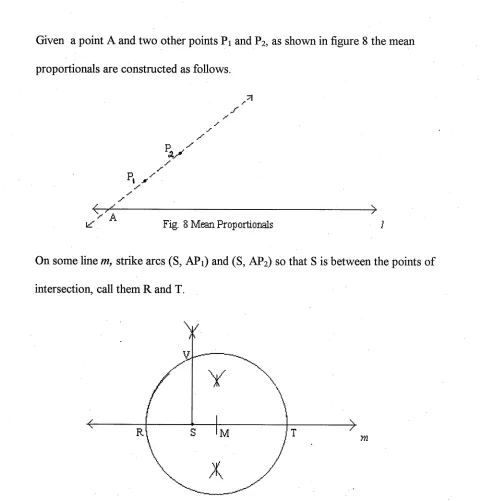
Given a point A and two other points Pi and P2, as shown in figure 8 the mean
proportionals are constructed as follows.
j-P ^
V
y P ^ yj-Fig. 8 Mean Proportionals
On some line m, strike arcs(S, APi)and(S, AP2)so that S is between the points of
intersection, call them R and T.
V
Y
M
X
Find the midpoint, M,ofRT,and construct the circle(M,MR). Construct a perpendicular
toRT at S,intersecting the circle at V. SV in the mean proportional between APj
and AP2. This construction was available to the Greeks, but again the final solution of
constructing the required length eluded them.
Squaring A Circle
Another area ofinterest in early geometry is the idea ofquadrature or squaring.
Quadrature involves constructing a square that has the same area as some original plane
figure. Ifthe square can be constructed then the original figure is said to be quadrable.
All rectangles are quadrable. All triangles are quadrable since pairs ofcongruent triangles
can be used to create rectangles. Similarly^ since all polygons can be divided into disjoint
rectangles and triangles, all polygons are quadrable. More difficult quadrature involves
plane figures with curved edges. Specifically, is a circle quadrable? Over time this
problem became known as squaring a circle. The desired square can be constructed with
compass and straight-edge, ifthe required length ofthe side can be constructed Early
mathematicians began by tr5fing to determine ifother plane figures with curved edges were
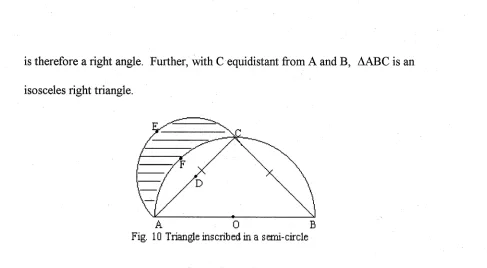
quadrable. One figure, a crescent shape called a lune(figure 9), can be shown(in some
forms)to be quadrable.
lune
is therefore a right angle. Further, with C equidistant from A and B, AABC is an
isosceles right triangle.
A 0 B
Fig. 10 Triangle inscribed in a serni-circle
By the Pythagorean Theorem, AB^= AC^+ CB^. Since AC = AB, AB^= 2AC^. The
ratio ofthe areas ofsemi-circles AECD and ACBO is the square ofthe ratio oftheir
diameters, since the ratio ofareas ofsimilar figures is the square ofthe ratio ofsimilarity.
This ratio
AC^which simplifies to V2, since 2AC^= AB^. Notice that the area of
semi-circle AECD equals the area ofsector AFCO,since their areas are each V2 the area
ofsemi-circle ACBO. The area ofthe lune AECF is the area of semi-circle AECD minus
the area oflune AFCD. Similarly the area of AACO is equal to the area ofthe sector
AFCO minus the area ofthe same lune AFCD. Therefore:
areaiuneAECF + areaiuneAFCD = areaiuneAFCD + areatnangieACO
Subtracting areaiuneAFCD from each side:
areaiuneAECF = areatriangieACO
Since the area ofthe lune can be shown to be equal to the area ofa quadrable figure, the
lune itselfis quadrable. This elegant result could only have encouraged Greek
Apollonius' Problem
The final historical construction problem is called Apollonius' Problem and deals
with circles. Here three arbitrary circles are given, and a fourth is to be constructed so
that it is tangent to all ofthe original three. Since the sizes ofthe circles and the points of
tangency are not specified, the problem can be viewed many different ways. Ifone or
more ofthe circles have zero radius, it reduces to a point. In the case ofthree
non-collinear points the problem is reduced to finding the circumscribed circle ofa triangle, a
known construction. Other special cases arise when one or more ofthe circles have
infinite radius(is a line). When all possible combinations are considered Apollonius'
Problem has ten distinct cases with the given data as follows;
1. Point-Point-Point 6. Line-Circle-Circle
2. Point-Point-Line 7.Point-Line-Circle
3. Point-Line-Line 8. Point-Point-Circle 4. Line-Line-Line 9. Point-Circle-Circle 5. Line-Line-Circle 10. Circle-Circle-Circle CASE 1
In case one, ifthe points are non-collinear they are the vertices ofa triangle.
Apollonius' problem in this case is to construct the circumscribed circle for that triangle.
1. Call the points A,B,C. Construct the line segments between them to form
AABC.
2. Construct the perpendicular bisector ofeach segment. This illustrates the
exercise on page 26 where the three bisectors all meet at the circumcenter, D.
3. Draw circle(D,DA)
Ifthe given points are collinear, then the only "circle" tangent to each ofthem has infinite
radius, that is, a line.
CASE 2
This case also breaks into sub-cases. IfPi and P2 are on the line, there is a circle
ofinfinite radius, the line is the desired solution. Otherwise the problem is to construct a
circle). To find the center ofthe required circle we use the mean proportionals between
AP, and AP2 as shown on page 50 to find the intersection ofthe perpendicular bisector
ofPjPj and the perpendicular to the point oftangency. There are two such points. Along
the given line / strike arcs(A,SV)on each side ofA. These are the tangent points Ti and
T2. Construct perpendiculars fi"om these points along with the perpendicular bisector
ofPjPj. The two points ofintersection along the perpendicular bisector, Ci, C2, are the
centers ofthe two circles meeting the required conditions.
y
A
In the special case wherePjPjis parallel to the given line, the perpendicular bisector of
PjPjis perpendicular to the given line, and there isjust one solution. The center ofthe
circle is the intersection ofthe perpendicular bisectors of PjPj and PjF(Figure 11).
Fig. li Apdllonius'Problem given a bne and 2points parallel
Ifone ofthe points is on the line there is againjust one solution, and if/is between Pi and
Pathere is no solution. Each ofthe ten different cases break down similarly. A further
Solution Overview
The five historical problems have intrigued mathematicians, professional and
amateur,for centuries. Though there is not a construction solution for each ofthem, a
conclusion has been reached for all ofthem - some requiring new branches ofmathematics
for the proof.
The solution for constructing n-gons is credited to Carl Frederick Gauss. It was thought that straight-edge and compass construction ofregular polygons was limited to
those with sides of2*', 3, 5, their products and 2" multiples. In 1796, at the age of
eighteen. Gauss was able to construct a regular polygon with 17 sides. Gauss eventually
proved that prime numbers ofthe form 2^" +1 would result in constructible polygons.
Numbers ofthe form 2^" +1 are called Fermat numbers,in honor ofFermat who first
called attention to them and said they are all prime. The first five Fermat numbers,for n =
0, I, 2,3,4 are primes, so the resulting polygons, with 3, 5, 17,257 and 65537 sides are
constructible, though such constructions are oftheoretical interest only for large numbers
ofsides. To date, despite considerable interest, no higher Fermat primes have been found.
The most famous Greek problems, doubling the cube, trisecting an arbitrary angle
and squaring the circle, continued to baffle thinkers for centuries. All three were
eventually answered, but only with the help ofalgebraic concepts and techniques far
beyond the Greeks.
Algebraically, the problem ofdoubling a cube comes down to constructing a
number X such that 2A^ = X^. In the case ofa unit cube, a cube with edges
oflength 1,the equation becomes 2=^orX=^ Now a real number yis said to be
constructible if, beginning with a segment oflength 1, a segment oflength y can be
constructed in a finite number ofsteps by means ofa compass and straight-edge. Numbers
that use successive applications ofaddition, subtraction, multiplication, division and the
taking ofsquare roots are constructible. Although ^2 is a real number it is not
constructible. The proofthat it is not constuctible requires the use ofabstract algebra and
extension fields. Using these tools, L. Wantzel in 1837 showed that cube duplication by
construction is impossible. In general the theorem that applies states that ifa cubic
equation with rational coefficients has no rational roots, then none ofits roots is
constructible. "
Similar considerations apply to trisecting an arbitrary angle. Note first that the sine
and cosine ofan angle determine a point on the unit circle. Ifan angle, and hence a
corresponding point on the unit circle is constructible, so are its sine and cosine by
dropping perpendiculars to the coordinate axes. Then ifeither the sine or cosine ofan
angle is not constructible, neither is the angle itself. Beginning with an angle 6 is
X =cos j —Ialways constructible? Since cos 0 =4 cos"' —
eI - 3 cos — I, this amounts
3J 3 3
to constructing the roots ofg =4z'-3z or 4z'- 3z - g = 0. In the case of & =60°,g = V2
possible to trisect a 60° angle with straight-edge and compass alone, it is not possible to
trisect arbitrary angles.
The problem ofsquaring a circle is equivalent to constructing a segment oflength
71. C. F. Lindemann, a German mathematician, showed in 1882 that 7t is not
constructible. His proofwas developed using the concept ofalgebraic and transcendental
numbers. An algebraic number is one which is a root ofa polynomial. All constructible
numbers are algebraic. Non-algebraic numbers are called transcendental numbers.
Transcendental numbers cannot be expressed as roots of polynomials and are not
constructible. Lindemann's work showed that n is transcendental and therefore not
constructible. If7C itselfis not constructible, then clearly is not constructible.
More on Apollonius' Problem
Two ofthe ten cases ofApollonius' problem have already been discussed. The
eight remaining cases are at least as complicated. This discussion will concentrate on the
classic interpretation of the problem, which is case ten; Given three distinct circles,
construct a fourth circle tangent to each ofthe originals. Figure 12 illustrates the fourth
circle externally tangent to the three given circles, Oi, O2 and O3.
Fig. 12 Apollonius'Problem given 3 non-intersecting circles
Once again, algebra can be the key to solving a geometry problem. Using a coordinate
system, place the centers ofthe three given circles at(xi, yi),(x2,y2) and (xs^ys). Ifthe
three given circles have radii ri, r2and rs respectively, they have equations:
Ifthe center(x, y)and radius r ofthe required circle can be found,the circle can be
drawn. If(x, y)is the center and r the radius ofa circle externally tangent to all 3 given
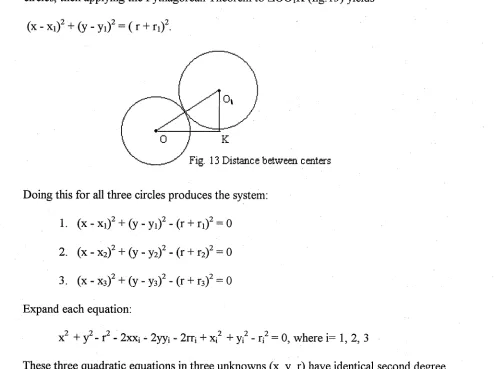
circles, then applying the Pythagorean Theorem to AOOiK (fig.13)yields
(x-xi)^+(y-yO'=(r+ ri)^.
Fig. 13 Distance between centers
Doing this for all three circles produces the system:
1. (x - xi)^ +(y - yi)^ -(r + ri)^ =0
2. (x - X2)^ +(y - y2)^ -(r+ r2)^=0
3. (x - xs)^ +(y - ys)^ -(r + rs)^ =0
Expand each equation:
2 .2_,
x^ + y^- r^ - 2xxi - 2yyi - 2rri + Xi^ + y-^ -
=0, where i= 1, 2,3
These three quadratic equations in three unknowns(x, y, r)have identical second degree
terms. Subtracting these quadratics in pairs yields two linear equations
1. 2(x2 - Xi)x + 2(y2 - yi)y + 2(r2 - ri)r =
+x]-xf +yl-yf
2. 2(x3 - X2)x + 2(y3 - yi)y + 2(r3 - r2)r =
-x^ + -y^
In general, these linear equations can be solved for x and y in terms ofr, and these values
can be substituted in one ofthe original equations, which can be solved for r. With r
determined, the solutions for x and y to equations 1 and 2 are fully specified. Since these
numbers were found using only rational operations and square roots, they are
constructible. Ifone or more ofthe circles is internally tangent, then the third term is the
square ofthe difference ofthe radii rather than ofthe sum. There are eight solutions
which correspond to the subtraction or addition ofthe radii depending on whether the
circles are internally or externally tangent. In cases where no geometric solution is
INVERSIONS
Inversions In A Circle
In addition to constructing specific figures, geometric construction can include
altering or transforming given figures according to certain mathematical rules.
Investigations ofsuch geometric transformations have produced fascinating studies and
yielded insight about construction problems. One particular transformation, called an
inversion in a circle, throws insight on Apollonius' problem. This transformation, studied
in 1831 by L. J. Magnus,is a function which sends each point in the plane(save one)to
another point in the plane. The function is defined as follows;
Let C be a circle ofradius r and center 0. Inversion in C sends each point P
except O itselfto a point P'where OP*OP'= r^ and P'lies on ray OP.
Inversion leaves each point ofcircle C invariant, and it is not defined at all for the point O,
which would have to be sent infinitely far away.
Constructing The Inverse OfA Given Point With Respect To A Given Circle
Given: Circle(O,r)and some point P with P 0
Construct: The inverse point P'ofP with respect to the given circle.
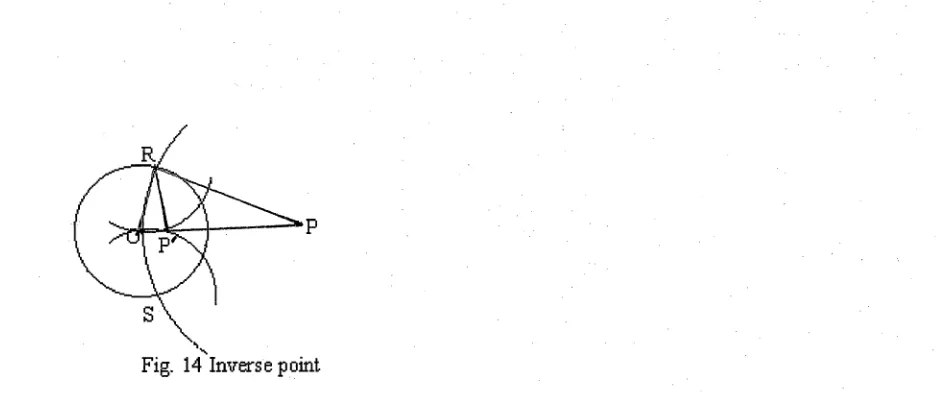
1. First suppose the given point P lies outside the circle. Draw arc(P, OP).
Mark the points ofintersection with the circle R and S.
2. Draw arcs(R,r)and(S, r).
The points ofintersection ofthe two arcs are O itselfand P'. P'is on OP,since they are
both equidistant from R and S, and are therefore on the perpendicular bisector of RS. To
Fig. 14 Inverse point
Since both triangles are isosceles and have a shared angle, they are similar, and their sides
are proportional. Hence:
— = —^OP•OP'=(OR)'
OR OP' ^ ^
the desired result.
When the given point lies inside the circle, the construction steps are the same
provided that the circle centered at P intersects the circle ofinversion. The point P'is
outside the circle as shown.
Ifthe circle centered atP does not intersect the circle ofinversion, the
construction requires the inverse ofanother point R where OR = nOP, with n an integer
greater than 1. The construction is completed as follows.
1. Construct the ray OP
2. Along OP,strike arc(P, OP), call the point ofintersection C. Strike arc
(C, OP). Repeat until you reach a point R outside the circle ofinversion.
4. Along OP strike arcs oflength OR'the same number oftimes as OP when
locating R. The final point is P'.
To verify that the resulting point is the correct inverse for P,consider the rule for
inversion in each case.
r^= OP*OP'and r^= OR*OR',therefore OP*OP'= OR*OR'
Since R was found using integer multiples ofOP,substitute for OR obtaining;
OP*OP'=(nOP)»OR'=> OP*OP'= OP*(nOR')=> OP'= nOR'
This verifies that the point P'is the correct inverse for the point P.
Constructions Using Inverse Points
Inversion can be used to complete compass-only constructions such as segment
bisection or locating centers ofcircles. To bisect a segment using inverse points, we begin
with the given points A and B and the initial steps ofour previous compass-only
construction shown on page 36.
1. Construct the circle(B, AB)
2. Strike three arcs: (A, AB),(C, AB)and(D, AB).
In section one it was shown that E is on the line containing AB and that
3. Construct the circle(A, AB)
4. Invert the point E in circle(A, AB). The image E'is the midpoint ofAB
To show that E'is themidpoint ofAB,note that:
AE'»AE = AB^
AE'*2AB = AB^
2AE'= AB
Additionally, E'is on AB ,as is E.
Locating Centers
Inversion can be used to construct the center ofa given circle with compass alone.
1. Select two points P and R on the given circle. Draw circle(P,PR).
2. Ifthis circle happens to meet the original circle only in the point R,then RP is
a diameter ofthe original circle. The midpoint of RP,as found in the previous
construction, is the center ofthe original circle.
3. If(P,PR)meets the original circle in a second point S, construct arcs(R,RP)
4. Construct the inverse ofQ with the circle centered at P as the circle of
inversion. Q'is the center ofthe original circle.
Verification that Q'is the center ofthe original circle is left as an exercise.
Some basic facts about inversion are:
1. The image ofa line through the center ofinversion is the same line, except for
the center.
2. The image ofa line not through the center is a circle not through the center.
3. The image ofa circle through the center is a line through the center
4. The image ofa circle not through the center is a line not through the center.
5. The image ofa circle ofinversion is the same circle.
Proofs ofthese properties can be found in Inversionshy I.Ya Bakel'man and will be used
to further investigate construction solutions to Apollonius' problem.
Inversions and Apollonius'Problem
Inversion sheds interesting light on Apollonius' Problem. Consider first the rather
1. Construct a circle ofinversion centered at P,the point ofintersection. The
at A2 and
and C3 at A3 and B3,
Under inversion the three circles are taken to the three lines A , A2B2 and A3B3.
These three intersect in pairs and create a triangle, call it ADEF.
2. Construct the inscribed circle of ADEF, and call the tangent points R,S and
B,
•(figure enlarged to show detail) ^
3. Invert again in the same circle(It is invariant under the first inversion) and call
the images ofR,S and T,respectively, R', S' and T'. These are the points of
4. Construct the circumscribed circle for AR'S'T'. This is the required
circle. Since the points R', S' and T'are obtained by inverting tangent points
they will continue to be tangent under inversion.
The original problem has more than one solution, To obtain the other three circles,
replace the inscribed circle in step 2 with the circle tangent to one side and the extei
lines as shown. Again,the tangent points will invert to points that are tangent.
Invert the tangent points,
Solution to Apollonius'Problem When The Three Given Circles Lie Outside Each Other
andDo NotIntersect
1. ConstructO1O2 connecting the centers ofCi and C2. Mark the points
ofintersection with the circles A and B.
2. Construct the perpendicular bisector of AB to locate the midpoint M.
0,0,—(r,+r,)
3. Let s = AM = — Construct circles Ci', C2' and C3' With radii
rj + s, r2 + s and rs+ s respectively.
C2
4. Circles Ci' and C2'are tangent at M.
Under inversion in C4 the circles Cr and C2'become parallel lines h and 4through AiBi
and A2B2, respectively. The circle C3'inverts to another circle, call it C3'.
(figure enlarged to show detail)
A. Construct the circles tangent to C3', h and /r
(figure enlarged to show detail)
is the circle ofinterest
Its center, when inverted, is the point with equal power with respect to the three circles
and determines the radical axes for the circles taken pair-wise. The completed
construction is shown in figure 16.
\
\
\
\
C|c
\
G
c:
CLOSING REMARKS
This project only touches on a few ofa large number ofconstructions. Its purpose
is to survey some basic ideas ofconstruction which can be used to develop a clearer
understanding ofconcepts through physical demonstration. Additionally, it introduces
some connections between early Greek and modern-day mathematics. Apollonius'
problem,in its many forms, illustrates both ofthese ideas. Some its cases may be solved
with basic constructions, but other cases require algebraic concepts. Formal geometry, as
a study ofrelationships in space, is supported by geometric construction, making the ideas
presented here worthy ofadditional study.
BroUOGRAPHY
Aaboe, Asger. EpisodesFrom The Fxirly History ofMathematics, New York; Random House, 1963
Bakel'man, LYa./«ver5zo«5, Chicago: The University ofChicago Press, 1974
Coolidge, Julian Lowell. A History ofGeometricalMethods, New York: Dover
Publications, Inc., 1963
Courant, Richard and Robbins, Herbert. WhatIs Mathematics?, New York: Oxford University Press, 1960
Coxeter, H. S. M.Introduction to Geometry, New York: John Wiley & Sons,Inc., 1961
Coxeter, H. S. M. and Greitzer, S. L. Geometry Revisited, New York: Random House,
1967
Dantzig, Tobias. Bequest ofThe Greeks, New York: Charles Scribner's Sons, 1955
Dixon, Robert. Mathographics, New York: Dover Publications, Inc., 1987
Euclid. (1952). The Thirteen Books ofEuclid's Elements. In Robert Maynard Hutchins (Ed.)and Sir Thomas L. Heath(Trans.), Great Books ofthe Western World (Volume 11, pp. 1-396)Chicago: Encyclopaedia Britannica, Inc.
Greenwood, Jay.(1996, April). The History ofMathematics:Hands-on Activities to Help
StudentsExperience It. Session presented at 74*^ Annual NCTM Meeting, San
Diego, CA.
Heath, Sir Thomas L. A ManualofGreek Mathematics, New York: Dover Publications,
Inc., 1963
Jones, Arthur and Morris Sidney A.Abstract Algebra andFamousImpossibilities, New York: Springer-Verlag, 1991
Kostovskii, A. N. Geometrical Constructions Using Compasses Only, New York:
Blaisdell Publishing Co., 1961
Pedoe,Dan. Geometry: A Comprehensive Course, New York: Dover Publications, Inc.,
1970
Polya, George. MathematicalDiscovery, New York: John Wiley & Sons,Inc., 1981
Posamentier, Alfred S. and Wemick, William. Advanced Geometric Constructions, Palo
Alto: Dale Seymour Publications, 1988
Serra Michael. Discovering Geometry: An Inductive Approach, Berkeley: Key
Curriculum Press, 1993
Stark, Marion Elizabeth and Archibald, Raymond (trans.), Jacob Steiner's Geometrical Constructions With A Ruler, New York: Scripta Mathematica, 1950
West,Beverly Henderson, Griesbach, Ellen Norma,Taylor, Jerry Duncan and Taylor, Louise Todd. The Prentice HallEncyclopedia ofMathematics, Englewood Cliffs: Prentice-Hall Inc., 1982