Collaborative national evaluation of
Signposts
–
a professional development resource for new tertiary
teachers
June 2010
Judith Honeyfield (Project Leader), Cath Fraser and Linda Shaw, Bay of Plenty Polytechnic
Pat Reid, NorthTec
Adam McMillan and Victor Fester, Waikato institute of Technology
Debra Robertson-Welsh, Manukau Institute of Technology
Helen van Toor and Liz Fitchett, Waiariki Institute of Technology
An Ako Aotearoa publication. Support for this work was provided by Ako Aotearoa through its Regional Hub Project Funding scheme.
2
Contents
Executive Summary ...3
Introduction: The purpose of this report ... 4
Background ...4
The Evaluation Project ...5
Methodology ... 6
Findings ...7
Demographics ... 7
Use of Signposts ... 8
Feedback about individual Signposts topics ... 10
Implementation in individual organisations ... 11
Alternative delivery options ... 12
Unexpected findings ... 13
Transferability ... 13
Benefits of collaboration ... 13
Conclusion ... 14
Recommendations ... 15
References ... 15
Appendix A: Survey ... 16
3
Executive Summary
The report A collaborative national evaluation of Signposts – a professional development resource for new tertiary teachers describes the context, process and outcomes of a formal evaluation of Signposts, a resource originally developed in 2008 with assistance from Ako Aotearoa‟s Northern Regional Hub. Signposts itself comprises 10 one-page „primers‟ designed to support novice teachers in their first few months in front of a class, and is available for download through the Ako Aotearoa Creative Commons licence, via their website.
Feedback from Ako Aotearoa‟s website knowledge manager indicated a high level of hits, and informal responses from staff developer colleagues suggested that the resource was useful, although several also offered ideas for further enhancements. The original collaborative team which had developed Signposts included members from three tertiary institutes; by 2009 when this evaluation was designed, the team had grown to include staff developers from the Bay of Plenty Polytechnic, NorthTec, Waikato Institute of Technology, Manukau Institute of Technology and Waiariki Institute of Technology.
The agreed goal was to develop an e-evaluation tool for Signposts, to discover how individuals within tertiary education organisations have experienced Signposts (or not and why) to obtain general feedback to improve utilisation and usability of this resource. An anonymous and confidential e-questionnaire was formatted using Survey Monkey software, piloted, then made available through a link on the Ako Aotearoa website and promoted through regular bulletins to registered contacts as well as direct contact with national tertiary education networks. Responses were slow and further prompting by the research team was required, but eventually 40 participants had contributed sufficient qualitative and quantitative feedback to meet the project aims.
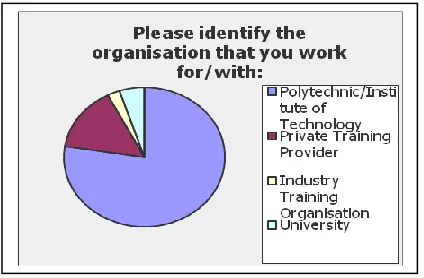
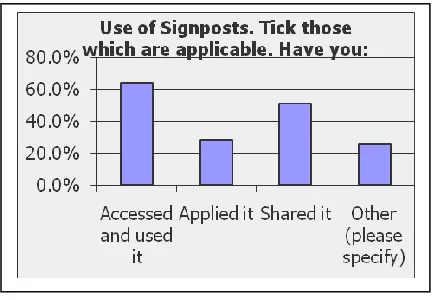
Most participants were from institutes of technology or polytechnics, although private training providers, universities and industry training organisations were also represented. Just over a third were teaching staff, the remainder were either staff developers, managers, or held an associated role. Three quarters of the participants had either accessed and used the Signposts resource, or applied it, or shared it. Most also rated it very high, or high with regard to it meeting their needs, being pitched at the right level, being visually appealing, and the content being right for their role. Some of the individual Signposts topics generated specific suggestions for additions or amendments, and many participants supported the idea that alternative delivery options to the current print-based media would be useful. In terms of application, participants were using the resource in a myriad of ways: as part of an initiation/induction package for new staff; as part of formal teacher training programmes; in discussion/coaching with a manager or a mentor/coach/buddy; as a basis for peer evaluation or self-review; for professional conversations in team meetings or workshops; as a refresher for longer term staff; and as a reminder of good practice.
4
Introduction: The purpose of this report
This report describes the context, process and outcomes of a formal evaluation of Signposts, a professional development resource for new tertiary teachers, originally developed in 2008. The evaluation survey was designed by a project team of staff developers representing five tertiary institutions from the northern regional hub of New Zealand. The aims of this research project were to identify who was using the resource, and how, and to canvass users‟ perceptions of its efficacy, delivery mode, and areas for improvement and/or expansion.
The report begins by describing the original Signposts resource development and the rationale for its evaluation. It outlines the methodology employed and presents the key findings which resulted from the team‟s analysis of the data. These findings have been utilised directly to guide the changes made to Signposts in the second edition, now available through the Ako Aotearoa website. They have also resulted in a number of additional outputs, described in the report‟s conclusions. This section of the report also notes a number of aspects of good practice in collaborative work, which are transferable beyond the single evaluation described here. Finally, the report offers two recommendations: firstly the need for systematic evaluations of all Ako Aotearoa resources; and secondly, the need for more targeted dissemination of new resources.
Background
In 2008, staff developers from three collaborating institutions (Wintec - Waikato Institute of Technology, Bay of Plenty Polytechnic, and Waiariki Institute of Technology) completed an Ako Aotearoa sponsored project to produce an inter-institutional resource which would assist new tertiary teachers in their first one – two months in their role.
The resource, known as “Signposts”, comprises 10 one-page topics with tips and techniques, covering: Planning to teach
How to get going with your class Engaging your students in their learning Classroom management
Delivering the goods
The language of assessment Reflecting on teaching
Knowing about and responding to difference Being professional
Literacy integration
A second strand to the original Signposts project was an analysis of the inter-institutional collaborative process itself. The intention was not only to inform the team‟s own on-going collaboration during the resource development, but also to offer insights to colleagues embarking on similar projects with others outside their workplace. An extensive literature review, and the application of the Wilder Collaboration Factors Inventory (Mattessich , Murray-Close & Monsey, 2001) contributed to the creation of additional resources also available on the Ako Aotearoa website.
5
A checklist for collaborative project planning and decision-making A list of success factors for collaborative projects
A list of potential challenges for collaborative projects The project team‟s own insights and reflections
A first draft of the Signposts resource was presented at the HERDSA conference in July 2008, piloted, then disseminated within the three project member institutions, and then posted on the Ako Aotearoa website in October 2008 for national use across the tertiary sector. Feedback from the site‟s administrator indicates that this resource has been the most downloaded document of any on the site, receiving over 600 hits at the time of writing. Informal feedback from staff developer colleagues suggested that the resource was filling the need for immediate teaching and learning tools experienced by staff who are new to an education environment. Comments via Ako Aotearoa‟s website and forwarded by email to the team leader of the original Signposts team also included suggestions for further enhancements and alternative deliveries.
In response to the feedback mentioned above, the team developed the current project: a collaborative national evaluation of Signposts with the objective of evaluating its usefulness and current applications, and identifying strategies for its expansion and improvement. The team had also noted in conversations with Ako Aotearoa that thus far, few of the resources available through the website had been subject to any formal evaluation process. Therefore, an added benefit of this project would be to provide a methodology which may be of interest to other teams involved in teaching and learning resource evaluation.
The Evaluation Project
The collegial partnership was widened to include new members who wished to become involved, so that the current project team expanded from staff development representatives of three institutions to five: Bay of Plenty Polytechnic, NorthTec, Wintec, Manukau Institute of Technology and Waiariki. In addition, one of the original team members retired, so the new team consisted of four members from the original project and four new members. The first meeting of the project team took place in August 2009, and resulted in agreement on guidelines, format and process of the Signposts evaluation, and review of the principles of collaborative good practice developed and field-tested in the original project for the development of the Signposts resource.
The agreed goal was to develop an e-evaluation tool for Signposts which would be available on the Ako Aotearoa website and promoted through the regular bulletins to all registered contacts as well as direct contact with national tertiary education networks. This e-evaluation tool would discover how individuals within tertiary education organizations have experienced Signposts (or not and why) to obtain general feedback to improve utilization and usability of this resource across the sector.
Alongside this evaluation, guidelines for inter-institutional collaboration frameworks as identified in the 2008 Signposts development project would be reviewed and expanded.
The proposed benefits were to:
6
Facilitate sharing and further development of existing resources and expertise
Help fulfill Ako Aotearoa‟s commitment to a collaborative approach to professional development Strengthen working relationships between Northern Hub professional development staff including TASDEN (Tertiary Academic Staff developers Education Network (Northern))
Provide knowledge of inter-institutional similarities and differences
Help ensure that teaching practice is informed by research and scholarship
Increase capabilities amongst staff developers in five partnering organizations in relation to undertaking research
Expand good practice guidelines for collaborative projects to be made available to other project teams
For the tertiary education sector, it would provide:
A tested and contemporary resource for new teachers tailored for use and adaptation across institutions including methods for including new material for the resource
A refined source for information for good practice guidelines for inter-institutional professional development initiatives and guidelines for collaboration in such contexts.
Methodology
Following the initial team meeting, members communicated electronically to develop an online survey tool which would provide valid data and allow for respondents to record meaningful contributions. Once the team agreed on the final survey content, the team leader drew on technical expertise from her own organisation, and the survey was formatted as an anonymous and confidential e-questionnaire (see Appendix A) using Survey Monkey software. It was piloted with three new staff members from Bay of Plenty Polytechnic, the team leader‟s own institution, and checked within each institution for usability and refinement. It was then adjusted and made available via a link from the front page of the Ako Aotearoa website. The Webmaster attached a live link to the next two Ako Aotearoa bulletins circulated to an extensive national mailing list.
Low responses were noted and a request to send the evaluation to all Ako Aotearoa registered users was referred to the National Director of Ako Aotearoa. A discussion was held regarding the use of this list for direct contact for evaluation purposes. Subsequently the three regional hub coordinators were contacted by telephone by the project leader with a follow up email request to forward the live link and an explanation about the evaluation to their mailing lists. We then encouraged these colleagues to distribute it widely within their own organizations.
The project team then contacted other members of TASDEN, a new professional community group hosted on Ako Aotearoa, with 28 members representing most of the region‟s tertiary providers. As TASDEN represents the primary users of Signposts, this group was asked to participate in the survey, and to raise awareness of the evaluation project within their own institutions, particularly to new staff, who were the secondary target group in this evaluation.
7
notices were issued, and by early November 2009, 40 responses had been received – an ample sample to provide the qualitative and quantitative feedback sought.
A second face-to-face meeting of the project team took place November 10, 2009 to analyse the collated data and consider the implications for amendments to Signposts, including access, dissemination and ongoing renewal. A schedule was drawn up to identify both immediate changes and additions which could be made to the resource to widen applicability and ensure currency, as well as longer term recommendations which would require more extensive project development and/or resourcing. Following the guidelines for successful collaborative initiatives (developed during the first Signposts project 2008-9), tasks were allocated to members according to personal preferences and professional strengths. The timeline goal was to have a draft of the revised Signposts completed to showcase at the TASDEN workshop held on December 9, during the ASCILITE conference in Auckland – a goal which was achieved.
Following the TASDEN workshop, final suggestions were incorporated into the second edition of Signposts for submission to Ako Aotearoa for approval, along with additional supporting documents developed to address demands identified from the survey results. A final meeting of the project team was held in January 2010 with three distinct purposes. The first was to reflect on the collaborative process employed during this second Signposts project, and to compare members‟ experiences against the literature and checklists from the first project. Each participating team member contributed to a brief narrative account (see Appendix B) identifying the challenges and successes of the collaborative process from a personal perspective. The second purpose of the January meeting was to finalise a draft version of Signposts incorporating all amendments for the evaluation and team feedback. The final purpose was to finalise this report, and then to scope opportunities for future collaborative research surrounding teaching and learning resource development.
Findings
Demographics
Figure 1. Institutional representation
Just over a third of respondents (37%; 14 respondents) were teaching staff, the remainder were either staff developers, managers, or held an associated role – resource developer, course developer, quality
8
assurance manager, literacy and numeracy coordinator – that is, they were not involved in classroom teaching as part of their primary role. This may explain the large number ( 47%; 15 respondents) who indicated that they usually taught at level 5 to 6 – the level of most entry-level professional teacher training programmes – or above (level 7: 16%; level 8 (post-graduate): 6%).
There was also a considerable variation in the length of time in tertiary education: two thirds (67%; 26 respondents) had more than three years experience; 13% had between one and three years; 15% between 6 and 12 months, and 5% less than 6 months.
The significance of these results to the project team lies in the verification that staff developers, or those working to assist new staff develop an effective teaching practice, are most likely to actively seek out resources which will be of use to others, to recognise tools which address a professional need, and know how and where to direct them. It means that while the Signposts topics are designed for new teachers, staff developers remain the primary target group for dissemination.
This conclusion is further substantiated by the responses to a question about where respondents first heard about Signposts. Five (13%) found it through the Ako Aotearoa website, but all others
were introduced to the resource through staff development promotion (39%); knowing colleagues involved in the development; from a manager, from hearing about it at a conference, or from receiving a copy in an induction pack.
Use of Signposts
Figure 2. Use of Signposts
Such a good level of uptake would appear to indicate that once staff educators and teachers are aware of the resource, they find it easy to see a use for it.
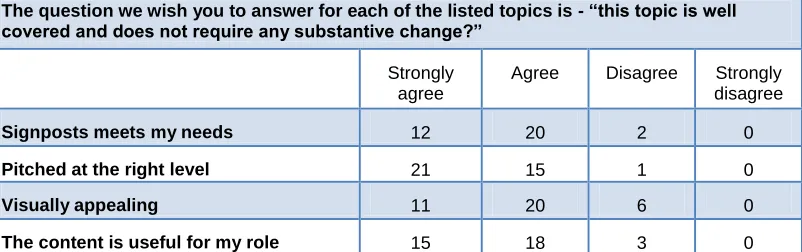
Respondents were also asked to indicate their responses to four statements about the Signposts resource as a concept, and these are shown in Table 1 below.
9
Pleasingly, in every area, Signposts was strongly endorsed by respondents, with the only significant issue being the third statement about the appearance of the pages. Some respondents had added comments to explain their response further:
- “the document is very text-heavy…Use of graphics would help this a great deal”
- “it needs more visual appeal…and…a call to action (like a workbook rather than an information package)”
During the team‟s analysis of this data, we agreed that such comments had perhaps mistaken the idea of Signposts: that it was a concise series of tips and techniques, designed to be printed off as single page guidelines, rather than read from beginning to end as a single document. This indicated to the team the need for supporting guidelines to help users understand and apply the resource appropriately. However, the team also accepted the point about breaking text up for ease of reading and visual appeal, and will incorporate this into any future web-based, rather than print-based format.
Other comments were both positive and explicit about use and usefulness:
- “It will be excellent for our vocational tutors (boat building) to give them teaching awareness and skills. They will be able to move away from 'transmission-only' teaching styles and have a more engaging and inclusive style. The level is pitched perfectly - it is very clear and accessible, and the Literacy integration page at the back isn't daunting / scary, it has practical suggestions for tutors to use. I think is an excellent resource (sic). Thank you to the designers!”
There were also some comments about specific issues of content and language which have been addressed by the project team in the revised version of Signposts produced as a result of this evaluation exercise:
- “Only suggestion would be to preface the assessment section (where you talk of the NQF) with the information that this is not used in the university sector. New staff - often overwhelmed by all the 'stuff' they have to remember - may not recall verbal information that universities don't use unit standards, and wonder why they're not finding these in their own practice. Also, the term 'tutor' is used differently in the university sector, although Signpost's use of 'teacher' predominantly is good.
Table 1.
Please rate the following topics in Signposts based on how useful the content is for you. The question we wish you to answer for each of the listed topics is - “this topic is well covered and does not require any substantive change?”
Strongly agree
Agree Disagree Strongly
disagree
Signposts meets my needs 12 20 2 0
Pitched at the right level 21 15 1 0
Visually appealing 11 20 6 0
10
Feedback about individual Signposts topics
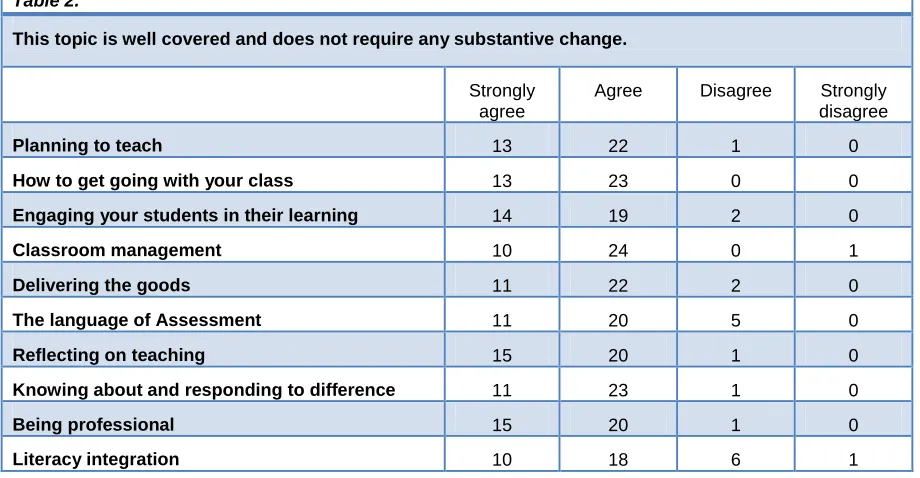
We asked respondents to rate each of the 10 Signposts topics according to how useful they found the content by responding to the statement: “This topic is well covered and does not require any substantive change.” Table 2, shows the responses.
Again, the overall feedback was very positive, with two particular topics, The Language of Assessment and Literacy Integration, drawing more comments than other areas. Several respondents made explicit suggestions which have now been incorporated into the second edition, including reference to plagiarism, copyright, cloze testing, diagnostic assessment, feed forward and talking more about assessment which is not unit standard based. The team also noted that since the original Signposts were developed in 2008, TEC has launched a new Literacy Embedding Strategy, and that this needed to be highlighted.
Other useful comments addressed areas of cultural interaction, lesson plans and time management, reflection and building relationships. All such feedback was addressed when revising and updating Signposts, some topics requiring minimal changes to text, others a more significant editing and rewriting of parts of the text.
Overall, about half the respondents (53%) were happy with the resource as it was, and the other half (47%) indicated a need for changes. Comments in this section reiterated some of the points already made about graphics, formatting and language, but most suggested changes were looking for more material, further resources, and practical exercises. Examples included:
A list of links to further resources
Examples of good teaching – e.g. videos
A complementary resource for teachers who have the base knowledge, but need a refresher, or extension
Table 2.
This topic is well covered and does not require any substantive change.
Strongly agree
Agree Disagree Strongly
disagree
Planning to teach 13 22 1 0
How to get going with your class 13 23 0 0
Engaging your students in their learning 14 19 2 0
Classroom management 10 24 0 1
Delivering the goods 11 22 2 0
The language of Assessment 11 20 5 0
Reflecting on teaching 15 20 1 0
Knowing about and responding to difference 11 23 1 0
Being professional 15 20 1 0
11
A new topic about e-learning and e-teaching
A new topic about effective use of ICT, such as PowerPoint, YouTube, podcasts, etc
The project team discussed these suggestions at length during the November 2009 data analysis meeting, and decided to address the first two topics as part of the improvement of the second edition of Signposts, but to defer actual development of new resources until a later phase of the Signposts evolution.
Implementation in individual organisations
The question “How do you think Signposts could be used effectively in your organisation?” was answered by 30 out of the 40 respondents, and the comments received are almost certainly from those in staff development or management roles, rather than new teachers. This was an extremely valuable section of the survey for the project team and formed the basis of the new documents “Guidelines for Staff developers”, an additional output of this evaluation project. Suggestions included:
Insertion as part of an initiation/induction package for new staff , especially part-time and casual, to indicate institutional expectations, e.g.
- “It is clear and direct and purposeful and provides a good starting point for practical„tips‟”
- “I like the fact that it covers everything in not too much detail at first as there is so much to learn for new staff”
As part of formal teacher training programmes, e.g.
- “I deliver new lecturer training and am building this into my 2010 programme as a trial, I think it will be well received”
Following this up with discussion/coaching with a manager
Use for one-to-one discussions with a mentor/coach/buddy
Use as a basis for peer evaluation
Use as a check-list in self-review
As a basis for professional conversations in team meetings or workshops – one topic
per meeting
As a refresher for longer term staff – maybe even add a quiz or some form of interactive activity
As a reminder of good practice – placing it in staff pigeon holes, reminding staff of the link through internal communication, especially with updates to the resource
Modifying to suit individual organisational contexts, e.g.
12
Alternative delivery options
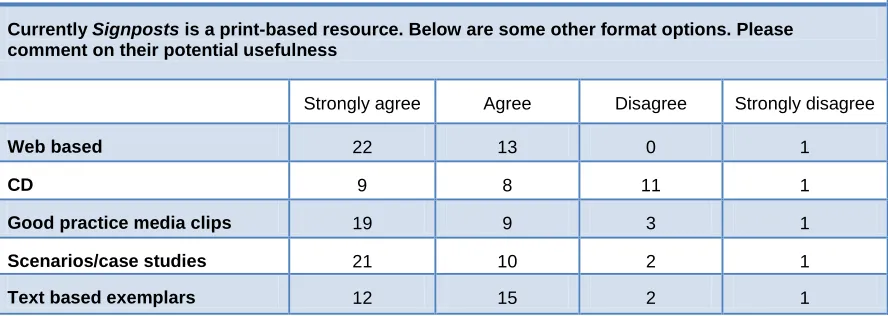
Signposts is currently a print-based resource. The final question in the survey asked respondents to comment on the usefulness of alternative formats (Table 3).
The responses here were more spread across the options than in some of the previous survey sections. Some liked the print-based format as a base:
- “I have printed my version from the Ako Aotearoa site and it is in an A5 booklet form - that way it fits into a diary or notebook and can be with my other resources that travel with me”
- “I would like to see the print-based format kept. It is the most 'portable' for new tutors and provides some degree of security, being able to 'hold onto it'. However, having more interactive 'extras' that could be used in group/classroom or tutoring sessions would also be beneficial”
Others liked the idea of a range of options:
- “All of the above in addition as all access different things in different ways at different times”
- “Use a variety of media to suit learning styles”
Over half the respondents (58%) believed that Signposts fitted in well with other academic professional development their institution was offering:
- “Used as main resource in "Starter Strategies for Beginning Teachers" 2-hour workshop”
- “I refer and use it in workshops, 1-1 tutor conversations and given as part of new tutor welcome package”
- “It is part of the reading in the first course in our adult education qualification for academic staff. It is also promoted on our website (though the website itself is not good!). We believe it will be a very useful part of a planned induction pack for new tutors. We had a local version but this is much more professional and comprehensive”
Table 3.
Currently Signposts is a print-based resource. Below are some other format options. Please comment on their potential usefulness
Strongly agree Agree Disagree Strongly disagree
Web based 22 13 0 1
CD 9 8 11 1
Good practice media clips 19 9 3 1
Scenarios/case studies 21 10 2 1
13
- “We are promoting embedded literacy and numeracy, which is often seen as very academic or difficult. Signposts will be a great vehicle to show how LLN fits in to the lesson in a practical, everyday way. I think it will be an excellent resource for early PD”
Thirteen percent said “No”, that is, that Signposts did not fit, but some indicated that they hadn‟t used it yet, and were planning to; 11 respondents (29%) didn‟t know – again, this is likely to be the new teachers who are still comparatively unfamiliar with their institution‟s full range of professional development offerings.
Unexpected findings
The team did not expect such slow response time or such a low response to the initial request. This resulted in a need to extend the survey and date and for team members to initiate more extensive personal requests of their colleagues and institute‟s teachers. This may have been one reason for the dominance of polytechnic responses as opposed to university, wananga and private tertiary providers. (This may, however, have also been reflective of a difference in approach to staff development at polytechnics).
Transferability
Signposts has been designed for use across all tertiary institutes. As mentioned above, survey results may be indicative of a heavier use in polytechnics as opposed to other tertiary institutes. This may indicate a need for further dissemination on its availability and use. Based on the survey results regarding who uses the tool currently, further dissemination might be targeted more to staff developers in various institutions with more focus on how it can be customized for their purposes.
Benefits of collaboration
Some of the major benefits of the collaboration have been:
The ability to develop Signposts and evaluate specific topics, and develop new guidelines. Although each of the institutes has staff developers, individually they were unable to develop the resource – a distinct result of multiple and diverse people and perspectives being better than one or two.
The ability to develop guidelines which are useful across the sector and, based on survey results, do have positive use – the Ako Aotearoa funding and website location have increased the visibility and use of Signposts beyond what a single institute or even the TASDEN group could have accomplished.
Benefits to participating organisations, offering opportunities to grow new relationships, and to experience different approaches to the provision of professional development for teaching staff. Personal benefits for the individual team members, growing research capability alongside the
development of a resource with tangible, everyday applications in their role.
14
A model for others undertaking research into teaching and learning under the auspices of Ako Aotearoa. The efficacy of resources or recommended practice needs to be tested in the field, and adjusted to reflect feedback wherever practicable and appropriate.
The collaborative team in this project increased the number of involved institutes from three to five. Despite the extra members and consequent additional communications and logistic constraints, the team worked well together using the same structure and procedures as in the initial project. The team was also “up to speed” faster than in the initial project, partially because the group stages of establishing a common rapport and purpose were already completed, and despite the change in numbers, did not need to be revisited. This is a reflection of the well-defined and structured collaboration of the first project (see Appendix B for an extended account of enablers, challenges and benefits).
Conclusion
The evaluation results, while not a large sample size, offer rich and relevant data for immediate amendments to the resource, as well as future development. Overall, the evaluation has affirmed the value and contribution of Signposts as a staff development tool to support novice teachers. The evaluation also shows that Signposts is working as a framework to outline teacher training topics, and as a revision tool for more experienced educators. The format, language and level are appropriate. It is being used, and found to be useful.
Responding to suggestions received has enabled the team to develop a number of outputs which successfully meet the goals of evaluating Signposts and refining the resource, and of revisiting the guidelines for inter-institutional collaboration.
Outputs include:
Revision of some pages (as mentioned above)
Two formats available: a PDF for new teachers, and a Word document to allow contextualisation to each institute
List of links to websites and online resources that may be useful for staff developers and new teachers
A new section specifically targeted to staff developers outlining both customization guides and various suggestions for use
A review of the collaborative process
Recommendations for possible future actions
The evaluation involved participation by 40 learners, in addition to the team members and their colleagues who consulted during the piloting phase of the questionnaire. The end use of the evaluation is a revised and extended staff development resource which has the potential to assist dozens of staff developers in tertiary organisations across the sector, and hundreds of new tertiary teachers.
15
Recommendations
Ako Aotearoa should identify a systematic, scheduled evaluation and review of all tools (including Signposts) provided by Ako Aotearoa to ensure they remain useful and current. Although less than a year old, Signposts did not reflect the current/emerging practice in literacy and numeracy.
A dissemination system should be designed for all Ako Aotearoa projects which considers appropriate people to receive different types of information or to be surveyed. Although the Signposts team used the Ako Aotearoa website to survey, we did not realize the primary users of the site are staff developers as opposed to new teachers, impacting survey results.
References
Honeyfield, J., McMillan, A., Reid, P., Fester, V., Shaw, L., Spence, P., & Hunt, D. (2008). Signposts: A professional development resource for new teaching staff in the tertiary sector. Ako Aotearoa: Wellington, New Zealand
16
20
Appendix B: The Challenges and Successes of the Collaborative
Process, 2009
Background
The first Signposts project of 2008 used the Wilder Collaboration Factors Inventory tool (Mattessich, Murray-Close & Monsey, 2001) to review the team‟s progress and perceptions of working on an inter-institutional development. This parallel focus of how the work was done, as well as what it produced provided a rich source of learning about aspects of good practice in collaboration, as well as identifying the enablers and barriers faced by participants. Several documents to record the process and to assist others in similar collaborations were developed, and appeared as appendices to the original Signposts Final Report to Ako Aotearoa. These were:
Appendix 3: Bibliography for literature on collaboration
Appendix 6: Planning and decision-making checklists
Appendix 7: Inter-institutional collaborative projects: Success factors identified in literature
Appendix 8: Inter-institutional collaborative projects: Potential challenges identified in literature
Appendix 9: Wilder Collaboration Inventory
Appendix 10: Considerations when planning for our collaboration
Consequently, the team for the second Signposts project of 2009 had a wealth of material and guidelines on which to draw when planning and implementing the evaluation of the Signposts resource, as described in this report.
Need for face-to-face meetings
With the growth of the Signposts team now representing five institutions, instead of the original three, and changes in actual personnel, it was essential to begin the 2009 process with a face-to-face meeting. At this time, the collaborative guidelines for the project were agreed, and the parameters for working together were set. Using the above documents, conventions of respect, inclusiveness and shared ownership were naturally interwoven as part of the work ethos. Once this environment was confirmed, division of task allocation was straightforward. Email correspondence and occasional meetings of some team members at national forums, such as TASDEN and Ako Aotearoa Northern Hub Advisory meetings, helped to maintain the informal and supportive relationship.
Collaboration enablers
A strong practical and theoretical platform of identified good practice in similar collaborations. The team acknowledges the input in 2008 from Neil Haigh, who offered invaluable experience and expertise in this area. The framework he helped to establish in 2008 was carried through to this 2009 evaluation.
Existing relationships – from previous Signposts project, as well as professional memberships.
21
A shared enthusiasm for the resource and its usefulness, so that motivation to contribute to an effective outcome was high.
All input was respected and welcomed. For some the project was “a learning curve” but they were still able to make a meaningful contribution. The team recognised, and capitalised on different areas of expertise.
Strong project leadership. Team members recognised Judi‟s role coordinating and driving the different phases of the project was essential to achieving a successful and timely outcome.
Commitment to an “action research” approach – developing the resource, implementing, reflecting and evaluating, and adjusting in response to measurable, empirical data.
Challenges to collaboration
Scheduling. Meetings to complete the new edition of Signposts and finalise the project were particularly difficult to plan at the end of 2009 and beginning of the 2010 academic year, with team members unavailable due to institutional annual reporting requirements, planning meetings, leave, etc.
Logistics. The inter-institutional nature of the collaboration was at once its greatest strength, representing many different points of view, but also at times, an obstacle to progress, requiring team members to travel for meetings and protect time for prompt responses to assist the project meet agreed timelines.
Institutional changes meant team members changed roles and one even moved institutions, which meant new organisational cultures and accountabilities needed to be addressed and catered for when staff negotiated their workloads and availability for the project.
Some final thoughts about the benefits of the collaboration for stakeholders
Clear benefits to participating organizations, offering opportunities to grow new relationships, and to experience different approaches to the provision of professional development for teaching staff.
The ability to develop guidelines. Although each of the institutes has staff developers, individually they were unable to develop the resource – a distinct result of multiple and diverse people and perspectives being better than one or two.
The ability to develop Signposts topics and guidelines which are useful across the sector and, based on survey results, do have positive use – the Ako Aotearoa funding and website location have increased the visibility and use of Signposts beyond what a single institute or even the TASDEN group could have accomplished.
Personal benefits for the individual team members, growing research capability and confidence alongside the development of a resource with tangible, everyday applications in their role.
Strengthening a community of practice for staff developers with the unselfish sharing of resources and customisation strategies supported by the Creative Commons approach of Ako Aotearoa.