World Maritime University
The Maritime Commons: Digital Repository of the World
Maritime University
World Maritime University Dissertations
Dissertations
2014
Outsourcing workers in Indonesia Port
Corporation II : a cost effective measure in The
Procurement Bureau and recommended actions for
IPC
Ni Made Devita
World Maritime UniversityFollow this and additional works at:
http://commons.wmu.se/all_dissertations
This Dissertation is brought to you courtesy of Maritime Commons. Open Access items may be downloaded for non-commercial, fair use academic purposes. No items may be hosted on another server or web site without express written permission from the World Maritime University. For more
Recommended Citation
Devita, Ni Made, "Outsourcing workers in Indonesia Port Corporation II : a cost effective measure in The Procurement Bureau and recommended actions for IPC" (2014).World Maritime University Dissertations. 472.
WORLD MARITIME UNIVERSITY
Malmö, Sweden
OUTSOURCING WORKERS IN
INDONESIA PORT CORPORATION II
A Cost EffectiveMeasure In The Procurement Bureau and
Recommended Actions for IPC
By
NI MADE DEVITA
Republic of Indonesia
A dissertation submitted to the World Maritime University in partial
Fulfilment of the requirements for the award of the degree of
MASTER OF SCIENCE
In
MARITIME AFFAIRS
PORT MANAGEMENT
DECLARATION
I certify that all the material in this dissertation that is not my own
work has been identified,and that no material is included for
which a degree has previously been conferred on me.
The contents of this dissertation reflect my own personal views,
and are not necessarily endorsed by the University.
(Signature): ………..
(Date): ………..
Supervised by: Prof. Patrick Donner
World Maritime University
Assessor:Dr.IliasVisvikis
World Maritime University
ACKNOWLEDGMENT
First, I would like to thank Allah The Almighty for His blessing.
I would like to express my highest acknowledgement to the Management of Indonesia
Port Corporation II, especially the Human Resource Department for this precious
opportunity. To Mr. ChiefyAdiKusmargono, Mrs. DessyEmastari, Mr. Yana Pratapa and
Mr. Stenus for their useful knowledge and support, which have been of great help and
assistance.
To Professor Patrick Donner, my supervisor, who has given me a lot of advice, his
encouraging words and insightful feedback made this dissertation possible. Thank you
to all the lecturers, visiting profesoor and staff at the WMU that I cannot mention one by
one for sharing their knowledge and experience.
To all my colleagues in WMU, especially from Indonesia for their help and assistance
during my studies.To Indonesian families in Malmo and my host family for their
hospitality.
Most of all, to my parents, brother, and sister-in-law for their love and support and to my
ABSTRACT
Title of Dissertation : Outsourcing Workers in Indonesia Port Corporation II
A Cost Effective Measure in The Procurement Bureau and Recommended Actions for IPC
Degree : MSc
Indonesia Port Corporation II (IPC) is one of the State-Owned Enterprises (SOE) in the maritime industry enganged in port and logistic services that implements outsourcing to support performance and productivity. Before the Regulation of the Minister of Manpower and Transmigration Number 19 of 2012, concerning the Requirement of Assignment of Part of the Implementation of the Work, came into force, IPC was often considered to be violating the provisions of employment law because it outsourced its core business, which was prohibited.
Consequently, asBUPI (Indonesian Port Enterprises Association) was established in order to form clear definitions of “core” and “supporting” activities in ports by establishing a business flow that contains both activities. Moreover, the clear definitions of core and supporting activities then became the legal basis for IPC to outsource their work. This research attempts to analyse and evaluate the application of outsourcing at the Procurement Bureau of IPC through workload and cost effectiveness analysis.
In practice, there are many obstacleswhen outsourcing occurs in IPC. For instance, outsourced workers often conduct strikes and demonstrations, anddemand to permanent IPC status. These circumstances definitely disturb port operations and IPC can not grant all of their demands due to financial reasons.
Therefore, this study addresses three recommendations to address this issue as follows. First, a solution that should be carried out by IPC; Second, a solution to managing outsourced workers; and third, a solution related to outsourcing service provider companies.
TABLE OF CONTENTS
DECLARATION ii
ACKNOWLEDGMENT iii
ABSTRACT iv
TABLE OF CONTENTS v
LIST OF TABLES viii
LIST OF FIGURES ix
LIST OF ABBREVIATIONS x
1 INTRODUCTION 1
1.1 Overview 1
1.2 Identification of problems 2
1.3 Objectives 3
1.4 Research questions 3
1.5 Methodology 3
1.6 Limitations of the study 4
2 A PROFILE OF INDONESIA PORT CORPORATION II 5
2.1 Historical Background 5
2.2 Head Office, Branches, Subsidiaries and Affiliates 6
2.3 Vision and Mission 8
2.4 Business Segments 8
2.5 Overview of Branches 9
3.1 An Overview of Human Resource Outsourcing 21
3.1.1 Defining Outsourcing 21
3.1.2 Trend of Human Resource Outsourcing 21
3.2 Reasons for and Risks of Outsourcing 23
3.2.1 Reasons for Outsourcing 23
3.2.2 Risks of Outsourcing 25
3.3 Outsourcing in Indonesia 27
3.3.1 Legal Basis of Outsourcing Implementation 27
3.3.2 Terms of jobs that can be submitted to another party 28
3.4 Outsourcing Practices in Indonesia 30
4 ANALYSIS OF CORE BUSINESS AND WORKLOAD 34
4.1 Workers in IPC 34
4.1.1 Workers Based on Service Center 34
4.1.2 Workers Based in Subsidiaries 37
4.1.3 Worker Productivity 39
4.2 The Core Business and the Support Business 40
4.3 Analysis oftheProcurement Bureau 43
4.3.1 OrganizationalStructure, Function,andDuties 43
4.3.2 Workload analysis in the Procurement Bureau 46
4.3.3 Outsourcing in the Bureau of Procurement 52
5 ANALYSIS OF COST EFFECTIVENESS OF OUTSOURCING 55
5.1 Transaction Cost Economics 55
5.1.2 Wages 59
5.1.3 Welfare Programs 65
5.2 Cost Effectiveness in the Procurement Bureau 68
5.3 How to Perform Outsourcing Successfully 71
5.3.1 Issue of Workers‟ Strike 71
5.3.2 Recommended Actions 72
6 CONCLUSION AND RECOMMENDATIONS 78
6.1 Conclusion 78
6.2 Recommendations 79
LIST OF TABLES
Table 4-1 Total Workers Based on Service Centre ... 35
Table 4-2 Total Workers Based on Subsidiaries ... 38
Table 4-3 Effective Days in 2012-2013 ... 46
Table 4-4 Effective Work Hour in 2012-2013 ... 47
Table 4-5 Comparison Required Worker and Actual Number ... 51
Table 4-6 Placement Workers in The Procurement Bureau (Proposed) ... 53
Table 5-1 Basic Salary of Permanent Worker ... 60
Table 5-2 Basic Salary for Outsourced Worker ... 60
Table 5-3 Transportation Allowance of Permanent Workers ... 62
Table 5-4 Transportation Allowance of Outsourced Worker... 62
Table 5-5 Housing Allowance of Permanent Worker ... 63
Table 5-6 Performance Incentive of Permanent Workers ... 64
Table 5-7 Performance Incentive of Outsourced Worker ... 65
Table 5-8 Welfare Program Comparison Between Permanent Worker and Outsourced Worker ... 67
Table 5-9 Health Allowance of Outsourced Workers ... 68
Table 5-10 THP Comparison Between Permanent Worker and Outsourced Worker ... 69
LIST OF FIGURES
Figure 1-1 Ports Under IPC 1
Figure 3-1 Types of Activities or Functions Outsourced 22
Figure 3-2 Disadvantages of Outsourcing 25
Figure 4-1 Total of Outsourced Workers 36
Figure 4-2 Percentage Worker Composition Based on Service Centre 37
Figure 4-3 Percentage Worker Composition Based on Subsidiaries 39
Figure 4-4 Workers' Productivity 40
Figure 4-5 Outsourced Work Assignation Mechanism 41
Figure 4-6 Structure Organization of Procurement Bureau 44
Figure 4-7 Workload Analysis in 2012-2013 49
Figure 4-8 The Average Number of Workers Required 50
LIST OF ABBREVIATIONS
AsBUPI AsosiasiBadan Usaha Pelabuhan Indonesia or Indonesian Port Enterprises
Association
BPP BebanTugas or a number of workload in a year
HR Human Resource
ILO International Labour Organization
IPC Indonesia Port Corporation II
Jamsostek JaminanSosialTenagaKerja or Workers‟ Social Security
JICT Jakarta International Container Terminal
Kopegmar KoperasiPegawaiMaritim or Maritime Workers Cooperative
KPI Key Performance Indicator
NI Net Income
PDS PelindoDaya Sejahtera Corporation
PT Perusahaan Terbatas or Limited Liability Company
SKR Standard Kemampuan Rata-rata or Average Ability Standard of Task
Completion Time
SOE State-Owned Enterprises
TE Total Employee
THP Take Home Pay
TR Total Revenue
1 INTRODUCTION
1.1 Overview
Increasingly tight competition requires companies to be more flexible in responding to
market demand. The strategy of outsourcing is a form of flexibility that is often practiced
by companies (Wahyuni, Idrus, Zain, & Rahayu, 2010). The term outsourcing is derived
from the words "out" and "source" which means a source from outside, and is a
management approach that gives authority to a third party to take responsibility fora
process or service previously done by the company.
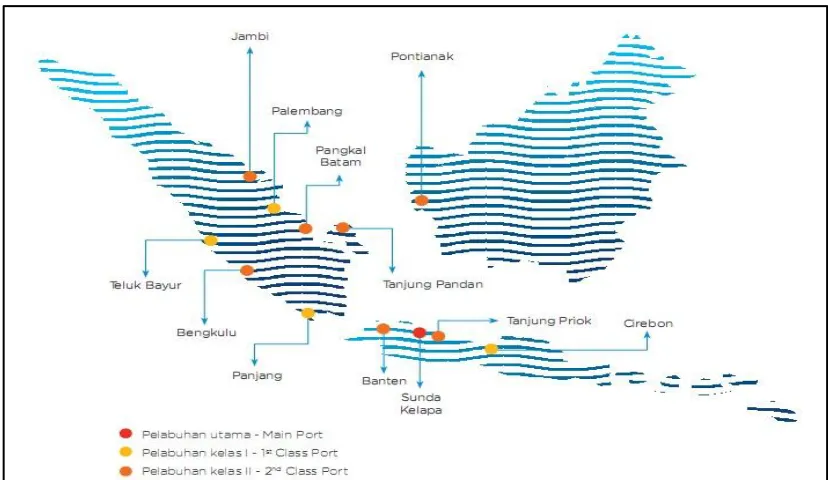
Indonesia Port Corporation II (IPC) is one of the State-Owner Enterprises
(SOE)responsible for the governance, regulation, maintenance and operation of 12
ports in Indonesia.IPC has established policies to use outsourced workers to meet the
demand of workforce in the port.
.
Figure 1-1 Ports Under IPC
For outsourcing of workers to be really effective, an organization must figure outwhat
can be outsourced as well as what cannot be outsourced (Caruth, Haden, & Caruth,
2013). There are several types of activities that, based on regulation, should never be
outsourced. Activities related to the core business or confidential information should not
be outsourced. Severe problems may arise if a company outsourcesthese
activities,such as sanctions from the Ministry of Manpower, lossof confidential
information or work not being finished correctly.
Moreover, a company must understand the positive and negative impact of outsourcing
workers. A company has to consider the whole aspect because even when the
outsourcing strategy promises potential value, there are adverse side effects in
practice.
Another strategy to achieve effective outsourcing of workers is creating preventive
measures to reduce the negative impacts of outsourcing. A positive mutual relationship
must be established between the user company, the outsourcing service provider
company and the outsourced workers.
1.2 Identification of problems
The Manpower Act (2003) states that there are five types of job that areallowed tobe
outsourced, namely hygiene services (cleaning services) business, catering service
businesses for workers, business of security personnel (security), ancillary businesses
in mining and petroleum and businesses providing transport for workers. In the process,
many companies outsource work without referring to that provision. Both permanent
workers and outsourced workers are still working in the same field and with the same
responsibility. Nevertheless, they are paid differently and accept different facilities,
whereby permanent workers continue to receive greater salaries and more complete
benefits.
This situation often gives rise to dissatisfaction among outsourced workers. Thus, they
same facilities as permanent employees. The strikes and demonstrations inevitably
affect the business of the company negatively.
The same circumtances occur in the IPC.Conceding to the demands of outsourced
workers to promote them to permanent workers is not possible and would increase
operational costs. On the other hand, considering all of the risks mentioned, companies
start to question whether outsourcing is the right decision to make or not. Therefore,
IPC needs to understand all aspects related to outsourcing in order to implement it
successfully.
1.3 Objectives
The purpose of this study is to identify jobs that can be outsourced in the IPC, to
analyze the application of outsourcing in the Procurement Bureau as well as benefits
that can be obtained, and actions that should be taken to perform outsourcing
successfully.
1.4 Research questions
How is outsourcing implemented at IPC? This dissertation intends to conduct an
analysis to answer this question. The analysis will also answer the following questions:
1. What kind of work can be outsourced?
2. How should the application of outsourcing in the Procurement Bureau be analysed
and what benefits can be obtained?
3. What actions should be taken to perform outsourcing successfully?
1.5 Methodology
In collecting the necessary data and information, the following methods have been
1. Interviewing parties that are involved in the processes this research focuses on,
such as management of IPC, outsourced workers and outsourcing service provider
companies. The interviewswere conducted over the phone and the internet.
2. The data for workload analysis was obtained through open interviews and
observation. The calculationsweremade based on the Decree of State Minister for
the Empowerment of State Apparatus (2004) NumberKEP/75/M.PAN/7/2004on
Guidelines for Calculation of Employee‟s Need based Workload.
3. Collecting secondary data and information available in IPC databases
4. Conducting literature research on other institutions related to the main service of
the port operator, the WMU library, the Malmo city library, internet (outsourcing
institutes) and other sources
5. Consulting with experts at WMU and other companies to gain the necessary
information and to confirm the process of analysis
1.6 Limitations of the study
The author failed to obtain data and information about the application of outsourcing in
other similar companies, so data comparison was not possible. The limitations of work
time and the broad scope of the IPC‟s departments/divisions are two problems arising
in analyzing outsourcing in the IPC as a whole.
It is expected that this paper can contribute to IPC‟s achievement of higher advantages
of outsourcing in terms of cost and productivity. In addition, this will also help the
2 A PROFILE OF INDONESIA PORT CORPORATION II
Indonesia Port Corporation II (IPC) is one of the State-Owned Enterprises (SOE) in the
transportation sector responsible for port and logistic services. IPC is situated in
Jakarta, the capital city of Indonesia known as its main economic node and strategic
gateway for export-import operations in Indonesia.
2.1 Historical Background
The IPC‟s history started in 1960 when the government of the Republic of Indonesia
issued the decision to establish State Enterprise of Pelabuhan I to Pelabuhan VIII as
the managing parties for all sea ports in Indonesia according to Government Regulation
Number 19/1960 on public port management conducted by the port management
agency (BPP) (Indonesia Port Corporation II, 2014).
BPP had an obligation to the commercial sector management, while the Port
Administrator (Adpel) had responsibility for the operational sector coordination. The
separated tasks occurred because the government decided to restructure public port
management in 1964 by dividing the operational and commercial sectors in the
management of the ports.
From 1969 until 1983, the BPP operated each seaport according to Government
Regulation Number 18/1969. In 1983, the status of BPP was transformed into
Perusahaan Umum (Perum) by the government. As a result, BPP only operated the
public ports for commercial purposes. Further, the management of public ports, which
are not designed for commercial purposes, was taken over by the Technical
Implementation Unit of the Directorate General of Sea Transportation, Ministry of
Transportation.
According to Government Regulation Number 15/1983 juncto PP Number 5 dated 5
February 1983, PerumPelabuhan was merged and divided into four operational regions
under the names of PerumPelabuhan I to IV (Indonesia Port Corporation II, 2014). The
According to Government Regulation Number 57/1991, the Perum was changed into a
Limited Liability Company (PT) in which the government owned all shares leading to the
change in name to PT Pelabuhan Indonesia II, as stated in Notarial Deed Number 3,
dated 1 December 1992, and changed by Notarial Deed Number 4, dated 5 May 1998,
both notarized under Notary Imas Fatimah, S.H., a notary in Jakarta and approved by
the Ministry of Justice of the Republic Indonesia under Decision Letter Number
C2-17612-HT.01.01.TH.98, dated 6 October 1998.
The latest amendment to the Company‟s Articles of Association was made based on
the resolutions of Shareholders General Meeting Number 2 of Notary
AgusSudionoKuntjoro, SH, dated 15 August 2008 jo. Act Number3, dated July 30,
2009. Thisamendment to the Articles of Association had obtained approval from the
Ministry of Justice and Human Rights of Republic of Indonesia Number
AHU-80894.AH.01.02.2008, dated 3 November 2008.The legal standing for the
establishment of the Company as a state owned company managing port business was
the Law Number 19/2003 concerning State Owned Companies, the law Number 40
Year 2007 on Limited Liability Companies, and the Shipping Law Number 17 of 2008,
and the Government Regulation Number 61 Year 2009.
2.2 Head Office, Branches, Subsidiaries and Affiliates
The IPC head office is located in Jakarta and it has operational areas across 10
provinces. The operating areas include 12 ports:
1. TelukBayur Port in West Sumatra Province;
2. Jambi Port in Jambi Province;
3. Palembang Boom Baru Port in South Sumatra;
4. Bengkulu Port in Bengkulu Province;
5. Panjang Port in Lampung Province;
6. TanjungPandan Port and PangkalBalam Port in Bangka Belitung Province;
7. Banten Port in Banten Province;
9. Cirebon Port in West Java Province; and
10. Pontianak Port in West Kalimantan Province.
Furthermore, IPC has planned the construction of three new ports which are:
1. Kalibaru Utara Port (Jakarta);
2. Sorong (West Papua); and
3. Batam (Riau Island).
IPC also has 15 subsidiaries namely:
1. KSO Terminal PetikemasKoja (TPK Koja);
2. PT Jakarta International Container Terminal (JICT
3. PT RumahSakitPelabuhan (RSP);
4. PT EDI Indonesia (EDII);
5. PT Multi Terminal Indonesia (MTI);
6. PT IntegrasiLogistikCiptaSolusi (ILCS);
7. PT Indonesia Kendaraan Terminal (IKT);
8. PT JasaPeralatanPelabuhan Indonesia (JPPI);
9. PT PengembangPelabuhan Indonesia (PPI);
10. PT EnergiPelabuhan Indonesia (EPI);
11. PT Jasa Armada Indonesia (JAI);
12. PT PendidikanMaritimdanLogistik Indonesia (PMLI);
13. PT IPC Terminal Petikemas;
14. PT Pengerukan Indonesia;
15. PT Terminal Petikemas Indonesia.
IPC not only conducts port management activities, but also engagesin other relevant
business sectors such as equipment maintenance, port energy supply, and port
development. The organizationset up Business Partner Cooperations (KSMU) together
with business partners from private companies such as Terminal Operator cooperation,
tug boats, and management of other port facilities in order to perform port operation and
2.3 Vision and Mission
IPC was established as a modern, efficient, and excellent port service provider for
customers. IPC has also set up its vision, mission and company commitment in order to
reach the goal of becoming a world class port operator,
The company‟s vision is to become the preferred partner for reliable, best class in port
and logistics services by creating an exciting enterprise for the people of Indonesia and
contributing to national growth(Indonesia Port Corporation II, 2014). The company‟s
mission is to ensure the quality of port services with an excellent logistics network to
fulfillthe expectations of key stakeholders (customers, shareholders, employees,
partners and regulators), determining the security and safety of vessel and cargo traffic
to createthe efficiency of logistics costs in order to support national economic growth.
The company‟s commitments are (Indonesia Port Corporation II, 2014):
1. To the partners and the port service customers:
To provide and operate reliable and world-class quality port services;
2. To the national interests:
To escalatethe organization‟s welfare and boost national economic development
professionally;
3. To the port community:
To promote the establishment of cooperative and communal port society;
4. To the company‟s members:
To develop human resources that are loyal, qualified, optimistic, friendly and
service oriented, proud of the company and its culture, and to implement welfare
and work.
2.4 Business Segments
IPC provides three types of business activities (Indonesia Port Corporation II, 2014).
The features of these services are maintaining the safety of the vessel, passengers and
1. Ship Services
The company offers ship services starting from the time vessels enter the port
until they depart from the port. The services are:
Anchorage Service
Mooring Service
Pilotage Service
Towage Service
Fresh Water Service
2. Cargo Services
The company offers cargo loading and unloading of the ships and cargo delivery
to the owners. The provided services are:
Public Berth
Storage Warehouse
Storage Yard
Private Berth
3. Other Services
For operational supporting processes, IPC provides other services. The other
services are:
Port Equipment Maintenance Services
Land Rental, Buildings, Water and Electricity
Miscellaneous Business Services
2.5 Overview of Branches
As was mentioned before, IPC has 10 branches. Each branch has its special
1. Port of TanjungPriok
Port of TanjungPriok is the largest and the busiest port in Indonesia because its
location is near a hinterland, an area with trading and industrial activities. The Port
of TanjungPriok lies at 06 06/00‟‟ S in latitude and 106 53/00‟‟ W in longitude. The
port has a channel with a length of 19,850 m, a width of 30-150 m and a maximum
depth of 14 LWS. The port also has breakwaters of 9,247 km in length. In addition,
the container yard area is 879,304 m2, the conventional yard area is 166,128 m2
and the warehouse area is 101,977 m2 (Indonesia Port Corporation II, 2014).
Facilities:
Stevedoring Equipment
Excavator : 11 Units
Reach Stacker : 58 Units
Shore Crane : 7 Units
Forklift : 124 Units
Mobile Crane : 1 Unit
Top Loader : 7 Units
HMC : 14 Units
Quay Container Crane : 7 Units
Rubber Tyred Gantry Crane : 14 Units
Rail Mounted Gantry Crane : 5 Units
Side Loader : 1 Unit
Floating Equipment
Tugboat : 20 Units
Mooring Boat : 7 Units
Survey Boat : 1 Unit
2. Port of Panjang
The Port of Panjang is situated in Lampung Province. The Port of Panjang is the
biggest port in Sumatera Island and has a significant role as the major point for
economic growth. The Port of Panjang lies at 50 28‟ 23” S in latitude and 1050 19‟ 03” E in longitude. This port has 10,000 m in berth length with 7m to 16m LWS in
channel and basin depth. The container area is about 75,000 m2, the conventional
area is 23,253 m2 and warehouse area is 5,160 m2 with 3 units in total (Indonesia
Port Corporation II, 2014).
Facilities:
Stevedoring Equipment
Container Crane : 3 Units
Forklift : 9 Units
Transtainer : 5 Units
Gantry Jib Crane : 4 Units
Top Loader : 1 Unit
Side Loader : 1 Unit
Head Truck : 13 Units
Chassis : 15 Units
Floating Equipment
Tugs : 5 Units
Pilot Boat : 6 Units
3. Port of Palembang
The Port of Palembang, known as Boom Baru, is the widestriver port in Sumatra
Island. The port has high prospects for future development because it is supported
by a wide area for industrial processing activities. The Port of Palembang is located
at 20 59‟ 08” S latitude and 1040 46‟ 00” E longitude. On the operational side, the
port is 109,268 m in channel length with -6 m LWS in channel depth and -7 to -9 m
LWS in basin depth. The container area is around 45,328 m2, the conventional area
is 15,687 m2and warehouse area is 6,785 m2.
Facilities:
Stevedoring Equipment
Container Crane : 2 Units
Forklift : 16 Units
Side Loader : 2 Units
Head Truck : 14 Units
Chassis : 12 Unit
Reach Stacker : 1 Unit
Rail Mounted Gantry Crane : 4 Units
Jib Crane : 4 Units
Floating Equipment
Pilot Boat : 6 Units
Mooring Boat : 1 Units
Water Boat : 2 Units
4. Port of TelukBayur
TelukBayur Port is situated on the west coast of Sumatera Island. The Port of
TelukBayur is an ocean port and is open to international trade. This port is
supported by the economic activities area in West Sumatera, including Muara
Padang and Air Bangis. This port is situated at 10 00‟ 04” S latitude and 1000 19‟ 03” E longitude. The channel length is 1,856 m with -2.5 to -12 m LWS in channel
depth and -2.5 to -10 m LWS in basin depth. The container yard area is 62,520 m2,
the conventional yard area is 24,094 m2 and storage area is 13,250 m2.
Facilities:
Stevedoring Equipment
Forklift : 4 Units
Mobile Crane : 1 Unit
Top Loader : 1 Unit
Side Loader : 1 Unit
Head Truck : 10 Units
Chassis : 11 Units
Reach Stacker : 3 Units
Spreader : 1 Unit
Floating Equipment
Tugboat : 2 Units
Pilot Boat : 3 Units
Mooring Boat : 2 Units
5. Port of Pontianak
The Port of Pontianak lies at the Kapuas riverside. The Port of Pontianak consists
of the Port of Sintete and the Port of Ketapang, both of which are under IPC‟s
management. The Port of Pontianak is the main port in West Kalimantan and has
been strengthened due to the existence of sub-ports near the surrounding area.
The port is 31,000 m in channel length with -4 to -9 m LWS in channel depth and -2
to -8 m LWS in basin depth. The container yard area is 47,794 m2, the conventional
yard area 9,825 m2 and total warehouse area is 4,390 m2.
Facilities:
Stevedoring Equipment
Container Crane : 3 Units
Rail Mounted Gantry Crane : 4 Units
Gantry Jib Crane : 2 Units
Reach Stacker : 5 Units
Top Loader : 2 Units
Side Loader : 6 Units
Mobile Crane : 1 Unit
Forklift : 10 Units
Head Truck : 13 Units
Chassis : 13 Units
Floating Equipment
Tugboat : 2 Units
Pilot Boat : 3 Units
6. Port of Cirebon
The Port of Cirebon is centrally located on the northern coast of West Java. This
port functions as a highway-and-railway-crossing-area to all cities in Java Island.
This port lies at 60 42‟ 55.6” S latitude and 1030 34‟ 13.9” E longitude. It has 2,500
m in channel length with -5,3 m LWS in channel depth and -2 to -6 m LWS in basin
depth. The container yard area is 5,400 m2, the conventional area is 27,908 m2 and
the storage area is 9,863 m2.
Facilities:
Stevedoring Equipment
Excavator : 2 Units
Mobile Crane : 1 Unit
Wheel Loader : 1 Unit
Rampdoor : 2 Units
Dump Truck : 4 Units
Floating Equipment
Tugboat : 2 Units
7. Port of Jambi
The Port of Jambi is located in TalangDuku, at the Batanghari River in Jambi
Province. The hinterland area produces rubber, plywood, and molding industries.
Further, the commodities are exported to the Europe, Japan, the Middle East,
South Korea andUnited States. The port has 200,942 m in berth length with -3 to -8
m LWS in channel depth and -2.5 to -9 m LWS in berth depth. The container yard
area is about 33,869 m2, the conventional yard area is 32,295 m2 and the storage
area is 2,640 m2.
Facilities:
Stevedoring Equipment
Mobile Crane : 2 Units
Forklift : 10 Units
Head Truck : 6 Units
Reach Stacker : 1 Unit
Chassis : 8 Units
Wheel Loader : 1 Unit
Floating Equipment
Speed Boat : 1 Unit
Pilot Boat : 1 Unit
8. Port of Bengkulu
Bengkulu port is placed around 21 km from city center of Bengkulu. The hinterland
area has various commodities such as mining, plantation and forestry. Those
mining, and industry. The port lies at 30 54‟ 26” S latitude and 1020 18‟ 09” E
longtiude. The port is 2,000 m in channel length with -12 m LWS in channel depth
and -9 to -12 m LWS in basin depth. The conventional yard area is 7,872 m2, and
the warehouse area is 1,750 m2.
Facilities:
Stevedoring Equipment
Forklift : 4 Units
Conveyor : 3 Units
Wheel Loader : 2 Units
Bulldozer : 1 Unit
Reach Stacker : 1 Unit
Luffing Crane : 1 Unit
Floating Equipment
Tugboat : 2 Units
Pilot Boat : 2 Units
9. Port of Banten
The Port of Banten is located around 10 km from the center of Serang city, Banten
province. The hinterland area is growing fast and becoming an industrial area for
steel processing, machinery, chemicals, and palm oil industries. The port of Banten
is located at 60 01‟ 03” S latitude and 1050 57‟ 04” E longitude. The port has 500 m
in channel length, 971 m in berth length with -5 to -13 m LWS in channel depth and
-2 to -14 m LWS in basin depth. The conventional yard area is 4,282 m2 and
Facilities:
Stevedoring Equipment
Container Crane : 2 Units
Transtainer : 2 Units
Diesel Forklift : 1 Unit
Mobile Crane : 1 Unit
Gantry Crane : 2 Units
Fire Trucks : 1 Unit
Spreader : 2 Units
Floating Equipment
Tugboat : 2 Units
10. Port of SundaKelapa
The port of SundaKelapa is located in Jakarta bay. The hinterland area is growing
rapidly with offices, hotels, trading and industrial centers. The Port of SundaKelapa
is considered the oldest port which has unique characteristics and serves as a
maritime tourism site in Jakarta. This port is situated at 06 06/30 ′S latitude, 106 07/50 ″W longtiude. The port is 2,212 m in channel length and 2,411 in berth length
with -6 m LWS in channel depth and -3 to -4 m LWS in basin depth. The
conventional yard area is 31,169 m2and warehouse area is 8,606 m2.
Facilities:
Stevedoring Equipment
11. Port of PangkalBalam
PangkalBalam port is situated in Bangka island, part of Bangka-Belitung province.
The main commodities of Bangka Island are, kaolin, palm oil,quartz sand,
granite,tin, pepper and rubber. This port is located at 2° 15` 32" S latitude, 106°
71` 54" E longitude. The port is 26,475 m in channel length and 707 m berth length
with -1 to -9 m LWS in channel depth and -1 to -7 m LWS in basin depth. The
conventional yard area is 6,720 m2, the container yard area is 2,391 m2and
warehouse area is 1,760 m2.
Facilities:
Stevedoring Equipment
Crane : 2 Units
Forklift : 4 Units
Jib Crane : 1 Unit
Head Road Truck : 4 Units
Floating Equipment
Mooring Boat : 1 Unit
12. Port of TanjungPandan
The Port of TanjungPandan is situated in Belitung Island, part of Bangka-Belitung
province. Belitung Island has an inland area covering 80.000 Ha of oil palm, kaolin,
granite, and quartz sand. Those commodities are produced in Belitung Island and
transported through the Port of TanjungPandan to Sumatera and Java Island.
Moreover, the Port of TanjungPandan has renovated its passenger terminal into a
modern terminal with a capacity of 200 passengers. This terminal is also complete
2° 04` 00" S latitude and 107° 00` 00" E longitude. The port is 6,300 m in channel
length and 395 m berth length with -2,5 m LWS in channel depth and -2,2 to -3 m
LWS in basin depth. The conventional yard area is 19,348 m2 and warehouse area
is 750 m2.
Facilities:
Stevedoring Equipment
Mobile Crane : 1 Unit
Floating Equipment
3 LITERATURE REVIEW
3.1 An Overview of Human Resource Outsourcing
With the increasing globalization and competition, companies are becoming more
intensive in finding any strategy that can allow them to achieve success. One strategy
that can lead to greater competitiveness among those companies is outsourcing
(Embleton & Wright, 1998). Outsourcing seems to play a significant role in
organizations through a managed outsourcing strategy.
3.1.1 Defining Outsourcing
Elmuti defined outsourcing as the use of outside resources to perform activities
traditionally handled by internal staff and resources (Elmuti, 2003). Furthermore,
Brown and Wilson described outsourcing as the act of achieving service from
external sources (Brown & Wilson, 2005). There are manyu definitions of this term
as found in academic literature, but the key point is that the processes are not done
internally.
In the knowledge-based work sense, outsourcing is differentiated from consulting
whereby consultants give advice about „how to do‟ something, while outsourcing providers tend to „do it‟ (Norman, 2009). The popularity of outsourcing is growing
worldwide. In recent decades, the number of organizations that outsource their
activities has been increasing.
3.1.2 Trend of Human Resource Outsourcing
A company can gain benefitsof cost reduction through outsourcing. That is the
reason why the market for outsourcing providers has increased dramatically in
recent years (Elmuti, 2003). In 2004, McKinsey & Company carried out a survey of
in Europe, North America and Asia, approximately 80% of companies agreed with
the statement. Another question concerned whether or not outsourcing was good
for their companies and 97% of companies in India agreed with it, followed by
China with 86%, Europe with 70% and lastly, America with 58% in agreement.
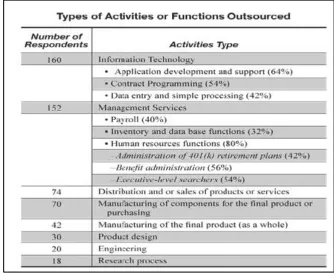
There are many activities that can be outsourced. Table 3-1 shows a list of
outsourced activities. It can be seen that the human resource function is the most
popular outsourced function by 80% of respondents. In India, for example, IT
outsourcing is not the only available outsourcing service, but is the most popular
service among them. The human resource outsourcing market in India has been
growing rapidly in the past decade. The growing market has reached $32 billion
(Sriwongwanna, 2009).
.
Figure 3-1 Types of Activities or Functions Outsourced
According to Orion Partners, the full-service human resource outsourcing market in
the world covers more than 128 deals with a value of more than US$ 23 billion. It
shows the fact that human resource outsourcing deals with produced cost savings
of at least 20% (Hunter & Saunders, 2007). Nevertheless, besides cost
effectiveness, there are many reasons why human resource outsourcing is
increasing rapidly in the global market.
3.2 Reasons for and Risks of Outsourcing 3.2.1 Reasons for Outsourcing
There are a variety of reasons that are cited by companies in regard to decision
making in human resource outsourcing. In general, some companies tend to
outsource because this decision meets the desire to search for innovative ways to
improve the efficiency and quality of its business processes through services that
can provide added value and consumer satisfaction while having a direct impact on
increasing profit.
In a survey conducted by the Outsourcing Institute in New York, covering 1,200
companies, the organization found that outsourcing is done by a company for two
reasons, namely for tactical and strategic reasons (Johnson, 1997). The objective
of outsourcing for tactical reasons is to enhance service companies with less
capital and time. The advantages of tactical reasons are as follows:
Cost effectiveness and time saving
By shifting human resource activities to external parties who have lower cost
structures, most companies will save 9% of budgeted costs and experience an
increase in capacity and quality of 15% (Embleton and,1998 Wright). Further, more
than one third, or as much as 37% of companies surveyed, stated that the main
Allowing capital available for core business
In addition, the company expenditure for the purpose of running corporate business
functions which are not a core business can be reduced, so that the funds can be
shifted to core business. Particular financial measurements will complete through
outsourcing by eliminating the need for Return On Equity (ROE) of the funds
invested outside the core business (Kotabe & Mol, 2009).
Cash Infusion
Outsourcing can involve transferring assets of an organization to its provider
(Embleton& Wright, 1998). The transfer of these assets will provide more cash for
the company.
In strategic outsourcing, the purpose changes due to the efforts of management to
seek added value from cooperation and outsourcing becomes a strategic tool that
is marked with higher economic value in relation to outsourcing, an increasingly
integrated scope, and longer relationship duration (Johnson, 1997).
The advantages of strategic reasons are:
Focus on the core business
Many companies take a decision to outsource some of their activities because they
want to focus on core competencies (Embleton& Wright, 1998). Outsourcing can
reduce the workload of the staff, thus allowing the company to focus on strategic
decision making and develop core competencies.
Divide the risk
An investment made by a company basically contains great risks, especially on
specific economic conditions. By outsourcing to outside parties, the company
to Suwondo (2003) any risk of job, employment, crime and other risks will be
transfered to the provider.
Distributing the limited resources for other strategic purposes
Every company has limited resources. With outsourcing, a company can focus its
resources on areas that allow a greater return for the company.
3.2.2 Risks of Outsourcing
Many problems can arise when a company starts to outsource. International
research by KPMG (KPMG, 2006) found that 52 % of responding companies said
outsourcing providers are insufficient in terms of knowledge, 47% said that the
providers are non-responsive to the client, and the remainder said the providers
have low performance standards. In other words, not every company is able to
carry out outsourcing activities well.
Other risks that are identified include:
Hidden Costs
There are many hidden costs related to outsourcingthat companies should
consider and which they might not be able to control. Sriwongwanna (2009)
explained that the hidden costs include training costs due to lack of knowledge of
employees, the expense involved in renewing the system to improve computer
functions and losses from incomplete projects as a result of incapability of the
provider to transfer their knowledge.
Poor relationship maintenance with outsourcing company
The relationship between the organization and outsourcing provider must be good
in order to achieve successful outsourcing (Caruth, Haden, & Caruth, 2013). This is
a concern because disharmony between the two parties will cause difficulties in the
future.
Confused Responsibilities
Clear and firm role instructions are essential to avoid conflicts that may occur
concerning which entity is to perform which functions (Caruth, Haden, & Caruth,
2013). Fracturingof responsibilities may occur because of overlapping functions
between the organization and outsourcing provider.
Losing Confidential Information
For some companies, the most strategic assets are confidential data such as
customer information, business plans and financial data(Accenture, 2010). By
outsourcing, according Sriwongwanna (2009), the risk of losing confidential
information, including business transcripts, audit reports and customer and workers
Employee Attitude
Research by Sriwongwanna reveals that outsourcing could possibly increase
negative feelings of permanent workers, which in the future can impact on the
organizational culture (Sriwongwanna, 2009). An organization imbues permanent
workers with feelings of identification, security and belonging. The workers may feel
resentful and retaliatory when these are interrupted. They will also be afraid that
the company cosiders employees from outsourcing providers to be more skillful
and competent (Çiçek & Özer, 2011). As a consequence, downsizingin employees‟
morale may drive the most talented and marketable staff to look foropportunities to
a different place(Embleton & Wright, 1998).
3.3 Outsourcing in Indonesia
The implementation of outsourcing involves three parties, namely an outsourcing
service provider company, a user company and the outsourced workers themselves.
Hence, there is a need for regulation that protects the related parties againt loss caused
during the implementation of outsourcing.
3.3.1 Legal Basis of Outsourcing Implementation
Considering outsourcing business is closely related to employment practices, the
Manpower Act Number 13 of 2003 is one of the regulations governing outsourcing
in Indonesia and outsourcing is found in Article 64, Article 65 and Article 66.
The government further stipulates in Regulation of the Minister of Manpower and
Transmigration Number 19, Year 2012, about Terms of Resignation of Part of Work
Implementation to Other Companies on November 19, 2012 in order to improve the
decisions of the Minister of Manpower and Transmigration Number KEP
101/MEN/VI/2004 concerning Procedures for Licensing Providers of Services
Workers/labourers and Minister of Manpower and Transmigration Number KEP.
220/MEN/X/2004 on Terms of Resignation of a Part of Work Execution to Other
Approaching the endof 2013, The Minister of Manpower and Transmigration issued
Circular Letter Number SE.04/MEN/VIII/2013 on the Guidelines of the
Implementation of Regulations of Minister of Manpower and Transmigration
Number 19 of 2012 on Conditions for the Assignment of Part of Work to other
Companies on 26th August 2013 (Ashurst, 2013). The circular letter regarding
implementation of outsourcing guidelines coversfactors that should be observed in
the implementation of partial work execution to other companies, or the practice of
outsourcing.
The basic principle of outsourcing implementation is the occurrence of a
cooperation agreement between the user company and outsourcing service
provider company and is elaborated in a contract. This is in accordance with the
conditions set forth in Article 64 (Manpower Act, 2003), which explains that the
organization could hand over a part of its work to be done by another company
through a wholesale job contracting agreement or worker provider service
agreement.
Thus, the outsourcingcan be implemented,on condition that the wholesale job
contracting agreement or worker provider service agreement has been signed by
the user companyand outsourcing services provider company.
3.3.2 Terms of jobs that can be submitted to another party
To be able to implement outsourcing according to law, the first step to undertake to
understand what should and should not be outsourced. Under Article 66 of Law
Number 13 Year 2003, it is only permissible to outsource the supporting activities
and activities not directly related to the production process. In the explanation of
Article 66 of Law Number 13 of 2003 (Manpower Act, 2003), it is stated that:
personnel (security/guards) business, ancillary businesses in mining and petroleum, as well as businesses providing transport for workers/labourers”.
The given interpretation of the Law is still very limited compared to the needs of
today's business world, whereby the use of outsourcing increasingly extends to
various lines of activity in a company (Faiz, 2007)
The concept and definition of basic business or core business and supporting
activities or non-core business is changing and evolving dynamically. There are as
Caruth (2010) stated, seven hierarchical categories related to core activity or core
business (Caruth, Haden, & Caruth, 2013). The seven categories are:
Ancillary activities
Routine activities
Activities containing the potential for achieving economies of scale
Activities requiring specialized knowledge
Activities requiring broad organizational knowledge
Activities requiring high confidentiality
Activities requiring specific management decisions
Outsourcing in the modern world is done for strategic reasons, i.e., (1) to achieve a
competitive advantage, (2) to guarantee the competition in maintaining a market
segment, and (3) to guarantee life sustainability and company development (Faiz,
2007).
Outsourcing to achieve this competitive advantage can be seen in the big car
industries around the world such as Nissan, Toyota and Honda (Heikkila & Cordon,
2002). At first, during the car production process, its core business consisted of the
production design, manufacture of parts and assembly. In the end, the core
business is only the production of car design, while partsproduction and assembly
are passed to another company that is more competent, so the car companies can
The Manpower Act (2003) states that there are five types of jobs that could be
outsourced, namely hygiene services (cleaning service) business, catering service
businesses for workers, businesses of security personnel (security), ancillary
businesses in mining and petroleum, business providing transport for
workers/laborers. If a certain job is not contained in the five categories of business,
the job still can be outsourced if it fulfillsone condition, that is, the flow of work
must be clear and work activities clearly defined (Poltal HR, 2013). The definition of
the work activities and the flow chart is carried out by the associated business
sectors.
A company, when planning to outsource a workforce, first classifies the major work
and ancillary work of the institution into a written document and then reports it to
the local manpower agencies (Decree of Minister of Manpower and Transmigration
Number Kep.220/Men/X/2004 on Terms of Resignation of Part of Work Execution
to Other Companies)
The creation of a written document is important for the implementation of the
outsourcing company, for the following reasons (Faiz, 2007):
1. Asevidence of a company compliance with provisions concerning
manpowerbyreporting to theLocalDepartmentof Manpower
2. As a guideline formanagementin implementingoutsourcingin specific partsofthe
company
3. As a means ofcommunicationtotheworkersabout what parts are outsourced by
the company
4. To minimize the risk of conflict with theworkers, trade unions, government,and
shareholdersregardingthe outsourcing‟s validityandregulation inthe company
3.4 Outsourcing Practices in Indonesia
In Law Number 13 of 2003, Articles regarding outsourcing are Article 64, Article 65,
Article 64 is the foundation of outsourcing. In Article 64, it is stated that the company
can transfer partial execution of the work to other companies through a wholesale job
contracting agreement or worker provider service agreement which are made in writing.
Article 65 contains some provisions, which are:
submission of partial execution of the work to other companies is carried out through an wholesale agreement and is made in writing (paragraph 1);
the work that is submitted as mentioned in paragraph (1) must fulfil the following
conditions:
- done separately from the main activity;
- performed by the command directly or indirectly from the company giving
the job;
- ancillary activities of the company as a whole;
- do not directly hinder the production process. (paragraph 2)
the outsourcing service provider companies (that handle the submitted work) must
be in the form of legal entities (paragraph 3);
protection of the work and terms of employment in the outsourcing service provider companies must be the same as the protection of the work and terms of
employment at the company which gives the work or in accordance with
government legislation (paragraph 4);
any change or addition to the terms of the above is further regulated in the ministerial decree (paragraph 5);
the working relationship in the execution of the work is set forth in a written
agreement between the company and the workers being employed (paragraph 6)
the working relationship between company and workers/laborers can be based on
a work agreement for specific time, or work agreement for non-specific time
(paragraph 7);
When some of the requirements are not met, such as the conditions concerning
the work submitted to the other party, and the terms determining that another
worker/workers with outsourcing service provider companies is shifted to a
working relationship between the worker/workers with the user company
(paragraph 8).
Article 66 of Law Number 13 Year 2003 regulates that workers/laborers from an
outsourcing service provider company should not be employed by the employer to carry
out basic activities or activities that are directly connected to the production process,
except for activities of ancillary services that are not directly related to the production
process. The company providing services for the workforce, which are not directly
related to the production process also must fulfill several requirements, which are
(Kusmargono, 2012):
the existence of an employment working relationship between the workers and the outsourcing service provider company;
the work which can be outsourced is in a non-core business or supporting business;
the applicable agreement between workers and the company is a work agreement
for a specific time or agreement not for a specific time which is made in writing
and signed by both parties;
protection of wages, welfare, terms of employment and disputes arising are the responsibility of the outsourcing service provider company;
the agreement between the user company and the outsourcing service provider
company is made in writing.
An outsourcing service provider company is a legal form of business and has obtained
permission from the responsible agencies in the field of employment (Kusmargono,
2012). The terms of the conditions above are not met (with the exception of the
provision of welfare protection), then for the sake of the legal status of the working
changes to a working relationship between the workers and user company (Suwondo,
4 ANALYSIS OF CORE BUSINESS AND WORKLOAD OF OUTSOURCED WORKERS
4.1 Workers in IPC
Human resource (HR), for IPC, is the most important factor in achieving competitive
advantage. The port service industry nowadays is not only a transportation support
industry, but also becomes a comprehensive service center with demands for excellent
quality from port service users as well as high-level competition among port
management in the regional area. The composition and the number of IPC workers
dynamically transforms year by year. The development of the company will affect the
number and composition of workers. The transformation is a consequence of
requirements and the placement of workers in each line of the organization.
4.1.1 Workers Based on Service Center
According to the type of the service center, the workers are classified into two
different groups: the terminal group and the non-terminal group. The terminal
worker groups are those working in port service, while non-terminal worker groups
are those working outside of port services or as a supporting unit of a port.
The terminal group is divided into three types of workers based on the main duty of
each type. The types of non-technical groups are (1) direct operational workers, (2)
indirect operational workers, and (3) support staff.
Direct operational workers are those working in terminal operations. In the terminal,
services for ships, cargo, container terminal, special ports and other services are
provided. The services are open for 24 hours a day and 7 days a week, so the
management divides operational workers into three shifts. Each shift is 8 hours, in
Indirect operational workers are those working in administrative areas in the
operational division. They work for 8.5 - 9 hours a day, from Monday to Thursday
from 08.00 to 17.00 and on Friday from 08.00 to16.30. Their jobs relate to
paperwork administration.
In operational support, the workers work to assist the main division in the terminal.
Their working time is usually the same as that of indirect operational staff.
However, they also work shift time for several divisions to make sure that the
service functions for 24 hours and to prevent emergency cases. The technical
division is one example of this.
The non-technical groups or supporting units include port hospital, port training
agency, management personnel in the central office and non-active personnel. The
non-terminal workers work from 08:00 to 17:00 Monday to Thursday and 08:00 to
16:30 on Friday.
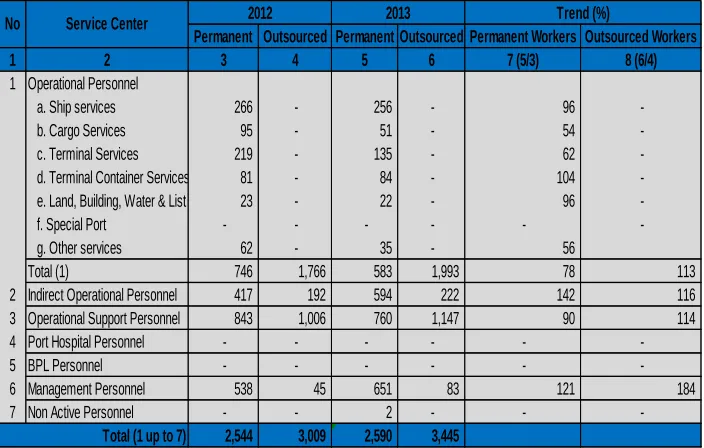
Table 4-1 Total Workers Based on Service Centre
Source: (Indonesia Port Corporation II, 2014)
Permanent Outsourced Permanent Outsourced Permanent Workers Outsourced Workers 1 2 3 4 5 6 7 (5/3) 8 (6/4)
1 Operational Personnel
a. Ship services 266 - 256 - 96 b. Cargo Services 95 - 51 - 54 c. Terminal Services 219 - 135 - 62 d. Terminal Container Services 81 - 84 - 104 e. Land, Building, Water & List 23 - 22 - 96 f. Special Port - - - g. Other services 62 - 35 - 56
Total (1) 746 1,766 583 1,993 78 113 2 Indirect Operational Personnel 417 192 594 222 142 116 3 Operational Support Personnel 843 1,006 760 1,147 90 114 4 Port Hospital Personnel - - - -5 BPL Personnel - - - -6 Management Personnel 538 45 651 83 121 184 7 Non Active Personnel - - 2 - -
-2,544
3,009 2,590 3,445
2012 2013 Trend (%) No Service Center
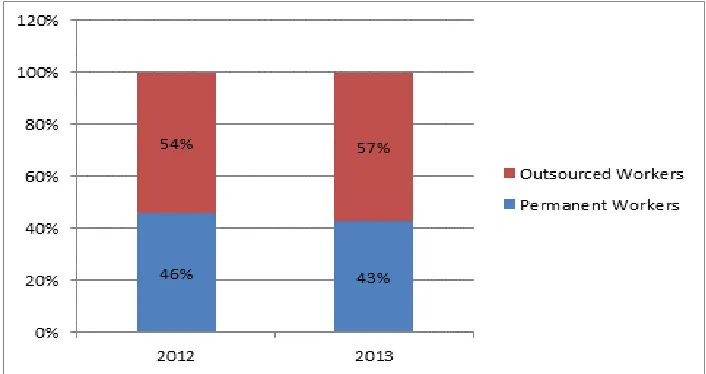
Table 4-1 above shows the trend of reduction in operational personnel. The
reduction is around 79%. Similarly, the reduction in operational support personnel
is 10%. On the other hand, both indirectoperationalpersonnelandmanagement
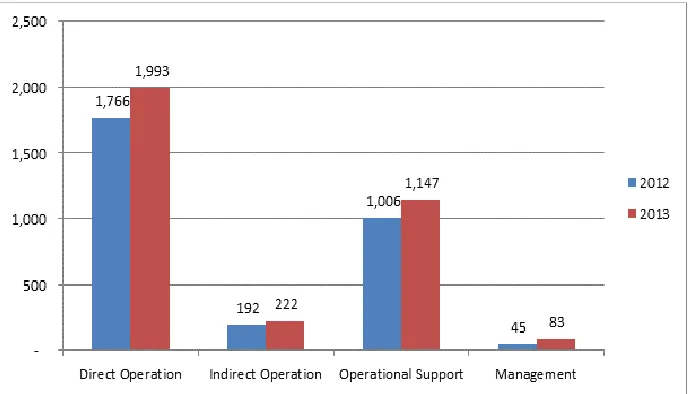
personnelhave increase in number. The positive trend has occurred in outsourcing
workers. Allservice centers for outsourced workers have increasedwiththe
followingdescription:
Figure 4-1 Total of Outsourced Workers
Source: Author
It can be concludedthat an increase has occured in the number
ofoutsourcedworkersandalso a decrease has occured in the number
Figure 4-2 Percentage Worker Composition Based on Service Centre
Source: Author
4.1.2 Workers Based in Subsidiaries
In its transformation into aportoperator, IPChassubsidiaries which are involved
invarious business fields. The transformation of business organization, with the
establishment of its subsidiaries, creates an advantage in terms ofagility,
specialization/focus on the core business, and independent financing of
subsidiaries. In2013, IPChighlightedbusinessstrategiesto itssubsidiarieswith
IDR873,979million in investments. Moreover, thenumber ofpersonnel in the
subsidiaries was 3,489people; it was 23.64% higher than the target of 2,822 people
No Subsidiary Type of Employees 2012 2013 Trend (%)
1 2 3 4 5 6 (5/4)
1 KSO TPK Koja Permanent 483 479 99.17 Outsourced - - -Total 483 479 99.17 2 PT RS Pelabuhan Permanent 839 868 103.46 Outsourced 254 630 248.03 Total 1,093 1,498 137.05 3 PT Multi Terminal Permanent 86 121 140.70 Indonesia Outsourced 639 924 144.60 Total 725 1,045 144.14 4 PT EDI Indonesia Permanent 113 115 101.77 Outsourced 88 88 100.00 Total 201 203 101.00 5 PT ILCS Permanent - 8
-Outsourced - 5 -Total - 13 -6 PT Pengembang Permanent - 21 -Pelabuhan Outsourced - - -Indonesia Total - 21 -7 PT Energi Permanent - 11 -Pelabuhan Outsourced - 7 -Indonesia Total - 18 -8 PT Jasa Peralatan Permanent - 11 -Pelabuhan Indonesia Outsourced - - -Total - 11 -9 PT Indonesia Permanent - 42 -Kendaraan Outsourced - 159 -Terminal Total - 201
-2,502
3,489 Total (1 up to 9)
Table 4-2 Total Workers Based on Subsidiaries
Source: (Indonesia Port Corporation, 2014)
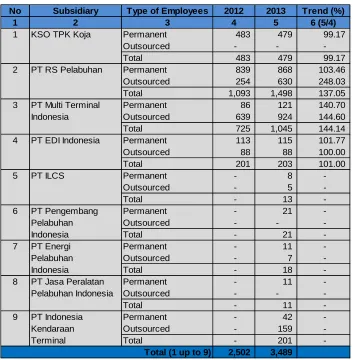
Table 4-2above shows that thenumber ofoutsourcedworkersincreasedsignificantly.
The number doubledfrom981in 2012 to1,813in 2013. On the other hand, there was
a slight increase in thenumber of permanentworkers by 10%, from the total number
Figure 4-3Percentage Worker Composition Based on Subsidiaries
Source: Author
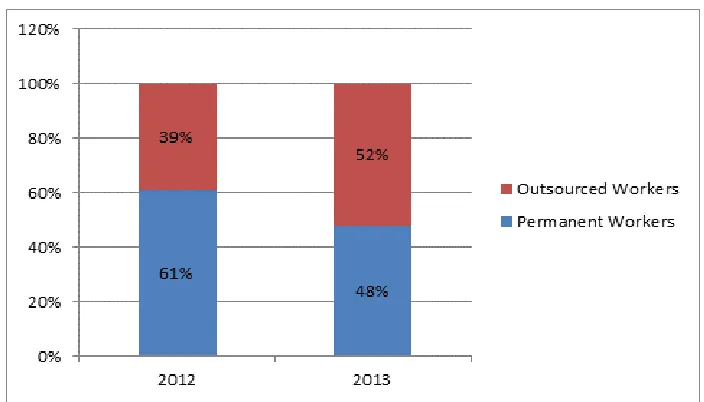
Figure 4-3 shows thatmorethan50% ofthe total workers inIPC's subsidiaries
wereoutsourcedworkers in 2013. The increase wasexpected tocontinue annually,
along with the development of IPC. The need for more outsourced workers is
because the company needs to bemore focusedonits core businessandon its
effective cost control of the service.
4.1.3 Worker Productivity
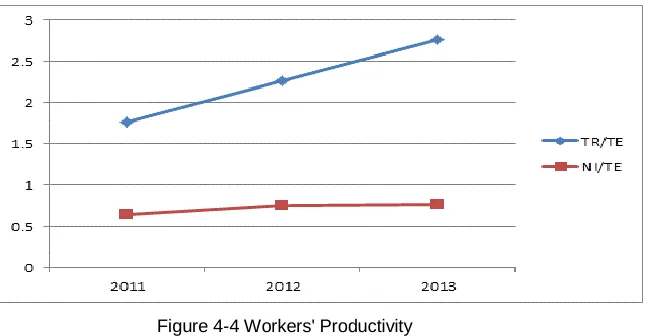
Workersproductivity is measuredbyusingTotalRevenue(TR) divided
byTotalEmployees(TE) and NetIncome(NI) divided byTotalEmployees(TE). The
obtained data in 2013isIDR 2.77billion/person by usingthis parameter. This number
shows an upsurge of 23% compared to IDR2.26billion in 2012. The total net profitin
2013was IDR0.77million/person and the total net profit in 2012 was IDR0.75
million/person. In other words, the total net profit increased by 3% from 2012 to
Figure 4-4 Workers' Productivity
Source: (Indonesia Port Corporation II, 2013), (Indonesia Port Corporation II, 2014)
However,the increase in worker productivityfrom2012 to2013was not as high as
worker productivity from 2011 to2012. From 2011 to 2012, the increase of workers‟
productivity was 28% or it increased from IDR 1.76 million/person to
2.26million/person; while, the upsurge of net profit was 17% or it increased from
IDR0.64million/personto IDR0.75million/person.
4.2 The Core Business and the Support Business
The Regulation of theMinister of ManpowerandTransmigrationNumber19of 2012
concerning the Requirement of Assignment of Part of the Implementation of Work with
other Companies was authorized on November 19,2013. The regulation asserts that
supportingwork is allowed to be outsourced. The core work and the supporting work are
categorized by the association as the procurement basis towards outsourced workers
(Manpower Regulations, 2012). This matter is run in order that the outsourced workers
are not hired in thecorework of a company.
The core businness shouldbe filledbypermanentworkers. However, thesupportingwork – the direct supporting workand the indirectsupporting work – is performed under certain
conditions. It means, the directsupporting workcan be filledby either permanentworkers
or outsourcedworkers, all of which depends onthe company‟s need. However, the
Indonesian PortEnterprises Association (AsBUPI) was establishedby notary actNumber
30onJuly 26, 2013 and was jointly foundedbyPTPelabuhan IndonesiaI,II,
IIIandIV(Persero) NumberSEKTAP/02/07/PI.II.III.IV/13. Theassociationmembershipis
opento other entities,bothstate-owned companiesandthe privatesector.
Accordingto theRegulation of the Ministerof Manpower andTransmigrationNo.19of
2012Article4, AsBUPIshoulddefine activity flow related to the work implementation
process which describes the work implementationprocess from the beginning to endand
containsthe core activitiesandsupporting activities(Manpower Regulations, 2012). It isa
basisfor the user companytoreport thetypes of supporting work, which can be submitted
to the outsourcing service provider company, to the responsible agency in the
manpower field.
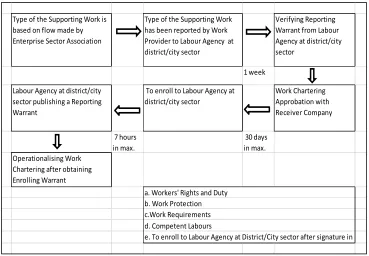
The mechanism performed by the company user is based on the description below:
Type of the Supporting Work is based on flow made by Enterprise Sector Association
Type of the Supporting Work has been reported by Work Provider to Labour Agency at district/city sector
Verifying Reporting Warrant from Labour Agency at district/city sector
1 week
Labour Agency at district/city sector publishing a Reporting Warrant
To enroll to Labour Agency at district/city sector Work Chartering Approbation with Receiver Company 7 hours in max. 30 days in max. Operationalising Work
Chartering after obtaining Enrolling Warrant
a. Workers' Rights and Duty b. Work Protection c.Work Requirements d. Competent Labours
e. To enroll to Labour Agency at District/City sector after signature in 30 days
Figure 4-5 Outsourced Work Assignation Mechanism
Source: (AsBUPI, 2013)
1. Unloading non-container
2. Loadingnon-container
3. Receiving goods of non-container
4. Delivering the goods of non-container
b. Activity flows of container terminal
1. Unloading container
2. Loading container
3. Receiving container
c. Activity flows of pilotage boat
d. Activity flows of ship service
Operational ship planning
e. Types of core work and port service supporting work
1. Ship services
2. Containerterminal
3.Noncontainerterminalservices
4. Miscellaneousbusiness
5.Engineering(facilities)
6. Human resources and public
7. Finance
8.Internal controlsystem
9.Informationsystems
10.Corporate secretary
11.Marketinganddevelopment
12.Law
13.Risk managementandquality systems
14.Procurement
This study takes theProcurement Bureauatthe headoffice as an example of outsourcing
the regulation. The data isobtainedthroughopeninterviewsandobservations. The method
of calculating the worker needs is based on workloads with assignment approach per
position assignment. The method is according to the Decree of State Minister for the
Empowerment of State Apparatus (2004) NumberKEP/75/M.PAN/7/2004on Guidelines
forCalculation ofEmployee‟s NeedbasedWorkload.
In running the functionsof the company, theprocurement of logistics,
equipmentandservices which support the optimal work in a particular organization is
definitelynecessary. Therefore, the Bureau of Procurement should be fully supportedin
order to obtaininvestmentandperform the organization's workmaximally throughthe use
ofoutsourcedworkers.
4.3 Analysis oftheProcurement Bureau
4.3.1 OrganizationalStructure, Function,andDuties
The Procurement Bureauis one of thedivisions locatedinIPC headquarters and is
responsible to the Managing Director. The Procurement Bureau is headed by the
Head of the Procurement Bureau and assisted bythreeassistants, which are