World Maritime University
The Maritime Commons: Digital Repository of the World
Maritime University
World Maritime University Dissertations
Dissertations
2014
Enhancement of seafarers' employability through
capacity building in maritime education and
training (MET): a case study of Bangladesh
MD Manjurul Kabir
World Maritime University
Follow this and additional works at:
http://commons.wmu.se/all_dissertations
Part of the
Higher Education Commons
This Dissertation is brought to you courtesy of Maritime Commons. Open Access items may be downloaded for non-commercial, fair use academic purposes. No items may be hosted on another server or web site without express written permission from the World Maritime University. For more information, please [email protected].
Recommended Citation
Kabir, MD Manjurul, "Enhancement of seafarers' employability through capacity building in maritime education and training (MET): a case study of Bangladesh" (2014).World Maritime University Dissertations. 465.
World Maritime University
Malmö, Sweden
Enhancement of seafarers’ employability through capacity
building in Maritime Education and Training (MET):
A case study of Bangladesh
By
MD.MANJURUL KABIR
Bangladesh
A dissertation submitted to the World Maritime University in partial fulfillment of the
requirements for the award of the degree of
MASTER OF SCIENCE
IN
MARITIME AFFAIRS
(MARITIME EDUCATION AND TRAINING)
2014
i
Declaration
I certify that all the material in this dissertation that is not my own work has been
identified, and that no material is included for which a degree has previously been
conferred to me.
The contents of this dissertation reflect my own personal views, and are not necessarily
endorsed by the University.
(Signature):
(Date): 24.09.2014
Supervised by: Dr. Momoko KITADA Lecturer,
World Maritime University
_____________________________________________________________________
Assessor: Dr.Takeshi Nakazawa
Professor, World Maritime University; and
Secretary, International Association of Maritime Universities
_____________________________________________________________________
Co-assessor: Professor Toshio Hikima
Rector,
ii
Acknowledgements
I wish to express my sincere thanks and the highest gratitude to my esteemed
dissertation supervisor Dr. Momoko KITADA for her invaluable guidance, suggestions,
motivations, and for the ultimate success of this dissertation. I am also thankful to
Professor Takeshi Nakazawa and Professor Toshio Hikima who have agreed to devote
their valuable time to assess and co-assess my work. I wish to thank Professor Clive
Cole for his contribution in linguistic correction of my work. My profound gratitude is
expressed to distinguished faculties, visiting professors and registry staffs for their
continuous support during the whole period of my studies at WMU. I am thankful to
library staffs for their co-operation and kind assistance.
I am in debt to Dr. Yohei Sasakawa, Chairman of the Nippon Foundation and staffs of
Ocean Policy Research Foundation for the generous sponsorship; without which my
studies at WMU would have not been possible. I am grateful to Commandant,
Bangladesh Marine Academy, and Ministry of Shipping, Bangladesh for nominating me
for this excellent opportunity to study at WMU. I also wish to thanks my colleagues,
cadets and ex-cadets of Bangladesh Marine Academy for keeping continuous contact
and morale support during my studies.
My whole-hearted respect and appreciation goes to my parents without saying. I wish to
express my thanks and gratitude to my elder brothers and sisters for their sincere love
and affection to me since childhood. My sincere respect goes to my in-laws; I am also in
debt to them for taking good care of my children with enormous love and affection in my
absence. My deepest thanks and appreciation goes to my wife Rozy and son
Mohammed Naveed, and Mohammed Zubair who had to sacrifice the most for my
studies at WMU.
Finally, thanks to almighty Allah, the most merciful and the most beneficent, for
iii
Abstract
Dissertation title: Enhancement of seafarers’ employability through capacity
building in Maritime Education and Training (MET): A case study of Bangladesh.
Degree: Master of Science
This dissertation focuses on employability of Bangladeshi seafarers under the prevailing
labour market condition. The paper discusses the concept, framework, and various
skills and attributes that constitute employability. The significance of education on
employability has also been highlighted. In addition, required elements of high quality
seafarers, as well as skills and attributes that are desirable in the seafaring profession
have been discussed.
The paper made an in-depth investigation on the factors that determine the
employability of seafarers, and analyzed the skills and abilities of Bangladeshi
seafarers. In addition, the investigation looked into the MET standards in Bangladesh
Marine Academy, as well as in the private MET institutions in light of STCW‟78 as
amended, and the global seafarer supply and demand trends. Furthermore, the
research encompassed the assessment and certification system, and application of
quality standards system by the Department of Shipping. To increase the validity of the
research outcome, supplemented literature review with questionnaire, and interviews.
The analysis identifies various internal and external factors that have an impact on the employability of Bangladeshi seafarers‟. The data analysis further illustrated in
discussions, proposing a model for Bangladeshi seafarers‟ employability incorporating
factors described in the widely known „USEM‟ model of employability. In addition,
suggestions are made on how to develop an effective MET system which will eventually
support the competitiveness of Bangladeshi seafarers in the global labour market.
iv
Table of contents
Declaration………i
Acknowledgements………...………ii
Abstract………..……….……iii
Table of contents………..…iv
List of figures………...………viii
List of abbreviations………....ix
1.0 Introduction………...1
1.1 Background and rationale………1
1.2 Problem statement………4
1.3 Objectives and research questions………..…….5
1.4 Scope……….……6
1.5 Research methodology and ethics……….6
1.6 Method of data analysis and presentation………8
1.7 Dissertation structure………...…………9
2.0 Concept of employability………...……….10
2.1 Introduction………..10
2.2 Historical background of the concept of employability……….…11
2.3 Definition of employability………...…..11
2.4 Understanding the theoretical framework of employability………..……13
2.4.1 „USEM‟ model of employability……….13
2.4.2 „CareerEDGE‟ model of employability…….………14
2.5 The significance of education on employability………...17
2.6 Understanding various employability skills……….…………17
v
2.6.2 Generic skills……….……..19
2.6.3 Emotional intelligence………20
2.6.4 Career development learning………..……….20
2.6.5 Work experience……….21
2.6.6 Reflection and evaluation………..21
2.6.7 Self-efficacy, self-confidence and self-esteem……….….22
2.6.8 Social capital………22
2.6.9 Attitude………..23
2.7 Conclusion……….……..23
3.0 Employability skills of seafarers………...24
3.1 Introduction………..……..24
3.2 Seafaring as a profession………24
3.3 Employability skills of seafarers………..27
3.3.1 In-depth knowledge, problem solving skills and sense of responsibility……….………...27
3.3.2 Leadership and teamwork skill……….29
3.3.3 Communication skill………30
3.3.4 Indefatigable spirit………..…….31
3.3.5 Adaptation in multicultural environment………..………32
3.3.6 Prudence and foresight……….….33
3.3.7 Situation awareness skill………33
3.3.8 Physical fitness……….…..34
3.4 Conclusion……….…..34
4.0 Analysis of competitiveness of Bangladeshi seafarers’………36
4.1 Introduction………..………..36
4.2 External factors……….….36
4.2.1 Manning cost………37
vi
4.2.3 Living cost and exchange rate………..40
4.2.4 Visa restriction to certain countries………..41
4.2.5 Occasional desertion………..42
4.3 Internal factors………....43
4.3.1 Insufficient number of ships in national fleet………..…43
4.3.2 Application of quality standards system………..…45
4.3.3 Assessment and certification system………..47
4.3.4 Qualification and experience of instructors and assessors……..48
4.3.5 Competency based training and assessment………...…….50
4.4 Conclusion………..…….51
5.0 Primary data analysis and presentation………...……..52
5.1 Introduction……….……52
5.2 Understanding – Knowledge and understanding of MET………...……53
5.2.1 MET standards in Bangladesh Marine Academy………..53
5.2.2 MET standards in Bangladeshi private MET institutions………..55
5.2.3 On-board training of cadets……….…….58
5.2.4 Application of quality standards system by the Department of Shipping……….………60
5.2.5 Suggestions for improvement………...………62
5.3 Skill – Skillful practices in seafaring contexts………..….64
5.3.1 Skills as determinant of employability……….……64
5.3.2 Skills and abilities of Bangladeshi seafarers……….…….65
5.4 Efficacy beliefs – Personal qualities……….……..68
5.5 Metacognition – Awareness of one‟s own thinking process…………...……70
5.6 External factors………..70
5.6.1 Visa restriction to certain countries………..71
5.6.2 Ship-owner‟s unwillingness to employ inexperienced seafarers.72 5.6.3 Occasional desertion……….…….73
vii
6.0 Discussion: Developing an effective MET system in Bangladesh…………..…74
6.1 Introduction……….……74
6.2 What are the factors that determine the employability of seafarers?...74
6.3 What are the limitations of Bangladeshi seafarers on those Completive parameters? ………. 77
6.4 What should be the appropriate role of MET in order to support the competitiveness of Bangladeshi seafarers? ………...78
6.5 Conclusions………...………..81
7.0 Conclusions………...……….82
References……….………86
Appendices Appendix 1 Self-administered questionnaire………..………….97
Appendix 2 WMU Research Ethics Committee protocol………...105
Appendix 3 Request letter to questionnaire respondents………...….107
Appendix 4 Consent form for maritime professionals………..……108
Appendix 5 Data analysis spiral………...………109
Appendix 6 Factors affecting employability………110
Appendix 7 Personality and competence requirements for seafarers………111
Appendix 8 Dynamic evolution of mental image………..……….112
Appendix 9 Career progression path for engine cadets………..………….113
Appendix 10 Factors affecting curriculum decisions………..……114
Appendix 11 Curriculum responses to social changes………..115
Appendix 12 Functions, levels and methods of assessment……….116
viii
List of figures
Figure 1.1 Number of seafarers in Bangladesh………..…….2
Figure 2.1 „USEM‟ employability model………..14
Figure 2.2 „CareerEDGE‟ employability model……….………….15
Figure 2.3 The „key‟ to employability………16
Figure 3.1 Job requirements of a master mariner……….……28
Figure 4.1 Structure of operating cost……….37
Figure 4.2 Area wise manpower update……….38
Figure 4.3 Comparison in wages between major seafarers supplying countries….39 Figure 4.4 Comparison of GDP in major seafarers supplying countries…………....41
Figure 4.5 Year wise number of desertions by Bangladeshi seafarers………….….42
Figure 4.6 Bangladesh merchant fleet in deadweight tons……….……….44
Figure 4.7 Coverage of quality standards system……….…….45
Figure 4.8 Increase in cadets‟ intake with same number of seafarers………..…….48
Figure 4.9 Bangladesh Marine Academy organogram……….49
Figure 5.1a Higher performance rating of Bangladesh Marine Academy………54
Figure 5.1b Lower performance rating of Bangladesh Marine Academy……….54
Figure 5.2a Performance rating of Bangladeshi private MET institutions………56
Figure 5.2b Performance rating of Bangladeshi private MET institutions………...….56
Figure 5.3 Performance rating of the Department of Shipping………61
Figure 5.4 Strategies for improvement of MET standards in Bangladesh………….63
Figure 5.5 Perception of whether employers look for skills and abilities………64
Figure 5.6 Skills and abilities of Bangladeshi seafarers……….……..66
Figure 5.7 Bangladesh‟s ability to become a major seafarers‟ supply country…….68
Figure 5.8 Perception of whether employers look for personal qualities………...…69
Figure 5.9 Personal qualities of Bangladeshi seafarers………..………….69
Figure 5.10 Issues negatively affecting Bangladeshi seafarers‟ employability……...71
ix
List of abbreviations
ACCI Australian Chamber of Commerce and Industries
BBC British Broadcasting Corporation
BIMCO Baltic International Maritime Council
BMA Bangladesh Marine Academy
BSC Bangladesh Shipping Corporation
CDC Continuous Discharge Certificate
COC Certificate of Competency
COLREG Convention on the International Regulations for preventing Collusions at
Sea 1972
DHFETE Northern Ireland Department of Higher and Further Education, Training
and Employment
DOS Department of Shipping
DWT Dead Weight Tons
ECOSOC United Nations Economic and Social Council
EMSA European Maritime Safety Agency
ESCAP Economic and Social Commission for Asia and the Pacific
GDP Gross Domestic Product
HTW Sub-committee on Human element, Training and Watch-keeping
IBC International code for the construction and equipment of ships carrying
dangerous Chemical in bulk
IGC International code for the construction and equipment of ships carrying
Liquefied Gases in bulk
ILO International Labour Organization
IMSBC International Maritime Solid Bulk Cargo Code
IMDG International Maritime Dangerous Goods Code
IMO International Maritime Organization
ISF International Shipping Federation
ISM International Safety Management Code
x
ITF International Transport Workers Federation
ITU International Telecommunication Union
JITI Japan International Transport Institute
MET Maritime Education and Training
METI Maritime Education and Training Institutions
MLC Maritime Labour Convention 2006
OECD Organization for Economic Co-operation and Development
PDP Personal Development Planning
P & I Protection and Indemnity Insurance
SOLAS International Convention for the Safety of Life at Sea, 1974
STCW International Convention on Standards of Training, Certification and
Watch keeping for Seafarers, 1978 as amended
UNCLOS United Nations Convention on the Law of the Sea, 1982
UNCTAD United Nations Conference on Trade and Development
USCG United States Coast Guard
1
Chapter: 1
Introduction
1.1 Background and rationale
Bangladesh maritime sector is prehistoric and mature. One of the largest river
networks, one of the largest bays, largest delta, longest sea-beach, ancient wooden
shipbuilding heritage, and rise of our ocean-going ship building industries - with all of
these, Bangladesh is spontaneously a maritime country (Hussain, 2011). Currently Bangladesh is a category “b” member of the IMO Council along with nine other states
with the largest interest in the international seaborne trade (IMO, 2014d). It is argued
that Bangladeshi seafarers have made it possible to be in that category (Ahad, 2013).
Bangladesh has a long tradition of grooming professionally sound & skilled maritime
personnel. The history of seafaring in Bangladesh dates back to the British colonial
period when they earned a good reputation in British and other foreign flag vessels for
their hard work and sincerity. During British rule in the first half of the twentieth century,
over 50,000 seafarers from Bangladesh were serving on various foreign sea-going
vessels, but with the advancements of technology the number reduced drastically.
Thereafter, during the Pakistan period, and now in independent Bangladesh, the
government owned Bangladesh Marine Academy, established in 1962, earned good
reputation to the Hong Kong and Singapore based shipping companies for producing
2
seafaring as a profession has not flourished in the country. As shown in figure 1.1, there
are a total of approximately 6,000 officers and 3,574 ratings in Bangladesh.
Figure 1.1: Number of seafarers in Bangladesh, Source: BIMCO-ISF Manpower
updates (2005) & (2010) and Government Shipping Office (2014).
As per the last BIMCO-ISF manpower update, held in 2010, the worldwide supply of
seafarers was estimated to be 624,000 officers and 747,000 ratings whereas the
demand during that time was 637,000 officers and 747,000 ratings; which indicated an
approximate balance between demand and supply for ratings with a modest over all
shortage of officers. In a more recent study, the Drewry report (2014) predicted that an
additional 38,500 officers will be required by the end of 2018. Another study conducted
by the Japan International Transport Institute (JITI) and the Nippon Foundation in 2010
suggested that 32,000 additional officers and 47,000 ratings would be needed to man
the projected fleet in 2020. The North of England P&I Association Limited (2013, p.16)
commented that the number of shortages is even more than that which is revealed in
various studies; as in many cases the capacity of the global maritime industry to train
competent seafarers is in question. 0
1000 2000 3000 4000 5000 6000
2005 2010 2014
3
Despite the above facts, the OECD countries that have historically been dominating
shipping, and hence a major source of seafarers, are facing difficulty in attracting young
people into seafaring. Due to the availability of alternative career opportunities on
shore, which are equally compensating, the people of these countries are no longer
willing to take up a career at sea. Although there is an increase in the number of
seafarers in the UK for the last few years, the present trend is not expected to change
soon.
All these reports suggest, a developing maritime country like Bangladesh has a good
opportunity to increase its share in the maritime labor market if the global standards are
met as there is an abundance of seafaring talents in the country. The ESCAP (2003)
report recommends seafarers trained in Bangladesh have relatively high standards of
proficiency, are hardworking and are traditionally recognized as good seamen. Also, the
report highlighted the good behavior, obedience, trust worthiness, reasonable English
speaking ability, and satisfaction with reasonable wages, non-addiction to alcohol and
high moral courage as the strength and special qualities of Bangladeshi seafarers. In
view of ISF (1990, p.12), Bangladesh has the potential substantially to increase the
number of seafarers employed by foreign companies.
However, it is the effective education and quality training that greatly influences the scope of seafarers‟ employment on merchant vessels. In addition, it is understood, an
ideal learning environment with all the hard and soft facilities is essentially needed for
effective education and training. The training institutes should be able to develop in
trainees, through constant guidance and supervision; a sense of purpose, loyalty,
devotion to duty, adaptability under trying circumstances, pride of profession and spirit
to service which will make them valuable and distinguished members of their profession
(Bangladesh Marine Academy, 2014c). Saharuddin et al. (2011, p.1) have a similar
opinion as they mentioned that the employability of seafarers is directly linked to their
competency level and last but not least, is the main reason why crew from certain
4
Bangladeshi seafarers should be considered from their competency point of view, which
is strongly related to the quality of education and training they receive from the MET
institutes. However, from a Bangladesh perspective there seems to be many other
issues that have a detrimental effect to the employability of seafarers in foreign shipping
companies which will be explored in this dissertation.
Therefore, with the above discussions, it seems that the topic of this dissertation on “Enhancement of seafarers‟ employability through capacity building in Maritime Education and Training (MET): A case study of Bangladesh” is relevant and timely; as it
is undertaken at a time when the shipping industry is facing difficulties to man its ships
with adequately qualified officers; whereas Bangladesh, having an abundance of
seafaring talents, is unable to market them in the global shipping industry. Reflection on
previous work shows that there is hardly any article written on the employability of
Bangladeshi seafarers. The focus of this study is to analyze the various skills and
attributes required for employability and to explore how the employability of
Bangladeshi seafarers can be enhanced with particular emphasis on the necessary
measures in order to develop an effective MET system, which will eventually support
the competitiveness of Bangladeshi seafarers in the global labour market.
1.2 Problem statement
Bangladesh is one of the most densely populated countries with nearly 160 million
people having a small territory of 144,000 square kilometers (Bangladesh Bureau of
Statistics 2014). With a relatively small economy, employment generation is a challenge
for the country. Bangladesh has to create up to 1.5 million new jobs each year for the
next 20 years (World Bank, 2012). Further, a recent report published by the Economist
Intelligence Unit, London (Prothom-alo, 2014b) mentioned that 47 percent of university
5
Regarding employment specific to seafarers, all the recent reports suggest that there is
a modest shortage of skilled seafarers at present and predict there will be shortfall of up
to 32,000 seafarers by 2020. From a Bangladesh perspective, this is an excellent
opportunity to excel in maritime manpower development, but unfortunately, so far the
country does not have a strong presence in the maritime labour market. Rather, the
employment of Bangladeshi seafarers is getting difficult day by day. This dissertation therefore, aims to identify the barriers in the way of Bangladeshi seafarers‟ employment
and suggest measures to develop an effective MET in order to acquire a remarkable
portion of this shortfall of seafarers; recognizing the fact that the main objective of
education in a country like Bangladesh is to transform the vast population of the country into „human resource‟1.
1.3 Objectives and research questions
The purpose of this study is to identify the challenges that Bangladeshi seafarers face
in terms of securing their employment in the global shipping industry and analyze the
MET in Bangladesh, including the assessment and certification process. The research
aims at proposing the ways to increase employability of Bangladeshi seafarers through
the development of MET in Bangladesh. With a view to meeting the objectives, this
research will focus on answering three questions:
1. What are the factors that determine the employability of seafarers‟ in the global
labour market?
2. What are the limitations of Bangladeshi seafarers on those competitive
parameters?
3. What should be the appropriate role of MET in order to support the
competitiveness of Bangladeshi seafarers?
1
Human resource refers to the skilled workforce. See United Nations Economic and Social Council [ECOSOC] at http://www.un.org/en/development/desa/oesc/humanresources.shtml for definition. See Bangladesh government guidelines on human resource development in Ministry of Education at
6
1.4 Scope
There are two main category of personnel employed on board the ship namely officers
and ratings. This dissertation will focus on the employability of Bangladeshi seafaring officers‟ only. However, instead of „seafaring officers‟, the term „seafarers‟ will be used
throughout this dissertation as it is a common term to mean the officers as well.
1.5 Research methodology and ethics
As the purpose of this study was to achieve an in-depth understanding of the
employability of Bangladeshi seafarers in the global labour market, a qualitative study
was considered appropriate. Three methods of research techniques including literature
review, questionnaires, and semi-structured interviews were utilized for data collection.
This method of using multiple research techniques is known as triangulation which is
widely used in social science research. Campbell and Fiske (1959, p.81) recommended
the use of this method in order to increase the validity of a construct and evaluate the
accuracy of a measurement tool. Knafl and Breitmayer (1989, cited in Hart, 2007,
p.349) as well assert that using more than one method will confirm the validity of the
concept by converging data from different methods and give more complete
descriptions. Finally, the triangulation method was preferred as it allows reviewing all of
the data and making sense of them, organizing them into categories and themes
(Creswell, 2007, p.38).
The literature review includes an extensive study of books, research papers, journal
articles, reports, newspaper articles, conference proceedings and visiting websites that
encompasses employability, maritime labour market and MET issues which are
available in WMU library, library data bases and other print and electronic media. The
7
The concept of employability, employability framework, and the contribution of
education on employability;
The required elements of high quality seafarers and various skills and attributes
attracting employers;
The skills and abilities of Bangladeshi seafarers in light of competitive
parameters;
The barriers of Bangladeshi seafarers‟ employment in the global labour market;
and
The requirements of STCW‟78 as amended, and the global seafarer supply and
demand trends.
The questionnaire and interview procedure were structured in line with the research
questions. The questionnaire was uploaded in Google drive and the link was forwarded
through e-mail to approximately 400 potential respondents including active seafarers,
ex-seafarers presently working in shore establishment in Bangladesh and abroad,
shipping company and manning agency officials in Bangladesh. In total 72 responses
were received. The responses were automatically saved in Google drive which was
password secured. The questionnaire was distributed from 19 July 2014 to 20 August
2014. As mentioned by Gilham (2008, p.8) collecting data using a questionnaire has the
disadvantage of incompleteness and inaccuracy, question wording effects on answers,
and the inability to check the seriousness or honesty of answers; still this method was
used due to its advantage of reduced interviewer bias, less pressure to the respondent
for immediate response and respondents anonymity (Gilham, 2008, p.6).
Regarding interviews, in depth, face-to-face, semi-structured interviews with
Bangladeshi maritime professionals were conducted from 29 July to 5 August 2014
during the field work in Bangladesh. A total of 12 maritime professionals participated in
interviews. The participants hold mid-level managerial positions in the Department of
Shipping, public and private MET institutions, ship management companies, and ship
8
Interviews were preferred as the data collection method for their ability to provide
opportunity for clarification as well as encouraging respondents to provide deeper
responses to open questions (Brace, 2004, p.24). This was due to the fact that the
respondents had in-depth knowledge and involvement in the seafaring profession as
well as MET and the maritime labour market. Ghauri & Gronhaug (2002) pointed out
that interviews provide a better fit between the responses and research problem, but
their disadvantage remains on the reliance of the respondents accurate, unbiased data.
Therefore, as recommended by Dawson (2007), semi-structured interviews were
preferred as it allowed comparing and contrasting with information obtained from other
interviewees; at the same time, it remained flexible so that other important information
could be gained.
Regarding research ethics, prior permission was obtained from World Maritime
University (WMU) Research Ethics Committee (REC) in order to carry out research
involving the human element (Appendix 2, 3 & 4). The participants were assured that
the information obtained from the questionnaire would be used for academic purposes
only and their identities would be treated with anonymity.
1.6 Method of data analysis and presentation
This dissertation adopted the qualitative method of data analysis and chose the spiral
model (Appendix 5) where raw data enters into the spiral and leaves as a narrative
account (Creswell, 2007, p.151). At the first step the data collected through
questionnaire, and interviews were organized into files and folders in systematic order;
followed by reading and listening to the audio for reflecting and writing notes across
questions. In the classification and interpretation loop, the data was categoriesd and
compared with each other, and in the final phase of the spiral, catagorised data was
converted into narrative theme.
The data analysis method also partly corresponded with the thematic analysis as the
9
2007). The analysis is presented in a statistical method which needed some
quantitative explanation. However, as suggested by Swetnam (2007), it was useful to
make interference between questionnaires, and interviews in order to present what has
been established. Finally, the major findings are presented with critical analysis as
aligned with the research questions of this dissertation.
1.7 Dissertation structure
This dissertation is structured in seven chapters. Chapter One is a general introduction
that includes the background and rationale, a problem statement, objectives and
research questions, scope, methodology, ethics, and methods of data collection and
analysis, and presentation. Chapter Two encompasses the concept of employability,
employability frameworks, and the importance of education to employability. Chapter
Three explores the elements of high quality seafarers and highlights the necessary
skills and attributes required in seafaring. Chapter Four analyses the competitiveness of
Bangladeshi seafarers in the global context. In Chapter Five, the primary data collected
through the questionnaire, and interviews are analyzed and presented. Chapters Six proposes a model for Bangladeshi seafarers‟ employability, and discuss further how to
develop the effective MET system in Bangladesh. Finally, Chapter Seven concludes the
dissertation with suggestions from this study to boost the employability of Bangladeshi
seafarers through an effective MET system, and outlining the limitations of this research
10
Chapter: 2
The concept of employability
2.1 Introduction
Employability first appeared in the literature, dated back to 1909, and William
Beveridge, one of the architects of British welfare state, introduced the concept of
employability in his book, „Unemployment: A problem of industry‟ (Beveridge 1909).
Oxford English Dictionary (2014) explains that employability is the character and quality
of being employed for wages or for a salary. In more simple terms, employability refers
to probabilities of getting employment. The current global working condition, as
highlighted by the World Bank (2000) is undergoing quick and dynamic changes of
knowledge revolution; participation in knowledge economy requires a new set of skills
and greater intellectual. Uncertain and unstable nature of job markets challenges the
notions of lifelong employment within the same organization, which are fading away in
many countries around the world. „Lifetime employability‟ instead of „lifetime employment‟ is becoming new phenomenon in the labour market (Forrier & Sels, 2003,
p. 103).
In addition, in current employability context, education plays the key role in maintaining
individual employability, as well as high quality in labour force. The World Bank (2002,
p.26) argues that, tertiary education systems should provide expanded and inclusive
education systems which reach larger segments of the population; these systems need
11
for citizens, with an emphasis on creativity and flexibility. Indeed, in the knowledge
economy, highly trained specialists and broadly educated generalists will be at a
premium (World Bank, 2000, p.14).
Although the term „employability‟ is being used in a variety of contexts with a range of
meanings, it lacks clarity and precision as an operational concept (Hillage & Pollard,
1998, p.1); it is therefore necessary within the scope of this dissertation to review
current and previous application of the term, analyze the definitions, its theoretical
framework, and essential components of employability.
2.2 Historical background of the concept of employability
Gazier (2001), one of the leading theorists of employability, describes that over the past
century the concept of employability has gone through seven stages, namely
Dichotomic, socio-medical, manpower policy, flow, labour market performance, initiative
and interactive employability. Literature review of these seven versions of the concept
indicates that the earlier versions have lost their application due to having been
exposed as too static. In present context, both „labour market performance employability‟ and „interactive employability‟ remain as basic component of policy
evaluation, while „initiative employability‟ maintains its role in human resource
development planning.
2.3 Definition of employability
As mentioned earlier, the term employability is being used in a variety of contexts; there
is no universally accepted definition of employability. For example, according to
Australian Chamber of Commerce and Industries (ACCI, 2002, p.3):
12
Yorke & Knight (2006, p.8) define employability as a set of achievements, that are,
skills, understandings, and personal attributes, which makes university graduates more
likely to gain employment and be successful in their chosen occupations. It also
benefits themselves, the workforce, the community and the economy. They further
suggest that there is a close link between employability and good learning. Sanders &
De Grip (2004, p.76) add the attitudes of people who are willing to develop themselves
and adapt to change, as described:
Employability is the capacity and the willingness to be and to remain attractive in the labour market, by anticipating changes in tasks and work environment and reacting to these changes in a proactive way.
Van der Heijde & Van der Heijden (2005, p.143) further explain employability as the
continuously fulfilling, acquiring or creating of work through the optimal use of
competencies. The other available definitions emphasize the impact of individual skills,
attributes and labour market conditions (i.e. demand and supply factors). For example, the Canadian Government‟s Labour Force Development Board presented the following
definition:
Employability is the relative capacity of an individual to achieve meaningful employment given the interaction of personal circumstances and the labour market (Canadian Labour Force Development Board, 1994;, cited in McQuaid & Lindsay, 2005)).
By situating individuals in the environment of economic activities, Hillage and Pollard
(1998, p.2) developed a broad-ranging definition that:
Employability involves the capability to move self-sufficiently within the labour market to realize potential through sustainable employment. For the individual, employability depends on the knowledge, skills and attitudes they possess, the way they use these assets and present them to employers and the context e.g. personal circumstances and labour market environment within which they work.
While acknowledging that there is no singular definition of employability, the summary
of the literature review suggests the following:
- Employability is an ability to gain initial employment, maintains employment,
move between roles and hierarchical ladder within the same organization, and
13
- Employability revolves fundamentally around the individual‟s characteristics,
personal circumstances and upon the external factors, i.e. labour market
influencing a person getting into a job, moving within jobs or improving their job.
- Education plays the key role in obtaining and maintaining one‟s employability.
2.4 Understanding the theoretical framework of employability
The concept of employability has stimulated the scholars to debate around various
interesting questions. For instance, what constitutes employability?; how labour market affects one‟s employability?; what makes a person more or less employable than
others?; why soft skills are so important? A great deal of literature is available to look
into answer these questions. In this dissertation, two theoretical employability models
are presented to understand the theoretical framework of employability.
2.4.1 The ‘USEM’ employability model
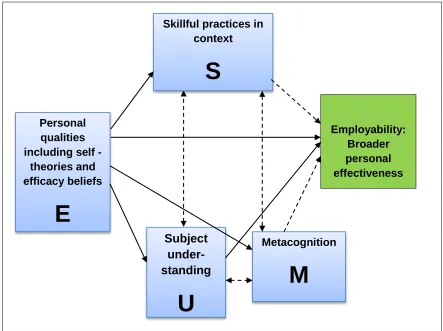
Yorke & Knight (2006, p.5) provide this model, suggesting employability should be
embedded into the curriculum. Their model is widely accepted and quoted. They
suggest that there is a close relationship between employability and good learning, and
stressed that employability results from a blend of achievements in four broad areas:
Understanding; Skills; Efficacy beliefs; and Metacognition.
They preferred the term „understanding‟ above „knowledge‟ because of its implication of
depth, and of course, a key outcome of higher education. By including „skills‟ they meant „skillful practice‟ with the implication that this hinges on awareness of, and
responsiveness to the context. As for „efficacy beliefs‟ the model points to the
advantages of a student having malleable, rather than fixed self-theories. Referring to „metacognition‟, they commented that its significance is increasingly being recognized
14 Figure 2.1: „USEM‟ model of employability
2.4.2 The ‘CareerEDGE’ model
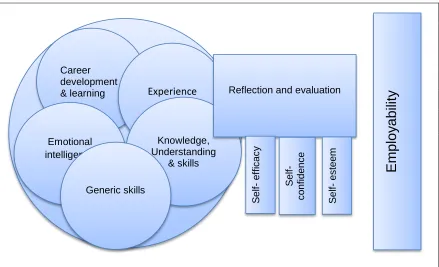
Pool & Sewell (2007) present their model based on the key skills. They use the term „CareerEDGE‟ as an aid to remember the five essential components of the model:
Career; E (Experience); D (Degree subject knowledge); G (Generic skills); and E
(Emotional intelligence). The model suggests that students, with all the skills on these
five components and essentially, through reflecting and evaluating these experiences,
will result in development of higher levels of efficacy, confidence, and
self-esteem which is the crucial links to the employability. The model ascertains that each
Skillful practices in context
S
Metacognition
M
Subject
under-standing
U
Personal qualities including self
-theories and efficacy beliefs
E
15
component of their model is essential and one missing element would considerably reduce a person‟s employability.
Figure 2.2: „CareerEDGE‟ model of employability
Career Development
Learning
Experience UnderstandingKnowledge
and skills
Generic skills Emotional Intelligence
Reflection and evaluation
Self-efficacy
Self-confidence
Self-efficacy
16
Pool & Sewell (2007, p. 281) have converted their original model with the metaphorical
image of a „key‟ and suggest that the pictorial version of the model is a useful and
practical way of explaining the concept of employability.
Figure 2.3: The key to employability.
Apart from above two models, broad framework model by McQuaid & Lindsay (2005,
p.209), Northern Ireland Department of Higher and Further Education, Training and
Employment model (DHFETE, 2002, p.7), and graduate identity model by Holmes
(2001, p.116) are widely known.
The employability models described above propose their own legitimate views.
However, these models are more or less inclined to a set of skills and attributes in order
to be employable. As employability can be understood as a multi-dimensional term
used in a range of meanings, it is not appropriate to reduce employability into a single
Career development
& learning Experience
Knowledge, Understanding & skills Emotional intelligence Generic skills
Reflection and evaluation
17
set of skills and attributes. Murphy & Otter (1999, cited in Holmes, 2001, p.1) criticize
that transferable skills, key skills, core skills, generic skills, personal skills along with
capabilities and personal competencies are broadly synonymous. Hence, they are
skeptical about the view that emphasis upon skills is a matter of common sense.
2.5 The significant of education on employability
Education holds the key role in finding an employment and helps to get one that offers
rewards proportionate to the level of education. With higher education one can get
better job that yields greater pay and chances for better career advancement. The
World Development Report 1998/99 (World Bank, 1998) states:
Knowledge is like light. Weightless and intangible, it can easily travel the world, enlightening the lives of people everywhere. Yet billions of people still live in the darkness of poverty unnecessarily. In part, at least, people live in poverty because they cannot reach the switch to turn on the light and that switch is called education.
Alainati et al. (2009) comment that education is increasingly important, not only for the
growing demand of technology, science and other fields, but also for improving individuals‟ prospects. A study conducted by Bynner (1998) has collected evidence on how individuals‟ educational needs changed over a period of time. It suggests that to
find and maintain a job with inadequate education is getting difficult day by day.
Emphasizing on education, World Bank (1998) further states that „today most
technologically advanced economies are knowledge based [omitted]………creating millions of knowledge related jobs in an array of disciplines that have emerged overnight.‟ Therefore, it is inevitable that more emphasis
should be given on education so as to enhance the employability.
2.6 Understanding employability skills
As already discussed, employability is not merely skills to be employable. Therefore,
18
as „employability skills‟ (Robinson, 2000). Employability models described earlier also
emphasize on such skills in order to remain competitive in the labour market. Based on
the literature review, the employability skills listed below are discussed in the following
sections.
Knowledge and understanding;
Generic skills;
Emotional intelligence;
Career development learning;
Work experience;
Reflection and evaluation;
Self-efficacy, self-confidence and self-esteem;
Social capital; and
Attitude.
2.6.1 Knowledge and understanding
Both „knowledge and understanding‟ are the most commonly referred elements that are
of utmost importance for employability; and therefore, they often appear in the central
part of any employability model. Becker (1993) argues that education and training that
form the basis of knowledge, understanding and skills are the most important factors of
human capital. Referring to competence as a form of knowledge and understanding,
Van der Heijde & Van der Heijden (2005) discuss occupational expertise as one of the
important deterministic factors for employability. Yorke (2003, p.2) explains that
employability and good learning have a lot in common, and should not be seen as
oppositional. Therefore, the quality and level of education can be understood as one of
19
2.6.2 Generic skills
Generic skills focus on the whole development of an individual; apart from one‟s
occupational training. According to the World Bank (2000, p.83), a person having good generic skills can be identified by one‟s ability of thinking and writing clearly, effectively
and critically, and who can communicate with precision, cogency and force. Bennett et
al. (1999, p. 76) defines generic skills which can support study in any discipline, and
which can potentially be transferred to a range of contexts, in higher education or the
workplace. Richard (2003, p.405) mentioned that research conducted by Michigan
State University in 1998 revealed that in addition to the knowledge and skills;
behaviours help students move successfully in the world or in the labour market. The
Pedagogy for Employability Group (2006, p. 4) lists 14 attributes2 that employers expect
in graduates. Yorke and Knight (2006, p.8) listed 39 aspects of generic skills3 which can
affect the employability. Further, Yorke (2006, p.5) mentioned that employers highly
value the generic skills and say, “Give us a bright and engaged graduate, and we will build specific expertise for this organization on top of that”. However, in recent years,
many of the higher educational institutions have embedded soft-skill4 development
programme into the curriculum. Therefore, education is expected to further enhance
employability as a whole.
2
14 Attributes: Imagination/creativity, adaptability/flexibility, willingness to learn, independent working/autonomy, working in a team, ability to manage others, ability to work under pressure, good oral communication, communication in writing for varied purposes, numeracy, attention to detail, time management, assumption of responsibility and for making decisions, planning, coordinating and organizing abilities as the expected attributes by employers.
3
39 aspects are divided into three categories namely personal qualities, core skills, and process skills. Personal qualities include self-theory, self-awareness, self-confidence, independence, emotional intelligence, adaptability, stress tolerance, initiative, willingness to learn, and reflectiveness. The core skills encompass reading effectiveness, numeracy, information retrieval, language skills, self-management, critical analysis, creativity, listening, written communication, oral presentations, explaining, and global awareness. The process skills are computer literacy, commercial awareness, political sensibility, ability to work cross-culturally, ethical sensibility, prioritizing, planning, applying subject understanding, acting morally, coping with complexity, problem solving, influencing, arguing for and/or justifying a point, resolving conflict, decision making, negotiating, and teamwork.
4
In the UK, the University of Luton, the University of North London and Oxford Brookes University have integrated a set of transferrable skills into the undergraduate curriculum. See
20
2.6.3 Emotional intelligence
In simple terms, emotional intelligence refers human talent. In view of Salovey & Mayer
(1990, p.190) emotional intelligence is the ability to monitor one‟s own and other‟s
feelings and emotions to discriminate among them and to use this information to guide one‟s thinking and actions. Fineman (2000, p.11) point out emotional intelligence as an
important organizational development tool that is widely accepted among managers,
consultants, and practitioners as a means for solving problems. According to Cooper
(1997), people with high levels of emotional intelligence motivate themselves and
others to achieve more; enjoy more career success, build stronger personal
relationships. Goleman (1998, p. 7) suggests that emotional intelligence can be learnt,
and higher educational institutions should be able to successfully teach, because
emotional intelligence is not genetically fixed, nor does only develop during early
childhood. As education connotes inner decision making, i.e. developing the ability to
think through situations (Ringness, 1975; cited in Manuel, 2005), a person with higher
education theoretically should have better emotional intelligence and thereby better
employability.
2.6.4 Career development learning
In order for someone to have the best chance of securing employment in which he can
be satisfied and successful, career development learning can be vital. Hillage and
Pollard (1998, p.2) identified career development skills as the combination of
self-awareness, opportunity self-awareness, decision making skills and transition skills. Foster
(2006; cited in Pool and Sewell, 2007, p.284) suggests, for career development learning
in his view, there is little to be gained in developing employability if a student cannot
identify a market in which to advertise their newly developed employability.
Furthermore, education has an important role to enhance one‟s employability in this
context. Watts (2006, p.3) states that there is growing attention within higher education
to enhance students employability and career development learning through specific
21
2.6.5 Work experience
Experience provides a person with distinctive and, tangible benefits. Employers greatly
value people who have undertaken work experience, and hence increase the likelihood
of success for them at the recruitment stage and also in their subsequent career. The
Association of Graduate Recruits (Department for Education and Skills, 2002, p.7)
mention that employers welcome initiatives that promote the effective recording and
presentation of such work experience where it involves the ability to reflect, articulate,
and apply what has been learned. Johnson and Burden (2003, p.39) acknowledge the importance of work experience by stating that, “The role of work experience is an issue on which there is almost complete unanimity between employers and young people.”
However, without appropriate education, work experience alone cannot prepare
someone for qualifying for a highly skilled job. The role of education, therefore, needs to
be explored in search of employability.
2.6.6 Reflection and evaluation
In addition to the development of necessary skills, knowledge, understanding and
attributes, it is equally important to provide graduates with opportunities for reflection on
and evaluation of the learning experiences that have already taken place (Pool and
Sewell, 2007, p.285). The Quality Assurance Agency for Higher Education in UK (2014)
suggests that Personal Development Planning (PDP) can be very useful for career
development as it is a structured and supported process undertaken by a learner to
reflect upon their own learning, performance and/or achievement, and to plan for their
personal educational and career development. The Higher Education Academy (2007,
p.5) suggests that there is a strong link between PDP and employability. In recent
years, PDP is integrated into curriculum in many educational institutions, and students
having higher education are automatically benefitted of this concept and are ahead in
22
2.6.7 Self-efficacy, self-confidence, and self-esteem
Bandura (1995, p.3) suggests people‟s beliefs concerning their efficacy can be
developed by four main forms of influences: mastery experiences, vicarious
experiences, social persuasion, and psychological and emotional states.
Self-confidence can be seen as the way a person projects him/her to the outside world,
which is visible from his/her manner and behaviour. According to Goleman (1998, p.
68), people with self-confidence are able to present themselves with self-assurance and
presence. Pool & Sewell (2007, p. 286) suggest that an increase in self-efficacy should
be reflected in an increase in demonstrated self-confidence. On the other hand,
Lawrence (2006, p.xiv) supports the inclusion of self-esteem in employability model as he describes, „self-esteem‟ as:
One of the most exciting discoveries in educational psychology in recent times has been the finding that people‟s levels of achievement are influenced by how they feel about themselves, i.e. their self-esteem.
From the educational perspective, education helps to build up efficacy,
self-confidence and self-esteem because education is the process of developing mentally,
morally and aesthetically (Merriam-Webster dictionary, 1996; cited in Manuel, 2005).
Therefore, an educated person is expected to have better self-efficacy, self-confidence
and self-esteem, and thereby better employability.
2.6.8 Social capital
Social capitals are those attributes that count for day-to-day life that includes social
networking, personal contacts, and awareness. McQuaid & Lindsay (2005, p.209) in
their model introduce social capital as an essential individual factor that determines
employability. Kluytmans & Ott (1999) suggested that in addition to know-how and
skills, employability is dependent on one‟s knowledge on the labour market itself,
including how the information is obtained through formal and informal networks. Seibert
23
to the social resources and the nature of the social resources are embedded into one‟s
networks. Education will enhance social capital including personal connectively and
knowledge on the labour market which eventually will make people more employable.
2.6.9 Attitude
In employability contexts, attitude is concerned with factors, such as attitude towards
the work, adaptability and flexibility, geographical mobility, wage flexibly and so on.
McQuaid & Lindsay (2005, p.209) understand assertiveness as essential factor for
employability. Van der Heijde & Van der Heijden (2005) state that willingness to learn,
and willingness to change, should be listed among the antecedents of employability.
Individual willingness to move for an employment, which is referred to as „mobility of human capital‟ is proposed by Defillippi & Arthur (1994), could impact on employability.
Attitudes can be learned and trained from the early stage of education, and good work
ethics are also expected to build through the engagement with other peers in school.
2.7 Conclusions
The discussions on employability models and skills have provided a comprehensive
understanding of the concepts of employability. The employability skills discussed in
this chapter are mostly categorized as soft skills, which become increasingly important
in seafaring profession. It is emphasized that education plays the key role in developing
these skills and attributes. Further, it is highlighted that a higher education system
should provide expanded and inclusive education to impart higher level of skills with
emphasis on creativity and flexibility. In this context, educational institutions in
Bangladesh need to develop an appropriate programme and relevant curriculum
incorporating with various employability skills in order to enhance the employability of
their graduates. It is also relevant with the government vision and policy of employment
24
Chapter: 3
Employability skills of seafarers
3.1 Introduction
This chapter endeavours to present an understanding of seafaring profession, the
required elements of high quality seafarers and essential skills and attributes that enhance their employability. From time immemorial, seafaring has practiced „on-the-job training‟. It is considered as a skill-based job; therefore, performance largely depends
on experience (Kennerly, 2002). However, the transition to shore-based schooling
started in 17th century and compulsory licencing started in the UK in 1851. In any case,
merchant seafaring in 21st century is radically different from 17th century; it is less
physical, more intellectual (Manuel, 2014). The range of knowledge, skills, and attitudes
required today by seafarers are so wide that the role of maritime education and training
(MET) is of significance.
3.2 Seafaring as a profession
Seafaring is a unique work domain which offers a completely different lifestyle from
other occupations. It is mainly because in seafaring, the ship implies both home and work
place. Any personal problems with other crew members are likely to stay until they disembark the ship. Seafarers are often required to „turn in‟ to harmonize with their
25
attracted adventurous young men and women. Couper et al. (1999, p.19) explore the work
profile of seafaring and summarize as:
Crews of merchant ships must be self-sufficient and able to improvise. They are responsible for the safety of the vessel, care of the cargo, maintenance and repairs; they need to prepare for fire, weather damage, evacuation and other emergencies without assistance from shore. Similarly there can be illness and injuries which require attention without direct medical assistance.
IMO (2014b), also, acknowledges the responsibility and hard work of seafarers, as the
regulatory body mentioned on the day of the seafarers 2014:
Quietly, mostly unnoticed, seafarers keep the wheels of the world in motion. Throughout the world, they face hardship and danger every day to keep our global economy afloat. Their work is hard and the level of responsibility is high.
BY appreciating such responsible personnel, how has the seafaring domain historically
evolved, and what qualities of seafarers are valued? Grech et al. (2008, p.1) explain that some of the most-valued qualities in mariners, prior to mechanically propelled ships,
included physical strength, endurance, ability to withstand a high level of discomfort, and to
some extent, an indifference to pain and even death. However, with the course of time and
in line with the fast changing world, these valued qualities also need to be updated,
since the volume of information that seafarers must know has enormously increased.
Bearing it in mind, the IMO Secretary General, Mr.Koji Sekimiju in his speech on the
day of the seafarers in 2013, in the Bangladesh Marine Academy, addressed:
The modern ship‟s officer needs to be far more than a navigator or an engineer, and the modern ship‟s crewman needs to be far more than a manual labourer. A modern ship is a highly technical workplace, which means that, as well as a highly advanced technical skillset, shipboard staff now also need to be fully conversant with management and communication skills, IT knowledge, and budget management, and so on (IMO,2013).
In order to update the competences of seafarers, the STCW‟785 has been amended
several times, including two major amendments in 1995 and 2010. Apart from STCW
5 STCW‟78 as amended: International Convention on Standards of Training, Certification and Watch
26
‟78 as amended, UNCLOS6, SOLAS7 regulation V/14, principles of safe manning (IMO
resolution A 1047(27), MARPOL8 73/78, MLC9 2006, ITU10 radio regulations, IBC11
code, IGC12, IMDG13, ISM14, ISPS15, IMSBC16 provide the legal frame-work for seafarers‟ education and training so as to perform their duties on board safely and in an
environmentally sound manner.
Besides the education and training required by the regulatory framework, Kimura (2003)
identifies the characteristics of a high quality seafarer in order to be competitive in the
global maritime labour market. For example, full knowledge of his trade and skill, ability
to watch out for all potential dangers, co-operation and leadership, strong sense of
responsibility, strict observance of punctuality, etiquette and manner are suggested. He
further emphasizes that these traits, characters and abilities of seafarers should be
cultivated through adequate training and on-board experience. It is to mention that the
6
UNCLOS: United Nations Convention on the Law of the Sea,1982
7
SOLAS: International Convention for the Safety of Life at Sea, 1974.
8
MARPOL 73/78: International Convention for the Prevention of Pollution from Ships, 1973 as modified by the protocol of 1978.
9
MLC 2006: Maritime Labour Convention 2006.
10
ITU: International Telecommunication Union.
11
IBC Code: International Code for the Construction and Equipment of Ships carrying Dangerous Chemical in Bulk.
12
IGC Code: International Code for the Construction and Equipment of Ships Carrying Liquefied Gases in Bulk.
13
IMDG Code: International Maritime Dangerous Goods Code.
14
ISM Code: International Safety Management Code.
15
ISPS Code: International Ship and Port Facility Security Code.
16
27
survey conducted by the KNOWME17 project has identified traditional seafaring skills,
safety and security skills, and human factor skills as the top three priorities for
employment (KNOWME, 2013).
3.3 Employability skills of seafarers
As seafaring is primarily a skill based profession, seafarers are expected to possess a
variety of skills and attributes in order to be employable in the global maritime labour
market. The following skills and attributes appeared from the literature review and will
be discussed respectively:
In-depth knowledge, problem solving skill and sense of responsibility;
Leadership and teamwork skill;
Communication skill;
Indefatigable spirit;
Adaptation in multi-cultural environment;
Prudence and foresight;
Situational awareness skill; and
Physical fitness.
3.3.1 In-depth knowledge, problem solving skills and sense of responsibility
The ultimate goal of seafarers is to ensure safe and economic transportation of cargos
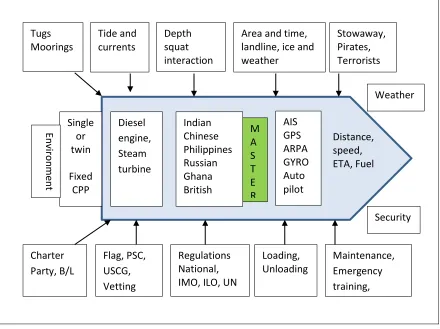
and passengers. The Figure 3.1 depicts the responsibility of a master mariner in a
commercial vessel. The Master needs to have sound knowledge on navigation,
metrological information, security related issues, engine room machineries, cargo-
handling equipment, crew management, national and international legislation, and
17
28
maritime commercial matters. Similarly, the Chief Engineer Officer is responsible for the
operation and maintenance of all the mechanical and electrical equipment on board.
Senior engineers shall have to lead junior engineers, trainees, and ratings. Besides,
they have to catch up with new technologies and adapt themselves to its use.
Figure 3.1: Job requirements of a master mariner, Source: Solanki (2007, p.12).
Professionals, such as Nakaya (2003) of NYK Ship Management, Japan, and Jensen
(2014) of Danica Crewing Services, Ukraine also discuss these elements of seafarers‟
qualities. Talent, personal characteristics, skills, knowledge, and behavior in a
diagrammatic arrangement (Appendix 7) form the basis of in-depth knowledge,
problem-solving skill, and sense of responsibility. In this view, to become a high-quality DD AIS GPS ARPA GYRO Auto pilot Distance, speed, ETA, Fuel M A S T E R Indian Chinese Philippines Russian Ghana British Diesel engine, Steam turbine Single or twin Fixed CPP Tugs Moorings Tide and currents Stowaway, Pirates, Terrorists Area and time,
29
seafarer, a person must have certain IQ and ability to understand problems and pick-up
new ways of doing things. It further suggests that a high-quality seafarer needs to have
good personal characteristics, such as making correct decision under stress, and
acquire sufficient knowledge and skill through MET.
3.3.2 Leadership and teamwork skill
Leadership is interpreted in various ways across the literature, however for example,
Yukl (2005, p.8) explains the leadership as the process of influencing others to
understand and agree about what needs to be done and how it can be done, and the
process of facil