A New Hybrid Architecture with an Intersection-Based
Coverage Algorithm in Wireless Sensor Networks
Young-Long Chen1, Mu-Yen Chen2, Fu-Kai Cheung3
, and Yung-Chi Chang1
1 Department of Computer Science and Information Engineering, National Taichung
University of Science and Technology, Taichung 404, Taiwan [email protected]
2 Department of Information Management, National Taichung University of Science and
Technology, Taichung 404, Taiwan [email protected]
3 Institute of Communication Engineering, National Yunlin University of Science and
Technology, Yunlin 640, Taiwan [email protected]
Abstract. Energy is limited in wireless sensor networks (WSNs) so that energy consumption is very important. In this paper, we propose a hybrid architecture based on power-efficient gathering in sensor information system (PEGASIS) and low-energy adaptive clustering hierarchy (LEACH). This architecture can achieve an average distribution of energy loads, and reduced energy consumption in transmission. To further extend the system lifetime, we combine the intersection-based coverage algorithm (IBCA) with LEACH architecture and the hybrid architecture to prolong the system lifetime that introducing sensor nodes to enter sleep mode when inactive. This step can save more energy consumption. Simulation results show that the performance of our proposed LEACH architecture with IBCA and the hybrid architecture with IBCA perform better than LEACH architecture with PBCA in terms of energy efficiency, surviving nodes and sensing areas.
Keywords: Hybrid architecture, PEGASIS, LEACH, System lifetime, IBCA, PBCA.
1.
Introduction
A Low-energy adaptive clustering hierarchy protocol (LEACH) for a distributed network proposed by Heinzelman et al. [10]. Sensor nodes are divided into several clusters in the LEACH architecture. Each cluster choosing a sensor node as the cluster head (CH), which delivers an advertisement (ADV) to every neighboring sensor node in accordance with carrier-sense multiple access (CSMA) [11], [12], [13] protocol in the MAC layer. Each sensor node identifies itself as cluster member with the CH [14], [15] through the strength of the ADV message. Cluster members transmit data to the CH using the time division multiple accesses (TDMA) [12], [13] mechanism. This TDMA protocol enables mechanisms to avoid and resolve collisions, because TDMA has a designated time slot for each node in which only that particular node transmits. Finally, the CH transmits the data to the BS which performs data aggregation.
In power-efficient gathering in sensor information system (PEGASIS) architecture [16], the nodes transmit data to the next closest neighboring nodes, and receive data from previous closest neighboring nodes, with all of the sensor nodes based on the greedy algorithm, to form a connected chain; each node collects from the previous node and transmits to the next one, until the node closest to the BS, called the chain header, is reached; it performs data aggregation and transmission to the BS [16], [17], [18]. The role of chain header for each round will rotate between nodes.
There are two problems with LEACH. First, there is an excess of CHs. Second, the distance between the CHs and cluster nodes is too great. However, PEGASIS architecture also has problems. In the first place, the transmission distance may not be the shortest between sensing nodes. Next, the aggregated number of data packets is larger than in LEACH architecture. To overcome these problems, we developed a combined architecture based mainly on PEGASIS, but utilizing the advantages of the LEACH structure.
In WSNs, sensor nodes are randomly deployed, as a result, the sensor field is uneven density, and this will cause coverage issues [19]. If a node's sensing range is overlapped, it is called a redundant node. The redundant node is entered into sleep mode, which does not affect the overall sensor field or connectivity. Sleep mode is a way to prolong the network lifetime. In order to upgrade LEACH system performance, there is a phase-based coverage algorithm (PBCA) [20], [21] for locating all redundant nodes. The results of LEACH architecture with PBCA show that provides excellent system efficiency compared with the original LEACH architecture. On the other hand, an intersection-based coverage algorithm (IBCA) is proposed in [22], [23], that is capable of locating all redundant nodes. The number of redundant nodes of IBCA will be larger than that of PBCA. Thus, IBCA can improve the network lifetime more than PBCA.
In order to achieve better network performance, we propose novel schemes involving the application of IBCA to the LEACH [24] and hybrid architectures in this paper. Our schemes can identify redundant nodes to improve energy consumption.
2.
Related Work
PBCA [20], [21] is employed as a criterion to determine whether the target node is k-coverage. PBCA is utilized to identify whether the sensing range of target node is fully covered by neighbor nodes with a time complexityO N( logN), where N represents the number of neighbor nodes around the target sensor node.
IBCA [22], [23] uses intersections to judge if certain sensor nodes can enter sleep mode. Both intersections of a target sensor node’s sensing range and other nodes' sensing ranges and intersections on the perimeter of the total sensing range, are k-coverage. The result is that the target sensor node will be k-k-coverage. This algorithm requires the coordinate information of all sensor nodes and the computational complexity is 3
( )
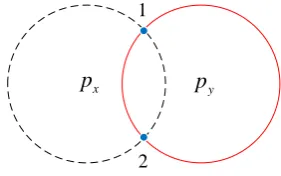
O N , where N is the number of neighbors of the target sensor node. Figure 1 shows an intersection of two sensor nodes. The target sensor node py and the neighboring sensor node px will intersect at two points, which are intersection 1 and intersection 2.
1
2 x
p
p
yFig. 1. The intersection of sensing ranges
The IBCA has a wider judgment condition (d2Rs) than the PBCA [20], [21], where d is the distance from a sensor node to the target sensor node, RS is the sensing range of each sensor node. Therefore, the selected number of redundant nodes will be larger than that of PBCA. The number of redundant nodes that can be used for judgment will be larger. In other words, there are more neighbor node of the target sensor node that can be used for judgment. The calculation will become more complicated, and the implementation time will become longer.
IBCA provide redundancy rules for nodes as shown in [22], [23]. If both conditions have been established, the target node py is considered a redundant node. Assuming a set of overlapped neighbor nodes N p( y), neighbor nodes pxN p( y), and d is the distance from neighbor node px to target node py.
Condition 1. The distance from px to py should be less than or equal to twice the sensing rangeRS. We have as follows:
( y, x) 2 S, x ( y)
Condition 2. The intersections are generated by node py and its neighbor nodes
x
p .The target node py must check all the intersections within its sensing range. Each intersection overlaps coverage by each neighbor node’s sensing range at least once.
It is a redundant node which can enter sleep mode which intersections of a sensor node py are covered by other sensor nodes’ sensing ranges.
LEACH has two point problems. One is generate the excess of CHs. Another is distance between the CHs and cluster nodes. However, PEGASIS architecture has one problem that the aggregated number of data packets is larger than in LEACH architecture. To improve above problems, we proposed a combined architecture mainly based on PEGASIS, but utilizing the advantages of the LEACH architecture.
Our proposed architecture has two advantages. One is using PBCA to identify the sensing range of target node is fully covered by neighbor nodes. Another is using IBCA to find the redundancy nodes, and then let these nodes get into sleep mode.
3.
LEACH Architecture with Intersection-Based Coverage
Algorithm
In this section, we combine IBCA with LEACH topology architecture [10] and enter redundant sensor nodes into sleep mode. In this way, we improve system energy efficiency and extend the system lifetime.
3.1. The LEACH Architecture
In [10], Heinzelman et al. proposed the LEACH architecture operation. Each cluster member delivers data directly to the cluster head, rather than to the distant base station. As a result, the energy consumed by the cluster members is merely the amount required during data transmission between cluster members and the cluster head, although the cluster head requires a larger amount of energy to perform data aggregation and implement data transmission to the base station. It should be noted that in LEACH architecture, the system is composed of variable clusters for each round.
LEACH protocol is mainly divided into two phases. The first is the setup phase; there is a probability P ti( ) that each sensor node will be specified as the cluster head in the initial round. The average expected value of the cluster head number is given by:
1
[ ] ( ) 1
K i i
E CH P t
(2)Where [E CH] is the average expected value of the number of cluster heads, K is the total deployed number of sensor nodes in a WSN, P ti( ) is the probability that node
, ( ) 1 ( mod )
( )
0 , ( ) 0 i i
i
C t K
K r
P t
C t
(3)
Where r is the current round and t is increased by unity in the event that all the cluster members have acted as the head. C ti
0 indicates that node i has been the cluster head this round. C ti
1 indicates that a node has not yet been the cluster head this round. LEACH architecture requires that each cluster member serve as the head once for each K/ round. Each node i should choose to become a cluster head with probability P ti( ) at roundr.3.2. The LEACH Architecture with IBCA
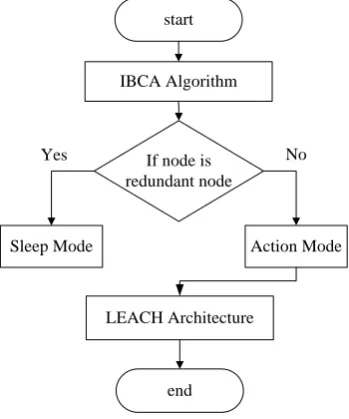
To extend the system lifetime, we combine the LEACH architecture with IBCA [24]. First, we use IBCA to find the redundant sensor nodes whose intersections are covered by other nodes’ sensing ranges. Let these redundant sensor nodes enter sleep mode in order to reduce the energy consumption of the WSN. The remaining nodes of the WSN then form LEACH architecture. The flow chart is shown in Fig. 2.
IBCA Algorithm
Action Mode Sleep Mode
LEACH Architecture If node is redundant node
Yes No
start
end
4.
An Intersection-Based Coverage Algorithm for the Novel
Hybrid Architecture
In this paper, we propose novel hybrid architecture with IBCA in order to obtain the advantages of both the PEGASIS and LEACH architectures. The hybrid architecture combined with IBCA improves the system energy efficiency and extends the system lifetime.
4.1. Our Novel Hybrid Architecture
In our proposed method, the hybrid architecture appoints a sensor node nearest the BS in each round, called the leader. The leader is responsible for the final aggregated data transmission to the BS. The leader is selected in turn from all the sensor nodes, so as to prevent the premature death of any one leader. When all of the sensor nodes have served as the leader, a new round begins.
The BS implements algorithms and receives data from sensor nodes. It has a leader list L which records the status of all the sensor nodes that have served as the leader. Those nodes that have been appointed leader this round and dead nodes will be removed from this list. After deleting the deceased nodes and former leaders, the BS designates the node closest to the BS as the current leader. If two or more sensor nodes are the same distance from the base station, the node with the highest energy will serve as leader. The purpose of this selection is to update leaders; the leader list composed of all active nodes is updated after all the nodes have served as leader once each round.
After determining the leader, our new network architecture begins operating. The leader is defined as the only member in level 0. To illustrate this idea by levels, the members of level k are generated by members in levelk1. For example, the members in level 1 are determined by the ADV message in level 0. Define a set Ckcomposed of all the members in levelk. The mthmember in level
k is m k
p , and ( m)
k
N p are all the
non-level sensor nodes regarding m k
p . Therefore, 1 0
p denotes the leader. Assuming the current level is leveli, all the members of level i will send an ADV message consisting of an ID and a level number to members not of that level. Based on the strength of the received ADV message, members then determine if they belong to ( m)
k N p .
To show the details of how the transmission path is determined, define pi as the
th
i non-level node. The distance between nodes pi and pj isd p p( i, j). The non-level nodes merely receive the ADV message to be sent by m
k p .
As long as either of the criteria, which are ( , m) ( , m)
j k i k
d p p d p p
ord p( j, pkm)d p p( i, j), are satisfied, these nodes will become members of the next level.
above criteria, one of the conditions is established, then pj is identified as a member in levelk1. It is clear that node pjis closer to pkm than the other node.
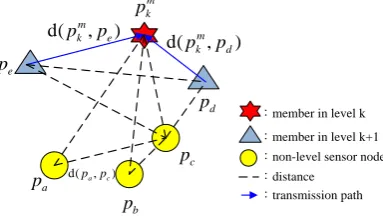
As shown in Fig. 3, m k
p represents the mth member in level k, and is intended to
locate the members belonging to level k1 from among nodes pa, pb, pc, pd and
e
p . Since all these non-level nodes merely receive the ADV message sent by pkm, nodes
a
p , pb, pc, pd and pe all pertain to N p( km), that is, N p( km)
pa, , , pb pc pd, pe
.According to the time interval between the transmission and reception of the ADV message, it is discovered thatd p( c, pkm) , as well as ( , ) ( , )
m m
d k e k
d p p d p p , and
then d p( e, )pc , as well as ( , ) ( , ) m
e d e k
d p p d p p . For the first criterion,
( d, mk) ( e, km)
d p p d p p is satisfied; then node pd is identified as a member of level 1
k in the same manner. For the second criterion, (d pe, pd)d p( e, pmk) is satisfied, and then pe is identified as a member of level k1 in the same manner.
:member in level k
:non-level sensor node
:transmission path
:distance
m k p d( m, )
k e
p p
d( m, )
k d
p p
d(pa,pc)
d p
c p e
p
a p
b p
:member in level k+1
Fig. 3. Determination of data transmission path between nodes
Applying such criteria to node pa , we find that d p( c, pkm) , ( , ) m d k
d p p ,
( e, d) ( a, km)
d p p d p p and then (d pa, )pc d p( a, pmk). It is concluded that pa does not pertain to levelk1, for neither of the two criteria are satisfied. Similarly, pb and
c
p are both identified as non-members of levelk1.
Fig. 4 illustrates the node distribution in which pb is the leader, the only member in level 0, while nodespa, pc, pe and ph are members, located by 1
0 b
p p , in level 1.
: member in level 0 : member in level 1 : member in level 2
: member in level 5 a
p
b
p pc
d
p pf
q
p
i
p
h
p
l
p
k
p
n
p pj
o
p pm
r
p
p
p
q
p
s
p : member in level 4 : member in level 3 g
p BS
Fig. 4. The novel hybrid architecture
4.2. The Hybrid Architecture with IBCA
In this section, we propose the application of the IBCA [22], [23] to our hybrid architecture. The complete IBCA as given by:
program IBCA algorithm Parameter definition:
S as the set of the sensor nodes entered into sleep
mode;
A as the set of the sensor nodes in active mode;
L as the set of live sensor nodes;
Node as the number of live sensor nodes;
N p( i) as the set of neighbor nodes of the target
sensor node;
D p( i) as the set of the intersections ofpi andN p( i)
where D p( i) must be overlapped by other sensor node
at least once; begin
All the live nodes belong to A; repeat
Locate N p( i), where piL, N p( i){p d p pj| ( , ) 2 }i j ≦ Rs ,
pi pj , pjL, and pjA;
Compute the intersections of pi and neighbor nodes,
where pjN p( i);
if pi is permitted to enter sleep mode.
D p( i) is an empty set;
pi is a redundant node permitted to sleep;
else
pi remain active;
piA;
end if
i ;
until iNode
end.
First, we use the IBCA to find the redundant sensor nodes. Next, these redundant sensor nodes enter sleep mode in order to reduce the energy consumption of the WSN. We then set up the hybrid architecture with the active sensor nodes using IBCA. In our algorithm, all the sensor nodes can be divided into two modes: active mode or sleep mode. Therefore, the fewer nodes that are active, the lower the energy consumption for each round will be.
In our hybrid architecture, each sensor node has the functions of data detection, collection and transmission. A sensor node will send its own data to its neighbor node closest to the BS. The neighbor nodes will then perform data collection on the received data and their own detected data. After fusing the data, they will transmit the fused data to the neighbor node closest to the BS. This process will repeat until the data reaches a node with no sensor node closer to the BS than itself, and complete data will then be transmitted to the BS.
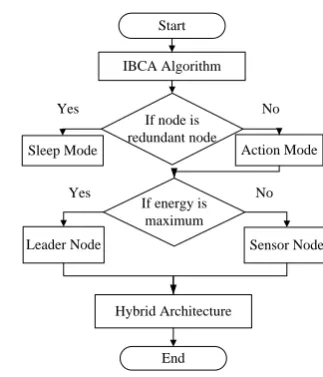
In order to extend the network lifetime, the IBCA for the hybrid architecture can be divided into three steps: active node selection, leader node selection and hybrid architecture.
Active node selection. The system will select sensor nodes to be active nodes using the IBCA, and instruct redundant sensor nodes to enter sleep mode.
Leader node selection. The system will compare the residual energy of each sensor node in the hybrid architecture and select the active sensor node with the maximum remaining energy as the leader.
Implementing hybrid architecture. The members of levels should send an ADV message to non-level nodes, and then a linkage message is sent to the remainder of those non-level nodes. The ADV messages of the linkage contain their identification, the members pertaining to the next level and the reception time. There are two criteria for judging if the condition is satisfied for them to be members of the next level. This ADV message is a small message which includes the node’s ID and a header, defined as an announcement message. This determines which non-cluster head node must join which cluster in this round, according to the signal strength of the ADV message from each CH.
Start
End IBCA Algorithm
Action Mode Sleep Mode
Hybrid Architecture
Leader Node Sensor Node No If node is
redundant node
Yes No
If energy is maximum Yes
Fig. 5. The flow chart of our hybrid architecture with IBCA
5.
Simulation Results
We propose LEACH with IBCA, and hybrid architecture with IBCA in this paper. In this section, we use C programming language to simulate and compare the system efficiencies, which are LEACH architecture [10], LEACH architecture with PBCA [21], LEACH architecture with IBCA and the hybrid architecture with IBCA. We compare the system efficiencies, which are based on total residual energy, number of deceased nodes and total sensing area. The simulation assumed 100 sensor nodes randomly distributed over a 100 meter by 100 meter field, a sensing radius RS of 15 meters and BS located at (50, 150), with the parameters specified in Table 1. From [10], [25], the optimal cluster number kopt is employed in the LEACH architecture. The transmission for energy consumption is given by:
2
0 4
0
( ),
( , )
( ),
elec fs Tx
elec mp
l E d d d
E l d
l E d d d
(4)
Where ETx( , )l d is the transmission of energy that packet size is l and the distance is
d; Eelec is the electronics energy; d0 is distance threshold; fs and mp represent the amplifier energy of free space and the amplifier energy of multi-path, respectively. The receiving for energy consumption ERx( )l is defined as:
( )
Rx elec
E l l E (5)
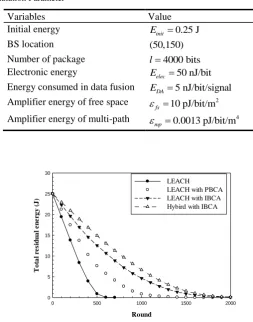
total residual energy in each round. The original LEACH architecture has the lowest residual energy, owing to the absence of IBCA. In addition, the LEACH architecture with IBCA has greater residual energy than does LEACH architecture with PBCA because IBCA can select more sensor nodes to enter sleep mode than PBCA can. The main reason for this is that the number of sensor nodes that can be used for judgment will become greater. Finally, the reason for the largest total residual energy is that our hybrid architecture ensures a minimum transmission distance between nodes.
Table 1. Simulation Parameter
Variables Value
Initial energy Einit 0.25 J
BS location (50,150)
Number of package l4000 bits
Electronic energy Eelec 50 nJ/bit
Energy consumed in data fusion EDA5 nJ/bit/signal
Amplifier energy of free space 2
10 pJ/bit/m fs
Amplifier energy of multi-path 4
0.0013 pJ/bit/m mp
Round
0 500 1000 1500 2000
T
o
ta
l
re
si
d
u
a
l
e
n
e
rg
y
(
J
)
0 5 10 15 20 25 30
LEACH LEACH with PBCA LEACH with IBCA Hybird with IBCA
Fig. 6. Comparison of total residual energy each round
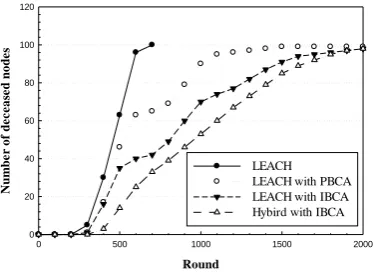
IBCA has the lowest sensor node mortality rate, while the original LEACH architecture has the highest.
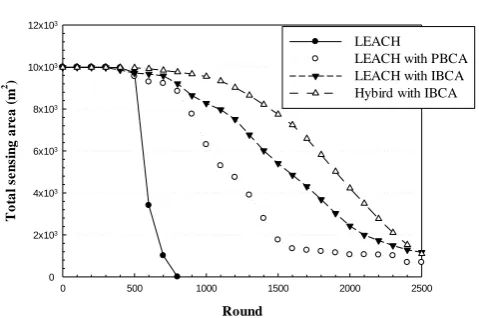
Total sensing area is shown in Fig. 8. Prior to round 300, the four architectures cover the same sensing area. After round 500, the hybrid architecture with IBCA maintains the largest sensing area, and the original LEACH the smallest. Thus, it is shown that for sensing area each round, the hybrid architecture with IBCA covers the maximum sensing area, while the original LEACH covers the minimum. The main reason for this is that the hybrid architecture with IBCA has an extended system lifetime.
In addition, we changed the sensing radius to, and compared the performances of the three WSN architectures in Figs. 9-11.
As shown in Fig. 9, the total residual energy of the original LEACH was depleted at round 700. The residual energy of LEACH with PBCA was 6.6 J at round 700, and the residual energy of LEACH with IBCA was 11 J at round 700. However, the residual energy of the hybrid architecture with IBCA was 13 J at round 700. Our novel scheme, the hybrid architecture with IBCA, and LEACH with IBCA obtain greater total residual energy than the other architectures.
Round
0 500 1000 1500 2000
N
um
be
r
o
f
de
c
e
a
se
d
no
de
s
0 20 40 60 80 100 120
LEACH LEACH with PBCA LEACH with IBCA Hybird with IBCA
Fig. 7. Comparison of the number of deceased nodes each round
Round
0 500 1000 1500 2000
T
o
ta
l
se
ns
ing
a
re
a
(
m
2)
0 2x10³
4x10³
6x10³
8x10³
10x103
12x103
LEACH LEACH with PBCA LEACH with IBCA Hybird with IBCA
Fig. 8. Comparison of total sensing area each round.
Round
0 500 1000 1500 2000 2500
T
o
ta
l
re
si
d
u
a
l
e
n
e
rg
y
(
J
)
0 5 10 15 20 25 30
LEACH LEACH with PBCA LEACH with IBCA Hybird with IBCA
Fig. 9. Total residual energy forRs18 m
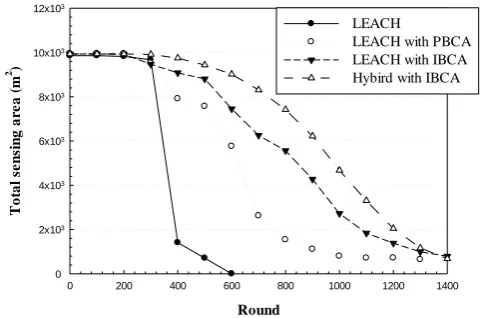
As demonstrated in Fig. 11, subsequent to round 580, our hybrid architecture with IBCA maintains the largest sensing area, while the original LEACH maintains the smallest. Prior to round 410, the hybrid architecture with IBCA covers the same sensing area as do LEACH with PBCA and LEACH with IBCA, which is larger than that covered by the LEACH architecture alone.
Furthermore, we assume that each node has a sensing radius ofRs15 m, and number of bits l6000 bits . We compare the WSN performance of the three architectures in Figs. 12-14.
Round
0 500 1000 1500 2000 2500
N
um
be
r
o
f
de
c
e
a
se
d
no
de
s
0 20 40 60 80 100 120
LEACH
LEACH with PBCA LEACH with IBCA Hybird with IBCA
Fig. 10. Number of deceased nodes forRs18 m
Round
0 500 1000 1500 2000 2500
T
o
ta
l
se
n
si
n
g
a
re
a
(
m
2)
0 2x10³
4x10³
6x10³
8x10³
10x103
12x103
LEACH LEACH with PBCA LEACH with IBCA Hybird with IBCA
Fig. 11. Total sensing area forRs18 m
Round
0 200 400 600 800 1000 1200 1400
T
o
ta
l
re
si
d
u
a
l
e
n
e
rg
y
(
J
)
0 5 10 15 20 25 30
LEACH
LEACH with PBCA LEACH with IBCA Hybird with IBCA
Fig. 12. Total residual energy for Rs15 m andl6000 bits.
Round
0 200 400 600 800 1000 1200 1400
N
um
be
r
o
f
de
c
e
a
se
d
no
de
s
0 20 40 60 80 100 120
LEACH LEACH with PBCA LEACH with IBCA Hybird with IBCA
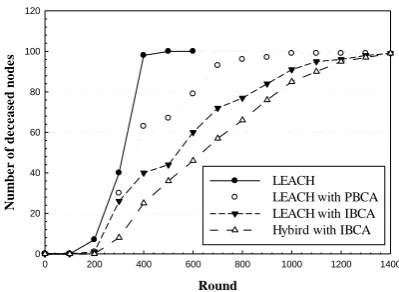
Fig. 13. Number of deceased nodes for Rs15 m andl6000 bits.
Fig. 14 shows that the hybrid architecture with IBCA maintains the largest sensing area subsequent to round 320, while the original LEACH architecture maintains the smallest.
Round
0 200 400 600 800 1000 1200 1400
T
o
ta
l
se
n
si
n
g
a
re
a
(
m
2 )
0 2x10³
4x10³
6x10³
8x10³
10x103
12x103
LEACH
LEACH with PBCA LEACH with IBCA Hybird with IBCA
Fig. 14. Total sensing area for Rs15 m andl6000 bits
6.
Conclusions
In this paper, we proposed a novel hybrid architecture with IBCA, and LEACH architecture with IBCA. Our novel hybrid architecture is based on both PEGASIS and LEACH architecture, with the four features that (a) it requires that only one leader perform data aggregation and transmit data to the BS for each round, (b) each sensor node must serve as the leader once each round, (c) the minimum transmission distance between nodes is guaranteed, and (d) it requires less aggregated data packets than does PEGASIS. In the hybrid architecture, the data aggregation task is assigned to a plurality of nodes, decreasing the energy required during the data transmission. Our proposed architectures use IBCA that the WSN’s sensor nodes are classified into two types, i.e., active nodes, which responsible for detecting data, and the sleep mode nodes, which remain idle. Therefore, the entire system requires less live sensor nodes to cover a sensor field. The nodes to enter sleep mode are determined using IBCA, and do not perform any functions, which reduces energy consumption. Finally, the system is constructed using only active nodes, further reducing the energy consumption of the WSN. On the other hand, IBCA selected a greater number of redundant nodes than did PBCA, the main reason being that, with IBCA, a greater number of sensor nodes can be used for judgment. For this reason, the application of IBCA to the hybrid architecture improves the system lifetime.
Simulation results show that our proposed hybrid architecture with IBCA, and IBCA combined with LEACH demonstrate excellent performance compared with both the original LEACH architecture and LEACH architecture combined with PBCA, in terms of total residual energy, death rate of sensor nodes and total sensing area.
References
1. Al-Karaki, J. N., Ul-Mustafa, R., Kamal, A. E.: Data Aggregation and Routing in Wireless Sensor Networks: Optimal and Heuristic Algorithms. Computer Networks, Vol. 53, No. 7, 945-960. (2009)
2. Burrell, J., Brooke, T., Beckwith, R.: Vineyard Computing: Sensor Networks in Agricultural Production. IEEE Pervasive Computing, Vol. 3, No. 1, 38-45. (2004)
3. Estrin, D., Girod, L., Pottie, G., Srivastava, M.: Instrumenting the World with Wireless Sensor Networks. In Proceedings of the IEEE International Conference on Acoustics, Speech, and Signal Processing. Salt Lake City, USA, 2033-2036. (2001)
4. Akyildiz, I. F., Su, W., Sankarasubramaniam, Y., Cayirci, E.: A Survey on Sensor Networks. IEEE Communications Magazine, Vol. 40, No. 8, 102-114. (2002)
5. Kumarawadu, P., Dechene, D. J., Luccini, M., Sauer, A.: Algorithms for Node Clustering in Wireless Sensor Networks: A Survey. In Proceedings of the IEEE 4th International Conference on Information and Automation for Sustainability. Colombo, Sri Lanka, 295-300. (2008)
6. Bonnet, P., Gehrke, J., Seshadri, P.: Querying the Physical World. IEEE Personal Communications, Vol. 7, No. 5, 10-15. (2000)
7. Islam, M. J., Islam, M. M., Islam, M. N.: A-sLEACH: An Advanced Solar Aware LEACH Protocol for Energy Efficient Routing in Wireless Sensor Networks. In Proceedings of the IEEE 6th International Conference on Networking. Sainte-Luce, France, 1-4. (2007) 8. Jin, Y., Liu, R., He, X., Huang, Y.: A distributed power management design based on MOST
networks. Computer Science and Information Systems, Vol. 8, No. 4, 1097-1115. (2011) 9. Qian1, Q., Shen, X., Chen, H.: An Improved Node Localization Algorithm Based on
DV-Hop for Wireless Sensor Networks. Computer Science and Information Systems, Vol. 8, No. 4, 953-972. (2011)
10. Heinzelman, W. B., Chandrakasan, A. P., Balakrishnan, H.: An Application-Specific Protocol Architecture for Wireless Microsensor Metworks. IEEE Transactions on Wireless Communications, Vol. 1, No. 4, 660-670. (2002)
11. Yigitel, M. A., Incel, O. D., Ersoy, C.: Design and Implementation of A QoS-Aware MAC Protocol for Wireless Multimedia Sensor Networks. Computer Communications, Vol. 34, No. 16, 1991-2001. (2011)
12. Guo, P., Jiang, T., Zhang, K.: Novel 2-Hop Coloring Algorithm for Time-Slot Assignment of Newly Deployed Sensor Nodes without ID in Wireless Sensor and Robot Networks. Computer Communications, Vol. 35, No. 9, 1125-1131. (2012)
13. Karkvandi, H. R., Pecht, E., Yadid-Pecht, O.: Effective Lifetime-Aware Routing in Wireless Sensor Networks. IEEE Sensors Journal, Vol. 11, No. 12, 3359-3367. (2011)
14. Huang, B., Hao, F., Zhu, H., Tanabe, Y., Baba, T.: Low-Energy Static Clustering Scheme for Wireless Sensor Network. In Proceedings of the IEEE International Conference on Wireless Communications, Networking and Mobile Computing. Wuhan, China, 1-4. (2006)
15. Wei, B., Hu, H. Y., Fu, W.: An Improved LEACH Protocol for Data Gathering and Aggregation in Wireless Sensor Networks. In Proceedings of the IEEE International Conference on Computer and Electrical Engineering. Phuket, Thailand, 398-401. (2008) 16. Lindsey, S., Raghavendra, C. S.: PEGASIS: Power-Efficient Gathering in Sensor
Information Systems. In Proceedings of the IEEE Aerospace Conference. Big Sky, Montana, 1125-1130. (2002)
17. Lindsey, S., Raghavendra, C., Sivalingam, K. M.: Data Gathering Algorithms in Sensor Networks Using Energy Metrics. IEEE Transactions on Parallel and Distributed Systems, Vol. 13, No. 9, 924-935. (2002)
19. Huang, C. F., Tseng, Y. C.: The Coverage Problem in a Wireless Sensor Network. In Proceedings of the ACM 2nd International Conference on Wireless Sensor Networks and Applications. San Diego, USA, 115-121. (2003)
20. Quang, V. T., Takumi, M.: An Algorithm for Sensing Coverage Problem in Wireless Sensor Networks. In Proceedings of the IEEE Sarnoff Symposium. Princeton, New Jersey, 1-5. (2008)
21. Quang, V. T., Takumi, M.: A Novel Gossip-Based Sensing Coverage Algorithm for Dense Wireless Sensor Networks. Computer Networks, Vol. 53, No. 13, 2275-2287. (2009) 22. Wang, X., Xing, G., Zhang, Y., Lu, C., Pless, R., Gill, C.: Integrated Coverage and
Connectivity Configuration in Wireless Sensor Networks. In Proceedings of the 1st International Conference on Embedded Networked Sensor Systems. Los Angeles, USA, 28-39. (2003)
23. Wang, X., Xing, G., Zhang, Y., Lu, C., Pless, R., Gill, C.: Integrated Coverage and Connectivity Configuration for Energy Conservation in Sensor Networks. ACM Transactions on Sensor Networks, Vol. 1, No. 1, 36-72. (2005)
24. Chen, Y. L., Cheung, F. K., Chang, Y. C.: A Low-Energy Adaptive Clustering Hierarchy Architecture with an Intersection-Based Coverage Algorithm in Wireless Sensor Networks. In Proceedings of the Seventh International Conference on Innovative Mobile and Internet Services in Ubiquitous Computing, Taichung, Taiwan. (2013)
25. Chen, Y. L., Wang, N. C., Shih, Y. N., Lin, J. S.: Improving Low-Energy Adaptive Clustering Hierarchy Architectures with Sleep Mode for Wireless Sensor Networks. Wireless Personal Communications, Vol. 75, No. 1, 349-368. (2014)
Young-Long Chen (SM’03-M’05) received the Ph.D. degree in electrical engineering from National Chung Cheng University, Chia-Yi, Taiwan, in 2007. From 1995 to 1999, he worked for Formosa Petrochemical Corporation as a Design Engineer. From 1999 to 2007, he was a Lecturer with the Department of Electrical Engineering, Chienkuo Technology University, Taiwan. From 2007 to 2009, he was an Associate Professor with the Department of Electrical Engineering, Chienkuo Technology University, Taiwan. Since 2009, he has been with the Department of Computer Science and Information Engineering, National Taichung University of Science and Technology, Taiwan, where he is currently a Professor. His research interests include wireless and mobile communications and networks, wireless sensor networks, information security, digital signal processing, fuzzy neural networks and embedded systems. He is a member of the IEEE.
Fu-Kai Cheung received the M.S. degree in the Graduate School of Communication Engineering from the National Yunlin University of Science and Technology, Yunlin, Taiwan in 2010. His research interests are in wireless sensor networks, mobile communications, and communication protocols.
Yung-Chi Chang received the B.S. degree in Department of Computer Science and Information Engineering from National Taichung Institute of Technology, Taichung, Taiwan, in 2011. The M. S. degree is received in department of computer science and information engineering from National Taichung University of Science and Technology, Taichung, Taiwan, in 2013. His research interests in wireless sensor networks, mobile communications, and embedded systems.