University of Pennsylvania
ScholarlyCommons
Publicly Accessible Penn Dissertations
1-1-2015
A Multi-Step Analysis of the Evolution of English
Do-Support
Aaron William Ecay
University of Pennsylvania, [email protected]
Follow this and additional works at:
http://repository.upenn.edu/edissertations
Part of the
Linguistics Commons
This paper is posted at ScholarlyCommons.http://repository.upenn.edu/edissertations/1049
Recommended Citation
Ecay, Aaron William, "A Multi-Step Analysis of the Evolution of English Do-Support" (2015).Publicly Accessible Penn Dissertations. 1049.
A Multi-Step Analysis of the Evolution of English Do-Support
Abstract
This dissertation advances our understanding of the historical evolution and grammatical structure of English
do-support through the application of novel historical data to this classical problem in historical syntax.
Do-support is the phenomenon in English whereby a pleonastic auxiliary verb do is inserted in certain clause
types. The phenomenon is characteristic of the modern language, and there is robust evidence that it emerged
beginning in roughly the year 1500. The fine quantitative details of this emergence and the variation it
engendered have been an object of study since Ellegård (1953). From the standpoint of generative grammar,
Roberts (1985), Kroch (1989), and many others have treated the emergence of do-support as a
closely-following consequence of the loss of V-to-T raising in the 15th and 16th centuries. Taking a cross-linguistic
perspective, I show that though the totality of English do-support is uncommon in other languages, the
phenomenon may be seen as the combination of several discrete building blocks, each of which is robustly
attested. From this perspective, a question is raised about the genesis of English do-support: given that the
present-day phenomenon is evidently composed of several separate subcases, why should its cause be
attributed solely to the loss of V-to-T raising? I argue that the earliest emergence of do-support in English is in
fact attributable to a different source: a usage of do as a marker of external arguments. This explanation
addresses the following points, which under earlier accounts were unexplained:
* The different behavior of do-support across argument structure types.
* The appearance of do-support in affirmative declaratives at a peak rate of 10%, much more than can be
attributed to emphatic assertions.
* The emergence of do-support from a Middle English causative.
This "intermediate do" spread through the language until roughly 1575, when the loss of verb raising triggered
an abrupt reanalysis which transformed the argument-structure marking do into its modern form.
Degree Type
Dissertation
Degree Name
Doctor of Philosophy (PhD)
Graduate Group
Linguistics
First Advisor
Anthony Kroch
Subject Categories
A MULTI-STEP ANALYSIS OF THE EVOLUTION OF ENGLISH DO-SUPPORT
Aaron Ecay
A DISSERTATION
in
Linguistics
Presented to the Faculties of the University of Pennsylvania in Partial Fulfillment of the
Requirements for the Degree of Doctor of Philosophy
2015
Supervisor of Dissertation
Anthony Kroch, Professor of Linguistics
Graduate Group Chairperson
Eugene Buckley, Associate Professor of Linguistics
Dissertation Committee:
Mark Liberman, Professor of Linguistics
This dissertation is backed up by a small army of my colleagues who have contributed in ways both
large and small to its empirical and technical underpinnings. It is only appropriate to acknowledge their
contributions here – though of course any shortcomings in the dissertation should not be attributed to
them. Pieces of this work were presented at PLC 34 and 38, and DiGS 14 and 16; audience members there
provided valuable feedback. I am grateful to Amy Goodwin-Davies, Kajsa Djärv, and Heimir Freyr van
der Feest-Viðarsson for providing judgments on their respective native languages. Heimir also provided
illuminating of the early Icelandicdo-support patterns. I am grateful to Hilary Prichard for sharing her
geocoding of the PPCME2 texts, and thus infecting me with enthusiasm for exploring spatial patterns of
variation in historical syntactic data. Don Ringe pointed out example (81) several years ago – and thus
provided a crucial inspiration for the account of intermediatedo-support that developed into the core of
this dissertation. Ann Taylor and Anthony Warner created an electronic version of the coding strings in
Ellegård’s corpus, thus allowing me to check my results against this earlier source of data. Their hard work
and generosity have been instrumental in allowing me to develop the quantitative analyses more fully. In
culmination, the entirety of the Penn Parsed Corpora of Historical English (PPCHE) project deserves a
distinguished mention. It would be impossible to overstate the debt that is owed, in the sense that writing
this dissertation would have been impossible – indeed inconceivable – if the PPCHE did not exist. It was the
elegant, thorough quantitative underpinning of English historical syntax that drew me to graduate school in
the first place, making the PPCHE deeply important to me on a personal level as well. I hope to one day
be able to create resources which unlocks as much potential for the field and for its future students as the
PPCHE has done.
I have been especially lucky to have spent nine years at Penn with some of the best teachers in the
world. I am grateful to all of them, but especially to the following. Lance Nathan first introduced me to the
notion of formalism in linguistics. Julie Legate deepened that acquaintance and mapped out the landscape
of modern theoretical syntax. I mean that literally – her careful blackboard taxonomies were a constant
source of enlightenment in her classes, and one that I can only aspire to emulate in my own career. Beatrice
Santorini has been a constant since the beginning of this dissertation, hatched in her LING-300 course in the
fall of 2009. She has provided unerring guidance with her ability to cut right to the heart of an issue with an
incisive question. She has also fielded many emails over the years reporting errors or inconsistencies in
the PPCHE files. She has always been supremely helpful in fixing the errors, even the ones that are located
between my ears. My committee members each contributed to my education, and this dissertation, in their
and how it relates to any given specific problem. Mark Liberman exposed me to big data linguistics; the
results of his influence can be seen most of all in chapter 5.
My fellow graduate student have made an equally important contribution to the last five years of my life.
The voices and personalities of these colleagues remain in my own mental landscape, expressing some of
the most crucial ideas to my scientific and personal success – ideas that they themselves helped inculcate.
I will make the attempt to enumerate the most salient members of the chorus, cognizant of the fact that
I will certainly fall short. Joel Wallenberg and Josef Fruehwald each served as role models in statistical
methodology and corpus analysis, as well as a constant willingness to teach these skills to others. Jana Beck
impressed on me the importance of the rigorous implementation and clear documentation of the technical
aspects of the field. Chris Ahern was the best officemate I could have asked for, always excited to share his
research with me, equally eager to hear about mine, and adept at finding conceptual links between these
and any other areas of the field. Meredith Tamminga proved an excellent collaborator on the results in
section 4.3.5. What’s more, her advice on intellectual and professional issues is always spot on, and her
passionate drive is a source of motivation. Caitlin Light has been like a cool older sibling – there’s no other
way to describe that mix of advice, inspiration, and camaraderie. Brittany McLaughlin and I made friends on
my first day of graduate school, and she’s been there for me ever since. Similarly, I met Betsy Sneller onher
first day of graduate school. I could not ask for a better friend. Finally, I want to thank all the folks at 3810
Walnut for their companionship.
My parents have been my first and most important role models. They have always emphasized the value
of education, and have sacrificed willingly of themselves so that I might pursue it. That’s why I’ve dedicated
this dissertation to them. I love you, mom and dad. I’m also grateful beyond words to Jamie, who has given
me unconditional love and support especially in the last months of the writing process.
Last but by no means least, I would like to express my deepest gratitude to my advisor, Tony Kroch. I’ve
been working with Tony for seven years now, and he has influenced my thinking, and my life, immensely.
Almost everything that I know about being a linguist can be traced to him. His curiosity, versatility, and
ABSTRACT
A MULTI-STEP ANALYSIS OF THE EVOLUTION OF ENGLISH DO-SUPPORT
Aaron Ecay
Anthony Kroch
This dissertation advances our understanding of the historical evolution and grammatical structure of
Englishdo-support through the application of novel historical data to this classical problem in historical
syntax. Do-support is the phenomenon in English whereby a pleonastic auxiliary verbdois inserted in
certain clause types. The phenomenon is characteristic of the modern language, and there is robust evidence
that it emerged beginning in roughly the year 1500. The fine quantitative details of this emergence and
the variation it engendered have been an object of study since Ellegård (1953). From the standpoint of
generative grammar, Roberts (1985), Kroch (1989), and many others have treated the emergence of do-support
as a closely-following consequence of the loss of V-to-T raising in the 15th and 16th centuries. Taking a
cross-linguistic perspective, I show that though the totality of Englishdo-support is uncommon in other
languages, the phenomenon may be seen as the combination of several discrete building blocks, each of
which is robustly attested. From this perspective, a question is raised about the genesis of Englishdo-support:
given that the present-day phenomenon is evidently composed of several separate subcases, why should its
cause be attributed solely to the loss of V-to-T raising? I argue that the earliest emergence ofdo-support in
English is in fact attributable to a different source: a usage ofdoas a marker of external arguments. This
explanation addresses the following points, which under earlier accounts were unexplained:
• The different behavior ofdo-support across argument structure types.
• The appearance ofdo-support in affirmative declaratives at a peak rate of 10%, much more than can be
attributed to emphatic assertions.
• The emergence ofdo-support from a Middle English causative.
This “intermediatedo” spread through the language until roughly 1575, when the loss of verb raising triggered
Contents
1 Introduction 1
2 Synchronic considerations 4
2.1 Do-support in Present Day English (PDE) . . . 4
2.1.1 Negation . . . 5
2.1.2 Emphasis . . . 5
2.1.3 Subject-Auxiliary inversion . . . 6
2.1.4 VP topicalization . . . 8
2.1.5 VP ellipsis . . . 8
2.1.6 Non-do-supportdo . . . 9
2.1.7 Structural remarks . . . 9
2.2 Do-support in other languages . . . 9
2.2.1 Northern Italian . . . 10
2.2.2 Scandinavian . . . 11
2.2.3 Old Icelandic . . . 15
2.2.4 Korean . . . 17
2.2.5 Summary . . . 18
2.3 Doas a non-vacuous light verb . . . 19
2.4 Synchronic variation in Germanicdo . . . 21
2.5 Conclusion . . . 22
3.2 Logistic regression . . . 27
3.3 Further topics in regression . . . 29
3.3.1 Standardization of variables . . . 30
3.3.2 Coding of categorical variables . . . 31
3.3.3 Model comparison . . . 33
3.4 Power analysis . . . 36
3.4.1 Power analysis in historical syntax . . . 39
4 The quantitative diachrony ofdo-support 41 4.1 Previous accounts . . . 41
4.1.1 Ellegård’s results . . . 42
4.1.2 Later analyses of Ellegård’s data . . . 50
4.2 Replication experiments . . . 53
4.2.1 Replications of Ellegård’s results . . . 53
4.2.2 Replication of the Constant Rate Hypothesis analysis . . . 56
4.2.3 Replication of Warner’s results . . . 66
4.3 Intermediatedo . . . 73
4.3.1 Cooccurrence with other Middle English (ME) causatives . . . 74
4.3.2 Distribution relative to adverbs . . . 77
4.3.3 Argument structure effects . . . 78
4.3.4 Interlude: structural analysis . . . 83
4.3.5 Priming data . . . 84
4.3.6 Shared constraints . . . 86
4.3.7 An analysis of the events of 1575 . . . 88
4.3.8 Comparison to other analyses . . . 93
4.4 From diachrony to synchrony . . . 97
4.4.1 Insert-and-delete . . . 98
4.4.2 Last-resort models . . . 100
4.4.3 Difficulties . . . 102
5 Data from a much larger corpus 105
5.1 Data gathering . . . 105
5.1.1 Training a part-of-speech tagger . . . 105
5.1.2 Tagging EEBO text . . . 106
5.1.3 Recognizing negative declaratives . . . 107
5.1.4 Extracting dates from text info files . . . 109
5.1.5 Lemmatization . . . 109
5.2 Results . . . 110
5.2.1 Validation of corpus . . . 110
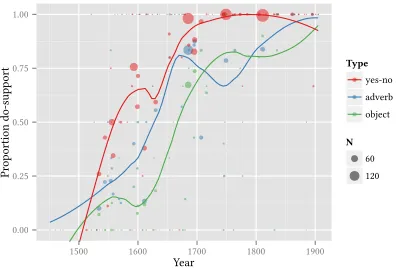
5.2.2 Lexical classes . . . 115
5.2.3 CRH regression . . . 126
5.3 Conclusion . . . 129
6 Conclusion 131
List of Tables
2.1 A table listing the surface restrictions imposed by different regimes of√-insertion. Languages
such as Danish and Norwegian which allow tensed and untensed roots to be inserted are
maximally permissive, being capable of deriving all available options. . . 13
2.2 A summary of various languages withdo-support phenomena, listing the context(s) where
it occurs in each. For Old Icelandic, the availability of topicalization, ellipsis, and
pronomi-nalization is not precisely known; values in parentheses reflect the behavior of the modern
language. . . 18
3.1 A comparison of two logistic regression models ondo-support data from the PPCHE. One
model standardizes the continuous time predictor, whereas the other does not. . . 30
3.2 A comparison of two logistic regression models ondo-support data from the PPCHE. One
has affirmative questions as the reference level, whereas the other has negative declaratives
fulfilling this role. . . 32
3.3 A comparison of two logistic regression models on a subsample ofdo-support data from the
PPCHE. Both models use sum contrasts. . . 33
3.4 A table of logistic regression interaction effects, interpreted in terms of their distances in
years. The first two rows indicate the length of the change (main effect of year) in years
and logit units per year. The left-hand column of numbers gives the magnitude of various
interaction terms. In the body of the table are listed the differences in duration of the change
(in units of years) that combinations of main effect and interaction implies. Thus, in the
top-left cell of the table’s content, the context in question has a slope of 0.118 - 0.1 = 0.018
4.1 Comparison of the size of Ellegård’s corpus with the parsed corpora. In the latter category,
only potentialdosupport sentences occurring before 1700 are counted. . . 53
4.2 Estimates of the proportion of pre-T adverb positioning in the PPCHE (Early Modern English
(EME) portion) with two different classes of verbs which move to T. . . 57
4.3 Estimates of the proportion of pre-T adverb positioning in the entire PPCHE (EME portion). 58
4.4 An estimate of the duration of the emergence ofdo-support in years from a model fit to the
PPCHE data from before 1575. . . 59
4.5 Comparison between a model which assumes the CRH (left) and non-CRH-assuming models.
The models are fit to data from the PPCHE. From left to right, these are two models with
three-way varying slope: one that holds the slope constant between the types of questions
(affirmative and negative) but allows variation in the other contexts; one that holds the
slope constant across negatives (questions and declaratives). The rightmost model is one
that allows full four-way slope variation across contexts. Non-parenthesized values are
coefficient estimates; parenthesized values are standard errors. The stars report significance
at the 0.05 (one star), 0.01 (two) and 0.001 (three)𝛼levels. . . 60
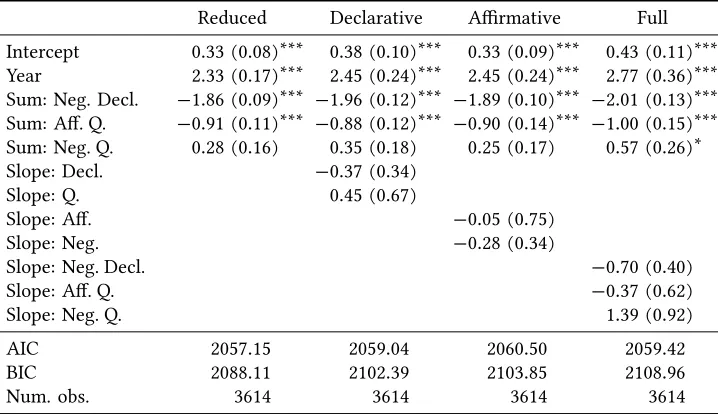
4.6 Comparison between a model which assumes the CRH (left) and models that allow one
context each to differ in slope from the other three.Non-parenthesized values are coefficient
estimates; parenthesized values are standard errors. The stars report significance at the 0.05
(one star), 0.01 (two) and 0.001 (three)𝛼levels. . . 61
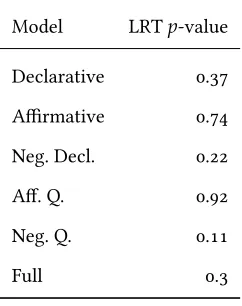
4.7 Likelihood ratio test results between various alternative models and the Constant Rate
Hypothesis (CRH)-assuming equal-slopes model. . . 62
4.8 The sizes of the effects in Tables 4 and 9 of Kroch (1989), measured in logit units and years of
change. . . 64
4.9 A power test of the CRH test fordo-support in Kroch (1989). The proportion of likelihood
ratio tests which reported a significant year×clause type interaction when the real difference
between affirmative questions (reference level), negative declaratives (rows) and negative
questions (columns) was as reported in the table. The other parameters (intercept, main
effects of year and clause type) were as estimated from a regression on the original data. The
year variable was𝑧-centered, and thus the interaction values along the edges of the table are
4.10 Information criterion model comparisons between models which include and exclude average
word length as a predictor ofdo-support usage. A negative value means the model including
the extra predictor has a lower *IC value. The model was fit using theglmfunction in
R, with the formulado support ~ clause type + year (+ word length); the year and
word length variables were standardized to z-scores. . . 67
4.11 Information criterion model comparisons between models which include and exclude
type-token ratio as a predictor ofdo-support usage. The details of the table construction are
identical to those of Table 4.10. . . 68
4.12 Models testing the predictions of Warner (2005) on the presence of age-grading in negative
declaratives in the periods pre-1575 and 1575–1700. . . 70
4.13 Models testing the presence of age-grading ofdousage in affirmative declaratives in the
periods pre-1575 and 1575–1700, following the procedure given by Warner 2005. . . 70
4.14 Unaccusative verbs in the combined corpora, pre-1700. “Total” indicates the #+caption:
number of occurrences in all sentences, whereas the “With possibledo-support” column
indicates the number of occurrences in potentialdo-support sentences (whether or not
do-support actually occurs in the sentence). . . 79
4.15 Experiencer-subject verbs in the combined corpora, pre-1700. “Total” indicates the number
of occurrences in all sentences, whereas the “With possibledo-support” column indicates
the number of occurrences in potentialdo-support sentences (whether or notdo-support
actually occurs in the sentence). . . 79
4.16 A test of the CRH betweendo-support and verb raising pastnever on PPCHE data coming
only from transitives. . . 92
5.1 A comparison of the number of tokens available in various corpora ofdo-support. . . 109
5.2 The quantile of resampled data into which the actual minimum yearly slope in Ellegård’s
List of Figures
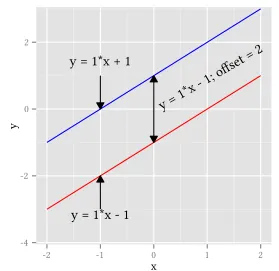
3.1 An illustration of two possible parameterizations of parallel lines. The left-hand system
considers the lines as separate objects, assigning to each a slope and an intercept (for a total
of 4 parameters). The right-hand system uses only three parameters: a slope and an intercept
to describe one line, and an offset to measure the distance between the lines. . . 25
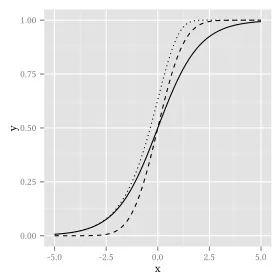
3.2 The logistic (solid) probit (dashed), and complementary log-log (dotted) link functions. . . . 28
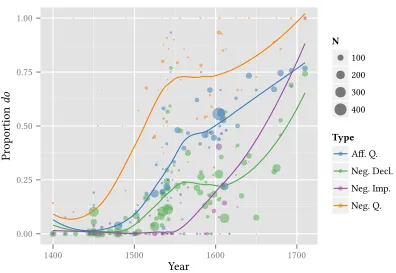
4.1 Do-support in Ellegård’s corpus. . . 43
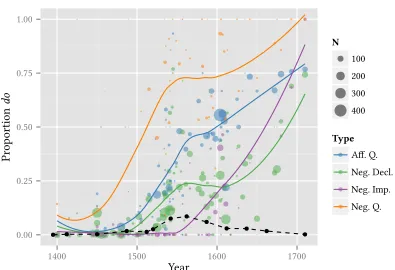
4.2 Do-support in Ellegård’s corpus. Ellegård’s estimate of the proportion ofdo-support in affirmative declaratives is represented by the black points (not scaled according to size), and the intervening dashed line gives a linear interpolation between the points. . . 45
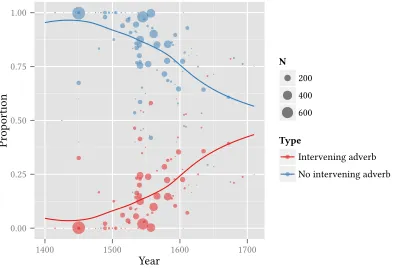
4.3 The behavior of affirmative declarativedo-support in conjunction with adverbs in Ellegård’s data. . . 46
4.4 Do-support in Ellegård’s corpus, partitioned by transitivity. . . 47
4.5 The behavior ofknow-class verbs compared to others in Ellegård’s corpus. . . 48
4.6 The trajectory ofdo-support in various types of questions in Ellegård’s corpus. . . 49
4.7 A syntactic analysis of ME verbal inflection in the absence of an auxiliary. The verb raises to T, across any intervening adverbs. For reasons of simplicity, the movement chain headed by the subject is not shown, nor are a variety of intermediate projections. (cf. Roberts 1985) . . 50
4.8 A syntactic analysis of late EME (and PDE) verbal inflection in the absence of an auxiliary (in affirmative declaratives). T lowers onto the verb by a morphological operation (Embick and Noyer 2001). The tree is simplified somewhat as in figure 4.7. (cf. Roberts 1985) . . . 51
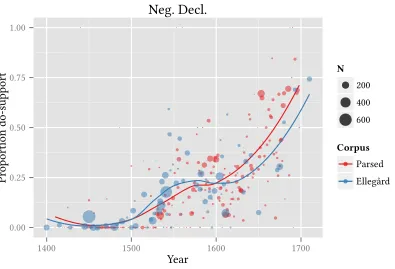
4.9 A comparison ofdo-support in the parsed corpora and Ellegård’s data. . . 54
4.11 The behavior of various types of question in the parsed corpora. The𝛼smoothing parameter
of the LOESS lines has been set to 0.5. . . 56
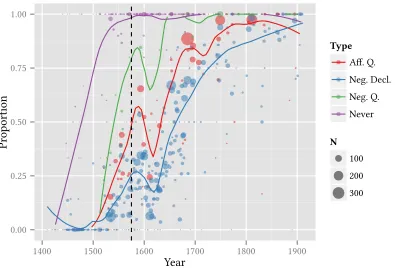
4.12 A plot, using data drwan from the PPCHE, of severaldosupport environments alongside the
incidence of failure of verb raising pastnever. The𝛼parameter of the LOESS smoother is set
to 0.3. A vertical dashed line is placed at 1575. . . 59
4.13 Confidence intervals for the differences between slope coefficients in the full model of the
evolution ofdo-support and verb raising over never. (Calculated by themultcomppackage in
R.) . . . 63
4.14 Relationship between two style measures proposed by Warner (2005) in data from the parsed
corpora (only texts longer than 600 words). . . 67
4.15 The behavior of negative declaratives in the high- and low-word-length halves of the parsed
corpora. . . 68
4.16 The behavior of affirmative questions in the high- and low-word-length halves of the parsed
corpora. . . 69
4.17 The behavior of affirmative declaratives in the high- and low-word-length halves of the
parsed corpora. . . 69
4.18 Predicted age effects of a model with non-linear effects of age and time in the years 1550 and
1600. . . 71
4.19 Predicted trajectory ofdo-support in a model with non-linear effects of age and time in the
years 1550 and 1600. The two age groups are the 25th and 75th percentile of ages represented
in the data. . . 72
4.20 Causative sentences with a non-overt causee formed withletanddoin the PPCME2 (Kroch
and Taylor 2000). The solid points with a black border are the centroid of each cloud of
points. (To avoid excessive overplotting, a small amount of random noise is added to each
point, which is why some data from coastal regions is located in the nearby ocean. Thanks
to Hilary Prichard for the geocoding of the PPCME2 texts on which this map is based.) . . . 75
4.21 Data on the position of adverbs relative to certain types of finite auxiliary verbs in the PPCHE. 78
4.22 Do-support in affirmative declaratives, by argument structure type. (Some data points are
off the top of the graph.) . . . 80
4.23 Do-support in negative declaratives, by argument structure type. . . 81
4.25 The positions ofdoat various points in the history of EME. . . 83
4.26 The predicted priming behavior ofdoin early EME. . . 84
4.27 Priming data ondo-support in EME. The two possible clause types are affirmative declaratives
and all other clause types (those which would be expected to havedo-support in PDE, referred
to as “modern”do-support environments). The graph partitions all eligible prime-target pairs
by which of these two classes the prime and target belong to. The error bars represent 95%
confidence intervals based on the binomial distribution. Dots which seem to lack error bars
have a 95% CI which is smaller than the diameter of the dot. . . 85
4.28 Subject type effects in affirmative declarativedo-support in the PPCHE data. . . 87
4.29 Subject type effects in various moderndo-support environments in the PPCHE data. Note
that wh trace subjects are only attested in declarative clauses, since wh subject questions are
not ado-support environment. . . 88
4.30 A graph of the evolution of affirmative declarative do-support with the most common
non-perfective verbs in the parsed corpora, as diagnosed by the “for/in” test. The black line
is the (weighted) average trajectory for the class. . . 95
4.31 A graph of the evolution of affirmative declarative do-support with the most common
perfective verbs in the parsed corpora, as diagnosed by the “for/in” test. The black line is the
(weighted) average trajectory for the class. . . 96
4.32 The structure of an English sentence for Schütze (2004). For simplicity, specifiers are omitted. 98
5.1 A visualization of the algorithm used to recognize negative declaratives from POS-tagged
EEBO text. . . 107
5.2 The trajectory ofdo-support in negative declaratives in the EEBO corpus. The blue line is a
LOESS smooth with𝛼= 0.7. The red line is a smooth fit using a logistic regression over a
cubic B-spline basis with three evenly-spaced knots at the 0.25, 0.5, and 0.75 quantiles of the
data. . . 111
5.3 The trajectory of negative declarativedo-support in various corpora. . . 112
5.4 Density of the minimum yearly slope from 1550–1625 of a LOESS model fit to EEBO
data resampled under various techniques. The actual values in Ellegård’s corpus (E), the
5.5 Density of the number of years between 1550–1625 that the slope of a LOESS model fit to
EEBO data resampled under various techniques decreases. The actual values in Ellegård’s
corpus (E), the PPCEME+PCEEC (PC) and EEBO are indicated with vertical lines. . . 113
5.6 Density of the slope between the LOESS-fit minimum and maximum points between 1550–1625,
using EEBO data resampled under various techniques. The actual values in Ellegård’s corpus
(E), the PPCEME+PCEEC (PC) and EEBO are indicated with vertical lines. . . 114
5.7 The behavior of several verbs of inherently directed motion in negative declaratives in the
EEBO dataset. . . 115
5.8 The behavior of several verbs of inherently directed motion in affirmative declaratives in the
EEBO dataset. . . 116
5.9 The behavior verbs of inherently directed motion and other unaccusatives in negative
declar-atives in the EEBO dataset. . . 117
5.10 The behavior verbs of inherently directed motion and other unaccusatives in affirmative
declaratives in the EEBO dataset. . . 118
5.11 The behavior of various high-frequency transitive verbs in negative declaratives in the EEBO
corpus. . . 119
5.12 The behavior of various high-frequency transitive verbs in affirmative declaratives in the
EEBO corpus. . . 120
5.13 The behavior of various clausal-object verbs in negative declaratives in the EEBO corpus. . . 121
5.14 The behavior of various clausal-object verbs in affirmative declaratives in the EEBO corpus. 122
5.15 The behavior of various lexical classes (as defined above) in negative declaratives in the
EEBO corpus. . . 123
5.16 The behavior of various lexical classes (as defined above) in affirmative declaratives in the
EEBO corpus. . . 124
Chapter 1
Introduction
This dissertation addresses a series of related theoretical and empirical questions in the historical syntax of
EME, and specifically thedo-support construction.Do-support is the phenomenon in English whereby a
pleonastic auxiliary verbdois inserted in certain clause types (such as negatives, emphatic assertions, and
subject-auxiliary inversion contexts including questions). The phenomenon is characteristic of the modern
language, and there is robust textual evidence that it emerged during EME, beginning in roughly the year
1500. This change has been of long-standing interest to philologists and linguists, with many theories of its
origin and spread advanced. The fine quantitative details of the emergence ofdo-support and the surface
variation it engendered in texts has been the object of study for over 60 years, beginning with Ellegård (1953).
From the standpoint of generative grammar, Kroch (1989) and Roberts (1985), and many others have treated
the emergence of do-support as a closely-following consequence of the loss of V-to-T raising in the 15th and
16th centuries.
Taking a cross-linguistic perspective, this dissertation amasses evidence that, though the totality of
English do-support is uncommon in other languages (if not indeed entirely unattested), the phenomenon
may be seen as the combination of several discrete building blocks, each of which is robustly attested in
languages, some of which are historically and typologically close to English and some of which are not. From
this perspective, a question is raised about the genesis of English do-support: given that the present-day
phenomenon is evidently composed of several separate subcases, why should its cause be attributed solely
to the loss of V-to-T raising?
The core innovative proposal of this dissertation is a grammatical model of the evolution ofdo-support
from the PPCHE which has never previously been applied to the study of do-support, this dissertation
provides evidence for this proposal. This explanation addresses the following points, which under earlier
accounts were unclear:
• The different behavior of do-support across argument structure types (latent in Ellegård’s description
of the phenomenon and elaborated more clearly in the more adaptable data from the PPCHE).
• The appearance of do-support in affirmative declaratives at a peak rate of 10%, much more than can be
attributed to emphatic assertions (previously unexplained).
• The emergence of do-support from a Middle English causative, since there is a plausible semantic
reanalysis from causative to agent-marker.
This “intermediate do” (between the ME causative and the present-day pleonastic support auxiliary) spread
through the language until roughly 1575, when the loss of verb raising triggered an abrupt reanalysis which
transformed the argument-structure marking “do” into its modern form.
In the process of establishing this result, several ancillary conclusions are reached. The PPCHE corpus of
do-support constitutes a source of evidence about the diachrony of the construction which is independent of
Ellegård’s corpus, on which previous quantitative studies were based. It is thus possible to pursue replication
of previous results ondo-support. Many of these are broadly upheld, increasing our scientific confidence in
the reliability of quantitative historical studies. However, certain revisions are necessitated by the new data,
demonstrating the continued value of data collection.
Furthermore, this dissertation demonstrates that such a rich diachronic understanding is necessary from
the standpoint of purely synchronic analysis. There are two families of analysis, both of which make identical
predictions about the distribution ofdo-support in PDE. Broadly speaking, one analysis insertsdowhere it
appears, and the other deletes it where it does not. However, I argue that the understanding of the history of
do-support which is suggested by previous work and confirmed and deepened by this dissertation favors the
insertion account over the deletion one.
Finally, in order to validate certain hypotheses about the behavior of individual lexical verbs, an entirely
novel mechanically-annotated database of EME texts was produced, comprising one billion (109) POS-tagged
words. From this corpus, it is possible to extract two orders of magnitude more data ondo-support than
were previously available. The result is an ability to test hypotheses about the detailed diachronic behavior
gained further advance the understanding ofdo-support, and the data and methods presented will continue
to be of use in other historical syntactic investigations.
This dissertation is organized as follows. Chapter 2 gives an overview of the phenomenon ofdo-support
in English, and provides comparisons to similar phenomena in other Germanic languages as well as more
typologically diverse languages. Chapter 3 introduces a variety of statistical techniques which will be
brought to bear in the investigation. Chapter 4 contains the discussion of many of the core results of the
dissertation, including the replication and extension of previous accounts and the novel proposals about
the structural analysis ofdoin early EME. Chapter 5 discusses the extension of these results in a large
automatically-annotated corpus, with special emphasis on examining the behavior of individual lexical items
Chapter 2
Synchronic considerations
In this chapter, I will give an overview of synchronic data that inform the primary topic of this dissertation,
i.e. the diachronic behavior ofdo-support in English. In section 2.1, I’ll review the environments in which
do-support appears in PDE. Section 2.2 discusses the parallels between Englishdo-support and similar
constructions in other languages. These two sections inform the construction of a structural description of
thedo-support phenomenon, a crucial step for articulating how it arose in English. Section 2.3 discusses
the presence in other languages of constructions involving ado-like auxiliary verb which is not completely
devoid of semantics (as indo-support), but rather is associated with certain semantic features of the lexical
verb. Section 2.4 discusses in more detail variation within English and other Germanic languages in the
use ofdoas such a non-vacuous auxiliary. These two sections relate to the proposed analysis (detailed in
section 4.3) of the intermediate stages of Englishdo-support.
2.1
Do-support in PDE
Do-support refers to the phenomenon whereby a semantically vacuous (“dummy”) auxiliary verb surfaces
in certain morphosyntactic contexts. The “support” nomenclature arises from an intuition thatdo-support
sentences are somehow deficient without the presence ofdo, and more specifically that the function of the
auxiliary is to allow bound morphemes to be spelled out which for morphosyntactic reasons otherwise could
not be. The phenomenon is named after the dummy auxiliary in English, although as will be discussed below
(Section 2.2), it has been observed in other languages as well. In standard PDE,do-support shows up in
variably with so-called pseudo-auxiliaries such asneed,dare, andought; for information on the status and
history of the class of auxiliaries in English see Warner 1993), and is obligatory where it appears. These
contexts are discussed in the following subsections.
2.1.1 Negation
Sentences wherenotis a sentence negator showdo-support:
(1) John didn’t finish his chores.
In addition to negated indicative sentences (and negated questions, which also are an instance of subject
auxiliary inversion discussed immediately below),doappears in negative imperatives:
(2) Don’t lie to me, John.
Auxiliaries other thandoare restricted in their ability to appear in imperatives. Modals are banned. Perfective
haveand progressive and passivebeare both permitted in the appropriate context. When these are negated,
they appear withdo(unlike in negated indicatives):
(3) Don’t have eaten everything before the guests arrive. Potsdam 1995 (18c)
(4) Don’t be fooled by his shoddy argumentation. Potsdam 1995 (16a)
(5) Don’t be ringing the doorbell incessantly. compare Potsdam 1995 (17b)
These facts indicate that there is a potential discontinuity betweendo-support in indicative sentences
and in imperatives.
Whennotis not a sentence negator, but rather constituent negation attached to the main verb,do-support
cannot salvage the sentence from ungrammaticality. On the other hand, if such a sentence has an auxiliary
verb (including adotriggered by a sentence-negatornot), there is no obstacle to its grammaticality. For a
discussion of these facts, consult Embick and Noyer (2001, sec. 7.2).
2.1.2 Emphasis
Affirmative sentences that are emphatic (i.e. have verum focus) havedo-support. Among indicatives, there
are several varieties of emphatic sentences. The first kind places a pitch accent (represented by capital letters)
on the auxiliary:
(6) John DID finish his chores.
A second kind has the auxiliary unstressed, and places the pitch accent instead on an adverbso, which
(7) John did SO finish his chores.
For innovative younger speakers (including the author of this dissertation), it is possible to have thisso
without an accompanying auxiliary. That is to say,do-support is optional for these speakers in this context:
(8) John SO died on level 3 of Super Mario.
(A verb likediewhich cannot be graded is used to distinguish another, more archaizing use ofsoin similar
contexts to mean “to a great degree,” as in “For God so loved the world that he gave his one and only son…”.)
Imperatives can also be made emphatic by the addition ofdo:
(9) A: Don’t sit down B: No, DO sit down.
There is an alternative, unstressed, kind ofdo-support which is associated with obsequious politeness.
This is perhaps most easily illustrable precisely in the case of imperatives (heredomay have a – probably
secondary – pitch accent of some sort, but it is crucially not the same as the pitch accent assigned to it in the
previous example):
(10) Do sit down.
It has also been discussed in the literature as a stereotypical feature of flight attendants’ speech (Banks 1994;
Schütze 2013). The grammatical character of this unstresseddois not clear, but I shall tentatively hypothesize
that it is related in its function and history to the verum focus version of the auxiliary, and leave further
exploration of the details to one side.
2.1.3 Subject-Auxiliary inversion
Sentences where the verb inverts with an auxiliary displaydo-support. The most common such environment
iswh-questions:
(11) What did John say?
When thewh-word is the subject, it does not invert with an auxiliary, and thus does not triggerdo-support:
(12) Who said that? (13) Who will say that?
Polarity questions also involvedo-support:
(14) Did John finish his chores?
Other constructions can also produce Subject-Aux inversion. Examples include negative inversion:
(15) Never have I seen such a wondrous sight. Equative clauses introduced bysoandas:
(17) John finished his chores, as did Mary. Inversions triggered bysoandsuch:
(18) So lazy did John feel that he didn’t finish his chores.
(19) Such a heavy burden did John feel his chores to be that he didn’t finish them. Exclamatives:
(20) What pleasure did I feel on seeing that John had finished his chores! Other types of fronting phenomena:
(21) Only later did we realize that John hadn’t finished his chores (22) Thus did we realize that John hadn’t finished his chores
While this is a wide variety of environments for inversion withdo-support, it is worth noting that all cases
of surface inversion do not lead to the emergence ofdo-support. The above-listed inversion environments
are all analyzed (or analyzable) as involving the movement of the verb to a high position in the clause (C, for
example). There is at least one environment which involves auxiliary movement to C in PDE, but does not
licensedo– Conditional Inversion (CI):
(23) Had John not finished his chores, he would have been in trouble. (24) *Did John not finish his chores, he would have been in trouble.
However, CI was possible withdid until the 19th century (and perhaps even the 20th in highly literate
writing; see Visser 1963, §1473 for further examples):
(25) and surely I could move, did I but will it 1886, Visser (1963)
Furthermore, there is at least one other inversion construction which does not involve movement to a
high position and which also does not licensedo-support, namely inversion withcomeandgo. These two
verbs inverthereortherewith non-pronominal subjects:
(26) Here comes John.
However, pronouns fail to invert:
(27) Here he comes.
Also worth noting in this context is the argument by Culicover and Winkler (2008) that the (optional) surface
Subject-Aux inversion in comparative clauses headed bythan(as in the following sentence) is in fact not
generated by movement to C:
2.1.4 VP topicalization
In English, it is possible to topicalize the VP by fronting it to a sentence-initial position. In these cases,
do-support is generated:
(29) John wanted to see the Great Pyramid, and see it he did.
2.1.5 VP ellipsis
English also hasdo-support in VP ellipsis contexts:
(30) John finished his homework and Mary did too.
In this context,dois in complementary distribution with auxiliaries:
(31) John has finished his homework and Mary has too. (32) *John has finished his homework and Mary does have too. Compare:
(33) John will have finished his homework and Mary will⁇(have) too.
The precise conditions under which VP ellipsis is licensed in English are subtle, and the body of research on
the question is large – see van Craenenbroeck (to appear) for an overview. Nonetheless, the generalization
that English usesdoin VP ellipsis contexts whenever they occur and otherwise lack an auxiliary is robust.
There is one context in particular that is worthy of special mention. It combines subject-auxiliary inversion,
VP ellipsis, and the insertion ofso:
(34) John finished his homework, and so did Mary.
This construction involves bona fidedo-support, as illustrated by the alternation ofdo here with other
auxiliaries:
(35) John has finished his homework, and so has Mary. (36) *John has finished his homework, and so does Mary have. (37) *John has finished his homework, and so has Mary done.
This usage contrasts with a similar, yet non-inverteddo soconstruction. Thedoin this non-inverteddo so
fails to alternate with modals:
(38) John finished his homework, and Mary did so too.
(41) John knows that the Earth is round, and Mary does (*so) too. For these reasons, it cannot be treated as a support phenomenon.
2.1.6 Non-
do
-support
do
In addition to ‘do so’, there are other uses of ‘do’ in PDE that are not connected to the phenomenon of
do-support. For discussion of adowhich follows a modal or other auxiliary in VP ellipsis contexts in British
English, see section 2.2.2.
2.1.7 Structural remarks
The property that thedo-support environments discussed above share is a disruption of the local relationship
between T and V. In the case of negation and emphasis, a head intervenes between these two projections – Σ
in the terminology of Laka (1990). In the subject-auxiliary inversion and VP topicalization cases, movement
disrupts the relationship. In the former case, head movement is the relevant phenomenon, whereas in the
latter it is XP movement. In VP ellipsis, the V head is deleted by the ellipsis operation.
These facts suggest several architectural conclusions. The fact that head movement can disrupt adjacency
suggests thatdo-support is created relatively close to the surface on the widespread (though by no means
universal) view that head movement is a PF phenomenon (Chomsky 2001). The fact that a topicalized
VP cannot fulfill the adjacency requirement in its base position (in a way analogous to reconstruction for
interpretation at LF) is another piece of evidence in this direction.1 In lieu of presenting an overview here of
the different analyses of these facts, the reader is referred to section 4.4, where the proposals are spelled out
and evaluated in their coverage of both synchronic and diachronic facts.
Having established the contours ofdo-support in (standard American) PDE, the next section moves on
to consider the distribution of phenomena similar todo-support in other languages and dialects, another
important consideration for grounding the historical syntactic inquiry of this dissertation.
2.2
Do-support in other languages
It has been noted that phenomena resemblingdo-support may appear in languages other than English. In this
section, several such languages are reviewed, with the goal of placing the Englishdo-support phenomenon
1Of course, the mere description of the phenomenon as relating to “adjacency” presupposes a linear – and thus PF-oriented – view
in a crosslinguistic context.
2.2.1 Northern Italian
The case ofdo-support in certain Northern Italian (specifically Lombard) dialects is described by Benincà
and Poletto (2004, hereinafter BP). In the specific dialect analyzed by the authors, finite verbs raise to T in
all sentences, as in French and unlike in EME or PDE (cf. Pollock 1989). This is demonstrated by the finite
verb’s appearance to the left of an adverb likesemper‘always’:
(42) l he tʃàkola speaks semper always
‘He always speaks’ BP (7a)
Thus, in declarative sentences (affirmative or negative),do-support is not implicated:
(43) l he tʃàkola speaks mìa not
‘He doesn’t speak’ BP (8)
On the other hand, in questions (both polarity andwh)do-support is in evidence:
(44) fa does -l he majà? eat
‘Does he eat?’ BP (18a)
(45) ke what fe do -t you majà? eat
‘What do you eat?’ BP (21a)
Just as in English, thisdo-support applies only in cases where there is no auxiliary verb,2 and not to
subjectwh-questions. There are, however, some differences with Englishdo-support. In addition to the
previously-noted lack ofdo-support in negative declaratives, it fails to manifest in emphatic sentences and
in VP-ellipsis contexts. Each of these differences can be explained by an independent property of Northern
Italian syntax. In the case of emphasis, the verb raises past the polarity projection Σ which hosts negation
and emphatic affirmative features, renderingdo-support unnecessary (because no bound morphemes are
stranded by the syntax). As for ellipsis, it is generally banned in Northern Italian.
2For the Monnese dialect studied by BP, the class of auxiliaries includeshaveandbe, certain modal verbs (but not all such verbs),
More interesting is the case of subjectwh-questions. In transitivewh-subject questions for example, the
question construction merges an overt complementizer and is parallel to the syntax of embedded questions:
(46) ki who ke C maja eats
‘Who eats?’ BP (25a)
(47) el it so I.know mìa not kü who ke C à has majà eaten
‘I don’t know who has eaten.’ BP (15a)
Unaccusative subjects have two options: they can either trigger the subject-wh pattern with a matrix
interrogative complementizer, or the object-whstrategy withdo-support:
(48) ki who ke C l 3sg.subj va goes a to ka? home
‘Who goes home?’ BP (31a)
(49) fa does -l 3sg.subj nda go a to ka home ki? who
‘Who goes home?’ BP (31b)
This, BP argue, is related to the fact that unaccusative subjects may optionally remain in a low position.
The Northern Italian situation, then, has striking parallels to the English one. There is (distributionally)
a morphosyntactic requirement that C0be filled by a finite verb in matrix questions, except in sentences
with awhsubject in a high position (as all English subjects must be). A lexically restricted class of verbs
can fulfill this requirement by moving to C, but most verbs cannot. Those verbs rely on the insertion of a
semantically vacuous auxiliary in C to satisfy the morphological requirements on that head. On the other
hand, Northern Italian has verb movement to T in all circumstances (e.g. across negation), sodo-support
is never demanded by the requirements of T. These facts support an analysis ofdo-support as a last resort
phenomenon in Northern Italian, and also increase the confidence that an analogous analysis of PDE is on
the right track.
2.2.2 Scandinavian
In Mainland Scandinavian,do-support appears in VP topicalization, ellipsis, and pronominalization contexts
(attested primarily in the northern ME area as an alternant withdo,make, andletin the system of causatives).
The following example from Houser et al. (2006) illustrates the topicalization phenomenon in Danish:
(50) Jasper J. lovede promised at to vaske wash bilen the.car og and vaske wash bilen the.car gjorde did han he (så so sandelig) truly
‘Jasper promised to wash the car, and wash the car he did (indeed).’ (6)
In Danish as well as Norwegian, there is variation between constructions where the topicalized V is finite
as above, and those where it is an infinitive (51a). Swedish, on the other hand, allows only finite verbs to
topicalize (51b):
(51) a. og
and kørde/køre drove/drive bilen car.def gjorde did han he b. och and körde/*köra drove/drive bilen car.def gjorde did han he
c. and *drove/drive the car he did Platzack 2008 (5)
PDE allows only the non-finite construction (51c), however ME “occasionally” (in Visser’s words) displayed
the finite construction:
(52) And touchede þe chest þo he dude with his honde c1450, Visser (1963, §1423)
Danish, Norwegian, and PDE – but not Swedish – allow VP-ellipsis withdo-support. This is illustrated
for Danish here:
(53) Mona M. vaskede washed ikke not bilen the.car men but Jasper J. gjorde did
‘Mona didn’t wash the car but Jasper did.’ Danish, Houser et al. 2006 (7)
Danish, Norwegian, and Swedish – but not English – allow insertion of ado-verb when the VP is replaced
by a pronoun:
(54) Mona M. vaskede washed ikke not bilen the.car men but det it gjorde did Jasper J.
‘Mona didn’t wash the car but Jasper did so.’ Danish, Houser et al. 2006 (8)
It is important to distinguish the pronominalization here fromdo sosubstitution in English. Englishdo
socan only substitute for verbs of a certain aspectual class, being incompatible with statives as discussed
previously. In Mainland Scandinavian, however,do-support+pronoun is compatible with all verb types
(55) Maria M. gillar likes inte not fisk fish men but det it gör does Johan. J.
‘Maria doesn’t like fish but John does.’ Swedish, Platzack 2008 (10d)
Thus, we may regard this phenomenon as a genuine instance of a pleonastic support phenomenon, unlike
the superficially similar English construction.
Platzack analyzes thedo-support in these constructions as being realized inv, not in T as in standard
analyses ofdo-support in English. His evidence for this claim comes from the following crucial sentence,
where thegør is inserted below negation, which in turn is positioned below T:
(56) Maria M. liker likes melk milk mens but Johan J. ikke not gør does det it
‘Maria likes milk but Johan doesn’t.’ (11)
A word-for-word identical sentence can also be constructed for Swedish.
Platzack approaches the questions raised by the above data from a Distributed Morphology perspective,
where a category-neutral root (or√) combines in the syntax with a category-determining head (such asv
to form verbs) in order to yield what appears on the surface as an open-class lexical word. The features of
category-defining heads are relatively fixed – that is, such heads are drawn from a small set (possibly of
cardinality one) in a given language. On the other hand,√s are subject to idiosyncratic variation in their
content in terms of syntactic (as well as phonological and semantic) features.
Table 2.1:A table listing the surface restrictions imposed by different regimes of√-insertion. Languages such as Danish and Norwegian which allow tensed and untensed roots to be inserted are maximally permissive, being capable of deriving all available options.
√ has Tense? Language VP ellipsis VP topicalization VP pronominalization
yes Swedish no tensed yes
no English yes untensed no
yes/no Norwegian, Danish yes variable yes
Platzack argues that the microvariation in these facts is explained by a parameter controlling the insertion
of√ with or without a Tense feature from the lexicon. The possibilities are laid out in Table 2.1. The presence
or absence of a Tense feature on the root has the most straightforward effect on VP topicalization: if it is
pronominalization cases are handled confusingly by Platzack’s analysis. The core assumption is that in either
case the root cannot move tov, since that position is occupied bygøre(etc.). The uTense feature onvis the
beneficiary of checking by T, but in languages with tensed√ such as Swedish there is an extra uninterpretable
tense feature on the root, present in the lexicon, which has no way to be checked. VP pronominalization is
licit (and in fact required) aftergörabecause it removes the root from the tree along with its extra tense
feature, allowing the derivation to proceed. There is no satisfactory explanation, however, of why the lack of
VP pronominalization in English follows from the lack of tense features on roots. Platzack merely avers that
“it should be no surprise that comparing the structures [without tense on the root] and [with it], it is the
more self-contained one, [the latter], that is the basis for pronominalization, whereas the more dependent
one, [the former], is the basis for ellipsis.” (18) Platzack’s account thus falls short of successfully capturing in
a coherent formalism all the properties of the data presented above. However, it does seem to be on the right
track towards identifying the microvariation in the Mainland Scandinavian(+English) dialect continuum. I
take Platzack’s conclusions to mean that English shares with Scandinavian a kind ofdo-support which is
unconnected in its synchronic syntax with the kind that is exclusive to English (i.e. that appearing in negative
declaratives, questions, and emphatic sentences). The latter type ofdo-support is commonly analyzed as
being associated with the position T; it is noteworthy that Platzack’s analysis also is powered by tense
features even though the action takes place in a different structural position. The proposal in section 4.3
about the diachrony ofdo-support in English precisely postulates that in early EMEdois merged inv; this
provides a diachronic link between the different kinds ofdo-support in English.3
British English ellipsisdo
There is a kind ofdo-insertion which occurs in British English and shares some superficial similarities with
the phenomena discussed in the above section. It is illustrated here:
(57) The Eagles won’t win the Super Bowl, but the Giants may do.
I will argue, however, that this phenomenon is not connected to the above paradigms. Rather, it is an
alternative to absolute elimination for the realization of elided VPs. The evidence for this claim is the
observation that what I will call the British ellipsisdois not in complementary distribution with auxiliaries,
but in fact cooccurs with them. Sentence (57) above is one example of this fact with a modal auxiliary.
Examples withhaveand auxiliarydofollow:
3It also could be used to generate predictions about the spread ofdo-support through the language. The simplest of these proposes
(58) I didn’t know the answer, but John may do. Pullum and Wilson 1977, (41b) (59) John didn’t go to the ball game, but Peter did do.
This contrasts with thedoof VP topicalization which is in complementary distribution with auxiliaries in
English – including British English, where the following judgments come from:4
(60) Listen though he may (*do), he won’t be able to hear a thing. Swedish minimally contrasts with British English in this environment:5
(61) Maria M. lovade promised att to köra drive bilen the.car och and köra drive bilen the.car ska will hon she göra do
‘Maria promised to drive the car, and drive the car she will do.’
2.2.3 Old Icelandic
In Old Icelandic, a construction similar todo-support appears briefly and never categorically.6 This
con-struction using the Icelandic synonymgeraof the worddoappears in very early (9th century) poetic texts,
and in prose beginning in the 12th century. In early Skaldic poetry,geraappears freely, apparently in a VP
topicalization construction. In the Eddic poetry (more vernacular in its syntax than Skaldic) and the earliest
prose texts,geraalways appears with negation:
(62) ef if hann he görr does eigi not segia say
‘If he doesn’t say/tell.’ Viðarsson 2009 (246a)
Later, it appears in contexts without negation as well, though apparently always in the presence of a
contrastive interpretation of some sort (for this reason, Viðarsson (2009) analyzes the construction in terms
of focus): (63) Klarus K. prestr priest gerdi did þvi it alldregi never trua believe
‘(context: others believed but) Klarus the priest never believed it.’ Viðarsson 2009 (261d) This later usage also becomes less restricted in other ways: it can appear embedded under a modal (64) and
with an inflected infinitive (65, i.e. with precedingatcorresponding very roughly totoin English.)
4Thanks to Amy Goodwin Davies for this judgment, which she also confirmed with 2 other speakers of British English. 5Thanks to Kajsa Djärv for the judgment of this sentence, which she reported to be “grammatical but perhaps a bit awkward/clunky.” 6The entirety of the discussion in this section is heavily based on information from Heimir van der Feest Viðarsson, for which I am
(64) at C hann he munnde would æi not lægia make.laugh gera do
‘(It was said about this man that there was no one) that he could not make laugh.’
Viðarsson 2009 (257) (65) þa then gerdi did hann he eigi not at to ganga go i in tidagerd divine.service þeira their
‘Then he didn’t go into their divine service.’ Viðarsson 2009 (262)
At this time, Icelandic was undergoing a change in its negator, from a bound morpheme-aor-atwhich
attached to a finite verb in C to a free (i.e. not bound) adverbialekki(the latter system continues in present-day
Icelandic). Viðarsson observes that suffixal negation survives longer with modals (and a certain subclass of
lexical verbs) at a time wheneigi(often but not always in combination withgera) is the negator for most
lexical verbs. This suggests an account of the emergence ofgera-support in Icelandic that assigns it initially
the role of a last-resort element which supports lexical verbs when they cooccur with negation; modals
are freer in their syntactic appearance as in English and do not demand a support auxiliary.7 The system
then quickly dissolves over the course of the following century, aseigi(and laterekki) become the default
negators and any requirement for a support auxiliary is lost. In turngerais reanalyzed as a marker of
information structure before disappearing from the language entirely (in this role; it survives as a lexical
verb and in VP pronominalization constructions). This development (insofar as we see it happen at all) is in
a sense the inverse of what happens in English. Instead of a verb which takes verbal complements (i.e.do)
gradually acquiring a more abstract grammatical character until it becomes fully semantically bleached and
fully predictable in its distribution as an auxiliary, in Icelandic the most abstract and constrained distribution
is the first observable, which subsequently erodes. (Unlike withdoin English,geraappears to basically
lack a causative use with an infinitival complement in Old Icelandic, outside of a few examples in direct
translations from Latin. On the other hand,geracan freely take nominal, adjectival, and past participial
complements.)
It is clear that the precise mechanics of the evolution ofgerain Icelandic are not fully captured by this
description. I mention the Icelandic case, albeit in this incomplete way, for two reasons: to point it out as
the only Germanic parallel to the last resortdoof PDE and to highlight the apparently quite pronounced
7The precise characterization of this last-resort type operation is somewhat mysterious, since lexical verbs in affirmatives are
differences in the diachronic trajectory ofdo-support through the grammar of the two languages. In English it
spread from a causative to a support auxiliary, whereas early Icelandic shows exactly the opposite evolution.
As a final note, present-day Icelandic shares with its Scandinavian relatives the VP pronominalization
construction in Section 2.2.2 – but allows neither VP topicalization nor ellipsis (Platzack 2008). The diachrony
of these constructions in Icelandic has not been, to my knowledge, explored in the literature.
2.2.4 Korean
As reported by Hagstrom (1995), Korean possesses a kind ofdo-support which emerges in two contexts. The
first of these is with negation. There are two possible types of negation in Korean: the so-called “short” and
“long” negation. In short negation, a negative prefix attaches to the verb directly, which acquires tense and
clause-typing suffixes and appears in the clause-final position:
(66) Chelswu-ka
Chelswu-nom
chayk-ul
book-acc
an-ilk-ess-ta
neg-read-past-decl
‘Chelswu did not read the book.’ Hagstrom (1995) (11a)
In long-form negation, on the other hand, the main verb appears with a participial ending,8followed by a
free morpheme expressing negation and the verbha-‘do’ inflected for tense and clause type:
(67) Chelswu-ka Chelswu-nom chayk-ul book-acc ilk-ci read-prt ani neg ha-ess-ta do-past-decl
‘Chelswu did not read the book.’ (11b)
Thus, in Korean the verb cannot raise pastani, requiring the insertion ofha. This is exactly analogous to the
situation in PDE withnot.
The second environment fordo-support in Korean involves a special information status for the verb:
(68) Chelswu-ka Chelswu-nom chayk-ul book-acc ilk-ki-nun read-prt-top ha-ess-ta do-past-decl
‘It’s read the book that Chelswu does.’ Hagstrom 1995 (35a)
The role of the verb in this construction is variously described as focus, topic, and contrastive topic; I will
use the term “topic” in keeping with the most common nomenclature for thenunmorpheme implicated,
even among authors who refer to the whole construction as a focus construction. The topicalization can
apply to any of several constituents: V,v, and T. (Aoyagi 2006) The cases of topicalization of V andvare
8Hagstrom (1995) remains non-committal about the nature of this morpheme, spelled-ci. The participial analysis comes from Yi
surface-identical, and yield structures like in (68) above. Topicalization of T yields two additional possibilities,
doubling of the tense morphology on the topicalized verb, and displacement of the tense morphology from
hato the lexical verb:
(69) … mek-ess-ki-nun
eat-past-prt-top
ha-ess-ta
do-past-decl
‘… ate.’ Aoyagi 2006 (31d)
(70) … mek-ess-ki-nun
eat-past-prt-top
ha-ta
do-decl
‘… ate.’ Aoyagi 2006 (31f)
It is also possible to double the topic-marked verb rather than replacing it withha:
(71) Chelswu-ka Chelswu-nom chayk-ul book-acc ilk-ki-nun read-prt-topic ilk-ess-ta read-past-decl
‘It’s read the book that Chelswu does.’ Hagstrom 1995 (35b)
Korean, then, has the ability to inserthaat several different levels of the structure in order to provide a
host for the clause-typing complementizer-ta, which cannot be a verb which is topic-marked by-nun.
2.2.5 Summary
Table 2.2:A summary of various languages withdo-support phenomena, listing the context(s) where it occurs in each. For Old Icelandic, the availability of topicalization, ellipsis, and pronominalization is not precisely known; values in parentheses reflect the behavior of the modern language.
Language neg. decl. ?s VP topic VP ellipsis VP pron
English + + + +
-Danish/Norwegian - - + + +
Swedish - - + - +
Monnese - + - -
-Korean + - + -
-Old Icelandic + - (-) (-) (+)
In this section, I have discussed the distribution ofdo-support-like phenomena in languages other than
language is known to exhibit the same distribution ofdo-support phenomena as English, each of the specific
contexts fordo-support in English finds an echo in some other language. Table 2.2 summarizes the findings.
Further discussion of these contexts can be found in Jäger (2006), who provides in his Tables 2 (p. 132) and
3 (p. 158) a list of up to 16 languages which showdo-support in negative sentences, 21 which show it in
questions (of some type or another), and 10 which have it in topic or focus constructions of some variety.
These findings demonstrate thatdo-support phenomena appear in a variety of languages and syntactic
contexts. English happens to havedo-support in most (but not all) of these contexts; however the existence
of languages withdo-support in fewer places confirms that the English phenomenon need not be treated
as monolithic, but can rather be treated as the end result of several independent activations ofdo-support.
(The intended sense of “independent” here refers to synchronic facts; of course any particular language’s
choices about where to usedo-support is the result of contingent, and mutually dependent, facts about the
language’s history.) Having discussed the distribution ofdo-support in PDE and other languages, I’ll now
move on to a crosslinguistic discussion of non-do-support contexts in whichdoappears as a functional
element.
2.3
Do
as a non-vacuous light verb
A variety of human languages show phenomena where a synonym ofdois used as a light or auxiliary verb,
but which nonetheless are differentiated fromdo-support phenomena in thatdoin these constructions has
some semantic value. The range and frequency of these constructions, especially those wheredo’s semantics
are associated with causativity, agentivity, or other properties of the external argument, is important for
understanding the stepwise development ofdoin the history of English, discussed in section 4.3. In this
section, I provide an overview of some representatives of such constructions drawn from a variety of
languages.
One common argument-structure related use for adolight verb involves the adaptation of loan words.
Several languages show a pattern whereby borrowed verbs cannot participate in native inflectional processes,
but rather are combined with a native light verb. The example below comes from Konkani (Indo-Aryan):
(72) kazar
marry
-karuk
make
(73) kazar
marry
-zavunk
be
‘to get married’ (Wohlgemuth 2009, p. 253)
Other languages which are claimed to have a similar system are Tamil (Dravidian) and Warlpiri
(Pama-Nyungan) (Wohlgemuth 2009). Jäger (2006, p. 165) provides the additional example of Rama
(Chibchan-Paezan) as a member of this class of languages. Jäger (2006, p. 171), following Alekseev (1994a,b), also points
out languages which extend periphrasis to native vocabulary as well: Rutul and Budukh (Caucasian) use
an auxiliary verb in every sentence obligatorily; for transitives the auxiliary is a synonym ofdowhereas
intransitives takebe.
Other languages have productive inflectional paradigms for lexical verbs, but usedoperiphrasis in a
transitivizing role. Jäger (2006, sec. 5.3.3) provides an overview of many such languages. One example taken
from that text are Apinajé (Ge-Kaingang), which has a productive transitivizer derived fromdo(ɔin the
below examples):
intransitive meaning intransitive form transitive meaning transitive form
drink itkō drink (something) tɔitkō
go tē take tɔtē
end apeč finish tɔapeč
be full dət fill ɔdət
be pretty bɛči beautify ɔbɛči
A second example comes from Lahu (Tibeto-Burman). In this language,te‘do’ can have a causativizing
function. However, it can also function as an optional transitivizer, as the following pair of synonymous
sentences illustrates:9
(74) yɔ̂ 3sg thàʔ acc dê scold chɛ̂ someone ve ?
‘They’re scolding him.’ (75) yɔ̂ 3sg thàʔ acc dê scold te do chɛ̂ someone ve ?
‘They’re scolding him’ / ‘*They’re making him scold someone’ Matisoff (1973, p. 246)
9The ? in the glosses does not correspond to a question marker; it is reported by Jäger (2006, p. 255) as an apparent indication of his