University of New Hampshire
University of New Hampshire Scholars' Repository
Honors Theses and Capstones Student Scholarship
Spring 2019
Storytelling Study
Samantha Irene Pepe
University of New Hampshire, Durham, [email protected]
Follow this and additional works at:https://scholars.unh.edu/honors
Part of theChild Psychology Commons,Cognitive Psychology Commons,Early Childhood Education Commons,Educational Methods Commons,First and Second Language Acquisition Commons,Health Psychology Commons,Human Factors Psychology Commons,Language and Literacy Education Commons, and thePsycholinguistics and Neurolinguistics Commons
This Senior Honors Thesis is brought to you for free and open access by the Student Scholarship at University of New Hampshire Scholars' Repository. It has been accepted for inclusion in Honors Theses and Capstones by an authorized administrator of University of New Hampshire Scholars' Repository. For more information, please [email protected].
Recommended Citation
STORYTELLING STUDY
A Look at the Impact of Prosody on Visual Attention and Comprehension Levels for Preschoolers During a Read-Aloud Story
BY
SAMANTHA PEPE
This thesis was examined and approved in fulfillment of the requirements for the University Honors Program.
Thesis Advisor: Jill C. Thorson PhD, Communication Sciences and Disorders
TABLE OF CONTENTS
ACKNOWLEDGEMENTS ………i
ABSTRACT………ii
1. INTRODUCTION ………..1
2. METHODS ……….…………7
2.1 Participants………7
2.2 Materials ………...8
2.3 Procedure ………10
2.4 Analysis ………..10
3. RESULTS ……….…………11
4. DISCUSSION ……….…….14
4.1 Limitations ……….16
4.2 Future Directions ………17
5. CONCLUSIONS ……….….17
REFERENCES ……….………19
APPENDIX A ……….……….21
Acknowledgements
I would like to thank my thesis advisor, Dr. Jill C. Thorson, for assisting me in every way not
only necessary but possible so that I could maximally succeed at my thesis. I would additionally
like to thank Dr. Greenslade for her assistance with the story portion of this study and for serving
as my committee. Lastly, I would like to thank CAT Lab for listening to me present my research,
ii
Abstract
Expressive prosody (i.e., a manner of communication that is characterized by lively rhythm and
tempo) and inexpressive prosody (i.e., monotone speech) present different environments for
listening to a story during a read-aloud session. This study aims to assess whether there are
visual attention differences for preschoolers in these varied prosodic environments and how this
1. Introduction
Story-time is a concept that has been incorporated into the routines of preschool aged
children for decades. Researchers and educators alike have seen the educational benefit of
children being exposed to narratives at a young age; it has been found to increase the child’s
interest in reading and overall increase the literary success of the child. Children who have had
more exposure to read-aloud story-times have generally scored higher on reading comprehension
tasks and rate their enjoyment of reading higher than children who have had limited exposure to
stories. Therefore, it is a commonly accepted fact that there is immense value in read-alouds for
younger children; what researchers evaluate now is how to maximize that value for the children
who encounter story-time in the classroom and at home—whether that is the manner in which
the language is presented, the amount the language is presented, or another linguistic element
that will impact language learning.
Language can be broken down into two components—segmental and suprasegmental.
Segmental components of language pertain to events that occur on the phonemic level
(Veenendaal, 2014), which consist of the sounds that create meaningful contrasts. On the other
hand, suprasegmental components of language are from a broader perspective than segmental
components. Suprasegmental elements are viewed in terms of not what is said, but how it is said.
These elements provide information about the emotional intent of language, boundaries that
indicate grammatical or structural intentions (syntax), variations in vocabulary based on stress
patterns, a hierarchy of information within an utterance, social intent, as well as other higher
level qualities of language. An umbrella term for variations in language in regards to the
aforementioned components is prosody of speech (Veendendaal, 2014; Cutler & Swinney,
2 Prosody of speech can be described as the “tune” and “rhythm” of speech (Ladd, 1996).
Prosody has several communicative functions. Many of the communicative properties of speech
prosody can be broken down into either linguistic or paralinguistic categories (also called
non-linguistic). Linguistic communicative functions refer to the interaction between suprasegmentals
and their segmental functions. An example of a linguistic communicative property is how
syllable stress may influence a semantic or lexical category of a word, for instance changing the
stress pattern of the word “record” can change the word from a noun to a verb. Another example
is changing the significance of a word during an utterance using increased stress and intonation,
such as when you are emphasizing a significant point (e.g., if you were emphasizing the fact that
an individual did not eat, you may put more stress on the word “didn’t” in the sentence “She
didn’t eat the food”). Paralinguistic functions refer to the use of prosody as the addition of
circumstantial information (Hirschberg, 1999). An example of using prosody for paralinguistic
purposes is using it to show emotional intent, irony, humor, or hinting other pragmatic elements
(Hirschberg, 1999; Veenendaal, 2014; Mitchell, Rachel et al, 2016 ). The only communicative
function of speech prosody that does not quite fit into either of these categories is the use of
prosody to show breaks in words and sentences, which is critical for children who are in the
process of acquiring their native language. For this function, the duration and intensity cues are
the most significant and can assist a child with determining when a sentence or thought ends and
where a new thought begins, as well as what combination of phonemes its own word and which
is separate (Hirschberg, 1999; Veenendaal, 2014). Though this property is a function of
language, it does not fall perfectly into either the paralinguistic category or the linguistic
category and can be somewhat qualified for both. It is variable among researches as to which
Without prosody, speech may sound monotone (Veenendaal, 2014). With the efficient
and productive use of prosody, as well as other factors such as social interactions and gestures,
our productions demonstrate an accurate portrayal of our intentions and thoughts. This is critical
in conversation and discourse on a daily basis for adults, and it is fundamental for the acquisition
of language (Veenendaal, 2014). Before a child becomes literate, the understanding of language
(i.e., naming of objects, demands, expressions of wants and needs, and understanding of the
world) comes solely from spoken speech and what can be visually observed from social
interactions between individuals and cues such as facial expression and physical gesture.
Without effective use of prosody, certain mechanisms of language would be lost entirely on
young children. For example, without prosody children may not know the difference between the
noun “attribute” and the verb “attribute,” or be able to distinguish what information is more
important than other bits of information. Some of the main ways that children learn social cues
as well as word segmentation and word learning from spoken speech is through labeling,
conversation with peers and adults, and read-aloud sessions of stories, therefore the manner in
which these things are communicated is critical. If the communicative partner of a child is
labeling objects, conversing with the child, and reading stories in an expressively prosodic
manner, the impact may be different and more impactful than if they do so in an inexpressive
prosodic manner (Cutler & Swinney, 1987; Mira & Schwanenflugel, 2013).
Prosody can be examined by analyzing its acoustic correlates, often categorized by
fluctuations in these areas. The primary acoustic correlates of prosody include fundamental
frequency (which has a perceptual correlate of pitch), intensity (which has a perceptual correlate
of loudness), and duration (which is seen in terms of prosody as breaks and longer time spent
4 fundamental frequency (pitch) fluctuations as the primary mechanism determining whether or
not we perceive the prosody of someone’s speech as being expressive or inexpressive
(Mira & Schwanenflugel, 2013). However, the other two factors influencing prosodic perception
also play a key role when combined with pitch. For example, duration, pitch, and intensity all
come together to indicate accentuationthat can be placed on a syllable, a word, or a phrase of an
utterance (Cutler & Swinney, 1987). Different types of accentuation can influence how
expressive we perceive an utterance, the importance of a word, or the semantic meaning of
a word. In addition, prosodic variation in these correlates and the placement of pauses (breaks)
can indicate word boundaries for preliterate children. In other words, breaks indicate to children
who cannot read what is part of a word and what is a separate word, which helps for word
learning (Hirschberg, 1999).
In addition, we perceive speech streams with more exaggerated pauses after sentences or
key words as being more expressive. These types of durational cues are a critical factor in child
directed speech (CDS), sometimes also referred to as “Motherese” (Zellou & Scarborough,
2017). It has been noted in studies conducted previously that when there are few fluctuations in
fundamental frequency (also annotated as f0),few fluctuations in durations of words, and little
intensity variation, adults and children alike view the speech as being inexpressive (Mira,
& Schwanenflugel, 2013).
In the case of prosody, expressiveness is characterized by fluctuations in pitch, loudness,
and duration that give a speech stream the impression of liveliness (Mira, & Schwanenflugel,
2013; Ladd 1996). There has been a positive correlation previously noted between numbers of
fluctuations in fundamental frequency and perceived expression in a speech segment
influencing prosody of speech, we view the speech as being inexpressive or more commonly
referred to as monotone. Mira and Schawanenflugel (2013) examined whether or not the
expressive nature of prosody during a read-aloud session impacted comprehension of the story
for preschool aged children. The expressiveness of the prosody was actively controlled and
regulated for the study. When controlling for inexpressive prosody during a sample for their
study, Mira and Schwanenflugel (2013) ensured that there was an average fundamental
frequency across the entire sample as well as a common level of intensity, and that each syllable
lasted for approximately the same amount of time (which controlled for number of syllables
influencing duration cues). This ensured that there were minimal fluctuations in the acoustic
correlates, which therefore allowed for the monotone perception of the tone.
There have been studies that have been done that have examined the correlation between
expressive prosody, inexpressive prosody, and comprehension of speech, with the most
prominent study being the aforementioned Mira and Schwanenflugel study (2013). There were
two-way between-subjects condition for this study, one in which an expressive version of a story
was read and one in which an inexpressive version of a story was read. Children sat and listened
to one of the two versions of the story and then answered open-ended as well as cued-recall
questions about the story. Also, there was an examination of whether or not the prosodic features
of the story impacted the comprehension abilities of the children who were listening to them. The
study concluded that, in fact, there was significant evidence that children who listened to the
expressive condition of the story had better comprehension scores of the story than those who
listened to the inexpressive condition (Mira and Schwanenflugel, 2013).
One factor that this study did not take into account was whether or not the children had
6 experienced. For example, if a child is listening to a story that is being read in an expressive
manner, are they more likely to pay closer attention to the content than if they are being read to
in an inexpressive manner? Connected to that question is the inquiry of whether visual attention
connects with the comprehension of the story, and whether this is a third variable mediating
prosody and speech comprehension. This question is the basis of the current study, where it is
asked if attention acts as a possible third variable in the correlation between prosody of speech
and comprehension for preschool aged children in a read-aloud setting (Mira and
Schwanenflugel, 2013).
Attention is something that is difficult to measure, as it is an aspect of our thought
processes that is oftentimes internal and not something outwardly expressed, particularly for
children. There are several ways in which researchers have measured attention, and the most
common way to measure attention in children by looking at where they visually attend. It has
been researched and determined that children are most likely to express their attention via eye
gaze, shifting from one object to another given their interest levels. For children without fully
developed lexicons, and without the discourse skills to be able to describe their thought
processes in attention tasks, tracking the eye gaze is the most concrete and least subjective way
to ensure that attention is being focused (Murphy & Bennett, 2007).
For the purposes of this study, eye gaze will help determine whether or not the child is
focused on the speech being presented to them or elsewhere. Eye gaze will represent general
interest in the content of the story without a specific target. Instead of specifically locating areas
of interest that the child’s eyes are more prone to go to, there will be several locations that are
Mira and Schwanenflugel found that the children in their study scored better on cued
recall questions than open-ended questions, which was the basis of their original study,
regardless of which condition they were experiencing. To connect the current study with
previous research, this study also includes a comprehension component. Adding the cued-recall
questions adds another dimension, so that it is not simply a task of whether children pay better
attention during one prosodic setting or another, but also about how that may influence their
comprehension of speech. This may provide information about different methods of speaking or
reading to children to increase their attention levels in a classroom and in-home settings.
Changes in prosodic expressiveness may then influence the way children learn to read or retain
information.
The hypothesis of the current study is if a child is read to in a prosodically expressive
manner, then they will have increased visual attention compared to if they are read to in a
prosodically inexpressive manner. A secondary hypothesis for this study is that if a child is read
to in a prosodically expressive manner and shows increased visual attention then they will
perform better on cued-recall questions and therefore have improved comprehension of the story
in the read aloud setting. These hypotheses are based on prior results by Mira and
Schwanenflugel (2013) as well as research and analysis by Hirschberg (1999) and Cutler &
Swinney (1987).
2. Methods
2.1. Participants
In this study, there were nine children included for analysis. Of those, five were females
and four were males. All of the participating children came from dual parent homes, four had
8 range of middle class, and all were Caucasian. All of the children additionally attended some
form of educational daycare or preschool program. In order to participate, children had to be
considered typically developing and have no confirmed diagnosis of the following: intellectual
disability, hearing loss, attention deficit disorders, or speech or language disorders. They must
have normal or corrected vision and have English as the primary language spoken at home.
Children were not disqualified if there was more than one language at home, as long as they
spoke English primarily. One child did not complete participation in one stage of the study (the
language assessment, PPVT), but all other participants completed all sections of the study to the
best of their ability. The mean age of the participants is 3 years and 8 months of age, with a range
of 2 years and 11 months of age through 4 years and 9 months of age.
The study was completed in the Communication Sciences and Disorders Research
Laboratories (CSDRL) in Hewitt Hall at the University of New Hampshire. The beginning
stages, including paperwork and free play, were conducted outside of the testing room. The
language assessment and story-telling portion were conducted in a testing room with a table and
two small chairs facing each other at an angle. All data were stored on a computer in the
CSDRL, and all video recordings were made using VALT, which stands for Video Audio
Learning Tool and is a secure location for the documents (Intelligent Video Solutions, 2018).
The study was completed between the years of 2018 and 2019.
2.2. Materials
The wordless picture book that was used for the study is Frog, Where Are You? by
Mercer Mayer. A unique script was written and used in conjunction to the book (see Appendix A
for the full script). The Flesch reading ease score was 0, which was deemed age appropriate for
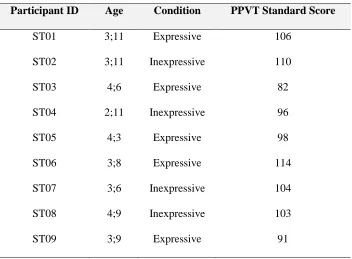
Table 1. The demographics of participants in regards to age, which reading condition they
experienced, and PPVT standard score.
Participant ID Age Condition PPVT Standard Score
ST01 3;11 Expressive 106
ST02 3;11 Inexpressive 110
ST03 4;6 Expressive 82
ST04 2;11 Inexpressive 96
ST05 4;3 Expressive 98
ST06 3;8 Expressive 114
ST07 3;6 Inexpressive 104
ST08 4;9 Inexpressive 103
ST09 3;9 Expressive 91
audio recordings that were created. One was a prosodically expressive version and one was a
prosodically inexpressive version. The expressive version contained an average fundamental
frequency of 318.16Hz, an average intensity of 63.4dB, and with a total duration of 169 seconds.
The inexpressive version was controlled for minimal fluctuations in pitch, intensity, and
duration. The inexpressive version contained an average fundamental frequency of 223Hz, an
average intensity of 54dB, and with a total duration of 160 seconds.
The language assessment that was used is the Peabody Picture Vocabulary Test version
4-A (PPVT). The iPod that was used to hold the recordings is an iPod Nano second generation
(2006). The speakers were placed at an angle approximately three feet from the child. The sound
10 halfway to the loudest setting. The paperwork that the parent of the participant received is a
consent form and demographic form.
2.3. Procedure
When the child arrives, the procedure is explained to the parent as the child explores
some of the toys that are provided for the free-play, warm-up portion of the study. As the parent
is filling out the consent form and demographic form, the researcher and the child played for
approximately ten minutes to build trust and dialogue. Once the child is comfortable and the
parent has signed the forms, the researcher brings the child to the lab room. The child completes
the PPVT-4 language assessment, which takes approximately ten minutes. Once that is
completed, the child gets a reward for the participation (a sticker) and the storytelling portion
begins. During this portion, the child listens to the story coming from the speakers, while the
researcher turns the pages of the picture book. This takes no more than five minutes. The child
only gets one version of the story: prosodically expressive or inexpressive. Afterwards, there are
five comprehension questions about the story that are asked to the child (see full list of questions
in Appendix B).
2.4. Analysis
The cued-recall questions are scored on a scale of 0, 1, 2, and 3. A score of 0 is awarded
for totally inaccuracy, 1 is scored for mild accuracy, 2 is awarded for moderate accuracy (some
missing parts, but you are able to follow the train of thought), and 3 for full accuracy. The total
cued recall score is the sum of the points divided by the total possible points. The video
recording is analyzed for eye-gaze and is measured in seconds, which is done by the program
and percentage of visual attention, duration and percentage looking at the book, and duration and
percentage looking at the speakers.
3. Results
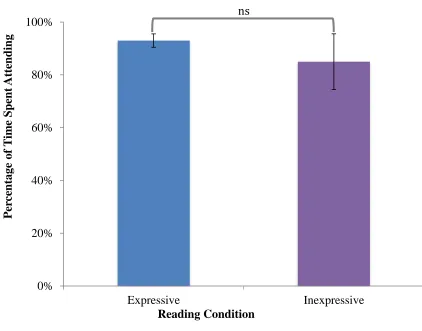
An independent-samples t-test was conducted to compare the percentage of visual
attention between the expressive and inexpressive conditions of the study. There was not a
significant difference between the expressive (M=93.00%, SD=0.06) and inexpressive
(M=85.53%, SD=0.21118) conditions (t=0.073, p=0.551). An independent-samples t-test was
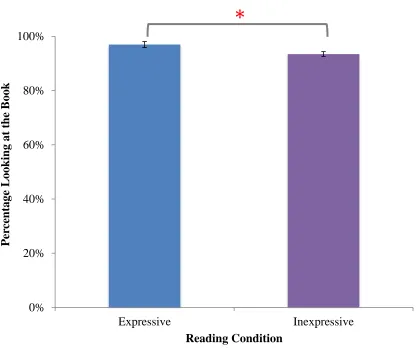
additionally conducted to compare the percent of time looking at the book (as opposed to the
audio speakers) between the expressive and inexpressive conditions of the study. There was a
significant difference between the expressive (M=96.98%, SD=0.02) and inexpressive
(M=93.45%, SD=0.02) conditions (t=5.098, p=0.041). Lastly, there was an independent-samples
t-test conducted to compare the total cued recall score between expressive and inexpressive
conditions of the study. There was not a significant difference between the expressive (M=10.4,
SD=3.29) and inexpressive (M=10, SD=1.41) conditions (t=0.887, p=0.414). Additionally, there
was a correlation run between the PPVT Standard Scores and the cued recall question total score.
The results showed a moderate positive relationship between PPVT Standard Scores and cued
12
Figure 1. The relationship between reading condition and the percentage of time attending
Figure 2. The relationship between reading condition and the percentage of time spent attending
to the visual stimulus of the book (as opposed to the speakers). Error bars show standard error. 0%
20% 40% 60% 80% 100%
Expressive Inexpressive
P
er
ce
n
tage
L
ook
in
g
at t
h
e B
ook
14
Figure 3. The Pearson’s Correlation between the PPVT Standard Scores and the Cued Recall
Question Scores. Purple indicate inexpressive, and blue indicate expressive conditions.
4. Discussion
The purpose of this study was to determine the impact of reading expressiveness on
visual attention levels of preschool aged children. A second explored was the impact of reading
expressiveness on comprehension of a story when asked cued recall questions. Overall analysis
of the data did not confirm either the primary or secondary research hypotheses that more
expressive reading of stories to young children would improve both visual attention and
comprehension scores compared to inexpressive reading of the same story. However, there was
evidence that there was more focus on the book rather than the speakers when the story was read
more expressively than when it was read inexpressively. Additionally, there was a correlation
found between a child’s receptive language score on a PPVT-4 test and their comprehension
0 2 4 6 8 10 12 14 16
80 85 90 95 100 105 110 115
Cu ed Reca ll Q u est io n Scor e
PPVT Standard Score
score on cued recall questions. In other words, there is a connection between a child’s ability to
access receptive language and how much they comprehended the story via read aloud.
Further analyses of visual attention of the participants in the expressive reading condition
showed that they did not attend significantly more than children in the inexpressive reading
condition. There was a difference in averages between the two groups (Figure One) that is
mostly reflecting the fact that one participant scored in the lower range for visual attention and is
an outlier in comparison to the rest of the group. If that participant was not included in the data
set, the averages would be extremely close together and the results would be much less
significant than they currently are. In-depth analyses into where the children paid attention
during the study revealed that looking at the picture book was generally a more prominent site of
visual attention, regardless of condition (96.98% of the time during the expressive condition and
93.45% of the time during the inexpressive condition). However, despite the fact that both
conditions had a higher presence of looking at the picture book than at the audio speakers, there
was a statistically significant amount of difference between the conditions. Children who were
read to expressively had higher levels of visual attention toward the picture book than children
who were read to in an inexpressive manner. This suggests that the more expressive the reading
is, the more a child pays direct attention to the context of the story.
Critically, the second hypothesis of the study which stated if a child is read to
expressively then they will score higher on comprehension questions, which echoed previous
research questions put forth in Mira and Schwanenflugel (2013), did not result in statistically
significant differences. Though this did not align with the previous research, the lack of
statistical significance in regard to comprehension levels between conditions may be due to
16 recall questions. For those children who did scored lower, these numbers were still relatively
equal across conditions (i.e., an equal number of children scored poorly on the questions in both
the expressive and inexpressive conditions). However, upon further analysis of the cued recall
questions it was revealed that the participants who scored with more points on the cued recall
questions similarly scored higher on the PPVT. After a Pearson’s correlation test was run, it was
concluded that there was a moderate correlation between the PPVT score and comprehension,
regardless of the reading condition of the study. Essentially, this relates back to the previous
study conducted by Mira and Schwanenflugel that stated that comprehension levels had more to
do with reading condition than receptive language. My findings did not align with those findings,
and found that receptive language ability was more tightly related to comprehension levels than
reading condition.
4.1 Limitations
There were several limitations of this study that were not present during previous
research and may have impacted portions of the results. One of the major limitations was that
there were only nine participants that were able to participate in the study. The study by Mira and
Schwanenflugel (2013) had over thirty participants, increasing their statistical power to detect
differences between the groups. Another potential limitation is that many of the participants
came from a nearly identical background. That is, they were all Caucasian and middle class with
a majority of parents interested in higher education and all children attending preschool
programs. This heterogeneity may have impacted the results as they may have been at less risk to
have lower language comprehension and likely have had more exposure to read-aloud stories in
the past during school than children who have not been exposed to academia (Mira and
that they were very strong in language which may have made their results more likely to be high
regardless of which condition of the study they participated.
4.2 Future Research
Future research would benefit from examining visual attention and language
comprehension in similar conditions of children who did not fall within the parameters of this
study. In other words, this study examined the visual attention levels of children who are
identified as being typically developing with normal hearing with no known diagnosis of
intellectual disability or attention deficit disorder. It would be beneficial to examine how children
with hearing loss, or children who are classified as having diagnoses that make attention and
learning more challenging than those who are considered typically developing, would perform
on a read-aloud story language comprehension task. It would additionally be beneficial to
explore different sites of visual attention in more depth. In the present study it was made
apparent that the audio speakers and the picture book were different focal sites of visual
attention and that the data from those different sites of attention were significant—if there was
more to look at, such as toys or words on the pages, would that also be impactful for
comprehension and would that affect the pattern of results.
5. Conclusions
In sum, the present study suggests that there is no difference in visual attention between
being read to in an expressive manner or in an inexpressive manner. In addition, there is no
evidence that suggests that language comprehension is increased due to being read to in a
prosodically expressive manner as opposed to a prosodically inexpressive manner. However,
there is evidence that suggests that being read to with expressive prosody increases the amount
18 is a moderate correlation between receptive language scores and story comprehension scores
regardless of the reading condition. This research does not align with previous research, which
may potentially be due to the limitations in sample size and participant diversity. The present
study adds to strategies that educators may have to increase the attention of children who appear
to have difficulty during read-aloud settings and may add to future research on the topics of
References
Cutler, A., & Swinney, D. S. (1987). Prosody and the development of listening comprehension.
Journal of Developmental Psychology, 76(6), 1372-1382.
Dunn, L., M., & Dunn, D. M. (2007). PPVT-4: Peabody picture vocabulary test. Minneapolis,
MN: Pearson Assessments.
ELAN (Version 5.2) [Computer software]. (2018, April 04). Nijmegen: Max Planck Institute for
Psycholinguistics. Retrieved from https://tla.mpi.nl/tools/tla-tools/elan/
Hirschberg, J. (1999). Communication and prosody: Functional aspects of prosody. ETRW on
Dialogue and Prosody, Veldhoven, The Netherlands. September 1-3, 1999.
Ladd, R. L. (1996). Intonational Phonology. Cambridge: Cambridge University Press.
M. Bennett Murphy, L, & M. Brinkman, T., & McNamara, K. (2007). Sustained attention and
social competence in typically developing preschool-aged children. Early Child
Development and Care, 177, 133-149. doi:10.1080/03004430500349559.
Mayer, M. (1969). Frog, where are you? New York: Dial Books for Young Readers.
Mira, W., & Schwanenflugel, P. (2013). The impact of reading expressiveness on the listening
comprehension of storybooks by prekindergarten children. Language, Speech, and
Hearing Services in Schools, 44, 183-94. doi:10.1044/0161-1461(2012/11-0073).
Morrison V., & Wlodarcyk, L. (2009). Revisiting read-aloud: Instructional Strategies that
encourage students’ engagement with texts. The Reading Teacher, 63(2), 110-118.
Pons, F., Sanz‐Torrent, M., Ferinu, L., Birulés, J., & Andreu, L. (2018), Children with SLI can exhibit reduced attention to a talker's mouth. Language Learning, 68, 180-192.
20 Veenendaal, N., Groen, M., & Verhoeven, L. (2014). The role of speech prosody and text
reading prosody in children's reading comprehension. British Journal of Educational
Psychology. doi:10.1111/bjep.12036.
Zellou, G., & Scarborough, R. (2015). Lexically conditioned phonetic variation in motherese:
Age-of-acquisition and other word-specific factors in infant- and adult-directed speech.
Appendix A
Storytelling Study – Samantha Pepe
Story Script for Frog, Where Are You? By Mercer Mayer (1969)
Once upon a time there were three friends.
They were a boy, a frog, and a dog.
One night, the frog climbed out of his jar.
In the morning, the boy and dog couldn’t find the frog.
They looked everywhere!
The boy checked his shoe—no frog!
The dog checked the jar—no frog!
They both looked outside for the frog.
They boy said, “Where are you frog!”
The dog jumped out the window. The boy was worried.
The boy jumped out the window too.
He told the dog to be careful.
They looked on a hill for the frog.
The boy said “Where are you frog!”
The boy looked in a hole for the frog.
The dog looked up a tree for the frog.
There were bees on the tree!
They scared the dog!
22
It scared the boy!
The boy climbed a tree and looked inside.
There was an owl!
It scared the boy and he fell.
The bees were still chasing the dog!
They ran away so fast!
The boy climbed a rock.
He leaned against a branch.
He said, “Where are you frog!”
The branches were antlers.
It was a deer!
It picked up the boy and carried him far away!
The dog followed them.
The deer saw a cliff and stopped.
The boy and dog fell all the way down!
They landed SPLASH into some water!
The boy thought he heard something.
It sounded like the frog!
“Shhhhh!” he said to the dog.
They looked into the log…
And found the frog!
The frog had a new friend.
It was late.
The boy and dog had to go home.
Frog decided to stay with his family.
A baby frog chose to go home with boy and the dog.
Now they had a new friend.
Everyone was so happy.
24
Appendix B
Cued Recall Questions:
1) Who ran away at night?
2) What was something that scared the boy or the dog? 3) Why did the boy fall into the water?