R E S E A R C H A R T I C L E
Open Access
Laparoscopic versus conventional appendectomy
- a meta-analysis of randomized controlled trials
Xiaohang Li
1, Jialin Zhang
1*, Lixuan Sang
2, Wenliang Zhang
2, Zhiqiang Chu
1, Xin Li
1, Yongfeng Liu
1Abstract
Background:Although laparoscopic surgery has been available for a long time and laparoscopic cholecystectomy has been performed universally, it is still not clear whether open appendectomy (OA) or laparoscopic
appendectomy (LA) is the most appropriate surgical approach to acute appendicitis. The purpose of this work is to compare the therapeutic effects and safety of laparoscopic and conventional“open”appendectomy by means of a meta-analysis.
Methods:A meta-analysis was performed of all randomized controlled trials published in English that compared LA and OA in adults and children between 1990 and 2009. Calculations were made of the effect sizes of: operating time, postoperative length of hospital stay, postoperative pain, return to normal activity, resumption of diet, complications rates, and conversion to open surgery. The effect sizes were then pooled by a fixed or random-effects model.
Results:Forty-four randomized controlled trials with 5292 patients were included in the meta-analysis. Operating time was 12.35 min longer for LA (95% CI: 7.99 to 16.72, p < 0.00001). Hospital stay after LA was 0.60 days shorter (95% CI: -0.85 to -0.36, p < 0.00001). Patients returned to their normal activity 4.52 days earlier after LA (95% CI: -5.95 to -3.10, p < 0.00001), and resumed their diet 0.34 days earlier(95% CI: -0.46 to -0.21, p < 0.00001). Pain after LA on the first postoperative day was significantly less (p = 0.008). The overall conversion rate from LA to OA was 9.51%. With regard to the rate of complications, wound infection after LA was definitely reduced (OR = 0.45, 95% CI: 0.34 to 0.59, p < 0.00001), while postoperative ileus was not significantly reduced(OR = 0.91, 95% CI: 0.57 to 1.47, p = 0.71). However, intra-abdominal abscess (IAA), intraoperative bleeding and urinary tract infection (UIT) after LA, occurred slightly more frequently(OR = 1.56, 95% CI: 1.01 to 2.43, p = 0.05; OR = 1.56, 95% CI: 0.54 to 4.48, p = 0.41; OR = 1.76, 95% CI: 0.58 to 5.29, p = 0.32).
Conclusion:LA provides considerable benefits over OA, including a shorter length of hospital stay, less postoperative pain, earlier postoperative recovery, and a lower complication rate. Furthermore, over the study period it was obvious that there had been a trend toward fewer differences in operating time for the two
procedures. Although LA was associated with a slight increase in the incidence of IAA, intraoperative bleeding and UIT, it is a safe procedure. It may be that the widespread use of LA is due to its better therapeutic effect.
Background
Acute appendicitis is a common indication for abdom-inal surgery with a life-time incidence between 7 and 9% [1], and appendectomy is one of the most common sur-gical procedures. Open appendectomy (OA) performed through the right lower quadrant incision was first described in 1894 [2]. It has become the standard
treatment of choice for acute appendicitis, remaining mainly unchanged for 100 years due to its favorable effi-cacy and safety. Laparoscopic appendectomy (LA), first performed by Semm [3] in 1983, has gradually gained acceptance. However, there remains a continuing con-troversy in the literature regarding the most appropriate method of removing the inflamed appendix.
Considering research published in English, to date there have been some prospective randomized con-trolled studies comparing LA and OA. While some stu-dies concluded that LA was superior to OA in terms of
* Correspondence: [email protected] 1
Department of General Surgery, First Affiliated Hospital, China Medical University, Shenyang 110001, Liaoning Province, China
Full list of author information is available at the end of the article
a faster recovery, improved wound healing, and earlier resumption of diet, other studies found no such benefits, or even favored conventional appendectomy. However, most of these studies had small sample sizes, and there-fore the risk of a type II error (failing to observe a dif-ference when in truth there is one) may be high. The statistical power of analysis can be increased through a meta-analysis, which combines and compares the data from different studies. The most recent meta-analysis of the two techniques was published 3 years ago [4], and many high-quality trials have been published since then. Therefore, we performed a new meta-analysis to deter-mine which technique, LA or OA, gives better patient outcome.
Methods Study search
We searched electronic databases (MEDLINE, EMBASE, and the Cochrane Central Register of Controlled Trials) for potentially relevant randomized controlled trials comparing LA and OA conducted from January 1990 to December 2009, published in English. Keywords used for the search included: randomized controlled trial and appendectomy/appendicectomy, laparoscopic appendect-omy/appendicectomy, laparoscopic versus open appen-dectomy/appendicectomy, minimally invasive versus conventional appendicectomy/appendectomy, and laparoscopic and open appendectomy/appendicectomy. The“related articles”function was used to broaden the search, and reference lists of these studies were reviewed to determine whether any other trials were potentially eligible for inclusion in the meta-analysis. Additionally, the abstracts from main international meetings (includ-ing the Society of American Gastrointestinal Endoscopic Surgeons, the European Association for Endoscopic Sur-gery and the International Pediatric EndosurSur-gery Group) for the last 5 years were searched by manual retrieval, and the authors were asked to provide full information on their study using a detailed data extraction form. Two investigators independently reviewed all studies. Eligible trials were then selected according to the inclu-sion criteria below. Discrepancies were resolved, if necessary, by discussion and consulting a senior reviewer.
Assessment of study eligibility
We systematically reviewed each study according to the following criteria: (1) a prospective randomized study format only; (2) a comparison of laparoscopic and open appendicectomy; (3) The study reported at least one of the desirable outcomes mentioned below and the stan-dard deviation of the mean for continuous outcomes of interest was reported or can be calculated; (4) Studies that allocated patients depending on the availability of
staff or instruments were excluded; (5) Studies that used variations on the standard laparoscopic technique, including hybrid procedures or single trochar techni-ques, were also excluded.
Outcomes of interest
The outcomes of interest included operating time, post-operative length of hospital stay, resumption time of normal activities and diet, and postoperative pain (assessed by visual analogue scale (VAS) graded from 0 to 10, with 0 being no pain and 10 being the most intense pain). We were also interested in several compli-cations including: wound infection, postoperative ileus, intraoperative bleeding (>500 mL), urinary tract infec-tion (UTI) and intra-abdominal abscess (IAA) formainfec-tion following LA vs. OA techniques.
Data extraction and quality assessment
Two investigators independently extracted the following data from each included study: first author, country, year of publication, number of participants allocated to each intervention group, study population characteris-tics, severity of appendicitis, the desirable outcomes, the method of randomization and allocation concealment, the blinding of outcome assessment, conversion rate from LA to OA, and whether intention-to-treat analysis was used. Any disagreement was discussed and resolved by consensus. The Jadad scale [5] was used to evaluate the overall quality of all included articles. According to Kjaergard et al.’s recommendation [6], low-quality stu-dies have a score of≤ 2 and high-quality studies have a score of≥3.
Statistical analysis
Meta-analysis was performed using Cochrane Collabora-tion Review Manager 5.0 software. For continuous vari-ables, statistical analysis was carried out using the weighted mean difference (WMD) as the summary sta-tistic, comparing the treatment (LA) group with the reference (OA) group using the inverse variance method. A negative WMD favored the LA group, and the point estimate of the WMD was considered statisti-cally significant at the p < 0.05 level if the 95% confi-dence interval (CI) did not include the value zero. For categorical variables, statistical analysis was carried out using the odds ratio (OR) as the summary statistic. An OR of less than one favored the LA group, and the point estimate of the OR was considered statistically sig-nificant at the p < 0.05 level if the 95% CI did not include the value one.
heterogeneity. If the test rejects the assumption of homogeneity of studies, then it is not appropriate to use a fixed effects model [7], and random effects analysis should be performed. Sensitivity analyses were con-ducted to explore statistical heterogeneity. Whether there was publication bias from a fixed effects model could be evaluated by an inverted funnel plot.
If studies reported their continuous variables as med-ians with ranges that a meta-analysis can not use, we assumed that the mean is equal to the median value itself and estimated the standard deviation (SD) as a quarter of the range (samples≤ 70) or range/6 (samples > 70) [8]. If neither ranges nor any other measure of dispersion was reported, and it was impossible to esti-mate the mean and SD based on the published data, the corresponding continuous variables were excluded from the statistical pool.
To ensure finding the exact change in comparative outcomes between OA and LA, and because the LA procedure is relatively recent and experience with it has increased rapidly, the studies published before the year 2000 were analyzed separately from those published afterward.
Results Search results
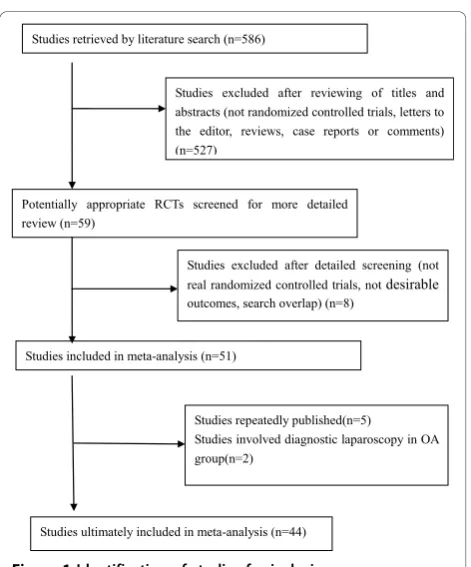
The search strategy generated 586 studies. After the initial screening, 51 studies were thought to meet the inclusion criteria [9-59]. After further screening of full texts, it was found that in three instances three [17,55,56], two [24,59] and three [31,57,58] of the stu-dies were performed by the same author; we therefore chose the most recent or highest quality article [17,24,31] from each author. Two studies which involved the use of diagnostic laparoscopy followed by OA in the LA group were also excluded [53,54]. In the end, 44 randomized controlled trials [9-52] were identi-fied for consideration in the meta-analysis (Figure 1). A total of 5292 participants were enrolled in the 44 stu-dies, of which 2609 (49.30%) underwent LA and 2683 (50.70%) OA. The characteristics of these studies are listed in Additional file 1, Table S1.
Methodological quality assessment of studies included in our meta-analysis
Additional file 1, Table S2 shows the quality of the included studies as assessed by the Jadad scale.
Effects of the intervention
Operating time
Thirty-six studies reported data that allowed quantitative pooled analysis for operating time (Additional file 1, Table S3). According to the analysis of all 36 with a ran-dom effects model, the laparoscopic approach takes
12.35 min longer than open surgery (95% CI: 7.99 to 16.72, p < 0.00001). However, subgroup analysis revealed that pre-2000, LA took 15.14 min longer than OA (95% CI: 10.79 to 19.50, p < 0.00001), and this decreased to only 8.67 minutes after this period (95% CI: 0.48 to 16.86, p = 0.04).
Postoperative hospital stay
Thirty-two studies comparing LA vs. OA reported post-operative length of stay. Using a random effects model, the pooled data from all years showed that the laparo-scopic approach led to a reduction in postoperative stay of 0.60 days (95% CI: -0.85 to -0.36, p < 0.00001; Addi-tional file 1, Table S3). The clinical significance of this was not clear. During the pre-2000 period, the differ-ence in postoperative stay was only 0.48 days (95% CI: -0.77 to -0.19, p = 0.001), and increased to 0.75 days from the year 2000 onwards (95% CI: -1.10 to -0.39, p < 0.0001). The evidence of a nearly one day hospital stay reduction would appear to have a stronger clinical significance.
Return to normal activity
Twenty-one studies reported the time required for patients to return to normal activity. Using a random effects model, the results showed an overall 4.52-day reduction in recovery time for LA compared to OA (95% CI: -5.95 to -3.10, p < 0.00001; Additional file 1, Table S3). For the subgroup of studies reported during the year 2000 and after, there was no statistical differ-ence between the two procedures, although the results demonstrated a trend in favor of LA.
Resumption of normal diet
Thirteen studies reported the time until patients could tolerate a normal diet. Overall analysis with a random effects model showed that the laparoscopic approach led to a reduction in this period of 0.34 days as compared to OA (95% CI: -0.46 to -0.21, p < 0.00001; Additional file 1, Table S3). The clinical significance of this was not clear. Subgroup analysis demonstrated a trend in favor of LA which had increased over time.
Postoperative pain
Only eight studies recorded postoperative pain data, measured by VAS, on the first postoperative day. Meta-analysis of VAS for postoperative pain with a random effects model demonstrated a score of 0.70 points less for LA compared with OA (95% CI: -1.22 to -0.19, p = 0.008; Additional file 1, Table S3). Subgroup analysis demon-strated a trend in which the VAS difference between LA and OA became less, decreasing from -1.11 for pre-2000 studies (95% CI: -1.80 to -0.42, p = 0.002) to -0.11 for post-2000 studies (95% CI: -1.05 to 0.83, p = 0.82).
Wound infection
infection for LA, compared with 8.41% (174/2069) for OA. The difference was statistically significant (OR = 0.45, 95% CI: 0.34 to 0.59, p < 0.00001; Additional file 1, Table S4). Analyzing the pre- and post-subgroups sepa-rately, this statistical significance continued, whereby the risk of wound infection associated with the LA proce-dure was demonstrably less than for the OA (OR = 0.36, 95% CI: 0.23 to 0.54, p < 0.00001 and OR = 0.53, 95% CI: 0.37 to 0.76, p = 0.0005, respectively).
IAA
Seventeen studies recorded data for the incidence of IAA. Pre-2000, post-2000, and overall meta-analysis with a fixed effects model failed to show any statistically significant difference in the incidence of IAA, but there was a trend in favor of OA (Additional file 1, Table S4).
Postoperative ileus
The combined data from 18 studies showed that the incidence of postoperative ileus was 1.96% (32/1630) for OA, and 1.78% (28/1576) for LA. The effect size of the difference in the ORs, analyzed by a fixed effects model, was 0.91 (95% CI: 0.57 to 1.47, p = 0.71; Additional file 1, Table S4). Although the results indicated that the laparoscopic approach resulted in a reduced incidence of postoperative ileus, the difference was not statistically significant.
Intraoperative bleeding
Only four studies provided details of intraoperative bleeding (>500 mL). The meta-analysis with a fixed
effects model suggested that the conventional approach led to a reduced incidence of intraoperative bleeding, however, the difference was not statistically significant (OR = 1.56, 95% CI: 0.54 to 4.48, p = 0.41; Additional file 1, Table S4). Because there was only one pre-2000 study, we did not perform the subgroup analysis.
Urinary tract infection
The combined data from only five studies revealed that the incidence of postoperative UTI was 0.76% (3/395) for OA and 1.75% (7/401) for LA. The effect size of the difference in ORs, analyzed by the fixed effects model, was 1.76 (95% CI: 0.58 to 5.29, p = 0.32; Additional file 1, Table S4). Although the results indicated that the laparoscopic approach resulted in an incidence of post-operative UTI that was greater than that of OA, the dif-ference was not statistically significant.
Sensitivity analysis
The heterogeneity was shown significantly for operating time, hospital stay, return to full activity, resumption of normal diet, and VAS for postoperative pain. A sensitiv-ity analysis was performed by excluding studies that intention-to-treat analysis (ITT) was not adopted or unclear, or included only males or females or children, or reported no measure of the standard deviation. Then heterogeneity was decreased. As shown in Additional file 1, Table S3, the overall estimates were similar between the sensitivity analysis and the meta-analysis.
Publication bias assessment
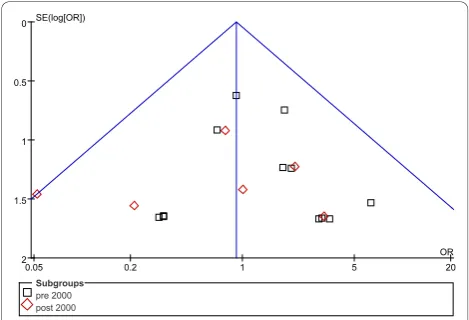
Concerning rates of complications, the possibility of publication bias was analyzed by the inverted funnel plot. The plot resembles a symmetric inverted funnel (the 95% CI). It is notable that in Figure 2 and 3, illus-trating the inverted funnel plot analyses of wound infec-tion and IAA rates respectively, only one study lay outside the 95% CI axis. In Figure 4, the inverted funnel plot analysis of the postoperative ileus rate, there was
Figure 1Identification of studies for inclusion.
no study outside the 95% CI axis. We therefore con-clude that there is no evidence of publication bias in our analysis.
Discussion
Laparoscopy, as a minimally invasive technique, has unique advantages in several areas, and many scholars have tried to prove these advantages. Yet, because OA involves a small incision and perfect skill, the advantages of LA over OA continues to be debated. In order to con-firm the greater efficacy of LA, we performed the present research. Compared to other meta-analyses [60-62], our’s included more high-quality studies and analyzed more outcomes. Therefore, the therapeutic effects of LA and OA can be sufficiently evaluated here.
Regarding operating time, there was an obvious trend toward parity between the two procedures. A reputation for extended operating time is a major disadvantage, and has considerably influenced the widespread use of LA:
according to an initial study, LA involved a significant increase in operating time [45]. This may have been due to the inexperience of the surgeons with the new techni-que. However, with increased experience the mean oper-ating time for LA and OA become similar [63].
According to the analysis for the entire study period (1990-2009), the length of hospital stay after surgery was shortened in LA by 0.60 days, a difference that is not of clinical significance. However, since the year 2000 the reduction in postoperative hospital stay became more significant. A 48-hour discharge policy for LA pro-posed by Grewal et al. [64] contributed to the increased difference. However, our results are not consistent with that of others [24], who believe that this was one area where LA has no advantage over OA. The discrepancy may be due to the different social standards, insurance systems and health care policies.
Early return to full activity is accepted as an obvious advantage of LA, which was supported by a large scale meta-analysis conducted by the Cochrane Colorectal Cancer Group [65]. The trocar incisions of LA contri-bute to minimal trauma to the abdominal wall and less pain [66], allowing faster recovery. A trend towards less difference in return to normal activity was noted in our study (OR = -5.73 for pre-2000 studies vs. -2.32 for post-2000 studies). Lord and Sloane [67] considered that early discharge and mobilization after OA were also fea-sible, if given the appropriate infrastructure. Fast resumption of a normal diet following LA was another appealing advantage, resulting from minimal manipula-tion of the cecum and ileum [68]. Although a significant difference was found (p < 0.00001), the practicality of a difference of 0.34 days remains doubtful.
Postoperative pain can be assessed quantitatively by the daily requirements for analgesics. Nevertheless, the various kinds of analgesics and routes of administration make it difficult to estimate pain relief. We qualitatively assessed pain on the first postoperative day by means of a VAS. The meta-analysis indicated that LA offered sig-nificant advantages in relieving postoperative pain (p = 0.008), mainly due to its minimal invasiveness. However, the difference in VAS between the two procedures was not statistically significant for the post-2000 subgroup of studies (p = 0.82). The trend toward a smaller incision in OA may explain this decreased difference.
The reduction of wound infection is a significant advan-tage of LA. The chance of wound infection is greater in OA partly because the inflamed appendix is removed from the abdominal cavity directly through the wound, whereas in LA it is extracted via a bag or trocar. In addition, the port-site wounds in LA are smaller compared to the longer wounds of OA, especially in obese patients.
There were several explanations for the reduction of ileus following LA. Firstly, decreased handling of the
Figure 3Inverted funnel plot analysis of the intra-abdominal abscess rate between LA and OA.
bowel during the procedure leads to less postoperative adhesion, and such adhesion may be responsible for ileus. Secondly, patients after LA had less opiate analge-sics, which inhibited bowel movements in the post-operative period. Lastly, earlier mobilization after LA may also contribute to the reduction of adhesion.
The finding that the incidence of IAA, intraoperative bleeding and UTI after LA was higher compared with OA should be noteworthy, even though these were not statisti-cally significant. Intraoperative bleeding and UTI were rare complications after appendectomy. The reason why the rates were higher after LA is not clear, and the further investigation is necessary. IAA is a serious complication following appendectomy and can potentially be life threa-tening; many investigators pay close attention to this com-plication. Gupta et al. [69] considered that aggressive manipulation of the infected appendix and increased use of irrigation fluid, possibly producing greater contamina-tion of the peritoneal cavity, might have an impact on IAA formation after LA. Memon et al. [70] believed that carbon dioxide pneumoperitoneum contributed to the mechanical diffusion of bacteria inside the peritoneal cavity, but experimental proof of this is lacking. Brümmer et al. [71] thought that the risk of developing IAA after LA was greater than for OA (0.31% vs. 0.21%). Conversely, Katkhouda et al. [72] believed that mastery of the learning curve and the use of standardized surgical techniques reduced the incidence of IAA after LA.
It is hard to understand why the conversion rate from LA to OA increased over time. Perhaps as experience with the laparoscopic procedure is gained, surgeons might attempt to perform LA for complicated cases such as gangrenous and perforated appendicitis, most of which might have been treated previously by the open approach. The increased difficulty in LA might have resulted in the higher conversion rate.
Meta-analysis is an increasingly popular method of data analysis to solve debatable problems. However, there were some drawbacks in our research. First, differ-ent studies included in our research may have had slightly different defining criteria for the outcome mea-sures, e.g., wound infection and ileus. Resumption of normal activity and diet might also be defined differ-ently. Second, not all the studies measured data based on a double-blind. In the absence of a double-blind, subjective variables such as pain assessment could be considerably influenced by the enthusiasm for a novel technique. Third, there was variation in surgical techni-ques and treatment protocols amongst the studies, and therefore heterogeneity in the studies might exist. Fourth, although most studies were comparable with regard to age and sex, fewer were matched for severity of appendicitis (represented by fever, raised WBC, peritoni-tis and perforated rate) and weight. These considerations
may have an influence on postoperative complications, recovery and operation time.
Despite the limitations mentioned above, we believe that LA involves a shorter hospital stay, less postopera-tive pain, a faster recovery, and a lower complication rate compared with OA. Our study demonstrates that LA is a safe and effective treatment alternative for patients with acute appendicitis, and is recommended for those hospitals where laparoscopic expertise and equipment are available. Although LA was associated with slightly more operating time than OA, subgroup analysis revealed that this difference has been diminish-ing. The slightly higher incidence of IAA, intraoperative bleeding and UTI was worrisome, and due to insuffi-cient primary data our research unfortunately was unable to stratify the postoperative abscess rate accord-ing to the severity of the appendicitis. Therefore, bias between groups might be present and might have affected the results. Further studies should match for the severity of appendicitis to settle the question.
Conclusion
In conclusion, the present study shows that LA provides considerable benefits over OA, including a shorter hos-pital stay, less postoperative pain, earlier postoperative recovery, and lower complication rate. Therefore, the widespread use of LA is routinely recommended in those hospitals where laparoscopic expertise and equip-ment are available.
Additional material
Additional file 1: 4 tables. This additional file includes 4 large tables with the format of Microsoft Word. The titles of dataset are listed below: Table S1: Characteristics of 44 studies included in our meta-analysis. Table S2: Methodological quality of studies included in our meta-analysis. Table S3: Meta-analysis of different outcomes in all studies and in selective studies. Table S4: Meta-analysis of the complications in all studies
Acknowledgements
We thank Dr. Dazhi Fu of the First Affiliated Hospital of China Medical University for correcting the manuscript.
Author details
1
Department of General Surgery, First Affiliated Hospital, China Medical University, Shenyang 110001, Liaoning Province, China.2Department of Gastroenterology, First Affiliated Hospital, China Medical University, Shenyang 110001, Liaoning Province, China.
Authors’contributions
Competing interests
The authors declare that they have no competing interests.
Received: 30 June 2010 Accepted: 3 November 2010 Published: 3 November 2010
References
1. Addiss DG, Shaffer N, Fowler BS, Tauxe RV:The epidemiology of appendicitis and appendectomy in the United States.Am J Epidemiol
1990,132:910-925, (PMID: 2239906).
2. McBurney C:The incision made in the abdominal wall in cases of appendicitis, with a description of a new method of operating.Ann Surg
1894,20:38-43, (PMID: 17860070).
3. Semm K:Endoscopic appendectomy.Endoscopy1983,15:59-64, (PMID: 6221925).
4. Bennett J, Boddy A, Rhodes M:Choice of approach for appendicectomy: a meta-analysis of open versus laparoscopic appendicectomy.Surg Laparosc Endosc Percutan Tech2007,17:245-255, (PMID: 17710043). 5. Jadad AR, Moore RA, Carroll D, Jenkinson C, Reynolds DJ, Gavaghan DJ,
McQuay HJ:Assessing the quality of reports of randomized clinical trials: is blinding necessary?Control Clin Trials1996,17:1-12, (PMID: 8721797). 6. Kjaergard LL, Villumsen J, Gluud C:Reported methodologic quality and
discrepancies between large and small randomized trials in meta-analyses.Ann Intern Med2001,135:982-989, (PMID: 11730399). 7. Friedman HP, Goldberg JD:Meta-analysis: an introduction and point of
view.Hepatology1996,23:917-928, (PMID: 8666350).
8. Hozo SP, Djulbegovic B, Hozo I:Estimating the mean and variance from the median, range, and the size of a sample.BMC Med Res Methodol
2005,5:13-22, (PMID: 15840177).
9. Al-Mulhim AS, Al-Mulhim FM, Al-Suwaiygh AA, Al-Masaud NA:Laparoscopic versus open appendectomy in females with a clinical diagnosis of appendicitis.Saudi Med J2002,23:1339-1342, (PMID: 12506292). 10. Attwood SE, Hill AD, Murphy PG, Thornton J, Stephens RB:A prospective
randomized trial of laparoscopic versus open appendectomy.Surgery
1992,112:497-501, (PMID: 1387739).
11. Bruwer F, Coetzer M, Warren BL:Laparoscopic versus open surgical exploration in premenopausal women with suspected acute appendicitis.S Afr J Surg2003,41:82-85, (PMID: 14768141). 12. Cox MR, McCall JL, Toouli J, Padbury RT, Wilson TG, Wattchow DA,
Langcake M:Prospective randomized comparison of open versus laparoscopic appendectomy in men.World J Surg1996,20:263-266, (PMID: 8661828).
13. Frazee RC, Roberts JW, Symmonds RE, Snyder SK, Hendricks JC, Smith RW, Custer MD, Harrison JB:A prospective randomized trial comparing open versus laparoscopic appendectomy.Ann Surg1994,219:725-731, (PMID: 8203983).
14. Hansen JB, Smithers BM, Schache D, Wall DR, Miller BJ, Menzies BL:
Laparoscopic versus open appendectomy: prospective randomized trial. World J Surg1996,20:17-21, (PMID: 8588406).
15. Hart R, Rajgopal C, Plewes A, Sweeney J, Davies W, Gray D, Taylor B:
Laparoscopic versus open appendectomy: a prospective randomized trial of 81 patients.Can J Surg1996,39:457-462, (PMID: 8956810). 16. Heikkinen TJ, Haukipuro K, Hulkko A:Cost-effective appendectomy. Open
or laparoscopic? A prospective randomized study.Surg Endosc1998,
12:1204-1208, (PMID: 9745057).
17. Hellberg A, Rudberg C, Kullman E, Enochsson L, Fenyö G, Graffner H, Hallerbäck B, Johansson B, Anderberg B, Wenner J, Ringqvist I, Sörensen S:
Prospective randomized multicentre study of laparoscopic versus open appendicectomy.Br J Surg1999,86:48-53, (PMID: 10027359).
18. Helmy MA:A comparative study between laparoscopic versus open appendicectomy in men.J Egypt Soc Parasitol2001,31:555-562, (PMID: 11478454).
19. Huang MT, Wei PL, Wu CC, Lai IR, Chen RJ, Lee WJ:Needlescopic, laparoscopic, and open appendectomy: a comparative study.Surg Laparosc Endosc Percutan Tech2001,11:306-312, (PMID: 11668227). 20. Ignacio RC, Burke R, Spencer D, Bissell C, Dorsainvil C, Lucha PA:
Laparoscopic versus open appendectomy: what is the real difference? Results of a prospective randomized double-blinded trial.Surg Endosc
2004,18:334-337, (PMID: 14691696).
21. Kald A, Kullman E, Anderberg B, Wirén M, Carlsson P, Ringqvist I, Rudberg C:
Cost-minimisation analysis of laparoscopic and open appendicectomy. Eur J Surg1999,165:579-582, (PMID: 10433143).
22. Kaplan M, Salman B, Yilmaz TU, Oguz M:A quality of life comparison of laparoscopic and open approaches in acute appendicitis: a randomised prospective study.Acta Chir Belg2009,109:356-63, (PMID: 19943593). 23. Karadayi KT, Turan M, Canbay E, Topcu O, Sen M:Laparoscopic versus
open appendectomy: analysis of systemic acute phase responses in a prospective randomized study.Chirurg Gastroenterol2003,19:396-400. 24. Katkhouda N, Mason RJ, Towfigh S, Gevorgyan A, Essani R:Laparoscopic
versus open appendectomy: a prospective randomized double-blind study.Ann Surg2005,242:439-450, (PMID: 16135930).
25. Kazemier G, de Zeeuw GR, Lange JF, Hop WC, Bonjer HJ:Laparoscopic versus open appendectomy. A randomized clinical trial.Surg Endosc
1997,11:336-340, (PMID: 9094272).
26. Klingler A, Henle KP, Beller S, Rechner J, Zerz A, Wetscher GJ, Szinicz G:
Laparoscopic appendectomy does not change the incidence of postoperative infectious complications.Am J Surg1998,175:232-235, (PMID: 9560127).
27. Kum CK, Ngoi SS, Goh PM, Tekant Y, Isaac JR:Randomized controlled trial comparing laparoscopic and open appendicectomy.Br J Surg1993,
80:1599-1600, (PMID: 8298936).
28. Laine S, Rantala A, Gullichsen R, Ovaska J:Laparoscopic appendectomy–is it worthwhile? A prospective, randomized study in young women.Surg Endosc1997,11:95-97, (PMID: 9069134).
29. Lavonius MI, Liesjarvi S, Ovaska J, Pajulo O, Ristkari S, Alanen M:
Laparoscopic versus open appendectomy in children: a prospective randomised study.Eur J Pediatr Surg2001,11:235-238, (PMID: 11558012). 30. Lejus C, Delile L, Plattner V, Baron M, Guillou S, Héloury Y, Souron R:
Randomized, single-blinded trial of laparoscopic versus open appendectomy in children: effects on postoperative analgesia. Anesthesiology1996,84:801-806, (PMID: 8638833).
31. Lintula H, Kokki H, Vanamo K, Valtonen H, Mattila M, Eskelinen M:The costs and effects of laparoscopic appendectomy in children.Arch Pediatr Adolesc Med2004,158:34-37, (PMID: 14706955).
32. Little DC, Custer MD, May BH, Blalock SE, Cooney DR:Laparoscopic appendectomy: an unnecessary and expensive procedure in children?J Pediatr Surg2002,37:310-317, (PMID: 11877640).
33. Long KH, Bannon MP, Zietlow SP, Helgeson ER, Harmsen WS, Smith CD, Ilstrup DM, Baerga-Varela Y, Sarr MG:A prospective randomized comparison of laparoscopic appendectomy with open appendectomy: clinical and economic analyses.Surgery2001,129:390-400, (PMID: 11283528).
34. Macarulla E, Vallet J, Abad JM, Hussein H, Fernández E, Nieto B:
Laparoscopic versus open appendectomy: a prospective randomized trial.Surg Laparosc Endosc1997,7:335-339, (PMID: 9282768).
35. Martin LC, Puente I, Sosa JL, Bassin A, Breslaw R, McKenney MG, Ginzburg E, Sleeman D:Open versus laparoscopic appendectomy. A prospective randomized comparison.Ann Surg1995,222:256-262, (PMID: 7677456). 36. Milewczyk M, Michalik M, Ciesielski M:A prospective, randomized,
unicenter study comparing laparoscopic and open treatments of acute appendicitis.Surg Endosc2003,17:1023-1028, (PMID: 12728377). 37. Minne L, Varner D, Burnell A, Ratzer E, Clark J, Haun W:Laparoscopic
versus open appendectomy. Prospective randomized study of outcomes.Arch Surg1997,132:708-712, (PMID: 9230853).
38. Moberg AC, Berndsen F, Palmquist I, Petersson U, Resch T, Montgomery A:
Randomized clinical trial of laparoscopic versus open appendicectomy for confirmed appendicitis.Br J Surg2005,92:298-304, (PMID: 15609378). 39. Moirangthem GS, Arunkumar C, Marak AB, Lokendra K, Singh LD:A
comparative study between laparoscopic versus open appendectomy. JMS2008,22:58-62.
40. Mutter D, Vix M, Bui A, Evrard S, Tassetti V, Breton JF, Marescaux J:
Laparoscopy not recommended for routine appendectomy in men: results of a prospective randomized study.Surgery1996,120:71-74, (PMID: 8693426).
42. Ortega AE, Hunter JG, Peters JH, Swanstrom LL, Schirmer B:A prospective, randomized comparison of laparoscopic appendectomy with open appendectomy.Am J Surg1995,169:203-213, (PMID: 7840381). 43. Ozmen MM, Zulfikaroglu B, Tanik A, Kale IT:Laparoscopic versus open
appendectomy: prospective randomized trial.Surg Laparosc Endosc Percutan Tech1999,9:187-189, (PMID: 10803997).
44. Pedersen AG, Petersen OB, Wara P, Rønning H, Qvist N, Laurberg S:
Randomized clinical trial of laparoscopic versus open appendicectomy. Br J Surg2001,88:200-205, (PMID: 11167866).
45. Reiertsen O, Larsen S, Trondsen E, Edwin B, Faerden AE, Rosseland AR:
Randomized controlled trial with sequential design of laparoscopic versus conventional appendicectomy.Br J Surg1997,84:842-847, (PMID: 9189105).
46. Ricca R, Schneider JJ, Brar H, Lucha PA:Laparoscopic appendectomy in patients with a body mass index of 25 or greater: results of a double blind, prospective, randomized trial.JSLS2007,11:54-58, (PMID: 17663093). 47. Simon P, Burkhardt U, Sack U, Kaisers UX, Muensterer OJ:Inflammatory
response is no different in children randomized to laparoscopic or open appendectomy.J Laparoendosc Adv Surg Tech A2009,19:S71-6, (PMID: 18999981).
48. Tate JJ, Dawson JW, Chung SC, Lau WY, Li AK:Laparoscopic versus open appendicectomy: prospective randomised trial.Lancet1993,342:633-637, (PMID: 8103144).
49. Tzovaras G, Liakou P, Baloyiannis I, Spyridakis M, Mantzos F, Tepetes K, Athanassiou E, Hatzitheofilou C:Laparoscopic appendectomy: differences between male and female patients with suspected acute appendicitis. World J Surg2007,31:409-413, (PMID: 17219281).
50. Wei Hongbo Wei HB, Huang JL, Zheng ZH, Wei B, Zheng F, Qiu WS, Guo WP, Chen TF, Wang TB:Laparoscopic versus open appendectomy: a prospective randomized comparison.Surg Endosc2010,24:266-9, Epub 2009 Jun 11.(PMID: 19517167).
51. Williams MD, Collins JN, Wright TF, Fenoglio ME:Laparoscopic versus open appendectomy.South Med J1996,89:668-674, (PMID: 8685751).
52. Yin WY, Lee MC, Cheng TJ, Chen HT, Huang SM:Laparoscopic versus open appendectomy: prospective randomized trial.Tzu Chi Med J1996,
8:213-221.
53. Larsson PG, Henriksson G, Olsson M, Boris J, Ströberg P, Tronstad SE, Skullman S:Laparoscopy reduces unnecessary appendicectomies and improves diagnosis in fertile women. A randomized study.Surg Endosc
2001,15:200-202, (PMID: 11285968).
54. van Dalen R, Bagshaw PF, Dobbs BR, Robertson GM, Lynch AC, Frizelle FA:
The utility of laparoscopy in the diagnosis of acute appendicitis in women of reproductive age.Surg Endosc2003,17:1311-1313, (PMID: 12739123).
55. Enochsson L, Hellberg A, Rudberg C, Fenyö G, Gudbjartson T, Kullman E, Ringqvist I, Sörensen S, Wenner J:Laparoscopic versus open appendectomy in overweight patients.Surg Endosc2001,15:387-392, (PMID: 11395821).
56. Hellberg A, Rudberg C, Enochsson L, Gudbjartson T, Wenner J, Kullman E, Fenyö G, Ringqvist I, Sörensen S:Conversion from laparoscopic to open appendicectomy: a possible drawback of the laparoscopic technique? Eur J Surg2001,167:209-213, (PMID: 11316407).
57. Lintula H, Kokki H, Vanamo K:Single-blind randomized clinical trial of laparoscopic versus open appendicectomy in children.Br J Surg2001,
88:510-514, (PMID: 11298617).
58. Lintula H, Kokki H, Vanamo K, Antila P, Eskelinen M:Laparoscopy in children with complicated appendicitis.J Pediatr Surg2002,37:1317-1320, (PMID: 12194123).
59. Katkhouda N, Mason RJ, Towfigh S:Laparoscopic versus open
appendectomy: a prospective, randomized, double-blind study.Adv Surg
2006,40:1-19, (PMID: 17163092).
60. Golub R, Siddiqui F, Pohl D:Laparoscopic versus open appendectomy:a metaanalysis.J Am Coll Surg1998,186:545-553, (PMID: 9583695). 61. Eypasch E, Sauerland S, Lefering R, Neugebauer EA:Laparoscopic versus
open appendectomy: between evidence and common sense.Dig Surg
2002,19:518-522, (PMID: 12499748).
62. Kim CB, Kim MS, Hong JH, Lee HY, Yu SH:Is laparoscopic appendectomy useful for the treatment of acute appendicitis in Korea? A meta-analysis. Yonsei Med J2004,45:7-16, (PMID: 15004862).
63. Kehagias I, Karamanakos SN, Panagiotopoulos S, Panagopoulos K, Kalfarentzos F:Laparoscopic versus open appendectomy: Which way to go?World J Gastroenterol2008,14:4909-4914, (PMID: 18756599). 64. Grewal H, Sweat J, Vazquez WD:Laparoscopic appendectomy in children
can be done as a fast-track or same-day surgery.JSLS2004,8:151-154, (PMID: 15119660).
65. Sauerland S, Lefering R, Neugebauer EA:Laparoscopic versus open surgery for suspected appendicitis.Cochrane Database Syst Rev2004,18: CD001546, (PMID: 15495014).
66. Koontz CS, Smith LA, Burkholder HC, Higdon K, Aderhold R, Carr M: Video-assisted transumbilical appendectomy in children.J Pediatr Surg2006,
4:710-712, (PMID: 16567181).
67. Lord RV, Sloane DR:Early discharge after open appendicectomy.Aust N Z J Surg1996,66:361-365, (PMID: 8678853).
68. Vernon AH, Georgeson KE, Harmon CM:Pediatric laparoscopic appendectomy for acute appendicitis.Surg Endosc2004,18:75-79, (PMID: 14625753).
69. Gupta R, Sample C, Bamehriz F, Birch DW:Infectious complications following laparoscopic appendectomy.Can J Surg2006,49:397-400, (PMID: 17234067).
70. Memon MA:Laparoscopic appendectomy: current status.Ann R Coll Surg Eng1997,79:393-402, (PMID: 9422862).
71. Brümmer S, Sohr D, Gastmeier P:Intra-abdominal abscesses and laparoscopic versus open appendectomies.Infect Control Hosp Epidemiol
2009,30:713-715, (PMID: 19496649).
72. Katkhouda N, Friedlander MH, Grant SW, Achanta KK, Essani R, Paik P, Velmahos G, Campos G, Mason R, Mavor E:Intraabdominal abscess rate after laparoscopic appendectomy.Am J Surg2000,180:456-461, (PMID: 11182397).
Pre-publication history
The pre-publication history for this paper can be accessed here: http://www.biomedcentral.com/1471-230X/10/129/prepub
doi:10.1186/1471-230X-10-129
Cite this article as:Liet al.:Laparoscopic versus conventional appendectomy - a meta-analysis of randomized controlled trials.BMC Gastroenterology201010:129.
Submit your next manuscript to BioMed Central and take full advantage of:
• Convenient online submission
• Thorough peer review
• No space constraints or color figure charges
• Immediate publication on acceptance
• Inclusion in PubMed, CAS, Scopus and Google Scholar
• Research which is freely available for redistribution